If you have ever visited a Shiva temple, you may have wondered why Abhishek is done to Shivling, why water is poured on the Shivling every day, and what this sacred ritual truly means.
Abhishek means the ceremonial bathing of the divine. In Sanatan Dharma, it is much more than offering water or milk. It is a heartfelt act of devotion that symbolizes purity, gratitude, and complete surrender to Lord Shiva.
The Shivling represents Lord Shiva in His formless and infinite nature. When we perform Shivling Abhishek, we are not merely following a ritual. We are learning to let go of our ego, calm the mind, and deepen our spiritual connection.
In this guide, you will discover the meaning of Shivling Abhishek, why it is performed, its scriptural significance, the symbolism of different offerings, the correct way to perform it at home, its spiritual benefits, and the deeper wisdom behind this timeless tradition.
By the end, you will understand that Shivling Abhishek is not just an ancient custom but a simple and powerful practice that brings inner peace, balance, and devotion into everyday life.
Quick Facts
| Aspect | Details |
|---|---|
| Meaning | The sacred bathing of the Shivling as an act of devotion to Lord Shiva. |
| Main Purpose | To express devotion, gratitude, surrender, and seek Lord Shiva’s blessings. |
| Primary Offering | Clean water (Jal) |
| Other Traditional Offerings | Milk, Panchamrit, Bel Patra, flowers, honey, curd, ghee, fruits |
| Sacred Mantras | Om Namah Shivaya, Mahamrityunjaya Mantra |
| Best Days | Monday (Somvar), Pradosh Vrat, and Mahashivratri |
| Who Can Perform It? | Anyone with faith and respect for Hindu traditions |
| Where Can It Be Performed? | At home or in a Shiva temple |
| Scriptural References | Shiva Purana, Linga Purana, and other Hindu scriptures |
| Core Message | Devotion and sincerity are more important than elaborate rituals. |
Table of Contents
ToggleWhy Is Shivling Abhishek Performed?
Shivling Abhishek is performed as an act of love, devotion, and surrender to Lord Shiva. In Sanatan Dharma, offering sacred substances like water, milk, or Panchamrit to the Shivling symbolizes the purification of the mind, body, and soul while strengthening one’s connection with the Divine.
The ritual also reminds devotees to let go of ego, negative thoughts, and worldly attachments. As each offering flows over the Shivling, it represents surrendering our pride, desires, and worries at the feet of Lord Shiva.
The main reasons why Shivling Abhishek is performed include:
- To express devotion and complete surrender to Lord Shiva.
- To symbolize cooling Lord Shiva, remembering the Samudra Manthan episode when He consumed the Halahala poison.
- To purify the mind and emotions through sincere worship and prayer.
- To release ego, negativity, and inner impurities, encouraging humility and self-discipline.
- To seek divine blessings for peace, health, prosperity, and spiritual growth.
- To maintain a regular spiritual connection through a simple yet meaningful daily practice.
Although the ritual appears simple, its true purpose lies beyond the physical act of pouring water or milk. Shivling Abhishek is a sacred practice that nurtures devotion, inner peace, and spiritual transformation, making it one of the most cherished forms of Shiva worship.

The Story Behind Shivling Abhishek
One of the most well-known stories associated with Shivling Abhishek comes from the Samudra Manthan (Churning of the Ocean), described in the Puranas.
During the churning of the cosmic ocean, a deadly poison called Halahala emerged before the divine nectar. Its destructive power threatened the entire universe. To protect all creation, Lord Shiva compassionately consumed the poison and held it in His throat, earning the name Neelkanth, meaning “the Blue-Throated One.”
The intense heat generated by the poison caused immense suffering. To cool Lord Shiva and express their gratitude, the gods continuously poured sacred water over Him. This act symbolized devotion, reverence, and the desire to restore cosmic balance.
According to this sacred tradition, this divine offering is regarded as the origin of Shivling Abhishek. Even today, devotees pour water, milk, and other sacred offerings over the Shivling to honor Lord Shiva, seek His blessings, and express their love and surrender.
This story beautifully explains why offering water to the Shivling remains one of the most cherished rituals in Sanatan Dharma and why Shivling Abhishek continues to hold deep spiritual significance for millions of devotees.
Did You Know?
According to Hindu tradition, Lord Shiva is known as Ashutosh, meaning “the One who is easily pleased.” It is believed that sincere devotion matters far more than expensive offerings or elaborate rituals.
Even a simple offering of clean water accompanied by heartfelt prayer is considered a meaningful act of worship.
Shivling Worship Across Different Hindu Traditions
The worship of Lord Shiva is practiced across many traditions within Sanatan Dharma. While the core devotion remains the same, the rituals, mantras, and customs may vary from one sampradaya or region to another.
For example, Shaiva traditions often emphasize Vedic mantras, Rudrabhishek, and temple-based worship. In many Smarta households, Shiva worship is performed alongside the worship of other deities as part of Panchayatana Puja. Regional customs in different parts of India may also include unique offerings, devotional songs, or local festivals dedicated to Lord Shiva.
These differences should not be viewed as contradictions but as the rich diversity of Sanatan Dharma. Every tradition encourages devotees to worship with faith, humility, and respect while following the customs passed down through their family, guru, or local temple.
What Do Hindu Scriptures Say About Shivling Abhishek?
The practice of Shivling Abhishek is deeply rooted in Hindu scriptures, particularly the Shiva Purana and the Linga Purana, where worship of the Shivling is described as a sacred means of expressing devotion to Lord Shiva.
These scriptures explain that offering pure substances such as water, milk, honey, curd, and ghee with sincerity pleases Lord Shiva and helps cultivate purity, humility, and spiritual merit. The act of Abhishek is regarded not merely as an external ritual but as an offering made with faith and a pure heart.
In temples, the continuous flow of water over the Shivling, known as Jaladhara (Dhara), symbolizes uninterrupted devotion, inner purity, and the eternal flow of divine consciousness. It also reflects the devotee’s constant remembrance of Lord Shiva.
Thus, the scriptures present Shivling Abhishek as much more than a ceremonial practice. It is a form of seva, meditation, and surrender that helps devotees strengthen their spiritual connection with Lord Shiva while cultivating peace, discipline, and devotion.
The Deeper Spiritual Meaning of Shivling Abhishek
Beyond the ritual itself, Shivling Abhishek carries a profound spiritual message. It reminds us that true worship is not limited to external offerings but begins with inner transformation.
As water flows gently over the Shivling, it symbolizes the continuous cleansing of the mind from ego, anger, attachment, and negative thoughts. Each offering becomes an act of surrender, encouraging devotees to place their worries, desires, and pride at the feet of Lord Shiva.
The uninterrupted flow of water also reflects the ideal state of a spiritual seeker: calm, steady, and connected to the Divine. Just as the water flows without resistance, devotees are encouraged to cultivate acceptance, humility, and unwavering faith in life’s journey.
With regular practice, many devotees experience a sense of inner peace, clarity, and emotional balance. These personal experiences reveal that Shivling Abhishek is far more than a sacred ritual—it is a simple yet powerful path to self-purification, devotion, and spiritual awakening.
The Symbolism of Shivling Abhishek
In Hindu philosophy, the Shivling is widely regarded as a symbol of Lord Shiva’s infinite, formless nature. Many spiritual traditions also interpret it as representing the eternal union of Shiva and Shakti, the harmony of consciousness and creative energy.
Every aspect of Shivling Abhishek carries a deeper spiritual meaning. The ritual reminds devotees that external worship should lead to inner transformation.
| Element | Spiritual Meaning |
|---|---|
| Shivling | Represents the infinite, formless nature of Lord Shiva and the eternal union of Shiva and Shakti. |
| Flowing Water | Symbolizes the continuous flow of life, purity, and divine grace. |
| Offering Water or Milk | Expresses devotion, surrender, gratitude, and humility. |
| Cleansing the Shivling | Reminds devotees to cleanse the mind of ego, anger, attachment, and negativity. |
| Continuous Abhishek (Jaladhara) | Represents uninterrupted remembrance of Lord Shiva and steady spiritual practice. |
| The Entire Ritual | Encourages inner peace, self-discipline, spiritual growth, and a deeper connection with the Divine. |
The true meaning of Shivling Abhishek lies beyond the physical act of offering sacred substances. While the ritual is performed externally, its real purpose is to inspire inner purity, humility, and unwavering devotion. Over time, this simple practice becomes a path to emotional balance, spiritual growth, and a deeper connection with Lord Shiva.
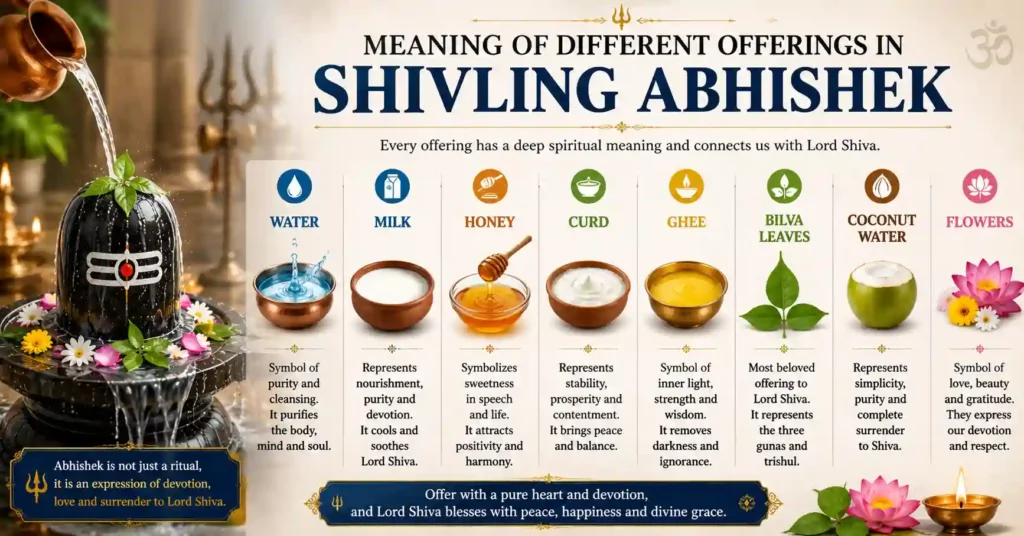
What Do Different Offerings in Shivling Abhishek Symbolize?
Every offering used in Shivling Abhishek carries a symbolic meaning. While devotees may offer different sacred substances according to tradition, scriptures emphasize that devotion and sincerity are more important than the offering itself.
| Offering | Symbolic Meaning |
|---|---|
| Water (Jal) | Purity, surrender, and inner cleansing |
| Milk (Dugdha) | Devotion, nourishment, and compassion |
| Curd (Dahi) | Stability, harmony, and emotional balance |
| Honey (Madhu) | Sweetness in speech, relationships, and life |
| Ghee (Ghrita) | Wisdom, inner light, and spiritual illumination |
| Sugar or Mishri | Joy, contentment, and positive energy |
| Bel Patra | Deep devotion and Lord Shiva’s grace |
| Panchamrit | Completeness, abundance, and divine blessings |
Although different offerings have their own symbolism, Hindu scriptures consistently emphasize that faith (Shraddha) and devotion (Bhakti) are the true essence of Shivling Abhishek. Even a simple offering of clean water, made with a pure heart, is considered equally sacred in Shiva worship.
How Should Sacred Offerings Be Treated After Worship?
The items offered during worship are regarded as sacred and should be handled respectfully after the ritual. Different families and temple traditions may follow slightly different customs, but the underlying principle is to avoid disrespect or unnecessary waste.
Water used during worship is often poured at the base of a sacred tree or used to nourish plants. Fruits and other edible offerings may be shared as prasad among family members. Flowers and Bel Patra are traditionally placed under a tree, in a garden, or immersed in clean flowing water where permitted by local customs.
Whenever possible, avoid throwing sacred offerings into ordinary household waste. Treating these items with gratitude and reverence reflects the spirit of worship and respect for nature.
Shivling Abhishek in Temples vs at Home
The essence of Shivling Abhishek remains the same everywhere—devotion to Lord Shiva. However, the way the ritual is performed may differ between temples and homes based on tradition, local customs, and practical considerations.
| Temple Shivling Abhishek | Home Shivling Abhishek |
|---|---|
| Usually performed by trained priests following Agama or temple traditions. | Can be performed by any devotee with faith and sincerity. |
| Many temples, especially Jyotirlingas, maintain a continuous flow of water called Jaladhara (Dhara) over the Shivling. | A simple Abhishek with clean water is sufficient for daily worship. |
| Offerings such as milk, Panchamrit, or other sacred substances may follow the temple’s customs and regulations. | Devotees may offer water, milk, Bel Patra, flowers, or fruits according to their family traditions and availability. |
| Rituals are often accompanied by Vedic chants, Rudram, or other sacred mantras. | Chanting “Om Namah Shivaya” or simple Shiva prayers is enough for sincere worship. |
Although the rituals may vary from one temple or region to another, their purpose remains unchanged: expressing devotion, seeking Lord Shiva’s blessings, and cultivating inner peace. In Sanatan Dharma, the sincerity of the devotee is always considered more important than the complexity of the ritual.

How to Perform Shivling Abhishek at Home
Performing Shivling Abhishek at home is simple and does not require elaborate arrangements. According to Hindu tradition, devotion and sincerity are more important than expensive offerings or complex rituals.
Follow these simple steps:
- Clean the worship area and place the Shivling on a clean plate or Abhishek tray.
- Offer clean water slowly over the Shivling while chanting “Om Namah Shivaya” with devotion.
- Offer Bel Patra, flowers, or fruits, if available, following your family or regional tradition.
- Light a diya and incense to create a peaceful atmosphere.
- Offer a short prayer and express your gratitude, wishes, or prayers to Lord Shiva.
- Sit quietly for a few minutes after the ritual. This silent meditation allows the mind to become calm and strengthens your spiritual connection.
Who Should Perform This Sacred Ritual?
This sacred ritual is open to anyone who wishes to worship Lord Shiva with faith and sincerity. It is not limited by age, gender, profession, or level of spiritual knowledge.
Many devotees perform it as part of their daily worship, while others observe it on Mondays, Pradosh Vrat, Mahashivratri, birthdays, anniversaries, or other auspicious occasions. Some also offer prayers before beginning a new chapter in life, such as starting a business, moving into a new home, or seeking inner strength during challenging times.
Beginners do not need to know elaborate rituals or Sanskrit mantras. Offering clean water, chanting “Om Namah Shivaya,” and praying with a pure heart are enough to begin a meaningful spiritual practice.
Ultimately, the true purpose of this worship is to cultivate devotion, humility, gratitude, and a deeper connection with Lord Shiva.
Can You Perform This Ritual Without a Temple or a Shivling?
Yes. While worshipping a consecrated Shivling at a temple or at home is the traditional practice, Hindu scriptures and saints emphasize that sincere devotion is the foundation of all worship.
If you do not have a Shivling, you can simply sit before an image of Lord Shiva, light a diya, offer flowers or water mentally, chant “Om Namah Shivaya,” and pray with a focused mind. Many devotees also visit a nearby Shiva temple whenever possible to offer their prayers.
The purpose of worship is to cultivate faith, gratitude, and inner purity. External arrangements are helpful, but they should never become a barrier to beginning a spiritual practice.
As your devotion grows, you may choose to establish a Shivling or a small home altar according to your family’s traditions and personal circumstances.
Which Mantras Should You Chant During Shivling Abhishek?
Chanting mantras during Shivling Abhishek enhances the spiritual experience by helping the mind remain focused and devoted. While elaborate Vedic hymns are recited in many temples, even a simple mantra chanted with faith is considered highly auspicious.
| Mantra | Purpose |
|---|---|
| Om Namah Shivaya | The most popular Shiva mantra for daily worship, devotion, and inner peace. |
| Mahamrityunjaya Mantra | Chanted for healing, protection, courage, and spiritual strength. |
| Om Tryambakam Yajamahe… | The opening verse of the Mahamrityunjaya Mantra, often recited during Abhishek and special pujas. |
| Shiva Ashtottara Shatanamavali | Recitation of the 108 names of Lord Shiva during special occasions and festivals. |
You do not need to memorize long prayers to perform Shivling Abhishek. Chanting “Om Namah Shivaya” with sincerity is sufficient for daily worship. What truly matters is devotion, concentration, and a pure heart rather than the number of mantras recited.

The Meditative Experience of Shivling Abhishek
Beyond its religious significance, Shivling Abhishek is also a deeply meditative practice. The gentle act of offering water while chanting Lord Shiva’s name naturally encourages the mind to slow down and remain focused on the present moment.
The continuous flow of water over the Shivling, combined with the rhythmic chanting of mantras such as “Om Namah Shivaya,” creates a peaceful atmosphere for prayer and self-reflection. For many devotees, this quiet practice becomes a time to pause, let go of distractions, and reconnect with their inner self.
Many practitioners describe experiencing a sense of calmness, emotional balance, and spiritual grounding after performing the ritual regularly. While these experiences may differ from person to person, they are one of the reasons Shivling Abhishek continues to be cherished as both an act of devotion and a form of mindful worship.
Rather than seeking scientific proof, this ritual invites devotees to experience its spiritual value through faith, regular practice, and personal reflection.
Common Myths About Shivling Abhishek
Many devotees have questions and misconceptions about Shivling Abhishek. Hindu scriptures emphasize that devotion, faith, and sincerity are far more important than performing the ritual perfectly.
| Myth | Fact |
|---|---|
| Mistakes during Abhishek bring negative results. | A sincere prayer offered with devotion is valued more than perfect ritual execution. Honest mistakes made without ill intent are not believed to attract negative consequences. |
| Only priests can perform Shivling Abhishek. | Anyone can perform Shivling Abhishek at home with a pure heart and respect for the tradition. |
| Expensive offerings are necessary. | Clean water offered with faith is considered one of the simplest and most sacred offerings to Lord Shiva. |
| The ritual must follow elaborate procedures every time. | Daily worship can be simple. Chanting “Om Namah Shivaya” while offering water is sufficient for many devotees. |
The true purpose of Shivling Abhishek is not to create fear about rituals or rules. It is a sacred practice of devotion, self-purification, and surrender that helps cultivate inner peace and a closer connection with Lord Shiva.
When Is the Best Time to Perform Shivling Abhishek?
Although Shivling Abhishek can be performed on any day with sincere devotion, certain days and times are traditionally considered especially auspicious in Sanatan Dharma.
| Day / Time | Significance |
|---|---|
| Monday (Somvar) | Considered the most auspicious day for worshipping Lord Shiva. Many devotees perform Abhishek while observing the Somvar Vrat. |
| Mahashivratri | One of the holiest occasions for Shivling Abhishek, when devotees offer water, milk, Bel Patra, and chant Shiva mantras throughout the day and night. |
| Pradosh Vrat | Worship performed during the evening twilight on Pradosh is believed to be especially dear to Lord Shiva. |
| Morning (Brahma Muhurta or early morning) | Traditionally preferred because of its peaceful atmosphere, making it ideal for prayer and meditation. |
| Any Time with Devotion | When special timings are not possible, Shivling Abhishek may be performed at any convenient time with faith and a pure heart. |
While these occasions hold special significance, Hindu scriptures emphasize that Bhakti (devotion) is more important than timing. A simple Abhishek performed with sincerity is always considered auspicious and spiritually rewarding.
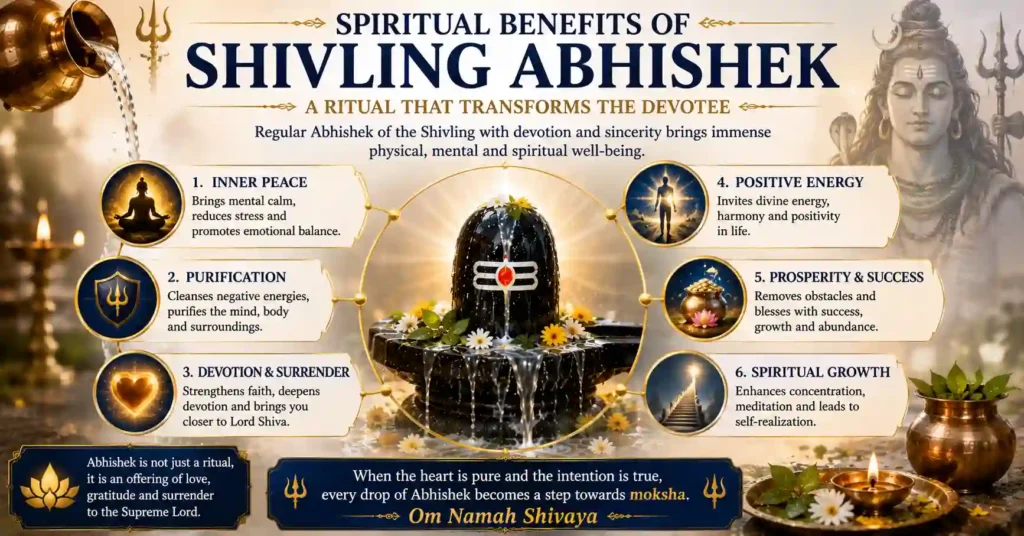
What Are the Benefits of Shivling Abhishek?
The benefits of Shivling Abhishek are primarily spiritual and emotional. While every devotee’s experience is unique, regular worship with faith and sincerity is believed to bring inner transformation over time.
| Benefit | How It Helps |
|---|---|
| Mental Calmness | The gentle act of offering water while chanting Shiva’s name helps quiet the mind and reduce mental restlessness. |
| Emotional Balance | Regular worship encourages patience, reduces anger and anxiety, and promotes emotional stability. |
| Inner Purification | The ritual symbolizes letting go of negative thoughts, ego, and emotional burdens. |
| Stronger Devotion | Daily Abhishek deepens faith and nurtures a closer spiritual connection with Lord Shiva. |
| Improved Focus | The combination of prayer, mantra chanting, and mindful worship enhances concentration and clarity. |
| Discipline and Mindfulness | Performing the ritual regularly builds consistency, self-discipline, and a peaceful daily routine. |
| Inner Peace | Sincere devotion fosters acceptance, surrender, and a lasting sense of calm. |
These benefits are not measured by miracles or instant results. Instead, they are often experienced gradually through regular practice, self-reflection, and unwavering devotion. In Sanatan Dharma, Shivling Abhishek is valued not only for the blessings it seeks but also for the positive transformation it inspires within the devotee.

Common Mistakes to Avoid During the Ritual Content
Even a simple act of worship becomes more meaningful when performed with awareness and respect. While Lord Shiva values sincere devotion above all else, keeping a few traditional guidelines in mind can help you perform the ritual with greater mindfulness.
Avoid these common mistakes:
- Performing the ritual hurriedly without concentration or prayer.
- Offering wilted flowers, damaged Bel Patra, or impure items.
- Forgetting to clean the worship area and the utensils beforehand.
- Treating the ritual as a mechanical task instead of an act of devotion.
- Wasting food or sacred offerings that can be respectfully consumed or distributed as prasad.
- Ignoring local temple customs when participating in worship at a temple.
Remember that these are traditional guidelines rather than rigid rules. A humble heart, sincere faith, and respectful conduct remain the most important aspects of worship.
Do's and Don'ts for Respectful Shiva Worship
Following a few traditional practices can help you perform Shiva worship with greater respect and awareness. While customs may differ across regions and sampradayas, these general guidelines are widely followed by devotees.
| Do’s | Don’ts |
|---|---|
| Bathe or wash your hands before beginning worship. | Do not perform worship carelessly or in haste. |
| Keep the worship area clean and peaceful. | Avoid offering stale flowers or spoiled food. |
| Offer fresh water, Bel Patra, and flowers with devotion. | Do not waste sacred offerings after the ritual. |
| Chant Shiva mantras with focus and sincerity. | Avoid unnecessary distractions, arguments, or mobile phone use during worship. |
| Follow your family or temple traditions whenever possible. | Do not criticize or compare different methods of worship. |
Remember that these are traditional guidelines intended to encourage reverence and mindfulness. The greatest offering to Lord Shiva is a heart filled with faith, humility, and gratitude.
The True Essence of Shivling Abhishek
As you continue the practice of Shivling Abhishek, something begins to change quietly within. The ritual gradually becomes less about the external act and more about the transformation taking place inside your own heart.
You realize that the offering is not merely water flowing over the Shivling. It is a symbolic act of surrender, where ego, worries, and attachments are gently placed at the feet of Lord Shiva.
Like the continuous flow of water, the mind slowly becomes calmer, simpler, and more receptive to divine grace. In that silence, devotion deepens, and an inner connection with Lord Shiva naturally begins to grow.
This is the true essence of Shivling Abhishek—not just performing a sacred ritual, but allowing it to inspire humility, inner peace, and spiritual awakening in everyday life.
Key Takeaways
- Worship of Lord Shiva is a timeless spiritual practice rooted in devotion, humility, and self-surrender.
- A simple offering of clean water and sincere prayer is considered meaningful in Hindu tradition.
- Bel Patra, Panchamrit, flowers, and other offerings carry symbolic spiritual significance.
- Anyone can perform this sacred ritual at home with faith and respect for traditional customs.
- Mondays, Pradosh Vrat, and Mahashivratri are especially popular occasions for Shiva worship.
- Chanting “Om Namah Shivaya” or the Mahamrityunjaya Mantra enhances the devotional experience.
- The true essence of worship lies in inner purity and devotion rather than elaborate rituals or expensive offerings.
Conclusion
In the end, Shivling Abhishek is not something Lord Shiva needs—it is a sacred practice that transforms the devotee. Through every offering of water, every mantra, and every moment of silent prayer, we gradually cultivate humility, inner peace, and unwavering devotion.
Whether you perform Shivling Abhishek with water alone or with traditional offerings, what truly matters is the sincerity of your heart. In Sanatan Dharma, faith and devotion have always been valued more than elaborate rituals.
Even a single drop of water offered with genuine love is enough to express your devotion to Lord Shiva. That simple act of surrender is what makes Shivling Abhishek a timeless spiritual practice that continues to guide millions of devotees on the path of peace, self-discovery, and divine connection.
Explore More
If you found this guide on Shivling Abhishek helpful, you may also enjoy these related articles on Lord Shiva worship, daily puja, Hindu rituals, mantra chanting, and other sacred practices of Sanatan Dharma:
Puja in Sanatan Dharma: Meaning, Vidhi, Bhav and Spiritual Significance
https://thesanatantales.com/puja-in-sanatan-dharma/
Daily Puja at Home: Simple Step-by-Step Guide for Everyday Worship
https://thesanatantales.com/daily-puja-at-home/
Mantra Japa: Meaning, Benefits and How to Practice Daily
https://thesanatantales.com/mantra-japa-meaning-method-rules/
Panchopchar Puja: Meaning, Five Offerings and Simple Worship Guide
https://thesanatantales.com/panchopchar-puja/
Havan: Meaning, Benefits and Step-by-Step Procedure
https://thesanatantales.com/havan-meaning-procedure-benefits/
Prasad in Hinduism: Why Food Offered to God Becomes Sacred
https://thesanatantales.com/prasad-in-hinduism/
Kalash (Purna Kalasha): Meaning, Symbolism and Importance in Hindu Worship
https://thesanatantales.com/kalash-in-hinduism/
Tilak in Hinduism: Meaning, Types and Spiritual Significance
https://thesanatantales.com/tilak-in-hinduism/
Abhisheka (Wikipedia)
https://en.wikipedia.org/wiki/Abhisheka
These articles will help you deepen your understanding of Shivling Abhishek, Lord Shiva worship, daily puja, mantra chanting, sacred offerings, and other important rituals of Sanatan Dharma, enabling you to perform your spiritual practices with greater knowledge, devotion, and understanding.
FAQs
What is Shivling Abhishek?
Shivling Abhishek is the sacred ritual of bathing the Shivling with offerings such as water, milk, Panchamrit, or other traditional substances while chanting the names or mantras of Lord Shiva.
In Sanatan Dharma, this ritual symbolizes devotion, surrender, inner purification, and gratitude. More than the physical offering, it is considered a spiritual practice that helps devotees strengthen their connection with Lord Shiva.
Why is Shivling Abhishek performed?
Shivling Abhishek is performed to express devotion, seek Lord Shiva’s blessings, and cultivate inner peace. It symbolizes offering one’s ego, worries, and negative thoughts to the Divine.
According to Hindu traditions and scriptures, the ritual also represents purity, humility, and spiritual transformation. Regular worship encourages self-discipline, mindfulness, and unwavering faith.
Can anyone perform Shivling Abhishek at home?
Yes. Anyone can perform Shivling Abhishek with a sincere heart and respect for the tradition. You do not need to be a priest to worship Lord Shiva at home.
A simple offering of clean water while chanting “Om Namah Shivaya” is considered sufficient. Devotion and sincerity are regarded as more important than elaborate rituals.
What can be offered during Shivling Abhishek?
The most common offerings include clean water, milk, Bel Patra, flowers, Panchamrit, honey, curd, ghee, and fruits. Each offering carries its own symbolic meaning in Hindu worship.
However, scriptures emphasize that even plain water offered with genuine devotion is considered sacred. The purity of intention matters more than the material being offered.
What is the best time to perform Shivling Abhishek?
Shivling Abhishek can be performed on any day with faith and devotion. Many devotees prefer Monday (Somvar) because it is traditionally dedicated to Lord Shiva.
The ritual is also especially popular during Mahashivratri and Pradosh Vrat. Early morning is generally considered the most peaceful time for worship, although there is no strict rule.
Which mantra should be chanted during Shivling Abhishek?
The most widely chanted mantra is “Om Namah Shivaya,” which is suitable for daily Shiva worship. It is simple, powerful, and easy for beginners to recite.
Many devotees also chant the Mahamrityunjaya Mantra, especially during special pujas or while praying for health, protection, and spiritual strength.
Is offering only water enough for Shivling Abhishek?
Yes. Offering clean water with devotion is considered one of the purest forms of Shivling Abhishek. Many devotees perform daily worship using only water and heartfelt prayers.
Traditional offerings like milk, Panchamrit, or Bel Patra are optional and may be used according to family customs, local traditions, or personal preference.
What are the spiritual benefits of Shivling Abhishek?
Devotees believe that regular Shivling Abhishek helps cultivate inner peace, emotional balance, humility, and devotion. The ritual also encourages mindfulness and self-reflection.
While every person’s experience is unique, many practitioners find that consistent worship strengthens their spiritual connection with Lord Shiva and brings greater calmness into daily life.
Is Shivling Abhishek mentioned in Hindu scriptures?
Yes. The worship of the Shivling is described in sacred texts such as the Shiva Purana and the Linga Purana. These scriptures present Abhishek as an important form of devotion and seva offered to Lord Shiva.
The scriptures also emphasize that worship performed with faith, purity, and sincerity is spiritually meaningful, regardless of the simplicity of the offerings.
Can women perform Shivling Abhishek?
Yes. In many Hindu families and traditions, women perform Shivling Abhishek with devotion at home and in temples. Practices may vary depending on regional customs, temple traditions, or family beliefs.
Devotees are encouraged to follow the customs they observe while remembering that the essence of Shiva worship is sincere devotion and respect for the tradition.
Glossary of Important Terms
| Term | Meaning |
|---|---|
| Abhishek | The sacred ritual of bathing a deity with water, milk, Panchamrit, or other holy offerings as an act of worship. |
| Shivling | The sacred symbol of Lord Shiva representing His infinite, formless, and eternal nature. |
| Bhakti | Loving devotion and complete surrender to God. |
| Seva | Selfless service or an offering performed with devotion and humility. |
| Jaladhara (Dhara) | The continuous flow of water over the Shivling, commonly seen in Shiva temples as a symbol of uninterrupted devotion. |
| Bel Patra (Bilva Leaf) | The sacred three-leafed Bilva leaf traditionally offered to Lord Shiva during worship. |
| Panchamrit | A sacred mixture of milk, curd, ghee, honey, and sugar used for Abhishek and other Hindu rituals. |
| Om Namah Shivaya | One of the most sacred mantras dedicated to Lord Shiva, meaning “I bow to Lord Shiva.” |
| Mahamrityunjaya Mantra | A powerful Vedic mantra dedicated to Lord Shiva, chanted for healing, protection, courage, and spiritual well-being. |
| Somvar Vrat | A devotional fast observed on Mondays, a day considered especially sacred to Lord Shiva. |
| Mahashivratri | The most important festival dedicated to Lord Shiva, celebrated with fasting, night-long prayers, and Shivling Abhishek. |
| Pradosh Vrat | A sacred observance dedicated to Lord Shiva, performed during the twilight period on the Trayodashi (13th lunar day) of each fortnight. |
| Neelkanth | A name of Lord Shiva meaning “Blue-Throated One,” earned after He consumed the Halahala poison during Samudra Manthan. |
| Samudra Manthan | The cosmic churning of the ocean described in Hindu scriptures, during which Halahala poison and Amrit (nectar of immortality) emerged. |
| Halahala | The deadly cosmic poison that appeared during Samudra Manthan and was consumed by Lord Shiva to protect the universe. |
| Agama | A collection of Hindu scriptures that provide detailed guidance on temple construction, deity worship, rituals, and spiritual practices. |
| Rudrabhishek | A special form of Shivling Abhishek performed while chanting the Shri Rudram from the Yajurveda, often conducted for spiritual blessings and auspicious occasions. |
| Shraddha | Faith, sincerity, and heartfelt devotion offered during worship and spiritual practices. |
| Sankalpa | A sacred resolve or intention made before beginning a puja or religious ritual. |
| Brahma Muhurta | The auspicious period approximately 1.5 hours before sunrise, traditionally regarded as the best time for meditation, prayer, and spiritual practices. |
About the Author
Yateendra Chaturvedi is a spiritual writer, researcher, devotee, and the founder of The Sanatan Tales. With over 35 years of professional experience and a lifelong interest in Sanatan Dharma, he writes about Hindu deities, temples, scriptures, festivals, Mahavidyas, sacred stories, rituals, and living traditions that continue to guide and inspire devotees across India.
Drawing from traditional scriptures, regional beliefs, temple traditions, devotional literature, and historical sources, he aims to present authentic, well-researched, and easy-to-understand content for modern readers. His work focuses on preserving spiritual wisdom, explaining sacred traditions, and helping seekers develop a deeper understanding of India’s rich spiritual heritage.
Through The Sanatan Tales, Yateendra strives to make the timeless teachings of Sanatan Dharma simple, meaningful, and relevant for today’s generation while maintaining respect for traditional sources, regional practices, and diverse spiritual perspectives.
Learn More About Yateendra Chaturvedi →
https://thesanatantales.com/about-the-author/
References & Sources
This article is based on widely accepted beliefs, traditions, and practices followed within Sanatan Dharma. The information has been compiled from traditional Hindu scriptures, Puranas, Smritis, spiritual literature, temple traditions, and insights preserved through the guru-shishya (teacher-disciple) tradition, along with reputable religious and educational resources.
Note: Beliefs, customs, rituals, and interpretations may vary across different regions, sects, sampradayas, and spiritual traditions within Sanatan Dharma. The purpose of this article is not to establish any single interpretation as the absolute truth, but to present commonly accepted religious and spiritual perspectives in a simple, respectful, and easy-to-understand manner.
Read More Interesting Articles on Sanatan Dharma