In Sanatan Dharma, there are many spiritual paths that guide seekers toward the Divine. Some emphasize devotion, others focus on knowledge, meditation, or self-realization.
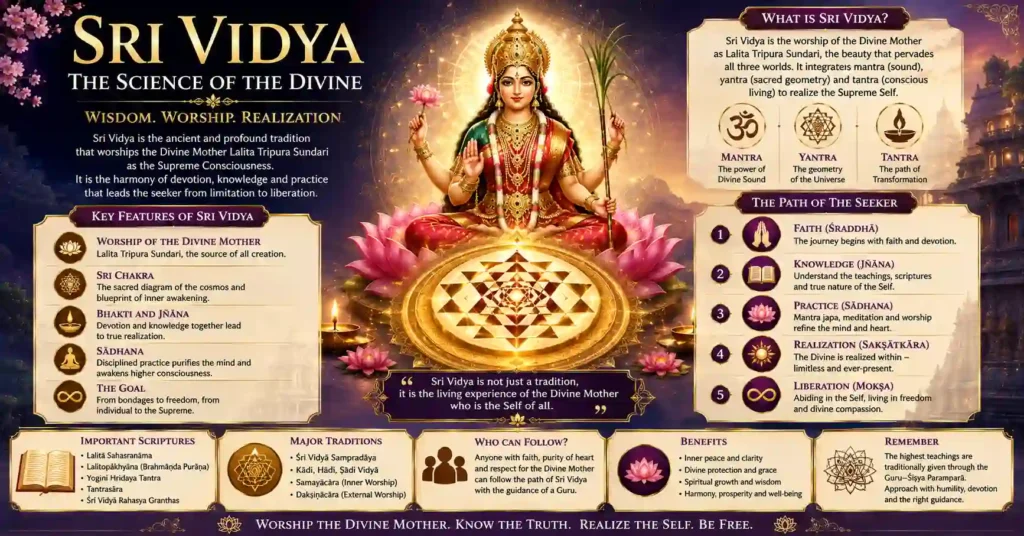
Among these timeless traditions, Sri Vidya is regarded as one of the most profound and sacred paths of Shakti worship. It honors Lalita Tripura Sundari as the Supreme Divine Mother and unites devotion, mantra, meditation, sacred geometry, and spiritual wisdom into a complete path of inner awakening.
More than a system of rituals, this ancient tradition is a journey toward understanding the true nature of the Self and the universe. For countless devotees, it represents the harmonious union of Bhakti, Jnana, and Sadhana under the guidance of the Guru-Shishya Parampara.
In this article, you will learn the meaning of Sri Vidya, its philosophy, the significance of Lalita Tripura Sundari, the symbolism of the Sri Chakra, the role of the Guru, important scriptures, and why this sacred path continues to inspire spiritual seekers today.
Quick Facts
Table of Contents
ToggleWhat Is Sri Vidya? Meaning and Spiritual Significance
| Aspect | Details |
|---|---|
| Meaning | Sacred Wisdom of the Divine Mother |
| Primary Deity | Lalita Tripura Sundari |
| Tradition | Shakta Tradition of Sanatan Dharma |
| Main Symbol | Sri Chakra (Sri Yantra) |
| Core Philosophy | Union of devotion, wisdom, meditation, and spiritual discipline |
| Sacred Practices | Mantra, Yantra, Tantra, Meditation, Sri Chakra Worship |
| Highest Goal | Bhoga (Righteous Prosperity) and Moksha (Liberation) |
| Guru Required? | Yes, for traditional initiation into the sacred tradition. |
| Important Scriptures | Lalita Sahasranama, Saundarya Lahari, Lalitopakhyana, Parashurama Kalpa Sutra |
| Spiritual Focus | Self-realization through the grace of the Divine Mother |
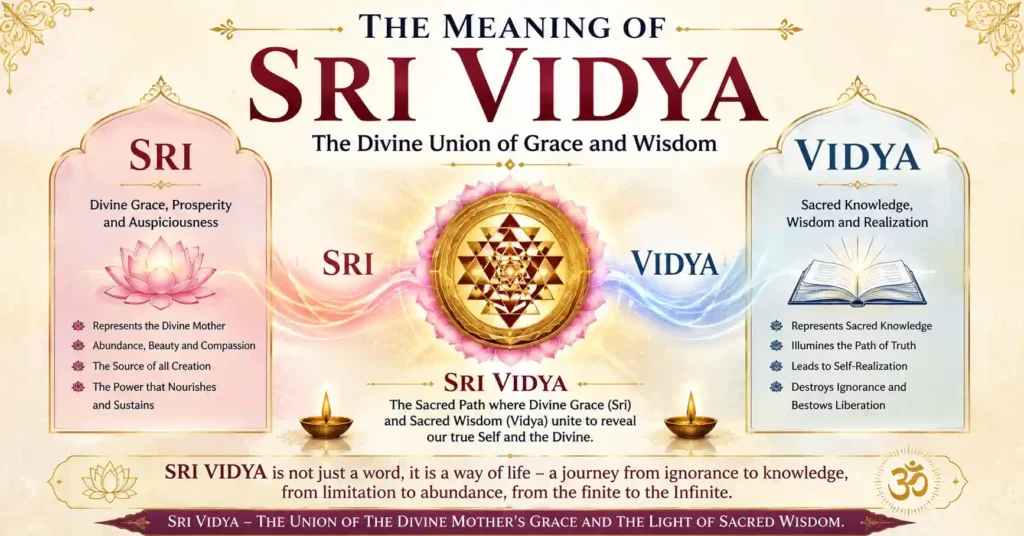
The term “Sri Vidya” carries a deep spiritual meaning rooted in the Shakta tradition of Sanatan Dharma.
The word “Sri” signifies divine beauty, prosperity, grace, and auspiciousness, while “Vidya” means sacred knowledge or spiritual wisdom. Together, they refer to the sacred wisdom of the Divine Mother that leads a seeker towards self-realization.
In this spiritual tradition, the Supreme Goddess is worshipped as Lalita Tripura Sundari, the highest manifestation of Shakti and the source of all creation. She is revered as the eternal Divine Mother who pervades the entire universe.
According to this philosophy, the universe is not separate from the Divine. Every living being, every form of nature, and every experience is considered an expression of Divine Consciousness through the cosmic play (Lila) of the Mother Goddess.
For this reason, Sri Vidya is regarded as a complete path that harmoniously combines devotion (Bhakti), wisdom (Jnana), meditation (Dhyana), and spiritual discipline (Sadhana), guiding seekers towards both Bhoga (righteous worldly fulfillment) and Moksha (liberation).
Sri Vidya vs General Devi Worship
| Aspect | Sri Vidya | General Devi Worship |
|---|---|---|
| Primary Focus | Lalita Tripura Sundari as the Supreme Divine Mother | Various forms of the Divine Mother such as Durga, Kali, Lakshmi, Saraswati, or Parvati |
| Main Symbol | Sri Chakra (Sri Yantra) | Idols, images, Yantras, or sacred symbols depending on the tradition |
| Spiritual Approach | Combines devotion, meditation, philosophy, and sacred symbolism | Primarily devotion, prayers, festivals, and temple worship |
| Guidance | Traditionally follows the Guru-Shishya Parampara | May be practiced individually or under the guidance of a Guru |
| Ultimate Goal | Bhoga (righteous prosperity) and Moksha (liberation) | Divine blessings, protection, prosperity, and spiritual growth |
Lalita Tripura Sundari: The Supreme Goddess
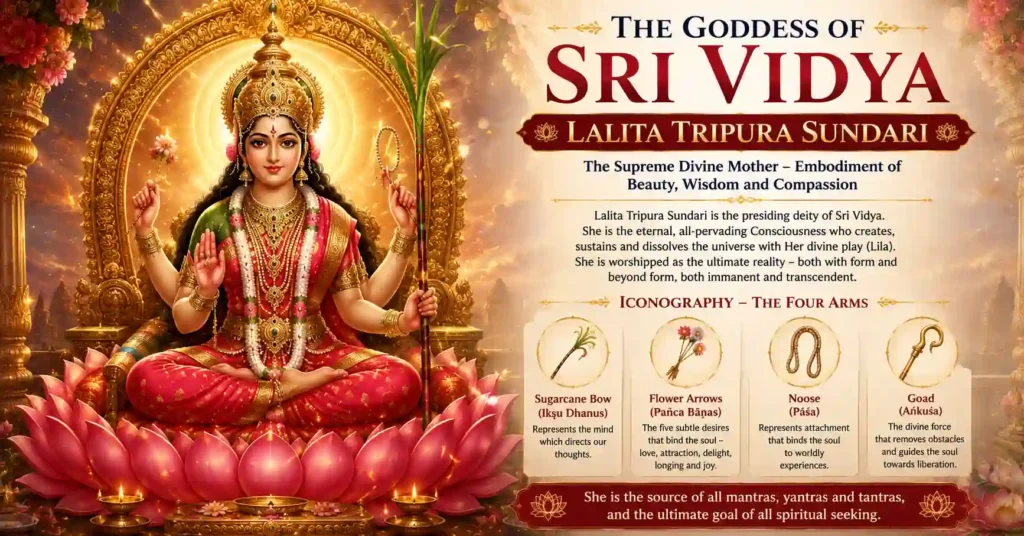
At the heart of this sacred wisdom tradition is Lalita Tripura Sundari, the Supreme Divine Mother and the central deity of Shakta worship. In Shakta philosophy, she is revered as the highest manifestation of Shakti and is also worshipped as one of the Dasa Mahavidyas.
Her name carries profound spiritual symbolism. Tripura refers to the three worlds, the three states of consciousness, or the three dimensions of existence, while Sundari means “the most beautiful one.” Together, the name signifies the Divine Beauty that pervades and transcends all creation.
Scriptures such as the Lalita Sahasranama describe her as the sovereign Queen of the universe, residing in the celestial abode of Sri Nagara (Manidvipa). Although she exists beyond time and space, she is also believed to manifest as the entire cosmos and dwell within every living being.
She is traditionally depicted with four sacred attributes, each representing a deeper spiritual truth:
- Sugarcane bow – mastery over the mind.
- Five flower arrows – control of the five senses.
- Noose (Pasha) – the power of love, attachment, and divine grace.
- Elephant goad (Ankusha) – guidance towards spiritual awakening and self-discipline.
Her divine consort is Kameshwara, a form of Lord Shiva. Together, they symbolize the eternal union of Shiva and Shakti, representing the inseparable principles of pure consciousness and divine energy that sustain the universe.
Sri Chakra: The Sacred Geometry of the Universe
One of the most revered symbols of this sacred tradition is the Sri Chakra, also known as the Sri Yantra. This sacred geometric diagram is regarded as a visual representation of the universe and the Divine Mother herself.
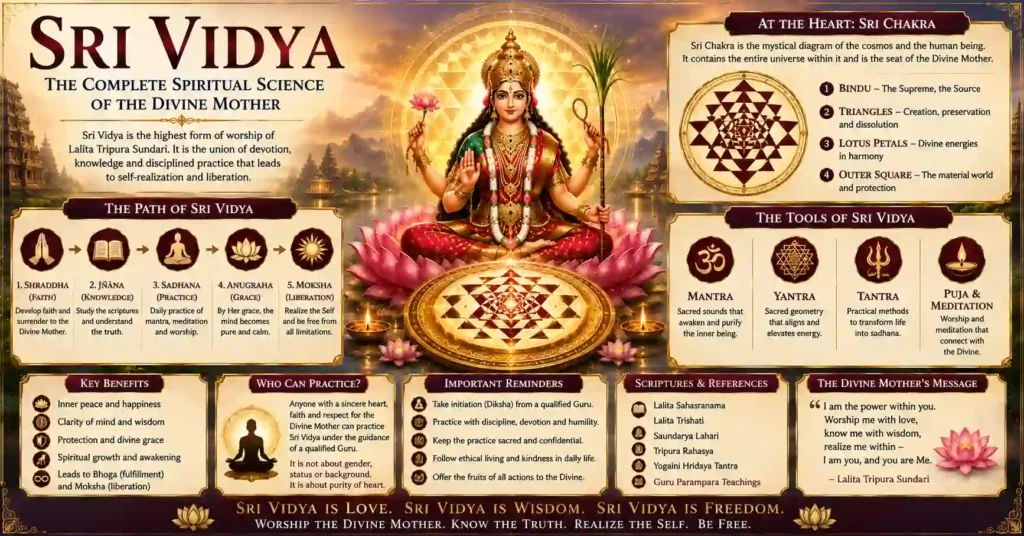
The Sri Chakra consists of nine interlocking triangles arranged around a central point called the Bindu. Together, they symbolize the harmony of Shiva and Shakti, the process of creation and dissolution, and the soul’s journey towards spiritual realization.
Its sacred design represents several profound spiritual concepts:
- Union of Shiva and Shakti – the inseparable principles of consciousness and divine energy.
- Creation, preservation, and dissolution – the eternal cycle of the universe.
- Cosmic order – the interconnectedness of all existence.
- Spiritual awakening – the seeker’s inward journey towards the Divine.
In this sacred tradition, the Sri Chakra is far more than a symbolic diagram. It is revered as the mystical abode of Lalita Tripura Sundari and is worshipped as a living embodiment of the Divine Mother.
During meditation and worship, devotees contemplate its sacred layers, progressing from the outer enclosures towards the Bindu, the spiritual center where the Goddess is believed to reside. This inward movement symbolizes the gradual journey from the outer world of duality to the direct realization of the Supreme Truth.
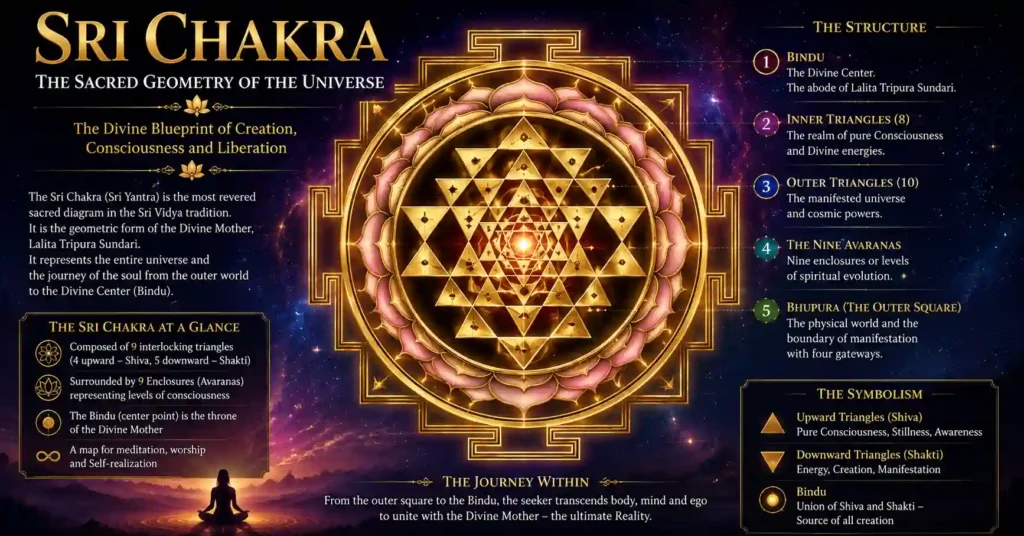
The Nine Avaranas: The Spiritual Journey Through the Sri Chakra
The Sri Chakra is more than a sacred geometric diagram. In this spiritual tradition, it is revered as a symbolic map of the universe and the soul’s journey toward Divine Consciousness.
Its design is divided into nine sacred enclosures, known as the Nine Avaranas. Each enclosure represents a progressive stage of spiritual awareness, guiding the seeker from the outer world of material existence to the highest state of inner realization.
During Navavarana Puja, devotees symbolically contemplate this inward journey by moving from the outer enclosures towards the spiritual center. This practice represents the gradual purification of the mind, the awakening of higher consciousness, and the removal of ignorance.
The outermost enclosure, known as the Bhupura, symbolizes the physical world and the beginning of spiritual life. As one moves inward through each sacred layer, the focus shifts from worldly awareness to inner transformation.
At the heart of the diagram lies the Bindu, the supreme center where Lalita Tripura Sundari is believed to reside. Spiritually, reaching the Bindu represents the realization that the individual soul (Atman) is one with the Supreme Divine Reality.
Sacred Mantras
Mantras form an important part of this sacred path and are regarded as powerful expressions of the Divine Mother’s grace. They are used for meditation, devotion, and spiritual contemplation rather than being viewed as ordinary words.
Among the most revered are the Panchadashi Mantra and the Shodashi Mantra. These sacred mantras hold a special place in the Shakta tradition and are honoured as profound spiritual practices dedicated to Lalita Tripura Sundari.
Traditionally, the deeper meaning and practice of these mantras are received only through Diksha (initiation) from a qualified Guru. This reflects the long-standing Guru-Shishya Parampara, where sacred knowledge is passed from teacher to disciple with proper guidance and responsibility.
For this reason, this article explains their spiritual significance without discussing their form or method of practice. Those aspects are traditionally learned under the guidance of an authentic Guru within the living lineage of the tradition.
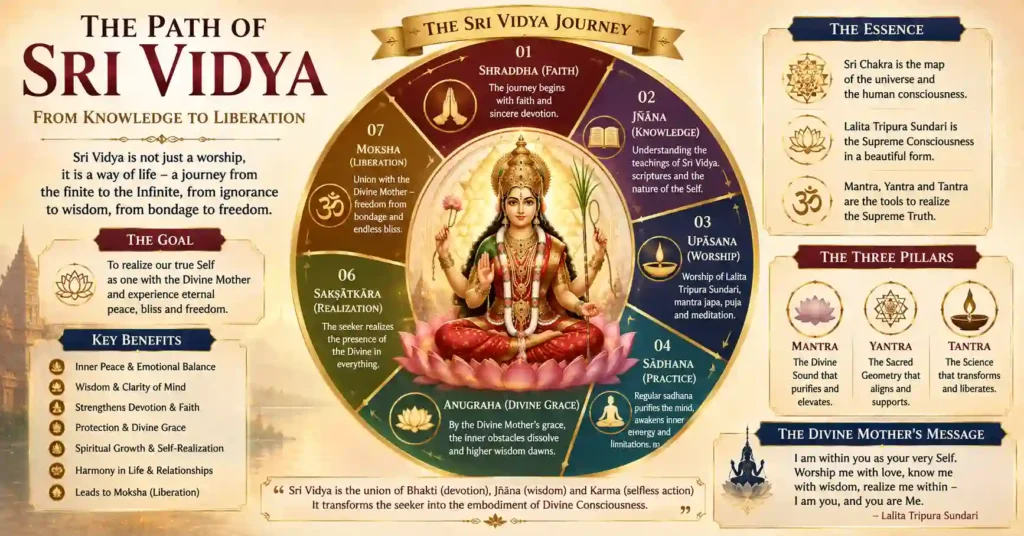
The Three Pillars of the Tradition
This sacred wisdom tradition is built upon three timeless foundations: Mantra, Yantra, and Tantra. Together, they form a complete path that harmoniously combines devotion, meditation, wisdom, and spiritual discipline.
Mantra
Mantras are sacred sound vibrations that help devotees focus the mind and deepen their connection with the Divine Mother. Among the most revered are the Panchadashi Mantra and the Shodashi Mantra, which hold a special place in the Shakta tradition.
Traditionally, these sacred mantras are received through Diksha (initiation) from a qualified Guru. Their deeper practice and interpretation are preserved through the Guru-Shishya Parampara.
Yantra
A Yantra is a sacred geometric representation of divine energy. In this tradition, the Sri Chakra is regarded as the highest Yantra and the symbolic abode of Lalita Tripura Sundari.
Devotees meditate upon its sacred design to cultivate concentration, inner purity, and awareness of the Divine Presence. It serves as a visual aid for contemplation rather than merely a symbolic diagram.
Tantra
Tantra provides the philosophical framework and traditional methods of worship. It brings together devotion, meditation, mantra, sacred symbolism, and disciplined spiritual practice into a unified path.
Its purpose is not merely ritual performance but the gradual transformation of the seeker’s mind and consciousness, leading towards spiritual realization under proper guidance.
Together, Mantra, Yantra, and Tantra complement one another, creating a balanced path that integrates Bhakti, Jnana, Dhyana, and Sadhana in the worship of the Divine Mother.
The Story of Lalita Tripura Sundari and Bhandasura
One of the most important narratives associated with this sacred tradition is found in the Lalitopakhyana, a revered section of the Brahmanda Purana. This sacred account explains the divine appearance of Lalita Tripura Sundari and her role as the protector of cosmic order.
According to the story, the powerful demon Bhandasura gained extraordinary strength and began spreading suffering and disorder throughout the universe. Unable to overcome him, the gods prayed to the Divine Mother for protection.
In response, Lalita Tripura Sundari manifested from the sacred fire of pure consciousness. Seated upon the Sri Chakra and accompanied by her divine attendants, she waged a righteous battle against Bhandasura and ultimately restored Dharma, harmony, and balance to creation.
Beyond its mythological significance, this story conveys a profound spiritual message. Bhandasura symbolizes ignorance, ego, and negative tendencies, while the Divine Mother represents wisdom, compassion, and the awakening of higher consciousness.
For spiritual seekers, the victory of Lalita Tripura Sundari reminds us that true transformation begins within. When ignorance is overcome through devotion, wisdom, and self-discipline, the light of the Divine naturally shines in one’s life.
Did You Know?
• The Sri Chakra is regarded as one of the most sacred geometric symbols in Sanatan Dharma and is revered as the mystical abode of Lalita Tripura Sundari.
• The Lalita Sahasranama, which praises the thousand names of the Divine Mother, is recited daily by countless devotees around the world.
• Traditional teachings consider Guru-Shishya Parampara essential for receiving deeper spiritual guidance in Sri Vidya.
• One of the unique features of this tradition is its balanced approach, teaching that Bhoga (righteous worldly fulfillment) and Moksha (liberation) can both be attained through the grace of the Divine Mother.
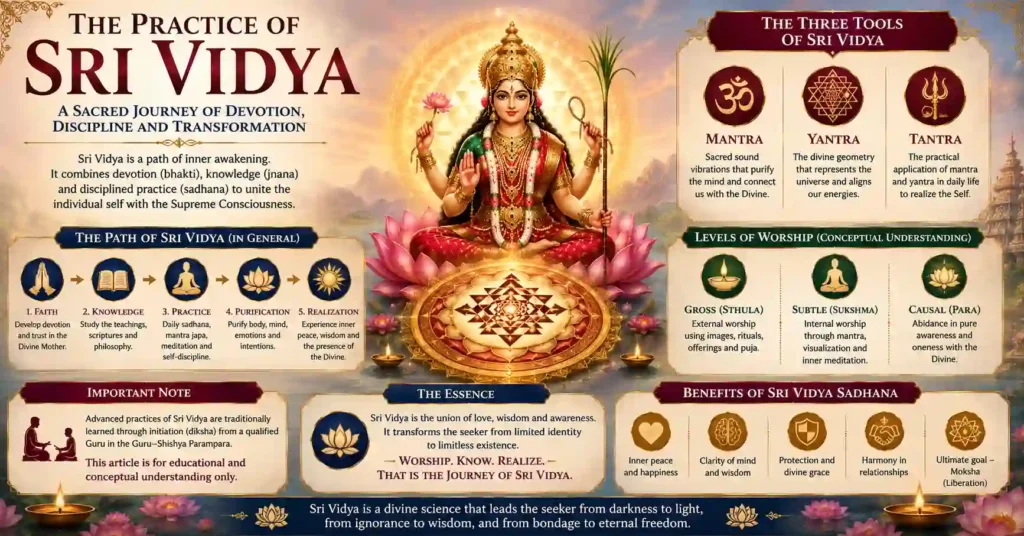
The Path of Sri Vidya Sadhana
The ultimate purpose of this sacred path is to help seekers purify the mind, awaken spiritual awareness, and realize their unity with the Divine Mother. It is regarded as a balanced path that harmoniously combines devotion, meditation, wisdom, and disciplined practice.
Traditional teachings describe several important aspects of this spiritual journey, including:
- Mantra Japa – devotional repetition of sacred mantras.
- Sri Chakra Puja – worship of the Divine Mother through the sacred yantra.
- Meditation (Dhyana) – cultivating inner stillness and spiritual awareness.
- Self-discipline (Sadhana) – developing purity, devotion, and higher consciousness.
Many traditional lineages also associate this path with the gradual awakening of Kundalini Shakti, the dormant spiritual energy within every individual. Such teachings are traditionally understood under the guidance of a qualified Guru.
In several traditions, seekers begin with the worship of Bala Tripura Sundari, the youthful and compassionate form of the Divine Mother. She represents purity, innocence, and the early stages of spiritual growth before progressing to deeper levels of practice.
While devotees pray for peace, prosperity, and divine blessings, the highest goal of this sacred path is Moksha—freedom from ignorance and the realization of one’s true nature through the grace of Lalita Tripura Sundari.
Guru-Shishya Parampara
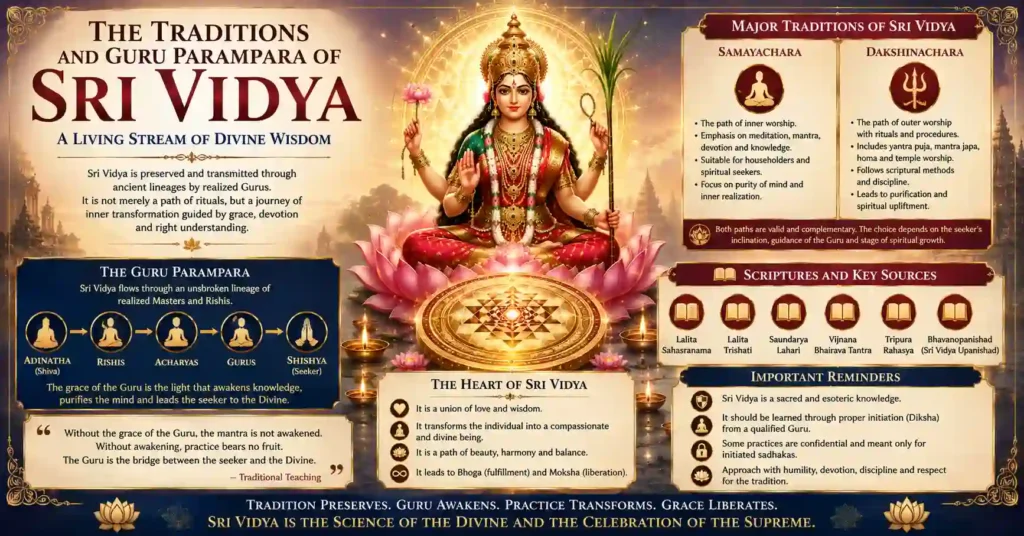
The teachings of this sacred wisdom tradition have traditionally been preserved through the Guru-Shishya Parampara, where spiritual knowledge is passed from Guru to disciple. This living tradition helps preserve both the philosophy and the proper understanding of the path.
Various scriptures and traditional lineages associate this sacred wisdom with revered sages such as Agastya, Vasishtha, Dattatreya, and Parashurama. Their names reflect the deep spiritual heritage connected with the transmission of this knowledge across generations.
Because this path involves profound spiritual practices, Diksha (initiation) is regarded as an essential step before undertaking its deeper disciplines. A qualified Guru not only imparts sacred knowledge but also guides the seeker according to their spiritual readiness.
For this reason, advanced aspects of the tradition are traditionally learned through personal guidance rather than from books or public sources. This preserves both the sanctity of the teachings and the well-being of the practitioner.
Who Can Follow Sri Vidya? Content
Many people wonder whether Sri Vidya is meant only for monks or advanced spiritual practitioners. Traditionally, this is not the case. The philosophy and devotional aspects of this sacred path are open to anyone who approaches it with sincerity, humility, and respect.
Anyone can learn about its history, symbolism, scriptures, and spiritual teachings. Many devotees also worship Lalita Tripura Sundari, recite devotional hymns such as the Lalita Sahasranama, and meditate upon the Sri Chakra according to their personal tradition.
However, traditional lineages maintain that advanced mantras, initiatory practices, and deeper disciplines should be learned only after receiving Diksha from a qualified Guru. This preserves the authenticity of the teachings while ensuring that seekers receive proper spiritual guidance.
For most devotees, the first step is not mastering complex practices but developing faith, devotion, self-discipline, and a sincere desire for spiritual growth.
Major Spiritual Traditions (Acharas)
Over the centuries, this sacred wisdom tradition has been preserved through several traditional schools of practice, known as Acharas. While each follows its own approach, all share the common goal of realizing the Divine Mother through devotion, meditation, and spiritual discipline.
| Achara | Main Focus |
|---|---|
| Samayachara | Emphasizes inner worship through meditation, contemplation, and the realization of the Divine within. |
| Dakshinachara | Follows traditional devotional worship using the Sri Chakra, sacred rituals, flowers, lamps, and scripturally guided practices. |
| Kaulachara | A traditional path with profound symbolic teachings that are practiced only under the guidance of a qualified Guru. |
| Mishrachara | Integrates elements of both inner meditation and external forms of worship in a balanced manner. |
Although these approaches differ in their methods, they all lead seekers towards the same spiritual goal: realizing the unity of the individual soul with the Divine Mother. The path followed by a devotee usually depends on the Guru, lineage, and spiritual tradition to which they belong.
Common Misconceptions
| Misconception | Reality |
|---|---|
| Sri Vidya is only for saints or monks. | The philosophy and devotional teachings can be studied by anyone. However, advanced spiritual practices traditionally require guidance from a qualified Guru. |
| It is only a Tantric ritual system. | While rooted in the Shakta and Tantric traditions, Sri Vidya is also a profound philosophy that emphasizes devotion, meditation, self-realization, and the worship of the Divine Mother. |
| The Sri Chakra is just a geometric design. | Devotees regard the Sri Chakra as the sacred abode of Lalita Tripura Sundari and a symbolic representation of the universe and inner consciousness. |
| Worldly life must be abandoned to follow this path. | Sri Vidya teaches that righteous worldly life (Bhoga) and spiritual liberation (Moksha) can exist in harmony when guided by Dharma and devotion. |
Important Scriptures
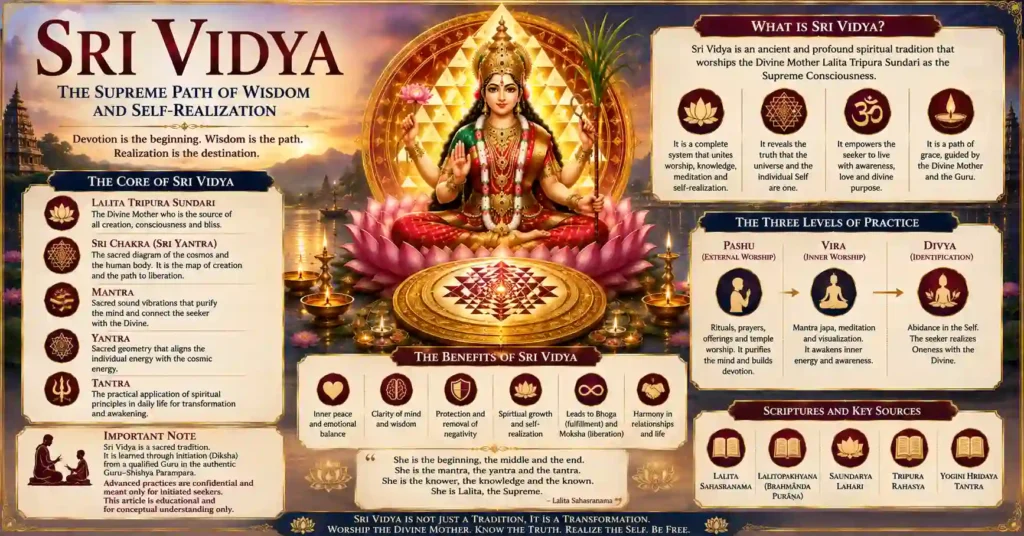
The philosophy and spiritual teachings of this sacred tradition are preserved in several revered scriptures, hymns, and traditional texts. Together, they explain the worship of Lalita Tripura Sundari, the symbolism of the Sri Chakra, and the deeper principles of Shakta philosophy.
The following works are among the most respected sources associated with this sacred tradition:
| Scripture | Significance |
|---|---|
| Lalita Sahasranama | Describes the thousand names and divine qualities of Lalita Tripura Sundari. It is one of the most widely recited devotional hymns in Shakta worship. |
| Saundarya Lahari | A celebrated hymn traditionally attributed to Adi Shankaracharya, explaining the beauty, power, and spiritual symbolism of the Divine Mother. |
| Lalitopakhyana (Brahmanda Purana) | Narrates the divine appearance of Lalita Tripura Sundari and her victory over Bhandasura, highlighting the triumph of divine wisdom over ignorance. |
| Parashurama Kalpa Sutra | An important traditional text associated with the philosophical and ritual aspects of the path. |
| Shakta and Tantric Scriptures | Various traditional texts preserve the philosophy, symbolism, and spiritual principles associated with the worship of the Divine Mother. |
Together, these scriptures provide the philosophical foundation of the tradition while preserving its devotional, symbolic, and spiritual heritage. They continue to inspire devotees, scholars, and spiritual seekers across generations.
Evolution of Sri Vidya Through History
| Period | Development |
|---|---|
| Puranic Period | The story of Lalita Tripura Sundari and Bhandasura appears in the Lalitopakhyana of the Brahmanda Purana. |
| 8th–12th Century CE | Shakta and Tantric traditions flourished, and Sri Vidya became an important philosophical and devotional tradition in many parts of India. |
| Medieval Period | Great scholars and spiritual masters composed works such as the Lalita Sahasranama commentaries and Saundarya Lahari, helping preserve the tradition. |
| Present Day | Sri Vidya continues to be practiced and studied through traditional Guru lineages, temples, and spiritual institutions across India and the world. |
Bhoga and Moksha: A Balanced Spiritual Vision
One of the unique teachings of this sacred path is that it does not ask seekers to reject the world, Instead it encourages living a balanced life where spiritual growth and worldly responsibilities complement one another.
Unlike paths that emphasize renunciation alone, this sacred wisdom tradition teaches that both Bhoga (righteous worldly fulfillment) and Moksha (spiritual liberation) are gifts of the Divine Mother. Material well-being and inner awakening are seen as harmonious, not opposing, goals.
Devotees believe that sincere worship of Lalita Tripura Sundari brings peace, prosperity, wisdom, and spiritual strength. While worldly blessings support a meaningful life, the highest aspiration remains the realization of one’s true nature through divine grace.
This philosophy reminds seekers that everyday life itself can become a path to spiritual realization when lived with devotion, self-awareness, and Dharma. In this way, worldly life and liberation are understood as two expressions of the same Divine Consciousness.
Conclusion
This sacred wisdom tradition is one of the most profound spiritual paths within Sanatan Dharma, bringing together devotion, meditation, sacred geometry, mantra, and philosophy into a complete journey of inner transformation. It teaches that the Divine Mother is both the source of the universe and the eternal presence within every living being.
At the heart of this sacred path is Lalita Tripura Sundari, the Supreme Goddess who embodies beauty, compassion, wisdom, and Divine Consciousness. Through her grace, devotees seek not only peace and prosperity in worldly life but also the highest goal of Moksha, the realization of their true nature.
More than a system of rituals, this timeless tradition invites seekers to cultivate devotion, self-awareness, and spiritual wisdom in everyday life. It reminds us that the journey towards the Divine begins within, where the individual soul ultimately discovers its eternal unity with the Divine Mother.
Key Takeaways
- Sri Vidya is one of the highest spiritual traditions within the Shakta school of Sanatan Dharma.
- Lalita Tripura Sundari is worshipped as the Supreme Divine Mother and the central deity of this tradition.
- The Sri Chakra symbolizes the universe, the Divine Mother, and the seeker’s journey toward spiritual realization.
- The path is founded on the harmonious integration of Mantra, Yantra, and Tantra.
- The Guru-Shishya Parampara plays a vital role in preserving the authenticity of its teachings.
- Bhoga (righteous worldly fulfillment) and Moksha (liberation) are viewed as complementary spiritual goals.
- The philosophy of Sri Vidya teaches that devotion, wisdom, meditation, and self-discipline together lead to inner transformation and realization of the Divine.
Suggested reading
If you found this guide on this sacred tradition helpful, explore these related articles to deepen your understanding of Shakti worship, Lalita Tripura Sundari, Sri Chakra, Tantra, and the spiritual philosophy of Sanatan Dharma. Together, they offer a broader understanding of the Divine Mother, sacred wisdom, and the path to self-realization.
Shakti in Sanatan Dharma: Meaning, Forms, Philosophy and Spiritual Significance
https://thesanatantales.com/shakti-in-sanatan-dharma/
Chausath Yogini: Meaning, History, Temples and Spiritual Significance
https://thesanatantales.com/chausath-yogini/
What Is Sanatan Dharma? Meaning, Principles and Eternal Wisdom
https://thesanatantales.com/sanatan-dharma-meaning/
Why Do Hindus Have So Many Gods? The Truth Behind Many Deities in Sanatan Dharma
https://thesanatantales.com/why-do-hindus-have-so-many-gods/
Karma: Meaning, Types, Philosophy and How It Works in Sanatan Dharma
https://thesanatantales.com/karma-meaning-types-and-how-it-works/
Atma and Parmatma: Meaning, Relationship and Their Role in Sanatan Dharma
https://thesanatantales.com/atma-and-parmatma/
Detachment in Hindu Philosophy: Meaning, Vairagya and the Path to Inner Freedom
https://thesanatantales.com/detachment-in-hindu-philosophy/
Kaal in Sanatan Dharma: Meaning, Yugas, Cosmic Time and Kala Chakra
https://thesanatantales.com/kaal-in-sanatan-dharma/
Shri Vidya (Wikipedia)
https://en.wikipedia.org/wiki/Shri_Vidya
FAQs
What is Sri Vidya in Sanatan Dharma?
This sacred wisdom tradition is one of the highest spiritual paths within the Shakta school of Sanatan Dharma. It is dedicated to the worship of Lalita Tripura Sundari, the Supreme Divine Mother, through devotion, meditation, mantra, and contemplation of the Sri Chakra.
More than a ritual system, it is a complete spiritual philosophy that guides seekers toward realizing the unity of the individual soul with the Divine. Its ultimate goal is both Bhoga (righteous worldly well-being) and Moksha (spiritual liberation).
Who is Lalita Tripura Sundari?
Lalita Tripura Sundari is the central deity of this sacred wisdom tradition and is revered as the Supreme manifestation of Shakti, the Divine Feminine Energy. She is also worshipped as one of the Dasa Mahavidyas in the Shakta tradition.
She symbolizes beauty, wisdom, compassion, and supreme consciousness. Devotees believe she is both the creator of the universe and the inner presence guiding every soul toward spiritual awakening.
What is the significance of the Sri Chakra in Sri Vidya?
The Sri Chakra, also known as the Sri Yantra, is the most sacred symbol associated with this wisdom tradition. It represents the entire universe and the harmonious union of Shiva and Shakti through sacred geometry.
Its nine enclosures symbolize the seeker’s inward journey from the material world to the realization of the Divine Mother. For devotees, it serves as both an object of worship and a visual aid for meditation and contemplation.
Is Sri Vidya only for initiated disciples?
The philosophy, history, and devotional aspects of this sacred tradition can be studied by anyone interested in understanding Sanatan Dharma. Learning about its principles does not require formal initiation.
However, traditional lineages maintain that advanced mantras and deeper spiritual practices should be undertaken only after receiving Diksha from a qualified Guru through the Guru-Shishya Parampara.
What is the difference between Sri Vidya and ordinary Devi worship?
General worship of the Divine Mother often focuses on devotion, prayers, festivals, and temple rituals. This sacred wisdom tradition includes these devotional elements while also emphasizing meditation, sacred symbolism, philosophical understanding, and contemplation of the Sri Chakra.
Rather than being a separate religion, it is a refined spiritual path within Shakta worship that seeks both inner transformation and realization of the Divine.
Why is a Guru important in Sri Vidya?
The Guru plays a central role because this sacred wisdom has been preserved through the Guru-Shishya Parampara for centuries. A qualified teacher helps seekers understand its philosophy, scriptures, and deeper spiritual principles.
Traditional teachings also emphasize that advanced mantras and spiritual disciplines should be practiced only under proper guidance. This preserves the authenticity of the lineage while supporting the seeker’s safe and meaningful spiritual progress.
Does Sri Vidya teach renunciation of worldly life?
No. One of the unique teachings of this sacred wisdom tradition is that it does not ask seekers to reject the world. Instead, it encourages a balanced life where spiritual growth and worldly responsibilities exist in harmony.
It teaches that Bhoga (righteous prosperity) and Moksha (liberation) are both blessings of the Divine Mother. Worldly life itself can become a path to spiritual realization when lived with Dharma, devotion, and self-awareness.
Which scriptures are associated with Sri Vidya?
Several revered scriptures explain the philosophy and symbolism of this sacred wisdom tradition. Among the most important are the Lalita Sahasranama, Saundarya Lahari, Lalitopakhyana from the Brahmanda Purana, and the Parashurama Kalpa Sutra.
These texts describe the glory of Lalita Tripura Sundari, the significance of the Sri Chakra, and the spiritual principles that have guided devotees for centuries.
Glossary of Important Terms
| Term | Meaning |
|---|---|
| Atman | The eternal Self or soul present in every living being. In Sanatan Dharma, Atman is ultimately one with the Supreme Reality. |
| Bhakti | The path of loving devotion to God or the Divine Mother, leading to spiritual growth and inner peace. |
| Bhoga | Righteous worldly happiness, prosperity, and well-being granted through divine grace. In Sri Vidya, Bhoga and Moksha complement each other. |
| Bindu | The central point of the Sri Chakra, representing the Supreme Reality and the presence of Lalita Tripura Sundari. |
| Dasa Mahavidya | The ten Wisdom Goddesses of the Shakta tradition, representing different aspects of the Divine Mother. |
| Dharma | The eternal moral and spiritual order that upholds the universe, as well as righteous living and duty. |
| Dhyana | Meditation or deep contemplation practiced to develop inner peace, concentration, and spiritual awareness. |
| Diksha | Sacred initiation received from a qualified Guru before undertaking deeper spiritual practices. |
| Divine Mother | The Supreme Goddess worshipped in many forms, including Lalita Tripura Sundari, Durga, Kali, and Parvati. |
| Guru-Shishya Parampara | The traditional teacher-disciple lineage through which spiritual knowledge is transmitted across generations. |
| Jnana | Spiritual knowledge or wisdom that leads to self-realization and understanding of the Supreme Truth. |
| Kundalini Shakti | The dormant spiritual energy believed to reside within every individual, traditionally awakened under the guidance of a Guru. |
| Lalita Tripura Sundari | The Supreme Divine Mother in this Sacred Tradition, representing beauty, wisdom, compassion, and the highest manifestation of Shakti. |
| Mantra | A sacred sound, word, or phrase used in prayer, meditation, and spiritual practice to invoke divine grace. |
| Moksha | Liberation from the cycle of birth and death (Samsara) and realization of one’s eternal unity with the Divine. |
| Sadhana | Regular spiritual discipline that may include prayer, meditation, mantra, self-reflection, and devotional practices. |
| Shakta Tradition | A major tradition within Sanatan Dharma that worships Shakti, the Divine Feminine, as the Supreme Reality. |
| Shakti | The universal Divine Energy that creates, sustains, and transforms the universe, worshipped as the Divine Mother. |
| Shiva and Shakti | The inseparable principles of pure consciousness (Shiva) and divine energy (Shakti), whose union sustains creation. |
| Sri Chakra (Sri Yantra) | The most sacred geometric diagram in this Sacred Tradition, symbolizing the universe, the Divine Mother, and the seeker’s spiritual journey. |
| Tantra | A spiritual and philosophical tradition that integrates devotion, meditation, sacred symbolism, and disciplined practices for inner transformation. |
| Yantra | A sacred geometric diagram used for meditation and worship. The Sri Chakra is the highest Yantra in the Sri Vidya tradition. |
About the Author
Yateendra Chaturvedi is a spiritual writer, researcher, devotee, and the founder of The Sanatan Tales. With over 35 years of professional experience and a lifelong interest in Sanatan Dharma, he writes about Hindu deities, temples, scriptures, festivals, Mahavidyas, sacred stories, rituals, and living traditions that continue to guide and inspire devotees across India.
Drawing from traditional scriptures, regional beliefs, temple traditions, devotional literature, and historical sources, he aims to present authentic, well-researched, and easy-to-understand content for modern readers. His work focuses on preserving spiritual wisdom, explaining sacred traditions, and helping seekers develop a deeper understanding of India’s rich spiritual heritage.
Through The Sanatan Tales, Yateendra strives to make the timeless teachings of Sanatan Dharma simple, meaningful, and relevant for today’s generation while maintaining respect for traditional sources, regional practices, and diverse spiritual perspectives.
Learn More About Yateendra Chaturvedi →
https://thesanatantales.com/about-the-author/
References & Sources
This article is based on traditional beliefs, scriptures, philosophical teachings, and spiritual literature associated with Sanatan Dharma. It also draws upon widely accepted interpretations preserved through various religious traditions, classical texts, and the Guru-Shishya Parampara (teacher-disciple tradition).
Note: Beliefs, interpretations, and spiritual practices may vary across different traditions, sects, and lineages within Sanatan Dharma. This article is intended to present widely accepted spiritual and philosophical perspectives in a simple, balanced, and accessible manner for educational purposes, and not as the only or final interpretation of the subject.
Read More Interesting Articles on Sanatan Dharma