Across Bharat, there are places where the presence of Maa is not just believed, it is deeply experienced. These sacred sites have inspired millions of devotees with their divine energy and timeless spiritual significance.
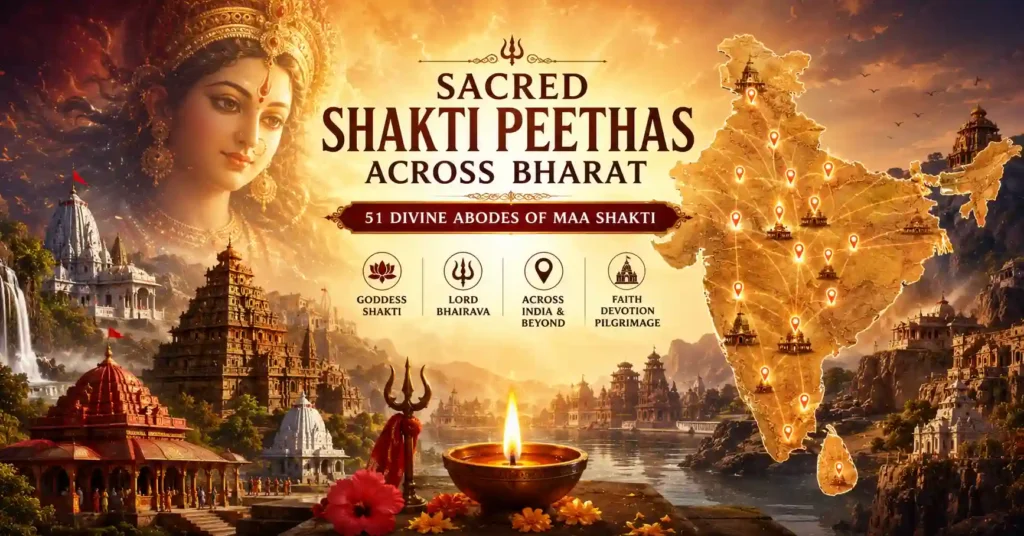
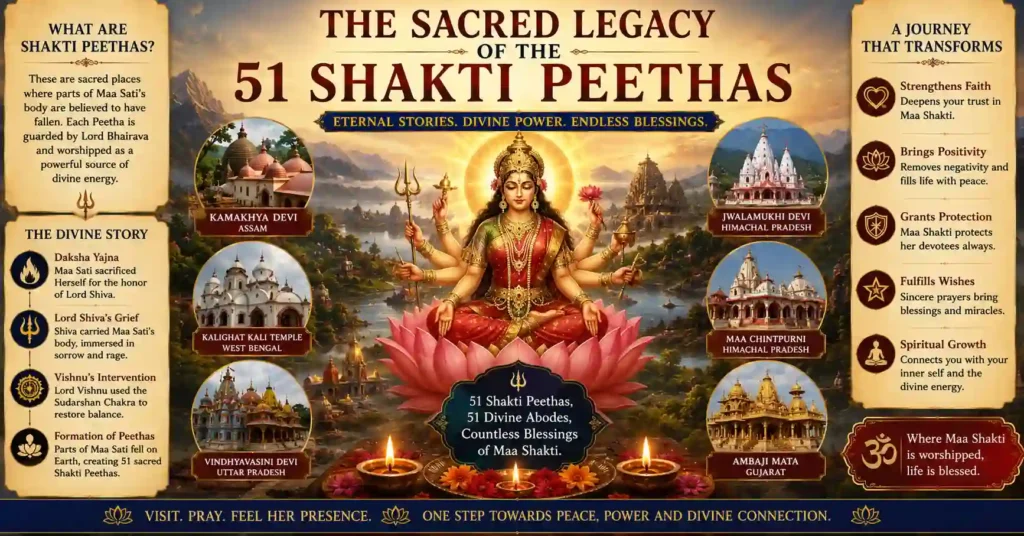
These are the 51 Shakti Peethas, among the holiest pilgrimage sites in Sanatan Dharma. Each Shakti Peetha is believed to mark the place where a part of Maa Sati’s body fell after the tragic events of the Daksha Yajna, making these temples eternal symbols of the Divine Mother.
The story of the 51 Shakti Peethas is not just about sacred temples. It is a timeless journey of love, sacrifice, devotion, and the eternal bond between Maa Sati and Lord Shiva. Every Shakti Peetha represents a unique form of Goddess Shakti and is protected by a corresponding form of Lord Bhairava.
In this complete guide, you will learn the Maa Sati story, how the 51 Shakti Peethas were formed, and why these sacred temples hold such an important place in Sanatan Dharma.
You will discover the difference between the 51, 52, and 108 Shakti Peethas, the role of Lord Bhairava, and the spiritual significance of each sacred site.
This guide also includes the complete Shakti Peeth list, famous Shakti Peethas in India, scriptural references, pilgrimage insights, and the deeper symbolism that continues to inspire millions of devotees.
To truly understand the 51 Shakti Peethas, we must look beyond geography. We must understand the story, the scriptures, the living traditions, and the divine energy that continues to make these sacred temples among the most revered pilgrimage destinations in Sanatan Dharma.
Table of Contents
ToggleHow to Use This Guide
Whether you are a devotee, a pilgrim, or simply curious about the 51 Shakti Peethas, this guide is designed to answer your questions in one place.
You can read it from beginning to end to understand the Maa Sati story, the origin of the 51 Shakti Peethas, their spiritual significance, and the role of Lord Bhairava. If you are looking for specific information, use the table of contents to jump directly to the complete list of Shakti Peethas, pilgrimage guidance, rituals, FAQs, or other sections that interest you.
As you explore this guide, you will also find links to detailed articles on individual temples, helping you continue your spiritual journey and learn more about the sacred traditions of Maa Shakti.
51 Shakti Peethas at a Glance
| Topic | Details |
|---|---|
| Primary Deity | Maa Shakti (Divine Mother) |
| Traditional Origin | Body parts of Maa Sati fell after the Daksha Yajna |
| Most Widely Accepted Number | 51 Shakti Peethas |
| Other Traditional Lists | 52 and 108 Shakti Peethas |
| Associated Deity | Lord Bhairava (Guardian of each Peetha) |
| Main Scriptures | Devi Bhagavata Purana, Kalika Purana, Tantra Chudamani, Pitha Nirnaya |
| Major Festival | Chaitra Navratri and Sharadiya Navratri |
| Countries Where Shakti Peethas Are Found | India, Nepal, Bangladesh, Pakistan and Sri Lanka (according to traditional lists) |
| Best Time to Visit | Throughout the year, especially during Navratri |
What Are the 51 Shakti Peethas?
The 51 Shakti Peethas are among the holiest pilgrimage sites in Sanatan Dharma, dedicated to Maa Shakti, the Divine Mother and the source of all creation. According to sacred traditions, these holy places were formed where different parts of Maa Sati’s body fell on Earth.
Every Shakti Peetha is much more than a temple. Each one is associated with a specific body part of Maa Sati, a unique manifestation of Goddess Shakti, and a corresponding form of Lord Bhairava, who serves as the guardian of the sacred site.
This divine connection makes every Shakti Peetha spiritually unique. Devotees believe that each temple radiates a different form of divine energy, allowing them to experience the blessings of Maa in different ways.
Visiting the Shakti Peethas in India is not just a pilgrimage. Every temple has its own traditions, rituals, architecture, and atmosphere, making each journey a unique spiritual experience.
Some Shakti Peethas enshrine a beautiful idol of the Goddess, while others worship a natural rock, sacred flame, or another divine symbol. This diversity reflects the richness of Shakta traditions and the many ways in which the Divine Mother is worshipped across Bharat.
For millions of devotees, the 51 Shakti Peethas are not merely places of worship. They are living centers of faith where devotion, spiritual energy, and centuries-old traditions continue to inspire seekers from around the world.
The Story of Maa Sati and Lord Shiva
The origin of the 51 Shakti Peethas begins with one of the most emotional and spiritually significant stories in Sanatan Dharma. It is a story of love, devotion, sacrifice, and the eternal bond between Maa Sati and Lord Shiva.
Maa Sati, the daughter of King Daksha Prajapati, chose Lord Shiva as her husband through her unwavering devotion. Although Shiva was one of the supreme deities, Daksha never accepted him because he could not understand Shiva’s simple and ascetic way of life.
Filled with pride, Daksha organized a grand Daksha Yajna and invited all the gods, sages, and celestial beings. However, he deliberately chose not to invite Lord Shiva and Maa Sati as a mark of disrespect.
Despite not receiving an invitation, Maa Sati decided to attend the yajna. She believed that a daughter had the right to visit her father’s home and hoped the misunderstanding between her father and her husband could be resolved.
Instead, she witnessed King Daksha publicly insulting Lord Shiva before the assembled guests. Unable to bear the humiliation of her beloved husband, Maa Sati declared that she could no longer remain connected to a family that dishonoured Mahadev.
In an act of immense sorrow and spiritual resolve, Maa Sati entered the sacred yajna fire and gave up her mortal body. Her sacrifice was not an act of defeat but a profound expression of devotion, self-respect, and divine purpose.
This heartbreaking event shook the heavens and disturbed the balance of the universe. It marked the beginning of a series of divine events that ultimately led to the creation of the 51 Shakti Peethas, the sacred places where the Divine Mother is worshipped even today.
How the 51 Shakti Peethas Were Formed
When Lord Shiva learned of Maa Sati’s sacrifice, he was overwhelmed with grief. Losing his beloved was not just a personal tragedy, it was a sorrow that shook the very foundation of creation.
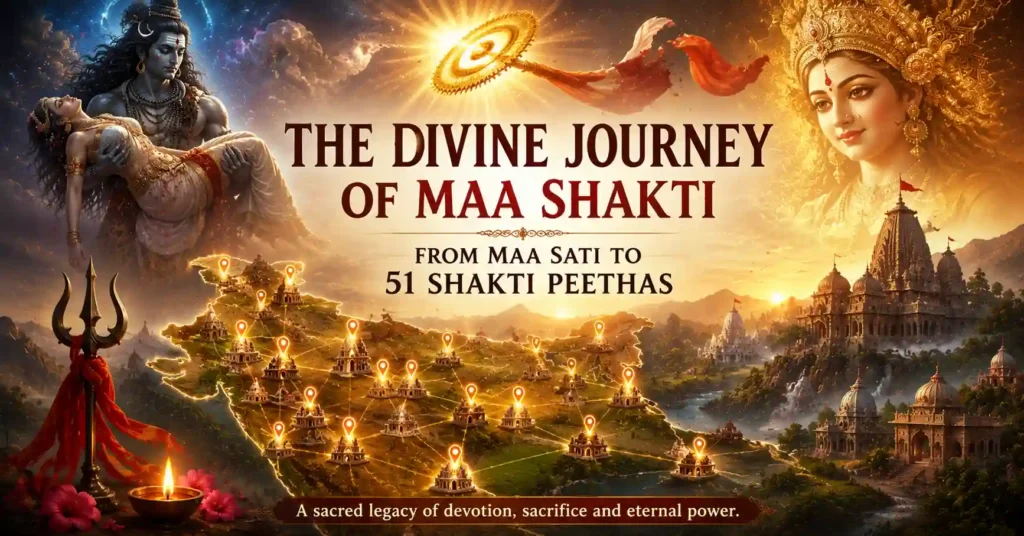
Holding Maa Sati’s lifeless body in his arms, Lord Shiva wandered across the universe in deep anguish. His divine sorrow was so intense that the balance of the cosmos began to collapse, bringing fear to the gods and sages.
To restore harmony, the gods prayed to Lord Vishnu for help. According to Shakta traditions and Puranic accounts, Lord Vishnu used his Sudarshan Chakra to gently separate Maa Sati’s body into different parts. This was not an act of destruction but a compassionate act to restore cosmic balance and ease Lord Shiva’s unbearable grief.
As the body parts of Maa Sati fell at different places across the Indian subcontinent, each location became sanctified by her divine presence. These sacred places came to be known as the 51 Shakti Peethas, where devotees continue to worship the Divine Mother in her many forms.
Each Shakti Peetha is associated with a specific body part of Maa Sati, a unique manifestation of Goddess Shakti, and a corresponding form of Lord Bhairava, who protects the sacred site. This makes every Peetha spiritually distinct and deeply revered.
The 51 Shakti Peethas are therefore not simply ancient temples. They are living centres of divine energy, faith, and devotion, where the presence of Maa Shakti is believed to bless devotees even today.
Lord Bhairava and His Role at the 51 Shakti Peethas
An important yet often overlooked aspect of the 51 Shakti Peethas is the presence of Lord Bhairava. According to Shakta traditions, every Shakti Peetha is accompanied by a corresponding form of Bhairava, who serves as the guardian and protector of that sacred site.
While Maa Shakti represents divine energy, creation, and transformation, Lord Bhairava represents Lord Shiva as the protector, guide, and stabilising force behind that energy. Together, they symbolise the eternal union of Shakti and Shiva, which is one of the fundamental principles of Sanatan Dharma.
For this reason, devotees traditionally offer their prayers to both the Goddess and Bhairava during their pilgrimage. In many traditions, worship of a Shakti Peetha is considered spiritually complete only after paying respects to its associated Bhairava.
Every Shakti Peetha has a unique form of the Goddess as well as a corresponding Bhairava. This sacred pairing reminds devotees that divine energy and divine consciousness are inseparable, working together to sustain balance throughout the universe.
The presence of Lord Bhairava also signifies protection. He is believed to guard the sacred power of each Peetha, remove obstacles from the path of sincere devotees, and preserve the spiritual sanctity of these holy pilgrimage sites.
Why Are the 51 Shakti Peethas Spiritually Powerful?
Every one of the 51 Shakti Peethas is believed to radiate a unique spiritual energy. According to sacred tradition, each Peetha is associated with a different body part of Maa Sati, a distinct form of Goddess Shakti, and a corresponding form of Lord Bhairava.
For this reason, no two Shakti Peethas are exactly alike. The deity, rituals, temple traditions, and spiritual atmosphere vary from one sacred site to another, giving every pilgrimage a unique experience.
Some Shakti Peethas enshrine beautifully crafted idols of the Goddess, while others worship a natural rock, an eternal flame, or another sacred symbol. These different forms reflect the richness and diversity of Shakta traditions across Bharat.
A well-known example is Kamakhya Temple in Assam. Instead of an idol, devotees worship a naturally formed rock believed to represent the creative power of the Divine Feminine. This unique tradition makes Kamakhya one of the most revered Shakti Peethas in India.
The power of the 51 Shakti Peethas does not lie only in their temples or architecture. It lies in the living presence of Maa Shakti, preserved through centuries of faith, worship, and sacred traditions.
For devotees, visiting a Shakti Peetha is more than a pilgrimage. It is an opportunity to experience inner peace, seek the blessings of the Divine Mother, and deepen their spiritual connection with the eternal power of Shakti.
Did You Know?
Every Shakti Peetha is traditionally associated with a specific form of Maa Shakti and a corresponding form of Lord Bhairava.
While the 51 Shakti Peethas are the most widely accepted tradition, some scriptures and regional traditions recognise 52 or 108 Shakti Peethas.
The sacred Peethas are spread across India, Nepal, Bangladesh, Pakistan, and Sri Lanka, reflecting the shared spiritual heritage of the Indian subcontinent.
Some Shakti Peethas worship the Goddess in the form of an idol, while others revere a natural rock, an eternal flame, or a sacred symbol such as the Shri Yantra.
Pilgrims believe that every Shakti Peetha carries a unique spiritual energy because each is associated with a different manifestation of the Divine Mother.
Why Do Some Traditions Mention 51, 52, or 108 Shakti Peethas?
One of the most common questions among devotees is why different traditions mention 51, 52, or even 108 Shakti Peethas. The answer lies in the diversity of Sanatan Dharma, where various scriptures and regional traditions preserve different lists of these sacred sites.
| Tradition | Number of Shakti Peethas |
|---|---|
| Most widely accepted Shakta tradition | 51 |
| Some regional traditions | 52 |
| Expanded devotional traditions | 108 |
The 51 Shakti Peethas are the most widely accepted tradition and are mentioned in several Shakta texts, including the Tantra Chudamani and the Pitha Nirnaya. In these traditions, each Peetha is associated with a specific body part of Maa Sati, a form of Goddess Shakti, and a corresponding Lord Bhairava.
Some regional traditions recognise 52 Shakti Peethas by including an additional sacred site that is revered in a particular region. These differences developed over time through local temple traditions and devotional practices.
The number 108 comes from a broader spiritual tradition in Hinduism. Since 108 is considered a highly auspicious and sacred number, some devotional texts and later traditions expanded the list to include many more temples associated with the worship of the Divine Mother.
These variations do not contradict one another. They reflect the richness and diversity of Shakta traditions across Bharat, where different communities have preserved their own sacred heritage while honouring the same Divine Mother.
Whether a devotee follows the tradition of 51, 52, or 108 Shakti Peethas, the spiritual message remains unchanged. Every Shakti Peetha is a sacred place where devotees seek the blessings of Maa Shakti, experience her divine presence, and strengthen their spiritual connection with the Divine Mother.
Scriptural References to the 51 Shakti Peethas
The tradition of the 51 Shakti Peethas is preserved through several revered scriptures and sacred texts within the Shakta tradition of Sanatan Dharma. While the names and locations of a few Peethas may differ across these sources, they all honour the Divine Mother and the sacred story of Maa Sati.
Among the most important texts are the Tantra Chudamani and Pitha Nirnaya, which describe the Shakti Peethas along with their associated forms of Maa Shakti and Lord Bhairava. References to the glory of the Divine Mother and her sacred places are also found in the Devi Bhagavata Purana and the Kalika Purana.
These scriptures are not merely historical records. For devotees, they preserve centuries of spiritual wisdom, temple traditions, and the living heritage of Shakti worship that continues to inspire millions even today.
Are the 51 Shakti Peethas Mentioned in the Ramayana or Mahabharata?
The 51 Shakti Peethas are primarily described in Shakta scriptures and later Puranic literature rather than in the Ramayana or the Mahabharata. The most detailed traditional references are found in texts such as the Tantra Chudamani, Pitha Nirnaya, Devi Bhagavata Purana, and Kalika Purana.
Although the Ramayana and Mahabharata honour the Divine Mother in different forms, they do not present the complete tradition of the 51 Shakti Peethas as it is understood today. Over time, temple traditions, regional beliefs, and Shakta literature helped preserve and expand this sacred pilgrimage tradition.
For devotees, the importance of the 51 Shakti Peethas comes not only from ancient scriptures but also from centuries of uninterrupted worship, living traditions, and the deep faith associated with these sacred places.
Complete List of the 51 Shakti Peethas
The 51 Shakti Peethas are spread across India and neighbouring countries. According to Shakta traditions, each sacred site is associated with a specific body part of Maa Sati, a unique manifestation of Maa Shakti, and a corresponding form of Lord Bhairava.
Although different scriptures and regional traditions preserve slight variations in the names and locations of a few Peethas, the following list represents one of the most widely accepted traditional enumerations. Every Shakti Peetha has its own history, temple traditions, and spiritual significance, making each one a unique destination for devotees.
The table below provides an overview of the 51 Shakti Peethas and their locations. Dedicated articles on individual temples are gradually being added to The Sanatan Tales to help devotees explore their history, legends, rituals, festivals, and pilgrimage information in greater detail.
Complete List of the 51 Shakti Peethas
The table below provides an overview of the 51 Shakti Peethas and their locations. Dedicated articles on individual temples are gradually being added to The Sanatan Tales to help devotees explore their history, legends, rituals, festivals, and pilgrimage information in greater detail.
| Location | Shakti Peeth | Why It Is Famous |
|---|---|---|
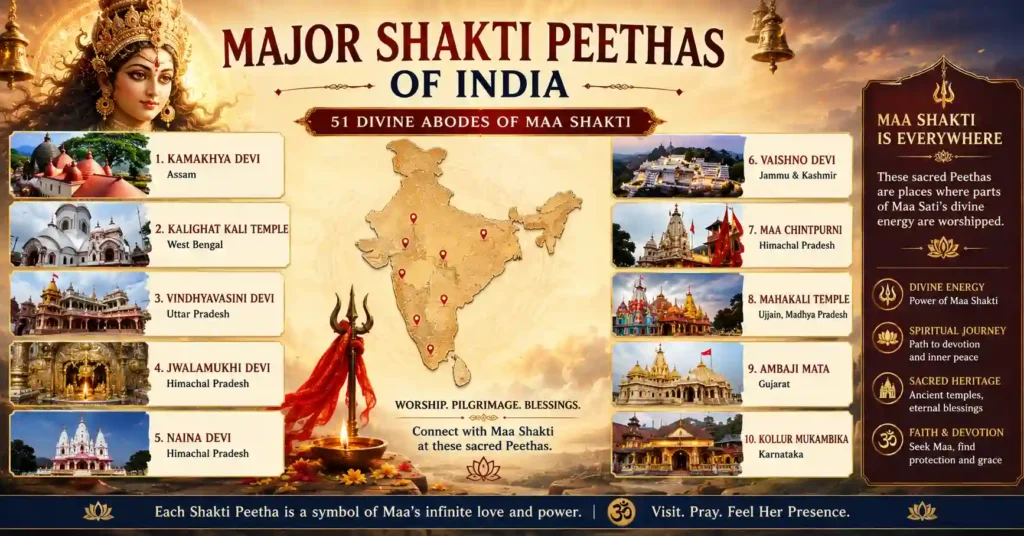
| Assam, India | Kamakhya Temple | One of the most revered Shakti Peethas, famous for Ambubachi Mela and worship of the Divine Mother in a natural form. |
| Gujarat, India | Ambaji Temple | Sacred Shri Yantra is worshipped instead of an idol. |
| Himachal Pradesh, India | Jwala Ji Temple | Worship of the eternal natural flames representing Maa Shakti. |
| West Bengal, India | Kalighat Temple | One of the oldest and most revered temples dedicated to Maa Kali. |
| Tamil Nadu, India | Kamakshi Amman Temple, Kanchipuram | Ancient centre of Shakta worship and Sri Vidya tradition. |
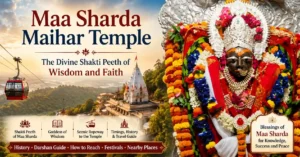
| Madhya Pradesh, India | Maihar Sharda Devi Temple | Revered hilltop shrine associated with Maa Sharda. |
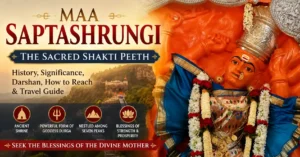
| Maharashtra, India | Saptashrungi Temple | Sacred mountain temple dedicated to Goddess Saptashrungi. |
| Odisha, India | Biraja Temple | Ancient Siddha Peetha dedicated to Goddess Biraja. |
| Andhra Pradesh, India | Draksharamam (Manikyamba Temple) | Revered Shakti Peetha associated with Goddess Manikyamba. |
| Uttar Pradesh, India | Vindhyavasini Devi Temple | One of the most important centres of Shakti worship in North India. |
| Jammu & Kashmir, India | Sharada Peeth (traditional location) | Ancient seat of learning and worship of Goddess Sharada. |
| Bihar, India | Mangala Gauri Temple | Famous Siddha Peetha associated with Maa Mangala Gauri. |
| Tripura, India | Tripura Sundari Temple | One of the most important temples dedicated to Tripura Sundari. |
| Haryana, India | Sthaneshwar region (Bhadrakali Temple tradition) | Revered regional Shakti tradition associated with Maa Bhadrakali. |
| Chhattisgarh, India | Danteshwari Temple | Ancient temple deeply revered in central India. |
| Jharkhand, India | Chhinnamastika Temple (Rajrappa) | Famous for the worship of Goddess Chhinnamasta. |
| Maharashtra, India | Mahalakshmi Temple, Kolhapur | Revered shrine of Goddess Mahalakshmi in Shakta tradition. |
| Himachal Pradesh, India | Naina Devi Temple | One of the most visited Shakti temples in North India. |
| Himachal Pradesh, India | Chintpurni Temple | Revered Siddha Peetha dedicated to Maa Chintpurni. |
| Himachal Pradesh, India | Brajeshwari Devi Temple | Ancient temple associated with Goddess Vajreshwari. |
| Nepal | Guhyeshwari Temple | Sacred temple closely associated with Pashupatinath and Shakta worship. |
| Bangladesh | Jessoreswari Temple | One of the most important Shakti Peethas in Bangladesh. |
| Bangladesh | Sugandha Shakti Peeth | Ancient Peetha associated with Goddess Sunanda. |
| Bangladesh | Chandranath Temple | Revered Shakti shrine on Chandranath Hill. |
| Bangladesh | Bhabanipur Shakti Peeth | Important Peetha dedicated to Goddess Aparna. |
| Pakistan | Hinglaj Mata Temple | One of the oldest and most revered Shakti Peethas, located in Balochistan. |
| Sri Lanka | Shankari Devi Temple (traditional location) | Revered southern Shakti Peetha associated with Goddess Shankari. |
| Tibet (traditional) | Manasarovar Shakti Peeth | Sacred Himalayan pilgrimage associated with Maa Dakshayani. |
| Odisha, India | Tara Tarini Temple | One of the oldest centres of Goddess worship in eastern India. |
| West Bengal, India | Attahas Shakti Peeth | Associated with the divine smile (lips) of Maa Sati. |
| West Bengal, India | Kankalitala Temple | Ancient Shakti Peetha associated with the skeletal remains of Maa Sati. |
| West Bengal, India | Nandikeshwari Temple | Revered temple dedicated to Goddess Nandini. |
| West Bengal, India | Bahula Temple | Ancient Peetha dedicated to Goddess Bahula. |
| West Bengal, India | Nalateshwari Temple | Sacred temple associated with the throat of Maa Sati. |
| West Bengal, India | Ratnavali Shakti Peeth | Revered traditional Peetha dedicated to Goddess Kumari. |
| West Bengal, India | Bakreshwar Temple | Sacred Peetha known for its hot springs and Shiva temple. |
| West Bengal, India | Kiriteswari Temple | Ancient temple associated with the crown (kirita) of Maa Sati. |
| Odisha, India | Vimala Temple, Puri | Sacred Shakti shrine within the Jagannath Temple complex. |
| Maharashtra, India | Tulja Bhavani Temple (traditional association) | Revered temple of Goddess Bhavani with deep historical significance. |
| Karnataka, India | Chamundeshwari Temple (traditional association) | Famous hilltop temple dedicated to Goddess Chamundeshwari. |
| Telangana, India | Jogulamba Temple | One of the eighteen Maha Shakti Peethas and an important Shakta shrine. |
| Andhra Pradesh, India | Srisailam (Bhramaramba Temple) | Revered temple where Shakti and Shiva are worshipped together. |
| Kerala, India | Kodungallur Bhagavathy Temple (traditional association) | Ancient temple dedicated to Goddess Bhagavathy. |
| Uttar Pradesh, India | Lalita Devi Temple, Prayagraj | Sacred temple associated with Goddess Lalita. |
| Uttarakhand, India | Purnagiri Temple | One of the most visited Shakti pilgrimage sites in North India. |
| Rajasthan, India | Savitri Temple, Pushkar (regional tradition) | Revered temple connected with Goddess Savitri. |
| Bihar, India | Patan Devi Temple | Ancient Shakti shrine in Patna. |
| Gujarat, India | Bahucharaji Temple (regional tradition) | Revered temple dedicated to Goddess Bahuchara Mata. |
| Nepal | Dakshinkali Temple (regional tradition) | Famous temple dedicated to Goddess Kali. |
| Bangladesh | Karatoya Tat Shakti Peeth | Traditional Peetha associated with Goddess Aparna. |
| Pakistan | Shivaharkaray Shakti Peeth (traditional location) | Ancient Shakti Peetha preserved in traditional lists. |
Every Shakti Peetha has its own sacred story, unique traditions, and spiritual significance. While this table provides a helpful overview of the 51 Shakti Peethas, the true essence of each sacred site is best understood through its history, rituals, festivals, and the faith of the devotees who worship there.
For millions of pilgrims, these temples are far more than places on a map. They are living centres of Maa Shakti’s divine presence, where generations of devotees have sought blessings, strength, protection, and inner peace.
As you explore the 51 Shakti Peethas, you will discover that each one offers a unique spiritual experience while carrying the same eternal message: the Divine Mother is present wherever devotion is sincere and the heart is filled with faith.
Can All 51 Shakti Peethas Be Visited Today?
Many devotees dream of visiting all 51 Shakti Peethas, but this is not always possible. While most sacred sites are located in India, several traditional Shakti Peethas are situated in present-day Nepal, Bangladesh, Pakistan, and Sri Lanka, according to widely accepted traditional lists.
International borders, travel regulations, and local conditions may make it difficult to visit every Peetha. For this reason, many devotees choose to undertake pilgrimages to the temples that are accessible while remembering the others through prayer and devotion.
In Sanatan Dharma, the true spirit of a pilgrimage lies in faith rather than the number of temples visited. Whether you visit one Shakti Peetha or many, sincere devotion to Maa Shakti is believed to be the greatest offering.
Why Do Devotees Visit the 51 Shakti Peethas?
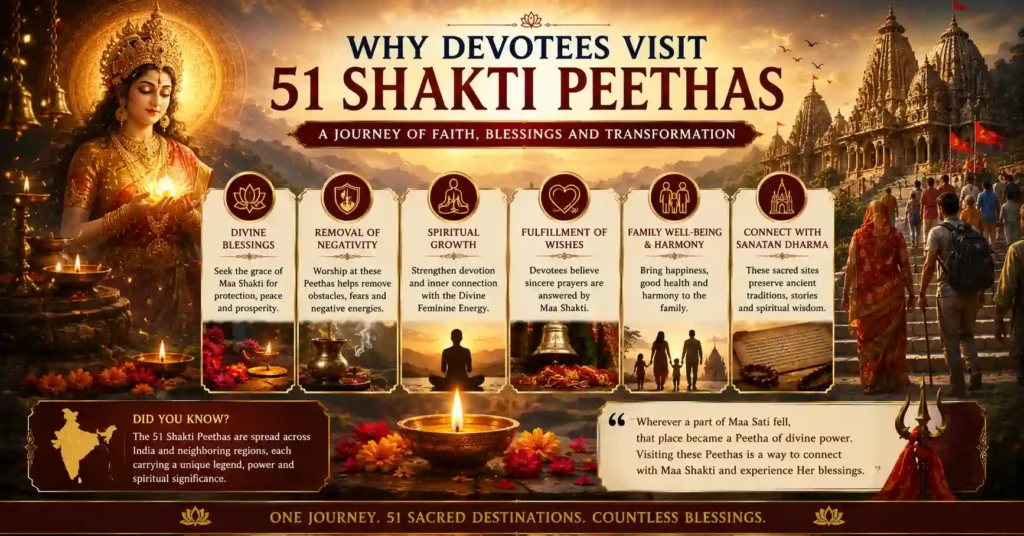
Devotees visit the 51 Shakti Peethas not as tourists, but as pilgrims seeking the blessings of Maa Shakti. For many, the journey is an act of faith, surrender, and devotion rather than simply visiting a sacred temple.
Some devotees pray for strength during difficult times, while others seek peace, protection, good health, or spiritual guidance. Many undertake this pilgrimage to express gratitude after their prayers have been answered.
It is widely believed that the Divine Mother listens with special compassion at these sacred places. This deep faith draws millions of devotees to the Shakti Peethas every year, regardless of age or background.
The pilgrimage itself is considered a form of worship. Every step taken towards a Shakti Peetha becomes an offering of devotion, reminding pilgrims that the spiritual journey is often as meaningful as reaching the destination.
Whether a devotee visits one temple or aspires to seek the blessings of all the 51 Shakti Peethas, the experience is believed to strengthen faith, bring inner peace, and deepen one’s connection with the Divine Mother.
Many devotees also undertake the pilgrimage to fulfil a personal vow (Mannat) or to express gratitude after their prayers have been answered. Offering a chunri, coconut, sweets, or simply bowing before the Goddess with a sincere heart are among the common expressions of devotion at many Shakti Peethas.
Some pilgrims aspire to visit all 51 Shakti Peethas over the course of their lives. While completing such a pilgrimage is considered highly auspicious, Sanatan Dharma teaches that the sincerity of one’s devotion is more important than the number of temples visited. Even a single visit made with faith is believed to invite the blessings of Maa Shakti.
Planning a Pilgrimage to the 51 Shakti Peethas
Visiting all 51 Shakti Peethas is a lifelong spiritual aspiration for many devotees. Since these sacred sites are spread across different states of India and neighbouring countries, most pilgrims visit them over several journeys rather than attempting them all at once.
Many devotees begin their pilgrimage with the Shakti Peethas closest to their home or include them as part of a larger temple yatra. Others choose to visit famous temples such as Kamakhya, Ambaji, Kalighat, Jwala Ji, or Kamakshi Amman Temple before exploring lesser-known Peethas.
Before planning your journey, check the temple timings, local weather, accommodation options, and festival dates. Visiting during Navratri offers a unique spiritual experience, although the temples are often more crowded during this period.
Above all, approach the pilgrimage with humility, patience, and devotion. While every temple has its own customs and traditions, sincere faith remains the most meaningful offering that a devotee can bring to the Divine Mother.
The Deeper Spiritual Meaning of the 51 Shakti Peethas
The true meaning of the 51 Shakti Peethas goes far beyond their physical locations. These sacred sites remind us that the Divine Mother is not confined to a single temple or place, but is present throughout creation.
According to Sanatan Dharma, Maa Shakti is the universal energy that sustains life. The story of Maa Sati teaches that her divine presence continues wherever her sacred energy is remembered and worshipped with faith.
The 51 Shakti Peethas also symbolise that the Divine Mother exists not only in temples but in nature, in every living being, and within our own hearts. This understanding transforms devotion from an external ritual into an inner spiritual journey.
In Shakta philosophy, Shakti represents divine energy, while Shiva represents pure consciousness. Together, they remind us that creation, balance, and spiritual awakening are possible only when energy and consciousness exist in harmony.
For devotees, visiting a Shakti Peetha is not only about seeking blessings. It is also an opportunity to awaken devotion, cultivate inner strength, and experience the presence of Maa Shakti in everyday life.
When we understand this deeper meaning, the 51 Shakti Peethas become more than sacred pilgrimage sites. They become timeless reminders that the Divine Mother is always with us, guiding, protecting, and inspiring every sincere seeker.
Rituals and Traditions at the 51 Shakti Peethas
Although all 51 Shakti Peethas are dedicated to Maa Shakti, the rituals and traditions followed at each temple are unique. These customs have evolved over centuries through local traditions, temple practices, and different schools of Shakta worship.
Most Shakti Peethas begin the day with Mangala Aarti, followed by daily puja, chanting of sacred mantras, flower offerings, and devotional prayers. Devotees also offer coconuts, red chunri, sindoor, fruits, and sweets as symbols of their faith and gratitude.
During Navratri, the temples witness their largest gatherings of devotees. Special pujas, havans, cultural programmes, and devotional singing are organised, creating a deeply spiritual atmosphere throughout the festival.
Some Shakti Peethas, such as Kamakhya Temple, are closely associated with Tantric traditions. These ancient practices focus on the worship of the Divine Mother through symbolic rituals and are followed only within specific traditions under the guidance of qualified gurus. They should not be confused with the daily worship performed by most devotees.
Every Shakti Peetha preserves its own customs, festivals, and methods of worship. This beautiful diversity reflects the richness of Sanatan Dharma, where different traditions honour the same Divine Mother while preserving their unique spiritual heritage.
Can You Connect with Maa Shakti Without Visiting the 51 Shakti Peethas?
Not everyone has the opportunity to visit the 51 Shakti Peethas or undertake a sacred pilgrimage. But in Sanatan Dharma, true devotion has never depended on distance or location.
You can remember Maa Shakti, offer a simple prayer, chant her name, or spend a few moments in silent meditation. Even the smallest act of sincere devotion can strengthen your connection with the Divine Mother.
The 51 Shakti Peethas remind us of Maa’s divine presence across the world, but her grace is not limited to these sacred places. She is believed to reside in every heart that remembers her with faith and love.
Whether you worship in a temple, at your home, or in the quietness of your heart, Maa Shakti is always near. True devotion begins within, and every sincere prayer reaches the Divine Mother.
A Simple Way to Feel Maa Shakti's Presence
You don’t need a complex ritual or an elaborate ceremony to connect with Maa Shakti. A sincere heart and a few moments of devotion are often enough.
Light a diya and sit quietly for a few moments. Close your eyes and remember Maa, not only as the Divine Mother but also as a loving presence who is always watching over you.
Do not worry about saying the perfect prayer. Do not feel any pressure or expectation. Simply sit with faith and allow your heart to speak in its own way.
As your thoughts become calm, you may begin to experience a quiet sense of peace, warmth, and reassurance. Many devotees believe this gentle feeling is the compassionate presence of Maa Shakti blessing their hearts.
Whether or not you have visited the 51 Shakti Peethas, remember that the Divine Mother is never far away. She is present in your prayers, in your faith, and in every sincere act of devotion.
When you call upon Maa with love and humility, every place can become a sacred space, and every moment can become an opportunity to feel her divine grace.
Conclusion
The 51 Shakti Peethas are far more than sacred pilgrimage sites. They are timeless symbols of Maa Sati’s love, sacrifice, and the eternal presence of Maa Shakti in Sanatan Dharma.
Through this guide, we have explored the Maa Sati story, the origin of the 51 Shakti Peethas, their spiritual significance, the role of Lord Bhairava, and the traditions that continue to keep these sacred places alive for millions of devotees.
Yet the greatest message of the Shakti Peethas is that the Divine Mother is not limited to temples or sacred geography. Her presence can be experienced wherever there is faith, devotion, compassion, and a sincere heart.
Whether you undertake a pilgrimage to the 51 Shakti Peethas or remember Maa from your own home, her blessings are always within reach. Every prayer offered with love becomes a step closer to the Divine Mother.
Maa is not only found in sacred temples. She lives in your faith, your awareness, your silence, and your heart.
Key Takeaways
- The 51 Shakti Peethas are among the holiest pilgrimage sites dedicated to Maa Shakti in Sanatan Dharma.
- According to sacred tradition, these Peethas were formed where different parts of Maa Sati’s body fell after the Daksha Yajna.
- Every Shakti Peetha is associated with a unique form of the Goddess and a corresponding form of Lord Bhairava, symbolising the eternal union of Shakti and Shiva.
- Different scriptures and regional traditions mention 51, 52, or 108 Shakti Peethas, but all honour the Divine Mother and her sacred presence.
- Visiting a Shakti Peetha is regarded as a spiritual journey of faith, devotion, and inner transformation rather than simply a temple visit.
- Whether you visit these sacred temples or worship from your home, sincere devotion remains the true path to experiencing the grace of Maa Shakti.
Continue Your Journey into Shakti Worship
If this guide on the 51 Shakti Peethas has deepened your devotion to Maa Shakti, continue your spiritual journey with these carefully selected articles.
Explore the many forms of the Divine Mother, her sacred temples, the Das Mahavidya, and the timeless wisdom of Sanatan Dharma to deepen your understanding of Shakti worship and its rich traditions.
Maa Durga: Meaning, Story, Navadurga, Worship and Spiritual Significance
https://thesanatantales.com/maa-durga-meaning-story-navadurga-worship/
Regional Forms of Maa Durga in India: Traditions, Temples and Beliefs
https://thesanatantales.com/regional-forms-of-maa-durga/
Nine Forms of Maa Durga and Their Divine Powers
https://thesanatantales.com/nine-forms-of-maa-durga-and-their-divine-powers/
Das Mahavidya: Meaning, Origin, 10 Goddesses, Temples and Spiritual Significance
https://thesanatantales.com/das-mahavidya/
Maa Kali: Origin, Story, Meaning, Power and the Truth Behind Her Fierce Form
https://thesanatantales.com/maa-kali-origin-story-meaning-power/
Maa Tara: Meaning, Story, Mahavidya, Tarapith, Mantra and Worship
https://thesanatantales.com/maa-tara-meaning-story-benefits/
Maa Tripura Sundari: The Beauty of the Three Worlds
https://thesanatantales.com/maa-tripura-sundari-the-beauty-of-the-three-worlds/
Maa Bhuvaneshwari: The Mahavidya Who Holds the Universe
https://thesanatantales.com/maa-bhuvaneshwari/
Vindhyavasini Devi: The Goddess Who Always Resides
https://thesanatantales.com/vindhyavasini-devi/
Shakta Pithas (Wikipedia)
https://en.wikipedia.org/wiki/Shakta_pithas
Share this article with your family and friends who wish to learn about the sacred 51 Shakti Peethas and the glory of Maa Shakti.
FAQs
What are the 51 Shakti Peethas?
The 51 Shakti Peethas are among the holiest pilgrimage sites dedicated to Maa Shakti in Sanatan Dharma. According to sacred traditions, these temples mark the places where different parts of Maa Sati’s body fell after Lord Vishnu used the Sudarshan Chakra to restore cosmic balance. Each Shakti Peetha is associated with a unique form of the Goddess and a corresponding form of Lord Bhairava, making every temple spiritually distinct.
Why are there 51, 52, and 108 Shakti Peethas in different traditions?
Different scriptures and regional traditions preserve different lists of Shakti Peethas. The 51 Shakti Peethas are the most widely accepted in Shakta traditions. Some regional traditions include one additional shrine and recognise 52 Shakti Peethas, while later devotional traditions expand the list to 108, a sacred number in Hinduism. Although the numbers differ, all traditions honour the Divine Mother and her sacred presence.
Which scripture mentions the 51 Shakti Peethas?
The 51 Shakti Peethas are described in several traditional Shakta texts, including the Tantra Chudamani, Pitha Nirnaya, and references found in the Devi Bhagavata Purana and Kalika Purana. These texts preserve different traditions regarding the names and locations of the Peethas, which is why slight variations exist across regions and lineages.
Which is the most powerful Shakti Peetha?
Every Shakti Peetha is considered equally sacred because each represents the divine presence of Maa Shakti. However, temples such as Kamakhya, Kalighat, Jwala Ji, Ambaji, and Hinglaj Mata are especially revered due to their ancient history, unique traditions, and importance within Shakta worship. Devotees often choose a temple based on their family tradition, faith, or spiritual calling.
Is Vaishno Devi one of the 51 Shakti Peethas?
Vaishno Devi is one of the most revered temples dedicated to the Divine Mother and attracts millions of pilgrims every year. However, it is not traditionally included in most classical lists of the 51 Shakti Peethas. Despite this distinction, it remains one of the most important Shakti pilgrimage destinations in India.
Why does every Shakti Peetha have a Bhairava?
According to Shakta traditions, every Shakti Peetha is accompanied by a corresponding form of Lord Bhairava, who represents Lord Shiva as the guardian of the sacred site. While Maa Shakti symbolises divine energy, Bhairava represents protection, stability, and pure consciousness. Together, they express the inseparable unity of Shiva and Shakti.
Can I worship Maa Shakti at home without visiting the 51 Shakti Peethas?
Yes. Sanatan Dharma teaches that sincere devotion is more important than physical distance. Although visiting the 51 Shakti Peethas is considered highly auspicious, devotees can worship Maa Shakti at home through prayer, mantra chanting, meditation, or simple offerings. The Divine Mother is believed to bless every sincere devotee, regardless of where they worship.
Which are the most famous Shakti Peethas in India?
Some of the most visited Shakti Peethas in India include Kamakhya Temple in Assam, Kalighat Temple in West Bengal, Jwala Ji Temple in Himachal Pradesh, Ambaji Temple in Gujarat, and Kamakshi Amman Temple in Tamil Nadu. Each temple has its own history, traditions, and unique form of worship dedicated to Maa Shakti.
What is the spiritual significance of the 51 Shakti Peethas?
The 51 Shakti Peethas symbolise the eternal presence of the Divine Mother across creation. Beyond being sacred pilgrimage sites, they remind devotees that Maa Shakti is the source of strength, compassion, wisdom, and transformation. Visiting these temples is believed to deepen faith, inspire inner peace, and strengthen one’s spiritual connection with the Divine Mother.
Are all 51 Shakti Peethas located in India?
No. While many of the 51 Shakti Peethas are located in India, several are situated in present-day Bangladesh, Nepal, Pakistan, and Sri Lanka, according to different traditional lists. These sacred sites reflect the shared spiritual heritage of the Indian subcontinent and continue to be revered by devotees across the world.
What is the best time to visit the 51 Shakti Peethas?
The 51 Shakti Peethas can be visited throughout the year, but festivals such as Chaitra Navratri and Sharadiya Navratri are considered especially auspicious. During these periods, temples are beautifully decorated, special rituals are performed, and thousands of devotees gather to seek the blessings of Maa Shakti.
What should devotees keep in mind while visiting a Shakti Peetha?
When visiting a Shakti Peetha, devotees should dress modestly, respect temple customs, maintain cleanliness, and follow the instructions of the temple authorities. It is also important to remember that every temple follows its own traditions and rituals. Visiting with humility, patience, and devotion is considered the most meaningful offering to Maa Shakti.
Glossary of Important Terms
| Term | Meaning |
|---|---|
| 51 Shakti Peethas | The most widely accepted sacred sites where different parts of Maa Sati’s body are believed to have fallen after the Daksha Yajna. |
| Shakti Peetha | A sacred seat of Goddess Shakti. Each Peetha represents a unique manifestation of the Divine Mother and is associated with a specific body part of Maa Sati. |
| Maa Shakti | The Divine Mother and the supreme feminine energy in Sanatan Dharma, regarded as the source of creation, preservation, and transformation. |
| Maa Sati | The first consort of Lord Shiva, whose self-sacrifice during the Daksha Yajna led to the origin of the Shakti Peethas. |
| Lord Shiva | One of the principal deities of Sanatan Dharma. He is the eternal consort of Maa Shakti and is worshipped as the Supreme Yogi and the embodiment of pure consciousness. |
| Lord Bhairava | A fierce and protective form of Lord Shiva. Every Shakti Peetha has a corresponding Bhairava who is believed to guard the sacred site. |
| Daksha Yajna | A grand sacrificial ritual performed by King Daksha, where Lord Shiva was deliberately insulted. This event led to Maa Sati’s self-sacrifice and the creation of the Shakti Peethas. |
| Sudarshan Chakra | The divine discus of Lord Vishnu. According to tradition, it was used to separate Maa Sati’s body to restore cosmic balance after her sacrifice. |
| Shakta Tradition | A major tradition within Sanatan Dharma that worships Goddess Shakti as the Supreme Divine Reality. |
| Divine Mother | A respectful name for Goddess Shakti, who is worshipped as the universal mother and source of all existence. |
| Pilgrimage (Tirtha Yatra) | A sacred journey undertaken by devotees to visit holy places such as the 51 Shakti Peethas for worship, blessings, and spiritual growth. |
| Navratri | A nine-night Hindu festival dedicated to the worship of Maa Durga and her various forms, celebrated with special devotion at many Shakti Peethas. |
| Tantra | An ancient spiritual tradition that includes specific methods of worship, meditation, and rituals. Some Shakti Peethas, such as Kamakhya, are associated with Tantric practices. |
| Sanatan Dharma | The eternal spiritual tradition commonly known as Hinduism, encompassing diverse philosophies, scriptures, rituals, and paths to spiritual realization. |
| Ambubachi Mela | An annual festival celebrated at Kamakhya Temple in Assam, symbolizing the creative and regenerative power of the Divine Mother. |
About the Author
Published:
March 27, 2026
Last Updated:
July 2026
Yateendra Chaturvedi is a spiritual writer, researcher, devotee, and the founder of The Sanatan Tales. With over 35 years of professional experience and a lifelong interest in Sanatan Dharma, he writes about Hindu deities, temples, scriptures, festivals, Mahavidyas, sacred stories, rituals, and living traditions that continue to guide and inspire devotees across India.
Drawing from traditional scriptures, regional beliefs, temple traditions, devotional literature, and historical sources, he aims to present authentic, well-researched, and easy-to-understand content for modern readers. His work focuses on preserving spiritual wisdom, explaining sacred traditions, and helping seekers develop a deeper understanding of India’s rich spiritual heritage.
Through The Sanatan Tales, Yateendra strives to make the timeless teachings of Sanatan Dharma simple, meaningful, and relevant for today’s generation while maintaining respect for traditional sources, regional practices, and diverse spiritual perspectives.
Learn More About Yateendra Chaturvedi →
https://thesanatantales.com/about-the-author/
References & Sources
This article is based on the beliefs, traditions, and devotional practices followed within the Shakta tradition of Sanatan Dharma, along with traditional knowledge associated with Maa Shakti, the 51 Shakti Peethas, and the sacred story of Maa Sati.
It also draws upon widely accepted interpretations found in revered Hindu scriptures, including the Devi Bhagavata Purana, Kalika Purana, Tantra Chudamani, Pitha Nirnaya, and other traditional religious and spiritual study sources.
Some insights are also inspired by temple traditions, regional customs, and teachings preserved through the guru-disciple (Guru-Shishya) tradition.
Note: The number, location, and traditions associated with the Shakti Peethas may vary across different scriptures, regions, and lineages within Sanatan Dharma. Beliefs, rituals, and methods of worship can also differ among temples and Shakta traditions.
The purpose of this article is not to present any single tradition as the absolute truth, but to explain widely accepted religious, historical, and spiritual perspectives in a simple, respectful, and accessible manner.
Explore More Fascinating Topics from Sanatan Dharma