There are moments in life when comfort is not enough. When familiar answers stop working, hidden fears rise to the surface, and we are forced to face parts of ourselves we would rather avoid.
It is in such moments that many devotees turn toward Maa Chamunda. Unlike the gentle forms of the Divine Mother, Maa Chamunda appears fierce, uncompromising, and intensely transformative.
Yet beneath that fearsome appearance lies a profound compassion. She destroys not to punish, but to remove what stands between the seeker and truth.
Known for slaying the demons Chanda and Munda, Maa Chamunda is far more than a mythological warrior. In Shakta tradition, she represents the power that confronts illusion, dissolves negativity, and awakens inner strength.
For generations, devotees have worshipped her as a protector, a liberator, and a manifestation of Divine Shakti whose presence remains deeply woven into scripture, Tantra, temple traditions, and living faith across India.
Table of Contents
ToggleWho Is Maa Chamunda in Shakta Tradition
Maa Chamunda is a powerful form of the Divine Mother, most closely associated with Maa Durga and Maa Kali. She is best known from the Durga Saptashati (Devi Mahatmya), where she appears during the battle against the forces of Shumbha and Nishumbha.
Her name comes from the demons Chanda and Munda, whom she destroys during this sacred narrative. For this reason, she is known as Chamunda, the goddess who overcomes destructive and unrighteous forces.
Because her appearance is described in the Devi Mahatmya, Maa Chamunda occupies an important place within the scriptural tradition of Shaktism and is far more than a symbolic or folk deity.
In deeper Shakta understanding, Chanda and Munda are often seen as representing aggression, ego, and inner distortion. Maa Chamunda therefore symbolizes the power that removes these tendencies and guides the seeker toward clarity and truth.
She is revered as a fierce yet compassionate form of Shakti, worshipped as a protector, liberator, and source of spiritual strength by devotees across India.
Traditional Textual Sources of Maa Chamunda
Maa Chamunda appears in several important Shakta scriptures and traditions. Her most well-known scriptural appearance is in the Devi Mahatmya (Durga Saptashati), where she emerges during the battle against the demons Chanda and Munda and receives the name Chamunda after their destruction.
Over time, her worship became closely associated with Saptamatrika traditions, Tantric lineages, and Yogini traditions, where she is revered as a fierce manifestation of the Divine Mother.
Because these traditions developed through different regions and spiritual schools, descriptions of Maa Chamunda may vary in symbolism and practice.
Yet across these traditions, she remains recognized as a powerful form of Shakti associated with protection, transformation, and liberation.
The Deeper Story of Chamunda From Devi Mahatmya
According to the Devi Mahatmya, when the demons Chanda and Munda attacked Goddess Ambika, a fierce form emerged from her forehead.
Dark, powerful, and unstoppable, she destroyed the demonic armies, slew both demons, and presented their heads to the Goddess. It was after this victory that she came to be known as Chamunda.
Beyond the outer narrative, many spiritual traditions see a deeper symbolism within this story. Chanda is often associated with uncontrolled aggression, while Munda represents cunning, deception, and distorted thinking.
In this interpretation, Maa Chamunda does not merely destroy external enemies. She represents the power that removes these tendencies within the seeker.
Her victory symbolizes the transformation of anger, ego, and inner conflict into greater awareness, discipline, and spiritual strength.
Iconography and Symbolic Meaning
Maa Chamunda’s form is intentionally fierce. It is not designed to inspire fear but to reveal deeper spiritual truths.
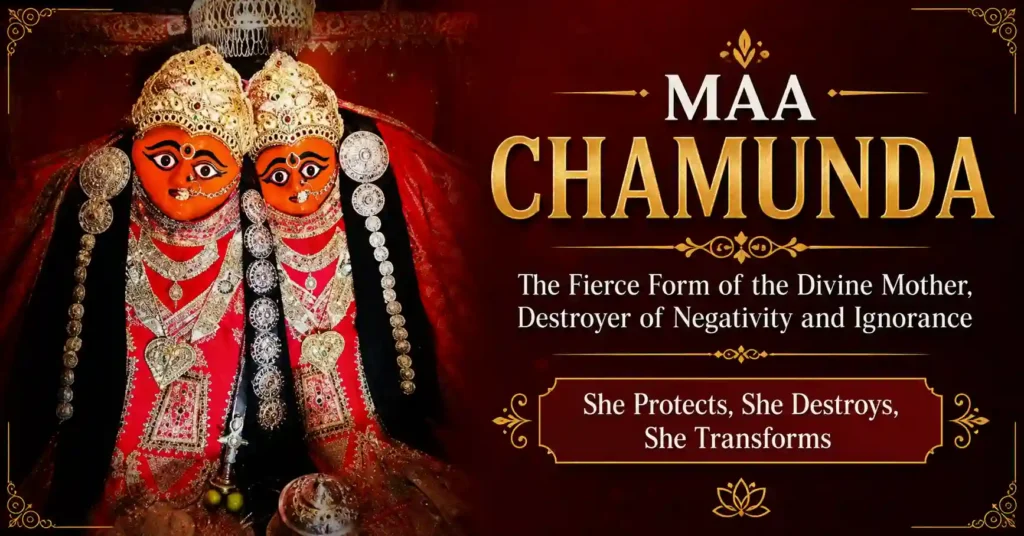
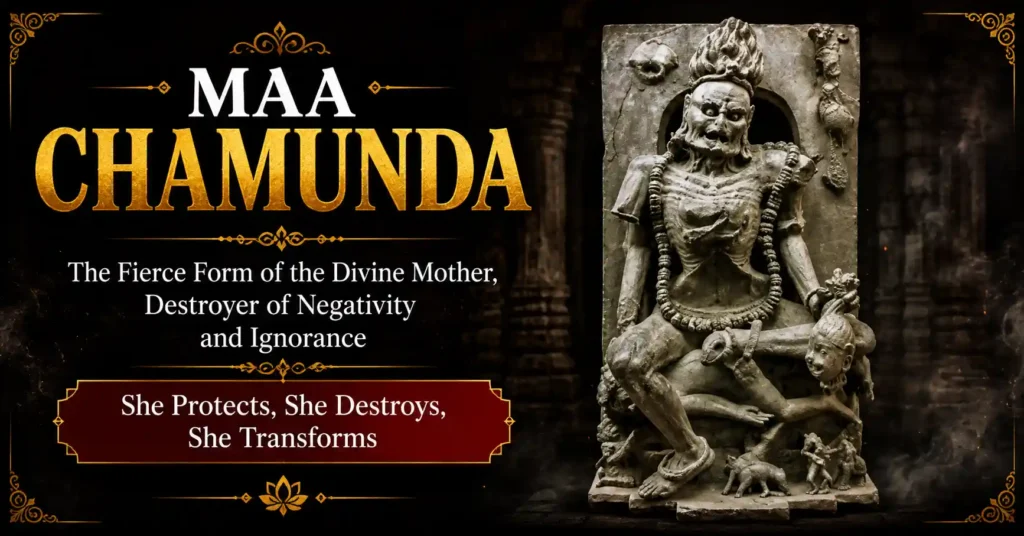
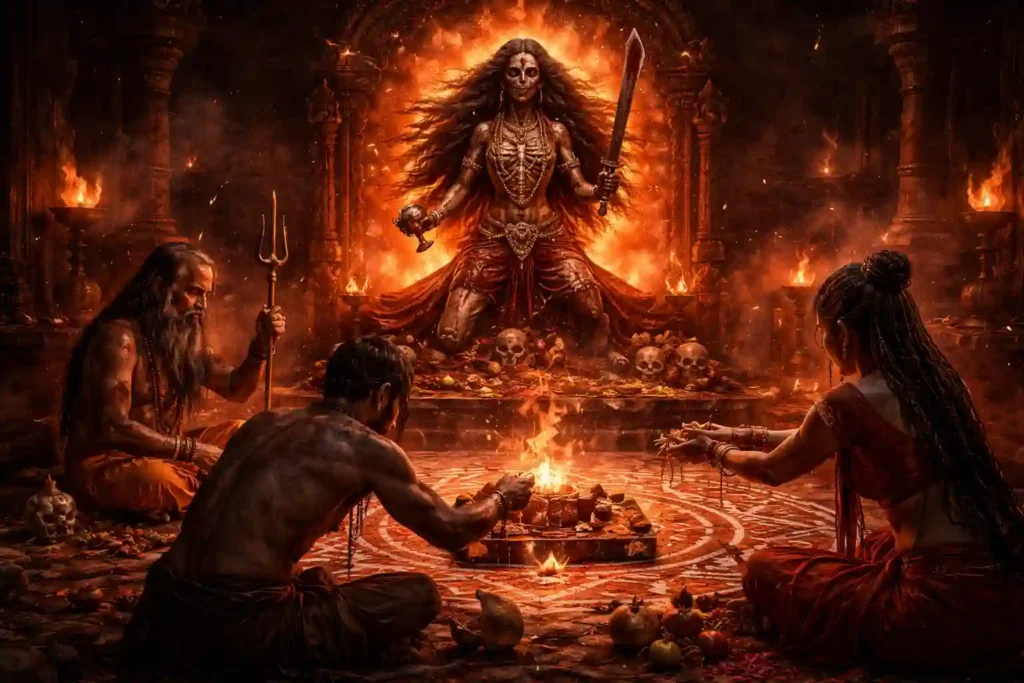
She is often depicted with an emaciated body, sunken eyes, a garland of skulls, and sacred weapons such as the trishul, sword, and kapala.
In many representations, she sits upon a corpse or defeated demon, symbolizing victory over ego, ignorance, and attachment.
Every aspect of her form carries meaning. Her skeletal appearance reminds devotees of the temporary nature of the physical body.
The skull garland symbolizes the passing of worldly identities and the inevitability of change. Her weapons represent the power to cut through ignorance, fear, and destructive tendencies.
The cremation ground associated with Maa Chamunda is not a symbol of despair but of truth. It reminds the seeker that wealth, status, beauty, and pride eventually fade, while spiritual awareness endures.
Some ancient depictions include additional symbols. A scorpion near the navel represents mastery over poison and the cycles of life and death.
The musk deer symbolizes humanity’s tendency to search outside for what already exists within. The corpse seat (preta) reflects freedom from the fear of death and attachment to the material world.
Together, these symbols present Maa Chamunda not merely as a fierce goddess, but as a teacher who guides seekers beyond illusion toward truth and inner freedom.
Why Maa Chamunda Is Associated With the Cremation Ground
One of the most striking aspects of Maa Chamunda’s imagery is her association with the cremation ground. While this setting may appear frightening, its meaning in Shakta and Tantric traditions is deeply spiritual.
The cremation ground is a place where worldly distinctions lose their significance. Wealth, status, beauty, pride, and social identity eventually dissolve, reminding the seeker of the impermanent nature of material existence.
For this reason, the cremation ground is often seen as a symbol of truth rather than fear. It represents the space where illusion ends and reality is confronted directly.
In Tantric understanding, this symbolism extends inward. The cremation ground also represents the inner transformation of the seeker, where attachment, ego, and limiting beliefs are gradually burned away. What remains is greater clarity, freedom, and awareness.
Maa Chamunda’s presence in this sacred setting teaches that spiritual growth begins not by avoiding difficult truths, but by facing them with courage and sincerity.
Dhyana Imagery and Contemplative Symbolism
Traditional meditation texts often describe Maa Chamunda in a form that is both fierce and deeply symbolic. She is visualized as a dark and emaciated goddess adorned with a garland of skulls, carrying sacred weapons, and dwelling beyond ordinary worldly concerns.
These descriptions are not intended merely to inspire awe. They serve as contemplative tools that help the practitioner reflect on impermanence, inner transformation, and freedom from ego.
During meditation, each aspect of her form carries meaning. The skull garland reminds the seeker of the passing nature of worldly identity, while her weapons symbolize the removal of ignorance, fear, and destructive tendencies.
Through this imagery, Maa Chamunda teaches that spiritual growth often begins when one is willing to face truth without avoidance.
Maa Chamunda as an Independent Matrika and Yogini
Among the Saptamatrikas, Maa Chamunda occupies a distinctive position. While the Matrikas are traditionally worshipped as a group, Chamunda developed a strong independent identity in many regions and spiritual traditions.
In Shakta and Tantric worship, she is often revered not merely as one among the Matrikas but as a powerful manifestation of the Divine Mother in her own right.
This independent status helped establish dedicated temples, pilgrimage traditions, and forms of worship centered specifically on Maa Chamunda.
Tantric traditions also associate her with Yogini worship. She is linked with Yogini lineages and, in some traditions, with the broader symbolism of the 64 Yoginis.
Because of her fierce and transformative nature, practitioners often regard her as a guide through deeper stages of spiritual discipline and inner awakening.
Although Maa Chamunda is not counted among the Das Mahavidyas, her symbolism shares certain themes with fierce forms of Shakti such as Maa Kali.
She is associated with the dissolution of ego, freedom from attachment, and the pursuit of truth beyond outward appearances.
Why Maa Chamunda Holds a Unique Place Among the Saptamatrikas
Among the Saptamatrikas, Maa Chamunda is especially known for her fierce symbolism and transformative spiritual role.
While all seven Matrikas represent different expressions of divine power, Chamunda is most closely associated with confronting fear, impermanence, and the deeper realities of existence.
Her prominent role in the Devi Mahatmya further strengthens her importance within Shakta tradition.
Unlike many maternal forms of the Divine Mother that emphasize nourishment and protection, Maa Chamunda also represents the courage required to face inner darkness and overcome limiting tendencies.
For this reason, devotees often view her not only as a protective mother but also as a guide who leads seekers toward self-transformation, detachment, and spiritual awakening.
How Maa Chamunda is Related to Maa Kali
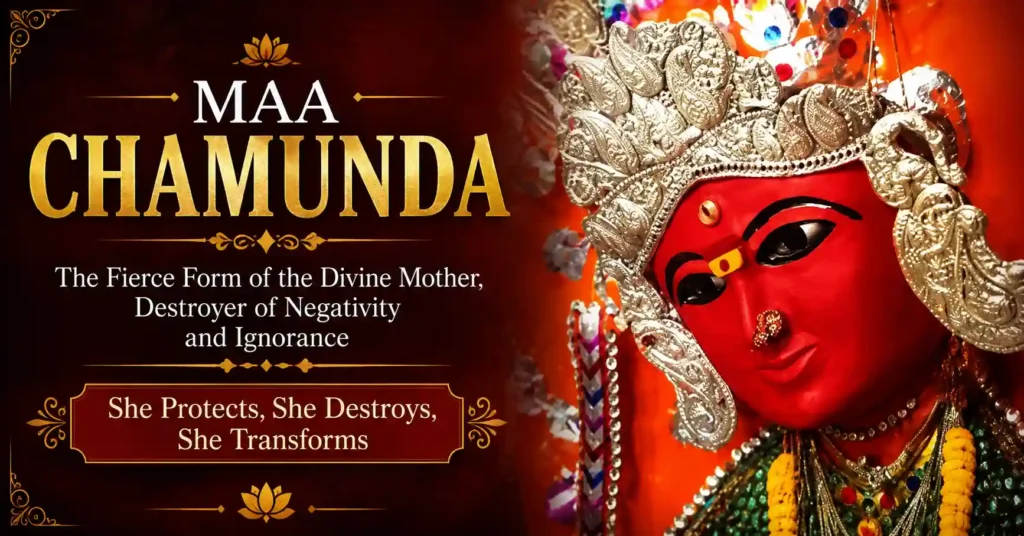
Maa Chamunda and Maa Kali are closely related in many Shakta traditions. Both are fierce manifestations of the Divine Mother and are associated with the destruction of ignorance, ego, and negative forces.
In iconography, both goddesses are often depicted in cremation grounds, adorned with skulls, and standing beyond conventional ideas of beauty and comfort. These similarities reflect their shared role as liberating forms of Shakti.
At the same time, the two are not always viewed as identical. Maa Kali is often understood as the vast cosmic power of time, dissolution, and transcendence, while Maa Chamunda is more specifically connected with the destruction of the forces symbolized by Chanda and Munda.
For this reason, many traditions regard Chamunda as a specialized expression of the same transformative power embodied by Kali.
Tantric Significance and Chamunda Vidya
Maa Chamunda holds an important place within several Tantric traditions. Her worship is associated with a spiritual path often referred to as Chamunda Vidya, which focuses on inner transformation rather than external achievement.
In this understanding, the demons Chanda and Munda are not viewed only as mythological figures. They are also seen as symbols of destructive tendencies that exist within the human mind. Chanda represents uncontrolled anger and aggression, while Munda symbolizes deception, ego, and distorted thinking.
For this reason, advanced Chamunda sadhana is not limited to prayer alone. It encourages the seeker to confront fear, attachment, and inner darkness with honesty and awareness.
Her association with cremation grounds, night sadhana, silence, and inward reflection reflects this deeper purpose. These symbols point toward the transformation of the self rather than outward ritual alone.
Within Tantric philosophy, Maa Chamunda is revered not only as a protector but also as a guide toward liberation. Her fierce form reminds seekers that spiritual growth often begins when illusion is removed and truth is faced directly.
Maa Chamunda and BhairavaTraditions
Many Tantric traditions associate Maa Chamunda with Bhairava, a fierce manifestation of Shiva. In temple worship and sacred iconography, Bhairava is often regarded as a guardian and companion of powerful forms of the Divine Mother.
This relationship is not simply that of a divine couple. In Shakta philosophy, Bhairava represents pure consciousness, while Shakti represents the dynamic power that manifests and transforms creation.
When Maa Chamunda is worshipped alongside Bhairava, the symbolism points toward the union of awareness and power, stillness and action, witness and transformation.
Different traditions emphasize this relationship in different ways, but together they express an important principle of Tantra: consciousness and energy are ultimately inseparable.
Navarna Mantra and Its Esoteric Meaning
One of the most revered mantras associated with Maa Chamunda is:
Om Aim Hreem Kleem Chamundayai Vichche
Often called the Navarna Mantra or Navakshari Mantra, it holds a central place in Shakta worship, Navchandi rituals, Navratri observances, and various Tantric traditions.
In traditional interpretation, each syllable carries symbolic meaning. Aim is associated with knowledge and clarity, Hreem with divine consciousness and spiritual power, Kleem with attraction and transformation, while Vichche is understood as the cutting away of ignorance, negativity, and limiting patterns.
For devotees, the mantra is not merely a chant but a form of invocation that connects the mind with the transformative energy of the Divine Mother. Regular and respectful recitation is traditionally believed to cultivate courage, inner stability, spiritual awareness, and protection from negative influences.
Because of its importance in Shakta tradition, the Navarna Mantra remains one of the most widely recited mantras dedicated to Maa Chamunda.
Symbolism of the Chamunda Yantra
In some Tantric traditions, practitioners use a Chamunda Yantra as a symbolic representation of the Goddess’s transformative energy. A yantra is not merely a sacred diagram but a meditative aid designed to focus awareness and devotion.
The geometric patterns within the yantra represent order emerging from chaos and the movement of consciousness toward spiritual clarity.
For devotees of Maa Chamunda, the yantra serves as a reminder that fear, confusion, and negative tendencies can be transformed through disciplined practice and divine grace.
While external worship may include offerings and rituals, the deeper purpose of the yantra is to help the seeker cultivate inner stability, concentration, and self-awareness.
Navchandi Yagna and Its Spiritual Importance
In traditional Shakta worship, Maa Chamunda is closely associated with the Navchandi Yagna, especially during Navratri and other major Devi observances.
This sacred ritual typically includes the complete recitation of the 700 verses of the Devi Mahatmya (Durga Saptashati), the chanting of the Navarna Mantra, and the invocation of multiple forms of the Divine Mother through prayer, worship, and homa.
Beyond its ritual aspects, Navchandi Yagna is traditionally regarded as a practice of purification and spiritual renewal. Devotees participate in it to strengthen devotion, cultivate inner clarity, and seek the blessings of the Divine Mother.
Because Maa Chamunda plays an important role within the Devi Mahatmya, many practitioners view this ritual as a powerful way of connecting with her transformative and protective aspects.
Regional Traditions and Variations in Worship
Maa Chamunda is worshipped across India, but her forms, rituals, and local traditions vary from region to region. These variations reflect the rich diversity of Shakta worship while preserving her identity as a powerful manifestation of the Divine Mother.
In Himachal Pradesh, particularly at the renowned Chamunda Nandikeshwar Dham, the Goddess is closely associated with protection, liberation, and the spiritual teachings surrounding impermanence and transcendence.
In Gujarat, especially at Chotila, she is widely revered as a compassionate and protective mother. Local traditions include unique customs and beliefs that have become an important part of regional devotion.
In Karnataka, Maa Chamundeshwari of Mysuru is closely linked with the Mahishasura Mardini tradition and has long been associated with the cultural and royal history of the region.
In Rajasthan, several communities worship Maa Chamunda as a Kuldevi (family deity), seeking her blessings for protection, strength, and lineage welfare.
Some scholars and traditions also trace aspects of her worship to older regional and tribal forms of goddess devotion that were gradually integrated into mainstream Shakta practice.
These regional expressions demonstrate how devotion to Maa Chamunda has adapted across centuries while retaining its spiritual core.
Maa Chamunda in Regional Oral and Folk Traditions
Beyond scriptures and formal temple worship, Maa Chamunda lives within many oral and folk traditions preserved by families, village communities, and local devotional lineages.
These traditions are passed down through stories, folk songs, seasonal observances, and community practices. In some regions, she is worshipped as a fierce guardian who protects villages, farmlands, and community well-being. In others, she is remembered as a compassionate mother who supports families during times of hardship and uncertainty.
Because these traditions developed locally over many generations, their stories and rituals may differ from classical scriptural descriptions. Yet they share a common devotion to Maa Chamunda as a source of protection, strength, and guidance.
Together, these living traditions demonstrate how faith in Maa Chamunda continues to adapt to the needs of different communities while preserving its spiritual essence.
Temple-Specific Rituals and Traditions
Maa Chamunda’s temples preserve a wide variety of devotional practices shaped by local history, regional customs, and spiritual traditions. While rituals vary from place to place, certain patterns are commonly found across many temples dedicated to the Goddess.
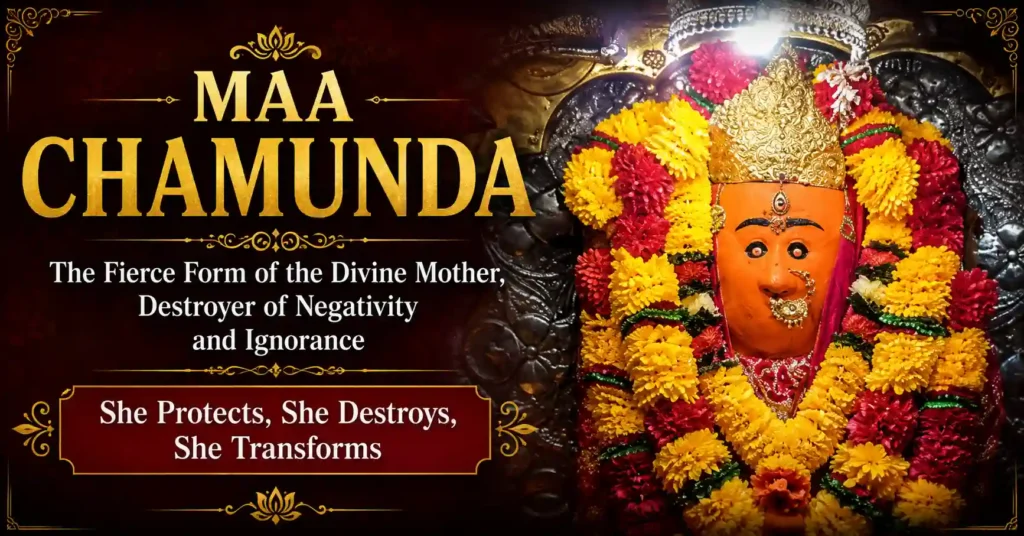
Daily worship often includes aarti at sunrise and sunset, mantra recitation, flower offerings, and special observances during Navratri and Ashtami. Devotees commonly offer coconuts, sweets, red cloth, and lemons as expressions of gratitude and devotion.
In several temple traditions, Bhairava and Hanuman are also revered as guardian deities associated with the sacred space of the Goddess. Their presence reflects the protective aspect of Maa Chamunda worship.
These living traditions reveal the many ways in which Maa Chamunda is experienced by devotees, not only as a fierce protector but also as a compassionate mother who remains closely connected to the spiritual lives of her worshippers.
Connection With Shakti Peethas
Maa Chamunda is also associated with several Shakti traditions and sacred centers dedicated to the Divine Mother, although the exact connections vary across regions and lineages.
Some traditions link her worship with places such as Kangra, Chotila, and Mysuru, where powerful forms of the Goddess have been revered for centuries. These sacred sites have played an important role in preserving devotion to fierce and protective manifestations of Shakti.
While not all traditions classify these locations in the same way, their association with Maa Chamunda highlights her presence within the broader network of Goddess worship across India.
This connection reflects an important aspect of her identity. Maa Chamunda is not worshipped only as a local deity or regional guardian but as a widely revered form of the Divine Mother whose influence extends across multiple spiritual traditions and sacred landscapes.
The Protective and Transformative Nature of Maa Chamunda
Maa Chamunda is often understood as a goddess who works on both the outer and inner dimensions of life.
On the external level, devotees worship her as a protector who helps them face fear, adversity, and negative influences with courage and faith. Her fierce form symbolizes strength in the face of challenges and uncertainty.
On the inner level, Maa Chamunda represents transformation. She is believed to remove ego, ignorance, harmful tendencies, and the patterns that keep a person trapped in fear or illusion.
In this sense, her battle against demons also becomes a symbol of the seeker’s own spiritual journey.
This dual role as both protector and transformer is what makes Maa Chamunda unique. She not only offers protection from obstacles but also guides devotees toward greater self-awareness, inner strength, and spiritual growth.
Guidance for Maa Chamunda Worship
Maa Chamunda is traditionally approached with devotion, sincerity, and respect. Many devotees believe that a calm and focused mind helps deepen the experience of prayer, mantra chanting, and meditation.
Simple practices such as chanting her mantra with attention, reading sacred texts, and maintaining a spirit of humility are commonly encouraged in her worship.
At the same time, advanced Tantric practices associated with Maa Chamunda are traditionally undertaken only under proper guidance. For most devotees, sincere devotion and regular remembrance of the Goddess are considered more important than complex rituals.
Ultimately, Maa Chamunda worship is understood as a path of inner transformation, courage, and spiritual growth guided by faith and awareness.
When and How to Worship Maa Chamunda
Many devotees consider certain occasions especially auspicious for Maa Chamunda worship.
| Occasion | Traditional Significance |
|---|---|
| Pradosh Kaal | A time associated with prayer and spiritual reflection |
| Shukla Paksha Ashtami | Traditionally linked with Devi worship |
| Navratri | One of the most important periods for worshipping the Divine Mother |
For most devotees, worship can be simple and heartfelt. Common practices include:
Lighting a diya
Chanting Maa Chamunda’s mantra
Reading passages from the Devi Mahatmya
Spending time in prayer or silent meditation
Some spiritual traditions also include advanced forms of sadhana such as mantra japa, yantra worship, and specialized Tantric disciplines. These practices are traditionally undertaken with proper guidance and preparation.
Above all, Maa Chamunda worship is understood as a path of devotion, self-reflection, and inner transformation rather than elaborate ritual alone.
Astrological Associations of Maa Chamunda
Some spiritual traditions associate Maa Chamunda with periods of intense personal transformation and inner growth. Because of her fierce and protective nature, devotees often turn to her during challenging phases that require courage, discipline, and emotional resilience.
While different traditions offer different interpretations, Maa Chamunda is commonly invoked by those seeking strength to overcome fear, confusion, negative influences, or major life transitions. Her worship is understood as a means of cultivating clarity, determination, and inner stability during difficult times.
These associations should be viewed as devotional and spiritual perspectives rather than universal astrological rules. The primary focus of Maa Chamunda worship remains self-awareness, protection, transformation, and spiritual growth.
For many devotees, her grace is sought not merely for external results but for the strength to face life’s challenges with wisdom, faith, and resilience.
Festivals Associated With Maa Chamunda Worship
While Maa Chamunda is worshipped throughout the year, certain festivals hold special significance for her devotees.
| Festival | Significance |
|---|---|
| Navratri | The most important period for Maa Chamunda worship, especially Ashtami and Navami |
| Chaitra Navratri | Dedicated to the worship of the Divine Mother during the spring season |
| Ashwin Navratri | One of the most widely celebrated Navratri observances across India |
| Durga Puja | Celebrates the victory of the Goddess over negative forces and is closely connected with Devi traditions |
During these occasions, devotees participate in prayer, mantra chanting, recitation of sacred texts such as the Devi Mahatmya, and special temple observances.
The exact form of worship varies according to regional customs, family traditions, and local practices.
These festivals provide opportunities for collective devotion, spiritual reflection, and a deeper connection with the transformative power of Maa Chamunda.
The Spiritual and Psychological Meaning of Maa Chamunda
For a serious seeker, Maa Chamunda is not merely a deity to be worshipped. She represents a process of inner transformation.
Her symbolism invites the devotee to face uncomfortable truths, let go of ego, overcome destructive tendencies, and accept the impermanent nature of life.
In this sense, the demons she destroys are not only external forces but also the fears, attachments, and illusions that limit human growth.
Unlike paths that seek comfort alone, Maa Chamunda’s teachings emphasize courage, self-awareness, and honesty. Her fierce form reminds seekers that lasting transformation often begins when one is willing to confront what has long been avoided.
For many devotees, worship of Maa Chamunda is therefore not simply a request for protection. It is a journey toward greater strength, clarity, resilience, and spiritual maturity guided by the grace of the Divine Mother.
What Maa Chamunda Teaches in Modern Life
Although Maa Chamunda emerges from ancient traditions, her symbolism remains relevant today. Many of the demons she is said to destroy can also be understood as inner challenges such as fear, anger, self-deception, insecurity, and unhealthy attachment.
Her teachings encourage individuals to face uncomfortable truths rather than avoid them. In this sense, Maa Chamunda represents courage, honesty, resilience, and the willingness to transform difficult experiences into spiritual growth.
For modern seekers, her message is not simply about protection from external negativity but about developing the strength to overcome inner limitations and live with greater awareness.
Suggested Reading
If Maa Chamunda’s energy touched something within you, you may also feel drawn to explore these deeper aspects of Shakti and devotion.
Maa Kali: The Dark Mother of Time and Transformation
https://thesanatantales.com/maa-kali-meaning-story-significance
Maa Matangi: Meaing, Symbolism, Mantra and The 9th Mahavidya
https://thesanatantales.com/maa-matangi-ninth-mahavidya/
Maa Lalita Tripura Sundari: Meaning, Story, Sri Vidya, Sri Chakra & Significance
https://thesanatantales.com/maa-lalita-tripura-sundari/
Durga Saptashati: Meaning, Story and Spiritual Power
https://thesanatantales.com/durga-saptashati-meaning-story
Navarna Mantra: Meaning, Benefits and How to Chant
https://thesanatantales.com/navarna-mantra-meaning-benefits
Das Mahavidya: From Kali to Kamala, The Journey Within
https://thesanatantales.com/das-mahavidya-journey-within
FAQs
Who is Maa Chamunda?
Maa Chamunda is a fierce form of the Divine Mother in Shakta tradition. She is best known from the Devi Mahatmya, where she destroys the demons Chanda and Munda. Devotees worship her as a protector, liberator, and powerful manifestation of Shakti who removes negativity and guides seekers toward spiritual growth.
Is Maa Chamunda a form of Maa Kali?
Many Shakta traditions consider Maa Chamunda closely related to Maa Kali because both represent the fierce and transformative power of the Divine Mother. While they share similar symbolism, Maa Chamunda has her own distinct identity, mythology, and worship traditions.
What is the meaning of the name Chamunda?
The name Chamunda comes from the demons Chanda and Munda, whom the Goddess defeated in the Devi Mahatmya. The name symbolizes her power to overcome destructive forces, both external and internal.
What is the Navarna Mantra of Maa Chamunda?
The most widely known mantra associated with Maa Chamunda is:
Om Aim Hreem Kleem Chamundayai Vichche
This sacred mantra is central to many Shakta and Tantric traditions and is recited for devotion, protection, spiritual strength, and inner transformation.
Can beginners worship Maa Chamunda?
Yes. Maa Chamunda can be worshipped by anyone with sincerity and respect. Simple practices such as chanting her name, reading the Devi Mahatmya, offering prayers, or lighting a diya are common forms of devotion.
Which day is considered auspicious for Maa Chamunda worship?
Many devotees consider Ashtami, Navratri, and Pradosh Kaal especially favorable for Maa Chamunda worship. However, sincere devotion can be offered on any day.
What are the benefits of Maa Chamunda worship?
Devotees believe that Maa Chamunda worship helps cultivate courage, inner strength, clarity, protection, and spiritual awareness. Her worship is also associated with overcoming fear, negative tendencies, and emotional obstacles.
Why is Maa Chamunda associated with cremation grounds?
In Shakta and Tantric symbolism, the cremation ground represents impermanence, truth, and freedom from ego. Maa Chamunda’s association with this setting reflects her role in helping seekers move beyond fear, attachment, and illusion.
Is Maa Chamunda one of the Saptamatrikas?
Yes. Maa Chamunda is one of the seven Saptamatrikas, a group of powerful mother goddesses in Hindu tradition. She is especially notable because she is also widely worshipped independently as a major form of the Divine Mother.
What does Maa Chamunda symbolize spiritually?
Spiritually, Maa Chamunda represents transformation, fearlessness, self-awareness, and the courage to face difficult truths. Her symbolism teaches that genuine spiritual growth comes through overcoming ego, ignorance, and inner limitations.
Glossary of Important Terms
| Term | Meaning |
|---|---|
| Maa Chamunda | A fierce form of the Divine Mother who represents protection, transformation, and the destruction of negativity. |
| Chamunda | A name derived from the demons Chanda and Munda, whom the Goddess defeated according to the Devi Mahatmya. |
| Shakti | The divine cosmic energy or power, worshipped as the Divine Mother in Hinduism. |
| Shaktism (Shakta Tradition) | A major Hindu tradition centered on the worship of the Divine Mother in her many forms. |
| Devi Mahatmya | A sacred scripture, also known as the Durga Saptashati, describing the victories of Goddess Durga and her various manifestations. |
| Durga Saptashati | A collection of 700 verses from the Markandeya Purana that forms one of the most important texts of Goddess worship. |
| Chanda and Munda | Two demons defeated by the Goddess, symbolizing aggression, ego, and ignorance. |
| Maa Kali | A fierce manifestation of the Divine Mother associated with time, transformation, liberation, and the destruction of evil. |
| Saptamatrikas | The seven divine mother goddesses who represent different aspects of Shakti. Maa Chamunda is one of them. |
| Matrika | A mother goddess who embodies a specific form of divine feminine power. |
| Yogini | A divine female spiritual being associated with Tantra, mystical wisdom, and Shakti worship. |
| 64 Yoginis | A group of sixty-four Yoginis worshipped in Tantric traditions as manifestations of divine feminine energy. |
| Tantra | A spiritual tradition that emphasizes meditation, mantra, ritual, symbolism, and inner transformation. |
| Chamunda Vidya | A Tantric path of worship dedicated to Maa Chamunda that focuses on overcoming fear, ego, and inner limitations. |
| Bhairava | A fierce manifestation of Lord Shiva who serves as the guardian and companion of powerful forms of the Divine Mother. |
| Navarna Mantra | The sacred nine-letter mantra “Om Aim Hreem Kleem Chamundayai Vichche,” widely used in Shakta worship. |
| Navakshari Mantra | Another traditional name for the Navarna Mantra dedicated to Maa Chamunda. |
| Yantra | A sacred geometric diagram used for meditation, concentration, and worship. |
| Chamunda Yantra | A sacred yantra representing Maa Chamunda’s transformative and protective energy. |
| Navchandi Yagna | A sacred fire ritual that includes the recitation of the Devi Mahatmya and worship of the Divine Mother. |
| Homa (Havan) | A Vedic fire ritual in which offerings are made into the sacred fire while chanting mantras. |
| Mantra Japa | The repeated chanting of a sacred mantra to deepen concentration and spiritual awareness. |
| Pradosh Kaal | A sacred twilight period considered auspicious for worship, especially of Shiva and forms of Shakti. |
| Ashtami | The eighth lunar day of the Hindu calendar, regarded as especially sacred for Goddess worship. |
| Navratri | The nine-night festival dedicated to the worship of the Divine Mother in her various forms. |
| Chaitra Navratri | The spring Navratri festival celebrated during the Hindu month of Chaitra. |
| Ashwin Navratri | The autumn Navratri, the most widely celebrated festival of Goddess Durga. |
| Durga Puja | A major festival celebrating Goddess Durga’s victory over evil and the triumph of righteousness. |
| Shakti Peetha | A sacred pilgrimage site associated with the Divine Mother where parts of Goddess Sati are believed to have fallen. |
| Kuldevi | The ancestral or family goddess worshipped for protection, prosperity, and blessings. |
| Cremation Ground (Shmashana) | A powerful spiritual symbol representing impermanence, detachment, and the transcendence of worldly attachments. |
| Kapala | A skull, symbolizing the impermanence of life and the transcendence of ego. |
| Trishul (Trident) | A sacred weapon representing the destruction of ignorance and the balance of creation, preservation, and dissolution. |
| Preta | A corpse, often used symbolically in Goddess iconography to represent victory over ego and attachment. |
| Maya | The illusion that causes beings to identify only with the material world instead of ultimate reality. |
| Sadhana | A disciplined spiritual practice undertaken for self-purification and realization of the Divine. |
| Moksha | Liberation from the cycle of birth and death and realization of one’s true spiritual nature. |
| Dharma | The universal principle of righteousness, duty, and moral order. |
| Aarti | A devotional ritual in which a lighted lamp is offered before the deity while singing hymns. |
| Dhyana | Meditation or deep contemplation focused on the Divine. |
About the Author
Yateendra Chaturvedi is a spiritual writer, researcher, devotee, and the founder of The Sanatan Tales. With over 35 years of professional experience and a lifelong interest in Sanatan Dharma, he writes about Hindu deities, temples, scriptures, festivals, Mahavidyas, sacred stories, rituals, and living traditions that continue to guide and inspire devotees across India.
Drawing from traditional scriptures, regional beliefs, temple traditions, devotional literature, and historical sources, he aims to present authentic, well-researched, and easy-to-understand content for modern readers. His work focuses on preserving spiritual wisdom, explaining sacred traditions, and helping seekers develop a deeper understanding of India’s rich spiritual heritage.
Through The Sanatan Tales, Yateendra strives to make the timeless teachings of Sanatan Dharma simple, meaningful, and relevant for today’s generation while maintaining respect for traditional sources, regional practices, and diverse spiritual perspectives.
Learn More About Yateendra Chaturvedi →
https://thesanatantales.com/about-the-author/
References & Sources
This article is based on beliefs and traditions followed within the Shakta traditions of Sanatan Dharma, traditional knowledge associated with the Dashamahavidya tradition, Shakti worship, Devi sadhana, and insights drawn from various spiritual and religious study sources.
Some concepts discussed in this article are also inspired by teachings and interpretations preserved through the guru-disciple tradition.
Note: Beliefs, interpretations, and spiritual practices may vary across different traditions, sects, and paths within Sanatan Dharma. The purpose of this article is not to present any single viewpoint as the absolute truth, but to explain widely accepted religious and spiritual perspectives in a simple and accessible manner.
Explore More Fascinating Topics from Sanatan Dharma