
Death is one of the greatest mysteries of human life. Many people wonder what happens to the soul after death and how it reaches Yamaloka according to Sanatan Dharma.
Ancient Hindu scriptures describe that during its journey to Yamaloka, the soul encounters two important rivers: Vaitarni Nadi and Pushpodaka River. Although both are part of the soul’s journey after death, their nature and experience are said to be completely different.
According to the Garuda Purana, the soul travels toward the realm of Yamraj after leaving the physical body. Along the way, it must pass through Vaitarni Nadi, a river often described as frightening and difficult to cross. Traditional beliefs state that souls burdened by negative karma experience suffering while crossing this river.
In contrast, Pushpodaka River is described as peaceful, pure, and comforting. Souls who have performed virtuous deeds are believed to experience rest and relief there before continuing their journey toward Yamaloka.
In this article, you will learn the meaning of Vaitarni Nadi, its description in the Garuda Purana, what the soul experiences at the river, the role of karma, Go Daan, 13-day rituals after death, its connection with Yamraj, and the deeper spiritual lessons hidden within this powerful concept of Sanatan Dharma.
According to the teachings of Sanatan Dharma, the soul’s journey does not end with physical death. It continues beyond the material world, gradually moving toward its next destination. As the soul begins to detach from worldly relationships, possessions, and identities, it passes through various stages described in Hindu scriptures.
This is why the days immediately following death are considered spiritually significant and why rituals and prayers are performed to support the departed on its onward journey.
Vaitarni Nadi at a Glance
| Aspect | Details |
|---|---|
| Name | Vaitarni Nadi (Vaitarani River) |
| Mentioned In | Garuda Purana, Mahabharata, and other Hindu traditions |
| Associated With | Soul’s journey after death |
| Connected Deity | Yamraj |
| Guides of the Soul | Yamdoots |
| Represents | Karma, accountability, and spiritual consequences |
| Important Rituals | Shraddha, Tarpan, Pind Daan, Go Daan |
| Can It Be Avoided? | According to tradition, liberated souls (moksha) do not undergo the ordinary post-death journey |
| Related Concept | Rebirth (Punarjanma) |
| Spiritual Meaning | Self-reflection, responsibility, and inner transformation |
Table of Contents
ToggleVaitarni Nadi Meaning
In Hindu tradition, Vaitarni Nadi is a sacred river associated with the soul’s journey after death. It is described in the Garuda Purana and other religious traditions as a river that lies on the path to Yamaloka, the realm of Yamraj.
According to traditional beliefs, the experience of crossing this river depends on a person’s karma. Souls who have lived according to dharma are believed to find the crossing easier, while those burdened by negative actions may face greater difficulty.
Beyond its scriptural description, Vaitarni Nadi is also viewed as a symbol of accountability, reminding individuals that every action has consequences. For this reason, it occupies an important place in Hindu teachings about karma, the afterlife, and spiritual responsibility.
What Is Vaitarni Nadi?
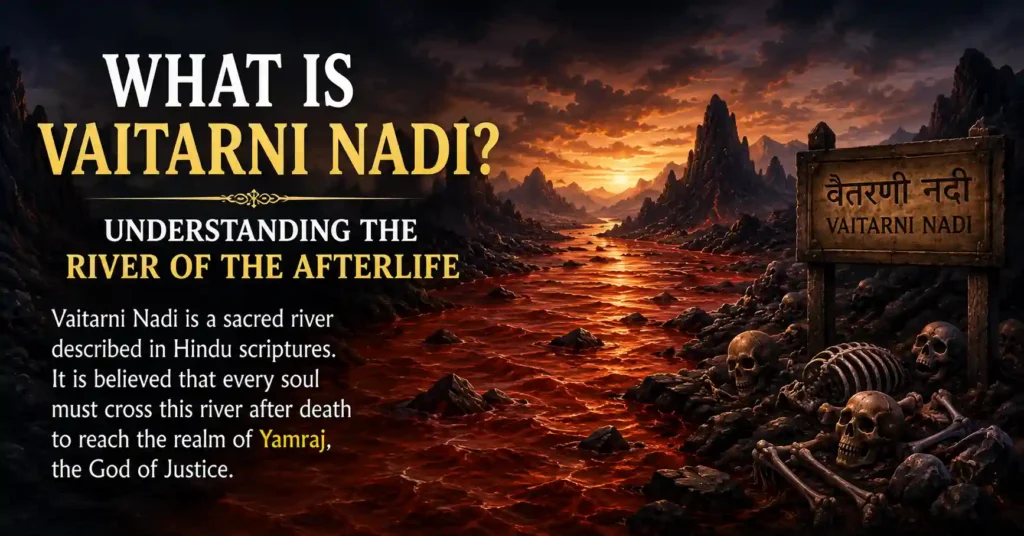
According to Hindu beliefs, Vaitarni Nadi is a sacred river that the soul encounters during its journey after death. It is described as lying on the path to Yamaloka, where the soul eventually comes before Yamraj, the deity associated with justice and the law of karma.
Unlike an ordinary river made of water, Vaitarni Nadi is portrayed in religious literature as a spiritual realm shaped by an individual’s actions. Traditional descriptions explain that its appearance and the experience of crossing it vary according to the karma accumulated during one’s lifetime.
For some souls, the river is said to appear calm and easier to cross. For others, it may seem frightening and difficult. These descriptions emphasize the Hindu teaching that every action produces consequences and that the soul carries the results of its deeds beyond physical death.
Because of this symbolism, Vaitarni Nadi is remembered not only as a stage in the afterlife journey but also as a reminder of the importance of dharma, righteous conduct, and personal responsibility.
Where Is Vaitarni Nadi Located According to Hindu Beliefs?
According to Hindu tradition, Vaitarni Nadi is not considered part of the physical world. It is described as a sacred river that exists on the path traveled by the soul after death as it moves toward Yamaloka, the realm of Yamraj.
Religious texts do not describe it as a river that can be found on a map or visited during earthly life. Instead, it is presented as part of the spiritual realm associated with the afterlife and the law of karma.
Traditional beliefs hold that the soul encounters this river during its onward journey after leaving the physical body. The experience of crossing it is said to depend upon the actions, intentions, and conduct of the individual during life.
Because of this, many spiritual teachers explain that the significance of the river lies not in a geographical location but in the spiritual lessons it represents about karma, accountability, and the consequences of one’s actions.
Vaitarni Nadi in Garuda Purana
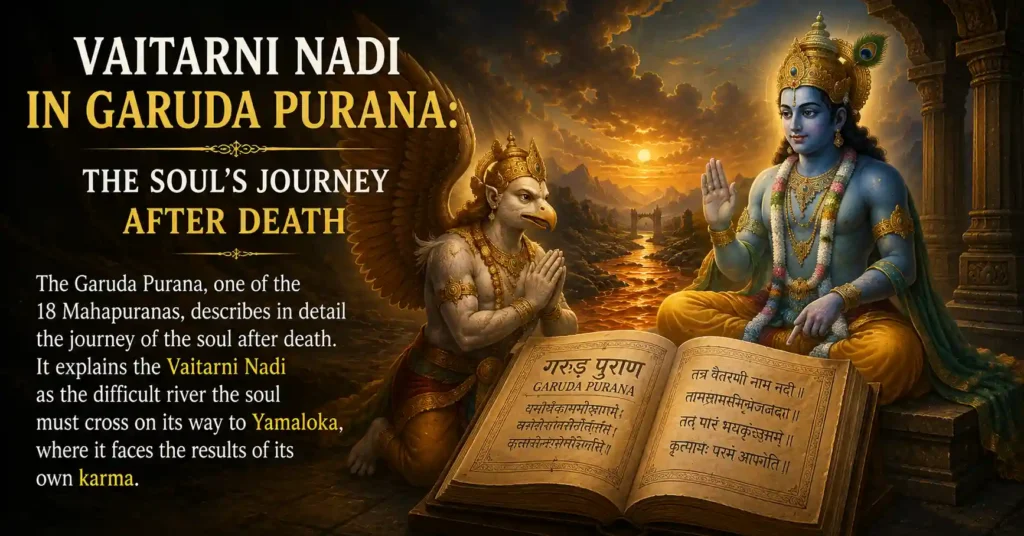
The concept of Vaitarni Nadi is described primarily in the Garuda Purana, one of the most well-known Hindu scriptures that explains the soul’s journey after death.
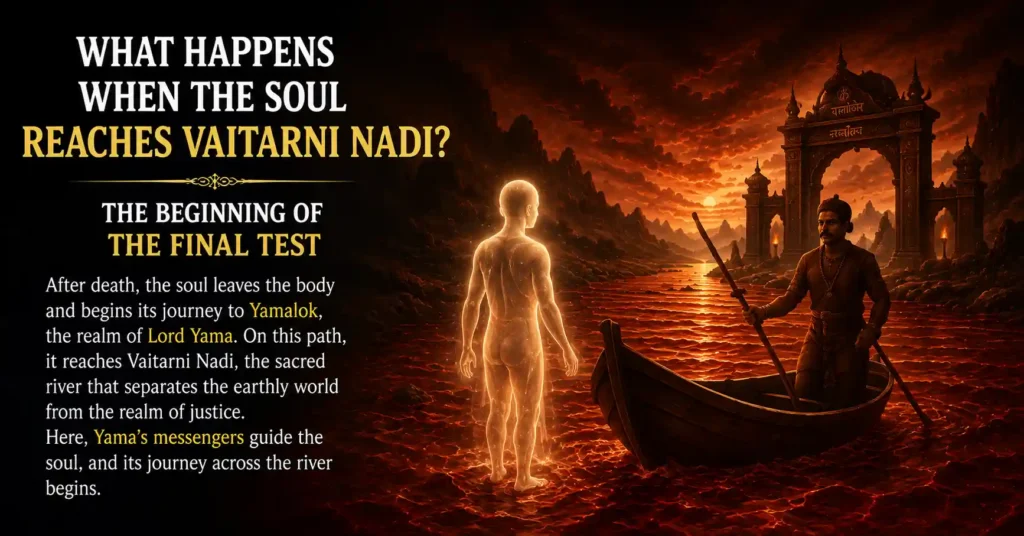
According to the Garuda Purana, when a person dies, the soul begins a spiritual journey toward the realm of Yamraj. During this journey, it is guided by Yamdoots, the messengers of Yamraj, who ensure that the soul reaches its destination according to the law of karma.
Yamdoots are described as powerful beings who carry out divine justice. Their role is not to punish or frighten the soul, but to ensure that every individual experiences the results of his or her actions.
The Garuda Purana explains that the soul encounters several stages on its journey, and one of the most important is the crossing of Vaitarni Nadi. The condition of the river and the experience of crossing it are said to reflect the karma accumulated during one’s lifetime.
Through these descriptions, the scripture teaches that every action has consequences and that a life guided by dharma, compassion, and righteousness creates a smoother path for the soul after death.
What Does the Garuda Purana Say About Vaitarni Nadi?
The Garuda Purana contains some of the most detailed descriptions of Vaitarni Nadi found in Hindu literature. It portrays the river as one of the important stages that a soul may encounter on its journey toward Yamaloka.
Traditional descriptions state that the river does not appear the same to every soul. Those burdened by negative karma may experience it as a terrifying river filled with blood, foul substances, darkness, and intense suffering. The crossing is described as painful and difficult.
In contrast, souls who lived according to dharma and accumulated punya are believed to experience far less difficulty. For them, the journey is said to be smoother and less frightening.
These vivid descriptions are among the reasons why Vaitarni Nadi occupies an important place in Hindu beliefs about the afterlife. Traditional teachings use the imagery of the river to emphasize the connection between karma and the soul’s journey after death.
The river’s appearance and the experience of crossing it are said to vary according to the actions performed during one’s lifetime. As a result, Vaitarni Nadi is remembered not only as a stage in the journey to Yamaloka but also as a reminder of the importance of righteous living.
Is Vaitarni Nadi Mentioned in Other Hindu Scriptures?
Although the Garuda Purana contains the most detailed descriptions of Vaitarni Nadi, the concept is not limited to a single scripture. References to Vaitarani can also be found in the Mahabharata and various Puranic traditions that discuss Yama, karma, and the soul’s journey after death.
These texts present the river as an important part of Hindu beliefs about the afterlife and the consequences of human actions. While the details may vary, the central theme remains consistent: the soul continues its journey after death and experiences the results of its karma.
Over the centuries, these scriptural references helped establish Vaitarni Nadi as a well-known symbol of accountability, spiritual transition, and the connection between actions and their consequences.
Together, these traditions reinforce a key teaching of Sanatan Dharma: every action matters, and the soul’s journey is shaped by the karma accumulated throughout life.
How Long Does the Soul Take to Reach Vaitarni Nadi?
Different Hindu traditions describe the soul’s journey after death in different ways, but many associate the early stages of this journey with the first 10 to 13 days following death.
According to traditional beliefs, the soul does not immediately reach its final destination. Instead, it gradually moves away from the physical world and progresses through various stages of the afterlife journey.
This is one reason why the first thirteen days after death are considered especially important in Hindu traditions. Family members perform prayers, Shraddha, Tarpan, and other rituals during this period to honor the departed soul and seek its peace.
The exact duration and details of the journey may vary across scriptures, regions, and traditions. However, the underlying belief remains the same: the soul undergoes a period of transition before moving further on its path toward Yamraj’s realm.
From a spiritual perspective, this timeline symbolizes the gradual separation of the soul from earthly attachments and its movement toward the consequences of its karma.
What Does the Soul Experience at Vaitarni Nadi?
When the soul reaches Vaitarni Nadi, it stands alone. All worldly identities, possessions, relationships, and social status are left behind.
At this stage, neither wealth nor power can provide support. According to traditional beliefs, the soul continues its journey carrying only the consequences of its own karma.
The Garuda Purana describes the river as frightening and difficult for those burdened by negative actions. It may appear burning, dark, turbulent, or impossible to cross. These descriptions symbolize the suffering created by one’s own deeds.
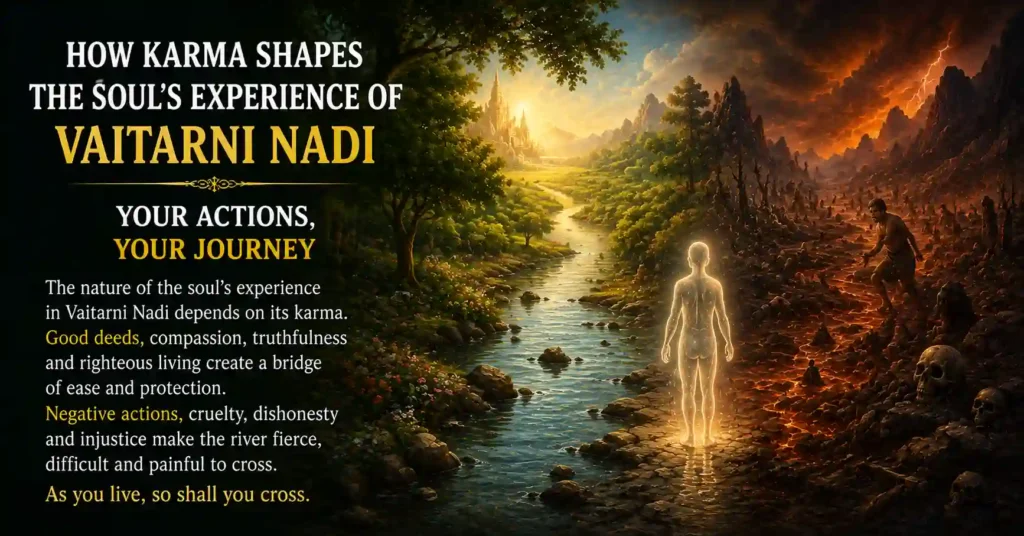
For those who lived with dharma, compassion, truthfulness, and righteous conduct, the experience is believed to be very different. The same river may appear calmer and easier to cross.
This teaching emphasizes that the condition of Vaitarni Nadi is not determined by external factors but by the karma accumulated throughout life. In this sense, the river becomes a reflection of the soul’s own actions and inner state.
Beyond its literal description, many spiritual teachers also view Vaitarni Nadi as a symbol of self-confrontation, where the soul faces the truth of how it has lived before moving forward on its journey.
Did You Know?
Hindu scriptures describe Vaitarni Nadi as a river that reflects the karma of the soul approaching it.
Rather than appearing identical to everyone, the experience of crossing it is believed to vary according to the actions, intentions, and conduct of each individual during life.
What Is Pushpodaka River and How Is It Different?
Traditional descriptions of the soul’s journey after death also mention another river known as Pushpodaka. While Vaitarni is often associated with hardship and karmic consequences, Pushpodaka is described as peaceful, pure, and comforting.
According to certain traditional beliefs, souls that have accumulated significant punya may experience periods of rest and relief during their onward journey. Pushpodaka is portrayed as a serene river where the soul experiences calmness before continuing toward Yamaloka.
The contrast between these two rivers carries an important spiritual message. One reflects the suffering created by negative actions, while the other symbolizes the peace that arises from righteous living and virtuous deeds.
Many spiritual teachers view this symbolism as a reminder that every action shapes future experiences. Just as harmful actions create obstacles, compassion, charity, devotion, and dharma help create a smoother path.
Whether understood literally or symbolically, the descriptions of Pushpodaka and Vaitarni together emphasize a central teaching of Sanatan Dharma: the soul experiences the results of its own karma.
Do All Souls Have to Cross Vaitarni Nadi?
According to traditional Hindu beliefs, most souls encounter Vaitarni Nadi as part of their journey after death. It is considered one of the important stages that the soul passes through before reaching the court of Yamraj.
However, the experience is not the same for everyone. Some souls are believed to cross the river with great difficulty, while others pass through it with far less suffering.
The difference is said to arise from karma rather than any external factor. A life guided by dharma, compassion, truthfulness, charity, and righteous actions creates positive karma that supports the soul on its journey.
In contrast, actions rooted in selfishness, dishonesty, or harm to others are believed to make the journey more challenging. In this way, Vaitarni Nadi serves as a reminder that every action carries consequences.
Some spiritual traditions also teach that souls who attain moksha, or liberation from the cycle of birth and death, do not undergo the ordinary post-death journey described in the scriptures. For most souls, however, the passage through this stage remains part of the karmic journey after death.
Can This Journey Be Avoided?
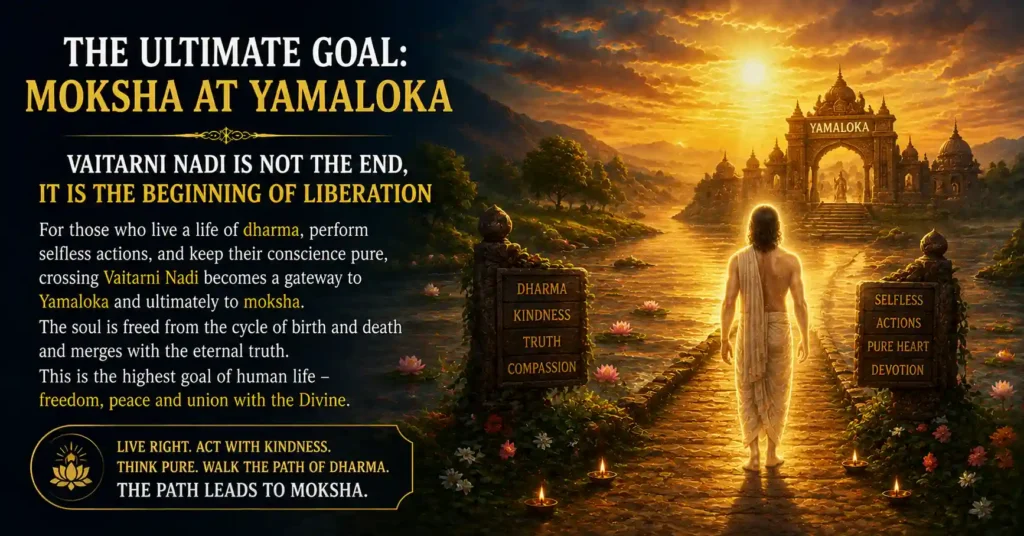
According to the spiritual teachings of Sanatan Dharma, souls who attain moksha do not follow the ordinary journey described after death.
Moksha is the state of liberation from the cycle of birth, death, and rebirth. When a soul realizes its true nature and becomes free from karmic bondage, it no longer returns to the cycle of worldly existence.
For such liberated souls, the stages associated with the afterlife journey, including Vaitarni Nadi, are generally not considered relevant. Their spiritual journey reaches its ultimate goal through union with the Supreme Reality.
For most souls, however, the cycle of rebirth continues. They experience the consequences of their karma and proceed through the stages described in traditional scriptures before moving toward their next destination.
This teaching highlights the ultimate goal of spiritual life in Hindu philosophy: not merely a better journey after death, but freedom from the cycle of birth and death itself.
Why Does Vaitarni Nadi Feel Frightening?
The fear associated with Vaitarni Nadi comes from the vivid descriptions found in traditional scriptures and religious teachings. The river is often portrayed as dark, difficult to cross, and filled with suffering for souls burdened by negative karma.
At first glance, these descriptions may seem harsh or frightening. However, their deeper purpose is not to create fear but to encourage self-reflection and righteous living.
According to Hindu philosophy, every action produces consequences. After death, the soul can no longer hide behind worldly status, possessions, or excuses. It must face the results of its own karma with complete honesty.
In this sense, Vaitarni Nadi represents a moment of truth rather than punishment. The river symbolizes the spiritual reality that every individual eventually encounters the consequences of his or her actions.
Many spiritual teachers also interpret the river symbolically. They explain that the fear associated with Vaitarni Nadi reflects the inner discomfort that arises when a person is forced to confront truth without illusion, denial, or attachment.
The deeper message is simple: a life guided by dharma, compassion, and self-awareness reduces fear, both in this life and in the journey beyond it.
What Is the Role of Karma in the Journey of Vaitarni Nadi?
According to Sanatan Dharma, karma is the foundation of the soul’s journey after death. Every thought, action, and intention leaves an impression that influences future experiences.
The concept of Vaitarni Nadi is closely connected with the law of karma. Traditional teachings explain that the condition of the river and the experience of crossing it reflect the balance of paap (negative actions) and punya (virtuous actions) accumulated during life.
Actions rooted in compassion, truthfulness, charity, self-discipline, and dharma are believed to create positive karma. Such actions help lighten the burden carried by the soul on its journey.
In contrast, actions driven by greed, dishonesty, cruelty, or selfishness are said to create obstacles that make the journey more difficult. The scriptures use the imagery of Vaitarni Nadi to illustrate how every action ultimately produces consequences.
The law of karma is not presented as reward or punishment imposed by an external force. Instead, it is described as a natural spiritual principle through which individuals experience the results of their own choices.
This journey also connects with the broader Hindu understanding of rebirth, where the soul continues its evolution based on the karma accumulated across lifetimes. In this way, Vaitarni Nadi serves as a reminder that every action matters and contributes to the path that lies ahead.
What Is the Role of Go Daan in Crossing Vaitarni Nadi?
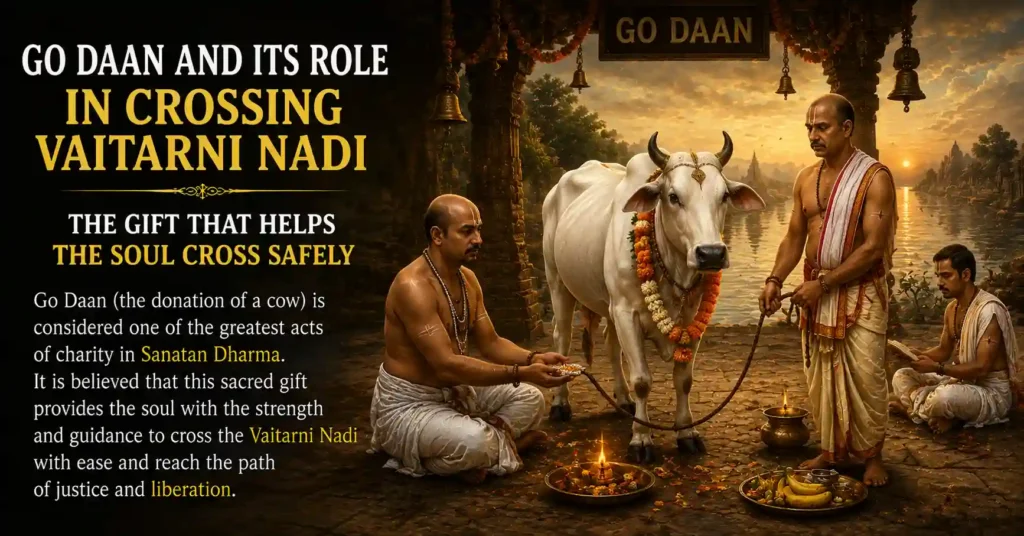
In many Hindu traditions, Go Daan (the donation of a cow) is regarded as one of the most sacred acts of charity. Ancient scriptures and religious customs associate it with spiritual merit and the welfare of the soul after death.
Traditional beliefs hold that the punya earned through sincere Go Daan helps the soul cross Vaitarni Nadi more easily. Some scriptural descriptions even portray the sacred cow assisting the soul in crossing the river on its journey toward Yamraj’s realm.
The cow has long been revered in Sanatan Dharma as a symbol of compassion, nourishment, motherhood, and selfless service. Because of this sacred status, donating a cow came to be associated with dharma, generosity, and spiritual upliftment.
Many spiritual teachers also interpret this teaching symbolically. They explain that the deeper message is not limited to the physical act of donation. Rather, it emphasizes the importance of charity, kindness, and selfless actions that create positive karma.
Whether understood literally or symbolically, the connection between Go Daan and Vaitarni Nadi highlights a central teaching of Hindu philosophy: acts of compassion and generosity continue to benefit the soul long after this life has ended.
Why Is the Cow Associated With the Soul's Journey?
The connection between the cow and the soul’s journey after death has deep roots in Hindu tradition. Ancient scriptures and religious customs regard the cow as a symbol of compassion, nourishment, purity, and selfless giving.
Traditional beliefs describe the sacred cow as a source of spiritual support during difficult stages of the afterlife journey. This belief is one of the reasons why Go Daan became associated with helping the departed soul.
Beyond its literal interpretation, many spiritual teachers explain that the symbolism of the cow represents the virtues of kindness, generosity, and dharmic living. These qualities create positive karma and are believed to benefit the soul long after physical life has ended.
The association between the cow and the afterlife journey reflects a broader teaching found throughout Sanatan Dharma: acts of compassion and selfless service become valuable companions on the path beyond this world.
What Is the Connection With 13-Day Rituals?
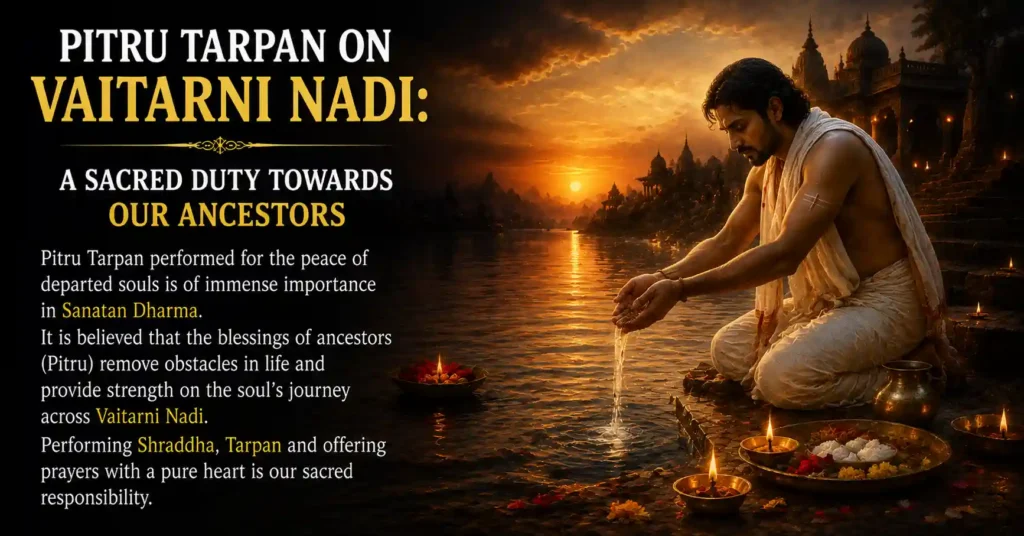
In many Hindu traditions, the first thirteen days after death are considered a significant transitional period for the departed soul. During this time, family members perform prayers and rituals to honor the deceased and seek peace for their onward journey.
Practices such as Shraddha, Tarpan, Pind Daan, and the recitation of sacred prayers are commonly performed during this period. These rituals express gratitude toward the departed and fulfill important religious duties prescribed in tradition.
According to traditional beliefs, these observances provide spiritual support as the soul gradually separates from earthly attachments and moves toward the next stage of its karmic path.
Different regions and communities may follow different customs, but the underlying purpose remains the same: offering prayers, remembrance, and blessings for the well-being of the departed.
The thirteen-day observances also remind the living about the impermanence of life, the importance of dharma, and the enduring connection between actions and their consequences.
How Can the Soul Cross the River Easily?
Many people wonder whether the journey after death can become easier. According to traditional Hindu teachings, the answer lies in the way a person lives rather than in any single ritual performed at the end of life.
A life guided by dharma, compassion, honesty, self-discipline, and service is believed to create positive karma. These actions help reduce the burden carried by the soul on its onward journey.
Scriptures and spiritual traditions also emphasize the importance of devotion, charity, respect for parents and elders, truthfulness, and helping those in need. Such actions are considered valuable because they cultivate inner purity and spiritual merit.
Practices such as prayer, selfless service, mantra japa, Go Daan, and righteous conduct are often associated with creating a smoother path beyond this life. However, these practices are meaningful only when performed with sincerity and the right intention.
The deeper teaching is simple: every action matters. A life lived with awareness, kindness, and responsibility becomes the greatest support for the journey that follows death.
Vaitarni Nadi as an Inner Journey
Vaitarni Nadi is not only associated with the journey after death. Many spiritual teachers also view it as a symbol of the challenges and transformations that people experience during life.
In this deeper interpretation, the river represents an inner crossing. It is the point where an individual must confront fear, guilt, attachment, ignorance, or unresolved emotions and move beyond them.
Every person encounters moments that require difficult choices, self-reflection, and personal growth. Such experiences can feel like crossing a challenging river, where old habits and limitations must be left behind.
From this perspective, the journey is not merely about what happens after death. It is also about the process of inner transformation that takes place while we are alive.
The symbolism teaches that spiritual growth begins when a person faces truth with honesty and courage. By overcoming attachment, cultivating self-awareness, and living according to dharma, one gradually moves toward greater wisdom and inner freedom.
Seen in this way, the river becomes a powerful reminder that the path to spiritual progress often requires crossing the obstacles that exist within ourselves.
What Is the Connection Between Yamraj and Vaitarni Nadi?
According to Hindu tradition, Yamraj is the divine ruler of Yamaloka and the guardian of cosmic justice. He is responsible for ensuring that every soul experiences the consequences of its own actions.
Although Yamraj is often associated with death, he is not viewed as a symbol of cruelty or punishment. Instead, he represents fairness, order, and the impartial law of karma that governs all beings.
Traditional beliefs describe the soul’s journey toward Yamaloka as a process of self-accountability. Before reaching the court of Yamraj, the soul passes through various stages that reflect the life it has lived and the choices it has made.
In this context, the crossing of the sacred river serves as a preparation for understanding one’s karma. It symbolizes the moment when worldly identities fade and the soul stands before the truth of its actions.
The deeper teaching is that divine justice is not arbitrary. Every individual shapes his or her own future through thoughts, actions, and intentions. Yamraj simply represents the cosmic order through which those consequences unfold.
What Happens After Crossing the River?
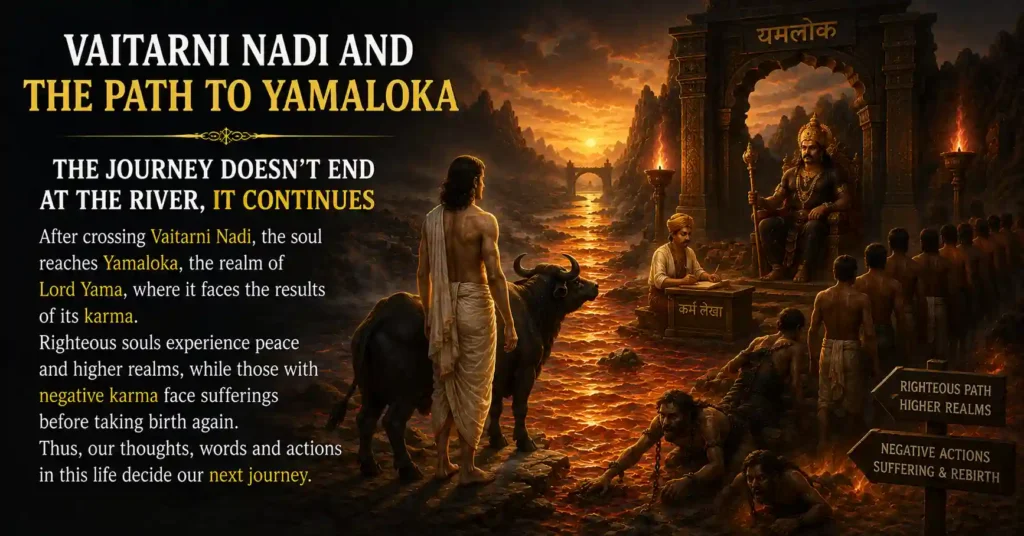
According to traditional Hindu beliefs, crossing the river is not the end of the soul’s journey. It is one stage in a larger process that ultimately leads the soul toward Yamaloka and the judgment of its karma.
After completing this passage, the soul continues its onward journey under the guidance of Yamdoots. Traditional texts describe this phase as a period when the results of one’s actions become increasingly clear.
The soul is then believed to arrive before Yamraj, who represents divine justice and the impartial law of karma. Based on the accumulated balance of paap and punya, the soul experiences the consequences of its actions and moves toward its next destination.
Different scriptures and traditions describe the later stages of this journey in different ways. Some focus on karmic judgment, while others emphasize rebirth, spiritual evolution, or the possibility of liberation.
The central teaching remains consistent: death is not viewed as an ending but as a transition in the soul’s continuing journey through existence.
What Is the Spiritual Meaning of Vaitarni Nadi?
The deeper meaning of Vaitarni Nadi is spiritual awakening. Beyond its descriptions in scripture, it serves as a reminder that life is guided by purpose and that every action carries significance.
The teachings associated with this sacred river emphasize personal responsibility. They remind us that our thoughts, intentions, and actions shape not only our present life but also our spiritual growth.
At its core, the symbolism encourages self-awareness. It invites individuals to look honestly at themselves, recognize their strengths and weaknesses, and strive to live according to dharma.
The journey described in the scriptures also highlights an important truth: nothing remains hidden forever. Wealth, status, and worldly achievements eventually fade, but the values we cultivate and the choices we make continue to matter.
For many spiritual seekers, the river represents the transition from ignorance to understanding and from attachment to wisdom. In this sense, its message is not about fear of death but about living a more conscious and meaningful life.
Ultimately, the spiritual lesson is simple. A life lived with truth, compassion, humility, and awareness becomes the foundation for inner peace and spiritual progress.
What Does Vaitarni Nadi Teach Us About Life?
The concept of Vaitarni Nadi is not only about what happens after death. It also offers important lessons about how we live in the present.
Its teachings remind us that every action has consequences and that our choices shape the path we create for ourselves. Thoughts, intentions, and deeds all contribute to the karma that influences our spiritual journey.
The symbolism of this sacred river encourages individuals to live with greater awareness, honesty, and responsibility. It teaches that true success is measured not only by worldly achievements but also by the values we cultivate and the impact we have on others.
Some of the key lessons associated with this teaching include:
Actions matter.
Intentions matter.
Awareness matters.
Compassion creates positive karma.
Dharma provides direction in life.
Spiritual growth begins with self-reflection.
Even small acts of kindness, truthfulness, and service can leave a lasting impact. In this way, the message of Vaitarni Nadi encourages us to live consciously, perform righteous actions, and strive for inner growth while we have the opportunity.
Conclusion
Vaitarni Nadi occupies an important place in Hindu beliefs about life, death, karma, and the soul’s journey beyond the physical world. Described in the Garuda Purana, it serves as both a stage in the afterlife journey and a powerful spiritual symbol.
Whether understood literally or as a representation of karmic consequences, its message remains the same. Every action, intention, and choice contributes to the path that unfolds before us.
The teachings associated with this sacred river encourage people to live with dharma, compassion, honesty, and self-awareness. They remind us that spiritual growth is shaped not by status or possessions, but by the values we cultivate and the actions we perform throughout life.
Ultimately, the concept of Vaitarni Nadi is not meant to create fear about death. Instead, it invites us to reflect on how we live today, recognizing that a life guided by righteousness, kindness, and wisdom becomes the strongest support for the journey ahead.
Suggested Reading
If you found this article helpful, you may also enjoy exploring other topics related to karma, the soul’s journey after death, rebirth, and spiritual growth in Sanatan Dharma. These articles provide deeper insights into the nature of the soul, the law of karma, and the spiritual principles that guide human life.
- Atma and Paramatma: Understanding the Soul and the Supreme
https://thesanatantales.com/atma-and-parmatma/ - Does the Soul Choose Its Next Journey? The Mystery of Rebirth
https://thesanatantales.com/does-the-soul-choose-its-next-journey/ - Karma Yoga: Meaning, Principles and Path of Selfless Action
https://thesanatantales.com/karma-yoga/ - Ahankara: Meaning, Role and Spiritual Significance in Sanatan Dharma
https://thesanatantales.com/ahankara/ - Sattva, Rajas and Tamas: Understanding the Three Gunas
https://thesanatantales.com/sattva-rajas-tamas/ - Karma: Meaning, Types, Philosophy and How it Works in Sanatan Dharma
https://thesanatantales.com/karma/ - Why Do Hindus Have So Many Gods? The Truth Behind Many Deities in Sanatan Dharma
- https://thesanatantales.com/why-do-hindus-have-so-many-gods/
- Purushartha: The Four Goals of Life in Sanatan Dharma
https://thesanatantales.com/purushartha/ Vaitarani (Wikipedia)
https://en.wikipedia.org/wiki/Vaitarani_(mythology)
FAQs
What is Vaitarni Nadi in Hinduism?
Vaitarni Nadi is a sacred river described in Hindu scriptures, particularly the Garuda Purana, as part of the soul’s journey after death. According to traditional beliefs, the soul encounters this river while traveling toward the realm of Yamraj.
The river is not viewed as an ordinary physical river. Instead, it is described as a spiritual stage where the soul experiences the consequences of its karma. For some souls, crossing it is difficult, while for others it is peaceful and easier.
Many spiritual teachers also interpret it symbolically. In this understanding, the river represents the truth that every individual must eventually face the results of his or her actions.
What happens when the soul reaches Vaitarni Nadi?
According to traditional Hindu beliefs, the soul reaches this sacred river during its journey after death. At this stage, worldly identity, wealth, status, and possessions no longer have any value.
The Garuda Purana explains that the soul experiences the river according to its accumulated karma. Souls burdened by negative actions may find the crossing difficult, while those who lived according to dharma may experience less suffering.
The deeper message is that every action has consequences. The river serves as a reminder that a person’s conduct during life influences the experiences that follow death.
Does every soul have to cross Vaitarni Nadi?
Many Hindu traditions teach that most souls encounter this stage as part of the post-death journey. However, the experience differs from one soul to another depending on karma.
Some spiritual traditions explain that souls who attain moksha, or liberation from the cycle of birth and death, do not undergo the ordinary journey described in scriptures. For such liberated beings, the cycle of rebirth comes to an end.
For most individuals, however, this river symbolizes an important stage in understanding the results of their actions before moving forward on the karmic path.
Why is Vaitarni Nadi described as frightening?
Scriptural descriptions often portray the river as dark, difficult, and filled with suffering. These images are intended to emphasize the seriousness of karma and personal responsibility.
The deeper purpose is not to create fear but to encourage righteous living. Hindu philosophy teaches that the soul cannot escape the consequences of its actions, whether positive or negative.
Many spiritual teachers view these descriptions symbolically. They explain that the river represents the moment when a person must face truth without illusion, attachment, or excuses.
What is the connection between Go Daan and Vaitarni Nadi?
In Hindu tradition, Go Daan (the donation of a cow) is considered one of the most sacred forms of charity. Ancient beliefs associate it with spiritual merit and the welfare of the soul after death.
Traditional teachings state that the punya earned through sincere Go Daan helps the soul during difficult stages of its journey beyond this life. Some descriptions even portray a sacred cow assisting the soul in crossing the river.
Many scholars interpret this symbolically, explaining that the real emphasis is on compassion, generosity, and selfless service. These qualities create positive karma that supports spiritual progress.
What is the role of the Garuda Purana in explaining Vaitarni Nadi?
The Garuda Purana is one of the most important Hindu scriptures discussing the soul’s journey after death. It describes various stages that the soul passes through after leaving the physical body.
Among these stages is the encounter with this sacred river. The scripture explains how karma influences the soul’s experiences and emphasizes the importance of dharma, charity, and righteous conduct.
Its teachings are intended to help people understand the consequences of actions and encourage a life guided by moral and spiritual values.
What do the 13-day rituals after death signify?
The first thirteen days after death are considered an important transitional period in many Hindu traditions. During this time, family members perform rituals such as Shraddha, Tarpan, and Pind Daan to honor the departed soul.
These ceremonies are believed to offer prayers, blessings, and spiritual support. They also provide an opportunity for family members to express gratitude and fulfill religious duties toward the deceased.
Different communities may follow different customs, but the underlying purpose remains the same: seeking peace and well-being for the departed while remembering the impermanence of life.
What spiritual lesson does Vaitarni Nadi teach?
The deeper teaching of Vaitarni Nadi is that actions, intentions, and choices matter. It reminds individuals that life is guided by the law of karma and that every deed leaves an impression.
Beyond its connection with the afterlife, the river symbolizes self-reflection, personal responsibility, and spiritual growth. It encourages people to live with honesty, compassion, self-discipline, and awareness.
Ultimately, its message is not about fearing death. It is about living a meaningful life guided by dharma so that one’s spiritual journey is shaped by wisdom, kindness, and righteous actions.
Glossary of Important Terms
| Term | Meaning |
|---|---|
| Atma (Soul) | The eternal spiritual self that continues to exist beyond physical death according to Sanatan Dharma. |
| Yamraj | The divine ruler of Yamaloka who oversees justice and ensures that every soul experiences the results of its karma. |
| Yamaloka | The realm associated with Yamraj, where souls are believed to proceed after death before their next destination is determined. |
| Yamdoots | The messengers of Yamraj who guide souls on their journey after death according to traditional Hindu beliefs. |
| Karma | The universal law of cause and effect, where every action, thought, and intention produces corresponding results. |
| Dharma | Righteous conduct, moral duty, and the path of living in harmony with spiritual and ethical principles. |
| Paap | Negative actions or deeds that create unfavorable karmic consequences. |
| Punya | Virtuous actions that generate positive karma and spiritual merit. |
| Moksha | Liberation from the cycle of birth, death, and rebirth, considered the ultimate goal of spiritual life. |
| Samsara | The continuous cycle of birth, death, and rebirth through which the soul evolves based on karma. |
| Garuda Purana | A Hindu scripture that discusses the soul’s journey after death, karma, rituals, and spiritual teachings. |
| Vaitarni Nadi | The sacred river described in Hindu scriptures that the soul encounters during its journey after death. |
| Go Daan | The donation of a cow, regarded as one of the most sacred forms of charity in Hindu tradition. |
| Shraddha | Rituals performed in remembrance of deceased ancestors to express gratitude and seek peace for their souls. |
| Tarpan | The offering of water and prayers to ancestors as an act of respect and remembrance. |
| Pind Daan | A ritual offering made for departed souls, traditionally performed to support their onward journey. |
| Rebirth (Punarjanma) | The belief that the soul takes a new birth after death according to its accumulated karma. |
| Afterlife Journey | The spiritual path that the soul is believed to travel after leaving the physical body. |
| Spiritual Merit | Positive karmic benefits earned through righteous actions, charity, devotion, and selfless service. |
| Liberation | Another term for moksha, the state of freedom from worldly attachments and the cycle of rebirth. |
About the Author
Yateendra Chaturvedi is a spiritual writer, researcher, devotee, and the founder of The Sanatan Tales. With over 35 years of professional experience and a lifelong interest in Sanatan Dharma, he writes about Hindu deities, temples, scriptures, festivals, Mahavidyas, sacred stories, rituals, and living traditions that continue to guide and inspire devotees across India.
Drawing from traditional scriptures, regional beliefs, temple traditions, devotional literature, and historical sources, he aims to present authentic, well-researched, and easy-to-understand content for modern readers. His work focuses on preserving spiritual wisdom, explaining sacred traditions, and helping seekers develop a deeper understanding of India’s rich spiritual heritage.
Through The Sanatan Tales, Yateendra strives to make the timeless teachings of Sanatan Dharma simple, meaningful, and relevant for today’s generation while maintaining respect for traditional sources, regional practices, and diverse spiritual perspectives.
Learn More About Yateendra Chaturvedi →
https://thesanatantales.com/about-the-author/
References & Sources
This article is based on traditional beliefs and teachings found in Hindu scriptures, particularly the Garuda Purana, as well as concepts related to karma, rebirth, Yamaloka, Shraddha rituals, and the soul’s journey after death in Sanatan Dharma. The article also draws upon traditional interpretations preserved through religious literature, spiritual discourse, and the guru-disciple tradition.
Note: Beliefs and interpretations regarding the afterlife, Vaitarni Nadi, Yamraj, and the soul’s journey may vary across different scriptures, regions, sects, and traditions within Sanatan Dharma. The purpose of this article is to present widely known religious and spiritual perspectives in a simple and accessible manner and should not be considered a definitive or universally accepted interpretation.
Read More Interesting Articles on Sanatan Dharma

This article provides a thoughtful and insightful perspective on one of life’s greatest mysteries, encouraging deep reflection and understanding.
Thanks Nagendra for encouraging words.