Mantra Japa is one of the simplest and oldest spiritual practices in Sanatan Dharma. It does not require wealth, extensive learning, or elaborate rituals. All it asks for is sincerity, regularity, and the heartfelt repetition of a sacred mantra.
For centuries, devotees have practiced mantra chanting in homes, temples, ashrams, forests, and other peaceful places. Some chant aloud, some whisper softly, while others repeat the mantra silently in the mind. Though simple in appearance, this sacred practice gradually develops inner discipline, concentration, and unwavering faith.
In this guide, you will learn the meaning of Mantra Japa, its different types, the correct method of practice, traditional rules, spiritual benefits, common mistakes to avoid, and how to make it a meaningful part of your daily life. Whether you are a beginner or an experienced devotee, this article will help you understand the practice from both a practical and traditional perspective.
This timeless tradition is not limited to monks or advanced spiritual seekers. Householders, students, elders, and even children can include it in their daily spiritual practice according to their faith and ability.
Whether performed with a japa mala or through silent mental repetition, this ancient discipline slowly becomes a natural part of everyday life. With patience and consistency, it transforms ordinary moments into opportunities for devotion, mindfulness, and inner peace.
Mantra Japa at a Glance
| Aspect | Details |
|---|---|
| Meaning | Repetition of a sacred mantra with devotion and concentration |
| Sanskrit Term | मन्त्र जप (Mantra Japa) |
| Purpose | Spiritual growth, inner peace, meditation, and devotion |
| Best Time | Brahma Muhurta, sunrise, sunset, or any quiet time |
| Methods | Vachika, Upanshu, Manasika, Ajapa Japa |
| Traditional Count | 108 repetitions using a japa mala |
| Ideal Place | Home temple, meditation room, temple, or any clean and peaceful place |
| Suitable For | Beginners, householders, students, and spiritual seekers |
| Main Benefits | Improves concentration, reduces stress, strengthens devotion, and prepares the mind for meditation |
Table of Contents
ToggleWhat Is Mantra Japa? Meaning and Spiritual Significance
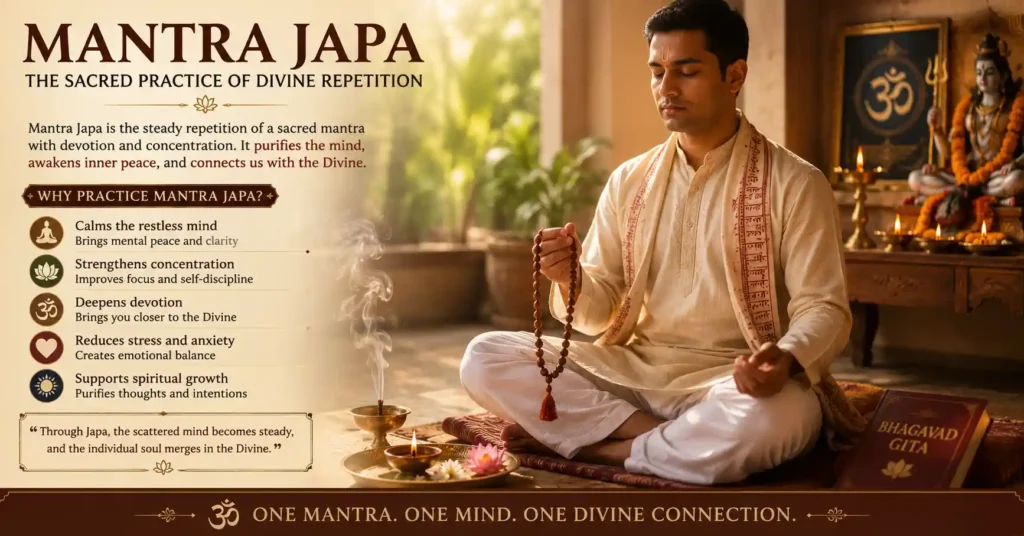
The word mantra comes from the Sanskrit roots man (to think or reflect) and tra (that which protects or liberates). Japa means the repeated chanting or silent repetition of a sacred mantra. Together, Mantra Japa refers to the mindful repetition of a divine sound, word, or phrase with devotion and concentration.
Unlike ordinary repetition, this sacred practice is not mechanical or merely about completing a certain number of chants. The true purpose is to absorb the mind in the mantra so that every repetition deepens awareness and strengthens one’s connection with the Divine.
As the mantra is repeated regularly, restless thoughts begin to settle, distractions gradually reduce, and the mind learns to return to a single point of focus. This is why mantra meditation is regarded as an effective way to cultivate inner peace, discipline, and spiritual awareness.
In Sanatan Dharma, the power of a mantra lies not only in its sound but also in the devotion, faith, and consistency with which it is practiced. Over time, this ancient discipline becomes a natural bridge between bhakti (devotion) and dhyana (meditation), helping the practitioner experience greater mental clarity and spiritual growth.
Types of Mantra Japa
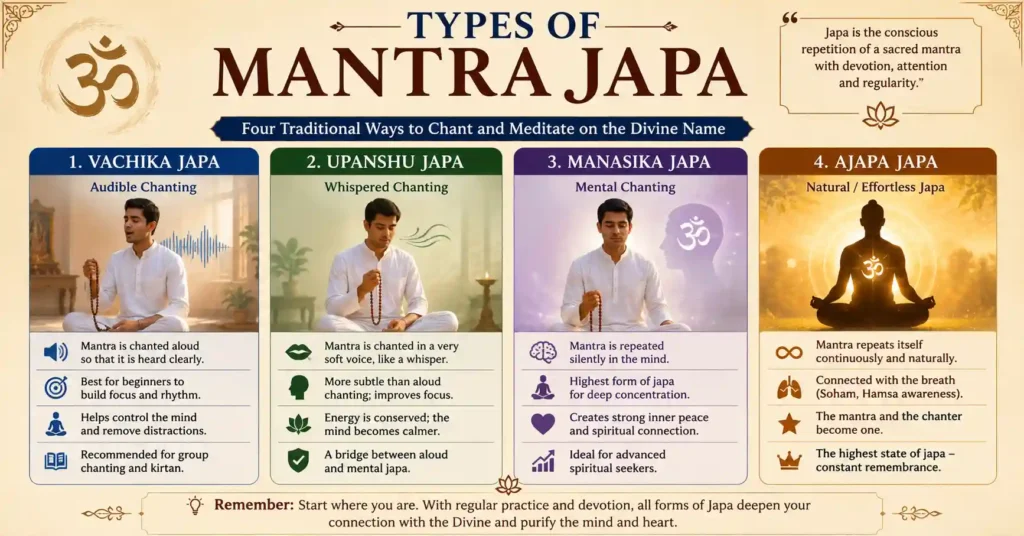
Sanatan Dharma describes different ways of practicing Mantra Japa, each suitable for different stages of spiritual practice. While the goal remains the same—remembering the Divine with devotion and concentration—the method of repetition can vary according to one’s experience and level of spiritual growth.
| Type | How It Is Practiced | Best For |
|---|---|---|
| Vachika Japa | Chanting the mantra aloud with clear pronunciation. | Beginners learning correct pronunciation and concentration. |
| Upanshu Japa | Repeating the mantra in a soft whisper that is audible only to oneself. | Devotees seeking greater focus with minimal distraction. |
| Manasika Japa | Repeating the mantra silently in the mind without moving the lips. | Experienced practitioners and meditation. |
| Ajapa Japa | The effortless remembrance of the mantra that continues naturally without conscious repetition. | Advanced spiritual seekers after long and sincere practice. |
Most beginners naturally start with Vachika Japa or Upanshu Japa, as speaking or whispering the mantra helps maintain concentration. With regular practice, many gradually progress to Manasika Japa, where the repetition becomes quieter, subtler, and more inward.
Traditional texts describe Ajapa Japa as the highest stage, where the remembrance of the Divine becomes continuous and effortless. It is not achieved through force but develops naturally through years of sincere devotion and disciplined practice.
At a Glance: Which Type of Japa Is Right for You?
| Type | Sound | Difficulty | Best For |
|---|---|---|---|
| Vachika Japa | Audible | Easy | Beginners learning correct pronunciation |
| Upanshu Japa | Soft whisper | Moderate | Daily spiritual practice |
| Manasika Japa | Silent | Advanced | Meditation and deeper concentration |
| Ajapa Japa | Effortless inner remembrance | Advanced | Experienced spiritual seekers |
This progression shows that there is no “better” type of Mantra Japa for everyone. Beginners should choose the method that helps them remain focused and consistent, while more experienced practitioners may naturally move toward subtler forms of chanting as their devotion and concentration deepen.
How to Choose the Right Mantra for Japa
Choosing the right mantra is an important step in beginning a meaningful Mantra Japa practice. While there are countless sacred mantras in Sanatan Dharma, the best mantra is often the one that inspires faith, devotion, and regular practice.
Traditionally, many seekers receive a mantra from a Guru, who selects it according to the disciple’s spiritual path and readiness. Others follow the mantra worshipped in their family or choose the name of their Ishta Devata (chosen deity), such as Lord Shiva, Lord Vishnu, Goddess Durga, Lord Ganesha, or Lord Hanuman.
If you are new to mantra chanting, it is perfectly acceptable to begin with a simple and widely practiced mantra. What matters most is chanting with sincerity rather than searching endlessly for the “perfect” mantra.
Some popular mantras for beginners include:
| Mantra | Associated Deity |
|---|---|
| Om Namah Shivaya | Lord Shiva |
| Om Namo Bhagavate Vasudevaya | Lord Vishnu |
| Om Shri Ganeshaya Namah | Lord Ganesha |
| Om Dum Durgayei Namah | Goddess Durga |
| Hare Krishna Mahamantra | Lord Krishna |
Once you choose a mantra, continue practicing it regularly instead of changing it frequently. Consistency allows the mind to develop deeper concentration and gradually strengthens your spiritual connection with the Divine.
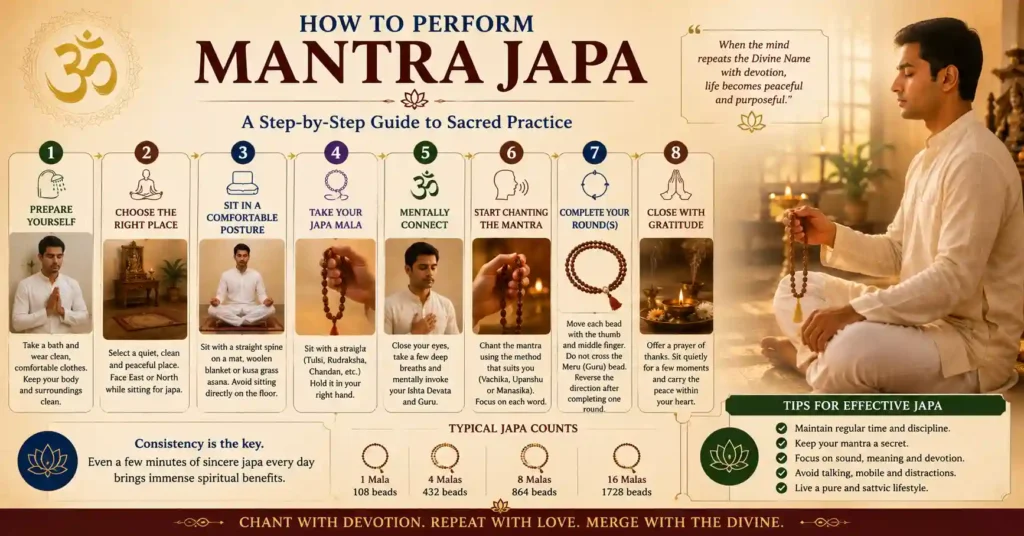
How to Do Mantra Japa: The Traditional Method
There is no single rigid method for Mantra Japa, but the traditional practice follows a simple and disciplined approach. A sacred mantra is usually received from a Guru, family tradition, or chosen with sincere faith and devotion.
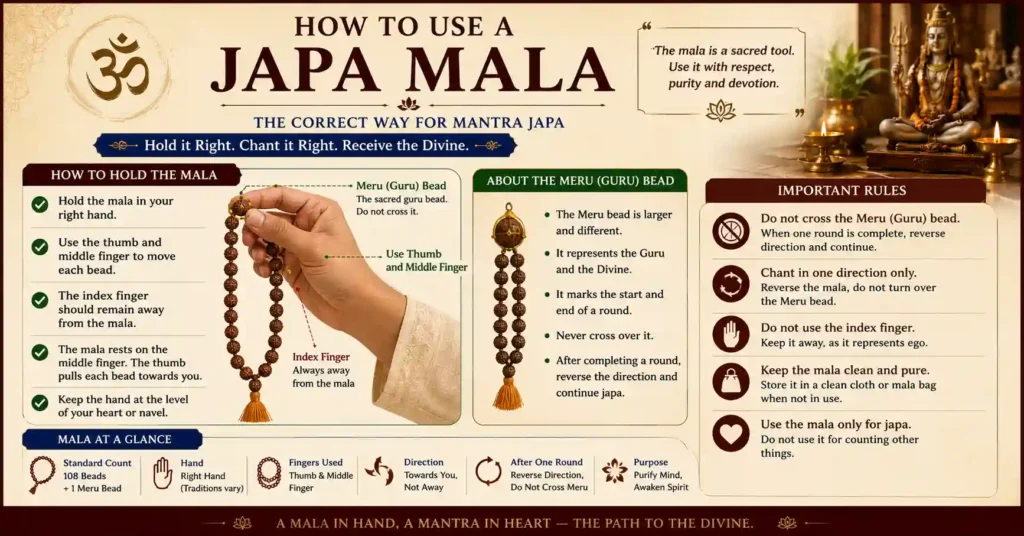
Many devotees use a japa mala with 108 beads to keep count, while others repeat the mantra for a fixed duration. The mala helps maintain focus and prevents the mind from wandering during the practice.
The chanting can be performed in three ways:
- Aloud (Vachika Japa) for clear pronunciation and concentration.
- Softly (Upanshu Japa) where only the practitioner can hear the mantra.
- Silently (Manasika Japa) by repeating the mantra mentally without moving the lips.
Beginners often find audible or whispered chanting easier because it helps develop concentration. As the mind becomes steadier, many naturally progress to silent repetition, which is considered deeper and more meditative.
Rather than rushing to complete a fixed number of repetitions, focus on chanting each mantra with attention, devotion, and correct pronunciation. Consistency is more important than speed, and even a few minutes of sincere daily practice can be spiritually rewarding.
💡 Beginner’s Tip
If you are just starting, choose one simple mantra and chant it for 5–10 minutes every day. Do not worry about completing 108 repetitions initially. Building a daily habit with sincerity and concentration is far more important than achieving a large count.
Best Time and Place for Mantra Japa
Mantra Japa can be practiced at any time with sincerity and concentration. However, the early morning during Brahma Muhurta (before sunrise) and the peaceful hours of dawn and dusk are traditionally considered the most auspicious for mantra chanting, as the mind is naturally calm and receptive.
Many devotees also practice in the evening after completing their daily responsibilities. Others quietly repeat a sacred mantra while walking, cooking, travelling, or sitting in a temple. This shows that devotional chanting can become a natural part of everyday life rather than a separate ritual.
In traditional Hindu homes, elders often dedicate time to this practice during sunrise or sunset. Even today, temples, ashrams, and pilgrimage sites echo with the gentle sound of sacred mantras, reflecting a living tradition that has continued for centuries.
While a clean and peaceful place helps improve concentration, it is regularity that matters most. Even 5 to 15 minutes of sincere daily practice can gradually strengthen focus, devotion, and inner peace.
Traditional Rules for Mantra Japa
Although Mantra Japa is a simple and accessible spiritual practice, Sanatan tradition recommends a few basic guidelines to help maintain purity, concentration, and consistency. These are not rigid obligations but time-tested practices that support a deeper spiritual experience.
Some commonly followed guidelines include:
- Choose a clean and peaceful place for chanting.
- Sit comfortably with your spine straight to remain alert and focused.
- Practice at the same time each day whenever possible.
- Use the same mantra consistently instead of changing it frequently.
- Chant with devotion, patience, and a calm mind rather than in haste.
- If using a japa mala, hold it traditionally with the thumb and middle finger, avoiding the index finger.
It is also beneficial to avoid anger, excessive distractions, or negative thoughts during the practice, as a peaceful state of mind helps deepen concentration and devotion.
Remember that these traditional guidelines are meant to cultivate self-discipline, not fear or rigidity. Sincere faith, regular practice, and a pure intention are far more important than achieving external perfection.
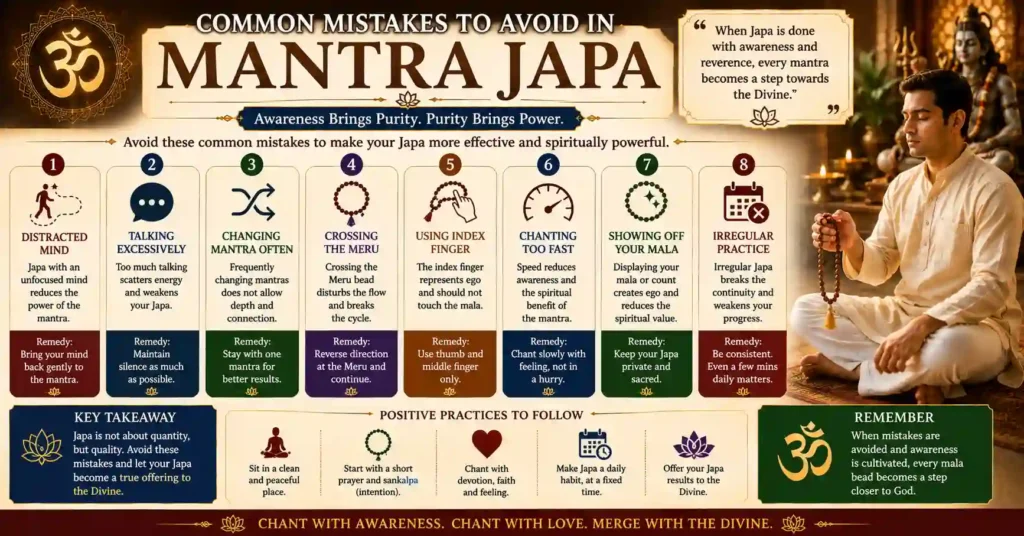
Common Mistakes to Avoid During Mantra Japa
While Mantra Japa is a simple spiritual practice, beginners often make small mistakes that can reduce their concentration and consistency. The purpose of these guidelines is not to create fear but to help cultivate a more meaningful and disciplined practice.
Some common mistakes include:
- Changing mantras frequently instead of practicing one mantra with faith and consistency.
- Rushing to complete a fixed count rather than chanting with attention and devotion.
- Treating the practice as a mechanical routine instead of remembering the Divine with sincerity.
- Practicing irregularly, making it difficult to develop focus and discipline.
- Expecting immediate results and becoming discouraged if spiritual or mental changes are not noticed quickly.
- Allowing distractions such as mobile phones or conversations to interrupt the practice.
- Ignoring correct pronunciation when learning a new mantra, especially Vedic mantras.
Remember that perfection is not the goal. Even if mistakes occur, continue your practice with humility, patience, and devotion. Over time, regular chanting naturally improves concentration, pronunciation, and inner awareness.
Spiritual and Mental Benefits of Mantra Japa
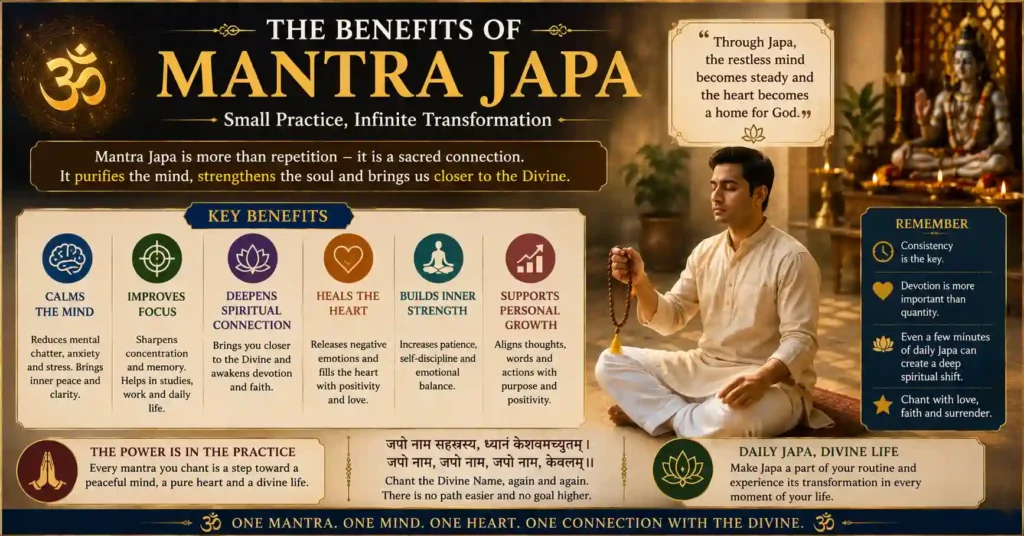
The benefits of Mantra Japa are often experienced gradually through regular and sincere practice. Rather than bringing instant results, this sacred discipline slowly transforms the mind, emotions, and spiritual outlook of the practitioner.
Many devotees notice improved concentration, greater mental calm, and reduced restlessness. As the mind becomes more focused on the sacred mantra, everyday stress, anxiety, and emotional disturbances begin to lose their hold, creating a greater sense of inner balance.
On a deeper spiritual level, mantra chanting strengthens devotion, faith, and trust in the Divine. During times of uncertainty, sorrow, or personal challenges, the repeated remembrance of the mantra becomes a source of comfort, courage, and inner strength.
Traditional scriptures also describe this practice as a means of purifying thoughts, speech, and intentions. With consistent practice, it prepares the mind for meditation (dhyana), self-reflection, and a deeper understanding of spiritual truths.
Scriptural Significance of Mantra Japa
The spiritual importance of Mantra Japa is highlighted throughout the sacred scriptures of Sanatan Dharma. The Vedas, Upanishads, Bhagavad Gita, and Puranas all emphasize the power of remembering the Divine through sincere devotion, disciplined practice, and the repetition of sacred mantras.
The Bhagavad Gita teaches that regular spiritual discipline and constant remembrance of God help purify the mind and lead a seeker toward inner peace and self-realization. Similarly, many Puranas and Bhakti traditions praise Nama Japa, or the repetition of the Divine Name, as one of the simplest and most effective paths to spiritual progress, especially in the present age.
Over the centuries, saints, sages, and spiritual teachers have encouraged devotees to practice mantra chanting with faith rather than merely as a ritual. Although different traditions may recommend different mantras, they all share the same principle: sincere and consistent repetition gradually deepens devotion, improves concentration, and strengthens one’s connection with the Divine.
Benefits at a Glance
| Area | Benefits |
|---|---|
| Mental | Improves concentration and mental clarity |
| Emotional | Reduces stress, anxiety, and restlessness |
| Spiritual | Deepens devotion and strengthens faith |
| Personal | Encourages patience, discipline, and positive thinking |
| Meditative | Prepares the mind for deeper meditation and self-awareness |
The Timeless Tradition of Mantra Japa
Mantra Japa has remained a cherished spiritual practice in Sanatan Dharma for thousands of years because of its simplicity, accessibility, and profound spiritual value. From the Vedic sages and temple traditions to saints, householders, and modern practitioners, its essence has remained unchanged.
Across generations, this sacred practice has been passed down through the Guru-Shishya tradition, family customs, and personal spiritual experience. Parents teach it to children, teachers guide their students, and devotees embrace it as a lifelong path of devotion and self-discipline.
In many Hindu households, the gentle sound of mantra chanting can still be heard at dawn and dusk, continuing a rhythm that has been preserved for centuries. This living tradition blends naturally with everyday life and does not require one to withdraw from worldly responsibilities.
Its enduring legacy lies not in ritual alone but in the inner transformation it brings. Through regular practice, faith, and personal experience, this timeless discipline continues to inspire peace, devotion, and spiritual growth in every generation.
Did You Know?
Many Hindu saints and spiritual traditions teach that the quality of mantra chanting is more important than the quantity. Even a few minutes of sincere Mantra Japa practiced daily with faith and concentration are considered more spiritually beneficial than thousands of distracted repetitions.
Common Doubts About Mantra Japa
Many beginners worry about pronunciation, mistakes, or a lack of concentration. While correct pronunciation is beneficial, Sanatan tradition teaches that sincerity, devotion, and regular practice are more important than perfection. A mantra bears its greatest fruit when repeated with faith and a pure intention.
Another common question is whether one mantra is better than another. In most cases, the mantra received from a Guru, followed through family tradition, or chosen with genuine devotion is the most suitable. Constantly changing mantras can make it difficult to develop steadiness and deeper concentration.
Some people also wonder if they must complete a fixed number of repetitions every day. While using a japa mala with 108 beads is a traditional method, beginners can start with a smaller count or a few minutes of daily chanting. Regularity is more valuable than a large number of repetitions performed without attention.
It is natural for the mind to wander during practice, especially in the beginning. Instead of becoming discouraged, gently bring your attention back to the mantra each time it drifts. Over time, this simple habit strengthens focus, patience, and inner peace.
Conclusion
Mantra Japa is not about achieving perfection. It is about showing up every day, even for a few minutes, and gently turning your mind toward the Divine. With love, patience, and regular practice, this sacred discipline gradually becomes part of your breath, your thoughts, and your way of life.
Over time, mantra chanting calms the mind, softens the heart, and nurtures quiet inner strength. While it may not change the circumstances around you overnight, it transforms the way you respond to them. Worries become lighter, faith grows deeper, and life begins to unfold with greater awareness, balance, and peace.
Whether you chant aloud, whisper softly, or repeat a sacred mantra silently, what matters most is sincerity and devotion. Even a simple mantra, practiced consistently, has the power to inspire lasting inner transformation.
May this timeless tradition guide you toward greater peace, unwavering faith, and a deeper connection with the Divine, one sacred repetition at a time.
 Join the Conversation
Have you started practicing Mantra Japa? Share your experience, favorite mantra, or any questions in the comments below. Your thoughts may inspire fellow devotees and encourage others on their spiritual journey.
Suggested Reading
If you found this guide on Mantra Japa helpful, you may also enjoy these related articles on Sanatan Dharma rituals, worship, sacred traditions, and spiritual practices:
Puja in Sanatan Dharma: Meaning, Vidhi, Bhav and Spiritual Significance
https://thesanatantales.com/puja-in-sanatan-dharma/Daily Puja at Home: Simple Step-by-Step Guide for Everyday Worship
https://thesanatantales.com/daily-puja-at-home/Panchopchar Pujan: The Five Sacred Offerings in Hindu Worship
https://thesanatantales.com/panchopchar-pujan/Havan in Sanatan Dharma: Meaning, Benefits and Complete Vidhi
https://thesanatantales.com/havan/How to Perform Abhishek to Shivling: Complete Vidhi and Significance
https://thesanatantales.com/abhishek-to-shivling/Prasad in Hinduism: Why Food Offered to God Becomes Sacred
https://thesanatantales.com/prasad-in-hinduism/Tilak in Hinduism: Meaning, Types and Spiritual Significance
https://thesanatantales.com/tilak-in-hinduism/Janeu (Yajnopavita): Meaning, Rules and Spiritual Importance
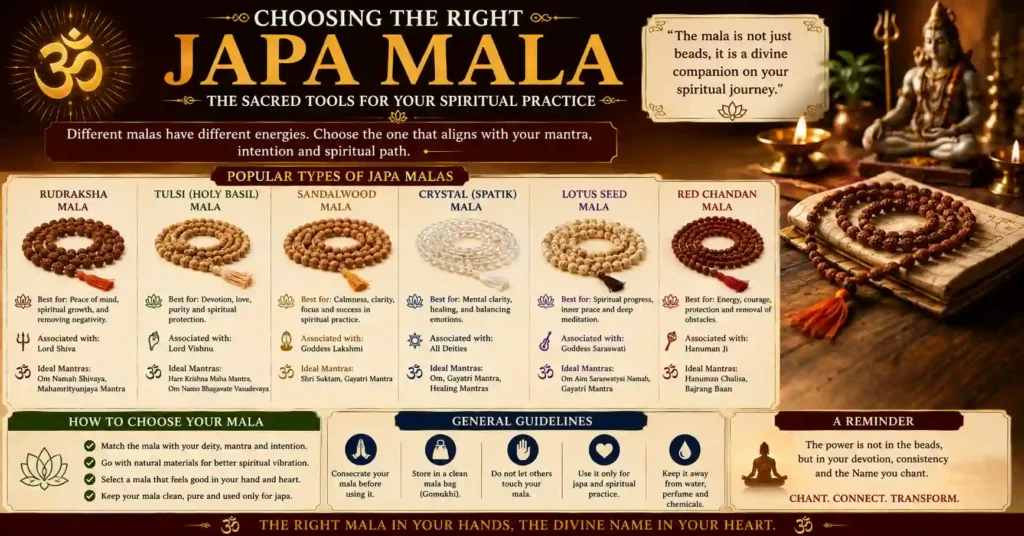
https://thesanatantales.com/janeu/Rudraksha: Meaning, Benefits and How to Wear It
https://thesanatantales.com/rudraksha/Kul Devta and Kul Devi: Meaning, Importance and Worship
https://thesanatantales.com/kul-devta-kul-devi/Japa (Wikipedia)
These articles will help you deepen your understanding of daily worship, mantra chanting, sacred rituals, and the spiritual traditions of Sanatan Dharma, making them ideal companions to your study of Mantra Japa.
FAQs
What is Mantra Japa?
Mantra Japa is the repeated chanting or silent repetition of a sacred mantra with devotion, concentration, and faith. In Sanatan Dharma, it is regarded as one of the simplest yet most powerful spiritual practices for calming the mind, strengthening devotion, and developing inner awareness.
The repetition may be done aloud, in a soft whisper, or silently within the mind. Some devotees use a japa mala with 108 beads to maintain count, while others chant for a fixed period of time. The true purpose is not merely repeating words but allowing the mantra to become a means of connecting with the Divine.
Why is Mantra Japa important in Sanatan Dharma?
This sacred practice has been followed for thousands of years by sages, saints, householders, and spiritual seekers. It is considered a simple path that anyone can follow, regardless of age, education, or social background.
Regular mantra chanting helps purify the mind, cultivate devotion, improve concentration, and prepare the practitioner for deeper meditation. It also encourages self-discipline and reminds devotees to keep the Divine present in their daily lives.
Can anyone practice Mantra Japa?
Yes. Mantra Japa can be practiced by anyone regardless of age, gender, or level of spiritual experience. It does not require elaborate rituals or special qualifications, making it suitable for beginners as well as experienced devotees.
If possible, receiving a mantra from a qualified Guru is considered ideal. However, many people also begin with traditional mantras learned through family traditions or personal devotion and gradually deepen their practice through regular chanting.
What is the best time to do Mantra Japa?
The most auspicious time is Brahma Muhurta, about one and a half hours before sunrise, when the mind is naturally peaceful and free from distractions.
If early morning is not practical, chanting during sunrise, sunset, or before bedtime is also beneficial. More important than the time itself is maintaining a consistent daily routine.
Is it necessary to use a Japa Mala?
No. A japa mala is a traditional aid but is not compulsory. It helps maintain count, improves concentration, and prevents the mind from wandering during the practice.
If you do not have a mala, you can chant mentally, count by time, or repeat the mantra a fixed number of times. Sincerity and regularity are always more important than the method of counting.
Which mantra should a beginner choose?
A beginner should ideally practice a mantra received from a Guru, family tradition, or one that inspires genuine faith and devotion.
Instead of changing mantras frequently, it is better to stay with one sacred mantra and repeat it consistently. This helps deepen concentration and allows the practice to become more meaningful over time.
How many times should a mantra be repeated every day?
There is no single rule for everyone. Traditionally, many devotees complete 108 repetitions using a japa mala, while beginners may start with 11, 21, or 27 repetitions according to their comfort.
You can also practice for 5 to 15 minutes each day. Even a short period of sincere daily chanting brings greater benefits than occasional long sessions.
Can Mantra Japa be done silently?
Yes. Traditional teachings describe three methods of practice: Vachika Japa (chanting aloud), Upanshu Japa (soft whisper), and Manasika Japa (mental repetition).
Beginners usually find audible or whispered chanting easier because it helps maintain concentration. With regular practice, many naturally progress to silent repetition, which is considered more inward and meditative.
What are the benefits of regular mantra chanting?
Regular mantra chanting helps improve concentration, reduce mental restlessness, and bring emotional balance. It also nurtures patience, self-discipline, and a sense of inner peace.
Spiritually, it strengthens devotion, purifies thoughts, and prepares the mind for meditation. Over time, this daily practice becomes a lifelong source of strength, faith, and spiritual growth.
Is perfect pronunciation necessary for Mantra Japa?
Correct pronunciation is desirable, especially for Vedic mantras, as it preserves their traditional sound and meaning.
However, for most devotional mantras, sincere faith, devotion, and regular practice are more important than absolute perfection. Rather than worrying about mistakes, continue chanting with humility while gradually improving your pronunciation through learning and practice.
Glossary of Important Terms
| Term | Meaning |
|---|---|
| Mantra | A sacred sound, word, or phrase repeated during worship or meditation to focus the mind and invoke divine blessings. |
| Mantra Japa | The repeated chanting or silent repetition of a sacred mantra with devotion, concentration, and faith as a spiritual practice. |
| Japa | The continuous repetition of a mantra, either aloud, softly, or mentally, as an act of worship and meditation. |
| Japa Mala | A string of prayer beads, traditionally containing 108 beads, used to count mantra repetitions during chanting. |
| Guru Bead (Meru Bead) | The larger or distinctive bead on a japa mala that marks the starting and ending point. It is traditionally not crossed while counting. |
| Vachika Japa | Chanting the mantra aloud so that it is clearly audible. This method is often recommended for beginners. |
| Upanshu Japa | Repeating the mantra in a soft whisper, audible only to the practitioner. It promotes deeper concentration. |
| Manasika Japa | Mentally repeating the mantra without moving the lips or producing sound. It is considered the most subtle and inward form of japa. |
| Ajapa Japa | The spontaneous, effortless remembrance of a mantra that continues naturally without conscious repetition, often associated with advanced spiritual practice. |
| Brahma Muhurta | The sacred period approximately 1½ hours before sunrise, considered the most auspicious time for meditation, mantra chanting, and spiritual practices. |
| Guru | A spiritual teacher who guides a disciple on the path of knowledge, devotion, and self-realization, often giving a mantra for personal practice. |
| Dhyana | Meditation or deep contemplation in which the mind becomes steadily focused on a single object or the Divine. |
| Bhakti | Loving devotion and complete surrender to God through prayer, worship, chanting, and righteous living. |
| Sadhana | A regular spiritual discipline or daily practice undertaken to achieve inner growth, self-purification, and realization of the Divine. |
| Ishta Devata | The personal deity or chosen form of God toward whom a devotee offers worship and spiritual devotion. |
| Nama Japa | The repetition of the Divine Name, such as “Rama,” “Krishna,” or “Shiva,” as a form of devotional practice. |
| Sankalpa | A sincere spiritual resolve or intention made before beginning a religious practice, expressing the purpose of the worship or chanting. |
| Pranayama | Yogic breathing techniques used to regulate the breath, calm the mind, and prepare for meditation or mantra practice. |
| Sanatan Dharma | The eternal spiritual tradition of Hinduism that encompasses its philosophy, rituals, scriptures, values, and way of life. |
About the Author
Yateendra Chaturvedi is a spiritual writer, researcher, devotee, and the founder of The Sanatan Tales. With over 35 years of professional experience and a lifelong interest in Sanatan Dharma, he writes about Hindu deities, temples, scriptures, festivals, Mahavidyas, sacred stories, rituals, and living traditions that continue to guide and inspire devotees across India.
Drawing from traditional scriptures, regional beliefs, temple traditions, devotional literature, and historical sources, he aims to present authentic, well-researched, and easy-to-understand content for modern readers. His work focuses on preserving spiritual wisdom, explaining sacred traditions, and helping seekers develop a deeper understanding of India’s rich spiritual heritage.
Through The Sanatan Tales, Yateendra strives to make the timeless teachings of Sanatan Dharma simple, meaningful, and relevant for today’s generation while maintaining respect for traditional sources, regional practices, and diverse spiritual perspectives.
Learn More About Yateendra Chaturvedi →
https://thesanatantales.com/about-the-author/
References & Sources
This article is based on the teachings, beliefs, and traditions of Sanatan Dharma, along with references from Hindu scriptures, Puranas, Smritis, traditional commentaries, temple traditions, and knowledge preserved through the Guru-Shishya (teacher-disciple) tradition. It also draws upon widely accepted religious practices, spiritual literature, and scholarly resources related to Hindu philosophy and worship.
Note: Beliefs, customs, rituals, and interpretations may vary across different sampradayas (traditions), regions, temples, and lineages within Sanatan Dharma. The purpose of this article is not to establish any one interpretation as the only truth, but to present widely accepted spiritual and religious perspectives in a simple, respectful, and easy-to-understand manner for educational and devotional purposes.
Read More Interesting Articles on Sanatan Dharma