Across India, almost every village has a sacred place dedicated to a guardian deity believed to protect the land, its people, livestock, crops, and community traditions. These guardian deities are known by different names, such as Gram Devta, Kshetrapal, Gram Bhairav, or local protector deities, depending on the region.
Although their names and forms vary, their purpose remains the same. They are revered as divine guardians who safeguard villages, sacred spaces, and the well-being of the community, making them an enduring part of Sanatan Dharma.
Among these guardian deities, Bhairav holds a unique place. In many parts of India, especially across North Indian villages, he is not worshipped only as a fierce form of Lord Shiva described in scriptures.
Instead, Bhairav is experienced as a Kshetrapal, a Gram Devta, and a silent guardian who watches over village boundaries, temples, and the moral order of society. His worship reflects a living tradition where protection, faith, and everyday life are deeply connected.
These traditions are not confined to temples or ancient texts. They continue through village shrines, oral histories, seasonal festivals, local rituals, and community practices that have been preserved across generations.
To understand Gram Devta, Kshetrapal, and Bhairav, one must look beyond scriptures and explore the living traditions of India’s villages. Here, devotion is woven into daily life, preserving a timeless relationship between sacred land, community, and faith.
In this article, you will learn who Gram Devtas, Kshetrapals, and Gram Bhairav are, how they differ from Kuldevta and Ishta Devta, and why these guardian deity traditions continue to thrive across India.
You will also discover their origins, regional variations, connection with Bhairav worship, role in village life, and their enduring relevance in modern times. By the end, you’ll understand how protection, land, devotion, and community come together in one of the oldest living traditions of Sanatan Dharma.
Quick Facts
| Quick Fact | Details |
|---|---|
| Tradition | Guardian Deity Worship |
| Primary Guardian | Bhairav (in many regions) |
| Other Names | Kshetrapal, Gram Bhairav, Village Guardian Deity |
| Associated With | Village protection, temple boundaries, sacred spaces |
| Worshipped By | Local communities across India |
| Main Purpose | Protection, justice, harmony, and spiritual guardianship |
Table of Contents
ToggleHow Did the Tradition of Gram Devta and Kshetrapal Begin?
The tradition of Gram Devta and Kshetrapal is believed to be as old as settled village life in India. Long before the construction of grand temples, communities worshipped guardian deities to seek protection for their land, homes, water sources, livestock, and crops.
As agriculture and permanent settlements grew, villages established shrines at their boundaries or near sacred trees, hills, rivers, and crossroads. These guardian deities were believed to protect the village from natural calamities, negative influences, and preserve harmony within the community.
Over time, these local guardian traditions became closely connected with the broader spiritual traditions of Sanatan Dharma. In different regions, they came to be identified with forms of Shiva, Shakti, Vishnu, or revered local heroes, while retaining their role as protectors of the land and its people.
Among these guardian deities, Bhairav emerged as one of the most widely revered Kshetrapals. As a fierce manifestation of Lord Shiva, he became associated with guarding sacred spaces, temple entrances, pilgrimage sites, and village boundaries. This is why many communities, especially in North India, worship Gram Bhairav as both a Gram Devta and a Kshetrapal.
Today, the traditions of Gram Devta, Kshetrapal, and Bhairav continue across India, reflecting the enduring belief that every village, sacred place, and community flourishes under divine protection.
Bhairav as Kshetrapal and Gram Devta
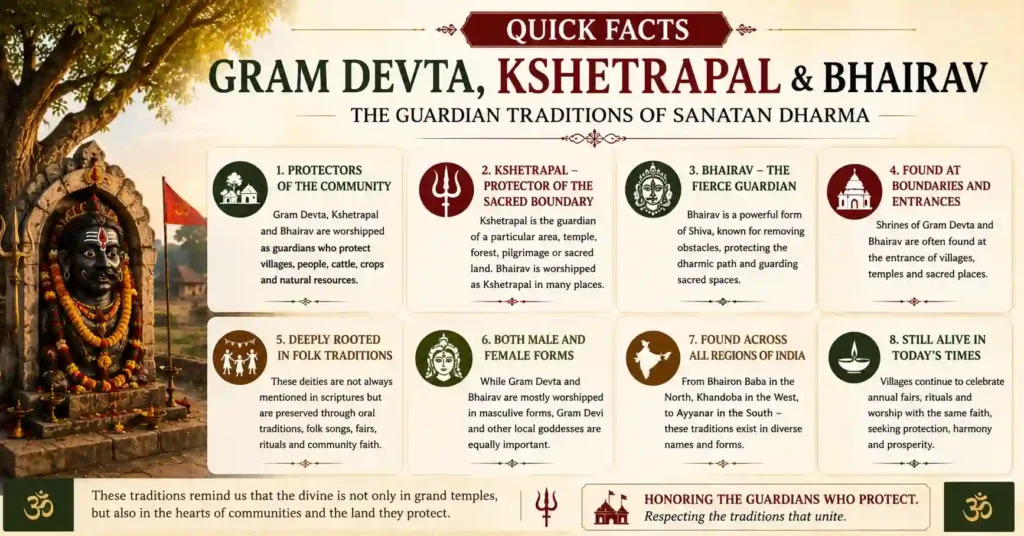
In many parts of India, especially across North India, Bhairav is worshipped in two closely connected roles: as a Kshetrapal and as a Gram Devta. These roles reflect his responsibility as both the guardian of sacred boundaries and the protector of the village community.
As a Kshetrapal, Bhairav is believed to guard the physical and spiritual limits of a place. His shrines are often found at village entrances, temple gateways, crossroads, hill paths, cremation grounds, or other boundary locations, symbolizing his role in protecting the land from negative influences and maintaining sacred order.
As a Gram Devta, Bhairav becomes the village’s own guardian deity. He is invoked before important festivals, harvests, community gatherings, and other significant occasions. In many regions, devotees first offer prayers to Bhairav before beginning major religious ceremonies, seeking his blessings for protection and the successful completion of the event.
These two roles make Bhairav both revered and approachable. While his fierce form inspires respect, his presence as a guardian reassures devotees that the village, its people, and its sacred traditions remain under divine protection.
This unique combination of Kshetrapal and Gram Devta explains why Bhairav worship continues as a living tradition. It is not limited to temples or festivals but remains deeply woven into everyday village life and the spiritual heritage of Sanatan Dharma.
How Are Gram Devta, Kshetrapal, Kuldevta, and Ishta Devta Different?
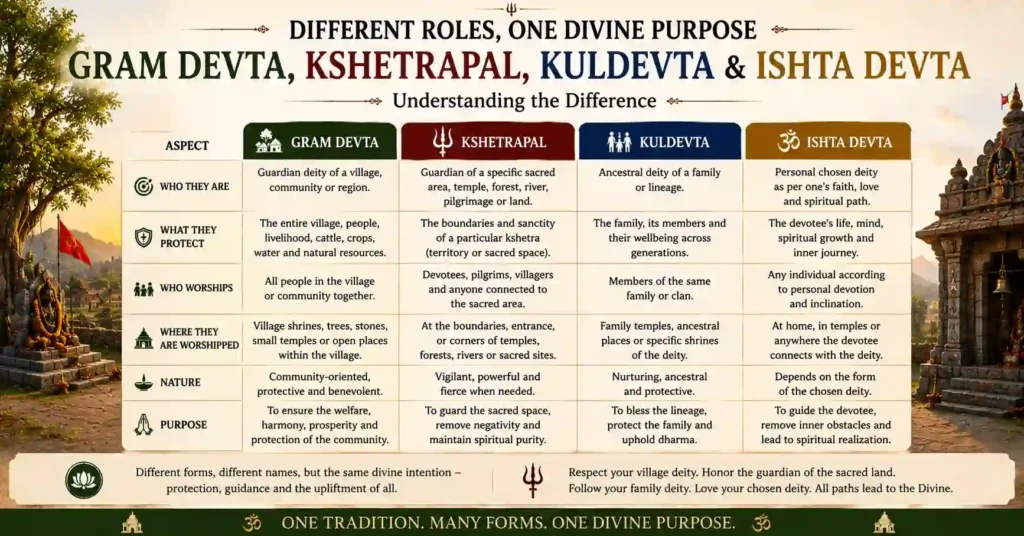
A Gram Devta, Kshetrapal, Kuldevta, and Ishta Devta all hold important places in Sanatan Dharma, but each serves a distinct spiritual purpose.
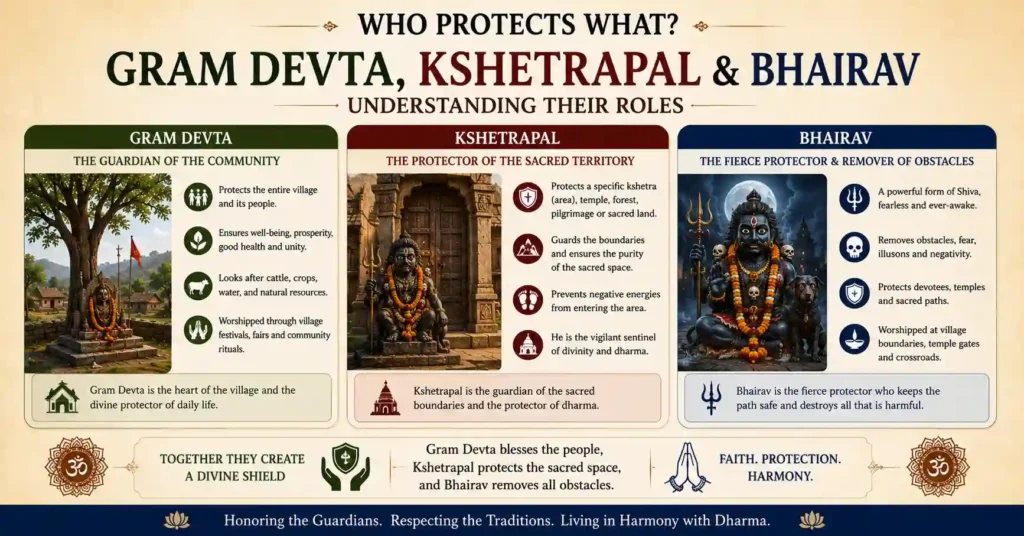
A Gram Devta is regarded as the guardian deity of an entire village or community. Devotees seek blessings for collective well-being, prosperity, protection, and harmony.
A Kshetrapal is the protector of a specific sacred area, such as a village boundary, temple, pilgrimage site, forest, or region. In many traditions, Bhairav is worshipped in this role.
A Kuldevta or Kuldevi is the ancestral deity of a particular family or lineage. Worship of the Kuldevta is passed down through generations and forms an important part of family traditions.
An Ishta Devta is a devotee’s personally chosen deity, with whom they feel a deep spiritual connection. This may be Shiva, Vishnu, Devi, Ganesha, Hanuman, Krishna, Rama, or any other form of the Divine.
Although these traditions differ, they complement one another. A devotee may worship a Gram Devta for the welfare of the village, a Kshetrapal for protection, a Kuldevta as the family deity, and an Ishta Devta for personal spiritual growth.
Folk Traditions and Scriptural Worship of Bhairav
A common misconception is that the folk traditions of Bhairav and the scriptural worship of Bhairav are separate or even contradictory. In reality, they complement each other and together reflect the richness of Sanatan Dharma.
In the Puranas, Tantras, and Shaiva traditions, Bhairav is revered as a fierce manifestation of Lord Shiva. He is the guardian of sacred spaces, the destroyer of ignorance, and the protector of dharma. His worship follows established rituals, sacred texts, and temple traditions.
In village traditions, Bhairav is worshipped as a Gram Devta or Kshetrapal, closely connected with the local community. His stories are preserved through oral traditions, regional customs, and generations of devotees who regard him as the protector of their village, fields, temples, and sacred boundaries.
Rather than representing two different deities, these traditions reflect two expressions of the same divine presence. The scriptural understanding gives Bhairav his universal spiritual significance, while folk traditions express that same divinity through local customs and lived experiences.
For devotees, there is no contradiction between these forms of worship. A person may recite a Bhairav Stotra in a temple and also offer prayers at the village Bhairav shrine before beginning an important journey, agricultural work, or community festival. Both practices are seen as part of the same living tradition of faith and devotion.
Regional Names of Bhairav in Village Traditions
One of the most fascinating aspects of Bhairav worship is that he is not always known by the name “Bhairav.” Across different regions of India, devotees worship the same guardian deity under local names that reflect their language, customs, and village traditions.
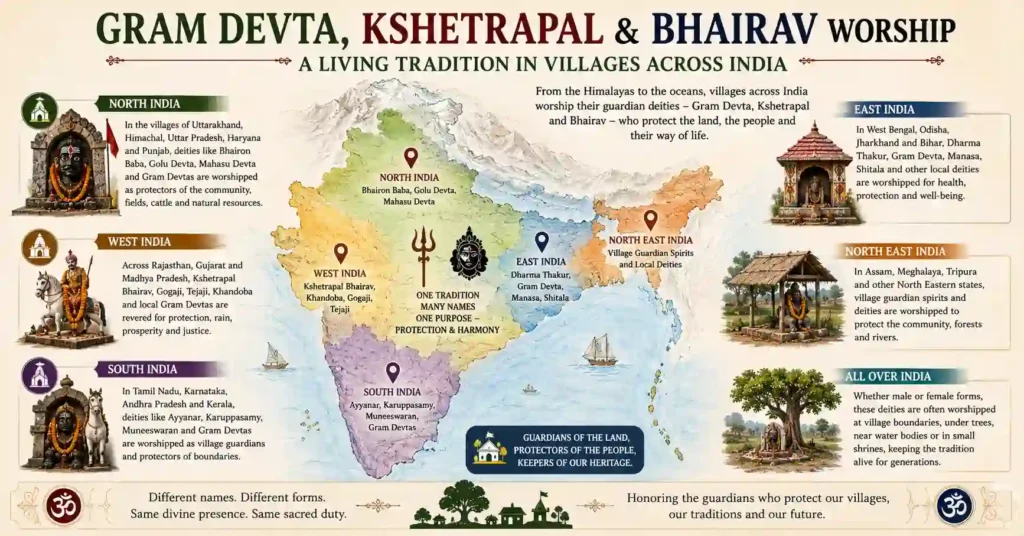
In many parts of North India, he is affectionately known as Bhairo Baba, Bhairon Baba, Kal Bhairav, Khetpal, Kshetrapal Dev, or simply Baba Ji. Although the names vary, the deity is revered as the protector of the village, its people, sacred places, and surrounding land.
In several villages, devotees worship Bhairon Baba without consciously connecting him to the Puranic form of Bhairav described in Shaiva scriptures. The connection exists through tradition and faith, even if it is not expressed in theological terms or scriptural language.
This reflects a unique strength of Sanatan Dharma, where the same divine presence is worshipped through both regional customs and scriptural traditions. While the names, rituals, and local stories may differ, the guardian’s role remains unchanged.
These regional variations demonstrate how the tradition of Gram Devta, Kshetrapal, and Bhairav has adapted across generations without losing its core purpose of protecting the community, preserving sacred spaces, and strengthening the spiritual bond between people and their land.
Guardian Deity Traditions Across India
India’s guardian deity traditions are remarkably diverse. While the idea of a Gram Devta or Kshetrapal is common throughout the country, every region has developed its own names, customs, and forms of worship.
In North India, Bhairav, Bhairon Baba, and Kshetrapal Dev are widely worshipped as protectors of villages, temples, and sacred boundaries. Their shrines are often found at village entrances, crossroads, and pilgrimage sites.
Across Western India, guardian traditions include regional deities such as Khandoba in Maharashtra and Khodiyar Maa in Gujarat, who are revered as protectors of communities, families, and the land.
In the Himalayan states, village guardian traditions are preserved through deities such as Golu Devta, Nanda Devi, and Dhari Devi, whose worship is closely connected with local customs, seasonal festivals, and oral traditions.
In South India, many villages worship Gram Devatas and Gram Devis such as Ayyanar, Karuppasamy, Mariamman, and other guardian deities who protect villages, fields, and community life according to long-standing regional traditions.
Although the names, rituals, and legends differ, the underlying belief remains remarkably similar. Across India, guardian deities are honoured as divine protectors who safeguard people, sacred spaces, and the cultural heritage of their communities.
Where Are Bhairav Shrines Located and What Makes Them Unique?
Unlike grand temple complexes, Bhairav shrines in villages are often simple and deeply connected to the surrounding landscape. Their significance comes not from elaborate architecture but from the faith of the community and the sacred role they serve as places of protection.
These shrines are commonly located at village entrances, boundary points, crossroads, hill paths, near sacred trees, beside grazing lands, or close to cremation grounds. Such locations symbolize Bhairav’s role as a Kshetrapal, guarding both the physical and spiritual boundaries of the community.
The shrine itself may consist of a sacred stone, a naturally formed rock, a carved idol, a metal image, or a small sanctum built over time. Many village shrines have no elaborate architecture, yet they are revered as powerful places of worship. A simple shrine beneath a sacred tree or at a village boundary may have been continuously worshipped for generations, making it spiritually significant through devotion rather than grandeur.
A distinctive feature of many Bhairav shrines is the presence of a dog, regarded in tradition as Bhairav’s faithful companion (vahana). The dog may appear as a sculpture, carving, painting, or simply be remembered through local beliefs and oral traditions.
Although the appearance of these shrines varies from one region to another, their purpose remains the same. They serve as sacred spaces where devotees seek protection, express gratitude, and honour Bhairav as both a Gram Devta and a Kshetrapal, keeping alive one of the oldest guardian deity traditions in Sanatan Dharma.
How Is Bhairav Worshipped in Village Traditions?
The worship of Bhairav in villages follows the rhythm of community life rather than a fixed daily schedule. Devotees turn to him during important moments such as harvests, festivals, journeys, illness, natural calamities, or times of uncertainty, seeking his blessings for protection and well-being.
Offerings vary from region to region and are guided by local customs. Common offerings include lamps, sindoor, flowers, coconuts, sweets, and seasonal food. In some traditions, offerings such as liquor or meat are also made as part of long-established regional practices associated with specific forms of Bhairav.
These rituals are not random or informal. They are preserved through family traditions, village customs, and oral knowledge passed down over generations. Each community follows its own inherited practices while honouring Bhairav as its guardian deity.
Many villages also organize annual fairs, festivals, or community gatherings dedicated to Bhairav, Gram Devta, or the local Kshetrapal. These occasions strengthen social bonds, celebrate shared traditions, and reaffirm the community’s faith in the guardian deity who watches over the village and its sacred boundaries.
Although rituals and offerings differ across regions, the purpose remains the same: to seek protection, express gratitude, and preserve a living tradition that continues to connect people, land, and faith within Sanatan Dharma.
Why Do Villages Worship Guardian Deities?
Villages worship Gram Devtas, Kshetrapals, and other guardian deities not only out of devotion but also as an expression of gratitude, protection, and collective identity. These traditions remind the community that human life exists in harmony with nature, sacred spaces, and divine grace.
For generations, villagers have sought the blessings of their guardian deity before beginning important activities such as farming, building a home, celebrating festivals, or undertaking long journeys. The guardian deity is believed to watch over both the people and the land on which they depend.
Guardian deity worship also strengthens social unity. Annual festivals, community prayers, and shared rituals bring families together, preserve local customs, and pass spiritual traditions from one generation to the next.
Beyond religious worship, these traditions help preserve sacred groves, village ponds, ancient shrines, and culturally significant places that are closely associated with the Gram Devta or Kshetrapal. In this way, guardian deity traditions continue to nurture both spiritual life and cultural heritage.
Who Performs Worship at Village Bhairav Shrines?
The daily care and worship of Bhairav shrines in villages are often entrusted to hereditary caretakers, village elders, or families that have preserved these traditions for generations. Their responsibility is passed down through custom, ensuring that local rituals continue without interruption.
In many regions, these caretakers belong to non-Brahmin communities, while in others, priests or temple authorities conduct the worship. The tradition varies across India, reflecting the diversity of local customs within Sanatan Dharma.
Unlike many large temple complexes that follow established Agamic or regional ritual systems, village Bhairav shrines are often guided by community traditions and oral knowledge. The emphasis is on preserving the guardian deity’s relationship with the village rather than following a single standardized form of worship.
This diversity reflects the inclusive nature of Sanatan Dharma, where both scriptural practices and regional traditions are respected. Whether worshipped by a priest, a hereditary caretaker, or the local community, Bhairav continues to be revered as a Kshetrapal and Gram Devta, protecting the land, its people, and their sacred traditions.
Bhairav's Role as the Guardian of Justice and Moral Order
Beyond protecting villages and sacred boundaries, Bhairav is also revered as a guardian of justice and moral order. In many communities, devotees believe that he watches over truthfulness, honesty, and the fulfilment of promises.
Traditional beliefs associated with Bhairav include:
Taking solemn oaths before Bhairav.
Avoiding false promises or lying in his name.
Believing that acts such as theft, betrayal, or violating sacred boundaries invite his displeasure.
These beliefs have long served as part of the moral and cultural fabric of village life. By associating ethical conduct with a revered guardian deity, communities encouraged honesty, accountability, and mutual respect, especially in times when formal legal institutions were less accessible.
For this reason, Bhairav is both deeply respected and lovingly worshipped. His fierce appearance symbolizes the protection of dharma, while his presence reassures devotees that righteousness, justice, and community harmony remain under divine care.
This enduring role as a protector of both sacred spaces and ethical values is one of the reasons Bhairav continues to be revered as a Kshetrapal and Gram Devta in many parts of India today.
Why Is Bhairav Associated with Cremation Grounds?
One of the most misunderstood aspects of Bhairav worship is his association with cremation grounds. While this imagery may appear intimidating, it carries deep spiritual and symbolic meaning within Shaiva and folk traditions.
In many regional beliefs, Bhairav is regarded as the guardian of sacred thresholds, including places connected with life, death, and transformation. Cremation grounds symbolize the impermanence of the physical world and the soul’s journey beyond worldly attachments, making them appropriate places for Bhairav’s protective presence.
Many village traditions also believe that Bhairav safeguards the community from negative influences and watches over sacred boundaries. In some regions, devotees pray to him for protection from misfortune, untimely death, and unseen dangers, reflecting his role as a vigilant guardian rather than a deity associated with fear.
For villagers and devotees, this is not viewed as dark worship. Instead, it represents Bhairav’s willingness to stand at places that symbolize transition and uncertainty, protecting both the community and its sacred spaces. His fierce form reminds devotees that divine protection extends even to places where fear and impermanence are most deeply experienced.
Bhairav, Tantra, and Village Traditions
The association between Bhairav and Tantra has deep roots in several Shaiva and Shakta traditions. In these spiritual lineages, Bhairav is revered through disciplined practices that include mantra, meditation, initiation (diksha), and rituals performed under the guidance of a qualified guru.
These practices are traditionally private and lineage-based. They are not intended as public rituals or spectacles but are regarded as sacred disciplines followed according to established spiritual traditions.
Village worship of Bhairav is generally different in its form and purpose. Most communities worship him as a Gram Devta or Kshetrapal, seeking protection, justice, and the well-being of the village through local customs, prayers, and annual festivals rather than formal Tantric rituals.
At the same time, some symbolic themes associated with Bhairav, such as confronting fear, overcoming negativity, and protecting sacred boundaries, are also found in Tantric philosophy. This reflects a shared spiritual symbolism rather than suggesting that every village tradition is itself Tantric.
Understanding this distinction helps appreciate both traditions with respect. While Tantric worship follows specific spiritual disciplines, village devotion reflects the living faith of local communities, and together they illustrate the many ways Bhairav is revered within the diverse traditions of Sanatan Dharma.
How Folk Traditions and Scriptures Complement Each Other
The traditions of Gram Devta, Kshetrapal, and Bhairav demonstrate that Sanatan Dharma is preserved through both sacred scriptures and living community practices. These are not separate paths but complementary expressions of the same spiritual heritage.
Scriptures, Puranas, Agamas, and Tantric texts provide the philosophical and theological foundation for these guardian deities. Village traditions, oral histories, festivals, and local customs keep that wisdom alive in the everyday lives of devotees.
Rather than competing with one another, these traditions strengthen each other. Scriptural teachings offer universal spiritual meaning, while regional practices express the same truths through local languages, customs, and cultural memories.
A meaningful understanding of Gram Devta, Kshetrapal, and Bhairav comes from appreciating both dimensions. Together, they reveal how Sanatan Dharma has remained a living tradition for thousands of years, adapting to different regions and communities while preserving its timeless spiritual values.
Why Is Bhairav Worshipped Before the Main Deity?
In many temples and village traditions, Bhairav is closely associated with the worship of the principal deity. Whether the presiding deity is Shiva, Devi, or another regional form of the Divine, Bhairav is often revered as the Kshetrapal who protects the sacred space and its devotees.
In several traditions, devotees first offer prayers to Bhairav before approaching the main deity. Seeking his blessings is believed to ensure a smooth and respectful entry into the sacred precincts, acknowledging his role as the guardian of the temple or village.
This practice reflects Bhairav’s unique position within the divine order. His fierce form is not independent of the principal deity but serves a protective purpose, preserving the sanctity of the temple, safeguarding devotees, and maintaining sacred boundaries.
The same tradition is also seen in many villages, where Bhairav is worshipped as both a Gram Devta and a Kshetrapal alongside the village’s principal deity. Together, these forms of worship illustrate how guardian deities and presiding deities complement one another, creating a harmonious and interconnected system of devotion within Sanatan Dharma.
This tradition also reminds devotees that entering a sacred space is both a physical and a spiritual act. By first seeking the blessings of the guardian deity, worshippers symbolically prepare themselves with humility, reverence, and discipline before approaching the principal deity.
Gram Devta and Kshetrapal in Famous Temples and Shakti Peethas
The tradition of worshipping a Kshetrapal is not limited to villages. Many of India’s ancient temples and Shakti Peethas also honour a guardian deity who protects the sacred precincts and the devotees who visit them.
In numerous Shaiva and Shakta traditions, Bhairav is revered as the Kshetrapal of the temple. Devotees often seek his blessings before approaching the principal deity, acknowledging his role as the guardian of the sacred space.
This tradition can be seen at several renowned pilgrimage centres, where Bhairav is worshipped alongside forms of Shiva, Devi, or other principal deities. Although the rituals and local customs vary, the underlying belief remains the same: every sacred place has a divine guardian who preserves its sanctity.
This continuity between village shrines, ancient temples, and major pilgrimage sites shows that the traditions of Gram Devta, Kshetrapal, and Bhairav are part of a broader spiritual framework within Sanatan Dharma. Whether in a small village or a celebrated temple, the guardian deity continues to symbolize protection, sacred order, and divine presence.
Respecting the Living Tradition of Gram Devta and Bhairav
The traditions of Gram Devta, Kshetrapal, and Bhairav are not merely subjects of historical or religious study. For millions of people, they remain living expressions of faith, preserved through daily worship, community rituals, and generations of oral tradition.
Anyone seeking to understand these traditions should approach them with humility and respect. Instead of viewing them only through books or academic discussions, it is equally important to observe how they are practiced in villages, temples, and local communities.
The location of a shrine, the families who care for it, the annual festivals, and the stories passed down by village elders all preserve the living memory of these guardian deity traditions. These practices often reveal cultural and spiritual insights that cannot always be found in written texts.
At the same time, some rituals, especially those associated with Tantric lineages, personal initiations (diksha), or family traditions, are intentionally kept private. Such practices should be respected and never documented, questioned, or shared without the consent of the communities that preserve them.
Documenting these traditions also requires recognizing that practices may vary from one village to another. Differences in rituals, offerings, and local legends do not diminish their authenticity. Instead, they reflect the remarkable diversity through which Sanatan Dharma has been preserved across generations.
The greatest service to these traditions is not to sensationalize or alter them, but to understand, respect, and preserve them with authenticity. By doing so, we help ensure that the living heritage of Gram Devta, Kshetrapal, and Bhairav continues to inspire future generations.
The Relevance of Gram Devta and Kshetrapal in Modern Times
The traditions of Gram Devta, Kshetrapal, and Bhairav continue to remain relevant in modern India. While villages have changed over time, the values these guardian deities represent, such as protection, community responsibility, respect for nature, and preservation of sacred places, remain as meaningful as ever.
Across many regions, annual festivals, village fairs, and community rituals dedicated to guardian deities continue to bring people together. These occasions strengthen cultural identity, preserve oral traditions, and pass local heritage from one generation to the next.
Guardian deity traditions also remind us that spirituality in Sanatan Dharma is closely connected with the land, local communities, and everyday life. Ancient shrines, sacred groves, village ponds, and temple boundaries continue to inspire reverence and collective care.
In a rapidly changing world, the traditions of Gram Devta, Kshetrapal, and Bhairav serve as living reminders that faith is not only expressed through grand temples and scriptures but also through the shared customs, values, and cultural memory that unite communities across generations.
Conclusion
The traditions of Gram Devta, Kshetrapal, and Bhairav are not relics of the past. They continue to thrive across India as living expressions of faith, where protection, devotion, community, and sacred geography come together within the broader tradition of Sanatan Dharma.
Whether worshipped as Gram Devta, Bhairav, Bhairon Baba, Kshetrapal Dev, or by other regional names, these guardian deities continue to watch over villages, temples, sacred landscapes, and the people who place their trust in them. Their forms and rituals may differ, but their purpose remains remarkably consistent across generations.
Understanding these guardian deity traditions helps us appreciate how Sanatan Dharma has always embraced both scriptural wisdom and living folk traditions. Together, they preserve a timeless spiritual heritage that continues to guide communities through faith, cultural memory, and shared values.
As long as villages honour their guardian deities, temples preserve their sacred guardians, and families pass these traditions from one generation to the next, the legacy of Gram Devta, Kshetrapal, and Bhairav will remain a vibrant and enduring part of India’s spiritual heritage.
Suggested Reading
If you enjoyed learning about Gram Devta, Kshetrapal, and Bhairav, you may also like these articles exploring guardian deities, regional traditions, temples, and the living spiritual heritage of Sanatan Dharma:
Khandoba: Story, Jejuri Temple, Festivals and Worship
https://thesanantales.com/khandoba-god-jejuri-temple-story/
Khodiyar Maa: Story, History, Temples, Miracles and the Beloved Kuldevi of Gujarat
https://thesanantales.com/khodiyar-maa/
Dhari Devi Temple: Story, History, Char Dham Significance and Travel Guide
https://thesanantales.com/dhari-devi-temple/
Nanda Devi: Story, Folk Beliefs, Raj Jat Yatra and Worship in Uttarakhand
https://thesanatantales.com/nanda-devi-story-raj-jat-yatra-worship/
Goludevta: Story, Temples and the Folk God of Justice in Uttarakhand
https://thesanantales.com/goludevta-folk-god-of-justice/
Folk Deities of Uttarakhand and Himachal: Gods of Hills and Forests
https://thesanantales.com/regional-folk-myths/
Gramadevata (Wikipedia)
https://en.wikipedia.org/wiki/Gramadevata
These articles explore the rich traditions of guardian deities, regional gods and goddesses, sacred temples, and local beliefs that continue to preserve the diverse spiritual heritage of Sanatan Dharma across India.
FAQs
What is a Gram Devta?
A Gram Devta is the guardian deity of a village or local community in Sanatan Dharma. Villagers worship the deity for protection, prosperity, good harvests, harmony, and the overall well-being of the community.
The identity of a Gram Devta varies across India. In some regions, the guardian deity is worshipped as Bhairav, while in others it may be a form of Shiva, Shakti, Vishnu, a local deity, or a revered ancestral protector.
What is the difference between a Gram Devta and a Kshetrapal?
A Gram Devta protects a specific village and its people, while a Kshetrapal is the guardian of a particular sacred area, temple, pilgrimage site, or geographical region.
In many traditions, these roles overlap. A deity such as Bhairav may be worshipped both as the Gram Devta of a village and the Kshetrapal of a temple or sacred place.
Why is Bhairav worshipped as a Kshetrapal?
Bhairav is regarded as a fierce and protective manifestation of Lord Shiva. According to Shaiva and Shakta traditions, he safeguards sacred spaces, removes obstacles, and preserves spiritual order.
This is why Bhairav shrines are commonly found at village entrances, temple gateways, crossroads, and pilgrimage sites, where devotees seek his blessings before worshipping the principal deity.
Are Gram Devtas mentioned in Hindu scriptures?
The concept of guardian deities is reflected in various Hindu scriptures, including the Puranas, Agamas, and Tantric traditions, particularly through the worship of Kshetrapals and Bhairav.
However, the worship of individual Gram Devtas is primarily preserved through regional traditions, temple customs, oral history, and local devotional practices that have been passed down for generations.
Who can worship a Gram Devta or Bhairav?
Anyone may offer prayers to a Gram Devta or Bhairav with sincerity and respect. While local communities often maintain specific customs and annual festivals, devotees from any background may visit these shrines and seek blessings.
Some temples follow traditional rituals or local practices, so visitors are encouraged to respect the customs observed at each sacred place.
Why are Bhairav shrines often located at village boundaries?
Village boundaries traditionally symbolize the transition between protected community life and the outside world. Bhairav is believed to guard these physical and spiritual boundaries, protecting the village from negative influences and preserving peace and harmony.
For this reason, many Bhairav shrines are located near entrances, crossroads, sacred trees, hill paths, or cremation grounds.
Is the worship of Gram Devtas still relevant today?
Yes. The traditions of Gram Devta and Kshetrapal continue to flourish in many parts of India through village festivals, temple rituals, and community celebrations.
Beyond their religious significance, these traditions preserve local culture, oral history, sacred landscapes, and a sense of collective identity that has been maintained for centuries.
Can the same deity be a Gram Devta, Kshetrapal, and Kuldevta?
Yes. In some traditions, the same deity may be worshipped in different roles depending on local customs and family traditions.
For example, Bhairav may be revered as a village guardian (Gram Devta), a protector of a sacred place (Kshetrapal), and the ancestral deity (Kuldevta) of certain families or communities.
Glossary of Important Terms
| Term | Meaning |
|---|---|
| Gram Devta | A guardian deity worshipped by a village or local community for protection, prosperity, and harmony. |
| Kshetrapal | Literally “protector of the region” or “guardian of the sacred boundary.” A deity believed to safeguard villages, temples, pilgrimage sites, and sacred spaces. |
| Bhairav | A fierce and protective manifestation of Lord Shiva, widely worshipped as a Kshetrapal and guardian deity across India. |
| Gram Bhairav | A local form of Bhairav worshipped as the guardian deity (Gram Devta) of a village. |
| Kuldevta / Kuldevi | The ancestral family deity worshipped by a particular lineage or clan across generations. |
| Ishta Devta | The personally chosen deity to whom an individual feels the deepest spiritual connection and offers regular worship. |
| Shakti Peetha | A sacred shrine dedicated to Goddess Shakti, traditionally associated with places where parts of Goddess Sati’s body are believed to have fallen. |
| Sanatan Dharma | The eternal spiritual tradition of India, encompassing diverse philosophies, scriptures, rituals, and forms of worship. |
| Tantra | A spiritual tradition within Sanatan Dharma that uses disciplined rituals, meditation, mantras, and symbolic practices for spiritual transformation. |
| Vahana | The divine vehicle or companion associated with a deity. The dog is traditionally regarded as the vahana of Bhairav. |
| Pradakshina | The act of walking clockwise around a deity, temple, or sacred object as a mark of reverence and devotion. |
| Prasad | Food or other offerings that have been dedicated to a deity and are then distributed to devotees as a sacred blessing. |
| Sadhana | A disciplined spiritual practice performed to deepen devotion, self-realization, or connection with the Divine. |
| Mandir | A Hindu temple or sacred place of worship dedicated to one or more deities. |
About the Author
Yateendra Chaturvedi is a spiritual writer, researcher, devotee, and the founder of The Sanatan Tales. With over 35 years of professional experience and a lifelong interest in Sanatan Dharma, he writes about Hindu deities, temples, scriptures, festivals, Mahavidyas, sacred stories, rituals, and living traditions that continue to guide and inspire devotees across India.
Drawing from traditional scriptures, regional beliefs, temple traditions, devotional literature, and historical sources, he aims to present authentic, well-researched, and easy-to-understand content for modern readers. His work focuses on preserving spiritual wisdom, explaining sacred traditions, and helping seekers develop a deeper understanding of India’s rich spiritual heritage.
Through The Sanatan Tales, Yateendra strives to make the timeless teachings of Sanatan Dharma simple, meaningful, and relevant for today’s generation while maintaining respect for traditional sources, regional practices, and diverse spiritual perspectives.
Learn More About Yateendra Chaturvedi →
https://thesanatantales.com/about-the-author/
References & Sources
This article is based on beliefs and traditions followed within Sanatan Dharma, traditional knowledge associated with guardian deity worship, Shaiva traditions, regional folk practices, temple customs, and insights gathered from various spiritual and religious study sources.
Some concepts discussed in this article are also inspired by interpretations preserved through the guru-disciple tradition, local oral traditions, and devotional literature.
Note: Beliefs, stories, and methods of worship related to Gram Devtas, Kshetrapals, Bhairav, and other guardian deities may vary across regions, communities, sects, and spiritual traditions. The purpose of this article is not to present any single viewpoint as the absolute truth, but to explain commonly accepted religious and cultural perspectives in a simple, respectful, and accessible manner.
Explore More Fascinating Topics from Sanatan Dharma