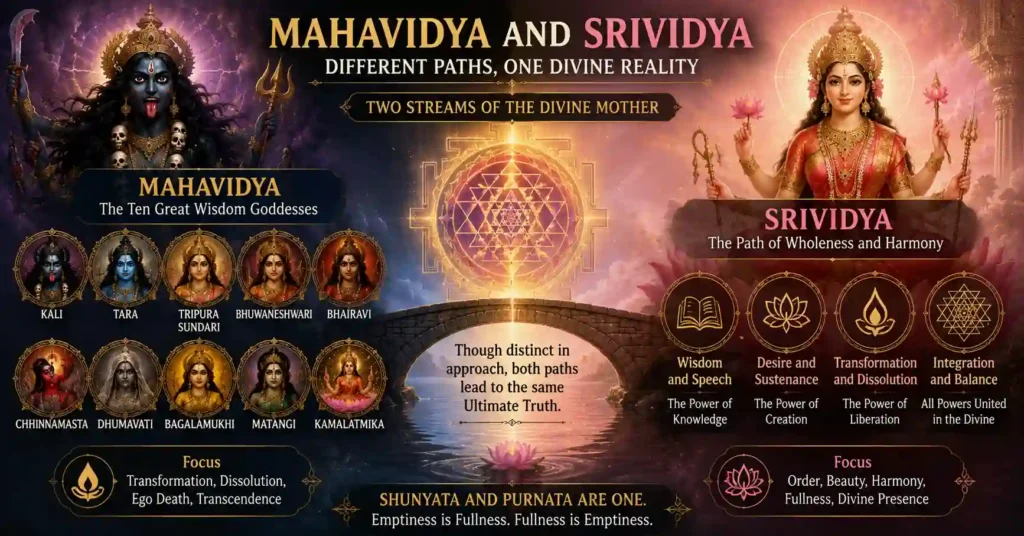
In the world of Shakta Tantra, Mahavidya and Srividya are not opposing paths or competing traditions.
They are two sacred ways of approaching the same Divine Mother, each revealing a different side of her infinite nature.
Mahavidya reveals the Mother in her raw and uncompromising forms. She appears fierce, direct, and transformative, breaking the ego and illusions that limit spiritual growth.
Srividya, on the other hand, reveals the Mother as harmony itself. Here she is beauty, balance, wisdom, and fullness, guiding the seeker gently toward inner wholeness.
One path awakens through intensity.
The other awakens through grace.
Yet both arise from the same source, and both demand humility, discipline, and deep respect from the seeker who walks toward the Divine Mother.
For many devotees, these traditions can appear very different on the surface. One emphasizes the diverse forms of Shakti, while the other centers on the unified vision of Lalita Tripura Sundari. However, traditional teachings reveal that they are deeply interconnected and ultimately lead toward the same spiritual truth.
Understanding the relationship between Mahavidya and Srividya offers a deeper appreciation of Shakta philosophy and helps seekers see how the many forms of the Divine Mother express one infinite Divine Consciousness.
Table of Contents
ToggleWhat Mahavidya Really Means
The word Mahavidya means “Great Wisdom.” In this context, wisdom does not simply mean knowledge or information. It refers to direct spiritual insight and the awakening of higher consciousness.
The Dasa Mahavidyas are ten powerful manifestations of Shakti, the Divine Mother. Each Mahavidya represents a unique aspect of existence and reveals a different dimension of spiritual truth.
Together, they encompass the entire spectrum of human experience, including time, fear, desire, beauty, speech, power, loss, abundance, transformation, and liberation.
The ten Mahavidyas are:
Kali
Tara
Tripura Sundari
Bhuvaneshwari
Bhairavi
Chhinnamasta
Dhumavati
Bagalamukhi
Matangi
Kamalatmika
In Shakta Tantra, these ten forms are not viewed as separate goddesses but as different expressions of the same Divine Mother. Each reveals a particular teaching and helps the seeker confront specific challenges on the spiritual path.
Mahavidya sadhana often focuses on one form at a time, depending on the seeker’s temperament, spiritual needs, and inner obstacles. Someone struggling with fear may be drawn toward Kali.
A seeker seeking clarity in communication and self-expression may turn to Matangi. Another facing conflict, negativity, or injustice may seek the blessings of Bagalamukhi.
For this reason, Mahavidya is often described as a direct and transformative path. It does not avoid life’s difficult realities. Instead, it teaches the seeker to face fear, attachment, ego, and limitation with courage, awareness, and the grace of the Divine Mother.
Srividya: The Auspicious and Complete Science of Shakti
Srividya means “Auspicious Knowledge” or “Sacred Wisdom.” It is not merely the worship of a deity but a complete spiritual tradition that combines devotion, philosophy, mantra, meditation, and contemplation into a unified path.
At the heart of Srividya is Lalita Tripura Sundari, the radiant Divine Mother who is regarded as the supreme expression of Shakti. In this vision, the many forms of the Goddess are not separate entities.
The fierce, protective, nurturing, and compassionate aspects of the Divine Mother are all understood to exist within her complete and perfect nature.
Srividya teaches that the universe is not something to reject or escape from. Instead, it is a sacred manifestation of Divine Consciousness that can be understood, purified, and ultimately transcended through spiritual insight.
One of the unique features of Srividya is its ability to harmonize both Bhoga (worldly fulfillment) and Moksha (spiritual liberation). Rather than viewing material life and spiritual life as opposites, Srividya teaches that both can be integrated when approached with wisdom, discipline, and devotion.
The tradition also emphasizes the use of sacred mantras, the Sri Chakra, and contemplative practices that guide the seeker from external worship toward inner realization.
For this reason, many practitioners regard Srividya not simply as a form of Goddess worship but as a complete path leading toward spiritual wholeness and the direct experience of the Divine Mother.
Mahavidya and Srividya at a Glance
| Aspect | Mahavidya | Srividya |
|---|---|---|
| Primary Focus | Individual forms of the Divine Mother | Lalita Tripura Sundari as the complete Divine Mother |
| Approach | Transformation through specific aspects of Shakti | Harmonization of all aspects of Shakti |
| Spiritual Method | Often centered on a particular Mahavidya | Structured path involving mantra, yantra, and contemplation |
| Symbolic Emphasis | Confronting and transforming limitations | Realizing inner harmony and completeness |
| Central Symbol | Individual deity forms and their mantras | Sri Chakra (Sri Yantra) |
| Ultimate Goal | Spiritual awakening and liberation | Spiritual awakening and liberation |
| Traditional Guidance | Guru and lineage-based instruction | Guru and lineage-based instruction |
Scriptural Foundations of Mahavidya and Srividya
Both Mahavidya and Srividya are rooted in a rich body of Shakta scriptures, philosophical texts, and living spiritual traditions. While different lineages may emphasize different teachings, several important texts help shape the understanding of these sacred paths.
| Scripture | Relevance to Mahavidya and Srividya |
|---|---|
| Devi Bhagavata Purana | Describes the Divine Mother as the supreme reality and explains many forms of Shakti worship. |
| Brahmanda Purana | Contains the Lalitopakhyana, one of the most important narratives associated with Lalita Tripura Sundari. |
| Lalita Sahasranama | Revered in Srividya traditions as a sacred hymn praising the thousand names and attributes of Lalita Tripura Sundari. |
| Tripura Rahasya | A profound philosophical text that explores consciousness, non-duality, and the wisdom associated with Tripura Sundari. |
The Devi Bhagavata Purana presents the Divine Mother as the source of creation, preservation, and dissolution. Many devotees and Shakta traditions draw upon its teachings to understand the many manifestations of Shakti, including the Mahavidyas.
The Brahmanda Purana, particularly the Lalitopakhyana section, plays a central role in Srividya traditions. It narrates the glory of Lalita Tripura Sundari and her divine kingdom, establishing her as one of the highest expressions of the Divine Mother.
The Lalita Sahasranama remains one of the most widely recited texts in Srividya worship. Each name reveals a different aspect of the Goddess, guiding devotees toward a deeper understanding of her nature and grace.
The Tripura Rahasya approaches the Divine Mother from a philosophical perspective, exploring the nature of consciousness and the ultimate reality beyond all duality. For many seekers, it serves as a bridge between devotion and spiritual insight.
Together, these scriptures reveal that Mahavidya and Srividya are not isolated traditions but interconnected expressions of the same Divine Wisdom.
Sri Chakra: Where Mahavidya and Srividya Meet
The heart of Srividya is the Sri Chakra, also known as the Sri Yantra.
This is not merely a sacred diagram. It is regarded as a symbolic map of the universe and the spiritual journey of the seeker. In Srividya traditions, the Sri Chakra represents both the outer cosmos and the inner dimensions of consciousness.
At its center resides Tripura Sundari as the Bindu, the point where all duality dissolves into pure Divine Awareness. Surrounding the Bindu are nine interconnected enclosures, each representing different levels of spiritual realization and divine energy.
The Sri Chakra is therefore not only an object of worship but also a tool for meditation and contemplation. Through its symbolism, seekers gradually move from external awareness toward the realization of their inner divine nature.
In deeper traditional interpretations, the Mahavidyas are not viewed as separate from this system. They are understood as complementary expressions of Shakti that support, protect, and activate different dimensions of spiritual transformation represented within the Sri Chakra.
This is why Mahavidya and Srividya are deeply connected rather than separate traditions. One explores the many expressions of Divine Power, while the other reveals how those same energies ultimately unite in a single Divine Consciousness.
Mahavidya Path and Srividya Path: How They Differ in Approach
Mahavidya sadhana is often compared to surgery, while Srividya is compared to alchemy.
Both seek spiritual transformation, but they approach that transformation in different ways.
Mahavidya practices typically focus on a particular form of the Divine Mother and the specific lessons associated with that form. A seeker may be drawn toward a particular Mahavidya to overcome fear, attachment, confusion, negativity, or other obstacles that hinder spiritual growth.
Mahavidya sadhana often centers around:
One Goddess
One Mantra
One Specific Transformation or Spiritual Challenge
The emphasis is on direct confrontation with the limitations that prevent inner awakening. Rather than avoiding difficult experiences, the Mahavidya path uses them as opportunities for transformation.
Srividya follows a more gradual and integrated approach. Through a traditional process often described as Srikrama, the seeker progresses step by step from external worship toward deeper states of inner awareness.
This journey is supported by sacred mantras, the Sri Chakra, meditation, contemplation, and disciplined spiritual practice. Instead of focusing on a single aspect of transformation, Srividya seeks to harmonize all dimensions of the seeker’s inner life.
In simple terms, Mahavidya removes obstacles and transforms specific aspects of consciousness, while Srividya seeks to integrate and refine the entire inner system. One emphasizes focused transformation, while the other emphasizes spiritual completeness and harmony.
Although their methods may appear different, both paths ultimately guide the seeker toward the same realization of the Divine Mother.
Srikula and Kalikula: Two Streams of the Same River
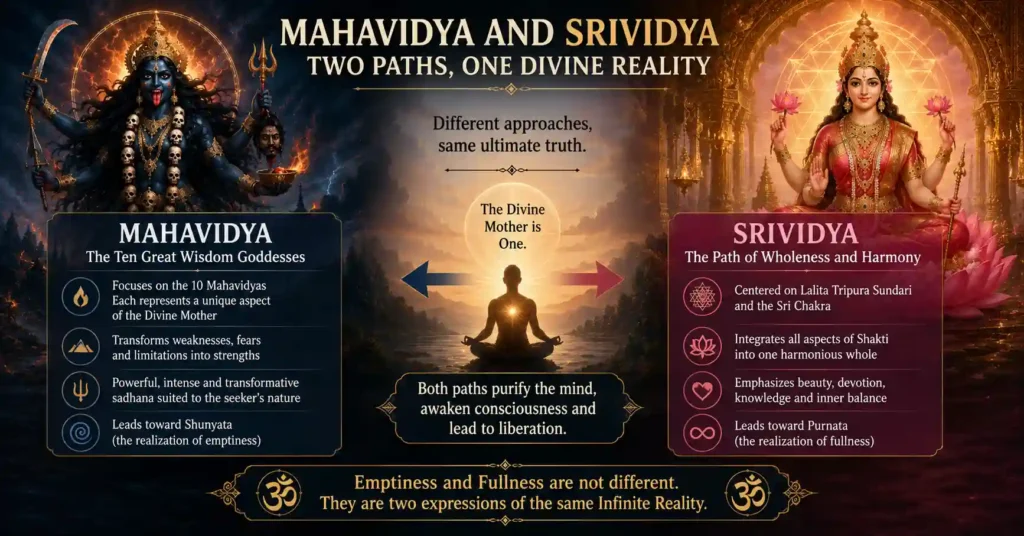
Shakta traditions often describe two major streams of Goddess worship: Kalikula and Srikula.
Kalikula emphasizes the fierce, transformative, and dissolving aspects of the Divine Mother. Goddesses such as Kali, Tara, Chhinnamasta, and Dhumavati are commonly associated with this stream.
The focus is often on confronting ego, transcending limitations, and realizing the truth beyond worldly attachments.
Srikula emphasizes the auspicious, harmonious, and manifesting aspects of Shakti. Tripura Sundari, Bhuvaneshwari, Matangi, and Kamalatmika are commonly associated with this tradition.
Here, the emphasis is on beauty, order, wisdom, fullness, and the recognition of Divine Presence within creation.
Although these streams may appear different, they are not opposing traditions. Both arise from the same Divine Mother and ultimately lead toward the same spiritual realization.
Mahavidya practices can be found within both Kalikula and Srikula traditions, depending on the form of the Goddess being worshipped. Srividya, however, belongs primarily to the Srikula tradition while still acknowledging and understanding the transformative wisdom represented by Kalikula.
For this reason, many teachers describe Kalikula and Srikula not as separate destinations, but as two complementary approaches to experiencing the same Divine Reality.
Mantra Science: How Mahavidya Energies Merge in Srividya
One of the most fascinating connections between Mahavidya and Srividya can be seen through mantra science.
At the heart of Srividya practice is the Panchadasi Mantra, one of the most revered mantras of the tradition. Traditionally divided into three sections, this mantra represents different dimensions of Divine Power and spiritual transformation.
In traditional interpretations:
One section is associated with speech, knowledge, and awareness.
One section relates to desire, creation, and sustenance.
One section is linked to transformation, dissolution, and spiritual awakening.
These energies closely reflect the powers represented by various Mahavidyas. While Mahavidya worship often approaches these divine forces through individual forms of the Goddess, Srividya integrates them into a single harmonious current centered on Lalita Tripura Sundari.
This illustrates an important principle of Srividya. It does not reject the energies represented by the Mahavidyas. Instead, it recognizes them as complementary aspects of the same Divine Consciousness and brings them together within a unified spiritual path.
For this reason, many practitioners view Srividya as a tradition that harmonizes and balances the diverse powers of Shakti rather than separating them into individual streams of worship.
Tripura Sundari: The Bridge Between Mahavidya and Srividya
Among the ten Mahavidyas, Tripura Sundari occupies a unique position. She is both one of the Dasa Mahavidyas and the central deity of the Srividya tradition. This makes her the natural bridge between these two sacred paths.
In the Mahavidya tradition, Tripura Sundari is revered as the third Mahavidya and represents beauty, harmony, wisdom, and the perfect balance of divine power. Unlike the more fierce Mahavidyas that emphasize transformation through intensity, Tripura Sundari reveals the Divine Mother through grace, refinement, and inner completeness.
In Srividya, she is worshipped as Lalita Tripura Sundari, the sovereign Goddess seated at the center of the Sri Chakra. Here she is understood not as one form among many, but as the supreme reality from which all divine powers emerge and into which they ultimately return.
This dual role helps explain why Mahavidya and Srividya are deeply connected. The Mahavidyas reveal individual dimensions of Shakti, while Srividya views those same energies as expressions of a unified Divine Consciousness centered in Tripura Sundari.
Many traditional teachers describe this relationship through a simple analogy. Mahavidya explores the many faces of the Divine Mother one by one, while Srividya contemplates the complete wholeness from which those faces arise.
For this reason, Tripura Sundari is often seen as a meeting point where the wisdom of Mahavidya and the harmony of Srividya come together. She represents both the journey and its fulfillment, both diversity and unity, both transformation and completion.
Shodashi: The Secret of Completeness
Tripura Sundari is often known as Shodashi, a name that literally means “the Sixteen-Fold One” and is sometimes poetically described as the eternal sixteen-year-old.
This symbolism is not about physical age. In Srividya traditions, Shodashi represents the sixteenth lunar phase, the hidden state of perfect completeness that exists beyond growth and decline, waxing and waning, gain and loss.
Many Mahavidyas reveal specific dimensions of spiritual truth. Kali teaches transcendence of time, Tara embodies wisdom and guidance, Bagalamukhi represents mastery over disruptive forces, and Kamalatmika reflects abundance and fulfillment. Each form expresses a unique aspect of Divine Power.
Shodashi, however, represents the state in which all these dimensions are already integrated and complete. Rather than focusing on a single aspect of spiritual transformation, she embodies the fullness of Divine Consciousness itself.
For this reason, Srividya traditions regard Shodashi as one of the highest expressions of the Divine Mother. Her worship symbolizes not only spiritual awakening but also the realization that all forms, powers, and paths ultimately arise from the same infinite source.
This is one reason why Srividya is sometimes described as the “Mother of All Vidyas,” the tradition in which the many expressions of Divine Wisdom are understood as one complete reality.
How a Seeker Traditionally Progresses
Very few seekers begin directly with advanced Srividya practices.
Traditionally, spiritual growth is viewed as a gradual process that develops through discipline, devotion, self-understanding, and guidance.
Different lineages may follow different methods, but many traditions emphasize building a strong foundation before undertaking more advanced practices.
A traditional progression may include:
Developing basic spiritual discipline and regular worship
Cultivating devotion, self-control, and ethical living
Receiving guidance suited to one’s temperament and spiritual needs
Working with specific forms of the Divine Mother when appropriate
Gradually preparing for deeper contemplative and initiatory practices
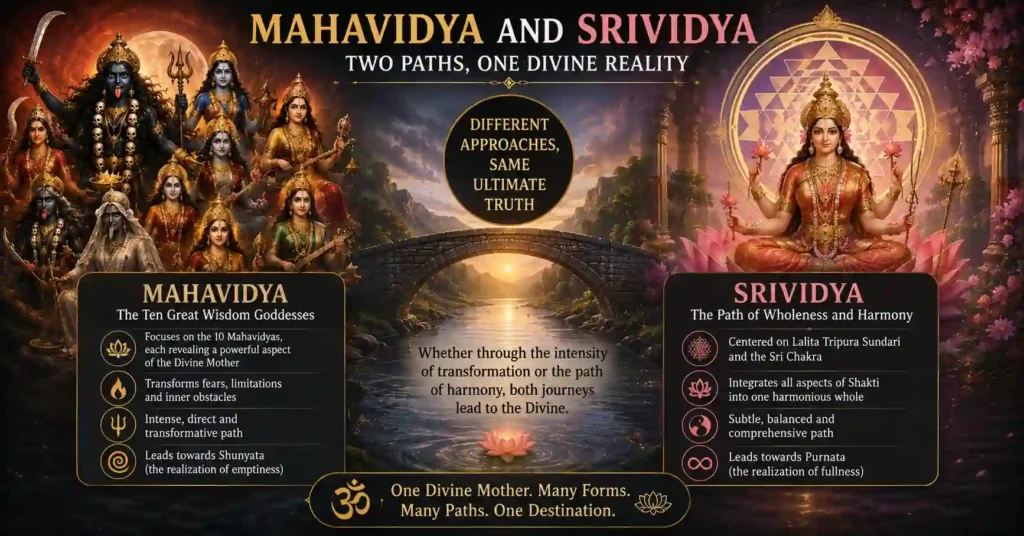
Within some traditions, Mahavidya worship can serve as a powerful means of transformation by helping the seeker overcome specific fears, attachments, limitations, or obstacles.
As spiritual maturity develops, the seeker may become prepared for the more integrated and comprehensive path of Srividya.
The underlying principle is not hierarchy but readiness. Different seekers require different approaches at different stages of their journey.
This gradual progression helps maintain balance and stability. Traditional teachers often emphasize that spiritual power should be accompanied by wisdom, humility, and proper guidance. In this way, the transformative potential of Tantra becomes a source of growth rather than confusion or imbalance.
Why Guru Initiation Matters in Both Traditions
Both Mahavidya and Srividya traditions place great importance on guidance from a qualified Guru. While reading sacred texts can provide valuable knowledge, traditional teachings emphasize that deeper practices involving mantras, yantras, and advanced rituals are best learned through proper initiation and instruction.
In these traditions, initiation is not viewed merely as receiving a mantra. It is considered the transmission of a living spiritual lineage that has been preserved and practiced for generations.
The Guru helps the seeker understand not only the outer rituals but also the inner meaning behind them.
This guidance becomes especially important because many tantric practices involve subtle aspects of consciousness, discipline, and spiritual transformation.
Without proper preparation, seekers may misunderstand teachings, practice incorrectly, or focus on techniques without developing the necessary foundation of humility and self-discipline.
Traditional Reasons a Guru Is Considered Essential
To provide proper mantra initiation and guidance
To explain the deeper meaning of rituals and symbols
To help the seeker progress at an appropriate pace
To prevent misunderstanding of advanced teachings
To preserve the authenticity of the spiritual lineage
Different lineages may follow different methods, but the underlying principle remains the same: spiritual knowledge is not only studied, it is also transmitted through experience, practice, and guidance.
For this reason, traditional teachers often encourage seekers to approach Mahavidya and Srividya with patience, sincerity, and respect for the lineage through which these teachings have been preserved.
Shunyata and Purnata: The Final Understanding
Mahavidya paths, particularly those associated with Kali and other transformative forms of the Divine Mother, often lead the seeker toward the realization of Shunyata, or emptiness.
In this context, emptiness does not mean absence or nothingness. It refers to freedom from limited identity, ego, attachment, and the illusion of separateness. The seeker gradually discovers the vast reality that exists beyond all personal limitations and mental constructs.
Srividya, by contrast, often emphasizes Purnata, the realization of fullness and completeness. Here the universe is experienced as a manifestation of Divine Consciousness, and the seeker recognizes the presence of the Divine Mother in all aspects of existence.
At first glance, emptiness and fullness may appear to be opposites. One speaks of transcendence beyond form, while the other celebrates the Divine within form.
Yet many spiritual traditions teach that these two realizations ultimately point to the same truth.
When all limitations dissolve, what remains can be described as infinite emptiness. The very same reality can also be experienced as infinite fullness. The difference lies not in the truth itself, but in the language used to describe it.
For this reason, many teachers view Shunyata and Purnata as complementary perspectives on the same Absolute Reality.
Whether approached through the transformative intensity of Mahavidya or the harmonious completeness of Srividya, the journey ultimately leads to the realization of the one Divine Consciousness that transcends all distinctions.
Final Thoughts on Mahavidya and Srividya
Mahavidya and Srividya are not merely subjects to be studied. They are living spiritual traditions rooted in devotion, discipline, wisdom, and inner transformation.
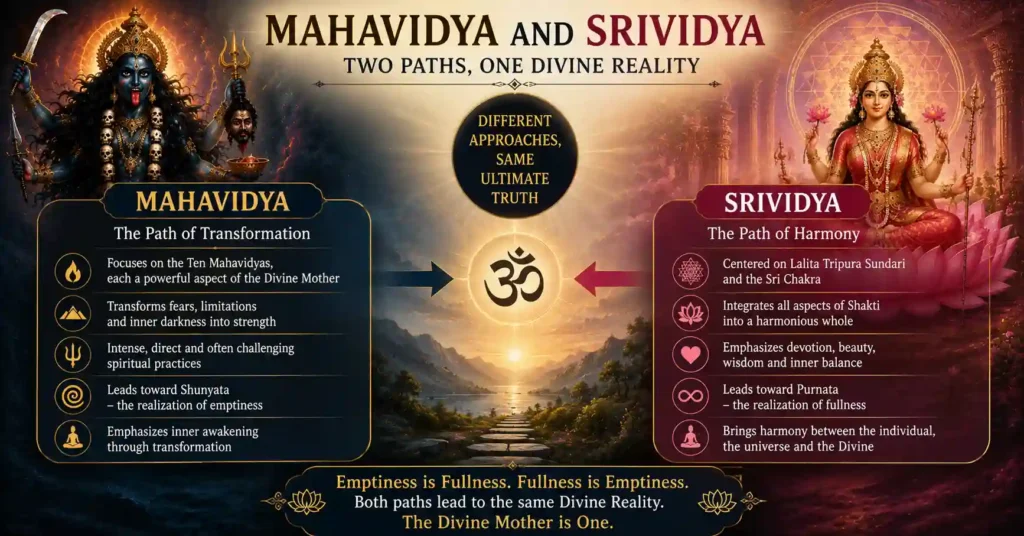
Although their methods may appear different, both paths seek the same ultimate realization. Mahavidya reveals the Divine Mother through her many transformative forms, while Srividya reveals the harmony and completeness that unites all those forms within a single Divine Consciousness.
Reading about these traditions can deepen understanding, but genuine spiritual growth requires humility, patience, sincerity, and respect for the teachings.
For those who feel drawn to these paths, guidance from a qualified teacher can help ensure that spiritual practice remains balanced, meaningful, and beneficial.
With proper understanding and devotion, both Mahavidya and Srividya can become powerful gateways to a deeper relationship with the Divine Mother and a greater awareness of one’s true spiritual nature.
Suggested Reading
The relationship between Mahavidya and Srividya becomes even more meaningful when explored through the individual forms of the Divine Mother and the traditions that surround them.
Whether you wish to understand the Dasa Mahavidyas, explore the symbolism of specific Mahavidya forms, or deepen your knowledge of Shakta philosophy and Goddess worship, the following articles can help continue that spiritual journey.
Dash Mahavidya: The Ten Great Wisdom Goddesses of Shakti
https://thesanatantales.com/dash-mahavidya/
Maa Kali: Meaning, Symbolism and Spiritual Significance
https://thesanatantales.com/maa-kali/
Maa Tara: The Compassionate Savior and Mahavidya of Wisdom
https://thesanatantales.com/maa-tara/
Tripura Sundari: Meaning, Symbolism and Spiritual Significance
https://thesanatantales.com/tripura-sundari/
Maa Bhuvaneshwari: Meaning, Symbolism and Spiritual Significance
https://thesanatantales.com/maa-bhuvaneshwari/
Maa Bhairavi: Meaning, Symbolism and Spiritual Significance
https://thesanatantales.com/maa-bhairavi/
Maa Chhinnamasta: Meaning, Symbolism and Spiritual Significance
https://thesanatantales.com/maa-chhinnamasta/
Maa Dhumavati: Meaning, Symbolism and Spiritual Significance
https://thesanatantales.com/maa-dhumavati/
Maa Bagalamukhi: Meaning, Symbolism and Spiritual Significance
https://thesanatantales.com/maa-bagalamukhi/
Maa Matangi: Meaning, Symbolism and Spiritual Significance
https://thesanatantales.com/maa-matangi/
Maa Kamalatmika: Meaning, Symbolism and Spiritual Significance
https://thesanatantales.com/maa-kamalatmika/
FAQs
What Is the Main Difference Between Mahavidya and Srividya?
Mahavidya focuses on the ten transformative forms of the Divine Mother, each representing a specific aspect of spiritual growth and inner awakening. Srividya is a complete spiritual tradition centered on Lalita Tripura Sundari, where these diverse aspects of Shakti are understood as part of one unified Divine Consciousness. While their approaches differ, both paths ultimately lead toward spiritual realization.
Is Srividya a Part of the Mahavidya Tradition?
Srividya and Mahavidya are closely related but are generally regarded as distinct traditions within Shakta Tantra. Mahavidya worship emphasizes the ten Mahavidyas, while Srividya centers on Lalita Tripura Sundari and the Sri Chakra.
Traditional teachings, however, recognize deep connections between the two paths, especially through the worship of Tripura Sundari, who is both a Mahavidya and the central deity of Srividya.
Who Is Tripura Sundari in Mahavidya and Srividya?
Tripura Sundari, also known as Shodashi, is one of the Dasa Mahavidyas and the principal deity of Srividya. She represents beauty, wisdom, harmony, and spiritual completeness. Because she occupies an important place in both traditions, she is often viewed as a bridge between Mahavidya and Srividya.
What Is the Role of the Sri Chakra in Srividya?
The Sri Chakra, also called the Sri Yantra, is one of the most sacred symbols in Srividya. It represents the universe, the Divine Mother, and the spiritual journey of the seeker. Through worship, meditation, and contemplation of the Sri Chakra, practitioners seek to progress from external awareness toward deeper spiritual realization.
Can Beginners Practice Mahavidya or Srividya Worship?
Simple devotional worship, prayer, and study can be practiced by anyone with sincerity and respect. However, advanced mantra practices, rituals, and initiatory traditions are traditionally undertaken under the guidance of a qualified Guru. Beginners are generally encouraged to focus on devotion, spiritual discipline, and understanding the teachings before pursuing advanced practices.
Why Is Guru Initiation Considered Important in These Traditions?
Both Mahavidya and Srividya place great importance on proper guidance. Traditional teachings hold that a Guru helps the seeker understand spiritual practices correctly, avoid confusion, and progress safely on the path. Guru initiation also preserves the authenticity of sacred teachings that have been passed down through established lineages.
Do Mahavidya and Srividya Lead to the Same Spiritual Goal?
Although their methods differ, both traditions ultimately seek spiritual awakening and realization of the Divine Mother. Mahavidya often emphasizes transformation through specific forms of Shakti, while Srividya emphasizes harmony and completeness. Traditional teachings generally view these as different approaches to the same ultimate truth.
What Do Shunyata and Purnata Mean in These Traditions?
hunyata refers to the realization that the limited ego and sense of separateness are ultimately empty of independent existence. Purnata refers to the realization of wholeness, completeness, and the presence of Divine Consciousness in all creation. Many spiritual teachers explain that these are not contradictory experiences but two ways of describing the same Absolute Reality.
Glossary of Important Terms
| Term | Meaning |
|---|---|
| Mahavidya | The ten great wisdom goddesses of Shakta Tantra, each representing a unique aspect of Divine Consciousness. |
| Srividya | A sacred Shakta tradition centered on Lalita Tripura Sundari and the worship of the Sri Chakra. |
| Shakti | The Divine Feminine Power that creates, sustains, and transforms the universe. |
| Tripura Sundari | The third Mahavidya and the central deity of Srividya, representing beauty, wisdom, and completeness. |
| Lalita Tripura Sundari | A revered form of the Divine Mother worshipped as the supreme Goddess in Srividya traditions. |
| Sri Chakra (Sri Yantra) | The sacred geometric diagram used in Srividya worship, symbolizing the universe and spiritual ascent. |
| Bindu | The central point of the Sri Chakra where all duality dissolves into pure consciousness. |
| Panchadasi Mantra | One of the principal mantras of Srividya, traditionally received through initiation. |
| Shodashi | A form of Tripura Sundari associated with spiritual completeness and the sixteenth lunar phase. |
| Srikula | A Shakta stream emphasizing harmony, beauty, order, and the worship of Tripura Sundari. |
| Kalikula | A Shakta stream emphasizing transformative and fierce aspects of the Divine Mother, especially Kali. |
| Tantra | A spiritual tradition that uses mantra, meditation, ritual, and inner discipline to realize the Divine. |
| Mantra | A sacred sound, word, or phrase used for prayer, meditation, and spiritual practice. |
| Yantra | A sacred geometric design used as a tool for meditation and worship. |
| Sadhana | A disciplined spiritual practice undertaken for inner growth and realization. |
| Guru | A spiritual teacher who guides a seeker on the path of knowledge and practice. |
| Diksha (Initiation) | The formal transmission of spiritual teachings or mantras from Guru to disciple. |
| Shunyata | The realization of emptiness or the transcendence of limited identity. |
| Purnata | The realization of completeness, fullness, and unity with the Divine. |
About the Author
Yateendra Chaturvedi is a spiritual writer, devotee, researcher, and the founder of The Sanatan Tales. With a deep interest in Sanatan Dharma and Indian spiritual traditions, he writes about Hindu deities, temples, scriptures, festivals, Mahavidyas, sacred stories, rituals, and living traditions that continue to inspire millions of devotees.
Drawing from traditional texts, regional beliefs, temple practices, and devotional literature, he aims to present authentic and accessible content for modern readers. His work focuses on preserving spiritual wisdom, explaining sacred traditions, and helping seekers develop a deeper understanding of India’s rich spiritual heritage.
Through The Sanatan Tales, Yateendra strives to make the timeless teachings of Sanatan Dharma simple, meaningful, and relevant for today’s generation while maintaining respect for traditional sources and diverse spiritual perspectives.
Learn More About Yateendra Chaturvedi →
https://thesanatantales.com/about-the-author/
References & Sources
This article is based on beliefs and traditions followed within the Shakta traditions of Sanatan Dharma, traditional knowledge associated with the Dashamahavidya tradition, Shakti worship, Devi sadhana, and insights drawn from various spiritual and religious study sources. Some concepts discussed in this article are also inspired by teachings and interpretations preserved through the guru-disciple tradition.
Note: Beliefs, interpretations, and spiritual practices may vary across different traditions, sects, and paths within Sanatan Dharma. The purpose of this article is not to present any single viewpoint as the absolute truth, but to explain widely accepted religious and spiritual perspectives in a simple and accessible manner.
Related Post