
Among the ten Mahavidyas, Maa Dhumavati stands apart in a way that makes many devotees uneasy. She does not promise comfort, beauty, or abundance.
She arrives when everything familiar has already fallen away. Loss, silence, hunger, old age, failure, isolation, and emptiness are her domain. Yet within these very states, she hides one of the deepest truths of Sanatan Dharma.
Maa Dhumavati is the seventh Mahavidya, worshipped not for worldly success but for liberation. She represents the moment when desire ends, when hope collapses, and when the soul stands alone before reality.
Serious seekers understand that this stage is unavoidable on the path of wisdom. That is why her worship has always remained limited, secretive, and demanding.
To understand Maa Dhumavati is to understand what remains when nothing else survives.
Table of Contents
ToggleMaa Dhumavati in the Dash Mahavidya Tradition
In the Dash Mahavidya path, each goddess reveals a specific stage of inner awakening. Maa Dhumavati appears after intense destruction and before final clarity. She represents the aftermath, not the battle.
Unlike Maa Kali or Maa Bhairavi, who actively destroy illusion, Maa Dhumavati presides over what is left once illusion has already collapsed.
Her presence signals spiritual exhaustion, where the seeker no longer runs after pleasure, fear, or identity. In this sense, Maa Dhumavati Mahavidya is not about action, but about stillness that follows collapse.
She is not invoked for wealth, marriage, fame, or victory. She is approached by those who are tired of pretending and ready to face truth without decoration.
Why Maa Dhumavati Has No Consort
Maa Dhumavati is the only Mahavidya shown without a consort. This is not a social statement. It is a metaphysical one.
In Tantra, Shiva represents consciousness and Shakti represents energy. Creation exists when both operate together. Dhumavati appears after dissolution, when creation has ended.
Shiva has withdrawn, leaving behind pure Shakti in a state of smoke, silence, and suspension.
This is why she is called the widow goddess, not as a sign of weakness, but as a symbol of absolute independence. She does not sustain life, nor does she decorate it. She remains when nothing else functions.
Some traditions describe her as Shakti without Shiva. Others call her the power of post-creation. Both point toward the same truth: Maa Dhumavati exists beyond relationship, beyond roles, beyond continuity.
Origin Stories of Maa Dhumavati
Two major origin narratives are found in Tantric texts.
One tradition says Maa Dhumavati emerged from the smoke of Sati’s self-immolation during Daksha’s yajna. When Sati burned herself, what remained was not form but smoke, grief, and silence. From this residue arose Dhumavati, embodying loss itself.
Another legend describes a moment where Sati, overcome by hunger, swallowed Lord Shiva. When Shiva emerged, he cursed her to assume the form of a widow. Tantra interprets this symbolically.
Hunger here is cosmic emptiness. Swallowing Shiva means absorption of consciousness into energy. The widow form represents regression into the unmanifest state.
Both stories point to dissolution, not punishment. Dhumavati is born when creation fails to sustain itself.
Outer Form and Iconography of Maa Dhumavati
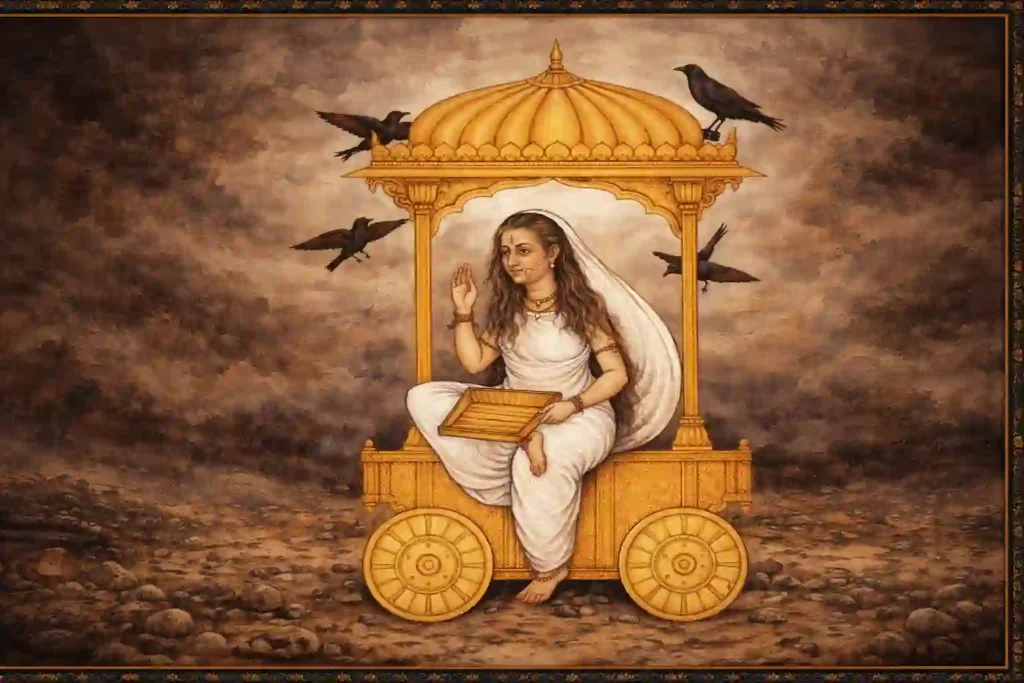
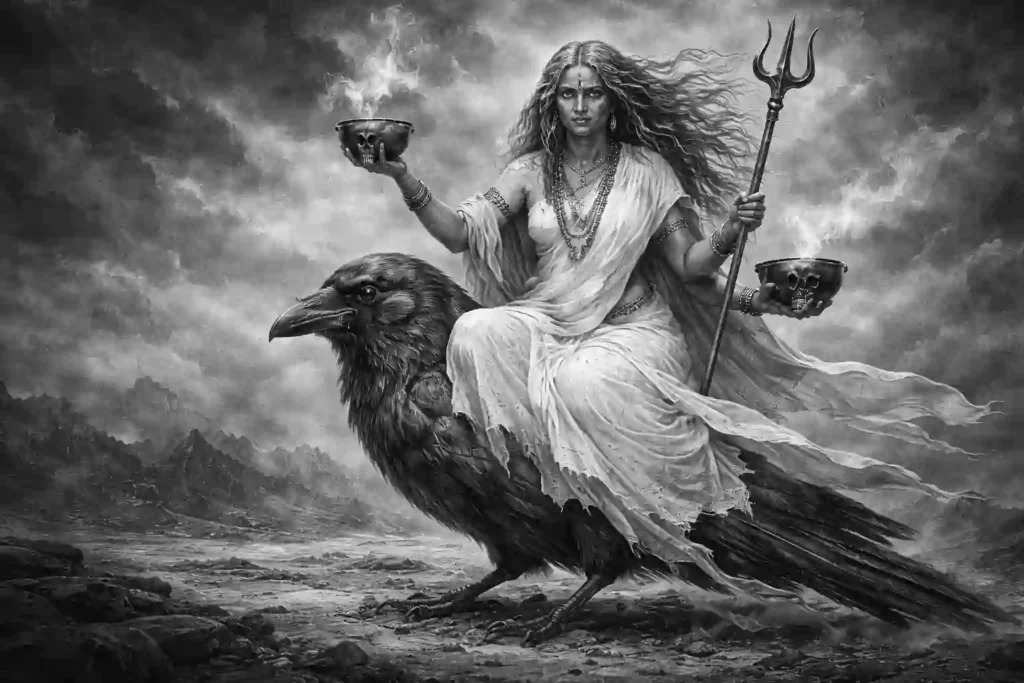
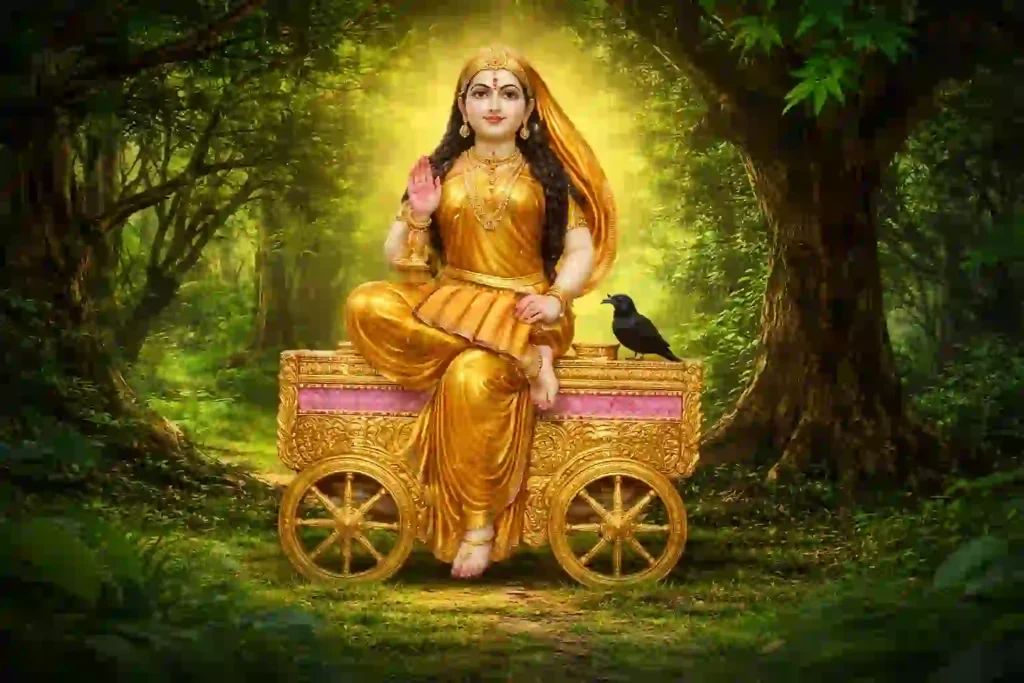
Maa Dhumavati is intentionally depicted as unattractive. She appears old, thin, with pale or smoky skin. Her hair is untied, her face wrinkled, her posture weary. She wears simple white or dirty widow clothes and no ornaments.
She holds a winnowing basket, often trembles, and rides either a crow or a chariot without horses or wheels.
Nothing in her form invites desire. This is deliberate. She challenges the seeker to confront attachment to beauty, youth, and pleasure. In her presence, the mind finds no place to escape.
Her appearance teaches that truth does not arrive dressed as comfort.
Inner Meaning of Her Sacred Symbols
Every symbol associated with Maa Dhumavati carries layered meaning.
Smoke represents obscuration, but also purification. Smoke burns the eyes and irritates the breath, yet it removes impurities. Spiritually, smoke is the state where illusion is exposed but not yet dissolved.
The winnowing basket separates grain from husk. This is viveka, the power to distinguish the eternal from the temporary. Dhumavati does not destroy illusion violently. She quietly removes what has no substance.
The crow is a creature of death, ancestors, and leftovers. It survives where others cannot. In Dhumavati worship, the crow symbolizes liminal existence, life at the edge of collapse.
The horseless chariot reflects a life that no longer moves forward in worldly terms. Desire has stopped pulling the soul. What appears as stagnation externally becomes inner stillness.
Maa Dhumavati and the Philosophy of Shunya
Maa Dhumavati embodies shunya, the void. This void is not emptiness in the modern sense. It is fullness without form.
In Sanatan philosophy, creation arises from shunya and returns to shunya. Dhumavati represents that silent interval between cycles. She is present after Mahapralaya, when even time dissolves.
She is also linked with yoganidra, the cosmic sleep where consciousness rests without thought. This is not unconsciousness. It is awareness without object.
For the seeker, encountering Dhumavati means learning to remain present when nothing responds.
Connection with Older Vedic and Folk Deities
Maa Dhumavati carries traits of several ancient figures.
Nirriti, a Vedic goddess, represented decay, disorder, and the breakdown of cosmic law. Jyestha symbolized decline, old age, and familial conflict. Alakshmi embodied poverty and lack of radiance.
Dhumavati absorbs these negative states but transforms them. Unlike Alakshmi, she does not represent misfortune alone. She is a Vidya, a wisdom path. What others feared, she uses as a doorway to liberation.
Who Traditionally Worships Maa Dhumavati
Her worship has always been restricted.
Sanyasis, widows, renunciates, and advanced tantrics are traditionally drawn to her. Those already detached from social roles find resonance with her energy.
Most lineages discourage married couples from home worship. Her energy pulls inward and can weaken household attachments. However, temple worship differs based on region.
In Kashi, even householders worship her as a guardian mother. This shows how temple tradition can override textual restrictions.
Tantric Worship and Accepted Practices
Maa Dhumavati tantra is austere, silent, and demanding.
Worship often happens at night, during Amavasya or Saturdays. Silence is central. Solitude is preferred. Cremation grounds symbolize confronting mortality without illusion.
Vamachara practices exist but are lineage-bound. Breaking taboos here is not indulgence but a method to dissolve fear and duality. Without guidance, these practices are dangerous.
Fear is not avoided in her worship. It is faced.
Offerings Offered to Maa Dhumavati
Unlike most goddesses, Maa Dhumavati does not prefer sweet offerings.
Black sesame, mustard oil lamps, dry coconut, and plain food are common. These items reflect austerity and darkness.
In certain Tantric traditions, meat, liquor, bhang, or cigarettes are offered. These are symbolic, linked to smoke and impurity, and must never be copied casually.
Her offerings mirror life stripped of comfort.
Mantras of Maa Dhumavati
The most common mantra is:
ॐ धूं धूं धूमावती देव्यै स्वाहा॥
This mantra dissolves stagnation and inner blockage.
Her Gayatri mantra focuses on wisdom of dissolution rather than creation.
Mantra sadhana for Maa Dhumavati requires discipline, grounding, and guru guidance. Casual chanting is discouraged.
Maa Dhumavati and Astrology
Astrologically, Maa Dhumavati is linked with Ketu.
Ketu represents detachment, loss, isolation, and spiritual rupture. When Ketu becomes overwhelming, Dhumavati worship helps stabilize the seeker.
She is not worshipped for prosperity remedies. Her grace comes as clarity, not comfort.
Temples and Regional Traditions
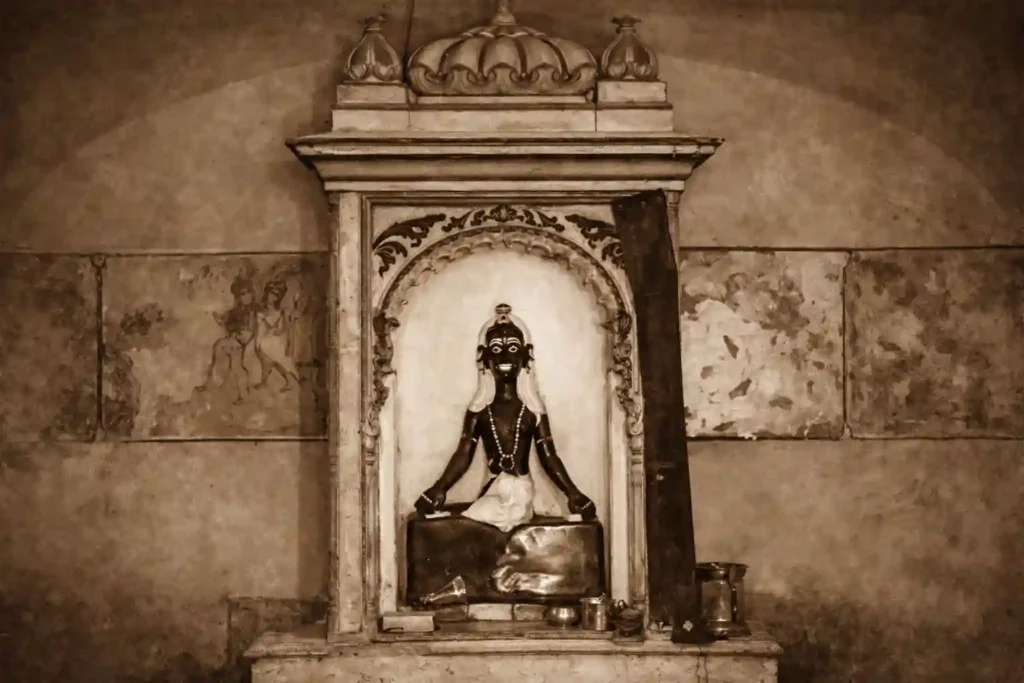
Dedicated temples to Maa Dhumavati are rare.
In Varanasi, she is worshipped as a protective mother. Married couples visit her shrine without fear.
At Pitambara Peeth in Datia, her temple carries strict traditions. Women are often advised not to gaze directly at the idol, reflecting her solitary energy.
In Rajrappa and Kamakhya, she appears within Mahavidya clusters, worshipped quietly by advanced seekers.
Temple practice often softens textual severity.
Dhumavati Jayanti and Sacred Timings
Dhumavati Jayanti falls on Jyeshtha Shukla Ashtami.
Amavasya nights, Saturdays, and Gupt Navratri are considered powerful times for her worship.
Fire rituals with black sesame are performed to dissolve karmic stagnation.
Maa Dhumavati and Gupt Navratri sadhana
Gupt Navratri is one of the rare periods where the worship of Maa Dhumavati naturally fits. Unlike Chaitra or Sharad Navratri, Gupt Navratri is inward and quiet, focused on Mahavidya sadhana rather than public rituals.
This hidden nature reflects Maa Dhumavati’s own energy of silence, withdrawal, and dissolution.
During Gupt Navratri, seekers turn toward Mahavidyas that guide the mind beyond desire and form. Maa Dhumavati is approached not for fulfilment, but for clarity during stagnation, loss, or inner emptiness.
Her worship during this time is traditionally linked with night hours, reduced speech, and silent reflection.
In many Tantric traditions, her Gupt Navratri sadhana is kept simple. Mustard oil lamps, black sesame offerings, and quiet meditation are preferred over elaborate puja.
The focus remains on stillness and surrender rather than ritual display. Maa Dhumavati Gupt Navratri worship is not advised for beginners seeking quick results.
Her sadhana can deepen isolation and inner confrontation, and is traditionally recommended only for those drawn toward renunciation or guided practice.
For others, Gupt Navratri may simply be a time to understand her wisdom rather than invoke her energy directly.
Spiritual Transformation Through Maa Dhumavati
Maa Dhumavati does not uplift. She empties.
Her path is one of radical unbecoming. Titles, roles, desires, and hopes fall away. What remains is resilience and truth.
She grants strength during depression, grief, and isolation. Many devotees feel her presence during the darkest phases of life, often without calling her.
Her blessings are silent and lasting.
Who Should Avoid Her Worship
Beginners without guidance
Those seeking quick results
Householders without inner readiness
People drawn by fear or curiosity
Maa Dhumavati responds to surrender, not ambition.
Maa Dhumavati in the Mahavidya Journey
In the Mahavidya cycle, Dhumavati prepares the seeker for final wisdom. She stands between destruction and transcendence.
She teaches that freedom begins when nothing is demanded from life.
Conclusion
Maa Dhumavati is not a goddess one approaches in comfort. She appears when illusions burn away and silence fills the space they once occupied.
In her smoky presence, the seeker learns to sit with loss without running, to remain steady without reward, and to trust the void as divine.
She is feared only by those who still cling. For those ready to release everything false, Maa Dhumavati becomes the quiet doorway to liberation.
Suggested Reading
To understand her deeper place in the Mahavidya path, explore our detailed guides on Maa Kali, Maa Bhairavi, and the complete Das Mahavidya tradition on thesanatantales.com.
FAQs
Who is the goddess Dhumavati?
Maa Dhumavati is the seventh Mahavidya, representing loss, detachment, and the wisdom that arises when all illusions fall away.
Can we worship Maa Dhumavati?
Yes, but her worship is traditionally meant for serious seekers and is usually done under guidance, as her energy turns the mind inward.
What are the benefits of Dhumavati?
She grants inner strength during loss, removes deep stagnation, and helps dissolve ego, fear, and karmic blocks.
How to please goddess Dhumavati?
She is pleased by simplicity, silence, restraint, and sincere surrender rather than elaborate rituals or show.
Who is the husband of Dhumavati?
Maa Dhumavati has no husband; she represents Shakti after dissolution, when Shiva has withdrawn from creation.
What is the secret of Dhumavati?
Her secret is that emptiness is not absence, but a doorway to truth and liberation.
What is Dhumavati's favorite food?
She traditionally accepts simple offerings like black sesame, dry coconut, and mustard oil rather than sweets.
Can anyone chant the Dhumavati mantra?
Basic remembrance is allowed, but mantra chanting is traditionally advised only with guidance due to her intense energy.