
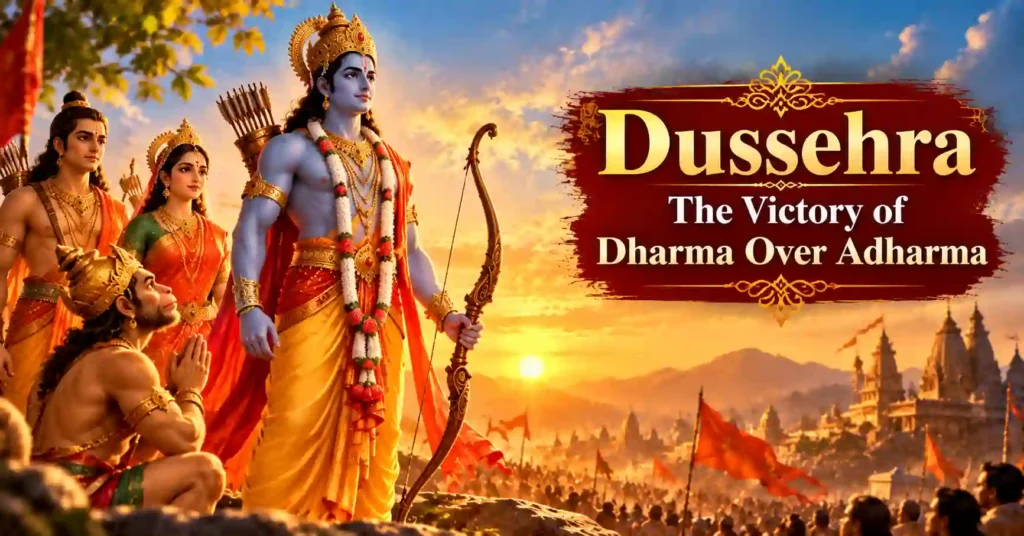
Dussehra is one of the most meaningful festivals in Sanatan Dharma. It celebrates the victory of good over evil and reminds us that truth, courage, and righteousness ultimately prevail. Also known as Vijayadashami, Dussehra is associated with two great victories:
Lord Rama’s defeat of Ravana and Maa Durga’s triumph over Mahishasura. Across India, people celebrate this sacred occasion through Ramlila performances, Ravan Dahan, prayers, and traditional puja rituals.
Dussehra 2026 falls on 20 October in most parts of India, while some regional observances follow different dates.
In this article, you will discover the date and auspicious timings of Dussehra, the stories behind the festival, its religious significance, puja vidhi, regional traditions, and the timeless spiritual lessons it offers for everyday life.
Dussehra 2026 at a Glance
Detail | Information |
|---|---|
Festival | Dussehra |
Also known as | Vijayadashami, Dasara |
Date | Tuesday, 20 October 2026, in most parts of India |
Hindu month | Ashwin (Ashwayuja) |
Tithi | Shukla Paksha Dashami |
Main significance | Victory of good over evil and dharma over adharma |
Associated victories | Lord Rama over Ravana and Maa Durga over Mahishasura |
Important rituals | Dussehra Puja, Shami Puja, Ayudha Puja and Ravan Dahan |
Vijay Muhurat | Approximately 1:59 PM to 2:45 PM in Delhi |
Regional variation | Bengal’s Vijayadashami is observed on Wednesday, 21 October 2026 |
Note: Muhurat timings vary by location. The Vijay Muhurat above is for Delhi; readers should consult their local Panchang for accurate timings.
Table of Contents
ToggleDussehra 2026: Date, Tithi and Vijayadashami Muhurat
Vijayadashami, widely known as Dussehra, will be celebrated on Tuesday, 20 October 2026, in most parts of India. It falls on the tenth day of the bright fortnight of the Hindu month of Ashwin. The festival commemorates Lord Rama’s victory over Ravana and Maa Durga’s triumph over Mahishasura, reminding devotees that truth and righteousness ultimately prevail.
Dussehra 2026: Important Dates and Timings
| Event | Date and time |
|---|---|
| Festival date | Tuesday, 20 October 2026 |
| Dashami Tithi begins | 20 October, 12:50 PM |
| Dashami Tithi ends | 21 October, 2:11 PM |
| Vijay Muhurat | 1:59 PM to 2:45 PM |
| Bengal Vijayadashami | Wednesday, 21 October 2026 |
The timings above are based on the New Delhi Panchang. Actual timings vary by location.
Why Is the Festival Celebrated on 20 October?
The Dashami Tithi begins around midday on 20 October and continues into the following afternoon. However, Hindu festival dates are not decided simply by when a tithi begins or ends. The observance also considers the tithi prevailing during specific periods of the day, along with traditional Panchang rules.
This is why the main celebration falls on 20 October in most parts of India, even though Dashami Tithi continues on 21 October. Bengal follows its own Vijayadashami observance, which falls on 21 October 2026.
What Is the Vijayadashami Muhurat?
Vijay Muhurat is considered an auspicious period for worship and certain important activities on this occasion. In New Delhi, the Vijay Muhurat on 20 October 2026 is from 1:59 PM to 2:45 PM. Devotees may use this period for traditional prayers, Shami Puja, or other rituals according to their family customs.
The exact muhurat differs from city to city because sunrise, sunset, and local Panchang calculations vary. Therefore, check a reliable local Panchang before planning your puja.
This festival is more than a date on the calendar. It reminds us to choose truth over falsehood, courage over fear, and dharma over adharma. Its stories and traditions explain why this timeless message continues to inspire generations.
What Is Dussehra and Why Is It Celebrated?
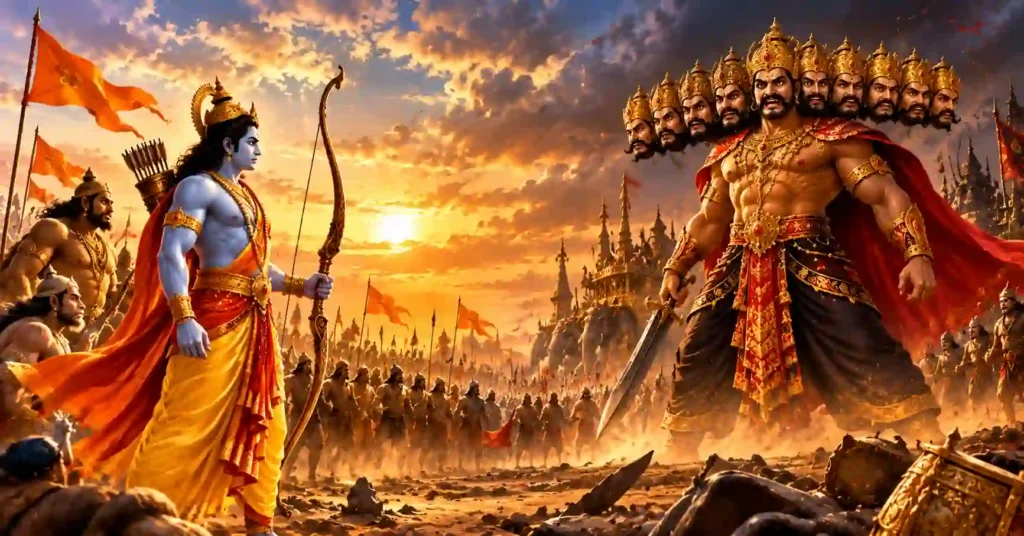
This major Hindu festival celebrates the victory of good over evil and dharma over adharma. The name is commonly associated with Lord Rama’s defeat of the ten-headed Ravana. Also known as Vijayadashami, it represents the triumph of righteousness.
In the Ramayana, Lord Rama defeats Ravana to rescue Maa Sita, who had been taken to Lanka. This victory represents the triumph of truth, courage, devotion, and righteousness over arrogance and wrongdoing. Ravan Dahan, the burning of Ravana’s effigy, recalls this powerful message.
The festival also celebrates Maa Durga’s victory over the buffalo demon Mahishasura. This tradition highlights the triumph of divine feminine power over destructive forces. The celebration follows the nine days of Navratri, which are dedicated to the worship of Maa Durga in many parts of India.
Although customs differ across regions, the central message remains the same. Power without righteousness can lead to destruction, while truth and humility guide us towards a better life. The occasion encourages us to overcome negative qualities such as anger, greed, pride, and dishonesty.
The Story of Lord Rama and Ravana
The story of Lord Rama and Ravana is one of the central reasons this festival is celebrated across India. It comes from the Ramayana, the ancient Hindu epic that teaches the importance of dharma, devotion, duty, and righteous conduct.
Ravana was the powerful king of Lanka, known for his great knowledge, strength, and devotion to Lord Shiva. However, his pride and desire for control led him towards adharma. When he abducted Maa Sita, the wife of Lord Rama, he crossed the limits of righteousness and brought destruction upon himself and his kingdom.
Lord Rama, accompanied by Lakshmana, Hanuman, and the Vanara army, travelled to Lanka to rescue Maa Sita. After a fierce battle, Rama defeated Ravana through his divine skill, courage, and determination. Maa Sita was rescued, and Ravana’s reign came to an end.
This victory is remembered through Ramlila performances and the burning of Ravana’s effigy. Ravana’s ten heads are often interpreted as symbols of negative qualities such as pride, anger, greed, attachment, and jealousy, although interpretations vary across traditions.
The story offers a lesson that remains relevant today. Knowledge, wealth, and power have little value when guided by arrogance rather than wisdom. Lord Rama’s victory reminds us to stand by truth, respect others, and follow the path of dharma even when it is difficult.
Maa Durga's Victory over Mahishasura
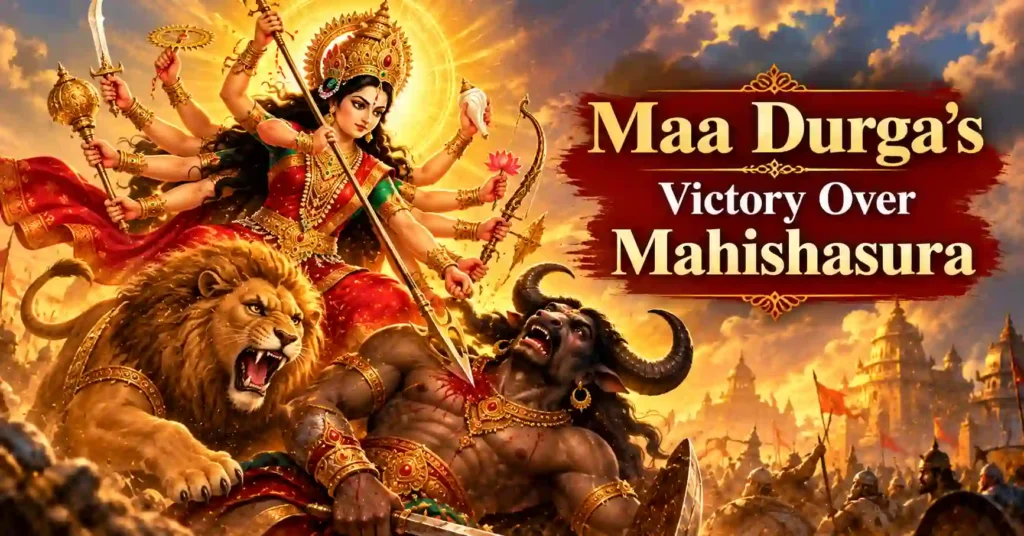
The festival also celebrates Maa Durga’s victory over Mahishasura, a powerful demon whose growing strength threatened the balance of the universe. According to Hindu tradition, Mahishasura had received a boon that made him difficult to defeat. He used his power to challenge the Devas and spread fear across the three worlds.
Unable to defeat him individually, the Devas combined their divine energies to create Maa Durga, the embodiment of Shakti. Armed with divine weapons and riding a lion, she confronted Mahishasura in a fierce battle that continued for several days.
On the tenth day, Maa Durga defeated Mahishasura, restoring peace and balance. Her victory is celebrated as Vijayadashami in many traditions and holds special significance in regions where Navratri honours the Divine Mother. In eastern India, Durga Puja culminates in the celebration of her triumph and her return to her divine abode.
This story gives the occasion a deeper spiritual meaning. Maa Durga represents courage, protection, and the divine power that destroys injustice. Her victory reminds us that inner strength, faith, and determination can help us overcome negative qualities that disturb our lives and relationships.
Why Is Dussehra Also Called Vijayadashami?
Vijayadashami is a name that carries the meaning of victory. The word combines Vijaya, meaning victory, and Dashami, referring to the tenth day of the lunar fortnight. It reflects the triumph of righteousness over evil.
In the Ramayana tradition, this day celebrates Lord Rama’s victory over Ravana and the restoration of dharma. In the Shakta tradition, it is associated with Maa Durga’s victory over Mahishasura after the nine days of Navratri. Both traditions share the message that destructive forces cannot prevail forever.
The occasion also reminds devotees that victory is not only about defeating an external enemy. It is equally about overcoming pride, anger, greed, jealousy, and dishonesty within ourselves. These qualities can weaken our judgment and disturb our peace when left unchecked.
Although Dussehra and Vijayadashami are often used interchangeably, regional customs and observances differ. In many parts of India, the celebration includes Ravan Dahan, while in Bengal, Vijayadashami marks the conclusion of Durga Puja and the farewell to Maa Durga.
The name Vijayadashami therefore expresses the heart of the celebration: victory guided by dharma, the restoration of balance, and the hope that goodness will prevail.
Dussehra Puja Vidhi: How to Perform Puja at Home
Dussehra is an auspicious occasion to offer prayers, seek divine blessings, and renew our commitment to dharma. Families may follow different customs depending on their region and family tradition. The following simple Dussehra puja vidhi can be performed at home with devotion and respect.
Steps for Dussehra Puja
Clean the puja area: Begin by cleaning your home and the place where you will perform the puja. Take a bath and wear clean clothes.
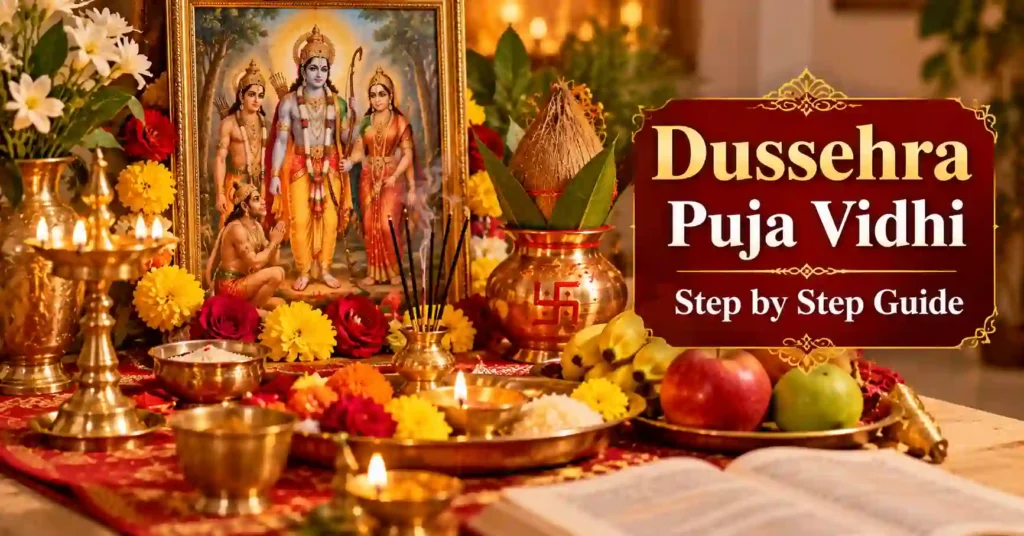
Prepare the puja samagri: Arrange a picture or idol of Lord Rama, flowers, a diya, incense, fruits, sweets, and kumkum. You may also include an image of Maa Durga if that is part of your family tradition.
Light the diya and offer prayers: Light the diya and incense, offer flowers, and pray to the deity with a peaceful mind. You may recite the Ram Raksha Stotra, chant Lord Rama’s name, or read a passage from the Ramayana.
Offer bhog: Present fruits, sweets, or other suitable offerings according to your family’s customs. Offer them with gratitude and devotion.
Perform aarti: Conclude the puja with aarti and pray for the well-being, peace, and prosperity of your family. Share the prasad with family members.
Worship According to Family Tradition
In many households, Dussehra puja also includes worship of tools, books, vehicles, weapons, or other objects connected with work and livelihood. This practice expresses gratitude for the means through which we fulfil our duties.
Some families perform Shami Puja or worship the Apta tree, while others focus on Lord Rama or Maa Durga. There is no need to follow every regional ritual. Choose the practices followed in your family or community and perform them with sincerity.
The true purpose of these rituals is not merely to complete a set of religious practices. It is to cultivate gratitude, courage, humility, and a sincere desire to follow the path of dharma. Celebrating Dussehra with devotion and understanding makes the occasion more meaningful.
Shami Puja on Dussehra: Significance and Tradition
Shami Puja is an important tradition observed during Dussehra in several parts of India, particularly in Maharashtra and other regions where the Shami tree is considered sacred. Commonly identified as Prosopis cineraria, the tree is associated with strength, protection, and good fortune. Worshipping it on Vijayadashami expresses the hope for success and the removal of obstacles.
One popular tradition connects the Shami tree with the Mahabharata. During their exile, the Pandavas hid their weapons in a Shami tree. After completing their year in disguise, they retrieved their weapons and prepared to reclaim their rightful place. This story is remembered as a symbol of courage, patience, and the eventual return of strength.
In some traditions, the tree is also associated with Lord Rama’s journey and victory over Ravana. Customs and explanations vary by region, so these stories should be understood within their respective traditions rather than treated as a single universal account.
How Is Shami Puja Performed?
Devotees may offer water, flowers, kumkum, or prayers to the Shami tree according to local custom. Some families exchange its leaves as a symbolic gesture of goodwill, prosperity, and respect. Where the tree is not available, devotees may follow their family’s customary form of worship.
The deeper message of this ritual is that patience and faith can help us face difficult times. Just as the Pandavas recovered their weapons after a period of hardship, Dussehra reminds us to remain steady in our duties and meet life’s challenges with courage.
Ayudha Puja: Worship of Tools, Weapons and Instruments
Ayudha Puja is a traditional Hindu observance associated with Navratri and Vijayadashami, especially in southern India. The word Ayudha means weapon or instrument. On this occasion, people worship the tools, machines, books, vehicles, and other objects that help them perform their work and fulfil their responsibilities.
This tradition is closely connected with gratitude and respect for one’s livelihood. Farmers may honour their agricultural tools, artisans their instruments, students their books, and workers the equipment they use daily. Today, some people also offer prayers for their computers, vehicles, and other work equipment.
How Is Ayudha Puja Performed?
People generally clean their tools and instruments, decorate them with flowers, and apply sandalwood paste or kumkum according to family and regional customs. A diya may be lit, and prayers are offered for safety, skill, prosperity, and success in one’s work.
In some regions, this ritual is observed on the ninth day of Navratri, while Vijayadashami is considered an auspicious time to resume work, begin learning, or start new activities. The exact practice varies across communities.
The deeper message of Ayudha Puja is that every honest form of work deserves respect. Our tools become useful through the skill and effort we put into them. By honouring them, we express gratitude for our abilities, our livelihood, and the opportunity to serve others through our work. This spirit of gratitude is also an important part of Dussehra celebrations.
Ravan Dahan: Why Is Ravana's Effigy Burned on Dussehra?
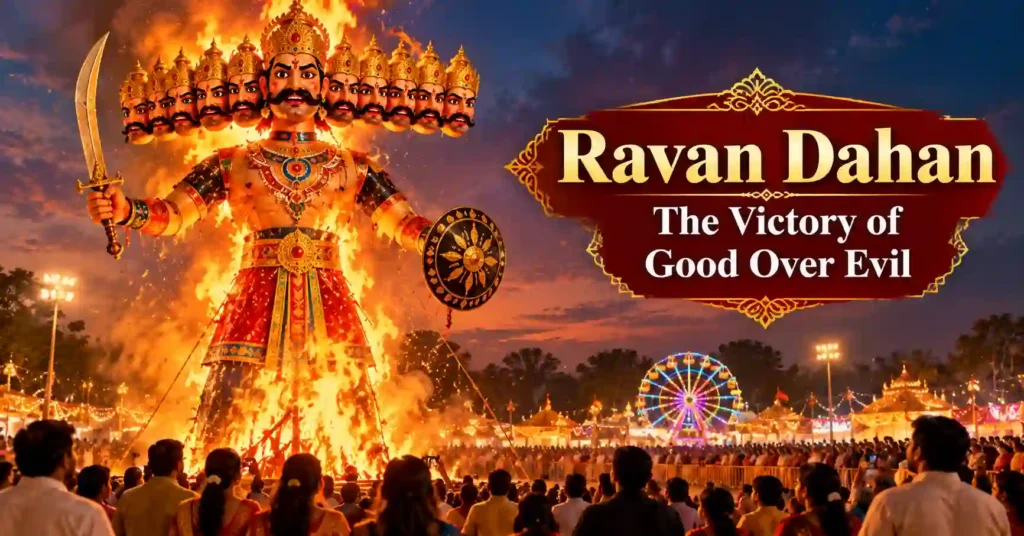
Ravan Dahan is one of the most recognisable traditions of Dussehra, especially in northern India. Every year, people gather in open grounds to watch the burning of large effigies of Ravana, often accompanied by those of Meghnad and Kumbhakarna. The event recalls Lord Rama’s victory in the Ramayana and symbolises the triumph of good over evil.
The effigies are often made with bamboo frames, paper, cloth, and other decorative materials. In many places, the celebration follows a Ramlila performance that presents important episodes from the life of Lord Rama. The burning of the effigies brings the performance to its symbolic conclusion.
What Do Ravana’s Ten Heads Represent?
Ravana’s ten heads are often interpreted as symbols of negative human qualities, including pride, anger, greed, attachment, jealousy, and uncontrolled desire. Interpretations vary across traditions, but the central lesson is that intelligence and power cannot protect a person who abandons righteousness.
The burning of Ravana’s effigy is therefore more than a public spectacle. It invites people to reflect on the faults they need to overcome within themselves. Simply watching an effigy burn has little meaning if anger, dishonesty, or arrogance continues to guide our actions.
The festival also encourages responsible celebrations. People should watch Ravan Dahan from designated safe areas, follow local instructions, and avoid handling fireworks or explosive materials themselves. A joyful celebration should protect families, children, animals, and the surrounding environment.
The true message of Ravan Dahan is simple: evil must be challenged, but lasting change begins with our own thoughts and actions. When we choose honesty over deception and humility over pride, we carry the spirit of Dussehra into everyday life.
How Dussehra Is Celebrated Across India
Dussehra is celebrated throughout India, but its customs, rituals, and local traditions differ from region to region. Some communities focus on Lord Rama’s victory over Ravana, while others celebrate Maa Durga’s triumph or follow traditions connected with work, learning, and prosperity.
North India: Ramlila and Ravan Dahan
In many parts of northern India, celebrations feature Ramlila, a dramatic presentation of the Ramayana. The performances often continue throughout Navratri and conclude with Lord Rama’s victory over Ravana. On the festival day, large effigies of Ravana are burned in public grounds, bringing families and devotees together.
West India: Garba, Shami Puja and Traditional Worship
In Gujarat, the nine nights of Navratri are marked by Garba and Dandiya Raas, devotional dances performed in honour of the Divine Mother. Vijayadashami follows these celebrations. In Maharashtra, people may worship the Shami tree and exchange its leaves as a symbol of goodwill and prosperity.
East India: The Conclusion of Durga Puja
In West Bengal and neighbouring regions, Durga Puja celebrates Maa Durga’s victory over Mahishasura. Vijayadashami marks the conclusion of the festival, with rituals, prayers, and the ceremonial farewell to Maa Durga before the immersion of her idol. The occasion carries both joy and the emotion of bidding farewell to the Divine Mother.
South India: Ayudha Puja and Mysuru Dasara
In several southern states, Ayudha Puja honours tools, instruments, vehicles, and other objects used in daily work. In Karnataka, the famous Mysuru Dasara features royal traditions, cultural performances, processions, and celebrations centred around the worship of Chamundeshwari, a form of Maa Durga.
These regional traditions show the many ways in which the festival expresses a shared spiritual message. Whether through Ramlila, Durga Puja, Shami Puja, or Ayudha Puja, Dussehra encourages devotion, gratitude, courage, and the victory of dharma over adharma.
The Spiritual Significance of Dussehra
The spiritual significance of this festival goes beyond Lord Rama’s victory over Ravana or Maa Durga’s triumph over Mahishasura. It reminds us that the struggle between good and evil also takes place within our own minds. Our thoughts, choices, and actions determine whether we follow the path of dharma or allow negative qualities to guide us.
Lord Rama represents righteousness, self-control, courage, and devotion to duty. Even when faced with hardship, he remains committed to dharma. His life teaches us that doing the right thing is not always easy, but it gives our actions meaning and direction.
Maa Durga represents divine strength, protection, and the power to overcome injustice. Her victory reminds us that courage and determination are necessary when facing harmful forces. It also teaches us that strength should be used to protect others and restore balance, not to dominate or exploit them.
Dussehra encourages us to examine our own weaknesses. Pride, anger, greed, jealousy, and dishonesty can damage relationships and disturb our peace. By recognising these qualities and working to overcome them, we can bring the deeper message of Vijayadashami into our daily lives.
Ultimately, this sacred occasion invites us to make dharma a part of everyday living. Speaking truthfully, treating others with respect, fulfilling our responsibilities, and standing against injustice are practical ways to honour its spirit throughout the year.
Life Lessons We Can Learn from Dussehra
This festival offers lessons that remain relevant in family life, relationships, work, and society. The stories of Lord Rama and Maa Durga remind us that real victory is not simply about defeating an opponent. It is about choosing the right path, controlling our weaknesses, and using our strength wisely.
Humility is greater than pride. Ravana possessed great knowledge and power, yet his arrogance led to his downfall. His story reminds us that intelligence and achievement are valuable only when guided by wisdom and good conduct.
Truth requires courage. Lord Rama’s journey was filled with difficulties, but he remained committed to his responsibilities. His example encourages us to stand by what is right, even when doing so demands patience and sacrifice.
Strength should protect, not harm. Maa Durga’s victory over Mahishasura teaches us to use our abilities to defend others, oppose injustice, and restore balance rather than misuse power.
Negative habits can be overcome. Anger, greed, jealousy, and dishonesty can weaken our judgment. The message of Dussehra encourages us to recognise these habits and consciously replace them with kindness, self-control, and honesty.
Good actions matter more than outward appearances. Festivals and rituals become more meaningful when their values influence our behaviour. Helping someone in need, keeping our promises, and treating others fairly are simple ways to practise dharma.
The message of this sacred occasion is not limited to one day of celebration. Every time we choose honesty over deception or humility over pride, we take a small step towards the victory of good within ourselves.
Dussehra Traditions, Customs and Celebrations
Dussehra brings families and communities together through prayers, cultural performances, and traditional celebrations. Although customs differ across India, the occasion is marked by devotion, gratitude, and the remembrance of divine victory. Many families also use this day to begin new activities or seek blessings for success in their work.
One popular custom is visiting temples dedicated to Lord Rama or Maa Durga. Devotees offer flowers, light diyas, recite prayers, and participate in aarti. In some places, special temple ceremonies and community gatherings are organised to mark Vijayadashami.
Another tradition is exchanging greetings, sweets, and gifts with family members, friends, and neighbours. In Maharashtra, some communities exchange Shami or Apta leaves as symbolic gold, expressing wishes for prosperity and goodwill. This custom represents the sharing of happiness rather than the exchange of material wealth.
In several regions, Vijayadashami is also considered an auspicious day to begin learning, start a new venture, or resume important work. Children may begin their formal education through traditional ceremonies, while families may perform puja for books, tools, or instruments connected with their daily responsibilities.
These customs give the festival its special place in Indian culture. They preserve family traditions, strengthen community bonds, and remind people that the message of righteousness and renewal can be carried into everyday life.
How Dussehra's Message Applies to Modern Life
The message of Dussehra remains just as relevant today as it was in ancient times. We may not fight battles like Lord Rama or face demons like Maa Durga, but we encounter everyday challenges such as dishonesty, anger, greed, jealousy, and pride. Overcoming these weaknesses is an important part of living according to dharma.
In our personal lives, the festival encourages us to practise patience, speak truthfully, and treat others with respect. At work, it reminds us to act honestly, fulfil our responsibilities, and avoid taking advantage of others. In society, its message inspires us to stand against injustice and use our abilities to help those in need.
The story of Ravana also teaches us not to judge success only by wealth, status, or power. He possessed great knowledge and strength, yet his pride led to his downfall. His story reminds us that achievements have lasting value only when supported by good character and wise decisions.
We can celebrate this occasion meaningfully by making one small personal commitment: controlling our anger, letting go of resentment, correcting a harmful habit, or helping someone without expecting anything in return. Such changes bring the spirit of Vijayadashami into everyday life.
The real victory begins within us. When our actions reflect honesty, compassion, courage, and self-discipline, we honour the timeless message of good triumphing over evil that lies at the heart of Dussehra.
Conclusion
This sacred festival celebrates more than the victory of Lord Rama over Ravana or Maa Durga over Mahishasura. It reminds us that truth, courage, and righteousness can overcome even the greatest challenges. The stories behind Vijayadashami inspire us to stand by dharma and use our strength and knowledge wisely.
As we celebrate Dussehra, let us reflect on the negative qualities within ourselves that need to change. Every step towards honesty, humility, compassion, and self-control brings us closer to the festival’s deeper meaning.
May Lord Rama guide us towards righteousness, and may Maa Durga bless us with courage and strength to face life’s challenges. Let this sacred occasion inspire us to make goodness a part of our everyday lives. May the victory of dharma over adharma begin within each of us. 🙏
Suggested Reading
If you found this guide on Dussehra helpful, you may also enjoy these related articles on Sharad Navratri, Lord Rama, Maa Durga worship, and the spiritual traditions of Sanatan Dharma.
Sharad Navratri 2026: Dates, Ghatasthapana Muhurat, Rituals and Significance
https://thesanatantales.com/sharad-navratri/
Maa Durga: Meaning, Story, Forms, Navadurga, Temples and Worship
https://thesanatantales.com/maa-durga-meaning-story-navadurga-worship/
Navadurga: Meaning, Nine Forms of Maa Durga, Navratri Significance and Spiritual Journey
https://thesanatantales.com/navadurga-nine-forms-of-maa-durga/
Durga Ashtami: Meaning, Significance, Kanya Puja and Rituals
https://thesanatantales.com/durga-ashtami/
Maha Navami: Significance, Rituals and Kanya Pujan
https://thesanatantales.com/maha-navami/
Ghatasthapana Guide: Meaning, Puja Vidhi, Samagri and Spiritual Significance
https://thesanatantales.com/ghatasthapana/
Read on Quora: Why Do We Celebrate Dussehra? Meaning, Story and Spiritual Significance
Explore this Quora post to understand the stories behind Dussehra, the victories of Lord Rama and Maa Durga, and the deeper spiritual lessons of this sacred festival.
Why Do We Celebrate Dussehra? Meaning, Story and Spiritual Significance
FAQs
1. When is Dussehra in 2026?
Dussehra in 2026 falls on Tuesday, 20 October, in most parts of India. The festival is observed on Ashwin Shukla Dashami, the tenth day of the bright fortnight of the Hindu month of Ashwin. It is also known as Vijayadashami and marks the victory of good over evil.
The Dashami Tithi continues into 21 October, and some regional observances, including Bengal’s Vijayadashami, fall on that date. Since festival timings depend on local Panchang calculations and regional traditions, devotees should check their local calendar for the correct puja timings.
2. Why is Dussehra celebrated?
Dussehra celebrates the victory of righteousness over evil. In the Ramayana tradition, it commemorates Lord Rama’s victory over Ravana and the rescue of Maa Sita. Ravana’s defeat represents the consequences of arrogance, wrongdoing, and the misuse of power.
In the Shakta tradition, Dussehra is also associated with Maa Durga’s victory over Mahishasura, the buffalo demon who threatened the balance of the universe. Both stories convey a shared message: destructive forces can be overcome when courage, divine strength, and righteousness prevail. The festival also
3. What is the difference between Dussehra and Vijayadashami?
Dussehra and Vijayadashami are commonly used as names for the same Hindu festival, observed on Ashwin Shukla Dashami. The word Vijayadashami combines Vijaya, meaning victory, and Dashami, meaning the tenth lunar day.
The name Dussehra is widely associated with Lord Rama’s victory over Ravana and the burning of Ravana’s effigy. Vijayadashami is also closely connected with Maa Durga’s victory over Mahishasura and the conclusion of Durga Puja in eastern India. Although the names are often interchangeable, regional customs and the stories emphasised during the festival may differ.
4. Why is Ravana's effigy burned on Dussehra?
Ravana’s effigy is burned on Dussehra to symbolise Lord Rama’s victory over Ravana and the triumph of good over evil. In many parts of India, the ceremony follows Ramlila performances that depict important events from the Ramayana. Effigies of Ravana, and sometimes Meghnad and Kumbhakarna, are set alight during public celebrations.
The ten heads of Ravana are sometimes interpreted as symbols of negative qualities such as pride, anger, greed, and jealousy. These interpretations vary across traditions. The deeper lesson is that knowledge and power cannot compensate for arrogance and wrongdoing. The burning reminds us to recognise and overcome our own weaknesses.
5. Which puja is performed on Dussehra?
The puja performed on Dussehra depends on regional customs and family traditions. Many devotees worship Lord Rama, offer flowers and sweets, light diyas, and recite prayers or passages from the Ramayana. Some families also perform Shami Puja, which is associated with auspiciousness and success.
Ayudha Puja, the worship of tools, weapons, instruments, and work equipment, is another important tradition in several regions, particularly in southern India. Some devotees also honour Maa Durga as Navratri concludes. Families can follow their customary rituals and consult a local Panchang for suitable timings. Devotion, gratitude, and respect for dharma remain central to the celebration.
6. What is the spiritual significance of Dussehra?
The spiritual significance of Dussehra lies in its message that truth, courage, and righteousness can overcome evil. Lord Rama represents duty and self-control, while Maa Durga symbolises divine strength and the power to defeat destructive forces. Their victories inspire devotees to live with honesty, compassion, and determination.
Dussehra also invites us to look within ourselves. Anger, greed, pride, jealousy, and dishonesty can harm our relationships and disturb our peace. By recognising these weaknesses and making an effort to overcome them, we bring the meaning of Vijayadashami into everyday life. The
7. What are the main rituals performed on Dussehra?
The main Dussehra rituals vary across India, but many include worship of Lord Rama or Maa Durga, lighting diyas, offering flowers and sweets, and seeking blessings for peace and prosperity. In northern India, Ramlila performances and Ravan Dahan are popular traditions that recall Lord Rama’s victory over Ravana.
In several regions, devotees also perform Shami Puja or Ayudha Puja to express gratitude for their tools, weapons, and instruments of work. Some families consider Vijayadashami an auspicious occasion to begin learning or start a new activity. These customs reflect devotion, gratitude, and the hope for success through righteous effort.
8. Why is Dussehra considered an auspicious day to start something new?
Dussehra is considered auspicious because Vijayadashami symbolises victory, renewal, and the triumph of dharma. Many families believe that beginning a new activity on this day brings blessings and encourages success. Children may begin their formal education, while others start a business, purchase work-related equipment, or resume important activities.
In some traditions, the day is associated with Vidyarambham, the ceremonial beginning of learning, and Ayudha Puja, which honours tools and instruments. Customs differ across regions and families. Beyond religious beliefs, Dussehra offers a meaningful opportunity to begin with positive intentions, discipline, and commitment to honest work.
About the Author
Yateendra Chaturvedi is a spiritual writer, researcher, devotee, and the founder of The Sanatan Tales. With over 35 years of professional experience and a lifelong interest in Sanatan Dharma, he writes about Hindu deities, temples, scriptures, festivals, Mahavidyas, sacred stories, rituals, and living traditions that continue to guide and inspire devotees across India.
Drawing from traditional scriptures, regional beliefs, temple traditions, devotional literature, and historical sources, he aims to present authentic, well-researched, and easy-to-understand content for modern readers. His work focuses on preserving spiritual wisdom, explaining sacred traditions, and helping seekers develop a deeper understanding of India’s rich spiritual heritage.
Through The Sanatan Tales, Yateendra strives to make the timeless teachings of Sanatan Dharma simple, meaningful, and relevant for today’s generation while maintaining respect for traditional sources, regional practices, and diverse spiritual perspectives.
Learn More About Yateendra Chaturvedi →
https://thesanatantales.com/about-the-author/
References & Sources
This article is based on traditional Hindu beliefs, the Ramayana, stories associated with Lord Rama and Ravana, and religious traditions surrounding Maa Durga’s victory over Mahishasura. It also draws upon cultural practices and spiritual teachings associated with Dussehra, Vijayadashami, Ravan Dahan, Shami Puja, and Ayudha Puja as observed in different parts of India.
Note: Dussehra celebrations, rituals, interpretations, and festival timings may vary across regions, communities, and family traditions. The purpose of this article is to explain widely followed beliefs and practices in simple, accessible language while respecting the diversity of Sanatan Dharma. Year-specific dates and auspicious timings should be checked against the relevant local Panchang.