Durga Ashtami is one of the most sacred and spiritually powerful days of Sharad Navratri. Observed on the eighth day of the festival, this auspicious occasion is dedicated to Maa Mahagauri, the eighth form of Navadurga. Across India, millions of devotees worship the Divine Mother on Durga Ashtami through prayers, fasting, mantra chanting, Kanya Puja, and special rituals seeking her blessings for peace, strength, and prosperity.
The significance of Durga Ashtami goes far beyond rituals alone. According to the traditions of Devi worship, this day represents the victory of divine power over negative forces. It is also closely associated with the sacred Sandhi Puja, the powerful junction between Ashtami and Navami, and the worship of young girls as living embodiments of the Goddess through Kanya Pujan.
For many devotees, Durga Ashtami is the spiritual peak of Navratri. Temples witness special celebrations, homes are filled with devotion, and families gather to honor Maa Durga in her compassionate as well as protective forms. The day reminds us that courage, purity, faith, and righteousness ultimately triumph over darkness and fear.
In this complete guide, you will learn the meaning of Durga Ashtami, its religious significance, the story behind the festival, Maa Mahagauri’s importance, Kanya Puja, Sandhi Puja, fasting rules, puja rituals, mantras, regional traditions, and the spiritual lessons that make this day so special for devotees of the Divine Mother.
Durga Ashtami At a Glance
| Aspect | Details |
|---|---|
| Festival | Sharad Navratri |
| Day | Eighth Day of Navratri |
| Also Known As | Maha Ashtami |
| Goddess Worshipped | Maa Mahagauri |
| Major Rituals | Kanya Puja, Sandhi Puja, Havan, Aarti |
| Spiritual Theme | Purity, Strength and Divine Protection |
| Observed By | Devotees of Maa Durga across India and worldwide |
| Significance | Celebration of Divine Shakti and victory of good over evil |
Table of Contents
ToggleWhat Is Durga Ashtami?
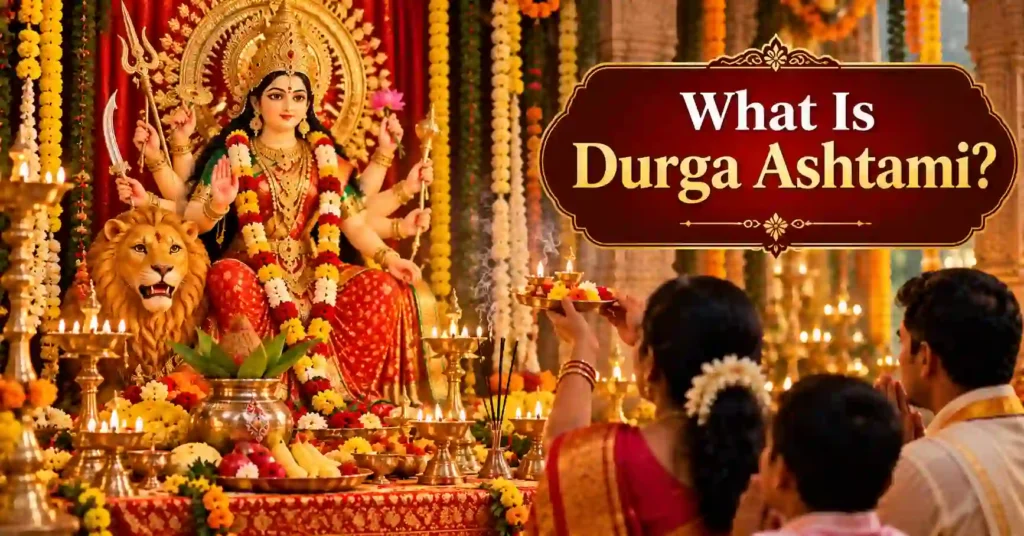
Durga Ashtami, also known as Maha Ashtami, is the eighth day of Sharad Navratri and one of the most important days dedicated to the worship of Maa Durga. The word Ashtami refers to the eighth lunar day (tithi) of the bright fortnight (Shukla Paksha) in the Hindu month of Ashwin. On this sacred day, devotees honor the Divine Mother and seek her blessings for strength, protection, wisdom, and spiritual growth.
Among the nine days of Navratri, Durga Ashtami is considered especially powerful because it marks a significant stage in the Goddess’s victory over evil forces. Temples and homes across India witness special prayers, devotional singing, fasting, havan, and the recitation of sacred texts dedicated to the Goddess.
The day is also associated with the worship of Maa Mahagauri, the eighth form of Navadurga. She represents purity, peace, forgiveness, and inner transformation. Devotees believe that sincere worship on Durga Ashtami helps remove negativity and brings clarity, prosperity, and divine grace into one’s life.
Another reason Durga Ashtami holds such importance is the performance of Kanya Puja and Sandhi Puja. While Kanya Puja honors young girls as manifestations of the Divine Mother, Sandhi Puja commemorates a sacred moment in the Goddess’s battle against evil. These traditions have made Durga Ashtami one of the most revered and widely celebrated days of Navratri.
Why Is Durga Ashtami Celebrated?
Durga Ashtami is celebrated to honor the power, compassion, and protective grace of the Divine Mother. In Sanatan Dharma, Maa Durga is revered as the embodiment of Shakti, the cosmic energy that sustains and protects the universe. This sacred day reminds devotees that divine strength is always present to guide and protect those who walk the path of dharma.
The festival is deeply connected to the timeless message of the victory of good over evil. According to sacred traditions, Maa Durga fought powerful demons who threatened cosmic balance and disturbed the peace of the world. Her triumph symbolizes the defeat of ignorance, arrogance, greed, and negativity. Through the celebration of Durga Ashtami, devotees remember that righteousness ultimately prevails over darkness.
Another important reason for observing Durga Ashtami is to seek the blessings of Maa Mahagauri. As the eighth form of Navadurga, she represents purity, inner peace, and spiritual transformation. Devotees worship her to remove obstacles, purify the mind, and cultivate positive qualities such as compassion, patience, and devotion.
The day also serves as a reminder to respect and honor feminine divinity. Rituals such as Kanya Puja reflect the belief that the Divine Mother resides in every living being. By worshipping young girls as manifestations of Devi, devotees express gratitude for the nurturing, protective, and life-giving energy that sustains creation.
Beyond rituals and celebrations, Durga Ashtami encourages self-reflection. It inspires devotees to overcome their inner weaknesses, strengthen their faith, and develop the courage to face life’s challenges. In this way, the festival becomes not only a religious observance but also a spiritual journey toward inner growth and divine connection.
Durga Ashtami in the Story of Devi Mahatmya
The significance of Durga Ashtami is closely linked to the sacred narratives found in the Devi Mahatmya, one of the most revered texts dedicated to the Divine Mother. This scripture describes how the Goddess manifested in different forms to protect the universe and restore dharma whenever evil forces became too powerful.
1. The Battle Against Mahishasura
According to the Devi Mahatmya, the demon king Mahishasura gained immense power through a boon and began terrorizing the three worlds. Neither gods nor humans could defeat him. In response, the combined divine energies of the gods manifested as Maa Durga, a radiant Goddess possessing extraordinary strength and celestial weapons.
Mounted on her lion, Maa Durga fought Mahishasura and his vast army in a fierce battle that lasted for several days. Her victory over the demon symbolizes the triumph of truth over falsehood, righteousness over injustice, and divine wisdom over ignorance. This story forms the spiritual foundation of Navratri celebrations across India.
2. The Slaying of Chanda and Munda
During her battle against evil forces, Maa Durga faced two powerful demon generals named Chanda and Munda. Seeing their growing aggression, the Goddess manifested a fierce form from her forehead. This terrifying yet protective form was created to destroy the forces threatening cosmic order.
The fierce Goddess defeated both demons and presented their heads to Maa Durga. Pleased by this victory, the Divine Mother bestowed upon her the name Chamunda, meaning the slayer of Chanda and Munda. This episode is one of the most important events remembered during Durga Ashtami.
3. Emergence of Maa Chamunda
Maa Chamunda represents the fierce aspect of Divine Shakti that destroys negativity, fear, ego, and evil tendencies. While many devotees associate Maa Durga with compassion and motherhood, the form of Chamunda reminds us that the Divine Mother also protects her devotees by removing harmful forces from their lives.
The worship of the Goddess during Durga Ashtami reflects both these dimensions of the Divine Mother: her nurturing grace and her unwavering power to defend dharma.
4. Why the Sandhi Moment Became Sacred
The battle involving Chanda and Munda is traditionally associated with the sacred transition between Ashtami and Navami, known as Sandhi Kaal. This junction period is considered highly auspicious because it marks a moment of divine victory and transformation.
For this reason, devotees perform Sandhi Puja during the final moments of Ashtami and the beginning of Navami. Special prayers, offerings, and lamps are offered to the Goddess, seeking her blessings for courage, protection, and spiritual awakening. Even today, Sandhi Puja remains one of the most revered rituals associated with Durga Ashtami.
The stories of the Devi Mahatmya remind devotees that the real battle is not only against external challenges but also against the inner enemies of anger, greed, fear, pride, and ignorance. Through devotion to the Divine Mother, one gains the strength to overcome these obstacles and move toward a life guided by wisdom and dharma.
Maa Mahagauri: The Goddess Worshipped on Durga Ashtami
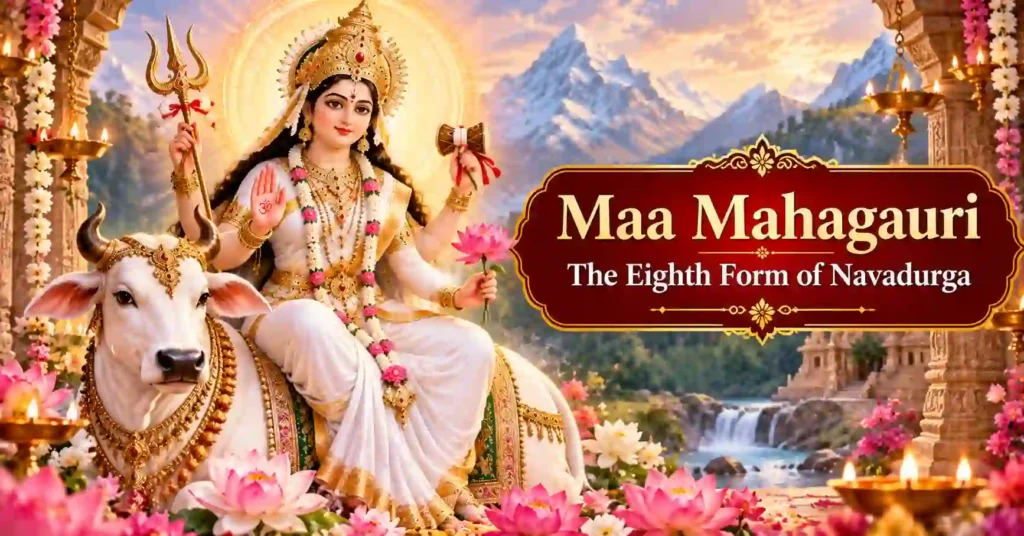
On Durga Ashtami, devotees worship Maa Mahagauri, the eighth form of Navadurga. She is revered as the embodiment of purity, serenity, compassion, and divine grace. Her name is derived from two Sanskrit words: Maha meaning great and Gauri meaning fair or radiant. Together, Mahagauri signifies the Goddess whose brilliance is pure and resplendent.
According to tradition, Maa Parvati performed intense penance for many years to attain Lord Shiva as her husband. Her rigorous austerities caused her complexion to become dark due to dust and hardship. Pleased with her devotion, Lord Shiva bathed her in the sacred waters of the Ganga, after which she emerged with a radiant white complexion. From then on, she became known as Maa Mahagauri.
Maa Mahagauri is usually depicted wearing white garments and riding a white bull. She holds a trident and a damru in two hands, while her other hands are shown in blessing and protection mudras. Her white attire, peaceful expression, and luminous appearance symbolize purity of thought, inner peace, and spiritual enlightenment.
For devotees observing Durga Ashtami, Maa Mahagauri represents the cleansing of the mind and heart. Her worship encourages individuals to let go of negativity, ego, and past burdens. Just as the Goddess attained divine radiance through devotion and perseverance, devotees are inspired to purify their lives through faith, discipline, and righteous actions.
It is believed that sincere prayers offered to Maa Mahagauri help remove obstacles, grant peace in family life, and fulfill noble wishes. Many devotees seek her blessings for health, prosperity, harmony, and spiritual progress. Her compassionate nature makes her one of the most beloved forms of the Divine Mother.
Beyond material blessings, Maa Mahagauri teaches an important spiritual lesson: true beauty arises from purity, devotion, and inner transformation. Her worship on Durga Ashtami reminds us that through faith and self-discipline, every soul can move closer to divine wisdom and grace.
Symbolism of Maa Mahagauri
| Symbol | Meaning |
|---|---|
| White Garments | Purity and spiritual cleansing |
| White Bull (Nandi) | Dharma, strength, and steadfast devotion |
| Trident (Trishul) | Destruction of negativity and ignorance |
| Damru | Cosmic rhythm and divine creation |
| Blessing Hand | Grace, protection, and fulfillment of wishes |
| White Complexion | Inner purity and spiritual illumination |
Spiritual Significance of Durga Ashtami
While Durga Ashtami is known for its rituals and celebrations, its deeper meaning lies in spiritual transformation. The festival reminds devotees that the Divine Mother is not only a protector from external difficulties but also a guide who helps overcome inner weaknesses. Through prayer, fasting, and devotion, devotees seek to strengthen their connection with the divine and cultivate positive qualities within themselves.
1. Purification of Mind and Heart
One of the central themes of Durga Ashtami is purification. Just as Maa Mahagauri symbolizes purity and radiance, devotees use this sacred day to cleanse their minds of negative thoughts and harmful habits. Fasting, mantra chanting, and meditation are seen as ways to purify both the body and the soul.
The day encourages individuals to reflect on their actions, seek forgiveness for mistakes, and renew their commitment to living a life guided by dharma. This process of inner cleansing helps create space for peace, devotion, and spiritual growth.
2. Removal of Negative Tendencies
The stories associated with Maa Durga often portray demons being defeated by divine power. Spiritually, these demons can be understood as the negative tendencies that exist within every human being. Anger, greed, jealousy, pride, fear, and ignorance can prevent a person from realizing their true potential.
The worship of the Divine Mother on Durga Ashtami symbolizes the victory over these inner enemies. Devotees pray for the strength to overcome destructive habits and develop self-control, wisdom, and compassion.
3. Awakening Inner Strength
Maa Durga is revered as the source of courage and resilience. Her stories inspire devotees to face life’s challenges with determination and faith. The festival teaches that true strength comes not from physical power alone but from a steady mind, strong character, and trust in the divine.
For many devotees, Durga Ashtami becomes a reminder that they are capable of overcoming difficulties when guided by righteousness and supported by divine grace.
4. Surrender to the Divine Mother
Another important spiritual lesson of Durga Ashtami is surrender. In Sanatan Dharma, surrender does not mean weakness; rather, it means placing one’s trust in the wisdom and protection of the Divine Mother. By offering prayers with humility and devotion, devotees acknowledge that divine guidance is essential for navigating life’s journey.
This attitude of surrender helps reduce anxiety, ego, and attachment. It allows individuals to cultivate faith, gratitude, and acceptance while continuing to perform their duties with sincerity.
Ultimately, the spiritual significance of Durga Ashtami lies in its message of transformation. The day inspires devotees to replace fear with courage, negativity with positivity, and doubt with faith. Through devotion to Maa Durga, one seeks not only blessings for worldly success but also progress on the path of inner awakening and spiritual fulfillment.
Durga Ashtami Puja Vidhi at Home
Performing Durga Ashtami Puja at home is a beautiful way to express devotion to Maa Durga and seek her blessings. While traditions may vary from region to region, the essence of the worship remains the same: honoring the Divine Mother with faith, purity, and gratitude.
You do not need elaborate arrangements to perform the puja. A clean prayer space, sincere devotion, and simple offerings are enough to worship Maa Mahagauri and celebrate Durga Ashtami meaningfully.
How to Perform Durga Ashtami Puja at Home
Take an early morning bath and wear clean or traditional clothes, preferably in light or auspicious colors.
Clean the puja area and decorate it with flowers, rangoli, diyas, and incense sticks.
Place an image or idol of Maa Durga or Maa Mahagauri on a clean altar.
Light a diya and incense to create a sacred atmosphere for worship.
Offer flowers, fruits, coconut, and sweets to the Goddess as a symbol of devotion and gratitude.
Take a Sankalpa (sacred resolve) by praying for the well-being of your family and spiritual growth.
Recite Durga Chalisa, Durga Saptashati, or other devotional hymns according to your time and tradition.
Chant Durga mantras with concentration and devotion.
Perform Aarti and offer your prayers to Maa Durga.
Observe Kanya Puja, if possible, by honoring young girls as manifestations of the Divine Mother.
Offer bhog such as halwa, puri, kala chana, fruits, or kheer before distributing prasad.
Conclude the puja with gratitude, seeking the blessings of Maa Durga for strength, wisdom, prosperity, and protection.
Essential Puja Samagri for Durga Ashtami
- Idol or picture of Maa Durga
- Kalash with water
- Flowers and garlands
- Kumkum and turmeric
- Akshat (unbroken rice)
- Coconut
- Incense sticks and camphor
- Ghee or oil diya
- Fruits and sweets
- Betel leaves and nuts
- Prasad for offering
The most important aspect of Durga Ashtami Puja is not the grandeur of the ritual but the sincerity of the devotee’s heart. When performed with faith and devotion, even a simple prayer can become a powerful offering to the Divine Mother.
Kanya Puja on Durga Ashtami
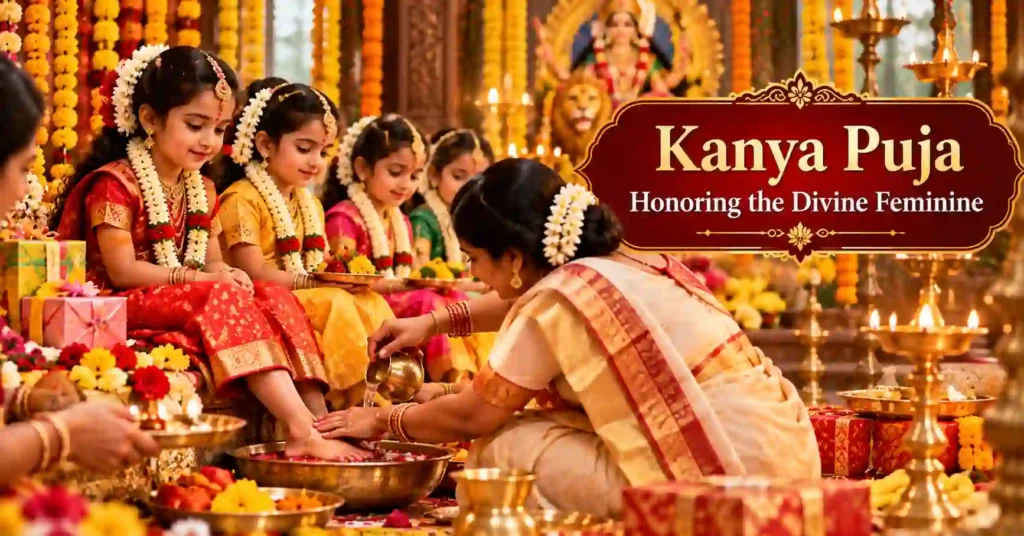
Kanya Puja, also known as Kanjak Puja or Kumari Puja, is one of the most cherished rituals performed on Durga Ashtami. On this sacred day, young girls are worshipped as living manifestations of the Divine Mother. The tradition reflects the belief that the feminine divine resides in every girl child and deserves respect, honor, and reverence.
For many devotees, Kanya Puja is the spiritual highlight of Durga Ashtami. While prayers, fasting, and mantra chanting are important, worshipping young girls symbolizes recognizing the presence of Shakti in human form. The ritual also teaches humility, gratitude, and respect for womanhood.
What Is Kanya Puja?
Kanya Puja is a ritual in which young girls, usually between the ages of two and ten, are invited and worshipped as forms of Maa Durga. In many households, a young boy is also invited as Langur or Bhairav, representing the divine companion and protector of the Goddess.
The girls are welcomed with devotion, seated respectfully, and offered food, gifts, and blessings. This practice reminds devotees that the Divine Mother is present in all beings and that serving others is also a form of worship.
Why Are Young Girls Worshipped?
According to Sanatan tradition, the Divine Mother manifests in many forms. Young girls are seen as symbols of innocence, purity, divine energy, and potential. Worshipping them during Durga Ashtami is a way of honoring the creative and nurturing power of Shakti.
The ritual also conveys an important social message: every girl deserves love, dignity, protection, and respect. Through Kanya Puja, devotees express reverence for the feminine principle that sustains life and society.
How Is Kanya Puja Performed?
The traditional procedure usually includes:
- Inviting young girls to the home or temple.
- Welcoming them respectfully.
- Washing their feet as a gesture of reverence.
- Applying tilak on their forehead.
- Offering flowers and prayers.
- Serving prasad, usually halwa, puri, and kala chana.
- Giving gifts, fruits, clothes, or dakshina.
- Seeking their blessings before they leave.
The ritual is performed with devotion and gratitude rather than formality. Even simple offerings made with a sincere heart are considered pleasing to the Divine Mother.
How Many Girls Are Worshipped During Kanya Puja?
The number of girls worshipped may vary according to family traditions and local customs.
| Number of Girls | Symbolic Representation |
|---|---|
| 2 | Divine Feminine Energy |
| 5 | Five Elements and Divine Powers |
| 7 | Sapta Matrikas (Seven Mother Goddesses) |
| 9 | Navadurga (Nine Forms of Durga) |
Many families prefer worshipping nine girls, as they are believed to represent the nine forms of Navadurga worshipped during Navratri.
Spiritual Message of Kanya Puja
Beyond rituals, Kanya Puja teaches a profound lesson. It reminds devotees that true devotion is not limited to temples and scriptures. Respecting women, caring for children, and recognizing the divine presence in every individual are equally important expressions of spirituality.
The tradition encourages devotees to carry the values of compassion, respect, and gratitude into daily life. In this way, Kanya Puja on Durga Ashtami becomes both a sacred ritual and a timeless lesson in honoring the Divine Mother in all her forms.
Sandhi Puja: The Most Sacred Moment of Durga Ashtami
Among all the rituals associated with Durga Ashtami, none is considered more powerful and spiritually significant than Sandhi Puja. Performed during the sacred transition between Ashtami and Navami, this ritual commemorates a divine moment in the Goddess’s battle against evil and is regarded as one of the holiest periods of Navratri.
For devotees of Maa Durga, Sandhi Puja is a time of intense prayer, devotion, and spiritual energy. Temples, especially those dedicated to the Goddess, conduct special ceremonies during this auspicious period, while many devotees also observe the ritual at home.
What Is Sandhi Puja?
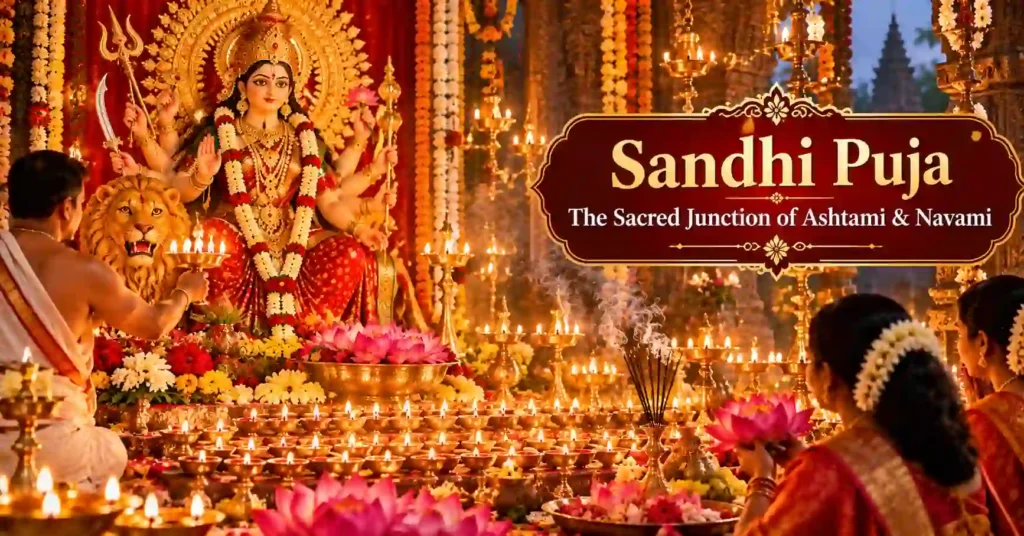
The word Sandhi means “junction” or “transition.” Sandhi Puja is performed during the meeting point of the last 24 minutes of Ashtami and the first 24 minutes of Navami, creating a sacred 48-minute window known as Sandhi Kaal.
This brief period is believed to carry immense spiritual power and is considered highly auspicious for worship, meditation, mantra chanting, and seeking the blessings of the Divine Mother.
Why Is Sandhi Puja So Important?
According to sacred tradition, Sandhi Puja marks the moment when Maa Durga manifested her fierce form, Maa Chamunda, to destroy the demons Chanda and Munda. This victory symbolized the triumph of divine power over forces of negativity and chaos.
Because of this association, devotees believe that prayers offered during Sandhi Kaal are especially potent and capable of removing obstacles, fears, and negative influences from one’s life.
Rituals Performed During Sandhi Puja
Common practices during Sandhi Puja include:
- Lighting numerous diyas to symbolize the victory of light over darkness.
- Offering lotus flowers to the Goddess.
- Chanting Durga mantras and hymns.
- Reciting portions of the Devi Mahatmya.
- Performing special aarti and prayers.
- Meditating on the Divine Mother.
Many temples conduct elaborate ceremonies during this period, creating a deeply devotional atmosphere filled with chants, bells, and sacred offerings.
Significance of 108 Diyas and 108 Lotus Flowers
The number 108 holds special importance in Hindu spiritual traditions. During Sandhi Puja, many devotees offer:
- 108 Diyas (lamps) to invoke divine light and blessings.
- 108 Lotus Flowers as symbols of purity, devotion, and spiritual awakening.
While these offerings are traditional, the true essence of the ritual lies in devotion rather than the quantity of offerings.
Spiritual Meaning of Sandhi Puja
The deeper significance of Sandhi Puja extends beyond mythology. The transition between Ashtami and Navami symbolizes the shift from ignorance to wisdom, fear to courage, and darkness to spiritual awakening.
Just as Maa Chamunda defeated destructive forces, devotees are encouraged to overcome their own inner enemies such as anger, ego, greed, jealousy, and doubt. Sandhi Puja serves as a reminder that transformation often occurs during moments of transition and faith.
For many devotees, the sacred observance of Sandhi Puja during Durga Ashtami represents the spiritual climax of Navratri, a powerful opportunity to connect with the Divine Mother and seek her protection, strength, and grace.
Durga Ashtami Fasting Rules
Fasting is an important part of Durga Ashtami for many devotees. It is observed not only as a religious practice but also as a way to cultivate self-discipline, devotion, and spiritual focus. By controlling physical desires and dedicating the day to prayer and worship, devotees seek the blessings of Maa Durga and strive for inner purification.
The manner of observing the fast may vary according to family traditions, regional customs, age, and health conditions. Some devotees observe a strict fast, while others follow a fruit-based or sattvic diet. The most important aspect is maintaining devotion and a pure state of mind throughout the day.
Foods Commonly Allowed During Durga Ashtami Fast
Many devotees consume foods that are considered light, pure, and suitable for vrat (fasting), such as:
- Fresh fruits
- Milk and dairy products
- Dry fruits and nuts
- Coconut and coconut water
- Sabudana (tapioca pearls)
- Samak rice (barnyard millet)
- Singhara flour (water chestnut flour)
- Kuttu flour (buckwheat flour)
- Rock salt (sendha namak)
- Potatoes and sweet potatoes
These foods provide nourishment while helping devotees maintain their spiritual observance.
Foods Commonly Avoided During the Fast
Traditional fasting rules generally exclude:
- Regular wheat flour
- Rice and lentils
- Onion and garlic
- Processed foods
- Non-vegetarian food
- Alcohol and intoxicants
- Excessively spicy or tamasic foods
Avoiding these items is believed to help maintain mental clarity and spiritual focus during Durga Ashtami.
When Is the Fast Broken?
Many devotees conclude their fast after performing Kanya Puja, offering bhog to Maa Durga, and distributing prasad. In some traditions, the fast is broken after the evening aarti, while others complete it after Navami rituals.
The exact timing may differ according to local customs and family practices. Following the guidance of one’s tradition or local priest is always recommended.
Spiritual Purpose of Fasting
The true purpose of fasting extends beyond dietary restrictions. Fasting teaches self-control, patience, and mindfulness. It encourages devotees to shift their attention away from material concerns and focus on prayer, gratitude, and spiritual growth.
On Durga Ashtami, fasting becomes a symbolic offering of devotion to the Divine Mother. It reminds devotees that real nourishment comes not only from food but also from faith, discipline, and connection with the divine.
Important Note
Sanatan Dharma places great importance on intention and sincerity. Those who are elderly, pregnant, ill, or unable to fast for health reasons may still participate in the worship of Maa Durga through prayer, mantra chanting, charity, and acts of devotion. The Goddess values genuine faith more than physical austerity alone.
Durga Ashtami Bhog Offerings
Offering bhog to Maa Durga is an important part of Durga Ashtami celebrations. Bhog is a sacred food offering presented to the Goddess with devotion and gratitude before being distributed as prasad among family members, guests, and devotees. It symbolizes love, surrender, and appreciation for the blessings received from the Divine Mother.
On Durga Ashtami, devotees prepare simple yet pure vegetarian dishes and offer them to Maa Durga during the puja. The offerings are usually prepared with cleanliness, devotion, and a prayerful mindset, as the intention behind the offering is considered more important than its grandeur.
Popular Bhog Offered on Durga Ashtami
Some of the most common bhog items include:
- Halwa (especially sooji halwa)
- Puri
- Kala Chana
- Fresh fruits
- Coconut
- Kheer
- Mishri (rock sugar)
- Dry fruits
- Makhana preparations
- Panchamrit
Among these, the traditional combination of halwa, puri, and kala chana is especially popular during Kanya Puja and is offered in countless homes across India.
Why Is Bhog Offered to Maa Durga?
Offering bhog is an expression of devotion and gratitude. Devotees believe that by first offering food to the Goddess, the meal becomes blessed and transformed into prasad. Consuming prasad is considered spiritually uplifting and a way of receiving the grace of the Divine Mother.
The act also teaches humility. It reminds devotees that everything they possess, including food and prosperity, is ultimately a gift of divine blessings.
Bhog for Kanya Puja
During Durga Ashtami, bhog plays a central role in Kanya Puja. After worshipping the young girls, devotees traditionally serve them:
- Halwa
- Puri
- Kala Chana
- Fruits
- Sweets
The meal is offered with respect and affection, recognizing the girls as manifestations of Maa Durga. Many families consider serving this sacred meal to be one of the most rewarding parts of the festival.
Durga Ashtami Mantra
Mantra chanting is an integral part of Durga Ashtami worship. Sacred mantras help devotees focus their minds, deepen their devotion, and connect with the divine energy of Maa Durga. During Navratri, many devotees chant Durga mantras while performing puja, meditation, aarti, or reciting sacred texts dedicated to the Goddess.
It is believed that sincere mantra chanting invokes the blessings of the Divine Mother, removes negative influences, and fills the devotee’s life with strength, courage, wisdom, and spiritual protection.
1. Navarna Mantra
One of the most powerful mantras associated with Maa Durga is the Navarna Mantra:
This sacred mantra is widely recited during Navratri and is especially significant during Durga Ashtami and Sandhi Puja.
ॐ ऐं ह्रीं क्लीं चामुण्डायै विच्चे॥
Om Aim Hreem Kleem Chamundayai Vichche॥
Meaning of the Navarna Mantra
The mantra invokes the Divine Mother in her powerful form as Chamunda and seeks her blessings for protection, wisdom, and spiritual awakening.
- Aim represents divine knowledge and wisdom.
- Hreem symbolizes divine energy and creative power.
- Kleem represents attraction, love, and fulfillment.
- Chamundayai refers to the Goddess who defeated the demons Chanda and Munda.
- Vichche is associated with removing obstacles and negative energies.
Together, the mantra is believed to invoke the complete power of Divine Shakti.
Other Popular Durga Ashtami Mantras
2. Ya Devi Sarva Bhuteshu Mantra
या देवी सर्वभूतेषु शक्ति रूपेण संस्थिता।
नमस्तस्यै नमस्तस्यै नमस्तस्यै नमो नमः॥
This mantra honors the Goddess as the divine energy present in all living beings.
3. Sarva Mangala Mangalye Mantra
सर्वमङ्गलमाङ्गल्ये शिवे सर्वार्थसाधिके।
शरण्ये त्र्यम्बके गौरी नारायणि नमोऽस्तुते॥
This prayer seeks the blessings, protection, and grace of the Divine Mother.
Benefits of Chanting Durga Mantras
Devotees believe that regular chanting of Durga mantras helps:
- Strengthen faith and devotion.
- Improve concentration and mental peace.
- Remove fear and negativity.
- Build inner courage and confidence.
- Promote spiritual growth and self-discipline.
- Seek the blessings of Maa Durga for protection and prosperity.
How to Chant Durga Mantras
For best results, devotees traditionally:
- Bathe and wear clean clothes before chanting.
- Sit in a peaceful and clean place.
- Focus on Maa Durga’s image or idol.
- Chant with devotion rather than speed.
- Maintain a calm and positive mindset.
- Conclude with a prayer of gratitude.
The true power of a mantra lies not only in its words but also in the sincerity and devotion of the person chanting it. On Durga Ashtami, mantra chanting becomes a beautiful way to connect with the Divine Mother and experience her presence in one’s life.
Durga Ashtami Across India
While the essence of Durga Ashtami remains the same throughout the country, the way it is celebrated varies across different regions of India. Each region has developed unique customs, rituals, and cultural traditions that reflect its local heritage while honoring the Divine Mother with devotion and reverence.
These diverse celebrations highlight the richness of Sanatan Dharma and demonstrate how devotion to Maa Durga unites people across languages, cultures, and communities.
1. North India: Kanya Puja and Fasting
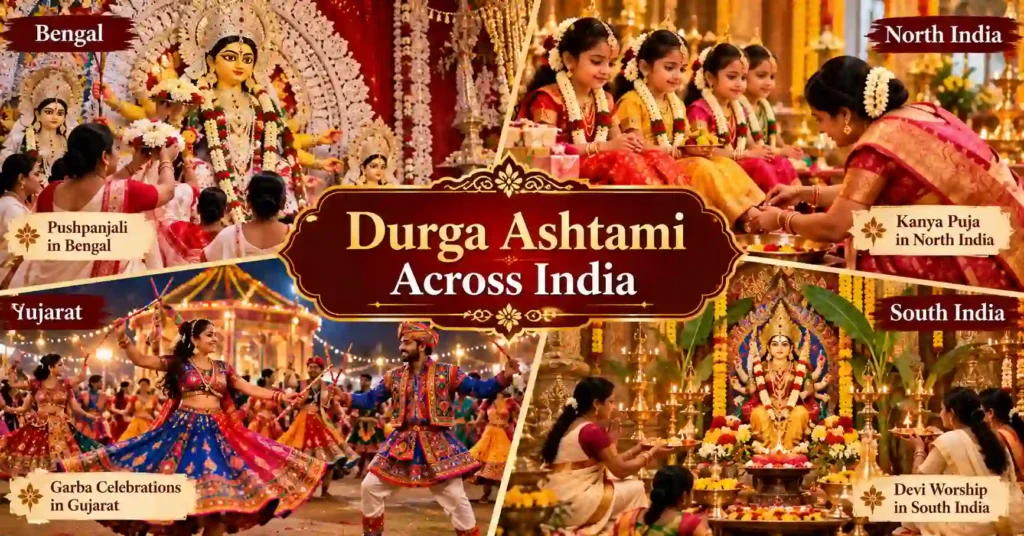
In North Indian states such as Uttar Pradesh, Delhi, Haryana, Punjab, and Rajasthan, Kanya Puja is one of the most important Durga Ashtami traditions. Families invite young girls into their homes, worship them as forms of the Goddess, and offer them halwa, puri, kala chana, fruits, and gifts.
Many devotees also observe Navratri fasting and visit local temples to participate in special prayers, bhajans, and aarti ceremonies dedicated to Maa Durga.
2. West India: Garba and Dandiya Celebrations
In Gujarat and parts of Maharashtra, Navratri is famous for its vibrant Garba and Dandiya celebrations. On Durga Ashtami, devotees gather in large numbers to perform traditional dances while singing devotional songs in praise of the Goddess.
The colorful attire, rhythmic music, and energetic dance performances create an atmosphere of joy and devotion, making Navratri one of the most celebrated festivals in the region.
3. West Bengal: Maha Ashtami and Pushpanjali
In West Bengal, Maha Ashtami is considered one of the most important days of Durga Puja. Thousands of devotees visit beautifully decorated pandals to offer Pushpanjali, a ritual in which flowers are offered to Maa Durga while sacred mantras are recited.
The day is also marked by elaborate rituals, devotional music, community gatherings, and the highly revered Sandhi Puja, which commemorates the Goddess’s victory over evil forces.
4. South India: Devi Worship and Navratri Traditions
In South Indian states such as Tamil Nadu, Karnataka, Andhra Pradesh, Telangana, and Kerala, devotees celebrate Durga Ashtami through special prayers, temple visits, and the worship of the Divine Mother in her various forms.
Many families arrange Golu or Bommai Kolu, decorative displays of dolls and deities that symbolize spiritual and cultural traditions. Devotional singing, scripture recitation, and community worship are also important aspects of the celebrations.
5. Eastern and Northeastern India
In states such as Odisha, Assam, and Tripura, Durga Puja and Durga Ashtami are celebrated with great enthusiasm. Temples and community pandals host special rituals, cultural programs, and devotional events that attract large numbers of devotees.
The worship of Maa Durga is often accompanied by traditional music, dance performances, and charitable activities, creating a strong sense of community and spiritual togetherness.
A Festival That Unites India
Although customs differ from one region to another, the central message of Durga Ashtami remains unchanged. Whether through Kanya Puja in North India, Garba in Gujarat, Pushpanjali in Bengal, or Golu celebrations in South India, devotees come together to honor the Divine Mother and celebrate the victory of divine goodness over negativity.
These regional traditions make Durga Ashtami not only a religious observance but also a vibrant cultural celebration that reflects the diversity and unity of India.
Durga Ashtami vs Maha Navami
Durga Ashtami and Maha Navami are two of the most important days of Navratri. Since they occur consecutively and share many rituals, people often wonder about the difference between them. While both days are dedicated to the worship of the Divine Mother, each has its own spiritual significance, traditions, and focus.
Durga Ashtami is generally regarded as the day of intense devotion, Kanya Puja, and the worship of Maa Mahagauri. Maha Navami, on the other hand, marks the culmination of Navratri worship and is associated with the blessings of Maa Siddhidatri, the ninth form of Navadurga.
Key Differences Between Durga Ashtami and Maha Navami
| Aspect | Durga Ashtami | Maha Navami |
|---|---|---|
| Navratri Day | Eighth Day | Ninth Day |
| Goddess Worshipped | Maa Mahagauri | Maa Siddhidatri |
| Main Theme | Purification and Divine Protection | Spiritual Fulfillment and Divine Grace |
| Important Rituals | Kanya Puja, Sandhi Puja, Aarti | Havan, Kanya Puja, Completion Rituals |
| Spiritual Focus | Removing Negativity | Attaining Blessings and Completion |
| Significance | Celebration of Divine Shakti | Culmination of Navratri Worship |
Similarities Between the Two Days
Both Durga Ashtami and Maha Navami are considered highly auspicious for worshipping Maa Durga. Devotees observe fasting, perform puja, chant mantras, visit temples, and participate in devotional activities on both days.
In many regions, Kanya Puja may be performed on either Durga Ashtami or Maha Navami depending on family traditions and local customs. Both days are believed to be especially favorable for seeking the blessings of the Divine Mother.
Which Day Is More Important?
From a spiritual perspective, both days are equally sacred. Durga Ashtami is often viewed as the peak of devotional worship and divine energy, while Maha Navami symbolizes the completion of the devotee’s spiritual journey through the nine days of Navratri.
Rather than choosing one over the other, devotees traditionally observe both days with faith and reverence, recognizing them as important stages in the worship of the Divine Mother.
Spiritual Lesson
Together, Durga Ashtami and Maha Navami teach a beautiful lesson. Durga Ashtami encourages devotees to purify their minds, overcome negativity, and strengthen their faith. Maha Navami reminds them to receive divine wisdom, blessings, and spiritual fulfillment with humility and gratitude.
When observed with devotion, these two sacred days help devotees deepen their connection with Maa Durga and carry the values of courage, purity, and righteousness into their daily lives.
Common Mistakes to Avoid on Durga Ashtami
While rituals and traditions are important, the true spirit of Durga Ashtami lies in devotion, sincerity, and respect for the Divine Mother. Sometimes, devotees unintentionally make mistakes that reduce the spiritual value of the observance. Being mindful of these common errors can help make the day more meaningful and fulfilling.
1. Ignoring Puja Timings
Many important rituals associated with Durga Ashtami, especially Sandhi Puja, are performed during specific auspicious periods. Ignoring these timings or performing rituals casually without checking the local Panchang may result in missing the significance of these sacred moments.
Whenever possible, consult a reliable Panchang or temple schedule before planning important rituals.
2. Treating Kanya Puja as a Formality
Kanya Puja is much more than serving food to young girls. It is a sacred act of honoring the Divine Mother in human form. Performing the ritual mechanically without respect, gratitude, or devotion defeats its deeper purpose.
The focus should be on reverence and heartfelt worship rather than merely completing a tradition.
3. Focusing Only on Rituals and Forgetting Devotion
Elaborate decorations, offerings, and ceremonies can enhance the celebration, but they should not overshadow the spirit of devotion. Even a simple prayer offered with faith is more meaningful than grand rituals performed without sincerity.
Durga Ashtami reminds devotees that the Goddess values genuine devotion above external display.
4. Breaking the Fast Improperly
Those observing a vrat should conclude it according to their family traditions and local customs. Overeating immediately after fasting or consuming inappropriate foods may diminish the discipline and spiritual focus cultivated during the day.
Breaking the fast mindfully and with gratitude helps preserve its spiritual significance.
5. Neglecting Cleanliness and Preparation
Cleanliness is an important aspect of Hindu worship. A clean puja area, fresh offerings, and personal hygiene help create a sacred atmosphere for prayer and meditation.
Preparing the worship space with care reflects respect for the Divine Mother.
6. Disrespecting Women or Girl Children
One of the core messages of Durga Ashtami is honoring feminine divinity. Performing Kanya Puja while failing to show respect and kindness toward women and girls in daily life goes against the spirit of the festival.
True worship of Maa Durga includes treating every woman with dignity, compassion, and respect.
7. Forgetting the Spiritual Purpose of Durga Ashtami
Many people become so focused on rituals that they overlook the deeper message of the festival. Durga Ashtami is ultimately about overcoming inner negativity, strengthening faith, and moving closer to the Divine Mother.
The day should inspire self-reflection, gratitude, and personal transformation rather than becoming merely a social or ceremonial event.
Lessons We Can Learn from Durga Ashtami
Durga Ashtami is more than a religious festival. It offers timeless lessons that can guide us in our daily lives. The stories, rituals, and traditions associated with this sacred day inspire devotees to develop strength, faith, compassion, and self-discipline.
1. Courage Over Fear
The Divine Mother’s victory over powerful demons reminds us that challenges can be overcome with determination and faith. Just as Maa Durga faced adversity with courage, we too should face life’s difficulties with confidence and resilience.
2. Good Ultimately Triumphs Over Evil
One of the central messages of Durga Ashtami is that truth and righteousness eventually prevail. While the path of dharma may not always be easy, it ultimately leads to victory over negativity and injustice.
3. Purity Leads to Inner Peace
The worship of Maa Mahagauri teaches the importance of purity in thoughts, words, and actions. A pure mind is more capable of experiencing peace, wisdom, and spiritual growth.
4. Respect for the Divine Feminine
Through Kanya Puja, Durga Ashtami reminds us to honor and respect women and girls. The festival teaches that feminine energy is sacred and deserves dignity, appreciation, and protection.
5. Strength and Compassion Can Coexist
Maa Durga is both a fierce protector and a loving mother. Her example teaches us that true strength does not require harshness. One can be courageous while remaining compassionate and kind.
6. Self-Discipline Brings Spiritual Growth
Fasting, prayer, and devotion encourage self-control and mindfulness. Durga Ashtami shows that discipline is not about restriction alone but about directing our energy toward higher goals.
7. Faith Provides Inner Strength
The festival reminds devotees that faith can provide comfort and guidance during difficult times. Trusting in the Divine Mother helps cultivate hope, patience, and perseverance.
Key Takeaways
- Durga Ashtami is the eighth and one of the most sacred days of Sharad Navratri.
- The day is dedicated to Maa Mahagauri, the eighth form of Navadurga, who symbolizes purity, peace, and spiritual transformation.
- Important rituals of Durga Ashtami include Kanya Puja, Sandhi Puja, fasting, mantra chanting, and Durga worship.
- Kanya Puja honors young girls as manifestations of the Divine Mother and teaches respect for feminine divinity.
- Sandhi Puja commemorates the sacred moment of Maa Chamunda’s victory over the demons Chanda and Munda.
- Fasting and devotional practices on Durga Ashtami help cultivate self-discipline, inner purity, and spiritual growth.
- The festival reminds devotees that faith, courage, and righteousness ultimately triumph over negativity and fear.
Conclusion
Durga Ashtami is one of the most spiritually significant days of Navratri, celebrating the power, compassion, and protective grace of the Divine Mother. From the worship of Maa Mahagauri and the observance of fasting to the sacred rituals of Kanya Puja and Sandhi Puja, every aspect of the festival carries a deeper message of faith, purity, and inner transformation.
The day reminds us that the battle between good and evil is not only fought in ancient stories but also within our own hearts. By overcoming fear, anger, ego, and negativity, devotees can move closer to the ideals represented by Maa Durga and live a life guided by dharma.
Whether you observe Durga Ashtami through prayer, fasting, mantra chanting, temple visits, or acts of kindness, the essence of the festival remains the same: honoring the Divine Mother and seeking her blessings for strength, wisdom, protection, and spiritual growth.
As we bow before Maa Durga on this sacred occasion, may her divine grace fill our lives with courage, peace, prosperity, and unwavering faith. May the blessings of the Divine Mother guide us on the path of righteousness and inspire us to become better versions of ourselves every day.
Jai Maa Durga! 🙏🌺
Suggested Reading
If you found this guide on Durga Ashtami helpful, you may also enjoy these related articles on Navratri, Maa Durga worship, sacred rituals, devotional practices, and the timeless traditions of Sanatan Dharma.
Sharad Navratri 2026: Dates, Ghatasthapana Muhurat, Rituals and Significance
https://thesanatantales.com/sharad-navratri/
Ghatasthapana Guide: Meaning, Puja Vidhi, Samagri and Spiritual Significance
https://thesanatantales.com/ghatasthapana/
Maa Durga: Meaning, Story, Forms, Navadurga, Temples and Worship
https://thesanatantales.com/maa-durga-meaning-story-navadurga-worship/
Navadurga: Meaning, Nine Forms of Maa Durga, Navratri Significance and Spiritual Journey
https://thesanatantales.com/navadurga-nine-forms-of-maa-durga/
Kalash in Hinduism: Meaning, Symbolism, Kalash Sthapana and Spiritual Significance
https://thesanatantales.com/kalash-in-hinduism/
Durga Saptashati: Meaning, Story, 13 Chapters and Navratri Significance
https://thesanatantales.com/durga-saptashati-meaning-navratri/
Durga Chalisa: Lyrics, English Pronunciation, Hindi Meaning, Benefits & Significance
https://thesanatantales.com/durga-chalisa-lyrics-meaning/
Navarna Mantra: Meaning, Benefits, Chanting Rules and How to Chant
https://thesanatantales.com/navarna-mantra/
Argala Stotra: Lyrics, Meaning, Benefits and How to Chant
https://thesanatantales.com/argala-stotra/
Aarti of Maa Ambe: Lyrics, Meaning, Benefits and How to Perform
https://thesanatantales.com/aarti-of-maa-ambe/
Durga Mantras: Complete Guide to Powerful Mantras, Stotras, Chalisa and Aarti
https://thesanatantales.com/durga-mantras-stotras-chalisa-aarti/
Navratri Fasting Rules: What to Eat and What to Avoid During Vrat
https://thesanatantales.com/navratri-fasting-rules/
Durga Ashtami (Wikipedia)
https://en.wikipedia.org/wiki/Durga_Ashtami en.wikipedia.org
FAQs
1. What is Durga Ashtami?
Durga Ashtami, also known as Maha Ashtami, is the eighth day of Sharad Navratri and one of the most important days dedicated to the worship of Maa Durga. It is considered a highly auspicious occasion for prayer, fasting, mantra chanting, and seeking the blessings of the Divine Mother.
The day is especially associated with the worship of Maa Mahagauri, the eighth form of Navadurga. Devotees observe special rituals such as Kanya Puja, Sandhi Puja, havan, and aarti to honor the Goddess and celebrate the victory of divine power over negative forces.
2. Why is Durga Ashtami called Maha Ashtami?
Durga Ashtami is often called Maha Ashtami because of its exceptional spiritual significance during Navratri. The word Maha means “great,” emphasizing the sacredness of this day among the nine days of Goddess worship.
According to tradition, several important events from the Divine Mother’s battle against evil are associated with this period. Many devotees believe that the spiritual energy of the Goddess is especially powerful on Maha Ashtami, making it an ideal day for worship, meditation, fasting, and devotion.
3. Which Goddess is worshipped on Durga Ashtami?
The primary Goddess worshipped on Durga Ashtami is Maa Mahagauri, the eighth form of Navadurga. She symbolizes purity, peace, forgiveness, and spiritual transformation.
Maa Mahagauri is often depicted wearing white garments and riding a white bull. Devotees pray to her for the removal of past negativity, fulfillment of righteous desires, inner peace, and spiritual growth. Her worship reminds us that purity of heart and sincere devotion can help bring us closer to divine grace.
4. What is Kanya Puja and why is it performed on Durga Ashtami?
Kanya Puja is a sacred ritual in which young girls are worshipped as manifestations of the Divine Mother. It is one of the most important traditions observed during Durga Ashtami and reflects the belief that feminine energy is divine and worthy of reverence.
During the ritual, girls are respectfully welcomed, their feet may be washed, and they are offered food, gifts, and prayers. Kanya Puja teaches devotees to honor womanhood, respect feminine divinity, and recognize the presence of Shakti in every living being.
5. What is Sandhi Puja?
Sandhi Puja is a special ritual performed during the sacred junction between Ashtami and Navami. This period consists of the final moments of Ashtami and the opening moments of Navami and is considered one of the most powerful times for worship during Navratri.
The ritual commemorates the Divine Mother’s victory over the demons Chanda and Munda. Devotees light lamps, offer flowers, chant mantras, and seek divine blessings during this auspicious period. Many temples conduct elaborate Sandhi Puja ceremonies that attract large numbers of devotees.
6. Is fasting compulsory on Durga Ashtami?
No, fasting is not compulsory on Durga Ashtami. While many devotees observe a vrat as an expression of devotion and self-discipline, Sanatan Dharma places greater importance on sincere faith than on physical austerity.
Those who are elderly, pregnant, unwell, or unable to fast for health reasons can still participate in the worship of Maa Durga through prayer, mantra chanting, charity, and devotional practices. The true purpose of fasting is spiritual focus, not hardship.
7. What foods are traditionally offered during Kanya Puja?
The most common offerings during Kanya Puja are halwa, puri, and kala chana. This traditional meal is prepared with devotion and served to the young girls who are worshipped as forms of the Divine Mother.
In addition to these items, fruits, sweets, coconut, and gifts may also be offered. The meal symbolizes gratitude, devotion, and the sharing of divine blessings. Many devotees consider serving this sacred bhog to be one of the most meaningful parts of Durga Ashtami celebrations.
8. Can Kanya Puja be performed on Navami instead of Durga Ashtami?
Yes, Kanya Puja can be performed on either Durga Ashtami or Maha Navami, depending on family traditions, regional customs, and local temple practices.
In some households, the ritual is performed on Ashtami, while others observe it on Navami. Both days are considered highly auspicious for honoring young girls as manifestations of the Divine Mother. Devotees should follow the tradition practiced in their family or community.
9. What is the most powerful mantra for Durga Ashtami?
One of the most widely chanted mantras on Durga Ashtami is the Navarna Mantra:
ॐ ऐं ह्रीं क्लीं चामुण्डायै विच्चे॥
This mantra invokes the Divine Mother in her powerful form and is associated with protection, spiritual growth, courage, and the removal of negative influences. Many devotees chant it during puja, meditation, and Sandhi Puja to seek the blessings of Maa Durga.
10. What is the spiritual message of Durga Ashtami?
The spiritual message of Durga Ashtami is the victory of divine wisdom, courage, and righteousness over fear, ignorance, and negativity. The festival teaches that every individual has the inner strength to overcome challenges through faith, devotion, and self-discipline.
The worship of Maa Durga encourages devotees to cultivate purity, compassion, courage, and respect for the Divine Mother in all her forms. Ultimately, Durga Ashtami inspires spiritual growth and reminds us that true transformation begins within.
About the Author
Yateendra Chaturvedi is a spiritual writer, researcher, devotee, and the founder of The Sanatan Tales. With over 35 years of professional experience and a lifelong interest in Sanatan Dharma, he writes about Hindu deities, temples, scriptures, festivals, Mahavidyas, sacred stories, rituals, and living traditions that continue to guide and inspire devotees across India.
Drawing from traditional scriptures, regional beliefs, temple traditions, devotional literature, and historical sources, he aims to present authentic, well-researched, and easy-to-understand content for modern readers. His work focuses on preserving spiritual wisdom, explaining sacred traditions, and helping seekers develop a deeper understanding of India’s rich spiritual heritage.
Through The Sanatan Tales, Yateendra strives to make the timeless teachings of Sanatan Dharma simple, meaningful, and relevant for today’s generation while maintaining respect for traditional sources, regional practices, and diverse spiritual perspectives.
Learn More About Yateendra Chaturvedi →
https://thesanatantales.com/about-the-author/
References & Sources
This article is based on traditional Hindu scriptures, Navratri observances, Durga worship practices, devotional traditions, and widely accepted teachings associated with Sanatan Dharma. The information presented draws upon traditional knowledge preserved through sacred texts, temple traditions, spiritual commentaries, and cultural practices followed by devotees across India.
Note: Rituals, customs, dates, and interpretations related to Durga Ashtami may vary across regions, communities, family traditions, and spiritual lineages. The purpose of this article is not to promote any one tradition as the only correct approach, but to explain commonly followed beliefs, practices, and spiritual perspectives in a simple, respectful, and accessible manner.
Explore More Topics from The Sanatan Tales