Sharad Navratri 2026 is one of the most sacred and widely celebrated festivals in Sanatan Dharma. Also known as Shardiya Navratri 2026, this nine-night festival is dedicated to the worship of Goddess Durga and her nine divine forms, collectively known as the Navadurga.
The festival begins with Ghatasthapana (Kalash Sthapana) and concludes with Vijayadashami (Dussehra), symbolising the victory of righteousness over negativity. In 2026, Sharad Navratri begins on 11 October and concludes with Vijayadashami on 20 October.
During Sharad Navratri 2026, millions of devotees observe fasting, perform daily puja, chant sacred mantras, recite the Durga Saptashati, and seek the blessings of the Divine Mother. Temples are beautifully decorated, homes are filled with devotion, and communities come together to celebrate through prayers, cultural events, Garba, Dandiya, and Durga Puja.
In this article, you will learn the meaning of Sharad Navratri, its spiritual significance, important dates and tithis, Ghatasthapana Muhurat, Navadurga worship, fasting rules, Kanya Pujan, and how the festival is celebrated across India.
Sharad Navratri 2026 at a Glance
| Quick Facts | Details |
|---|---|
| Festival | Sharad Navratri (Shardiya Navratri) |
| Dedicated To | Goddess Durga and Navadurga |
| Duration | Nine Nights and Ten Days |
| Begins | 11 October 2026 |
| Ghatasthapana | 11 October 2026 |
| Maha Ashtami | 19 October 2026 |
| Maha Navami | 19 October 2026 |
| Vijayadashami (Dussehra) | 20 October 2026 |
| Main Observances | Ghatasthapana, Durga Puja, Navratri Vrat, Durga Saptashati, Kanya Pujan |
| Spiritual Message | Victory of divine power, inner transformation, and devotion |
Note: Festival dates and puja timings may vary slightly according to local Panchang calculations and geographical location. Always refer to your local Panchang or nearest temple for the most accurate timings.
Table of Contents
ToggleWhat Is Sharad Navratri?
Sharad Navratri is the most important and widely observed Navratri dedicated to the Divine Mother. The word Navratri means “nine nights,” while Sharad refers to the autumn season. The festival is observed during the bright fortnight (Shukla Paksha) of the Hindu month of Ashwin and is regarded as the principal Navratri of the year.
Throughout these nine sacred nights, devotees worship a different form of Goddess Durga each day. The festival represents a spiritual journey in which the seeker gradually develops faith, discipline, courage, wisdom, purity, and divine awareness.
Many people often wonder about the difference between the various Navratris observed during the year. While Chaitra Navratri occurs during spring and Gupta Navratri is mainly associated with specific spiritual practices, Sharad Navratri is the most widely celebrated and publicly observed form of Navratri across India.
For devotees, Sharad Navratri is more than a festival. It is a sacred opportunity to strengthen devotion, purify the mind, and seek the blessings of the Divine Mother for protection, prosperity, wisdom, and spiritual growth.
Why Is Sharad Navratri Celebrated?
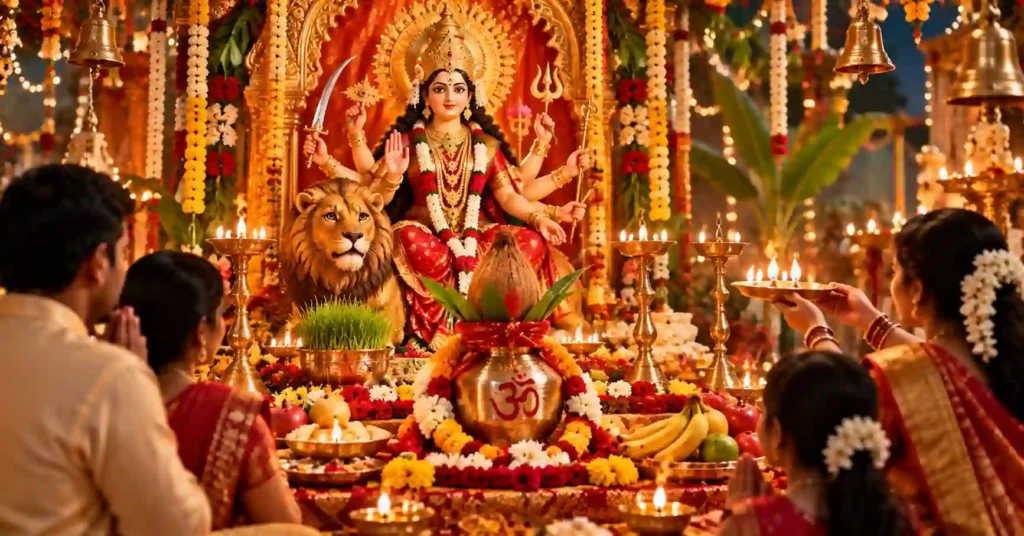
Sharad Navratri is celebrated to honour the Divine Mother, who is revered as the source of strength, compassion, wisdom, protection, and cosmic energy. Through prayers, fasting, and worship, devotees seek her blessings and express gratitude for her divine presence in their lives.
The festival also commemorates the victory of Goddess Durga over the buffalo demon Mahishasura. This victory symbolises the triumph of dharma over adharma, wisdom over ignorance, and divine consciousness over negative tendencies.
Another important aspect of the festival is its timing. Sharad Navratri occurs during a seasonal transition, making it a traditional period for spiritual reflection, self-discipline, and inner renewal. Many devotees view these nine days as an ideal time to strengthen their connection with the Divine.
The deeper message of Sharad Navratri reminds us that every individual possesses inner strength. Just as the Divine Mother overcomes darkness and negativity, devotees are encouraged to overcome fear, ego, anger, and ignorance through faith and righteous living.
Story Behind Sharad Navratri
The most widely known story associated with Sharad Navratri comes from the Devi Mahatmya, also known as the Durga Saptashati. According to this sacred text, the demon king Mahishasura obtained great powers and began troubling the gods and righteous beings.
Unable to defeat him, the gods combined their divine energies, which manifested as Goddess Durga. Armed with celestial weapons and divine strength, she fought Mahishasura in a fierce battle that lasted for several days.
On the final day, Goddess Durga defeated Mahishasura and restored cosmic balance. This victory is celebrated as the triumph of good over evil and remains one of the central spiritual themes of Sharad Navratri.
The festival concludes with Vijayadashami, a day that symbolises victory, righteousness, courage, and the eventual triumph of truth. For devotees, the story serves as a reminder that divine grace and determination can help overcome even the greatest challenges.
Sharad Navratri 2026 Dates and Important Tithis
Sharad Navratri 2026 begins on 11 October 2026 with Ghatasthapana (Kalash Sthapana) and continues for nine sacred nights dedicated to the worship of Goddess Durga in her various divine forms. The festival concludes with Vijayadashami (Dussehra) on 20 October 2026, a day that symbolises the victory of dharma over adharma and the triumph of divine power over negativity.
Each day of Sharad Navratri carries its own spiritual significance. While the entire festival is devoted to the Divine Mother, certain days such as Maha Saptami, Maha Ashtami, and Maha Navami are considered especially auspicious and attract large numbers of devotees to temples and community celebrations.
Many devotees plan their fasting, mantra chanting, Durga Saptashati recitation, and Kanya Pujan according to these important tithis. Understanding the festival calendar helps devotees participate in the celebrations with greater devotion and awareness.
Sharad Navratri 2026 Important Dates
| Event | Date |
|---|---|
| Sharad Navratri Begins & Ghatasthapana | 11 October 2026 (Sunday) |
| Maa Shailaputri Puja | 11 October 2026 |
| Maa Brahmacharini Puja | 12 October 2026 |
| Maa Chandraghanta Puja | 13 October 2026 |
| Maa Kushmanda Puja | 14 October 2026 |
| Maa Skandamata Puja | 15 October 2026 |
| Maa Katyayani Puja | 16 October 2026 |
| Maa Kalaratri Puja | 17 October 2026 |
| Maha Ashtami & Maa Mahagauri Puja | 18 October 2026 |
| Maha Navami & Maa Siddhidatri Puja | 19 October 2026 |
| Vijayadashami (Dussehra) | 20 October 2026 (Tuesday) |
Note: Tithi timings and Muhurat may vary slightly depending on location and Panchang calculations. Always consult your local Panchang or temple for the most accurate timings.
The progression of these nine days is often viewed as a symbolic spiritual journey. Beginning with the grounding energy of Maa Shailaputri and culminating in the divine wisdom of Maa Siddhidatri, the festival encourages devotees to cultivate discipline, courage, devotion, purity, and spiritual awakening.
Ghatasthapana Muhurat and Kalash Sthapana
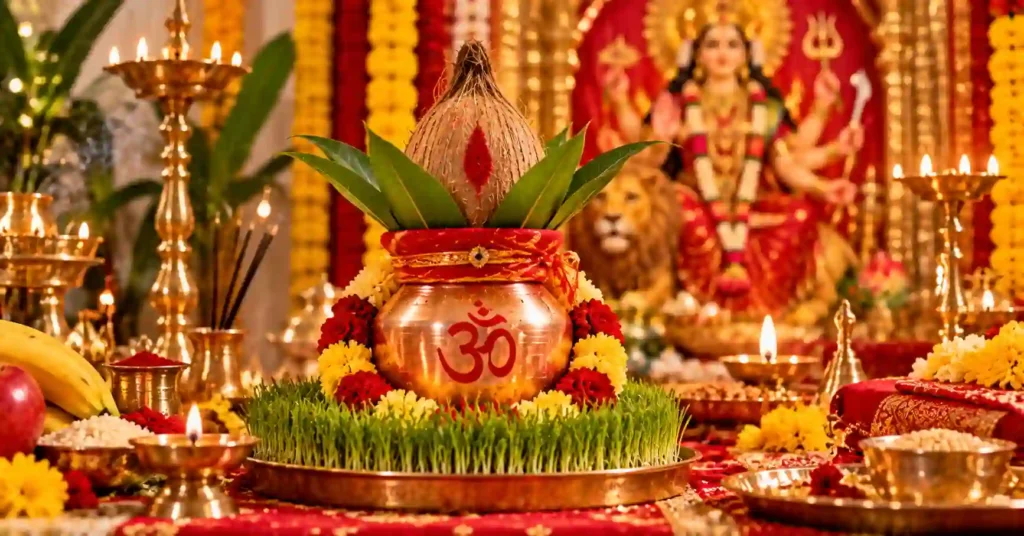
Ghatasthapana, also known as Kalash Sthapana, marks the beginning of Sharad Navratri and is one of the most important rituals of the festival. Through this sacred ceremony, devotees invoke the presence and blessings of the Divine Mother into their homes and places of worship.
The Kalash is considered a symbol of creation, abundance, purity, and divine energy. During Sharad Navratri, devotees establish the Kalash on a clean altar, sow barley seeds, light a sacred lamp, and begin nine days of worship, prayer, fasting, and spiritual discipline.
Although the ritual may vary slightly according to family traditions, the spiritual purpose remains the same: inviting the Divine Mother into one’s life and dedicating the coming nine days to devotion and self-transformation.
Items Required for Ghatasthapana
- Earthen pot or Kalash
- Clean soil
- Barley seeds (Jau)
- Coconut
- Mango leaves
- Red cloth
- Kumkum and Akshat (rice)
- Flowers
- Ganga Jal or clean water
- Diya (oil lamp)
How to Perform Kalash Sthapana
- Clean the worship area and prepare a sacred altar.
- Spread clean soil in a shallow container and sow barley seeds.
- Fill the Kalash with water and place mango leaves at the opening.
- Position a coconut wrapped in red cloth on top of the Kalash.
- Apply kumkum and offer flowers.
- Invoke Goddess Durga through prayer and sankalpa.
- Light a diya and begin daily Navratri worship.
The growing barley shoots are traditionally viewed as a symbol of prosperity, growth, and divine blessings. Throughout Sharad Navratri, devotees continue their daily prayers before the Kalash until the conclusion of the festival on Vijayadashami.
Navadurga Worship During the Nine Days of Sharad Navratri
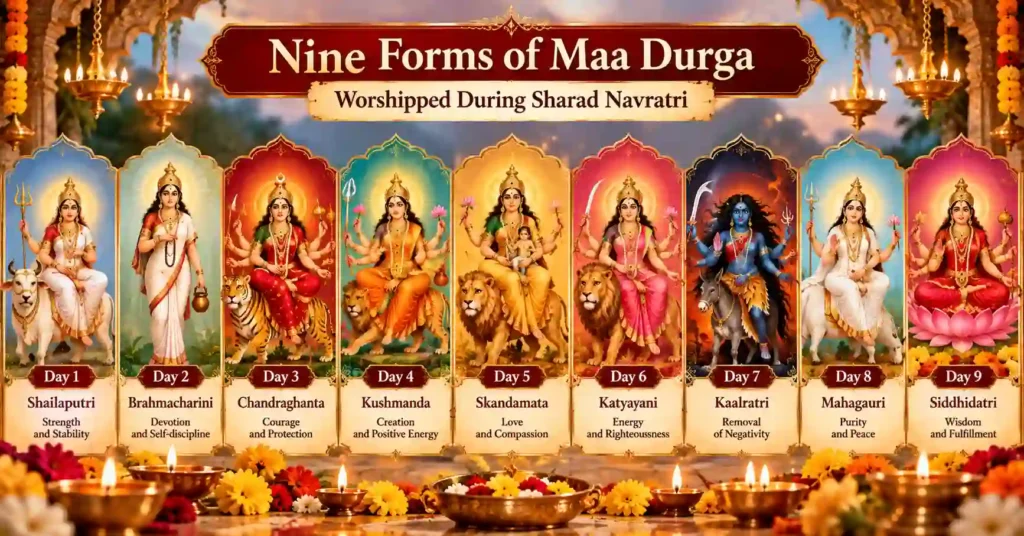
One of the most important traditions of Sharad Navratri is the worship of the Navadurga, the nine divine forms of Goddess Durga. Each day of the festival is dedicated to a different manifestation of the Divine Mother, and each form represents a unique spiritual quality that guides devotees on the path of inner growth.
The worship of the Navadurga is not merely a sequence of rituals. It is often viewed as a symbolic spiritual journey. As devotees progress through the nine days, they are encouraged to cultivate qualities such as discipline, courage, compassion, wisdom, purity, and self-realisation.
Across India, temples and households perform special pujas dedicated to the day’s form of the Goddess. Many devotees wear specific colours, offer particular flowers and bhog, and chant mantras associated with the respective manifestation of Maa Durga.
Through Navadurga worship, devotees seek not only material blessings but also spiritual strength, protection, and divine guidance for life’s journey.
The Nine Forms of Goddess Durga Worshipped During Sharad Navratri
| Day | Form of Goddess | Represents |
|---|---|---|
| Day 1 | Maa Shailaputri | Strength, stability, and a strong spiritual foundation |
| Day 2 | Maa Brahmacharini | Devotion, discipline, and perseverance |
| Day 3 | Maa Chandraghanta | Courage, protection, and fearlessness |
| Day 4 | Maa Kushmanda | Creation, vitality, and prosperity |
| Day 5 | Maa Skandamata | Motherly love, wisdom, and compassion |
| Day 6 | Maa Katyayani | Determination, righteousness, and bravery |
| Day 7 | Maa Kalaratri | Protection from negativity and destruction of fear |
| Day 8 | Maa Mahagauri | Purity, peace, and spiritual growth |
| Day 9 | Maa Siddhidatri | Divine wisdom, fulfilment, and spiritual perfection |
As devotees move from the worship of Maa Shailaputri on the first day to Maa Siddhidatri on the ninth day, the journey symbolises the gradual awakening of higher consciousness. Each form teaches an important spiritual lesson and encourages devotees to overcome limitations while cultivating noble qualities.
Suggested Reading: Learn more about each divine form in our detailed guide on Navadurga: Meaning, Nine Forms of Maa Durga, Navratri Significance and Spiritual Journey.
Daily Worship During Sharad Navratri
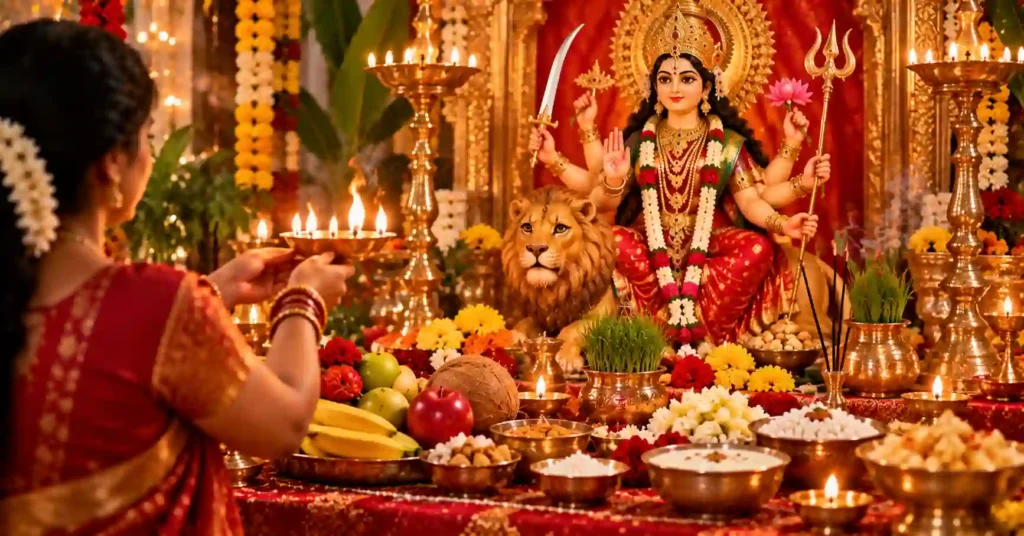
Sharad Navratri can be observed in many ways according to family traditions, regional customs, and personal spiritual practices. While rituals may differ, the heart of the festival remains devotion to the Divine Mother and the cultivation of purity, discipline, and gratitude.
Many devotees begin each day with prayers, lighting a diya, offering flowers, chanting Durga mantras, and performing simple puja before the Kalash established during Ghatasthapana. Some observe a full Navratri fast, while others fast only on selected days such as Ashtami or Navami.
Reading sacred texts such as the Durga Saptashati, Durga Chalisa, Devi Kavach, and Argala Stotra is also a common practice during these nine days. Many families gather for evening aarti and devotional singing, creating an atmosphere of faith and spiritual reflection.
Although the rituals may vary, Sharad Navratri reminds devotees that sincere devotion and righteous conduct are more important than elaborate ceremonies.
Daily Observances During the Nine Days
| Day | Main Observance |
|---|---|
| Day 1 | Ghatasthapana and worship of Maa Shailaputri |
| Day 2 | Worship of Maa Brahmacharini and mantra chanting |
| Day 3 | Worship of Maa Chandraghanta and daily Durga Puja |
| Day 4 | Worship of Maa Kushmanda and devotional offerings |
| Day 5 | Worship of Maa Skandamata and scripture reading |
| Day 6 | Worship of Maa Katyayani and continued fasting |
| Day 7 | Worship of Maa Kalaratri and special prayers for protection |
| Day 8 | Maha Ashtami, Kanya Pujan, and Durga worship |
| Day 9 | Maha Navami, Havan (where customary), and final prayers |
| Day 10 | Vijayadashami and conclusion of Navratri observances |
The purpose of these daily practices is not simply to follow tradition but to strengthen faith, develop self-discipline, and deepen one’s connection with the Divine Mother. Through devotion, prayer, and reflection, devotees seek both inner transformation and divine blessings.
Sharad Navratri Vrat Rules and Fasting Guidelines
Observing a Navratri Vrat during Sharad Navratri is a cherished tradition for millions of devotees. While fasting practices vary from family to family, the primary purpose of the vrat is not merely dietary restriction but spiritual discipline, self-control, and devotion to the Divine Mother.
Some devotees observe a fast for all nine days, while others fast only on the first and last day or on Maha Ashtami and Maha Navami. The form of fasting often depends on family traditions, age, health, and personal spiritual commitment. There is no single rule that every devotee must follow.
During Sharad Navratri, devotees are encouraged to maintain purity in thoughts, words, and actions. Along with dietary discipline, many people dedicate more time to prayer, mantra chanting, meditation, scripture reading, and acts of kindness.
The essence of the vrat lies in strengthening one’s connection with the Divine Mother. Sincere devotion, humility, and self-discipline are considered more important than the strictness of the fast itself.
Common Navratri Fasting Practices
- Consume sattvik food prepared without onion and garlic.
- Eat fruits, milk, curd, nuts, and vrat-approved foods.
- Use Sendha Namak (rock salt) instead of regular salt.
- Avoid meat, alcohol, tobacco, and tamasic foods.
- Spend time in prayer, meditation, and mantra japa.
- Practice truthfulness, patience, and self-control.
- Maintain a peaceful and positive mindset throughout the festival.
Foods Commonly Eaten During Navratri Vrat
| Food Category | Common Examples |
|---|---|
| Fruits | Banana, apple, papaya, pomegranate, orange |
| Milk & Dairy | Milk, curd, buttermilk, paneer |
| Dry Fruits & Nuts | Almonds, cashews, walnuts, raisins |
| Vrat Flours | Kuttu flour, Singhara flour |
| Fasting Grains | Samak rice (barnyard millet) |
| Root Vegetables | Potato, sweet potato, arbi |
| Seasonings | Sendha Namak, cumin, black pepper |
| Healthy Drinks | Coconut water, lemon water, fresh fruit juices |
It is important to remember that fasting should never become a burden. Elderly people, children, pregnant women, and individuals with medical conditions may observe the festival according to their health and circumstances. In Sanatan Dharma, devotion is measured by sincerity of heart rather than physical hardship.
Kanya Pujan During Sharad Navratri
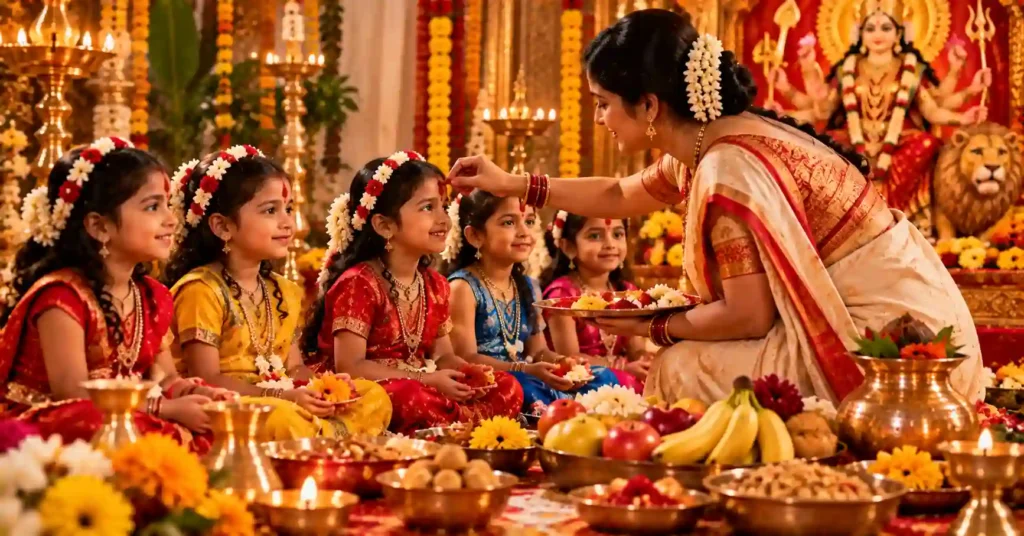
Kanya Pujan, also known as Kumari Puja, is one of the most sacred observances associated with Sharad Navratri. In this tradition, young girls are worshipped as living manifestations of the Divine Mother and are honoured with respect, prayers, and offerings.
The ritual is generally performed on Durga Ashtami or Maha Navami, though local customs may vary. Devotees invite young girls, wash their feet, offer flowers, apply tilak, serve prasad, and seek their blessings. In many families, a young boy representing Bhairava is also worshipped alongside the girls.
This tradition reflects the belief that divine energy resides in all beings. By honouring young girls as forms of Goddess Durga, devotees express reverence for purity, innocence, compassion, and the nurturing power of the Divine Mother.
Beyond the ritual itself, Kanya Pujan carries a deeper message. It reminds society to respect, protect, and value women and girls while recognising the sacred feminine principle that sustains creation.
Spiritual Significance of Kanya Pujan
- Honours the Divine Mother in her living form.
- Symbolises purity, innocence, and divine grace.
- Encourages respect for women and girl children.
- Completes many Navratri observances.
- Invites blessings for prosperity, harmony, and spiritual growth.
Suggested Reading: Explore our complete guide on Kanya Pujan in Navratri: Meaning, Ritual and Spiritual Significance.
Durga Saptashati and Mantra Chanting During Navratri
One of the most important spiritual practices during Sharad Navratri is the recitation of sacred hymns, scriptures, and mantras dedicated to Goddess Durga. These devotional practices help devotees deepen their faith, focus the mind, and cultivate a stronger connection with the Divine Mother.
Among all scriptures associated with Navratri, the Durga Saptashati (Devi Mahatmya) holds special significance. This sacred text narrates the divine victories of Goddess Durga over powerful forces of negativity and symbolises the triumph of wisdom, righteousness, and divine consciousness.
Many devotees complete the entire Durga Saptashati during the nine days of Navratri, while others read selected chapters according to their family traditions. Alongside scripture recitation, mantra chanting and devotional hymns form an important part of daily worship.
Whether performed at home or in temples, these practices create an atmosphere of devotion and spiritual reflection, helping devotees experience the deeper meaning of Sharad Navratri.
Popular Prayers and Texts Recited During Navratri
| Sacred Text or Prayer | Significance |
|---|---|
| Durga Saptashati | Principal scripture dedicated to Goddess Durga |
| Durga Chalisa | Devotional hymn praising Maa Durga |
| Devi Kavach | Prayer seeking divine protection |
| Argala Stotra | Hymn glorifying the Divine Mother |
| Siddha Kunjika Stotram | Revered prayer associated with Durga Saptashati |
| Navarna Mantra | Powerful mantra dedicated to Goddess Durga |
| Durga Beej Mantra | Sacred seed mantra for devotion and spiritual strength |
| Aarti of Maa Ambe | Traditional aarti offered during Durga worship |
Regular recitation of these sacred texts is believed to strengthen faith, purify the mind, and inspire courage, devotion, and inner peace. For many devotees, these prayers become a daily source of spiritual guidance throughout Sharad Navratri and beyond.
How Sharad Navratri Is Celebrated Across India
While the spiritual essence of Sharad Navratri remains the same throughout the country, its celebrations vary across regions, reflecting India’s rich cultural diversity. From grand Durga Puja pandals in the east to vibrant Garba nights in the west, the festival brings together devotion, community participation, music, dance, and traditional customs.
In many places, devotees visit temples, observe fasting, participate in special pujas, and gather for devotional singing. Communities decorate homes, streets, and temples with lights, flowers, and colourful displays dedicated to the Divine Mother.
Sharad Navratri also serves as a time for social harmony and cultural celebration. Families come together, communities organise religious events, and devotees express their devotion through both worship and traditional festivities.
Although customs differ from region to region, the festival’s central message remains unchanged: honouring the Divine Mother and celebrating the victory of goodness, faith, and righteousness.
Regional Celebrations of Sharad Navratri
| Region | Popular Tradition |
|---|---|
| Gujarat | Garba and Dandiya Raas performed in honour of Goddess Durga |
| West Bengal | Grand Durga Puja celebrations, cultural programmes, and pandals |
| North India | Fasting, Ramleela performances, Kanya Pujan, and temple worship |
| Maharashtra | Ghatasthapana, Durga worship, and community celebrations |
| Himachal Pradesh | Temple fairs and special Navratri gatherings |
| South India | Golu displays, devotional music, and special pujas |
| Nepal | Dashain festival celebrated with Durga worship and family traditions |
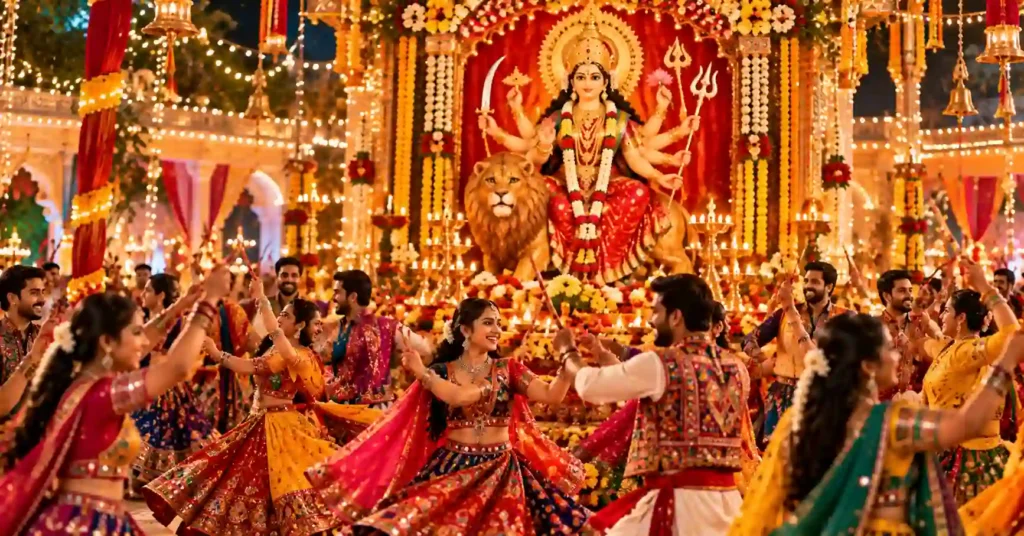
One of the most recognised aspects of Sharad Navratri is the colourful celebration of Garba and Dandiya Raas in Gujarat. Thousands of devotees gather in beautifully decorated venues to dance in circles around a lamp or image of the Divine Mother, symbolising the eternal presence of Shakti at the centre of creation.
In West Bengal, the final days of Sharad Navratri coincide with Durga Puja, one of the largest religious and cultural celebrations in the world. Magnificent idols, artistic pandals, devotional rituals, music, and community participation transform entire cities into vibrant centres of devotion and celebration.
Spiritual Significance of Sharad Navratri
Beyond its rituals and festivities, Sharad Navratri carries a profound spiritual message. The festival reminds devotees that true strength comes not merely from physical power but from faith, wisdom, self-discipline, compassion, and devotion.
The nine days of Navratri are often viewed as a symbolic journey of inner transformation. Each form of Navadurga represents a spiritual quality that helps devotees progress from ordinary awareness toward higher consciousness and self-realisation.
The battle between Goddess Durga and Mahishasura is also understood on a deeper level. The demons described in sacred texts can be seen as symbols of negative tendencies such as ego, anger, greed, fear, attachment, and ignorance. Through devotion and self-reflection, devotees strive to overcome these inner obstacles.
For many spiritual seekers, Sharad Navratri is a sacred opportunity to pause, reflect, strengthen faith, and reconnect with the Divine Mother. The festival teaches that when wisdom, courage, and devotion guide our actions, the light of dharma ultimately prevails over darkness.
Key Spiritual Lessons of Sharad Navratri
- Cultivate faith and devotion to the Divine Mother.
- Develop self-discipline through prayer and fasting.
- Overcome fear, negativity, and harmful habits.
- Strengthen compassion, gratitude, and humility.
- Recognise the divine presence within all beings.
- Walk the path of dharma with courage and wisdom.
The enduring message of Sharad Navratri is that spiritual growth begins within. By awakening the qualities represented by the Divine Mother, devotees seek not only blessings for worldly well-being but also inner peace, wisdom, and spiritual fulfilment.
Key Takeaways
Sharad Navratri is one of the most important festivals dedicated to Goddess Durga and the worship of her nine divine forms. Celebrated over nine sacred nights, it combines devotion, spiritual discipline, fasting, mantra chanting, and community celebrations.
The festival begins with Ghatasthapana (Kalash Sthapana) and progresses through the worship of the Navadurga, culminating in Vijayadashami, which symbolises the victory of righteousness over negativity. Throughout these nine days, devotees seek the blessings of the Divine Mother for strength, wisdom, protection, prosperity, and spiritual growth.
Whether observed through fasting, daily puja, scripture recitation, Kanya Pujan, Garba, Durga Puja, or simple acts of devotion, Sharad Navratri offers an opportunity to deepen one’s faith and strengthen the connection with the Divine.
Key Points to Remember
- Sharad Navratri 2026 begins on 11 October 2026 and concludes with Vijayadashami on 20 October 2026.
- The festival is dedicated to the worship of Navadurga, the nine forms of Goddess Durga.
- Ghatasthapana marks the beginning of Navratri observances.
- Fasting, mantra chanting, Durga Saptashati recitation, and Kanya Pujan are important traditions.
- Garba, Dandiya, Durga Puja, and temple celebrations are widely observed across India.
- The festival symbolises the victory of divine wisdom, faith, and righteousness over negativity and ignorance.
Conclusion
Sharad Navratri is much more than a nine-day festival. It is a sacred journey of devotion, self-discipline, spiritual reflection, and inner transformation dedicated to the Divine Mother. Through the worship of the Navadurga, fasting, prayer, mantra chanting, and acts of devotion, devotees seek to strengthen their connection with Goddess Durga and invite her blessings into their lives.
From the auspicious ritual of Ghatasthapana on the first day to the celebration of Vijayadashami at its conclusion, Sharad Navratri reminds us that faith, courage, wisdom, and righteousness ultimately triumph over negativity and ignorance. The festival inspires devotees to awaken the divine qualities within themselves and walk the path of dharma with confidence and humility.
Whether you observe Sharad Navratri through daily puja, Durga Saptashati recitation, Kanya Pujan, Garba celebrations, or simple heartfelt prayers, the true essence of the festival lies in sincere devotion to the Divine Mother. May Sharad Navratri 2026 bring peace, strength, prosperity, spiritual growth, and the blessings of Maa Durga to you and your family.
Jai Mata Di! 🙏🌺
Suggested Reading
If you would like to deepen your understanding of Sharad Navratri 2026 and explore the traditions, rituals, and spiritual wisdom associated with Sharad Navratri 2026, these carefully curated guides from The Sanatan Tales will help you continue your journey of devotion and learning.
Maa Durga: Meaning, Story, Forms, Navadurga, Temples and Worship
https://thesanatantales.com/maa-durga-meaning-story-navadurga-worship/
Navadurga: Meaning, Nine Forms of Maa Durga, Navratri Significance and Spiritual Journey
https://thesanatantales.com/navadurga-nine-forms-of-maa-durga/
Kanya Pujan in Navratri: Meaning, Ritual and Spiritual Significance
https://thesanatantales.com/kanya-pujan/
Kalash in Hinduism: Meaning, Symbolism, Kalash Sthapana and Spiritual Significance
https://thesanatantales.com/kalash-in-hinduism/
Durga Saptashati: Meaning, Story, 13 Chapters and Navratri Significance
https://thesanatantales.com/durga-saptashati-meaning-navratri/
Durga Chalisa: Lyrics, English Pronunciation, Hindi Meaning, Benefits & Significance
https://thesanatantales.com/durga-chalisa-lyrics-meaning/
Durga Beej Mantra: Meaning, Benefits, Chanting Rules and How to Chant
https://thesanatantales.com/durga-beej-mantra-meaning/
Navarna Mantra: Meaning, Benefits, Chanting Rules and How to Chant
https://thesanatantales.com/navarna-mantra/
Devi Kavach: Meaning, English Pronunciation, Benefits and Protection Prayer
https://thesanatantales.com/devi-kavach-meaning/
Argala Stotra: Lyrics, Meaning, Benefits, and How to Chant
https://thesanatantales.com/argala-stotra/
Aarti of Maa Ambe: Lyrics, Meaning, Benefits and How to Perform
https://thesanatantales.com/aarti-of-maa-ambe/
Durga Mantras: Complete Guide to Powerful Mantras, Stotras, Chalisa and Aarti
https://thesanatantales.com/durga-mantras-stotras-chalisa-aarti/
Navaratri (Wikipedia)
https://en.wikipedia.org/wiki/Navaratri
FAQs
What is the difference between Sharad Navratri and Shardiya Navratri?
There is no difference between Sharad Navratri and Shardiya Navratri. Both names refer to the same nine-night festival dedicated to Goddess Durga and her nine divine forms. The term Sharad refers to the autumn season, while Shardiya means “belonging to the Sharad season.”
Today, both terms are widely used in Panchangs, temples, spiritual literature, and devotional discussions across India. Whether someone says Sharad Navratri or Shardiya Navratri, they are referring to the most widely celebrated Navratri observed during the Hindu month of Ashwin.
Why is Sharad Navratri considered the most important Navratri?
Although four Navratris are observed during the year, Sharad Navratri is regarded as the most widely celebrated and spiritually significant. It is dedicated to the worship of the Divine Mother and commemorates Goddess Durga’s victory over Mahishasura, symbolising the triumph of dharma over adharma.
The festival is observed across India through fasting, Durga Puja, Garba, Dandiya, scripture recitation, and temple worship. Its deep connection with Vijayadashami and the celebration of divine feminine energy makes it one of the most important festivals in Sanatan Dharma.
What is the difference between Chaitra Navratri and Sharad Navratri?
Both festivals are dedicated to Goddess Durga and the worship of the Divine Mother, but they occur in different seasons and have distinct cultural associations. Chaitra Navratri is observed during spring and concludes with Ram Navami, while Sharad Navratri is celebrated during autumn and culminates in Vijayadashami or Dussehra.
Although the spiritual practices of fasting, prayer, and Durga worship are common to both, Sharad Navratri is generally celebrated on a much larger scale across India. Festivals such as Durga Puja in West Bengal and Garba and Dandiya in Gujarat are closely associated with Sharad Navratri, making it the most widely observed Navratri of the year.
Can I observe Sharad Navratri without fasting?
Yes. Fasting is an important tradition during Sharad Navratri, but it is not compulsory for every devotee. The true purpose of the festival is devotion, self-discipline, prayer, and spiritual growth. Those who cannot fast due to age, health conditions, pregnancy, or other reasons can still participate meaningfully.
Many devotees observe Navratri through daily puja, mantra chanting, reading sacred texts such as the Durga Saptashati, offering flowers, lighting a diya, and maintaining a sattvik lifestyle. In Sanatan Dharma, sincerity of devotion is considered more important than the strictness of a fast.
Which day is Kanya Pujan performed during Sharad Navratri?
Kanya Pujan is most commonly performed on Maha Ashtami or Maha Navami, though traditions may vary from region to region. During this sacred ritual, young girls are worshipped as manifestations of the Divine Mother and are offered food, gifts, flowers, and prayers.
The ritual symbolises reverence for the feminine divine and reminds devotees that divine energy exists within all beings. Many families consider Kanya Pujan one of the most important observances of Sharad Navratri and perform it with great devotion and respect.
Can Durga Saptashati be read at home during Sharad Navratri?
Yes. Durga Saptashati, also known as Devi Mahatmya, is commonly recited at home during Sharad Navratri. Many devotees complete the entire scripture over nine days, while others read selected chapters according to their family traditions and available time.
The text narrates the divine victories of Goddess Durga and is considered one of the most important scriptures associated with Navratri. Reading it with faith and devotion is believed to inspire courage, strengthen spiritual resolve, and deepen one’s connection with the Divine Mother.
Why is Vijayadashami celebrated after Sharad Navratri?
Vijayadashami marks the conclusion of Sharad Navratri and celebrates the victory of good over evil. It commemorates Goddess Durga’s triumph over Mahishasura and, in many traditions, Lord Rama’s victory over Ravana. As a result, the day is regarded as a symbol of righteousness, courage, and divine grace.
The festival reminds devotees that truth and dharma ultimately prevail, even in the face of great challenges. For this reason, Vijayadashami is considered one of the most auspicious days in the Hindu calendar and marks the spiritual culmination of the Navratri celebrations.
What is the spiritual message of Sharad Navratri?
The deeper spiritual message of Sharad Navratri is the awakening of inner strength and divine consciousness. The nine forms of Goddess Durga represent different virtues such as courage, wisdom, discipline, compassion, purity, and spiritual fulfilment. Through worship and self-reflection, devotees seek to cultivate these qualities in their own lives.
The battle between Durga and Mahishasura is often interpreted as a symbolic struggle between higher values and negative tendencies such as ego, anger, greed, and ignorance. The festival encourages de
What are the nine colours of Sharad Navratri 2026?
Many devotees wear specific colours during Sharad Navratri as a symbolic way of honouring the different forms and qualities of Goddess Durga. The sequence of Navratri colours changes each year based on the weekday on which the festival begins and the corresponding calendar calculations.
For Sharad Navratri 2026, the commonly followed colour sequence is Yellow, Green, Grey, Orange, White, Red, Royal Blue, Pink, and Purple. While wearing these colours is a popular tradition, it is important to remember that devotion, prayer, and righteous conduct remain the true essence of Navratri observance.
What is Ghatasthapana and why is it important during Sharad Navratri?
Ghatasthapana, also known as Kalash Sthapana, is the sacred ritual that marks the beginning of Sharad Navratri. During this ceremony, devotees establish a Kalash filled with water, place a coconut and mango leaves on it, and sow barley seeds in prepared soil. The ritual symbolises the invocation of Goddess Durga into the home and the beginning of nine days of worship.
Ghatasthapana is considered one of the most important Navratri rituals because it represents creation, prosperity, divine energy, and spiritual growth. The barley seeds that sprout during the nine days are traditionally viewed as a symbol of abundance and blessings, while the Kalash itself represents the presence of the Divine Mother.
Glossary of Important Terms
| Term | Meaning |
|---|---|
| Sharad Navratri | The most widely celebrated Navratri festival, observed during the Hindu month of Ashwin and dedicated to Goddess Durga. |
| Shardiya Navratri | Another name for Sharad Navratri, referring to the Navratri celebrated during the Sharad (autumn) season. |
| Navratri | Literally meaning “Nine Nights,” a sacred festival dedicated to the worship of the Divine Mother. |
| Shakti | The divine feminine energy believed to be the source of creation, preservation, and transformation in the universe. |
| Maa Durga | The Divine Mother worshipped as the protector of righteousness and destroyer of negativity. |
| Navadurga | The nine divine forms of Goddess Durga worshipped during the nine days of Navratri. |
| Ghatasthapana | The ritual installation of a sacred Kalash marking the beginning of Navratri celebrations. |
| Kalash Sthapana | Another name for Ghatasthapana, symbolising the invocation of divine energy into the home or temple. |
| Vrat | A religious fast or spiritual observance undertaken with devotion and self-discipline. |
| Durga Saptashati | A revered scripture, also known as Devi Mahatmya, that narrates the divine victories of Goddess Durga. |
| Devi Mahatmya | Sacred text from the Markandeya Purana describing the glory and divine deeds of Goddess Durga. |
| Kanya Pujan | A ritual in which young girls are worshipped as manifestations of the Divine Mother during Navratri. |
| Maha Ashtami | The eighth day of Navratri, considered one of the most sacred days for Durga worship and Kanya Pujan. |
| Maha Navami | The ninth day of Navratri dedicated to the worship of Maa Siddhidatri and completion of many Navratri observances. |
| Vijayadashami (Dussehra) | The tenth day following Navratri, celebrating the victory of good over evil. |
| Mahishasura | The buffalo demon defeated by Goddess Durga, symbolising the triumph of righteousness over negativity. |
| Durga Puja | A grand festival honouring Goddess Durga, especially celebrated in West Bengal during Sharad Navratri. |
| Garba | A traditional devotional dance performed in Gujarat during Navratri in honour of the Divine Mother. |
| Dandiya Raas | A popular folk dance performed with decorated sticks during Navratri celebrations. |
| Panchang | The traditional Hindu calendar used to determine tithis, festivals, Muhurat, and religious observances. |
| Tithi | A lunar day in the Hindu calendar used for determining festival dates and religious rituals. |
| Sankalpa | A sacred vow or intention made before beginning a religious ritual or spiritual practice. |
| Prasad | Blessed food or offerings distributed to devotees after worship. |
| Diya | A traditional oil lamp lit during worship as a symbol of divine light and knowledge. |
| Jau (Barley Seeds) | Seeds sown during Ghatasthapana that symbolise growth, prosperity, and divine blessings. |
| Dharma | The path of righteousness, duty, and moral living according to Sanatan Dharma. |
| Adharma | Actions or conduct that go against righteousness, truth, and moral values. |
About the Author
Yateendra Chaturvedi is a spiritual writer, researcher, devotee, and the founder of The Sanatan Tales. With over 35 years of professional experience and a lifelong interest in Sanatan Dharma, he writes about Hindu deities, temples, scriptures, festivals, Mahavidyas, sacred stories, rituals, and living traditions that continue to guide and inspire devotees across India.
Drawing from traditional scriptures, regional beliefs, temple traditions, devotional literature, and historical sources, he aims to present authentic, well-researched, and easy-to-understand content for modern readers. His work focuses on preserving spiritual wisdom, explaining sacred traditions, and helping seekers develop a deeper understanding of India’s rich spiritual heritage.
Through The Sanatan Tales, Yateendra strives to make the timeless teachings of Sanatan Dharma simple, meaningful, and relevant for today’s generation while maintaining respect for traditional sources, regional practices, and diverse spiritual perspectives.
Learn More About Yateendra Chaturvedi →
https://thesanatantales.com/about-the-author/
References & Sources
This article is based on teachings, traditions, and practices associated with Sanatan Dharma, including insights drawn from Hindu scriptures, devotional literature, temple traditions, sacred festivals, and widely accepted spiritual teachings related to Goddess Durga, Navratri, and the worship of the Divine Mother. It also reflects knowledge preserved through cultural customs, family traditions, spiritual communities, and practices that have been followed across generations.
The article incorporates commonly understood interpretations of rituals, observances, symbolism, and spiritual values associated with Sharad Navratri, as practiced in different parts of India and other regions where Sanatan traditions are observed.
Note: Beliefs, customs, festival practices, and spiritual interpretations may vary across different regions, traditions, sampradayas, temples, and individual paths within Sanatan Dharma. The purpose of this article is not to present any single tradition or viewpoint as the only authoritative perspective, but to offer a simple, respectful, and reader-friendly overview of commonly accepted teachings and practices associated with Sharad Navratri. Sanatan Dharma embraces diversity in worship, devotion, knowledge, meditation, and spiritual practice, allowing individuals to connect with the Divine in ways that resonate with their faith and tradition.
Explore More Topics from The Sanatan Tales