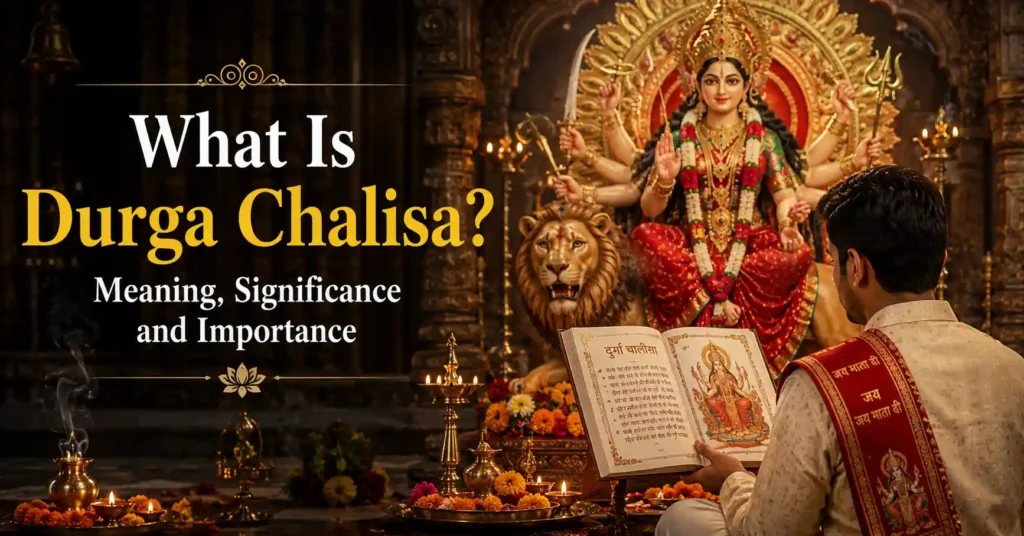
The Durga Chalisa is one of the most beloved devotional hymns dedicated to Maa Durga, the Divine Mother and embodiment of Shakti in Hinduism. Recited by millions of devotees, the Durga Chalisa praises the goddess’s strength, compassion, protection, and victory over negative forces. It is especially popular during Navratri, Durga Puja, Fridays, and other occasions dedicated to Devi worship.
Many devotees chant the Durga Chalisa to seek courage, inner strength, peace of mind, and the blessings of Maa Durga. Its simple verses make it accessible to beginners, while its deep spiritual teachings continue to inspire experienced devotees. The hymn also highlights various forms of the Divine Mother and her role as the protector of dharma.
In this article, you will find the complete Durga Chalisa lyrics, English pronunciation, line-by-line Hindi meaning, English meaning, spiritual significance, benefits of chanting, proper chanting method, daily life lessons, interesting facts, FAQs, and related devotional resources. Whether you wish to learn the Durga Chalisa for daily recitation or understand its deeper meaning, this guide will help you connect with Maa Durga’s divine grace and wisdom.
Durga Chalisa At a Glance
| Aspect | Details |
|---|---|
| Name | Durga Chalisa |
| Dedicated To | Maa Durga (Adi Shakti) |
| Type | Devotional Chalisa (40-Verse Hymn) |
| Tradition | Shakta Tradition |
| Language | Awadhi/Hindi with Sanskrit influences |
| Attributed To | Devidas |
| Main Theme | Praise, protection, devotion, and divine blessings of Maa Durga |
| Common Occasions | Navratri, Durga Puja, Fridays, Ashtami, Navami |
| Primary Benefits | Spiritual strength, devotion, courage, inner peace, divine protection |
| Best Time to Chant | Early morning or evening during worship |
| Suitable For Beginners | Yes |
| Related Scriptures | Devi Mahatmya, Durga Saptashati, Devi Kavach |
| Popular Forms Mentioned | Durga, Kali, Annapurna, Lakshmi, Saraswati, Tara, Baglamukhi, Bhuvaneshwari, Matangi, Dhumavati |
| Purpose of Recitation | Seeking blessings, protection, strength, wisdom, and spiritual growth |
Table of Contents
ToggleWhat Is Durga Chalisa?
The Durga Chalisa is a sacred Hindu devotional hymn consisting of forty verses that glorify Maa Durga, the Divine Mother and supreme embodiment of Shakti. It is one of the most widely recited prayers in Devi worship and is cherished for its simple language and powerful spiritual message.
The word Chalisa comes from the Hindi word chalis, meaning forty. Like other Chalisas in Hindu tradition, the Durga Chalisa uses forty verses to praise the virtues, divine powers, and compassionate nature of the deity.
Dedicated to Maa Durga, the Durga Chalisa describes her various forms, divine qualities, victories over evil forces, and her role as the protector of devotees. It portrays the Goddess as the source of strength, wisdom, prosperity, courage, and spiritual awakening.
In Hindu tradition, devotees recite the Durga Chalisa to seek the blessings of the Divine Mother during times of difficulty, uncertainty, and spiritual practice. It is especially popular during Navratri, Durga Puja, Fridays, Ashtami, and other occasions associated with Shakti worship.
The hymn also highlights several manifestations of Devi, including forms associated with Lakshmi, Saraswati, Kali, Annapurna, Tara, and other aspects of the Divine Feminine. This makes the Durga Chalisa not only a prayer of devotion but also a celebration of the many expressions of divine energy in Sanatan Dharma.
For many devotees, chanting the Durga Chalisa is a way to strengthen faith, cultivate inner courage, overcome fear, and develop a deeper connection with Maa Durga’s grace and protection. Its teachings continue to inspire spiritual seekers across generations.
Origin and Scriptural Significance of Durga Chalisa
The Durga Chalisa is traditionally attributed to the poet-saint Devidas, who composed this devotional hymn in praise of Maa Durga. Written in simple and devotional language, it helped make the worship of the Divine Mother accessible to ordinary devotees.
Although the Durga Chalisa is not part of the Vedas or the major Hindu scriptures, its teachings are deeply rooted in the broader tradition of Shakti worship. The hymn reflects many themes found in sacred texts that glorify the Divine Mother.
The spiritual foundation of the Durga Chalisa can be linked to the Devi Mahatmya, also known as the Durga Saptashati, which appears in the Markandeya Purana. This revered scripture narrates how Maa Durga defeats powerful demons and restores cosmic balance.
Throughout the Durga Chalisa, the Goddess is described as the protector of devotees, destroyer of evil, and source of divine energy. These qualities closely align with the portrayal of Devi in the Devi Mahatmya and other Shakta scriptures.
The hymn also mentions several forms of the Divine Mother, highlighting the belief that all manifestations of Shakti originate from the same supreme source. This reflects an important teaching of Sanatan Dharma that the Divine Mother appears in different forms to guide and protect creation.
In the Shakta tradition, the Durga Chalisa is often recited as a devotional prayer alongside other sacred texts such as:
Durga Saptashati
Devi Kavach
Siddha Kunjika Stotram
Argala Stotram
Navarna Mantra
Many devotees chant the Durga Chalisa during Navratri, one of the most important festivals dedicated to Maa Durga. During these nine sacred nights, devotees seek her blessings for strength, wisdom, protection, prosperity, and spiritual growth.
The enduring popularity of the Durga Chalisa comes from its ability to combine devotion, philosophy, and prayer in a simple format. Whether recited daily or during special occasions, it continues to inspire faith and deepen one’s connection with the Divine Mother.
Durga Chalisa Lyrics (Sanskrit Text)
The Durga Chalisa is traditionally attributed to the devotee Devidas, who composed this hymn to praise the power and compassion of Maa Durga.
नमो नमो दुर्गे सुख करनी।
नमो नमो अम्बे दुःख हरनी॥
निरंकार है ज्योति तुम्हारी।
तिहुँ लोक फैली उजियारी॥
शशि ललाट मुख महा विशाला।
नेत्र लाल भृकुटि विकराला॥
रूप मातु को अधिक सुहावे।
दरश करत जन अति सुख पावे॥
तुम संसार शक्ति लय कीना।
पालन हेतु अन्न धन दीना॥
अन्नपूर्णा हुई जग पाला।
तुम ही आदि सुन्दरी बाला॥
प्रलयकाल सब नाशन हारी।
तुम गौरी शिव शंकर प्यारी॥
शिव योगी तुम्हरे गुण गावें।
ब्रह्मा विष्णु तुम्हें नित ध्यावें॥
रूप सरस्वती को तुम धारा।
दे सुबुद्धि ऋषि मुनि उबारा॥
धरयो रूप नरसिंह को अम्बा।
प्रगट भई फाड़कर खम्बा॥
रक्षा करी प्रह्लाद बचायो।
हिरण्याक्ष को स्वर्ग पठायो॥
लक्ष्मी रूप धरो जग माहीं।
श्री नारायण अंग समाहीं॥
क्षीर सिंधु में करत विलासा।
दयासिंधु दीजै मन आसा॥
हिंगलाज में तुम्हीं भवानी।
महिमा अमित न जात बखानी॥
मातंगी धूमावति माता।
भुवनेश्वरी बगला सुख दाता॥
श्री भैरव तारा जग तारिणी।
छिन्न भाल भव दुख निवारिणी॥
केहरि वाहन सोह भवानी।
लांगुर वीर चलत अगवानी॥
कर में खप्पर खड्ग विराजै।
जाको देख काल डर भाजै॥
सोहै अस्त्र और त्रिशूला।
जाते उठत शत्रु हिय शूला॥
नगर कोट में तुम्हीं विराजत।
तिहुँ लोक में डंका बाजत॥
शुम्भ निशुम्भ दानव तुम मारे।
रक्तबीज संहारें॥
महिषासुर नृप अति अभिमानी।
जेहि अघ भार मही अकुलानी॥
रूप कराल काली को धारा।
सेन सहित तुम तिहि संहारा॥
परी गाढ़ संत पर जब जब।
भई सहाय मातु तुम तब तब॥
अमरपुरी अरु बसव लोक।
तव महिमा सब रहै अशोक॥
ज्वाला में है ज्योति तुम्हारी।
तुम्हें सदा पूजें नर नारी॥
प्रेम भक्ति से जो यश गावें।
दुःख दारिद्र निकट न आवें॥
ध्यावे तुम्हें जो नर मन लाई।
जन्म मरण से मुक्त हो जाई॥
जोगी सुर मुनि कहत पुकारा।
योग न हो बिन शक्ति तुम्हारा॥
शंकर आचारज तप कीनो।
काम अरु क्रोध जीत सब लीनो॥
निशिदिन ध्यान धरो शंकर को।
काहु काल नहिं सुमिरो तुमको॥
शक्ति रूप का मरम न पायो।
शक्ति गई तब मन पछितायो॥
शरणागत हुई कीर्ति बखानी।
जय जय जय जगदम्ब भवानी॥
भई प्रसन्न आदि जगदम्बा।
दई शक्ति नहिं कीन विलम्बा॥
मोको मातु कष्ट अति घेरो।
तुम बिन कौन हरे दुख मेरो॥
आशा तृष्णा निपट सतावें।
रिपु मूरख मोहिं अति डरपावें॥
शत्रु नाश कीजै महारानी।
सुमिरौं इकचित तुम्हें भवानी॥
करो कृपा हे मातु दयाला।
ऋद्धि सिद्धि दे करहु निहाला॥
जब लगि जिऊँ दया फल पाऊँ।
तुम्हरो यश मैं सदा सुनाऊँ॥
दुर्गा चालीसा जो कोई गावै।
सब सुख भोग परम पद पावै॥
देवीदास शरण निज जानी।
करहु कृपा जगदम्ब भवानी॥
॥ दोहा ॥
शरणागत रक्षा करि।
जय जय जय जगदम्ब॥
संकट तू ही दूर कर।
मातु कृपा करि अम्ब॥
Durga Chalisa Meaning (Verse-by-Verse)
The Durga Chalisa is filled with devotion, praise, and spiritual wisdom dedicated to Maa Durga. Each verse highlights a different aspect of the Divine Mother, including her compassion, protective power, divine forms, and role in guiding devotees toward righteousness and inner strength.
Understanding the meaning of the Durga Chalisa can make its recitation more meaningful and spiritually enriching. Below, you will find the Durga Chalisa explained verse by verse with English pronunciation, Hindi meaning, English meaning, full verse interpretation, and spiritual essence to help you chant with deeper understanding and devotion.
Verse 1
Sanskrit Verse
नमो नमो दुर्गे सुख करनी।
नमो नमो अम्बे दुःख हरनी॥
Pronunciation
Namo Namo Durge Sukh Karni।
Namo Namo Ambe Dukh Harni॥
Line-by-Line Hindi Meaning
नमो नमो दुर्गे सुख करनी।
हे माता दुर्गा, आपको बार-बार प्रणाम है। आप भक्तों को सुख और कल्याण प्रदान करने वाली हैं।
नमो नमो अम्बे दुःख हरनी॥
हे जगदम्बा, आपको पुनः प्रणाम है। आप अपने भक्तों के दुःख, कष्ट और चिंताओं को दूर करने वाली हैं।
Line-by-Line English Meaning
Namo Namo Durge Sukh Karni.
Salutations again and again to Mother Durga, the giver of happiness, well-being, and divine blessings.
Namo Namo Ambe Dukh Harni.
Salutations to Mother Amba, who removes sorrow, suffering, and hardships from the lives of her devotees.
Full Verse Meaning
This opening verse of the Durga Chalisa offers heartfelt salutations to Maa Durga. The devotee acknowledges her as the compassionate Divine Mother who blesses her children with happiness, protection, and spiritual strength while removing their suffering and difficulties.
Spiritual Essence
This verse teaches the importance of surrender, faith, and devotion. By remembering Maa Durga with a sincere heart, devotees seek her grace, protection, and guidance on their spiritual journey.
Verse 2
Sanskrit Verse
निरंकार है ज्योति तुम्हारी।
तिहूँ लोक फैली उजियारी॥
Pronunciation
Nirankar Hai Jyoti Tumhari।
Tihun Lok Phaili Ujiyari॥
Line-by-Line Hindi Meaning
निरंकार है ज्योति तुम्हारी।
आपकी दिव्य ज्योति निराकार, अनंत और सर्वव्यापी है। वह किसी एक रूप या सीमा में बंधी नहीं है।
तिहूँ लोक फैली उजियारी॥
आपका दिव्य प्रकाश तीनों लोकों में फैला हुआ है और सम्पूर्ण सृष्टि को प्रकाशित करता है।
Line-by-Line English Meaning
Nirankar Hai Jyoti Tumhari.
Your divine light is formless, eternal, and present everywhere beyond all limitations.
Tihun Lok Phaili Ujiyari.
Your radiant light spreads across the three worlds, illuminating the entire universe.
Full Verse Meaning
In this verse, the Durga Chalisa praises Maa Durga as the supreme divine energy whose light transcends all forms and boundaries. Her presence shines throughout creation, guiding beings toward wisdom, truth, and spiritual awakening.
Spiritual Essence
This verse reminds devotees that Maa Durga exists as the universal divine consciousness that illuminates hearts and minds and leads seekers toward spiritual clarity.
Verse 3
Sanskrit Verse
शशि ललाट मुख महाविशाला।
नेत्र लाल भृकुटि विकराला॥
Pronunciation
Shashi Lalat Mukh Mahavishala।
Netra Lal Bhrikuti Vikarala॥
Line-by-Line Hindi Meaning
शशि ललाट मुख महाविशाला।
आपके मस्तक पर चंद्रमा सुशोभित है और आपका दिव्य मुख अत्यंत विशाल एवं तेजस्वी है।
नेत्र लाल भृकुटि विकराला॥
आपकी लाल आंखें और भयंकर भृकुटि दुष्टों में भय उत्पन्न करती हैं।
Line-by-Line English Meaning
Shashi Lalat Mukh Mahavishala.
The moon adorns your forehead, and your divine face is radiant and majestic.
Netra Lal Bhrikuti Vikarala.
Your red eyes and fierce brows strike fear into evil beings.
Full Verse Meaning
This verse describes the awe-inspiring form of Maa Durga. She is both beautiful and compassionate for devotees, yet powerful and fearsome toward negativity and evil forces.
Spiritual Essence
The Divine Mother represents both love and strength. She nurtures righteousness while firmly opposing injustice, ignorance, and harmful influences.
Verse 4
Sanskrit Verse
रूप मातु को अधिक सुहावे।
दरस करत जन अति सुख पावे॥
Pronunciation
Roop Matu Ko Adhik Suhave।
Daras Karat Jan Ati Sukh Pave॥
Line-by-Line Hindi Meaning
रूप मातु को अधिक सुहावे।
हे माता, आपका दिव्य स्वरूप अत्यंत सुंदर और मनोहर है।
दरस करत जन अति सुख पावे॥
आपके दर्शन करने वाले भक्त अत्यंत आनंद और सुख प्राप्त करते हैं।
Line-by-Line English Meaning
Roop Matu Ko Adhik Suhave.
O Mother, your divine form is exceedingly beautiful and enchanting.
Daras Karat Jan Ati Sukh Pave.
Those who behold you experience great joy and happiness.
Full Verse Meaning
The verse praises the beauty and divine grace of Maa Durga. Her presence fills devotees with devotion, peace, and spiritual happiness.
Spiritual Essence
True joy arises from connecting with the Divine. Remembering Maa Durga brings comfort, devotion, and inner fulfillment.
Verse 5
Sanskrit Verse
तुम संसार शक्ति लय कीना।
पालन हेतु अन्न धन दीना॥
Pronunciation
Tum Sansar Shakti Lay Kina।
Palan Hetu Ann Dhan Dina॥
Line-by-Line Hindi Meaning
तुम संसार शक्ति लय कीना।
आप ही सम्पूर्ण संसार की मूल शक्ति हैं।
पालन हेतु अन्न धन दीना॥
सृष्टि के पालन के लिए आपने अन्न, धन और आवश्यक संसाधन प्रदान किए हैं।
Line-by-Line English Meaning
Tum Sansar Shakti Lay Kina.
You are the fundamental power behind the entire universe.
Palan Hetu Ann Dhan Dina.
You provide food, wealth, and resources for the sustenance of creation.
Full Verse Meaning
This verse recognizes Maa Durga as the universal energy that supports and sustains all life. Everything necessary for existence ultimately comes from her divine power.
Spiritual Essence
The verse teaches gratitude. All blessings, resources, and opportunities are expressions of divine grace.
Verse 6
Sanskrit Verse
अन्नपूर्णा हुई जग पाला।
तुम ही आदि सुन्दरी बाला॥
Pronunciation
Annapurna Hui Jag Pala।
Tum Hi Aadi Sundari Bala॥
Line-by-Line Hindi Meaning
अन्नपूर्णा हुई जग पाला।
अन्नपूर्णा रूप में आप पूरे जगत का पालन-पोषण करती हैं।
तुम ही आदि सुन्दरी बाला॥
आप ही आदि शक्ति और परम सुंदर दिव्य माता हैं।
Line-by-Line English Meaning
Annapurna Hui Jag Pala.
As Goddess Annapurna, you nourish and sustain the entire world.
Tum Hi Aadi Sundari Bala.
You are the primordial and eternally beautiful Divine Mother.
Full Verse Meaning
The verse praises Maa Durga in her Annapurna form, highlighting her role as the provider and nourisher of all beings.
Spiritual Essence
The Divine Mother not only grants spiritual blessings but also cares for the material well-being of her devotees.
Verse 7
Sanskrit Verse
प्रलयकाल सब नाशन हारी।
तुम गौरी शिवशंकर प्यारी॥
Pronunciation
Pralayakal Sab Nashan Hari।
Tum Gauri Shiv Shankar Pyari॥
Line-by-Line Hindi Meaning
प्रलयकाल सब नाशन हारी।
प्रलय के समय आप समस्त सृष्टि का संहार करने वाली हैं।
तुम गौरी शिवशंकर प्यारी॥
आप गौरी रूप में भगवान शिव की प्रिय अर्धांगिनी हैं।
Line-by-Line English Meaning
Pralayakal Sab Nashan Hari.
At the time of cosmic dissolution, you bring all creation back into its source.
Tum Gauri Shiv Shankar Pyari.
As Goddess Gauri, you are the beloved consort of Lord Shiva.
Full Verse Meaning
This verse highlights two aspects of Maa Durga: her cosmic power over creation and dissolution, and her loving form as Goddess Gauri.
Spiritual Essence
Creation and destruction are both part of the divine order. The Divine Mother governs both with wisdom and compassion.
Verse 8
Sanskrit Verse
शिव योगी तुम्हरे गुण गावें।
ब्रह्मा विष्णु तुम्हें नित ध्यावें॥
Pronunciation
Shiv Yogi Tumhare Gun Gaven।
Brahma Vishnu Tumhen Nit Dhyaven॥
Line-by-Line Hindi Meaning
शिव योगी तुम्हरे गुण गावें।
भगवान शिव और महान योगी आपके गुणों का गान करते हैं।
ब्रह्मा विष्णु तुम्हें नित ध्यावें॥
ब्रह्मा और विष्णु भी निरंतर आपका ध्यान करते हैं।
Line-by-Line English Meaning
Shiv Yogi Tumhare Gun Gaven.
Lord Shiva and great yogis sing your divine praises.
Brahma Vishnu Tumhen Nit Dhyaven.
Lord Brahma and Lord Vishnu constantly meditate upon you.
Full Verse Meaning
The verse emphasizes the supreme nature of Shakti. Even the greatest deities honor and meditate upon the Divine Mother.
Spiritual Essence
All divine powers ultimately arise from the same supreme source. The verse encourages reverence for the Divine Mother as the universal energy.
Verse 9
Sanskrit Verse
रूप सरस्वती को तुम धारा।
दे सुबुद्धि ऋषि मुनिन उबारा॥
Pronunciation
Roop Saraswati Ko Tum Dhara।
De Subuddhi Rishi Munin Ubara॥
Line-by-Line Hindi Meaning
रूप सरस्वती को तुम धारा।
आपने सरस्वती का रूप धारण किया है।
दे सुबुद्धि ऋषि मुनिन उबारा॥
आपने ऋषियों और मुनियों को उत्तम बुद्धि देकर उनका कल्याण किया।
Line-by-Line English Meaning
Roop Saraswati Ko Tum Dhara.
You assume the form of Goddess Saraswati.
De Subuddhi Rishi Munin Ubara.
By granting wisdom, you uplift sages and seekers.
Full Verse Meaning
This verse praises Maa Durga as Saraswati, the goddess of wisdom, learning, and knowledge who guides seekers toward truth.
Spiritual Essence
Divine wisdom removes ignorance and helps individuals make righteous decisions in life.
Verse 10
Sanskrit Verse
धरयो रूप नरसिंह को अम्बा।
परगट भई फाड़कर खम्बा॥
Pronunciation
Dharyo Roop Narasinh Ko Amba।
Pragat Bhai Phadkar Khamba॥
Line-by-Line Hindi Meaning
धरयो रूप नरसिंह को अम्बा।
हे माता, आपने नरसिंह जैसी उग्र और रक्षक शक्ति का स्वरूप धारण किया।
परगट भई फाड़कर खम्बा॥
आप स्तंभ से प्रकट होकर धर्म की रक्षा हेतु प्रकट हुईं।
Line-by-Line English Meaning
Dharyo Roop Narasinh Ko Amba.
O Mother, you manifested a fierce and protective form similar to Narasimha.
Pragat Bhai Phadkar Khamba.
You appeared dramatically from a pillar to protect righteousness.
Full Verse Meaning
This verse celebrates the Divine Mother’s protective power. It emphasizes that whenever dharma is threatened, divine energy manifests to defend devotees and restore balance.
Spiritual Essence
The Divine always protects truth and devotion. Even in the darkest situations, divine grace can appear in unexpected ways to guide and protect sincere seekers.
Verse 11
Sanskrit Verse
रक्षा करि प्रह्लाद बचायो।
हिरण्याक्ष को स्वर्ग पठायो॥
Pronunciation
Raksha Kari Prahlad Bachayo।
Hiranyakash Ko Swarg Pathayo॥
Line-by-Line Hindi Meaning
रक्षा करि प्रह्लाद बचायो।
आपने भक्त प्रह्लाद की रक्षा की और उन्हें सभी संकटों से बचाया।
हिरण्याक्ष को स्वर्ग पठायो॥
आपने दुष्ट असुर का अंत करके धर्म की रक्षा की।
Line-by-Line English Meaning
Raksha Kari Prahlad Bachayo.
You protected the devotee Prahlada and saved him from danger.
Hiranyakash Ko Swarg Pathayo.
You destroyed the evil demon and upheld righteousness.
Full Verse Meaning
This verse praises the Divine Mother’s role in protecting sincere devotees and defeating forces that oppose dharma.
Spiritual Essence
Faith and devotion attract divine protection. The Divine always supports truth and righteousness.
Verse 12
Sanskrit Verse
लक्ष्मी रूप धरो जग माहीं।
श्री नारायण अंग समाहीं॥
Pronunciation
Lakshmi Roop Dharo Jag Mahin।
Shri Narayan Ang Samahin॥
Line-by-Line Hindi Meaning
लक्ष्मी रूप धरो जग माहीं।
आप संसार में लक्ष्मी के रूप में प्रकट होती हैं।
श्री नारायण अंग समाहीं॥
आप भगवान नारायण के साथ सदैव विराजमान रहती हैं।
Line-by-Line English Meaning
Lakshmi Roop Dharo Jag Mahin.
You manifest in the world as Goddess Lakshmi.
Shri Narayan Ang Samahin.
You eternally reside with Lord Narayana.
Full Verse Meaning
The verse honors Maa Durga as Lakshmi, the goddess of prosperity, abundance, and divine grace.
Spiritual Essence
True prosperity includes both material well-being and spiritual richness guided by divine values.
Verse 13
Sanskrit Verse
क्षीरसिन्धु में करत विलासा।
दयासिन्धु दीजै मन आसा॥
Pronunciation
Kshirsindhu Mein Karat Vilasa।
Dayasindhu Dijai Man Aasa॥
Line-by-Line Hindi Meaning
क्षीरसिन्धु में करत विलासा।
आप क्षीरसागर में दिव्य लीला करती हैं।
दयासिन्धु दीजै मन आसा॥
हे करुणामयी माता, भक्तों की शुभ इच्छाओं को पूर्ण करें।
Line-by-Line English Meaning
Kshirsindhu Mein Karat Vilasa.
You perform your divine pastimes in the Ocean of Milk.
Dayasindhu Dijai Man Aasa.
O ocean of compassion, fulfill the noble aspirations of your devotees.
Full Verse Meaning
This verse glorifies the compassionate nature of the Divine Mother and seeks her blessings for worthy desires and spiritual progress.
Spiritual Essence
Divine grace flows through compassion. A sincere heart naturally receives the Mother’s blessings.
Verse 14
Sanskrit Verse
हिंगलाज में तुम्हीं भवानी।
महिमा अमित न जात बखानी॥
Pronunciation
Hinglaj Mein Tumhin Bhavani।
Mahima Amit Na Jat Bakhani॥
Line-by-Line Hindi Meaning
हिंगलाज में तुम्हीं भवानी।
हिंगलाज धाम में भी आप भवानी के रूप में पूजित हैं।
महिमा अमित न जात बखानी॥
आपकी महिमा अनंत है, जिसका पूर्ण वर्णन संभव नहीं।
Line-by-Line English Meaning
Hinglaj Mein Tumhin Bhavani.
You are worshipped as Bhavani at the sacred Hinglaj shrine.
Mahima Amit Na Jat Bakhani.
Your greatness is infinite and beyond complete description.
Full Verse Meaning
The verse acknowledges the widespread worship of Maa Durga and emphasizes that her divine glory cannot be fully expressed in words.
Spiritual Essence
The Divine is limitless. Human understanding can only grasp a small part of her infinite greatness.
Verse 15
Sanskrit Verse
मातंगी अरु धूमावति माता।
भुवनेश्वरी बगला सुखदाता॥
Pronunciation
Matangi Aru Dhumavati Mata।
Bhuvaneshwari Bagla Sukhadata॥
Line-by-Line Hindi Meaning
मातंगी अरु धूमावति माता।
आप मातंगी और धूमावती के रूप में भी पूजित हैं।
भुवनेश्वरी बगला सुखदाता॥
आप भुवनेश्वरी और बगलामुखी रूप में भक्तों को सुख प्रदान करती हैं।
Line-by-Line English Meaning
Matangi Aru Dhumavati Mata.
You are worshipped as Matangi and Dhumavati.
Bhuvaneshwari Bagla Sukhadata.
As Bhuvaneshwari and Baglamukhi, you bless devotees with protection and well-being.
Full Verse Meaning
This verse highlights different manifestations of the Divine Mother, showing that all forms of Shakti originate from the same supreme source.
Spiritual Essence
The Divine Mother appears in many forms to guide devotees according to their spiritual needs.
Verse 16
Sanskrit Verse
श्री भैरव तारा जग तारिणी।
छिन्न भाल भव दुःख निवारिणी॥
Pronunciation
Shri Bhairav Tara Jag Tarini।
Chhinna Bhal Bhav Dukh Nivarini॥
Line-by-Line Hindi Meaning
श्री भैरव तारा जग तारिणी।
आप तारा रूप में संसार को पार लगाने वाली हैं।
छिन्न भाल भव दुःख निवारिणी॥
आप जन्म-मरण के दुःखों को दूर करने वाली हैं।
Line-by-Line English Meaning
Shri Bhairav Tara Jag Tarini.
As Goddess Tara, you help beings cross the ocean of worldly existence.
Chhinna Bhal Bhav Dukh Nivarini.
You remove the sorrows associated with worldly life and rebirth.
Full Verse Meaning
The verse praises Maa Durga as the liberating force who guides devotees toward spiritual freedom and liberation.
Spiritual Essence
Divine grace helps seekers overcome attachment, fear, and suffering on the path to spiritual growth.
Verse 17
Sanskrit Verse
केहरि वाहन सोह भवानी।
लांगुर वीर चलत अगवानी॥
Pronunciation
Kehari Vahan Soh Bhavani।
Langur Veer Chalat Agavani॥
Line-by-Line Hindi Meaning
केहरि वाहन सोह भवानी।
माता भवानी सिंह पर विराजमान होकर शोभा पाती हैं।
लांगुर वीर चलत अगवानी॥
वीर गण उनके आगे-आगे चलते हैं और उनकी सेवा करते हैं।
Line-by-Line English Meaning
Kehari Vahan Soh Bhavani.
Mother Bhavani shines gloriously while riding her lion.
Langur Veer Chalat Agavani.
Brave attendants move ahead in service and reverence to her.
Full Verse Meaning
This verse describes the majestic appearance of Maa Durga as she rides her lion, symbolizing courage, authority, and divine power.
Spiritual Essence
The lion represents fearlessness and mastery over negative tendencies. Devotees are encouraged to cultivate courage and confidence.
Verse 18
Sanskrit Verse
कर में खप्पर खड्ग विराजे।
जाको देख काल डर भागे॥
Pronunciation
Kar Mein Khappar Khadga Viraje।
Jako Dekh Kal Dar Bhage॥
Line-by-Line Hindi Meaning
कर में खप्पर खड्ग विराजे।
माता के हाथों में खप्पर और तलवार सुशोभित हैं।
जाको देख काल डर भागे॥
जिन्हें देखकर स्वयं काल भी भयभीत हो जाता है।
Line-by-Line English Meaning
Kar Mein Khappar Khadga Viraje.
The Mother holds a skull bowl and a sword in her hands.
Jako Dekh Kal Dar Bhage.
Even Time and Death retreat in fear before her power.
Full Verse Meaning
The verse depicts the fierce protective aspect of Maa Durga, who possesses the strength to destroy evil and protect her devotees.
Spiritual Essence
Divine power is stronger than fear, negativity, and worldly limitations.
Verse 19
Sanskrit Verse
सोहै अस्त्र और त्रिशूला।
जाते उठत शत्रु हिय शूला॥
Pronunciation
Sohai Astra Aur Trishula।
Jate Uthat Shatru Hiy Shoola॥
Line-by-Line Hindi Meaning
सोहै अस्त्र और त्रिशूला।
माता के दिव्य अस्त्र-शस्त्र और त्रिशूल अत्यंत शोभायमान हैं।
जाते उठत शत्रु हिय शूला॥
उन्हें देखकर शत्रुओं के हृदय में भय उत्पन्न हो जाता है।
Line-by-Line English Meaning
Sohai Astra Aur Trishula.
Her divine weapons and trident shine magnificently.
Jate Uthat Shatru Hiy Shoola.
The enemies tremble with fear upon seeing them.
Full Verse Meaning
The verse praises the protective weapons of Maa Durga, which symbolize her ability to defeat negativity and safeguard righteousness.
Spiritual Essence
Divine strength helps remove inner enemies such as fear, ego, anger, and ignorance.
Verse 20
Sanskrit Verse
नगरकोट में तुम्हीं विराजत।
तिहुँ लोक में डंका बाजत॥
Pronunciation
Nagarkot Mein Tumhin Virajat।
Tihun Lok Mein Danka Bajat॥
Line-by-Line Hindi Meaning
नगरकोट में तुम्हीं विराजत।
आप नगरकोट (कांगड़ा देवी धाम) में विराजमान हैं।
तिहुँ लोक में डंका बाजत॥
तीनों लोकों में आपकी महिमा और यश का डंका बजता है।
Line-by-Line English Meaning
Nagarkot Mein Tumhin Virajat.
You are worshipped at the sacred shrine of Nagarkot.
Tihun Lok Mein Danka Bajat.
Your glory and fame resound throughout the three worlds.
Full Verse Meaning
This verse honors Maa Durga’s presence in sacred pilgrimage traditions and celebrates her universal fame and divine influence.
Spiritual Essence
The Divine Mother’s presence is not confined to one place. Her blessings and glory reach devotees everywhere.
Verse 21
Sanskrit Verse
शुम्भ निशुम्भ दानव तुम मारे।
रक्तबीज संखन संहारे॥
Pronunciation
Shumbh Nishumbh Danav Tum Mare।
Raktabeej Sankhan Sanhare॥
Line-by-Line Hindi Meaning
शुम्भ निशुम्भ दानव तुम मारे।
आपने शुम्भ और निशुम्भ नामक शक्तिशाली असुरों का वध किया।
रक्तबीज संखन संहारे॥
आपने रक्तबीज और अनेक दानवों का भी संहार किया।
Line-by-Line English Meaning
Shumbh Nishumbh Danav Tum Mare.
You defeated the mighty demons Shumbha and Nishumbha.
Raktabeej Sankhan Sanhare.
You destroyed Raktabeeja and countless other evil beings.
Full Verse Meaning
This verse recalls Maa Durga’s victories over powerful demons who threatened cosmic order and righteousness.
Spiritual Essence
The Divine Mother helps destroy arrogance, negativity, and harmful tendencies that obstruct spiritual growth.
Verse 22
Sanskrit Verse
महिषासुर नृप अति अभिमानी।
जेहि अघ भार मही अकुलानी॥
Pronunciation
Mahishasur Nrip Ati Abhimani।
Jehi Agh Bhar Mahi Akulani॥
Line-by-Line Hindi Meaning
महिषासुर नृप अति अभिमानी।
महिषासुर अत्यंत अहंकारी और शक्तिशाली असुर था।
जेहि अघ भार मही अकुलानी॥
जिसके पापों के भार से पृथ्वी पीड़ित हो उठी थी।
Line-by-Line English Meaning
Mahishasur Nrip Ati Abhimani.
Mahishasura was an extremely arrogant and powerful demon king.
Jehi Agh Bhar Mahi Akulani.
The Earth suffered under the burden of his sinful actions.
Full Verse Meaning
The verse describes the tyranny of Mahishasura and the suffering he caused throughout creation.
Spiritual Essence
Unchecked ego and pride create suffering for oneself and others.
Verse 23
Sanskrit Verse
रूप कराल कालिका धारा।
सेन सहित तुम तिहि संहारा॥
Pronunciation
Roop Karal Kalika Dhara।
Sen Sahit Tum Tihi Sanhara॥
Line-by-Line Hindi Meaning
रूप कराल कालिका धारा।
आपने उग्र कालिका का रूप धारण किया।
सेन सहित तुम तिहि संहारा॥
आपने उसकी सेना सहित उसका विनाश कर दिया।
Line-by-Line English Meaning
Roop Karal Kalika Dhara.
You assumed the fierce form of Goddess Kali.
Sen Sahit Tum Tihi Sanhara.
You destroyed the demon along with his army.
Full Verse Meaning
To restore dharma, Maa Durga manifested her fierce Kali form and defeated the forces of evil.
Spiritual Essence
Divine power acts decisively when righteousness is threatened.
Verse 24
Sanskrit Verse
परी गाढ़ सन्तन पर जब जब।
भई सहाय मातु तुम तब तब॥
Pronunciation
Pari Gadh Santan Par Jab Jab।
Bhai Sahay Matu Tum Tab Tab॥
Line-by-Line Hindi Meaning
परी गाढ़ सन्तन पर जब जब।
जब-जब संतों और भक्तों पर संकट आया।
भई सहाय मातु तुम तब तब॥
तब-तब आपने उनकी सहायता की।
Line-by-Line English Meaning
Pari Gadh Santan Par Jab Jab.
Whenever saints and devotees faced severe difficulties.
Bhai Sahay Matu Tum Tab Tab.
You came to their aid every time.
Full Verse Meaning
The verse praises Maa Durga’s constant protection of sincere devotees and spiritual seekers.
Spiritual Essence
The Divine Mother never abandons those who sincerely remember her.
Verse 25
Sanskrit Verse
अमरपुरी अरु बासव लोका।
तब महिमा सब रहें अशोका॥
Pronunciation
Amarpuri Aru Basav Loka।
Tab Mahima Sab Rahen Ashoka॥
Line-by-Line Hindi Meaning
अमरपुरी अरु बासव लोका।
देवलोक और इन्द्रलोक में भी।
तब महिमा सब रहें अशोका॥
आपकी महिमा का गुणगान किया जाता है।
Line-by-Line English Meaning
Amarpuri Aru Basav Loka.
Even in the heavenly realms and the abode of Indra.
Tab Mahima Sab Rahen Ashoka.
Your glory is celebrated by all.
Full Verse Meaning
The greatness of Maa Durga is recognized not only on Earth but also in the celestial realms.
Spiritual Essence
Divine virtues are honored across all levels of existence.
Verse 26
Sanskrit Verse
ज्वाला में है ज्योति तुम्हारी।
तुम्हें सदा पूजें नर नारी॥
Pronunciation
Jwala Mein Hai Jyoti Tumhari।
Tumhen Sada Poojen Nar Nari॥
Line-by-Line Hindi Meaning
ज्वाला में है ज्योति तुम्हारी।
ज्वाला रूप में भी आपकी दिव्य शक्ति विद्यमान है।
तुम्हें सदा पूजें नर नारी॥
स्त्री और पुरुष सभी आपकी पूजा करते हैं।
Line-by-Line English Meaning
Jwala Mein Hai Jyoti Tumhari.
Your divine light shines through the sacred flame.
Tumhen Sada Poojen Nar Nari.
Men and women alike worship you with devotion.
Full Verse Meaning
This verse acknowledges Maa Durga as the eternal divine light worshipped by devotees everywhere.
Spiritual Essence
The Divine Mother’s presence illuminates both the outer and inner worlds.
Verse 27
Sanskrit Verse
प्रेम भक्ति से जो यश गावें।
दुःख दारिद्र निकट न आवें॥
Pronunciation
Prem Bhakti Se Jo Yash Gaven।
Dukh Daridra Nikat Na Aaven॥
Line-by-Line Hindi Meaning
प्रेम भक्ति से जो यश गावें।
जो भक्त प्रेम और भक्ति से आपका गुणगान करते हैं।
दुःख दारिद्र निकट न आवें॥
उनके जीवन में दुःख और दरिद्रता दूर रहती है।
Line-by-Line English Meaning
Prem Bhakti Se Jo Yash Gaven.
Those who sing your praises with love and devotion.
Dukh Daridra Nikat Na Aaven.
Are protected from sorrow and hardship.
Full Verse Meaning
The verse highlights the transformative power of sincere devotion toward Maa Durga.
Spiritual Essence
A heart filled with devotion naturally develops strength, hope, and resilience.
Verse 28
Sanskrit Verse
ध्यावे तुम्हें जो नर मन लाई।
जन्म मरण ताको छुटि जाई॥
Pronunciation
Dhyave Tumhen Jo Nar Man Lai।
Janma Maran Tako Chhut Jai॥
Line-by-Line Hindi Meaning
ध्यावे तुम्हें जो नर मन लाई।
जो व्यक्ति एकाग्र मन से आपका ध्यान करता है।
जन्म मरण ताको छुटि जाई॥
वह जन्म-मरण के बंधन से मुक्त हो सकता है।
Line-by-Line English Meaning
Dhyave Tumhen Jo Nar Man Lai.
One who meditates upon you with full concentration.
Janma Maran Tako Chhut Jai.
May become free from the cycle of birth and death.
Full Verse Meaning
This verse teaches that sincere devotion and meditation on the Divine Mother can lead to spiritual liberation.
Spiritual Essence
The ultimate goal of spiritual practice is freedom from ignorance and attachment.
Verse 29
Sanskrit Verse
जोगी सुर मुनि कहत पुकारा।
योग न हो बिन शक्ति तुम्हारा॥
Pronunciation
Jogi Sur Muni Kahat Pukara।
Yog Na Ho Bin Shakti Tumhara॥
Line-by-Line Hindi Meaning
जोगी सुर मुनि कहत पुकारा।
योगी, देवता और मुनि सभी यह कहते हैं।
योग न हो बिन शक्ति तुम्हारा॥
आपकी शक्ति के बिना योग और साधना सफल नहीं हो सकती।
Line-by-Line English Meaning
Jogi Sur Muni Kahat Pukara.
Yogis, gods, and sages proclaim.
Yog Na Ho Bin Shakti Tumhara.
That spiritual realization is impossible without your divine power.
Full Verse Meaning
The verse emphasizes that all spiritual practices ultimately depend upon divine grace and Shakti.
Spiritual Essence
Inner transformation occurs when effort is supported by divine energy.
Verse 30
Sanskrit Verse
शंकर आचारज तप कीनो।
काम अरु क्रोध जीति सब लीन्हो॥
Pronunciation
Shankar Acharaj Tap Kino।
Kam Aru Krodh Jeeti Sab Leenho॥
Line-by-Line Hindi Meaning
शंकर आचारज तप कीनो।
महान आचार्यों और साधकों ने कठोर तप किया।
काम अरु क्रोध जीति सब लीन्हो॥
उन्होंने काम और क्रोध जैसे दोषों पर विजय प्राप्त की।
Line-by-Line English Meaning
Shankar Acharaj Tap Kino.
Great spiritual teachers practiced intense austerities.
Kam Aru Krodh Jeeti Sab Leenho.
They conquered desires and anger.
Full Verse Meaning
The verse praises disciplined spiritual practice and mastery over negative emotions.
Spiritual Essence
Self-control and inner discipline are essential for spiritual progress.
Verse 31
Sanskrit Verse
निशिदिन ध्यान धरो शंकर को।
काहु काल नहिं सुमिरो तुमको॥
Pronunciation
Nishidin Dhyan Dharo Shankar Ko।
Kahu Kal Nahin Sumiro Tumko॥
Line-by-Line Hindi Meaning
निशिदिन ध्यान धरो शंकर को।
उन्होंने दिन-रात भगवान शंकर का ध्यान किया।
काहु काल नहिं सुमिरो तुमको॥
लेकिन किसी समय आपकी महिमा को नहीं समझ पाए।
Line-by-Line English Meaning
Nishidin Dhyan Dharo Shankar Ko.
They meditated on Lord Shiva day and night.
Kahu Kal Nahin Sumiro Tumko.
Yet they did not fully remember your divine power.
Full Verse Meaning
The verse highlights the importance of recognizing Shakti alongside all spiritual practices.
Spiritual Essence
Divine energy and divine consciousness are inseparable.
Verse 32
Sanskrit Verse
शक्ति रूप को मरम न पायो।
शक्ति गई तब मन पछितायो॥
Pronunciation
Shakti Roop Ko Maram Na Payo।
Shakti Gayi Tab Man Pachhitayo॥
Line-by-Line Hindi Meaning
शक्ति रूप को मरम न पायो।
वे आपकी शक्ति के वास्तविक स्वरूप को नहीं समझ सके।
शक्ति गई तब मन पछितायो॥
जब शक्ति चली गई तब उन्हें पश्चाताप हुआ।
Line-by-Line English Meaning
Shakti Roop Ko Maram Na Payo.
They failed to understand the true nature of divine energy.
Shakti Gayi Tab Man Pachhitayo.
When that power departed, they regretted it.
Full Verse Meaning
The verse teaches the importance of appreciating the Divine Mother’s presence and power.
Spiritual Essence
Many blessings are recognized only after they are lost. Gratitude is essential.
Verse 33
Sanskrit Verse
शरणागत हुई कीर्ति बखानी।
जय जय जय जगदम्ब भवानी॥
Pronunciation
Sharanagat Hui Kirti Bakhani।
Jai Jai Jai Jagadamb Bhavani॥
Line-by-Line Hindi Meaning
शरणागत हुई कीर्ति बखानी।
शरण में आने वाले आपकी महिमा का गुणगान करते हैं।
जय जय जय जगदम्ब भवानी॥
हे जगदम्बा भवानी, आपकी जय हो।
Line-by-Line English Meaning
Sharanagat Hui Kirti Bakhani.
Those who seek refuge in you sing your praises.
Jai Jai Jai Jagadamb Bhavani.
Victory to Mother Jagadamba Bhavani.
Full Verse Meaning
The verse expresses complete surrender and devotion to the Divine Mother.
Spiritual Essence
True devotion begins with humility and surrender.
Verse 34
Sanskrit Verse
भई प्रसन्न आदि जगदम्बा।
दई शक्ति नहिं कीन विलम्बा॥
Pronunciation
Bhai Prasann Aadi Jagadamba।
Dai Shakti Nahin Kin Vilamba॥
Line-by-Line Hindi Meaning
भई प्रसन्न आदि जगदम्बा।
आदि जगदम्बा प्रसन्न हो गईं।
दई शक्ति नहिं कीन विलम्बा॥
उन्होंने तुरंत अपनी शक्ति और कृपा प्रदान की।
Line-by-Line English Meaning
Bhai Prasann Aadi Jagadamba.
The Primordial Mother became pleased.
Dai Shakti Nahin Kin Vilamba.
She bestowed her blessings without delay.
Full Verse Meaning
When devotees worship sincerely, Maa Durga responds with compassion and grace.
Spiritual Essence
Divine blessings flow naturally toward a sincere and devoted heart.
Verse 35
Sanskrit Verse
मोको मातु कष्ट अति घेरो।
तुम बिन कौन हरे दुःख मेरो॥
Pronunciation
Moko Matu Kasht Ati Ghero।
Tum Bin Kaun Hare Dukh Mero॥
Line-by-Line Hindi Meaning
मोको मातु कष्ट अति घेरो।
हे माता, मैं अनेक कष्टों से घिरा हुआ हूँ।
तुम बिन कौन हरे दुःख मेरो॥
आपके अतिरिक्त मेरे दुःखों को कौन दूर कर सकता है?
Line-by-Line English Meaning
Moko Matu Kasht Ati Ghero.
O Mother, I am surrounded by difficulties.
Tum Bin Kaun Hare Dukh Mero.
Who besides you can remove my sorrows?
Full Verse Meaning
The devotee turns to Maa Durga as the ultimate refuge during challenging times.
Spiritual Essence
Faith provides strength and hope even in life’s most difficult moments.
Verse 36
Sanskrit Verse
आशा तृष्णा निपट सतावें।
रिपु मूरख मोहिं अति डरपावें॥
Pronunciation
Asha Trishna Nipat Sataven।
Ripu Moorakh Mohin Ati Darpaven॥
Line-by-Line Hindi Meaning
आशा तृष्णा निपट सतावें।
अत्यधिक इच्छाएं और तृष्णाएं मुझे परेशान करती हैं।
रिपु मूरख मोहिं अति डरपावें॥
शत्रु और अज्ञान मुझे भयभीत करते हैं।
Line-by-Line English Meaning
Asha Trishna Nipat Sataven.
Desires and cravings trouble me greatly.
Ripu Moorakh Mohin Ati Darpaven.
Enemies and ignorance cause me fear.
Full Verse Meaning
The verse is a heartfelt prayer seeking freedom from attachment, fear, and inner weaknesses.
Spiritual Essence
The greatest battles are often fought within the mind.
Verse 37
Sanskrit Verse
शत्रु नाश कीजै महारानी।
सुमिरौं इकचित तुम्हें भवानी॥
Pronunciation
Shatru Nash Kijai Maharani।
Sumirau Ikchit Tumhen Bhavani॥
Line-by-Line Hindi Meaning
शत्रु नाश कीजै महारानी।
हे महारानी, मेरे शत्रुओं का नाश करें।
सुमिरौं इकचित तुम्हें भवानी॥
मैं एकाग्र भाव से आपका स्मरण करता हूँ।
Line-by-Line English Meaning
Shatru Nash Kijai Maharani.
O Great Queen, destroy my enemies.
Sumirau Ikchit Tumhen Bhavani.
I remember you with a focused and devoted mind.
Full Verse Meaning
The devotee seeks the Mother’s protection from both external obstacles and inner enemies.
Spiritual Essence
Anger, ego, fear, and ignorance are often the real enemies to overcome.
Verse 38
Sanskrit Verse
करो कृपा हे मातु दयाला।
ऋद्धि सिद्धि दे करहु निहाला॥
Pronunciation
Karo Kripa He Matu Dayala।
Riddhi Siddhi De Karahu Nihala॥
Line-by-Line Hindi Meaning
करो कृपा हे मातु दयाला।
हे दयालु माता, मुझ पर कृपा करें।
ऋद्धि सिद्धि दे करहु निहाला॥
मुझे समृद्धि, सफलता और आध्यात्मिक उन्नति प्रदान करें।
Line-by-Line English Meaning
Karo Kripa He Matu Dayala.
O compassionate Mother, shower your grace upon me.
Riddhi Siddhi De Karahu Nihala.
Bless me with prosperity, accomplishment, and spiritual progress.
Full Verse Meaning
The devotee prays for both material well-being and spiritual growth under the Mother’s guidance.
Spiritual Essence
True blessings include wisdom, devotion, and inner contentment.
Verse 39
Sanskrit Verse
जब लगि जियूँ दया फल पाऊँ।
तुम्हरो यश मैं सदा सुनाऊँ॥
Pronunciation
Jab Lagi Jiyun Daya Phal Paun।
Tumharo Yash Main Sada Sunaun॥
Line-by-Line Hindi Meaning
जब लगि जियूँ दया फल पाऊँ।
जब तक मैं जीवित रहूँ, आपकी कृपा प्राप्त करता रहूँ।
तुम्हरो यश मैं सदा सुनाऊँ॥
मैं सदा आपकी महिमा का गुणगान करता रहूँ।
Line-by-Line English Meaning
Jab Lagi Jiyun Daya Phal Paun.
May I continue receiving your grace throughout my life.
Tumharo Yash Main Sada Sunaun.
May I always sing your praises.
Full Verse Meaning
The devotee promises lifelong devotion and gratitude for the Mother’s blessings.
Spiritual Essence
A grateful heart naturally remains connected to the Divine.
Verse 40
Sanskrit Verse
दुर्गा चालीसा जो कोई गावै।
सब सुख भोग परम पद पावै॥
Pronunciation
Durga Chalisa Jo Koi Gavai।
Sab Sukh Bhog Param Pad Pavai॥
Line-by-Line Hindi Meaning
दुर्गा चालीसा जो कोई गावै।
जो व्यक्ति श्रद्धा और भक्ति से दुर्गा चालीसा का पाठ करता है।
सब सुख भोग परम पद पावै॥
वह जीवन में सुख प्राप्त करता है और अंततः परम लक्ष्य की ओर अग्रसर होता है।
Line-by-Line English Meaning
Durga Chalisa Jo Koi Gavai.
Whoever recites the Durga Chalisa with devotion.
Sab Sukh Bhog Param Pad Pavai.
Enjoys happiness and ultimately moves toward the highest spiritual state.
Full Verse Meaning
This verse describes the traditional benefits associated with the sincere recitation of the Durga Chalisa.
Spiritual Essence
Regular devotion strengthens faith, character, and spiritual awareness.
Verse 41
Sanskrit Verse
देवीदास शरण निज जानी।
करहु कृपा जगदम्ब भवानी॥
Pronunciation
Devidas Sharan Nij Jani।
Karahu Kripa Jagadamb Bhavani॥
Line-by-Line Hindi Meaning
देवीदास शरण निज जानी।
कवि देवीदास स्वयं को आपकी शरण में समर्पित करते हैं।
करहु कृपा जगदम्ब भवानी॥
हे जगदम्बा भवानी, उन पर कृपा करें।
Line-by-Line English Meaning
Devidas Sharan Nij Jani.
The poet Devidas surrenders himself at your feet.
Karahu Kripa Jagadamb Bhavani.
O Mother Jagadamba Bhavani, bestow your grace.
Full Verse Meaning
The composer humbly seeks the blessings and protection of the Divine Mother through complete surrender.
Spiritual Essence
Surrender and humility are at the heart of devotion.
Final Doha
Sanskrit Verse
शरणागत रक्षा करि।
जय जय जय जगदम्ब॥
संकट तू ही दूर कर।
मातु कृपा करि अम्ब॥
Pronunciation
Sharanagat Raksha Kari।
Jai Jai Jai Jagadamb॥
Sankat Tu Hi Door Kar।
Matu Kripa Kari Amb॥
Line-by-Line Hindi Meaning
शरणागत रक्षा करि।
जो आपकी शरण में आते हैं, उनकी रक्षा करें।
जय जय जय जगदम्ब॥
हे जगदम्बा, आपकी जय हो।
संकट तू ही दूर कर।
आप ही भक्तों के संकट दूर करती हैं।
मातु कृपा करि अम्ब॥
हे अम्बे, अपनी कृपा बनाए रखें।
Line-by-Line English Meaning
Sharanagat Raksha Kari.
Protect those who seek refuge in you.
Jai Jai Jai Jagadamb.
Victory to Mother Jagadamba.
Sankat Tu Hi Door Kar.
You alone remove difficulties and troubles.
Matu Kripa Kari Amb.
O Mother Amba, continue to bless us with your grace.
Full Verse Meaning
The concluding doha is a heartfelt prayer seeking protection, guidance, and blessings from Maa Durga. It reinforces complete faith in the Divine Mother’s compassion and power.
Spiritual Essence
The final message of the Durga Chalisa is surrender, trust, and devotion. Those who place their faith in Maa Durga seek her protection, strength, and grace throughout life’s journey.
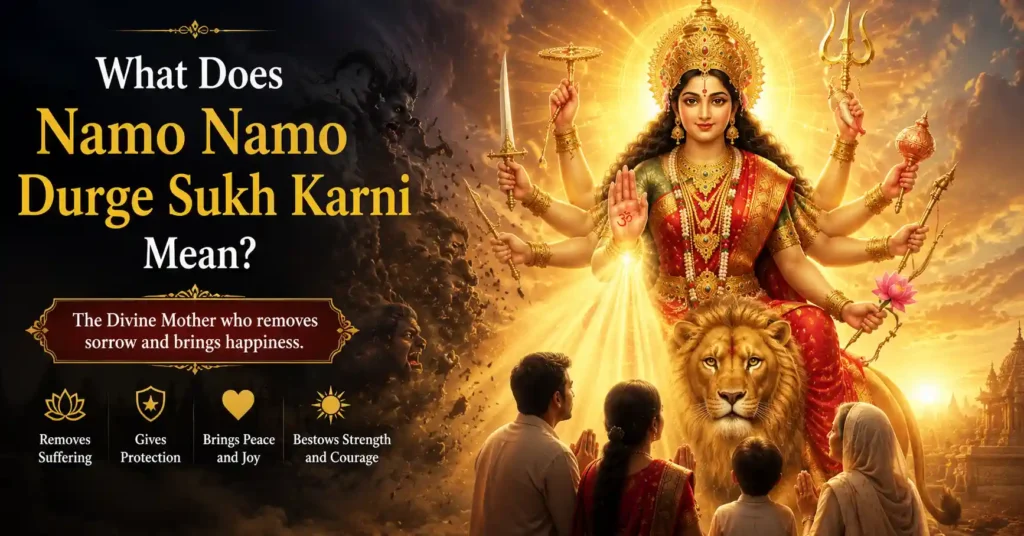
What Does "Namo Namo Durge Sukh Karni" Mean?
Among all the verses of the Durga Chalisa, “Namo Namo Durge Sukh Karni, Namo Namo Ambe Dukh Harni” is one of the most popular and widely recited lines. It beautifully captures the devotee’s love, faith, and surrender to Maa Durga.
Literal Meaning
Namo Namo Durge Sukh Karni
“I bow again and again to Maa Durga, the giver of happiness and well-being.”
Namo Namo Ambe Dukh Harni
“I bow again and again to Mother Amba, who removes sorrow, suffering, and difficulties.”
Together, these lines express gratitude toward the Divine Mother for her blessings, protection, and compassion.
Symbolic Meaning
At a deeper level, this verse teaches that Maa Durga is not only a goddess who removes external problems but also the divine force that helps overcome inner struggles such as:
Fear
Anxiety
Negativity
Ignorance
Attachment
Lack of self-confidence
The verse reminds devotees that true happiness comes from connecting with divine wisdom and inner strength.
Spiritual Interpretation
In the Durga Chalisa, Maa Durga represents the universal Shakti or Divine Energy that sustains and protects creation.
By repeatedly chanting this verse, devotees acknowledge:
Their dependence on divine grace
The power of faith during difficult times
The importance of surrendering ego to the Divine Mother
The presence of divine protection in everyday life
Practical Relevance in Daily Life
This famous verse remains relevant even today.
When facing challenges, uncertainty, stress, or emotional struggles, devotees often chant these lines to seek courage and reassurance from Maa Durga.
The message is simple yet powerful:
Remember the Divine during difficult times.
Trust that challenges can be overcome.
Develop inner strength through devotion.
Face life with faith rather than fear.
For many devotees, this verse serves as a daily reminder that Maa Durga is both a loving mother and a powerful protector who guides her children through every stage of life.
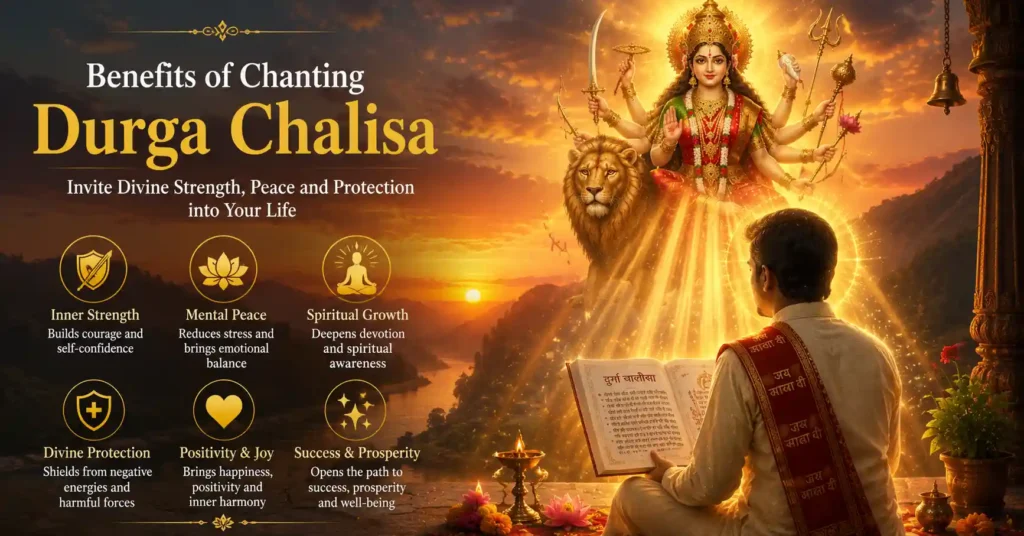
Benefits of Chanting Durga Chalisa
The Durga Chalisa is one of the most beloved devotional hymns dedicated to Maa Durga. Devotees chant it to seek her blessings, protection, courage, and guidance. While spiritual experiences vary from person to person, the following benefits are traditionally associated with the sincere recitation of the Durga Chalisa.
Spiritual Benefits
Regular chanting of the Durga Chalisa helps deepen devotion toward Maa Durga and strengthens one’s connection with the Divine Mother.
It encourages faith, surrender, and spiritual discipline while reminding devotees of the power of Shakti in their lives.
Many devotees believe that reciting the Durga Chalisa with devotion helps create a stronger spiritual foundation and inspires righteous living.
Mental Benefits
The rhythmic recitation of the Durga Chalisa can help calm the mind and improve concentration.
Many people find that daily chanting provides a sense of mental clarity and helps reduce distractions during prayer and meditation.
The focus required during recitation can also encourage mindfulness and inner awareness.
Emotional Benefits
The verses of the Durga Chalisa are filled with prayers for protection, strength, and divine support.
During challenging times, devotees often find comfort and reassurance in remembering Maa Durga’s compassionate presence.
Regular chanting may help cultivate emotional resilience, hope, and a positive outlook.
Traditional Benefits
According to Hindu tradition, the Durga Chalisa is believed to invoke the blessings of Maa Durga for protection from obstacles and negative influences.
Many devotees recite it during Navratri, Fridays, Tuesdays, and other auspicious occasions dedicated to the Divine Mother.
Traditional belief also associates the Durga Chalisa with courage, determination, and victory over difficulties.
Devotional Benefits
Reciting the Durga Chalisa allows devotees to reflect on the various forms and qualities of Maa Durga.
It nurtures gratitude, humility, and love for the Divine Mother while encouraging regular prayer and remembrance.
For many devotees, the Durga Chalisa becomes a daily expression of faith and devotion that strengthens their spiritual journey.
Key Takeaway
The greatest benefit of chanting the Durga Chalisa is developing a closer relationship with Maa Durga. Beyond any traditional beliefs, its verses inspire courage, devotion, self-discipline, and trust in divine guidance, helping devotees face life’s challenges with greater faith and inner strength.
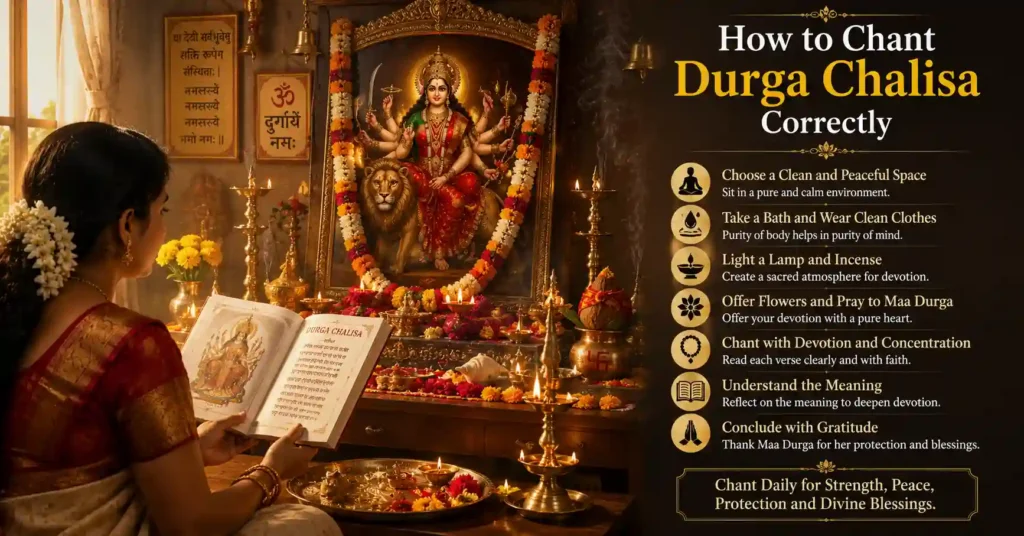
How to Chant Durga Chalisa Correctly
The Durga Chalisa can be recited by anyone with faith and devotion. While there are no strict requirements for sincere prayer, Hindu tradition recommends certain practices that can help make the chanting experience more focused and meaningful.
Best Time to Chant Durga Chalisa
Many devotees recite the Durga Chalisa during the early morning hours after bathing and completing daily prayers.
It is also commonly chanted:
During Navratri
On Tuesdays
On Fridays
During Durga Puja
Before beginning important tasks
During times of difficulty or uncertainty
However, Maa Durga can be remembered at any time with a sincere heart.
Preparations Before Chanting
Before reciting the Durga Chalisa, devotees traditionally:
Take a bath or wash their hands and face
Wear clean clothes
Sit in a peaceful place
Light a diya or incense if possible
Place an image or murti of Maa Durga nearby
These preparations help create a devotional atmosphere and improve concentration.
Traditional Method of Recitation
Many devotees begin by offering prayers to Lord Ganesha and then invoking Maa Durga.
The Durga Chalisa is usually chanted slowly and clearly so that each verse can be understood and appreciated.
Some devotees also recite:
Durga Aarti
Durga Kavach
Argala Stotra
Devi Mahatmyam passages
along with the Durga Chalisa during special worship.
Chanting Rules and Guidelines
While chanting the Durga Chalisa, it is traditionally recommended to:
Maintain a respectful attitude
Pronounce the verses carefully
Focus on the meaning of the words
Avoid unnecessary distractions
Chant with devotion rather than haste
The quality of devotion is considered more important than the speed of recitation.
Can Beginners Chant Durga Chalisa?
Yes. The Durga Chalisa is suitable for beginners as well as experienced devotees.
Even if someone cannot pronounce every word perfectly at first, sincere effort and devotion are valued in the bhakti tradition.
Reading the English pronunciation and understanding the meaning can gradually improve both confidence and connection with the prayer.
Why Understanding the Meaning Matters
Reciting the Durga Chalisa with understanding can make the experience more meaningful.
When devotees know the significance of Maa Durga’s forms, virtues, and teachings, the verses become more than a prayer. They become a source of inspiration, courage, wisdom, and spiritual growth.
For this reason, many devotees choose to study the meaning of the Durga Chalisa alongside their daily recitation practice.
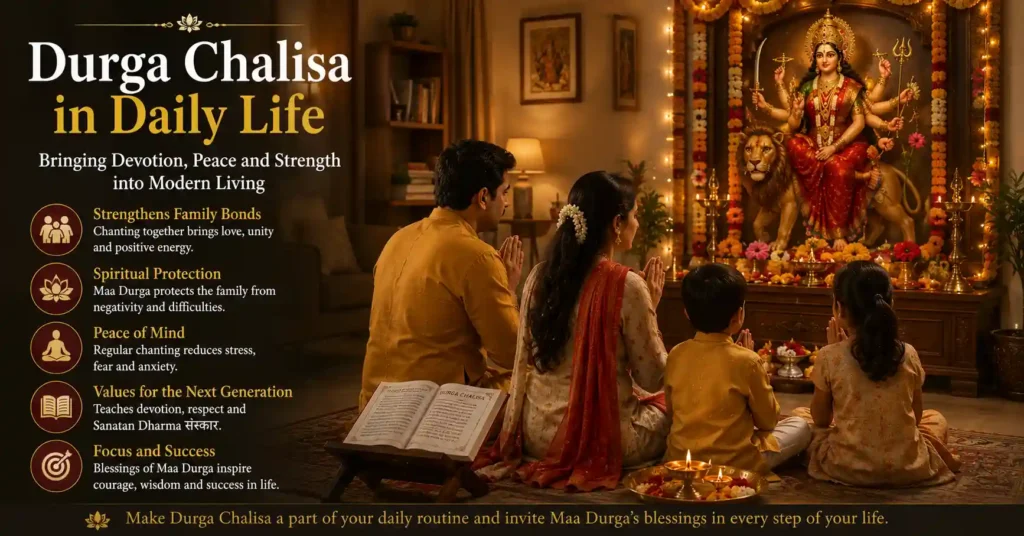
Durga Chalisa in Daily Life
The Durga Chalisa is not only a devotional hymn recited during worship but also a source of practical wisdom for everyday living. Its verses remind devotees of courage, faith, self-discipline, and the power of divine grace in overcoming life’s challenges.
Finding Strength During Difficult Times
Many verses of the Durga Chalisa describe Maa Durga as the remover of obstacles and protector of devotees.
These teachings encourage people to face difficulties with courage, patience, and trust rather than fear and despair.
Overcoming Fear and Negativity
Maa Durga’s victory over demons symbolizes the triumph of good over evil.
In daily life, these demons can represent:
Fear
Anger
Ego
Greed
Jealousy
Negative thinking
The Durga Chalisa inspires devotees to overcome these inner obstacles and develop a stronger character.
Developing Faith and Confidence
The repeated prayers and praises found in the Durga Chalisa help cultivate faith in divine guidance.
Many devotees find that regular recitation increases their confidence and helps them remain calm during uncertain situations.
Learning the Value of Devotion
The Durga Chalisa teaches that sincere devotion is not limited to rituals alone.
True devotion also includes:
Compassion
Humility
Gratitude
Honesty
Service to others
These values help strengthen both spiritual and personal growth.
Staying Connected to Dharma
Many verses highlight Maa Durga’s role in protecting righteousness and defeating injustice.
This reminds devotees to make ethical decisions, perform their duties sincerely, and uphold dharmic values in everyday life.
Finding Inner Peace
Regular recitation of the Durga Chalisa can become a daily moment of reflection and prayer.
For many devotees, it provides a sense of peace, emotional balance, and spiritual comfort amid the demands of modern life.
The Modern Relevance of Durga Chalisa
Even today, the message of the Durga Chalisa remains timeless.
Its teachings encourage devotees to:
Remain strong during challenges
Trust in divine guidance
Develop positive qualities
Act with courage and integrity
Grow spiritually while fulfilling worldly responsibilities
In this way, the Durga Chalisa serves as both a devotional prayer and a practical guide for living with faith, strength, and purpose.
Did You Know? Interesting Facts About Durga Chalisa
- The Durga Chalisa is a devotional hymn consisting of 40 verses (Chalisa means “forty”), dedicated to Maa Durga and her various divine forms.
- The hymn praises Maa Durga as the supreme Shakti, the divine feminine energy that sustains, protects, and guides the universe.
- Several verses of the Durga Chalisa mention different manifestations of the Divine Mother, including Annapurna, Lakshmi, Saraswati, Bhavani, Kali, Tara, Matangi, Dhumavati, Bhuvaneshwari, and Baglamukhi.
- The Durga Chalisa recalls famous stories from Hindu tradition, including Maa Durga’s victories over Mahishasura, Shumbha, Nishumbha, and Raktabeeja.
- Many devotees recite the Durga Chalisa daily, while others chant it during Navratri, Durga Puja, Tuesdays, Fridays, and other auspicious occasions dedicated to the Divine Mother.
- The famous opening line, “Namo Namo Durge Sukh Karni, Namo Namo Ambe Dukh Harni,” is one of the most widely recognized and recited verses of the Durga Chalisa.
- The hymn emphasizes both the compassionate and protective aspects of Maa Durga, portraying her as a loving mother for devotees and a powerful destroyer of evil.
- Several verses highlight the importance of Shakti, teaching that divine energy plays a central role in creation, preservation, and spiritual transformation.
- The Durga Chalisa is often recited alongside other Devi-related texts such as Durga Aarti, Durga Kavach, Argala Stotra, and selections from the Devi Mahatmyam (Durga Saptashati).
- Beyond prayers for protection and blessings, the Durga Chalisa teaches timeless values such as courage, devotion, self-discipline, faith, humility, and dedication to dharma.
- Many devotees believe that understanding the meaning of the Durga Chalisa can make its recitation more powerful by creating a deeper connection with Maa Durga’s teachings and symbolism.
- The recurring theme throughout the Durga Chalisa is that sincere devotion, faith, and surrender to the Divine Mother can help devotees navigate life’s challenges with strength and confidence.
Conclusion
The Durga Chalisa is a powerful devotional hymn that glorifies the many forms, qualities, and divine acts of Maa Durga. Through its verses, devotees learn about her compassion, protective nature, supreme Shakti, and unwavering support for those who walk the path of dharma.
Understanding the meaning of the Durga Chalisa helps transform its recitation from a routine prayer into a deeper spiritual experience. Each verse offers valuable lessons about faith, courage, devotion, humility, and inner strength.
Whether chanted daily, during Navratri, or in times of difficulty, the Durga Chalisa continues to inspire millions of devotees to seek Maa Durga’s blessings and guidance. Its timeless message reminds us that sincere devotion, righteous actions, and trust in the Divine Mother can help us overcome challenges and progress on our spiritual journey.
May Maa Durga bless you with wisdom, courage, protection, and devotion as you recite and reflect upon the sacred verses of the Durga Chalisa.
Suggested Reading
The Durga Chalisa is one of the most widely recited devotional hymns dedicated to Maa Durga. It is often chanted alongside other prayers, mantras, and sacred texts associated with Devi worship.
Exploring related scriptures can help devotees develop a deeper understanding of the Durga Chalisa, the concept of Shakti, Navratri traditions, and the spiritual teachings of Sanatan Dharma.
Argala Stotram Lyrics with Meaning and Spiritual Significance
https://thesanatantales.com/argala-stotram-lyrics-meaning/
Devi Kavach Meaning: Durga Saptashati Protection Prayer
https://thesanatantales.com/devi-kavach-meaning/
Durga Beej Mantra: Simple Meaning, Benefits and How to Chant
https://thesanatantales.com/durga-beej-mantra-meaning/
What Is Durga Saptashati? Meaning, Story and Why It Is Read in Navratri
https://thesanatantales.com/durga-saptashati-meaning-navratri/
Navarna Mantra Meaning, Benefits, Chanting Rules and How to Chant
https://thesanatantales.com/navarna-mantra/
Aarti of Maa Ambe: Lyrics, Meaning, Benefits and How to Perform
https://thesanatantales.com/aarti-of-maa-ambe/
Siddha Kunjika Stotram: The Sacred Key That Unlocks the Full Power of Durga Saptashati
https://thesanatantales.com/siddha-kunjika-stotram/
Gayatri Mantra: 7 Divine Benefits and Spiritual Power
https://thesanatantales.com/gayatri-mantra-meaning-benefits/
Durga Chalisa
https://en.wikipedia.org/wiki/Durga_Chalisa
FAQs
1. What is the Durga Chalisa and why is it important?
The Durga Chalisa is a devotional hymn of forty verses dedicated to Maa Durga, the Divine Mother and embodiment of Shakti. The hymn praises her various forms, divine qualities, and victories over negative forces such as Mahishasura, Shumbha, Nishumbha, and Raktabeeja.
The importance of the Durga Chalisa lies in its ability to make devotion accessible to everyone. Through simple yet powerful verses, it helps devotees remember Maa Durga’s protection, compassion, and strength while deepening their connection with Sanatan Dharma and the path of bhakti.
2. What are the benefits of chanting Durga Chalisa daily?
Devotees traditionally believe that regular recitation of the Durga Chalisa helps cultivate faith, courage, inner strength, and devotion toward Maa Durga. The verses inspire positive thinking and remind devotees that divine guidance is always available during difficult times.
Many people also find that daily chanting creates a sense of mental calmness and emotional balance. While spiritual experiences differ from person to person, the Durga Chalisa is widely regarded as a prayer that supports both spiritual growth and personal resilience when recited with sincerity and devotion.
3. When is the best time to chant Durga Chalisa?
The Durga Chalisa can be recited at any time, but many devotees prefer chanting it during the early morning after bathing and completing daily prayers. Evening recitation is also common, especially during family worship or devotional gatherings.
The hymn is especially popular during Navratri, Durga Puja, Fridays, Tuesdays, Ashtami, and Navami. However, the most important factor is devotion and consistency. Even a single sincere recitation of the Durga Chalisa can become a meaningful part of one’s daily spiritual practice
4. Can beginners chant the Durga Chalisa?
Yes, the Durga Chalisa is considered one of the most beginner-friendly devotional hymns in Hindu tradition. Its language is easier to understand than many classical Sanskrit stotras, making it accessible to devotees of all ages and backgrounds.
Beginners can start by reading the English pronunciation and understanding the meaning of each verse. Over time, familiarity with the text naturally improves pronunciation and confidence. In the bhakti tradition, sincere devotion is considered more important than perfect recitation.
5. Is it necessary to understand the meaning of the Durga Chalisa before chanting?
While it is not mandatory to understand every verse before reciting the Durga Chalisa, knowing its meaning can greatly enrich the experience. Understanding the symbolism, stories, and teachings helps devotees connect more deeply with Maa Durga’s message.
When devotees understand the verses, the Durga Chalisa becomes more than a prayer. It becomes a source of guidance, inspiration, and spiritual reflection. This is why many teachers encourage studying both the lyrics and the meaning alongside regular chanting.
6. What is the connection between Durga Chalisa and Navratri?
The Durga Chalisa is closely associated with Navratri, the nine-night festival dedicated to the worship of Maa Durga and her nine forms known as Navadurga. During this period, millions of devotees recite the hymn as part of their daily prayers and devotional practices.
Many households chant the Durga Chalisa along with Durga Aarti, Durga Saptashati, Devi Kavach, and other sacred Devi texts. The hymn serves as a simple yet powerful way to honor the Divine Mother throughout the festival.
7. Who composed the Durga Chalisa?
The Durga Chalisa is traditionally attributed to a devotee named Devidas. This attribution is supported by the concluding verse, where the name “Devidas” appears in a prayer seeking the blessings of Maa Durga.
Although detailed historical information about Devidas is limited, the hymn has become one of the most widely recited devotional compositions dedicated to the Divine Mother. Its enduring popularity reflects the deep devotional connection that generations of devotees have felt toward Maa Durga.
8. What does the Durga Chalisa teach devotees?
The Durga Chalisa teaches many important spiritual values, including faith, courage, devotion, humility, gratitude, and perseverance. Through stories of Maa Durga’s victories over powerful demons, the hymn reminds devotees that righteousness ultimately triumphs over negativity and ignorance.
The deeper message of the Durga Chalisa is that divine strength exists within every individual. By remembering Maa Durga and following dharmic principles, devotees are encouraged to face life’s challenges with confidence, wisdom, and devotion.
9. What is the difference between Durga Chalisa and Durga Kavach?
The Durga Chalisa is a forty-verse devotional hymn that praises Maa Durga, her forms, divine qualities, and heroic deeds. It is primarily a prayer of devotion and remembrance that helps devotees connect with the Divine Mother through praise and worship.
The Durga Kavach, on the other hand, is a protective prayer found within the Durga Saptashati tradition. It invokes the protection of different forms of the Goddess over various parts of the body and life. Many devotees recite both texts together during Devi worship and Navratri observances.
10. Can the Durga Chalisa be recited every day?
Yes, the Durga Chalisa can be recited daily. Many devotees include it in their morning or evening prayer routine as a simple way to remember Maa Durga and seek her blessings. Daily recitation is a long-standing practice in many Hindu households.
Consistency is generally considered more valuable than the number of repetitions. Even a single daily recitation performed with devotion, concentration, and understanding can help strengthen one’s spiritual practice and foster a deeper connection with the Divine Mother.
Share Your Devotion
Have you ever recited the Durga Chalisa during Navratri, Durga Puja, or your daily prayers? Which verse of the Durga Chalisa inspires you the most, and what does it mean to you personally?
Many devotees turn to the Durga Chalisa for strength during difficult times, while others recite it as an expression of gratitude, faith, and devotion to Maa Durga. Every devotee’s spiritual journey is unique, and sharing experiences can inspire and encourage others on the path of bhakti.
Feel free to share:
Your favorite verse from the Durga Chalisa
How you first learned the Durga Chalisa
Your experience of chanting it during Navratri
Lessons or inspiration you have received from Maa Durga
Any family traditions related to Durga Chalisa recitation
May Maa Durga bless all devotees with courage, wisdom, devotion, and divine protection. We look forward to hearing your thoughts and experiences in the comments below.
References & Sources
The Durga Chalisa is a traditional devotional hymn dedicated to Maa Durga and has been recited by devotees for generations. The meanings and interpretations presented in this article are based on traditional Hindu understanding, devotional literature, and commonly accepted explanations within the Shakta tradition.
Primary Sources
Durga Chalisa (Traditional Text)
Devi Mahatmyam (Durga Saptashati / Chandi Path) from the Markandeya Purana
Markandeya Purana
Devi Bhagavata Purana
Traditional Shakta scriptures and devotional literature related to Maa Durga
Secondary Sources
Traditional Sanskrit commentaries and translations
Hindu devotional texts and prayer collections
Sanskrit manuscript repositories and reference works
Scholarly studies on Shaktism and Goddess traditions in Hinduism
Educational resources on Durga worship, Navratri, and Devi literature
Note: The Durga Chalisa has been transmitted through various devotional traditions over centuries. As a result, minor variations in pronunciation, transliteration, translation, and interpretation may exist across different regions, lineages, and published editions.
Readers are encouraged to approach the Durga Chalisa with devotion and an open mind, recognizing that its deeper spiritual significance is often understood through both study and personal practice.
Explore More Topics from The Sanatan Tales