
Maa Baglamukhi is one of the ten Mahavidyas, the great wisdom forms of the Divine Mother. She is worshipped not for comfort, but for control, protection, and victory when life turns hostile.
Devotees approach her during court cases, false accusations, political opposition, black magic attacks, or intense inner disturbance. Her power does not rush into destruction. It stops, freezes, and silences destructive forces at their source.
She is also known as Pitambara Devi, the goddess clothed in yellow. Yellow here is not decoration. It is her living spiritual frequency.
Table of Contents
ToggleMaa Baglamukhi’s place among the Mahavidyas
Maa Baglamukhi is the eighth Mahavidya.
While other Mahavidyas transform through time, destruction, or wisdom, Baglamukhi transforms through stillness. She removes the enemy’s ability to act, speak, or think clearly.
This is why her worship has historically drawn rulers, warriors, judges, tantric sadhaks, and seekers facing severe karmic pressure.
The true meaning of the name Baglamukhi
The word Bagala comes from the Sanskrit root Valga, meaning a bridle used to restrain a horse. Spiritually, it means restraining harmful speech, intention, and will.
Another accepted interpretation links her to the crane, a bird that stands perfectly still before striking. This stillness defines her power.
The classical and scripturally accepted name is Baglamukhi.
Regional pronunciations like Bagala or Bagula exist, but all refer to the same divine principle of stambhana.
Iconography and what her form represents
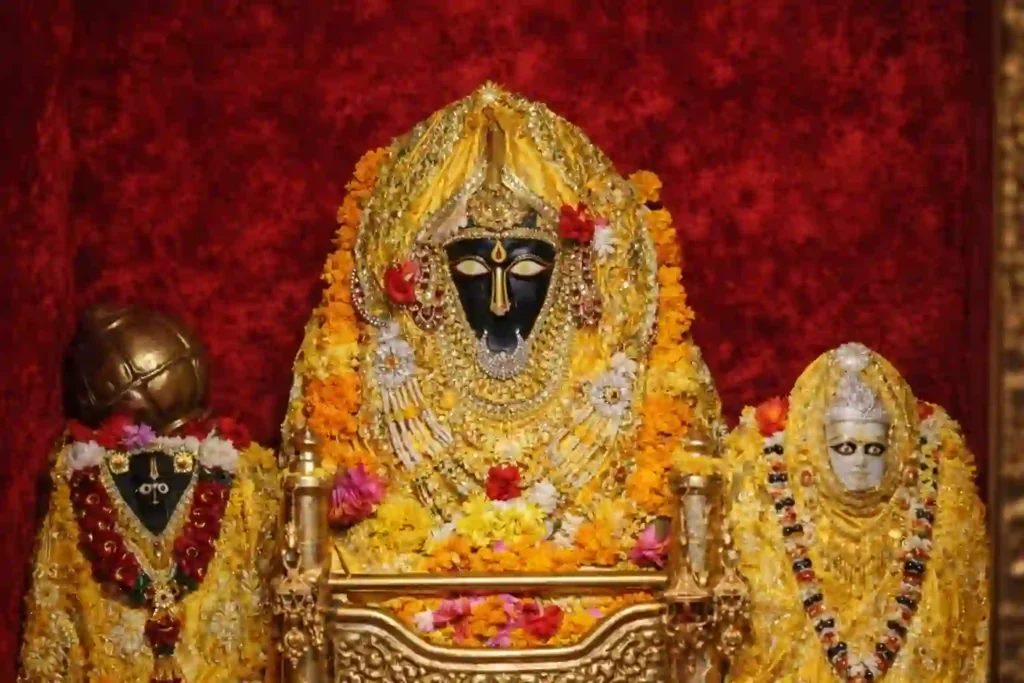
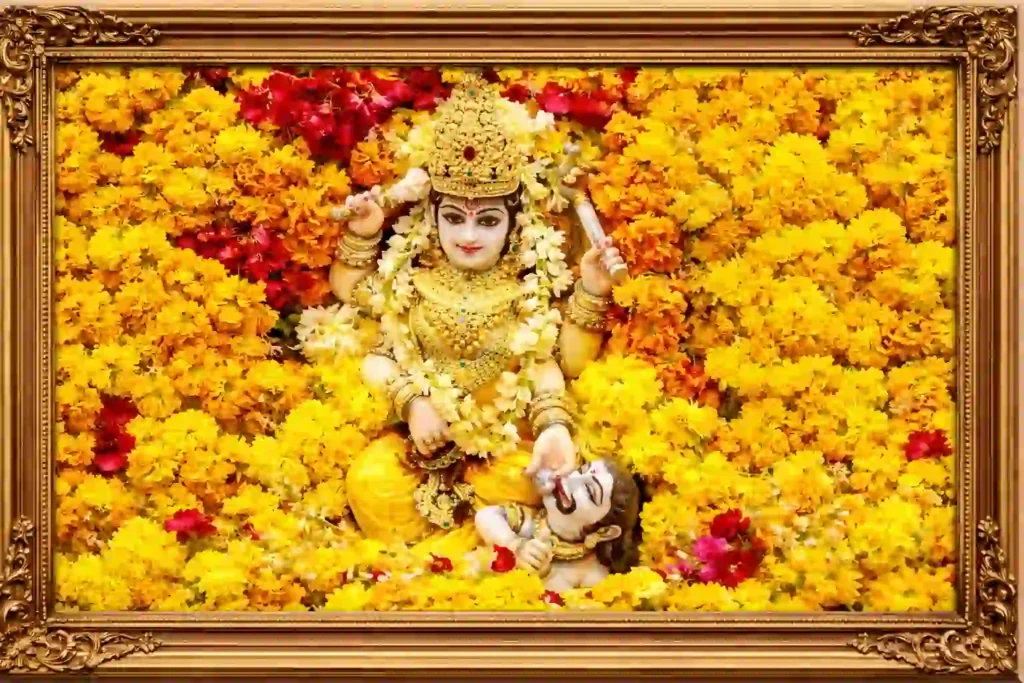
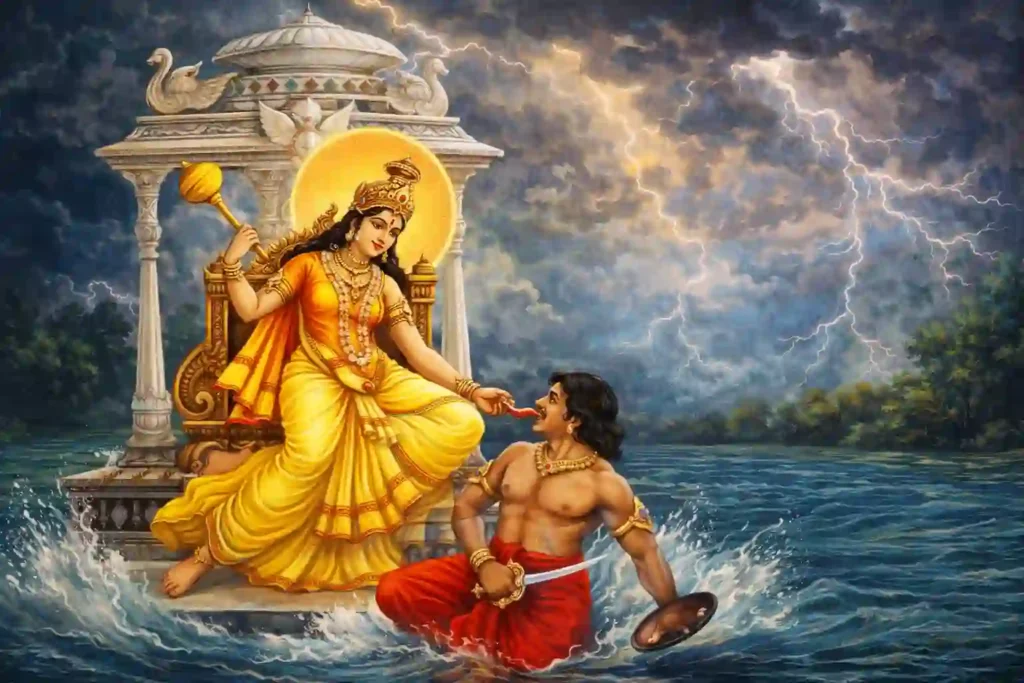
Maa Baglamukhi is shown with a golden yellow complexion, wearing yellow garments.
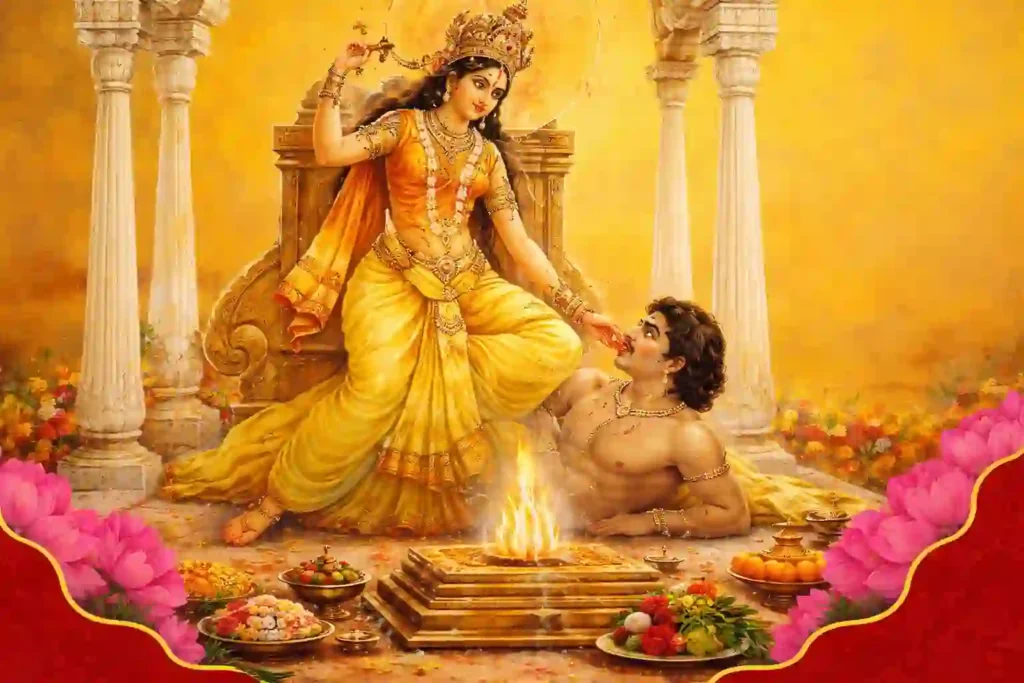
In one hand, she pulls the tongue of the demon Madana.
In the other, she holds a club.
The tongue represents false speech, lies, gossip, propaganda, black magic, and harmful vows.
The club represents decisive restraint.
Her power targets ability, not existence.
Origin from Haridra Sarovar
During the Satya Yuga, a cosmic storm threatened to dissolve creation.
Lord Vishnu performed intense penance on the banks of Haridra Sarovar, the lake of turmeric. From those golden waters emerged Maa Baglamukhi.
The moment she appeared, the storm stopped.
This is why turmeric, haldi, and yellow dominate her worship. Her energy is not chaotic fire. It is controlled, stabilizing force.
The legend of Madanasura and Vak Siddhi
Madanasura received Vak Siddhi, a boon where whatever he spoke became reality. He misused it, creating destruction through speech alone.
Maa Baglamukhi seized his tongue, ending the misuse of power.
Before losing his ability, Madana asked to be worshipped with her forever. This is why some forms show the demon present, not as honor, but as complete restraint of chaos.
Why Maa Baglamukhi is called Brahmastra Roopini
Brahmastra is the ultimate celestial weapon. Once released, it never fails.
Maa Baglamukhi is called Brahmastra Roopini because her energy works the same way. When invoked correctly, its effect becomes irreversible.
This is why her sadhana is never casual.
Connection with Ramayana and Mahabharata traditions
Traditional belief holds that Lord Rama worshipped her to neutralize Ravana’s destructive powers.
Mahabharata traditions state that Lord Krishna advised the Pandavas to invoke her stambhana shakti before the Kurukshetra war.
This belief is strongly connected with Baglamukhi Temple Nalkheda, where Pandava worship is still remembered.
The deeper meaning of Stambhana Shakti
Stambhana is the central power of Maa Baglamukhi.
On the outer level, it stops enemies, false accusations, hostile speech, black magic, and aggressive actions.
On the inner level, it stills the restless mind, ego reactions, uncontrolled anger, fear, and compulsive thinking.
Advanced devotees focus more on inner stambhana, where silence becomes transformation.
Accepted tantric framework of her worship
Maa Baglamukhi is classified as an Ugra Mahavidya.
Her tantric worship is scripturally accepted but highly regulated. It is traditionally performed at night, especially on Amavasya, Tuesdays, and Thursdays.
Silence, celibacy, mental discipline, and sattvic conduct are essential.
This is not folk magic. It is structured tantra passed through guru lineages.
Puja vidhi followed in traditional practice
Baglamukhi puja is exact and disciplined, not decorative.
The devotee wears clean yellow clothes and sits on a yellow cloth, preferably facing north or east.
The altar includes her image or yantra placed on a yellow base.
In some traditions, a turmeric swastika or chana dal mandala is used instead of an idol.
Yellow flowers, bananas, lemons, besan ladoo, turmeric, and yellow rice are common offerings.
A ghee lamp with a turmeric-tinted wick is lit before mantra japa begins.
Mantra japa and sankalpa discipline
Before chanting, the devotee takes a clear sankalpa.
The intention must be specific, calm, and free from rage or revenge.
Mantra japa is done using a haldi mala.
For intensive sadhana, 1.25 lakh repetitions are traditionally prescribed.
Mantra chanting is followed by silent sitting, allowing the energy to settle.
Baglamukhi mool mantra
ॐ ह्रीं बगलामुखी सर्व दुष्टानाम
वाचं मुखं पदं स्तम्भय
जिव्हां कीलय बुद्धिं विनाशय
ह्रीं ॐ स्वाहा ||
Havan rituals and their real purpose
Baglamukhi worship often includes homa, which anchors the mantra energy.
Haldi havan is performed for protection, peace, and clarity.
Yellow mustard seed havan is used to silence opposition, false speech, and legal obstruction.
Mirchi havan is reserved for extreme situations such as black magic, violent hostility, or severe planetary affliction.
It is never performed casually.
Major temples and living peethas
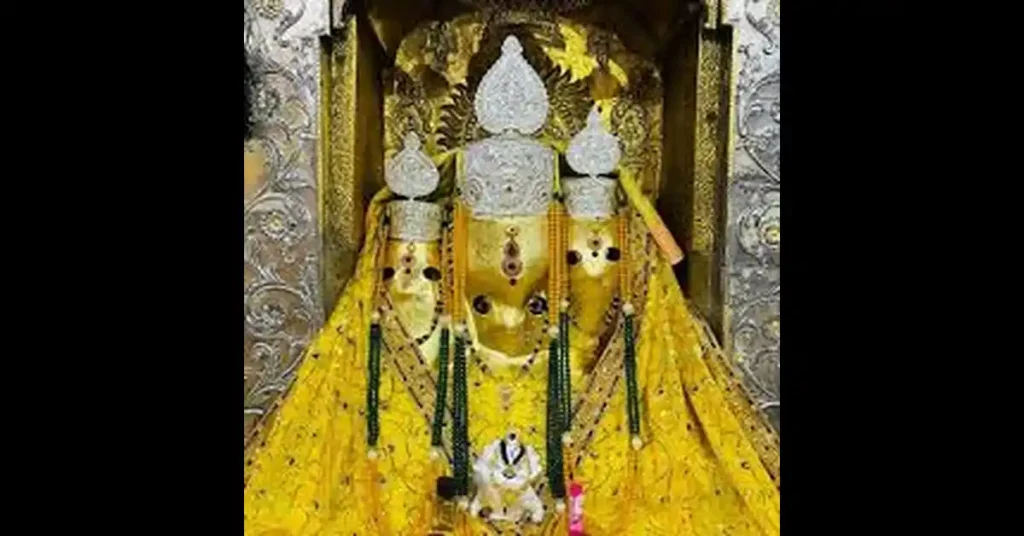
Pitambara Peeth Datia
A powerful peetha widely visited for legal and political protection.
Baglamukhi Temple Nalkheda
Known for intense tantric worship near a cremation ground.
Baglamukhi Temple Bankhandi
Associated with Pandava worship and midnight havans.
Kamakhya Temple
A major tantric center where Baglamukhi is worshipped among the Mahavidyas.
Planetary associations in Baglamukhi tradition
Some tantric and jyotish traditions associate Maa Baglamukhi with Mars and Saturn.
Mars represents force and confrontation, while Saturn represents restraint and control. Her energy does not destroy like Mars alone, nor delay like Saturn alone. Instead, it halts hostile momentum and neutralizes aggression with discipline and stillness.
This association is symbolic rather than a strict astrological rule, but it explains why her worship is often chosen during severe conflicts, court battles, and karmic pressure.
Vahana ambiguity in Baglamukhi worship
Unlike Maa Durga or Maa Kali, Maa Baglamukhi does not have a universally accepted vahana.
Some regional depictions show a lion or crane symbolism, while others show no vahana at all. This absence itself is meaningful. Her power does not move outward through speed or attack. It works through immobilization and restraint, making a vehicle unnecessary.
Different temples follow different iconographic traditions, and none cancel the other.
Baglamukhi yantra and home placement
The yantra is placed in the north-east or near the entrance of the home.
Daily lamp lighting and 108 mantra chants energize it.
It is used for protection, clarity, and steady decision-making.
Esoteric view of her spiritual power
On a higher spiritual level, Maa Baglamukhi represents complete stillness of consciousness.
She halts mental waves and suspends ego-driven reactions.
In yogic terms, her energy supports the cessation of vrittis, allowing awareness to rest in silence.
This is why advanced yogis respect her deeply, even when they do not worship her outwardly.
Internal enemies and higher sadhana focus
While popular belief focuses on external enemies, higher sadhana works inward.
Lust, anger, greed, fear, and ego are the real adversaries.
Baglamukhi’s energy freezes these tendencies, not by suppression, but by removing their momentum.
This inner victory is considered superior to worldly success.
Who should not do Baglamukhi sadhana
Baglamukhi sadhana is not for everyone, especially in its advanced tantric form.
Those who approach her worship with anger, revenge, ego, or harmful intent are traditionally advised to refrain. Her energy amplifies intent, and misuse can lead to mental disturbance, fear, or instability.
Beginners and emotionally fragile individuals should stick to simple mantra japa, prayer, and temple worship, and avoid intense rituals unless guided by a qualified guru.
This caution is part of responsible tradition, not fear.
Why serious devotees approach Maa Baglamukhi
She is not a comfort goddess.
She is a shield and a weapon combined.
Those who approach her with surrender are protected.
Those who approach her with ego are tested.
Suggested Reading
To deepen your understanding, explore our detailed guides on Das Mahavidyas,
Maa Kaali, Maa Tara, Maa Chhinnamasta, Maa Bhairavi, and Shakti Peethas of India on thesanatantales.com.
FAQs
What is Maa Baglamukhi famous for?
Maa Baglamukhi is famous for her power of stambhana, the ability to stop, silence, and control negative forces, enemies, and harmful situations.
Are Maa Durga and Maa Baglamukhi the same?
No, they are not the same. Maa Baglamukhi is a Mahavidya form of Shakti, while Maa Durga is a cosmic warrior form, though both arise from the same Divine Mother.
Which part of Mata Sati fell in Baglamukhi?
Maa Baglamukhi is not directly associated with a Shakti Peetha of Sati’s body parts. Her worship comes from Mahavidya and tantric traditions, not the Shakti Peetha list.
How to make Maa Baglamukhi happy?
She is pleased through discipline, purity of intent, yellow offerings, sincere mantra japa, silence, and respectful worship without ego or revenge.
Which planet does Maa Baglamukhi control?
Some traditions associate her energy with Mars and Saturn, symbolizing force and restraint, though this link is symbolic rather than strict astrology.
What is the favourite colour of Maa Baglamukhi?
Yellow is the favourite colour of Maa Baglamukhi, representing stillness, control, purity, and her Pitambara form.
Which temple of Maa Baglamukhi is most powerful?
Shri Pitambara Peeth in Datia and the Baglamukhi Temple at Nalkheda are considered among the most powerful centers of her worship.
What are the rules for Baglamukhi?
Worship should be sattvic, disciplined, and calm, with yellow offerings, mantra purity, mental restraint, and guru guidance for advanced sadhana.
How to connect with Maa Baglamukhi?
One can connect through regular mantra japa, yellow-based worship, inner silence, surrender, and visiting her temples with humility.
What problems can Baglamukhi Kavach solve?
Baglamukhi Kavach is believed to protect against black magic, false accusations, legal trouble, sudden fear, and harmful negative influences.