
There are days when the mind feels unusually heavy. Nothing major may have happened, yet small things seem to affect us more than usual. A casual comment stays in our thoughts, a delay creates irritation, or a disagreement keeps replaying in the mind long after it is over.
During such moments, many people search for ways to find inner peace and wonder how to stay calm when life feels overwhelming.
We often believe calmness will come once our problems disappear. Yet life never becomes completely free from challenges. There will always be uncertainties, unexpected situations, and moments that test our patience.
Real calmness begins when we stop waiting for the world to become perfect and start understanding our own responses to it. Through self-awareness, emotional balance, healthy habits, and spiritual wisdom, anyone can learn how to stay calm in every situation and develop lasting peace of mind.
Table of Contents
ToggleWhat Does It Really Mean to Stay Calm?
Many people think calmness means having no problems. But that is not what inner peace is.
Even calm people face stress, disappointment, criticism, uncertainty, and difficult situations. The difference is that they do not allow every situation to take control of their thoughts, emotions, and actions.
Learning how to stay calm is not about suppressing feelings or pretending nothing affects you. It is about creating a small space between what happens and how you respond. In that space, awareness replaces impulse and understanding replaces reaction.
When something upsetting happens, anger wants to speak, fear wants to imagine the worst, and frustration wants to take over. Calmness gives us the ability to pause, observe what is happening within, and respond more wisely.
Over time, this creates emotional balance and mental peace. Challenges may still come and go, but they no longer shake us in the same way. Calmness is not weakness. It is a quiet form of inner strength.
Why Staying Calm Is Difficult for the Human Mind
If staying calm is so valuable, why do so many of us struggle with it?
The human mind is naturally designed to notice problems. Long ago, this helped people survive danger. Today, the same tendency often creates unnecessary stress.
A delayed message can make the mind imagine the worst. A disagreement can replay in our thoughts for hours. A small mistake can become a source of self-criticism.
Instead of staying in the present moment, the mind often moves between memories of the past and worries about the future. This constant movement slowly pulls us away from inner peace and makes it harder to stay calm during difficult situations.
What Happens in the Brain During Stress and Anger?
Have you ever noticed how quickly the body changes when you feel angry, anxious, or overwhelmed?
The heart beats faster, muscles tighten, and the mind begins racing. This happens because the brain is trying to protect you.
When we feel threatened or emotionally overwhelmed, the body activates what scientists call the fight-or-flight response. Stress hormones prepare us to react quickly. While this response is useful during real danger, it can also be triggered by everyday situations such as workplace pressure, family conflicts, financial worries, or criticism.
Common signs include:
- Faster breathing
- Increased heart rate
- Tightness in the body
- Racing thoughts
- Strong emotional reactions
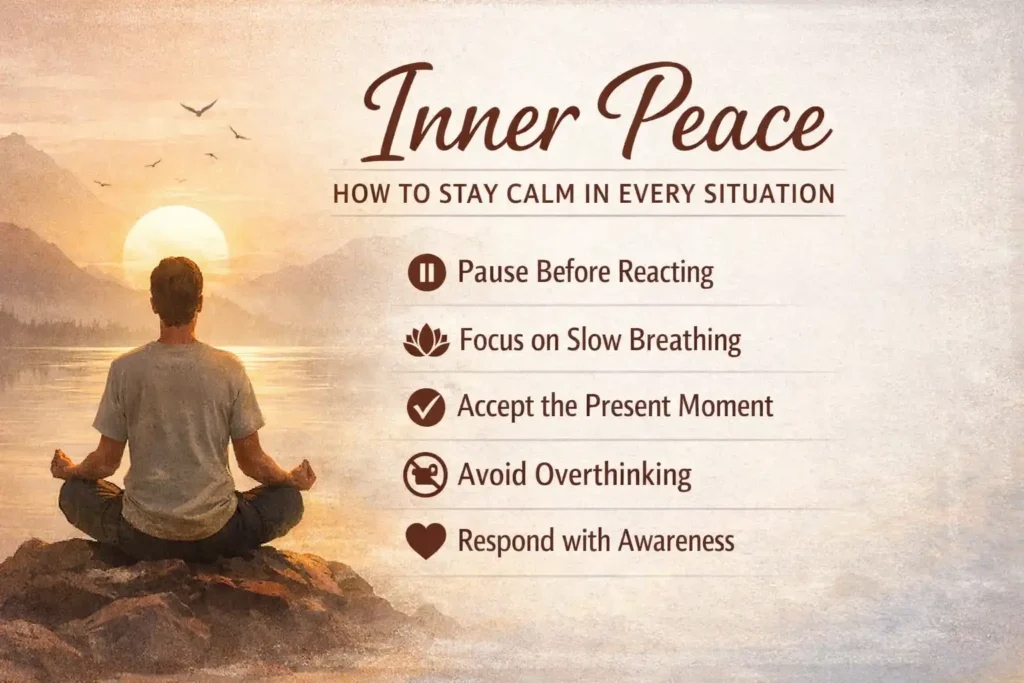
Learning how to stay calm does not mean stopping emotions from arising. It means becoming aware of them before they take control. The moment awareness enters, a small space appears between the trigger and the reaction. That space is where emotional balance and self-control begin.
Signs That You Are Losing Inner Peace
Inner peace is rarely lost all at once.
More often, it slips away through small reactions that build up throughout the day. A little frustration here, a little worry there, and before long the mind feels heavy and unsettled.
Some common signs include:
- Constant overthinking
- Feeling irritated more easily than usual
- Mental exhaustion even after resting
- Difficulty focusing
- Becoming defensive during conversations
- Worrying about things beyond your control
- Reacting impulsively
- Feeling restless even during moments of silence
Recognizing these signs early helps you return to emotional balance before stress becomes overwhelming.
The Role of Thoughts in Inner Peace
One of the most important things we discover on the journey toward inner peace is that not every thought deserves our attention.
The mind is constantly active. Some thoughts help us solve problems and make decisions. Others are simply worries, fears, assumptions, and stories created by the mind itself.
The trouble begins when we believe every thought that appears. A small concern can grow into hours of overthinking. A simple mistake can stay in the mind all day.
Learning how to stay calm does not mean stopping thoughts. It means learning to observe them without getting pulled into each one. Over time, we begin to see that thoughts are like clouds passing through the sky. They come and go naturally, and we do not have to chase every one of them.
As this awareness grows, the mind becomes lighter and a deeper sense of peace of mind begins to emerge.
Most thoughts pull us toward the past or the future. Inner peace grows when we gently bring our attention back to the present moment. The more present we become, the less power unnecessary worries tend to have over us.
Calming the Body to Calm the Mind
Many people try to calm the mind directly, but sometimes the easiest path to inner peace begins with the body.
When we feel stressed, breathing becomes shallow, the shoulders tighten, and the body feels restless. The mind and body are closely connected, so when one becomes disturbed, the other often follows.
This is why something as simple as taking a slow breath can help. A few moments of conscious breathing signal to the nervous system that there is no immediate danger. Gradually, the body relaxes, and the mind follows.
A quiet walk, gentle stretching, sitting peacefully for a few minutes, or simply paying attention to your breath can create a noticeable shift. Sometimes calming the body first is the quickest way to restore emotional balance and mental peace.
How to Stay Calm During Arguments and Conflicts
Few things test our inner peace as quickly as conflict.
When someone misunderstands us, criticizes us, or says something hurtful, the natural reaction is often immediate. We want to defend ourselves, prove our point, or respond with equal intensity.
Yet many arguments become bigger because both people react without truly listening.
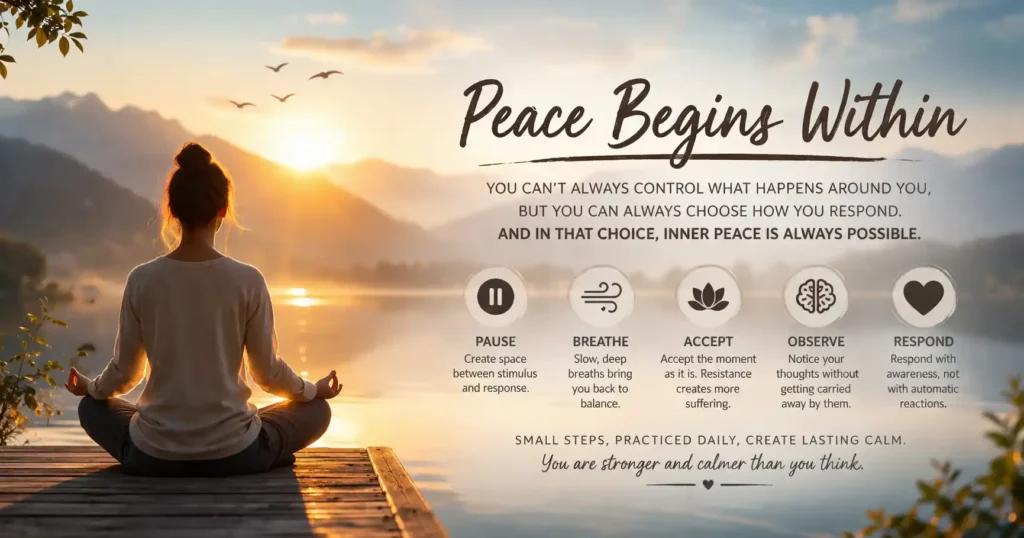
The next time you find yourself in a difficult conversation, pause before speaking. Listen fully, take a breath, and allow the first wave of emotion to settle before choosing your words.
Remaining calm does not mean staying silent or agreeing with everything. It simply means responding with awareness instead of reacting from anger. Often, that small difference is enough to prevent unnecessary pain and misunderstanding.
How to Stay Calm Under Pressure
Modern life can sometimes feel like a constant race. Responsibilities keep growing, expectations increase, and some days everything seems to demand attention at once.
During such moments, the mind often tries to solve every problem at the same time. That is when pressure begins to feel overwhelming.
A helpful reminder is that you do not need to solve your entire future today. You only need to focus on the next step in front of you.
When the mind starts running in different directions, gently bring it back and ask yourself, “What is the most useful thing I can do right now?”
This simple shift creates clarity and helps you stay calm under pressure by focusing on what can actually be done in the present moment.
How to Stay Calm When Life Feels Unfair
There are moments when life simply does not seem fair.
Good people face difficulties. Honest efforts do not always bring immediate results. Unexpected losses arrive without warning. Sometimes we do everything we believe is right and still face challenges.
During such times, frustration can easily take away our peace.
Acceptance becomes important here. Acceptance does not mean liking what happened or giving up. It simply means acknowledging reality before deciding how to move forward.
Much of our suffering comes from arguing with what has already happened. The mind keeps saying, “This should not have happened,” while reality quietly says, “But it did.”
When acceptance begins, resistance softens. And as resistance softens, emotional resilience grows, allowing us to face difficulties with greater strength and clarity.
A Spiritual Perspective on Inner Peace
Sanatan Dharma offers a gentle but profound understanding of peace.
It reminds us that lasting peace cannot be found only through external achievements. Success, recognition, possessions, and accomplishments may bring happiness for a while, but their effect is often temporary.
Real inner peace grows when we develop a deeper connection with ourselves and with the Divine. It comes from remembering that our worth is not determined by every success or failure that life brings.
For some people, this connection comes through prayer. For others, it comes through chanting, meditation, seva, or simply sitting quietly in remembrance of Krishna.
These simple practices create a spiritual anchor. They help us remain steady when life feels uncertain and remind us that we are supported by something greater than our temporary struggles.
Bhagavad Gita's Wisdom on Staying Calm
When we look for guidance on how to stay calm, few texts offer as much wisdom as the Bhagavad Gita.
One of its most powerful teachings is to focus on action rather than becoming consumed by results. Much of our stress comes from trying to control outcomes that are never fully in our hands.
Krishna encourages Arjuna to perform his duty sincerely while letting go of excessive attachment to success or failure. This does not mean becoming careless. It means giving your best effort without being trapped by constant anxiety about what may happen next.
When we begin to practice this teaching, the mind becomes lighter, decisions become clearer, and a deeper sense of inner peace starts to emerge. Even today, this wisdom remains deeply relevant for anyone seeking emotional balance and peace of mind.
Sthitaprajna: The Ideal of Inner Stability
The Bhagavad Gita describes a beautiful ideal known as the Sthitaprajna, a person whose wisdom remains steady regardless of circumstances.
Such a person experiences success and failure, praise and criticism, happiness and sorrow, yet does not allow these experiences to completely control their inner state.
When success comes, they do not become arrogant. When difficulties arise, they do not lose themselves in despair. They experience emotions like everyone else, but they are not carried away by them.
While this may seem like a distant goal, every moment of self-awareness, patience, and conscious choice brings us a little closer to that state of inner stability.
Emotional Resilience and Inner Strength
Many people assume that inner peace is a sign of softness. In reality, it often requires great strength.
Anyone can remain calm when everything is going well. The real test comes when life becomes difficult. Emotional resilience is the ability to keep moving forward without losing hope, even during challenging times.
It grows through simple qualities that strengthen the mind and heart:
- Self-awareness
- Patience
- Acceptance
- Gratitude
- Spiritual reflection
- Healthy daily habits
These qualities develop slowly through experience and conscious effort. Over time, they create a strong foundation for emotional balance, mental wellbeing, and inner strength.
Small Daily Habits That Build Inner Peace
Inner peace rarely arrives all at once. More often, it grows quietly through small habits that seem ordinary on the surface.
A few peaceful minutes before the day begins, a short walk without distractions, a moment of gratitude, or a simple prayer before sleeping can slowly change the atmosphere of the mind.
Some habits that support mental peace include:
- Spending a few quiet minutes with yourself each day
- Reducing unnecessary scrolling and mental noise
- Practicing gratitude for small blessings
- Spending time in nature whenever possible
- Remembering the Divine through prayer, chanting, or reflection
- Taking breaks from constant stimulation and busyness
Many people searching for how to find inner peace in daily life expect a complicated answer. Often, the answer is much simpler. Peace grows through small choices repeated consistently over time.
A Simple 5-Minute Calmness Routine
There are moments when the mind feels crowded with worries and emotions. During such times, even a few minutes of awareness can create a noticeable shift.
Whenever you feel overwhelmed, try giving yourself five quiet minutes.
- For the first minute, focus on your breathing.
- For the second minute, relax your shoulders, jaw, and any part of the body that feels tense.
- For the third minute, observe your thoughts without judging them.
- For the fourth minute, think about something you are grateful for.
- For the final minute, sit quietly and simply be present.
This simple practice may not solve every problem immediately, but it can help restore clarity, emotional balance, and peace of mind.
Common Mistakes People Make While Trying to Stay Calm
Many people genuinely want inner peace, but sometimes they unknowingly make the journey more difficult.
One common mistake is trying to suppress emotions instead of understanding them. Ignoring anger, sadness, or frustration does not make them disappear. Often, they simply return later with greater intensity.
Another mistake is expecting instant transformation. Learning how to stay calm is a gradual process that unfolds over time.
People also struggle when they avoid every difficult situation, seek perfection in themselves, or believe they should never experience negative emotions.
The truth is that emotions are part of being human. The goal is not to eliminate them. The goal is to experience them with awareness so they do not completely control our thoughts, words, and actions.
What Changes When You Develop Inner Peace?
One of the most surprising things about inner peace is that life outside may remain largely the same.
Responsibilities still exist. Challenges still arise. Unexpected situations still happen. What changes is your relationship with those experiences.
You begin worrying less about things you cannot control. Reactions become slower and more thoughtful. Decisions become clearer, and relationships often improve because you are no longer responding from constant emotional turbulence.
Over time, staying calm stops feeling like a technique that you must remember. It gradually becomes a natural part of who you are.
This is one of the greatest gifts of inner peace. It does not remove life’s storms, but it helps you remain steady while moving through them.
Conclusion
Learning how to stay calm is not about becoming emotionless or escaping life’s challenges. It is about developing the inner strength to face those challenges without losing yourself in them.
There will be days when calmness comes easily and days when it feels far away. There will be moments when you respond wisely and moments when emotions get the better of you. This is not failure. It is simply part of being human.
The journey toward inner peace is a practice of returning to awareness again and again. Each time you pause before reacting, choose understanding over anger, or remember what truly matters, you take another step forward.
Slowly, through self-awareness, emotional resilience, mindfulness, and spiritual wisdom, calmness becomes less of an effort and more of a natural way of living.
And one day, you may realize that the peace you spent so long searching for was never somewhere outside you. It was quietly waiting within you all along.
Suggested Reading
If this reflection on how to stay calm resonated with you, you may enjoy exploring these related topics. Each one looks at inner peace, self-awareness, and spiritual growth from a different perspective.
Ego in Spiritual Life: Signs, Meaning & How to Reduce
https://thesanatantales.com/ego-in-spiritual-life/
Sattva, Rajas and Tamas: Meaning, Examples and Role in Daily Life
https://thesanatantales.com/sattva-rajas-tamas-in-daily-life
Why Bad Things Happen to Good People: A Spiritual View
https://thesanatantales.com/why-bad-things-happen-to-good-people
What are the Four Purusharthas? A SImple Guide to Dharma, Artha, Kama and Moksha
https://thesanatantales.com/what-is-sakshi-bhav
Maya and Bhakti: Finding Balance Between the World and the Divine
https://thesanatantales.com/maya-and-bhakti
Does Soul Choose its Next Journey? The Mystery of Rebirth and Consciousness
https://thesanatantales.com/prarabdha-vs-purushartha
Detachment in Hindu Philosophy: The Deep Meaing of Vairagya and Inner Freedom
https://thesanatantales.com/why-do-we-suffer
Kaal in Sanatan Dharma: The Eternal Science of Time, Yugas and Cosmic Cycles
https://thesanatantales.com/how-to-develop-patience
FAQs
What is the fastest way to feel calm?
One of the quickest ways to feel calm is to pause and focus on your breathing. A few slow, deep breaths can help settle the body and interrupt the cycle of stress and overthinking. Even a brief moment of awareness can bring your attention back to the present.
How to stay calm in stressful situations naturally?
The best approach is to focus on what you can control and let go of what you cannot. Slow breathing, self-awareness, acceptance, and staying present can help reduce stress naturally. Small pauses often prevent emotions from taking over
Can inner peace be permanent?
Inner peace is usually not a permanent state. Life continues to bring challenges, emotions, and uncertainty. The goal is not to remain calm every moment but to learn how to return to inner peace more quickly whenever it is disturbed.
Why do I feel restless even in silence?
External silence does not always create inner silence. The mind may still be occupied with worries, memories, expectations, or unresolved emotions. Restlessness often decreases as self-awareness and mindfulness grow.
Is meditation necessary for inner peace?
Meditation can be helpful, but it is not the only path. Many people find inner peace through prayer, chanting, gratitude, self-reflection, mindful breathing, or spending time in nature. What matters most is developing awareness.
How to stay calm when someone hurts you?
When someone hurts you, try not to react immediately. Give yourself time to process the emotion and understand what you are feeling. A small pause can prevent words spoken in anger and help you respond with greater clarity.
How to stay calm during an argument?
Listen fully before responding and avoid reacting to every statement. Taking a breath, speaking slowly, and focusing on understanding rather than winning can help keep conversations calm and productive.
How to stay calm under pressure?
Break the situation into smaller steps and focus on one thing at a time. Pressure often feels overwhelming when the mind tries to handle everything at once. A calm approach improves both clarity and decision-making.
How to control anger instantly?
Anger may not disappear instantly, but its intensity can be reduced. Take a few slow breaths, step away from the situation if possible, and allow yourself a moment before responding. This helps prevent impulsive reactions.
What does the Bhagavad Gita teach about staying calm?
The Bhagavad Gita teaches that we should focus on our actions rather than becoming overly attached to results. By performing our duties sincerely and maintaining balance in success and failure, we gradually develop inner peace and emotional stability.