India is home to countless sacred festivals, pilgrimages, and spiritual celebrations, but Jagannath Ratha Yatra occupies a special place among them. More than a religious festival, it is a rare occasion when the Lord Himself leaves His temple and comes among His devotees. Every year, millions of pilgrims gather in Puri, Odisha, to witness Lord Jagannath, Lord Balabhadra, and Goddess Subhadra embark on their sacred journey from the Shri Jagannath Temple to the Gundicha Temple.
The Jagannath Ratha Yatra is one of the oldest continuously celebrated religious festivals in the world. Massive wooden chariots carrying the deities move through the streets of Puri as thousands of devotees pull the ropes with devotion and enthusiasm. For many, touching or pulling the chariot ropes is considered a blessing and an opportunity to serve the Lord.
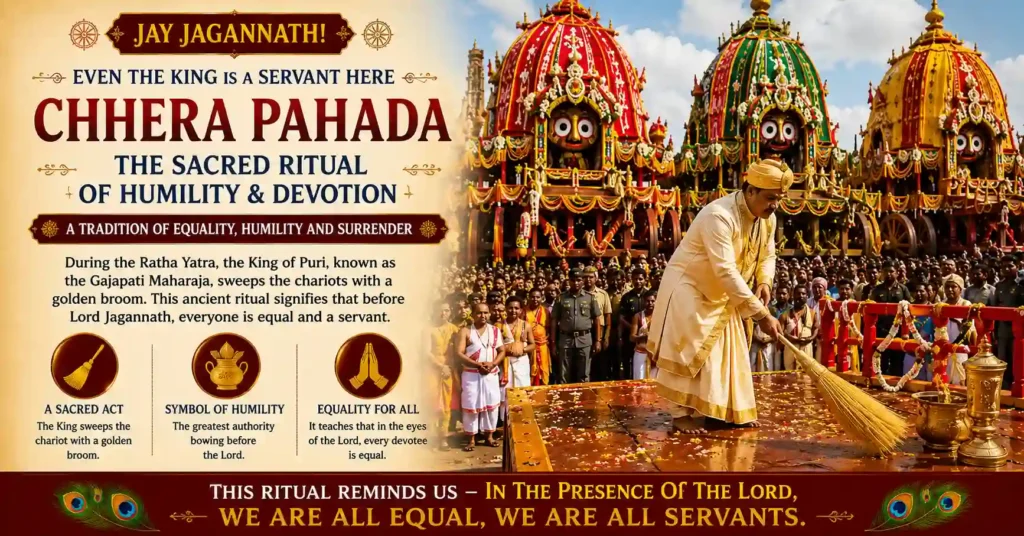
One of the most inspiring aspects of this festival is its message of equality. During the Ratha Yatra, distinctions of wealth, status, caste, and background fade away. From kings to ordinary devotees, everyone stands before the Lord as a servant. Even the Gajapati Maharaja of Puri performs the sacred ritual of sweeping the chariots, demonstrating humility and devotion.
The Jagannath Ratha Yatra is not merely a procession. It is a living celebration of faith, surrender, inclusiveness, divine grace, and the eternal bond between God and devotee. This is why it is regarded as one of the most revered and spiritually significant festivals in Sanatan Dharma.
Table of Contents
ToggleWho Is Lord Jagannath?
Before exploring the significance of Jagannath Ratha Yatra, it is important to understand who Lord Jagannath is and why He is worshipped by millions of devotees.
The word Jagannath comes from two Sanskrit words: Jagat, meaning “the universe,” and Nath, meaning “Lord” or “Master.” Thus, Jagannath means “Lord of the Universe.”
In the Vaishnava tradition, Lord Jagannath is widely revered as a divine form of Lord Krishna. Many devotees also worship Him as the complete manifestation of Lord Vishnu. His worship transcends regional boundaries and has become an important part of India’s spiritual heritage.
In various Vaishnava traditions, Lord Jagannath is revered as a form of Lord Krishna and Lord Vishnu. Sacred texts, devotional literature, and centuries of temple worship identify Him as the compassionate Lord who makes Himself accessible to devotees regardless of caste, status, or background.
At the Shri Jagannath Temple in Puri, Lord Jagannath is worshipped alongside His elder brother Lord Balabhadra and sister Goddess Subhadra. This sacred trio forms the heart of Jagannath worship and makes the temple unique among major Hindu pilgrimage sites.
Unlike most Hindu temple deities, Lord Jagannath’s appearance is distinctive. His large round eyes, wooden form, and simplified features often attract curiosity among first-time visitors. According to traditional beliefs, this form represents the limitless nature of the Divine, which cannot be confined within conventional human features.
The Jagannath tradition beautifully combines elements of:
- Vaishnava devotion
- Ancient tribal traditions
- Puranic teachings
- Regional Odia culture
- Temple worship practices
This unique blend has helped make Jagannath worship one of the most inclusive and vibrant spiritual traditions in India.
Why Is Lord Jagannath Called the Lord of the Universe?
The name Jagannath comes from the Sanskrit words Jagat, meaning “the universe” or “the world,” and Nath, meaning “Lord” or “Master.” Together, Jagannath means “Lord of the Universe.”
This title reflects the belief that the Lord belongs to everyone, regardless of caste, community, language, nationality, or social status. Unlike many temple traditions where the deity remains within the sanctum, Lord Jagannath is revered as a compassionate Lord who comes out among His devotees during the Ratha Yatra, allowing millions to receive His darshan.
Many saints and spiritual teachers explain that Lord Jagannath’s universal form represents the Divine as the protector and guide of all creation. His worship brings together elements of Vaishnava devotion, ancient tribal traditions, temple worship, and regional Odia culture, making the Jagannath tradition one of the most inclusive expressions of Sanatan Dharma.
The title “Lord of the Universe” also carries a deeper spiritual message. It reminds devotees that God is not confined to a particular place, community, or nation. Divine grace is available to everyone who approaches with faith, humility, and devotion.
For this reason, the Jagannath Ratha Yatra is celebrated not only as a festival of Puri but as a universal celebration of divine love, equality, and compassion.
Symbolism of Lord Jagannath's Divine Form
The appearance of Lord Jagannath is unlike that of most Hindu deities. His large round eyes, broad smiling face, simplified features, and wooden form have inspired devotion and spiritual reflection for centuries. Rather than representing physical perfection, His unique form conveys profound spiritual truths.
The symbolism of Lord Jagannath’s form can be understood as follows:
| Feature | Spiritual Meaning |
|---|---|
| Large Round Eyes | Symbolise the Lord’s constant watchfulness and His boundless compassion for all beings. Devotees believe that He lovingly watches over the entire universe without discrimination. |
| Gentle Smile | Represents unconditional love, divine grace, and the joy that comes from devotion. |
| Wooden Form (Daru Brahma) | Reminds devotees that the Divine can manifest through simple and natural forms while remaining eternal in essence. |
| Incomplete Arms and Legs | Often interpreted by spiritual teachers as a reminder that the Divine cannot be confined to ordinary human limitations. Different traditions offer different explanations for this distinctive form. |
| Bright Colours | Reflect the joy, compassion, and vibrant nature of divine consciousness. |
Many saints explain that Lord Jagannath’s appearance encourages devotees to look beyond external forms and recognise the limitless nature of the Divine. His image reminds us that God is present in every heart and is accessible to everyone, regardless of background or status.
This symbolism beautifully complements the spirit of the Jagannath Ratha Yatra, where the Lord leaves the temple to bless all devotees equally, expressing the universal message of love, compassion, and inclusiveness.
Jagannath Ratha Yatra at a Glance
Fact | Details |
Festival Name | Jagannath Ratha Yatra |
Location | Puri, Odisha, India |
Main Deities | Lord Jagannath, Lord Balabhadra, Goddess Subhadra |
Festival Type | Annual Chariot Festival |
Main Route | Jagannath Temple to Gundicha Temple |
Distance Covered | Approximately 3 km |
Main Ritual | Pulling the Sacred Chariots |
Global Recognition | One of the World’s Largest Religious Processions |
Best Known For | Massive Wooden Chariots and Public Darshan of the Lord |
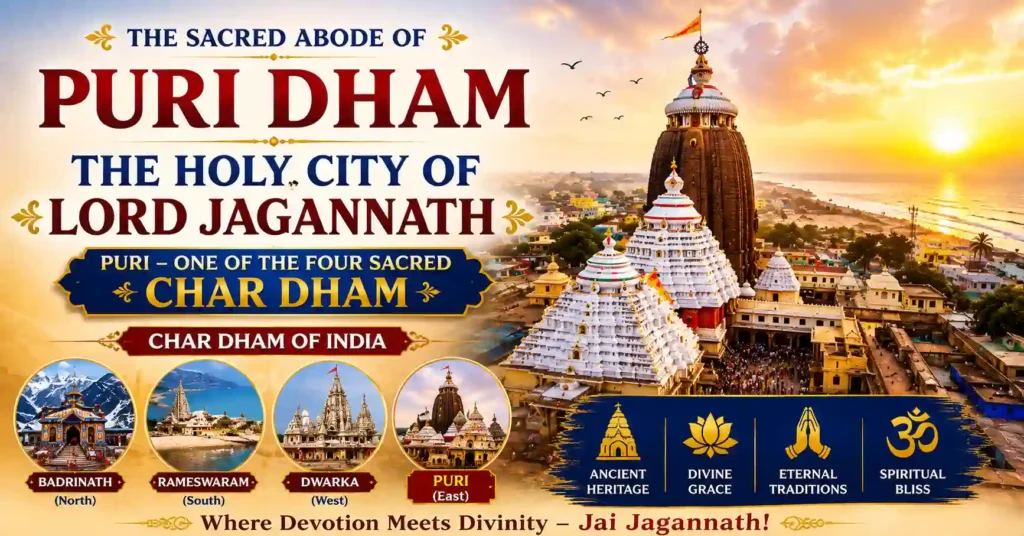
Puri Dham and Its Place in the Char Dham
In Hindu tradition, certain pilgrimage destinations are regarded as sacred gateways to spiritual awakening and divine blessings. Puri Dham is one of these revered places.
According to tradition, Adi Shankaracharya established the four sacred Char Dham pilgrimage sites that represent the four directions of India.
Direction | Sacred Dham |
North | Badrinath |
South | Rameswaram |
West | Dwarka |
East | Puri Dham |
Many devotees believe that visiting all four Char Dham pilgrimage sites at least once in life is highly meritorious and spiritually rewarding.
Puri is often called the City of Lord Jagannath. For centuries, saints, spiritual seekers, pilgrims, and devotees have traveled here to seek the blessings of the Lord. Its sacred atmosphere, ancient traditions, sea coast, and vibrant temple culture make it one of India’s most important spiritual destinations.
A Brief Introduction to the Shri Jagannath Temple
The Shri Jagannath Temple in Puri is among the most famous Vaishnava temples in India and serves as the spiritual center of the Jagannath tradition.
The present temple is believed to have been built during the 12th century by King Anantavarman Chodaganga Deva of the Eastern Ganga dynasty. Over the centuries, several rulers contributed to its preservation and expansion.
The temple’s towering spire, impressive architecture, and vast complex inspire awe among pilgrims. The sacred Nilachakra at the top of the temple and the temple flag are especially revered by devotees.
The Jagannath Temple is much more than a place of worship. Daily rituals, offerings, festivals, and temple services have continued here uninterrupted for centuries, making it one of the world’s oldest living religious traditions.
Why Is the Nilachakra So Sacred?
One of the most revered features of the Shri Jagannath Temple is the Nilachakra, the sacred blue wheel mounted at the top of the temple’s main spire. Made of an alloy of eight metals (Ashtadhatu), it is regarded as a symbol of Lord Vishnu’s Sudarshana Chakra, representing divine protection, righteousness, and the eternal cycle of time.
Devotees believe that offering prayers to the Nilachakra is spiritually equivalent to having darshan of Lord Jagannath Himself. The temple flag, which is changed every day according to centuries-old traditions, is always tied to the Nilachakra, reflecting the uninterrupted continuity of Jagannath worship.
For pilgrims, the sight of the Nilachakra is a reminder that the Lord watches over all devotees with compassion and guides them on the path of dharma.
Why Are Non-Hindus Not Allowed Inside the Jagannath Temple?
One of the most frequently asked questions about the Shri Jagannath Temple is why entry into the temple is traditionally restricted to Hindus.
According to the long-standing customs of the Jagannath Temple, only Hindus are permitted to enter the inner temple complex. This tradition has been followed for centuries and continues to be observed by the temple administration. It is based on the temple’s religious practices and customs rather than on a judgment about any particular faith or community.
Although non-Hindus cannot enter the temple premises, they can still experience the grandeur of the Jagannath tradition in several ways. During the annual Jagannath Ratha Yatra, Lord Jagannath, Lord Balabhadra, and Goddess Subhadra leave the temple and travel through the streets of Puri, allowing everyone, regardless of religion, nationality, or background, to have darshan and participate in the celebrations.
Visitors who cannot enter the temple may also admire its magnificent architecture from outside, learn about its history and traditions, and experience the vibrant spiritual atmosphere of Puri.
For many devotees, this beautifully reflects the deeper message of the Ratha Yatra. While the temple follows its own ancient customs, the Lord’s annual journey symbolises divine compassion and accessibility, reminding us that His blessings are available to all who approach with sincerity, respect, and devotion.
Mahaprasad of Jagannath Temple
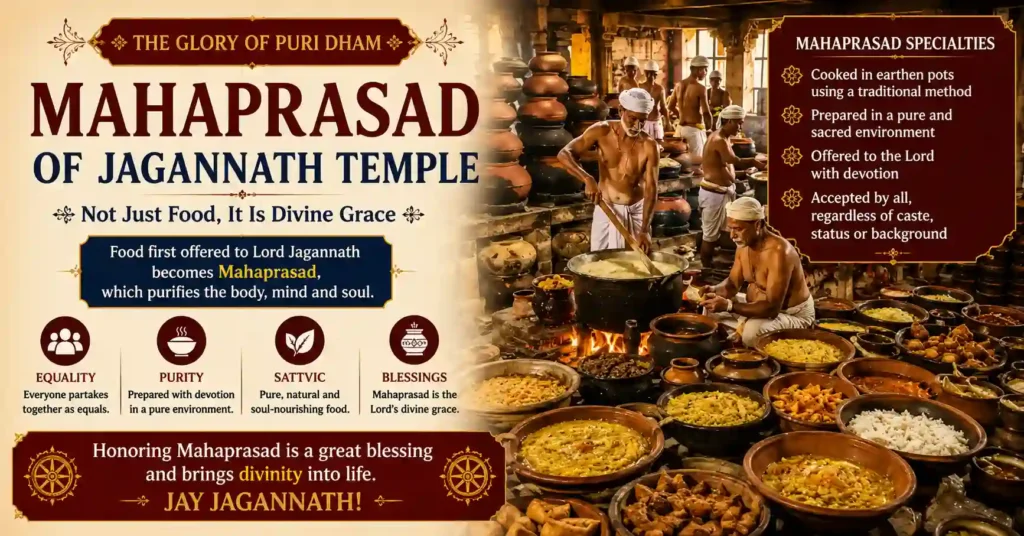
Any discussion about Puri is incomplete without mentioning Mahaprasad. Mahaprasad is the sacred food first offered to Lord Jagannath and then distributed among devotees. It is considered not merely food but the Lord’s blessing.
Thousands of devotees partake in Mahaprasad every day within the temple complex.
Why Is Mahaprasad So Special?
It is first offered to Lord Jagannath.
It is regarded as spiritually purifying.
Devotees from all backgrounds can share it together.
No distinction is made based on social status or community.
It symbolizes equality, unity, and divine grace.
The spirit of inclusiveness reflected in Mahaprasad is also seen throughout the Jagannath Ratha Yatra, where the Lord comes out of the temple to bless all devotees equally.
Why Is the Temple Kitchen So Unique?
The kitchen of the Shri Jagannath Temple is regarded as one of the largest temple kitchens in the world. Every day, hundreds of traditional cooks (known as Suaras) prepare Mahaprasad using age-old methods that have been preserved for centuries.
Food is cooked in earthen pots placed one above another over wood-fired stoves. According to temple tradition, the pot placed at the top is believed to cook first, a practice that devotees regard as one of the unique features of the Jagannath Temple.
The Mahaprasad prepared here is offered to Lord Jagannath before being distributed to devotees. More than a meal, it is considered a sacred blessing that reflects the values of equality, service, and community, as people from all backgrounds sit together to receive it.
The Story Behind Jagannath Ratha Yatra
One of the most frequently asked questions about Jagannath Ratha Yatra is why Lord Jagannath leaves His temple every year and travels to the Gundicha Temple.
Several traditions and beliefs offer explanations for this sacred journey.
According to the ancient traditions of Puri, Gundicha Temple is regarded as the home of the Lord’s aunt. Every year, Lord Jagannath, Lord Balabhadra, and Goddess Subhadra travel there and remain for several days, blessing devotees along the way.
Another popular belief connects the festival to Lord Krishna’s return to Vrindavan. For many Vaishnava devotees, the Ratha Yatra symbolizes the loving reunion between the Lord and His devotees.
Many spiritual teachers also interpret the festival on a deeper level. According to them, the Lord’s journey outside the temple demonstrates that God is not limited to sacred buildings or specific places. Divine grace is available to anyone who approaches with sincerity and devotion.
Why Does Lord Jagannath Visit Gundicha Temple?
Gundicha Temple serves as the principal destination of the Jagannath Ratha Yatra.
On the day of the festival, Lord Jagannath, Lord Balabhadra, and Goddess Subhadra travel from the Shri Jagannath Temple to Gundicha Temple on their magnificent chariots and remain there for about a week.
In local traditions, Gundicha Temple is regarded as an extremely sacred place. Some devotees view it as the Lord’s temporary residence, while others see it as a symbol of divine love and the Lord’s willingness to come closer to His devotees.
This aspect of the festival makes the Ratha Yatra especially meaningful because devotees experience the feeling that the Lord Himself has come among them.
Importance of This Story for Devotees
The story of Jagannath Ratha Yatra is not merely a historical tradition. It continues to inspire millions of devotees every year.
When devotees pull the ropes of the chariots, they believe they are doing much more than moving a wooden structure. Symbolically, they are guiding their own lives toward the Divine.
For this reason, the Ratha Yatra is often described as a grand festival of devotion, surrender, service, and spiritual awakening.
History of Jagannath Ratha Yatra
The Jagannath Ratha Yatra is considered one of the oldest continuously celebrated religious festivals in India. For centuries, devotees have gathered in Puri to witness this sacred event.
Empires rose and fell, rulers changed, and historical circumstances evolved, but the tradition continued with remarkable consistency and devotion.
Historians and scholars believe that Jagannath worship has very ancient origins. The tradition reflects a unique synthesis of:
Vedic spirituality
Puranic traditions
Vaishnava devotion
Ancient tribal beliefs
Regional cultural practices
This blend has helped make Jagannath culture one of the most inclusive spiritual traditions in India.
Jagannath Tradition in Ancient Scriptures
Several Hindu scriptures mention Purushottama Kshetra, the ancient name of present-day Puri.
The spiritual importance of Purushottama Kshetra is described in several Hindu scriptures, including the Skanda Purana, Brahma Purana, Padma Purana, and Narada Purana. These texts praise Puri as a sacred abode of Lord Vishnu and emphasize the spiritual merit of visiting the holy site. Over the centuries, these scriptural references helped establish Puri as one of the most important pilgrimage destinations in Sanatan Dharma.
Important references can be found in:
Skanda Purana
Brahma Purana
Padma Purana
Narada Purana
These texts describe the region as a sacred abode of Lord Vishnu and an important pilgrimage destination.
Although the grand form of the Jagannath Ratha Yatra developed over time, the concept of the Lord appearing before devotees in a public procession is believed to be extremely ancient.
Eastern Ganga Dynasty and the Development of Puri Temple
The Eastern Ganga dynasty played a crucial role in shaping the Jagannath tradition.
In the 12th century, King Anantavarman Chodaganga Deva initiated the construction of the present Shri Jagannath Temple. Later rulers expanded and strengthened the temple complex.
As the temple gained prominence, the Ratha Yatra evolved into a more organized and grand celebration that attracted pilgrims from across India.
Survival Through Invasions and Difficult Times
Throughout history, the Jagannath Temple faced numerous challenges, including invasions and political instability.
There were occasions when the sacred deities had to be moved to secure locations for protection. Despite these challenges, the Jagannath tradition survived through the dedication of kings, temple servitors, and devoted followers.
This continuity is one of the reasons the Jagannath Ratha Yatra is regarded as a remarkable example of India’s living spiritual heritage.
Jagannath Ratha Yatra Spreads Across the World
At one time, the festival was largely centered in Puri. Today, its influence extends far beyond Odisha and India.
Jagannath Ratha Yatras are now organized in many cities around the world, including:
London
New York
Toronto
Sydney
Moscow
Singapore
Johannesburg
As a result, the message of devotion, inclusiveness, and divine love associated with Lord Jagannath now reaches people across the globe.
Historical Timeline of Jagannath Ratha Yatra
Period | Major Development |
Ancient Period | References to Purushottama Kshetra appear in Hindu scriptures. |
Early Medieval Era | Growth of Jagannath worship in eastern India. |
12th Century | Construction of the present Jagannath Temple under the Eastern Ganga dynasty. |
Medieval Period | Expansion of temple traditions and Ratha Yatra rituals. |
Colonial Era | Festival gains wider recognition among travelers and historians. |
Modern Era | Jagannath Ratha Yatra becomes a global celebration in many countries. |
Preparations for Jagannath Ratha Yatra Begin Early
When devotees witness the magnificent chariots carrying Lord Jagannath, Lord Balabhadra, and Goddess Subhadra during the Jagannath Ratha Yatra, few realize that preparations for this grand festival begin several weeks earlier.
The Ratha Yatra is not a single-day event. It is the culmination of numerous sacred rituals, temple traditions, and religious ceremonies that gradually build anticipation among devotees. In many ways, the story of the festival begins long before the chariots start moving.
Akshaya Tritiya and the Beginning of Chariot Construction
The formal preparations for Jagannath Ratha Yatra begin on the auspicious occasion of Akshaya Tritiya.
On this day, the construction of the three sacred chariots officially starts.
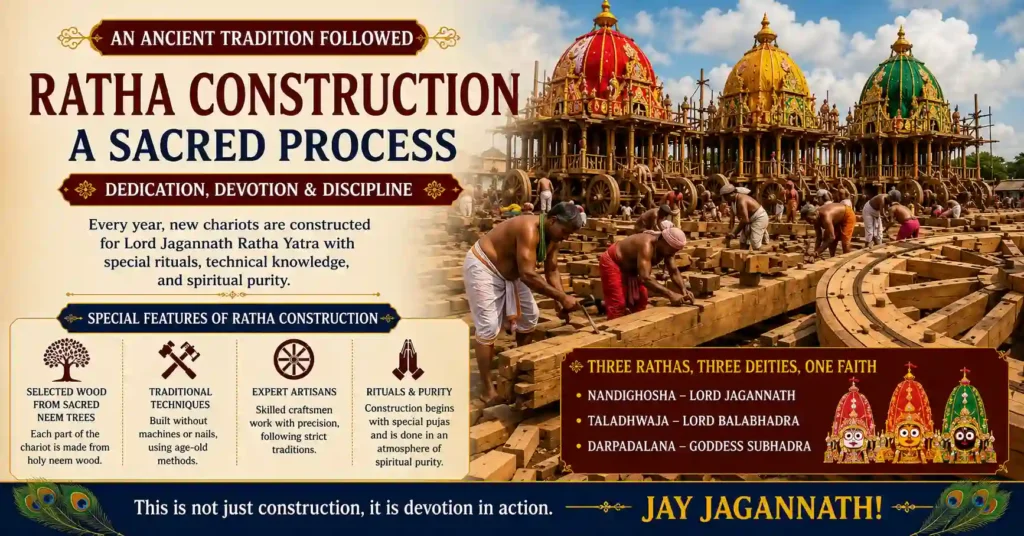
One of the most remarkable features of the Jagannath tradition is that the chariots are built anew every year. The previous year’s chariots are not reused. This practice has continued uninterrupted for centuries and remains one of the most unique aspects of the festival.
Specially selected sacred timber is used for the construction. Traditional craftsmen follow ancient measurements, rituals, and construction techniques that have been preserved through generations.
Chandan Yatra
The festival of Chandan Yatra also begins around this period and marks an important phase in the preparations.
This ritual is associated with offering cooling relief to the deities during the summer season.
Various temple ceremonies and celebrations take place during Chandan Yatra, making it one of the earliest stages in the build-up to the Jagannath Ratha Yatra.
Snana Purnima
One of the most important annual rituals in the Jagannath tradition is Snana Purnima.
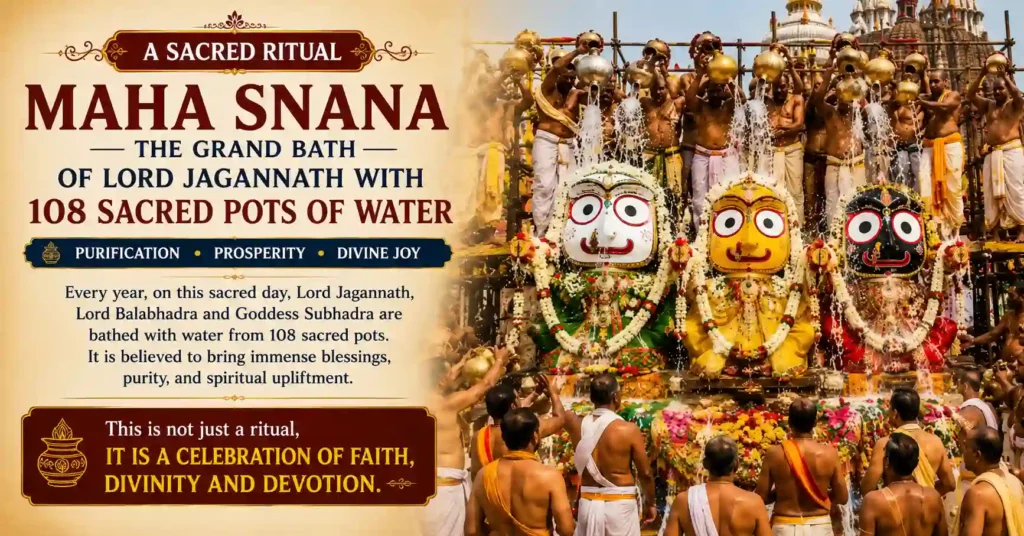
Observed on the full moon day of the Hindu month of Jyeshtha, this ceremony involves the public bathing of Lord Jagannath, Lord Balabhadra, and Goddess Subhadra.
According to tradition, the deities are bathed with water from 108 sacred pots.
Thousands of devotees gather in Puri to witness this grand ritual and receive blessings.
Highlights of Snana Purnima
Public ceremonial bathing of the deities.
Sacred water offered from 108 pots.
One of the most important annual temple rituals.
Attracts pilgrims from across India.
Marks the beginning of the final phase before Ratha Yatra.
What Is Anavasara Period?
Following Snana Purnima comes a fascinating tradition known as Anavasara or Anasara.
According to temple beliefs, the deities fall ill after the ceremonial bath and withdraw from public view to rest and recover.
During this period:
Public darshan remains suspended.
Devotees cannot see the deities.
Special healing rituals are performed.
The anticipation for their return grows stronger.
The Anavasara period usually lasts around fifteen days and is often considered a time of separation and longing for devotees.
Netrotsava and Nava Yauvana Darshan
At the conclusion of Anavasara, an important ceremony known as Netrotsava takes place.
This ritual is associated with the symbolic restoration of the deities’ eyes.
It is followed by Nava Yauvana Darshan, during which Lord Jagannath, Lord Balabhadra, and Goddess Subhadra appear before devotees in a renewed and youthful form.
For devotees, this is a deeply emotional occasion because it marks the return of the Lord after a period of absence.
The Atmosphere on the Eve of Ratha Yatra
A day before the Jagannath Ratha Yatra, the entire city of Puri transforms into a center of devotion and celebration.
The three gigantic chariots stand ready before the Singhadwara (Lion Gate) of the Jagannath Temple. Pilgrims from across India and around the world begin gathering around the temple complex.
The streets resonate with chants of “Jai Jagannath,” devotional songs, and the excitement of devotees eagerly awaiting the sacred journey.
Everyone looks forward to the divine moment when Lord Jagannath, Lord Balabhadra, and Goddess Subhadra will emerge from the temple and begin their annual journey among the devotees.
The Three Sacred Chariots of Jagannath Ratha Yatra
One of the most fascinating and visually striking aspects of the Jagannath Ratha Yatra is the presence of the three enormous wooden chariots.
Every year, Lord Jagannath, Lord Balabhadra, and Goddess Subhadra travel from the Jagannath Temple to Gundicha Temple in their respective chariots.
These are not viewed merely as vehicles. In the Jagannath tradition, each chariot possesses its own identity, symbolism, colors, flag, charioteer, and spiritual significance.
Built according to centuries-old rules and sacred measurements, each chariot represents a distinct aspect of divine consciousness.
The Three Chariots at a Glance
| Deity | Chariot Name | Wheels | Main Colors | Symbolism |
|---|---|---|---|---|
| Lord Jagannath | Nandighosha | 16 | Red & Yellow | Divine Love, Devotion and Ultimate Truth |
| Lord Balabhadra | Taladhwaja | 14 | Red & Green | Strength, Dharma and Protection |
| Goddess Subhadra | Darpadalana (Devadalana) | 12 | Red & Black | Compassion, Balance and Divine Motherhood |
In various scriptures and local traditions, Subhadra’s chariot is also referred to as Devadalana or Padmadhwaja.
The Three Chariots Compared
Although each chariot differs in size, design, and symbolism, together they represent the completeness of the Jagannath tradition.
Taladhwaja symbolizes strength, guidance, and protection.
Darpadalana represents compassion, balance, and humility.
Nandighosha signifies divine love, spiritual awakening, and liberation.
During the procession:
Lord Balabhadra’s chariot moves first.
Goddess Subhadra’s chariot follows.
Lord Jagannath’s chariot comes last.
This sacred order has been followed for generations.
Nandighosha: Lord Jagannath’s Chariot
Nandighosha is the chariot of Lord Jagannath and is considered the largest among the three.
During the Jagannath Ratha Yatra, this chariot attracts the greatest attention from devotees.
| Feature | Details |
|---|---|
| Deity | Lord Jagannath |
| Wheels | 16 |
| Main Colors | Red and Yellow |
| Sacred Symbol | Garuda Flag |
| Spiritual Meaning | Divine Love and Liberation |
Devotees believe that Nandighosha represents the Lord guiding all beings toward the highest spiritual truth.
When Lord Jagannath emerges from the temple and ascends this magnificent chariot, countless devotees become overwhelmed with devotion and emotion.
Taladhwaja: Lord Balabhadra’s Chariot
Taladhwaja is the chariot of Lord Balabhadra, the elder brother of Lord Jagannath.
Lord Balabhadra is traditionally associated with strength, righteousness, and protection.
| Feature | Details |
|---|---|
| Deity | Lord Balabhadra |
| Wheels | 14 |
| Main Colors | Red and Green |
| Symbolism | Strength, Leadership and Dharma |
Taladhwaja leads the entire procession.
Many devotees see this as symbolic of the elder brother guiding and protecting the journey.
Why Is Lord Balabhadra’s Chariot Pulled First?
During the Jagannath Ratha Yatra, Taladhwaja, the chariot of Lord Balabhadra, traditionally leads the procession, followed by Goddess Subhadra’s chariot and finally Lord Jagannath’s Nandighosha.
According to the Jagannath tradition, Lord Balabhadra is the elder brother of Lord Jagannath and is revered as a symbol of strength, protection, and dharma. Leading the procession reflects his role as the guardian who guides and safeguards the sacred journey.
Many devotees also see this sequence as a reminder that spiritual progress begins with righteousness and inner strength, followed by compassion and balance, before culminating in complete devotion to the Divine.
Darpadalana: Goddess Subhadra’s Chariot
Darpadalana, also known as Devadalana in some traditions, is the chariot of Goddess Subhadra.
Although smaller than the other two chariots, it holds immense spiritual importance.
| Feature | Details |
|---|---|
| Deity | Goddess Subhadra |
| Wheels | 12 |
| Main Colors | Red and Black |
| Symbolism | Compassion, Balance and Motherly Grace |
The name Darpadalana is often interpreted as “destroyer of pride.”
For devotees, Goddess Subhadra embodies love, harmony, humility, and divine compassion.
Her position between her two brothers during the procession symbolizes balance and unity.
Why Does Goddess Subhadra Travel Between Her Brothers?
One of the distinctive features of the Jagannath Ratha Yatra is that Goddess Subhadra’s chariot travels between the chariots of Lord Balabhadra and Lord Jagannath. This traditional arrangement has been followed for centuries as part of the sacred procession.
According to temple tradition, the three siblings journey together, reflecting their close family bond. Many spiritual teachers also interpret this arrangement symbolically, with Goddess Subhadra representing harmony, compassion, and balance between strength and divine love.
For devotees, this beautiful tradition reminds us that family, unity, and mutual care are cherished values in Sanatan Dharma. The procession of the three siblings together continues to inspire millions with its message of love, togetherness, and spiritual harmony.
Spiritual Significance of the Three Chariots
In the Jagannath tradition, the chariots are much more than ceremonial structures.
Many saints and spiritual teachers compare the human body to a chariot, the mind to the reins, and the soul to the traveler.
From this perspective, the Jagannath Ratha Yatra becomes a symbol of the soul’s journey toward God.
The three chariots together convey profound spiritual lessons:
| Chariot | Spiritual Message |
|---|---|
| Taladhwaja | Strength and righteous action |
| Darpadalana | Compassion and inner balance |
| Nandighosha | Divine love and liberation |
This deeper symbolism is one reason why millions of devotees consider pulling the chariot ropes an act of spiritual service rather than merely a festival activity.
The Chariot as a Symbol of Human Life
Many saints and spiritual teachers interpret the Jagannath Ratha Yatra as a symbolic representation of the human spiritual journey.
In this interpretation, the chariot represents the human body, the horses symbolize the senses, the reins represent the mind, and the destination symbolizes union with the Divine.
Just as a chariot requires guidance to reach its destination, human life requires wisdom, discipline, and devotion to progress toward spiritual fulfillment. This deeper symbolism transforms the Ratha Yatra from a festival into a powerful spiritual teaching.
Why Are New Chariots Built Every Year?
One of the most frequently asked questions about the Jagannath Ratha Yatra is why entirely new chariots are built every year despite their massive size and strength.
The answer lies within the unique philosophy of the Jagannath tradition.
For centuries, Lord Jagannath, Lord Balabhadra, and Goddess Subhadra have received newly constructed chariots every year. Reusing old chariots is not part of the tradition.
For devotees, this process is not simply construction work. It is itself a sacred religious ritual.
Selection of Sacred Wood
The chariots are not built from ordinary timber.
Specific varieties of trees are selected according to traditional rules and religious guidelines.
The process of selecting and transporting the wood is treated as a sacred activity and forms an important part of the preparations.
Construction Begins on Akshaya Tritiya
The actual construction begins on Akshaya Tritiya.
Following traditional prayers and rituals, skilled craftsmen start work on the three chariots.
The construction process continues for nearly two months and involves hundreds of artisans and temple workers.
Traditional Craftsmen and Family Lineages
Many of the families involved in chariot construction have served Lord Jagannath for generations.
For them, this work is not merely a profession. It is considered a sacred service to the Lord.
Even today, many aspects of construction continue to follow traditional methods passed down through centuries.
Spiritual Meaning Behind New Chariots
The annual rebuilding of the chariots carries a profound spiritual message.
Just as the human body changes with time while the soul remains eternal, the chariots are renewed each year while the divine presence remains unchanged.
The tradition reminds devotees that:
Everything in the material world is temporary.
Change is a natural part of life.
God alone remains eternal.
Spiritual renewal is essential for growth.
This deeper symbolism makes the annual construction of the chariots one of the most meaningful aspects of the Jagannath tradition.
The Main Day of Jagannath Ratha Yatra
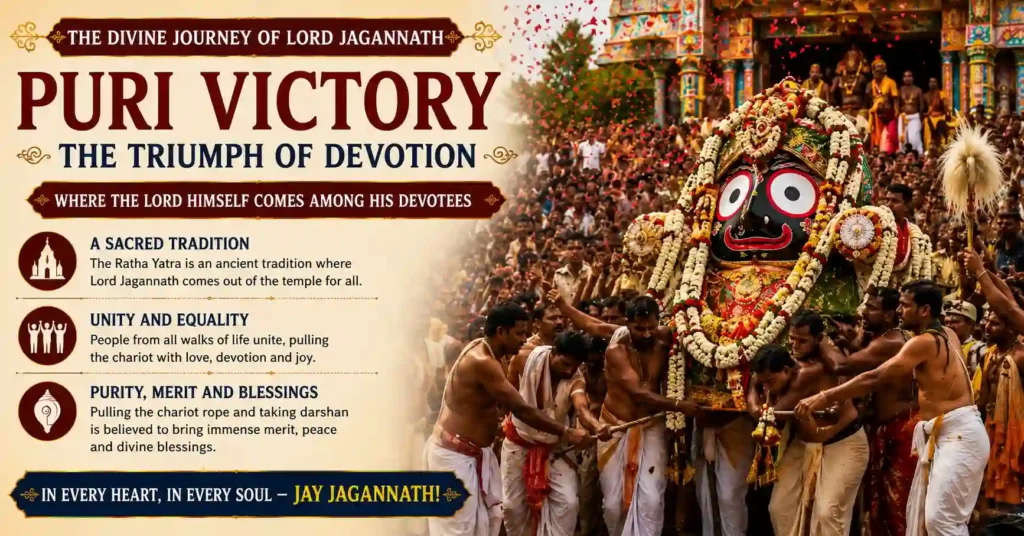
After months of preparation and anticipation, the most awaited day of the Jagannath Ratha Yatra finally arrives. For millions of devotees, this is not merely a festival but a deeply emotional and spiritual experience.
From early morning, the streets of Puri begin to fill with pilgrims from across India and around the world. The three magnificent chariots stand before the Singhadwara (Lion Gate) of the Jagannath Temple, ready for the sacred journey. Chants of “Jai Jagannath” echo through the air, filling the city with devotion and excitement.
It is on this day that Lord Jagannath, Lord Balabhadra, and Goddess Subhadra leave the temple and begin their journey to the Gundicha Temple.
What Is Pahandi Vijay?
One of the most emotional and visually captivating moments of the Jagannath Ratha Yatra is the ritual known as Pahandi Vijay.
Pahandi refers to the ceremonial procession in which the deities are brought from the sanctum of the temple to their respective chariots.
During this ritual, temple servitors carry the deities in a distinctive swaying movement. To devotees, it appears as if the Lord Himself is joyfully walking among His devotees.
As Lord Balabhadra, Goddess Subhadra, and Lord Jagannath emerge from the temple, the crowd erupts in celebration. Thousands wait patiently for hours just to witness this sacred moment.
For devotees, Pahandi is not merely a ritual. It symbolizes the Lord’s loving decision to leave His sanctum and come closer to His devotees.
The Deities Ascend Their Chariots
After the Pahandi procession, the deities are ceremonially placed upon their respective chariots.
The traditional order is:
| Order | Deity | Chariot |
|---|---|---|
| First | Lord Balabhadra | Taladhwaja |
| Second | Goddess Subhadra | Darpadalana |
| Third | Lord Jagannath | Nandighosha |
The entire ritual is performed according to centuries-old temple traditions and sacred procedures.
For many devotees, seeing the Lord seated upon His chariot is among the most cherished moments of the entire festival.
Chhera Pahara: The Unique Sweeping Ceremony
Among the most famous traditions of the Jagannath Ratha Yatra is Chhera Pahara.
In this ritual, the Gajapati Maharaja of Puri personally sweeps around the chariots using a golden broom and sprinkles fragrant water.
For first-time visitors, this can be a surprising sight. Why would a king perform such a humble task?
The answer lies at the heart of the Jagannath tradition.
Why Does the Gajapati King Sweep the Chariots?
Lord Jagannath is regarded as the true King of Puri.
The Gajapati Maharaja considers himself the servant of the Lord rather than a ruler before Him.
The Chhera Pahara ritual conveys several powerful messages:
Everyone is equal before God.
Humility is a form of devotion.
Service is greater than status.
True greatness lies in selfless service.
This beautiful tradition remains one of the most admired aspects of the festival and reflects the inclusive nature of Jagannath worship.
The Beginning of the Chariot Journey
After Chhera Pahara is completed, the moment everyone has been waiting for finally arrives.
Thousands of devotees gather around the enormous ropes attached to the chariots. The atmosphere becomes charged with devotion and excitement.
As the chariots begin to move, chants of “Jai Jagannath” fill the air. Conch shells sound, temple bells ring, devotional songs are sung, and countless devotees celebrate the sacred journey.
The procession travels from the Jagannath Temple to Gundicha Temple, covering a distance of approximately three kilometers.
Although the route is relatively short, the journey itself becomes a massive spiritual celebration due to the presence of millions of devotees.
Importance of Pulling the Chariot Rope
For many devotees, pulling the ropes of the chariots is one of the most sacred acts associated with the Jagannath Ratha Yatra.
Many pilgrims dream of participating in this act at least once in their lifetime.
According to traditional belief, pulling the chariot rope symbolizes:
Service to the Lord.
Devotion and surrender.
Spiritual merit.
Participation in a sacred tradition.
Guiding one’s life toward God.
Many saints have compared the chariot rope to the bond between the devotee and the Divine.
Just as thousands of devotees work together to move the chariot forward, collective devotion and righteous actions help move life toward spiritual progress.
Why Is Pulling the Chariot Considered So Auspicious?
Pulling the sacred chariot is one of the most cherished acts of the Jagannath Ratha Yatra. For devotees, it is more than a physical effort. It is an expression of devotion, humility, and surrender to Lord Jagannath.
According to temple traditions and popular belief, participating in this sacred service is highly auspicious. It symbolises the devotee’s desire to walk the path of dharma and move closer to the Divine through faith and selfless service.
The deeper symbolism can be understood as follows:
| Symbol | Spiritual Meaning |
|---|---|
| Pulling the Chariot | Walking the path of devotion and surrender to the Divine |
| The Sacred Rope | Represents the bond between the Lord and His devotees |
| Moving Together | Symbolises unity, cooperation, and equality among all devotees |
| The Chariot’s Journey | Reminds us that life itself is a journey towards spiritual awakening |
Even those who cannot pull the chariot can participate through prayer, chanting the Lord’s holy names, serving others, or witnessing the procession with devotion. In Sanatan Dharma, sincere faith and righteous intentions are considered the highest forms of worship.
When the Lord Comes Out Among Devotees
One of the most remarkable features of the Jagannath Ratha Yatra is that the Lord Himself comes out among His devotees.
During most of the year, devotees must enter the temple to seek darshan. During the Ratha Yatra, however, the Lord leaves the temple and becomes accessible to everyone.
This aspect of the festival carries a profound spiritual message.
God is not confined to temple walls. Divine grace is available to anyone who approaches with sincerity, faith, and devotion.
Many devotees consider this the most beautiful aspect of the Jagannath tradition. The festival becomes a celebration of divine compassion and inclusiveness.
Journey to Gundicha Temple and Stay There
The purpose of the Jagannath Ratha Yatra extends beyond the movement of the chariots themselves. The true destination of the journey is Gundicha Temple, where the deities stay for several days.
This sacred stay forms one of the most important parts of the festival.
When Lord Jagannath, Lord Balabhadra, and Goddess Subhadra travel from the Jagannath Temple, their destination is Gundicha Temple, which becomes the center of spiritual activity during this period.
History of Gundicha Temple
According to local traditions, Gundicha Temple is associated with Queen Gundicha, who is linked to King Indradyumna and the Jagannath tradition.
Although historians and traditional accounts offer different interpretations, there is no doubt that the temple has been closely connected with the Jagannath Ratha Yatra for centuries.
During the festival, Gundicha Temple becomes one of the most important pilgrimage sites in Puri.
How Long Do the Deities Stay at Gundicha Temple?
After reaching Gundicha Temple, Lord Jagannath, Lord Balabhadra, and Goddess Subhadra remain there for approximately one week.
During this period, thousands of devotees visit the temple to seek blessings and participate in the celebrations.
The stay at Gundicha Temple is considered highly auspicious within the Jagannath tradition.
Spiritual Meaning of the Gundicha Journey
The journey to Gundicha Temple has inspired several spiritual interpretations.
Some devotees view it as the Lord visiting His devotees.
Others associate it with Lord Krishna’s return to Vrindavan.
Many spiritual teachers interpret it as a symbolic representation of the soul’s reunion with the Divine.
Because of these layers of meaning, the Gundicha journey carries both historical and profound spiritual significance.
Hera Panchami: A Fascinating Tradition
One of the most interesting traditions associated with the Jagannath Ratha Yatra is Hera Panchami.
Celebrated a few days after the Ratha Yatra, this event is linked to a beloved story involving Goddess Lakshmi and Lord Jagannath.
The Story of Hera Panchami
According to popular tradition, when Lord Jagannath leaves for Gundicha Temple, Goddess Lakshmi remains at the Jagannath Temple.
After several days, Goddess Lakshmi symbolically travels to Gundicha Temple to bring the Lord back.
When she discovers that He has not yet returned, she expresses her displeasure.
Devotees view this story as a loving divine pastime that reflects the affectionate relationship between the Lord and Goddess Lakshmi.
The Unique Ritual Associated with the Chariot
During Hera Panchami, a symbolic ritual is performed.
According to tradition, Goddess Lakshmi expresses her displeasure by symbolically damaging a small portion of Lord Jagannath’s chariot before returning to the temple.
This playful ritual has been observed for generations and remains one of the most beloved customs associated with the festival.
Bahuda Yatra: The Return Journey
After the stay at Gundicha Temple comes another major event of the festival.
The return journey of Lord Jagannath, Lord Balabhadra, and Goddess Subhadra to the Jagannath Temple is known as Bahuda Yatra.
Just as devotees celebrate the outward journey with enthusiasm, the return journey is also observed with immense devotion and joy.
Importance of Bahuda Yatra
Bahuda Yatra symbolizes the Lord’s return to His sacred abode.
Thousands of devotees gather once again to witness the procession and receive blessings.
For many pilgrims, this journey marks the completion of an important spiritual cycle.
Stop at Mausi Maa Temple
An important tradition associated with Bahuda Yatra is the stop at the Mausi Maa Temple.
According to local beliefs, Lord Jagannath pauses here and receives a special offering.
This custom reflects the affectionate and family-centered nature of the Jagannath tradition, where the Lord is lovingly treated as a member of the family rather than a distant deity.
The stop at Mausi Maa Temple remains one of the most cherished traditions associated with the return journey.
Suna Besha: When the Lord Is Adorned in Gold
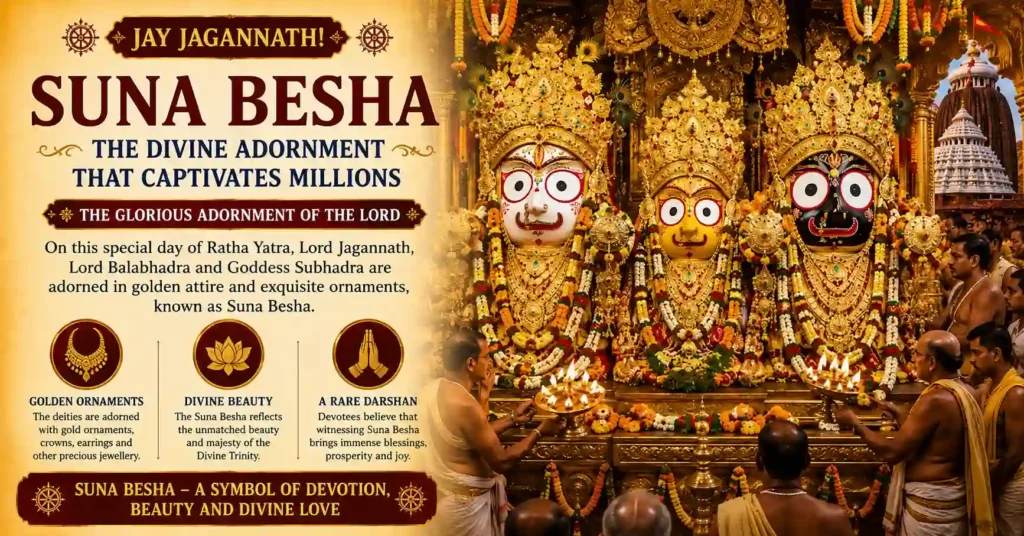
One of the most spectacular events associated with the Jagannath Ratha Yatra is Suna Besha, also known as the Golden Adornment Ceremony.
This grand celebration takes place after Bahuda Yatra, when Lord Jagannath, Lord Balabhadra, and Goddess Subhadra remain seated on their chariots and are decorated with magnificent gold ornaments.
Thousands of devotees gather to witness this extraordinary sight, while millions more follow the event through various media platforms.
Significance of Suna Besha
The word Suna means gold.
On this occasion, the deities are adorned with:
Golden crowns
Golden hands
Golden ornaments
Sacred weapons made of gold
Elaborate royal decorations
When sunlight reflects off these ornaments, the appearance of the deities becomes especially radiant and awe-inspiring.
For devotees, Suna Besha symbolizes:
Divine majesty
Prosperity and abundance
The Lord’s supreme sovereignty
The glory of devotion
It is considered one of the most visually magnificent rituals in the entire Jagannath tradition.
A Special Occasion for Devotees
Many pilgrims plan their visit specifically to witness Suna Besha.
Traditional beliefs hold that receiving darshan during this occasion is especially auspicious and spiritually rewarding.
The sight of the Lord adorned in gold leaves a lasting impression on devotees and remains one of the most memorable moments of the festival.
Adhara Pana Tradition
After Suna Besha, another unique ritual known as Adhara Pana is performed.
This ceremony is rarely seen in other temple traditions and is considered one of the distinctive features of Jagannath worship.
A special sweet drink is prepared in large earthen vessels and offered to the deities.
According to tradition, this offering is also intended for the invisible divine beings and guardian spirits believed to assist in the service and protection of the Lord throughout the festival.
Significance of Adhara Pana
Marks an important stage in the conclusion of the festival.
Expresses gratitude to divine attendants.
Reflects the inclusive nature of Jagannath worship.
Symbolizes completion and fulfillment.
Adhara Pana remains one of the most fascinating rituals associated with the Jagannath Ratha Yatra.
Niladri Bije and the Rasgulla Tradition
The final and most emotional stage of the Jagannath Ratha Yatra is known as Niladri Bije.
This ceremony marks the return of Lord Jagannath, Lord Balabhadra, and Goddess Subhadra to the Jagannath Temple after the completion of their annual journey.
Goddess Lakshmi Closes the Temple Door
According to a popular local tradition, Goddess Lakshmi becomes upset because Lord Jagannath left for Gundicha Temple without her.
When the Lord returns, she symbolically refuses Him entry and has the temple doors closed.
This playful episode is viewed as a divine pastime that highlights the affectionate relationship between the Lord and Goddess Lakshmi.
The Rasgulla Tradition
According to Odia tradition, Lord Jagannath offers Rasgulla to Goddess Lakshmi to appease her and seek forgiveness.
Once she is pleased, the temple doors are reopened and the Lord is welcomed back.
Over time, this tradition has become closely associated with Niladri Bije and has become an important cultural symbol of Odisha.
Although it is rooted primarily in local tradition and folklore, it remains one of the most beloved stories connected to the festival.
Conclusion of the Ratha Yatra Festival
With Niladri Bije, the annual cycle of the Jagannath Ratha Yatra comes to an end.
For devotees, however, the spiritual journey does not truly conclude. Instead, it marks the beginning of another year of waiting for the next opportunity to witness the Lord’s sacred journey among His devotees.
Interesting Facts About Jagannath Ratha Yatra
The Jagannath Ratha Yatra is one of the world’s most remarkable religious festivals and is associated with many fascinating traditions.
Quick Facts About Jagannath Ratha Yatra
Fact | Details |
New chariots are built every year | The previous year’s chariots are never reused. |
Construction begins on Akshaya Tritiya | Chariot building starts on an auspicious day. |
Traditional families build the chariots | Many craftsmen have served for generations. |
Millions participate | Devotees gather from India and abroad. |
The king sweeps the chariots | Chhera Pahara symbolizes humility. |
Mahaprasad serves all equally | No distinction is made among devotees. |
Celebrated worldwide | Ratha Yatras are held in many countries. |
Nabakalebara is unique | New idols are periodically created according to sacred traditions. |
Rasgulla tradition is famous | Associated with Niladri Bije. |
Lord comes out among devotees | A rare example of divine accessibility. |
Mysteries and Beliefs of the Jagannath Tradition
The Jagannath tradition is not only ancient and grand but also filled with fascinating beliefs, spiritual concepts, and sacred mysteries.
Some of these are rooted in scripture and temple tradition, while others belong to local faith and folklore. Together, they contribute to the unique character of Jagannath culture.
The Concept of Daru Brahma
Unlike most temple deities, the idols of Lord Jagannath, Lord Balabhadra, and Goddess Subhadra are made of wood.
In Jagannath philosophy, these sacred forms are known as Daru Brahma.
Daru means wood.
Brahma refers to divine consciousness.
According to traditional belief, divine consciousness resides within these sacred wooden forms.
For devotees, the deities are not merely artistic representations but living manifestations of the Divine.
Why Does Lord Jagannath Look Different?
One of the most common questions asked by visitors is why Lord Jagannath’s form differs so greatly from most Hindu deities.
His large circular eyes, unique facial features, and simplified limbs have inspired many interpretations.
According to a popular legend, Lord Vishwakarma was creating the deity’s form under specific conditions. Before the work was completed, the process was interrupted, and the deity was established in its unfinished form.
Many scholars and spiritual teachers offer another interpretation.
They suggest that the form of Lord Jagannath transcends conventional human appearance and symbolizes a Divine presence that cannot be limited by physical definitions.
What Is Nabakalebara?
One of the most unique traditions of the Jagannath culture is Nabakalebara.
The word consists of:
Naba meaning new.
Kalebara meaning body.
During special astrological alignments, new wooden idols of Lord Jagannath, Lord Balabhadra, Goddess Subhadra, and Sudarshana are created.
This event usually occurs once every 12 to 19 years.
The Nabakalebara Process
The Nabakalebara ritual follows highly specific sacred procedures.
Major Stages
Search for sacred neem trees.
Selection according to traditional signs.
Construction of new idols.
Sacred transfer of divine essence.
Consecration of the new deities.
The most mysterious stage is the transfer of the sacred Brahma element from the old idols to the new ones.
This ritual is conducted in complete secrecy and remains one of the most discussed mysteries of the Jagannath tradition.
The Extraordinary Tradition of Mahaprasad
The Mahaprasad of the Jagannath Temple is renowned throughout India.
The temple kitchen is often considered one of the largest religious kitchens in the world.
Every day, food is prepared for thousands of devotees.
Why Mahaprasad Is Unique
Considered the Lord’s blessing.
Shared by all without discrimination.
Deeply connected to temple worship.
Symbolizes unity and inclusiveness.
For devotees, Mahaprasad is not simply food but a sacred gift from Lord Jagannath.
The Inclusive Nature of Jagannath Culture
Lord Jagannath is often called the Lord of All.
His tradition reflects influences from:
Tribal traditions
Vaishnava spirituality
Temple worship
Local customs
Bhakti movements
This inclusive character is one of the reasons Jagannath culture has remained relevant and beloved for centuries.
The spirit of inclusiveness becomes especially visible during the Jagannath Ratha Yatra, when people from all backgrounds gather together in devotion.
What Is the Experience of Jagannath Ratha Yatra Like for Devotees?
Reading about the Jagannath Ratha Yatra and experiencing it in person are two very different things.
Many pilgrims describe the atmosphere as something that cannot be fully expressed in words.
Puri Echoes with Chants of “Jai Jagannath”
During the festival, the entire city becomes immersed in devotion.
Devotees witness:
Endless chants of “Jai Jagannath”
Devotional music and kirtans
Temple bells and conch shells
Massive gatherings of pilgrims
A deeply spiritual atmosphere
For many, it becomes one of the most memorable experiences of their lives.
The Experience of Pulling the Chariot
Many devotees cherish the dream of pulling the Lord’s chariot at least once.
They view it as:
A sacred privilege
An act of devotion
A form of direct service
A blessing from the Lord
When thousands of people pull the chariots together, the scene becomes a powerful expression of collective faith.
Mahaprasad and the Gathering of Devotees
Mahaprasad plays an important role during the festival.
Devotees from different regions, backgrounds, and communities sit together and share the sacred offering.
This reflects one of the core messages of the Jagannath tradition: unity through devotion.
Visiting Jagannath Ratha Yatra: What Devotees Should Know
For many devotees, attending the Jagannath Ratha Yatra is a lifelong dream. Since millions of pilgrims visit Puri during the festival, planning ahead can make the experience more comfortable and meaningful.
Helpful Tips for Visitors
Arrive in Puri at least one or two days before the main procession.
Expect very large crowds throughout the festival period.
Stay hydrated, especially during the summer heat.
Wear comfortable clothing and footwear.
Follow local security and crowd-management instructions.
Book accommodation well in advance.
Respect temple traditions and local customs.
Try Mahaprasad from authorized temple sources.
What to Expect During the Festival
Long waiting times in crowded areas.
Devotional singing and chanting throughout the city.
Extensive security arrangements.
Temporary traffic restrictions.
A spiritually charged atmosphere unlike any other festival.
Jagannath Ratha Yatra Around the World
Although the Jagannath Ratha Yatra began in the sacred city of Puri, Odisha, its message of devotion, equality, and divine love has crossed geographical and cultural boundaries. Today, the festival is celebrated in many countries, allowing devotees around the world to experience the joy of Lord Jagannath’s annual journey.
One of the major reasons for the global popularity of the Ratha Yatra is the work of the International Society for Krishna Consciousness (ISKCON). Inspired by the traditions of Puri, ISKCON has introduced public Ratha Yatra festivals in cities across the world, where beautifully decorated chariots, devotional music, kirtans, cultural programmes, and the distribution of prasadam bring communities together.
Some of the most well-known international celebrations include:
| City | Country | Highlights |
|---|---|---|
| London | United Kingdom | One of Europe’s oldest and largest Ratha Yatra festivals, attracting thousands of devotees and visitors every year. |
| New York | United States | A colourful procession through city streets featuring devotional singing, dancing, and free prasadam. |
| Toronto | Canada | A vibrant annual festival with traditional chariots, kirtans, and cultural performances. |
| Sydney | Australia | Celebrated with devotional processions, community gatherings, and spiritual programmes. |
| Singapore | Singapore | A popular celebration featuring chariot processions, bhajans, and devotional activities. |
While these celebrations may differ in scale and local customs, they all preserve the spirit of the original Ratha Yatra in Puri. Devotees gather to sing the Lord’s holy names, perform seva (selfless service), share prasadam, and celebrate the timeless values of compassion, humility, and devotion.
The worldwide celebration of Jagannath Ratha Yatra beautifully reflects the meaning of Jagannath, the “Lord of the Universe.” It reminds us that the Lord’s love and blessings are not limited by place, language, or nationality but are available to everyone who approaches Him with faith and a sincere heart.
Spiritual Message of Jagannath Ratha Yatra
The Jagannath Ratha Yatra is not only a historical or cultural event. It also carries a profound spiritual message that continues to inspire devotees around the world.
The Lord Comes to His Devotees
In many religious traditions, devotees travel to a temple to seek the Lord’s blessings.
During the Ratha Yatra, however, the Lord Himself comes out among His devotees.
This teaches that divine grace is available to everyone who sincerely seeks it.
No Discrimination in Devotion
One of the strongest messages of the festival is equality.
During the Jagannath Ratha Yatra:
Kings and commoners stand together.
Rich and poor worship side by side.
Locals and visitors participate equally.
Devotion matters more than status.
The festival reminds us that all are equal in the eyes of God.
Life Itself Is a Ratha Yatra
Many saints and spiritual teachers compare the festival to the journey of human life.
Just as the chariot moves toward its destination, every soul is on a journey toward spiritual fulfillment.
Faith, discipline, devotion, and righteous actions help guide that journey.
The Message of Surrender
Perhaps the greatest lesson of the Jagannath Ratha Yatra is surrender.
When devotees hold the ropes of the Lord’s chariot, they symbolically place the direction of their lives in His hands.
This spirit of surrender, trust, and devotion lies at the heart of Jagannath bhakti.
Jagannath Ratha Yatra 2026: Dates and Major Events
The Jagannath Ratha Yatra is not limited to a single day. It is a sequence of sacred rituals, ceremonies, and festivals that unfold over several weeks.
While the main Ratha Yatra attracts the greatest attention, each associated event holds its own spiritual and cultural significance.
For devotees planning a pilgrimage or simply wishing to understand the festival better, knowing the major dates and ceremonies can enhance the experience.
Major Events of Jagannath Ratha Yatra 2026
Event | Expected Date (2026)* | Significance |
Akshaya Tritiya | April–May 2026 | Construction of the sacred chariots begins |
Chandan Yatra | Begins on Akshaya Tritiya | Early preparations for the festival |
Snana Purnima | June 2026 | Sacred bathing ceremony of the deities |
Anavasara Period | After Snana Purnima | The deities remain away from public view |
Netrotsava & Nava Yauvana Darshan | Before Ratha Yatra | Reappearance of the deities |
Jagannath Ratha Yatra | 16 July 2026 | Journey to Gundicha Temple |
Hera Panchami | A few days later | Lakshmi’s symbolic visit to Gundicha Temple |
Bahuda Yatra | 24 July 2026 | Return journey to Jagannath Temple |
Suna Besha | After Bahuda Yatra | Golden adornment ceremony |
Adhara Pana | Following Suna Besha | Special offering ritual |
Niladri Bije | Festival conclusion | Return of the deities to the temple |
Dates should always be verified with the official Jagannath Temple calendar before publication.
Why These Events Matter
Each stage of the Jagannath Ratha Yatra carries its own spiritual message:
Event | Spiritual Meaning |
Snana Purnima | Purification and renewal |
Anavasara | Separation and longing for the Divine |
Nava Yauvana Darshan | Spiritual rejuvenation |
Ratha Yatra | Divine grace reaching devotees |
Gundicha Stay | Reunion between God and devotees |
Bahuda Yatra | Return to the spiritual center |
Suna Besha | Glory and majesty of the Divine |
Niladri Bije | Restoration of harmony and completion |
Together, these rituals transform the festival into a complete spiritual journey rather than a single-day celebration.
Conclusion
The Jagannath Ratha Yatra is far more than a religious procession. It is one of India’s greatest living spiritual traditions, where history, devotion, culture, philosophy, and community come together in a remarkable way.
Every year, Lord Jagannath leaves His temple and comes among His devotees. This simple yet profound act carries a timeless message: the Divine is never distant from those who seek Him with sincerity and faith.
The magnificent chariots, centuries-old rituals, Mahaprasad tradition, Gundicha journey, Suna Besha, Niladri Bije, and countless acts of devotion make this festival truly unique.
Key Spiritual Lessons from Jagannath Ratha Yatra
God is accessible to everyone.
Devotion is greater than social status.
Service is a form of worship.
Humility leads to spiritual growth.
Life itself is a journey toward the Divine.
Faith unites people beyond all differences.
Perhaps this is why the Jagannath Ratha Yatra has endured for centuries and continues to inspire millions around the world.
When the streets of Puri resound with chants of “Jai Jagannath,” devotees are reminded that the Lord resides not only in temples but also in every heart filled with love, faith, and devotion.
Suggested Reading
If you enjoyed learning about the Jagannath Ratha Yatra, you may also enjoy exploring these related articles on sacred pilgrimage sites, temple traditions, spiritual festivals, and Sanatan Dharma.
Bhagwan Jagannath Story, Nabakalebara, Mahaprasad and Temple Mysteries
https://thesanatantales.com/bhagwan-jagannath-story-nabakalebara/
Saptapuri: The Seven Sacred Cities of Liberation
https://thesanatantales.com/saptapuri/
Triyuginarayan Temple: Where Shiva and Parvati Were Married
https://thesanatantales.com/triyuginarayan-temple/
Ambubachi Mela 2026: Dates, Significance, Rituals and Travel Guide
https://thesanatantales.com/ambubachi-mela-2026/
Kamakhya Temple: Mystery, Shakti Peetha and Spiritual Significance
https://thesanatantales.com/kamakhya-temple/
Shiva Tandava Stotram: Meaning, Benefits and Complete Text
https://thesanatantales.com/shiv-tandav-stotram/
Rudrashtakam: Complete Text, Meaning and Benefits
https://thesanatantales.com/rudrashtakam/
Maa Tara: Form, Story, Worship and Spiritual Importance
https://thesanatantales.com/maa-tara/
Maa Lalita Tripura Sundari: Story, Symbolism and Spiritual Secrets
https://thesanatantales.com/maa-lalita-tripura-sundari/
Ratha Yatra (Wikipedia)
https://en.wikipedia.org/wiki/Ratha_Yatra_(Puri)
FAQs
Why is Jagannath Ratha Yatra celebrated?
Jagannath Ratha Yatra commemorates the annual journey of Lord Jagannath, Lord Balabhadra, and Goddess Subhadra from the Jagannath Temple to Gundicha Temple in Puri. The festival symbolizes divine compassion, equality, devotion, and the Lord’s willingness to come among His devotees and bless all people regardless of status or background.
When is Jagannath Ratha Yatra 2026?
The main Jagannath Ratha Yatra in 2026 is expected to be celebrated on 16 July 2026. Devotees should verify the date with the official Jagannath Temple calendar or local authorities, as festival schedules are determined according to the Hindu lunar calendar.
Why does Lord Jagannath visit Gundicha Temple?
According to long-standing temple traditions, Gundicha Temple is the destination of Lord Jagannath’s annual journey during the Ratha Yatra. Some local traditions associate it with the home of the Lord’s aunt. Spiritually, the journey symbolizes the Lord coming closer to His devotees and extending His blessings beyond the temple walls.
How many chariots are used in Jagannath Ratha Yatra?
Three chariots are used during the Jagannath Ratha Yatra:
| Deity | Chariot |
|---|---|
| Lord Jagannath | Nandighosha |
| Lord Balabhadra | Taladhwaja |
| Goddess Subhadra | Darpadalana |
Each chariot has its own design, colors, symbolism, and religious significance.
Why are new chariots built every year?
New chariots are built every year as part of an ancient Jagannath Temple tradition. The practice symbolizes renewal, the temporary nature of the material world, and the eternal presence of the Divine. Skilled artisans construct the chariots using traditional methods that have been preserved for generations.
What is Chhera Pahara?
Chhera Pahara is a sacred ritual in which the Gajapati Maharaja of Puri sweeps around the chariots with a golden broom and sprinkles fragrant water. The ceremony symbolizes humility, equality, and the belief that everyone, regardless of status, is a servant of the Lord.
What is Nabakalebara?
Nabakalebara is a unique and sacred ritual in which new wooden idols of Lord Jagannath, Lord Balabhadra, Goddess Subhadra, and Sudarshana are created and consecrated. This ceremony takes place during specific astrological alignments, usually every 12 to 19 years, and represents spiritual renewal within the Jagannath tradition.
Why are the idols of Lord Jagannath made of wood?
Unlike many Hindu temples where stone or metal idols are worshipped, Lord Jagannath, Lord Balabhadra, and Goddess Subhadra are worshipped in sacred wooden forms. In the Jagannath tradition, these forms are known as Daru Brahma, reflecting the belief that divine consciousness resides within the wooden deities.
What is the significance of pulling the chariot rope?
Pulling the chariot rope is considered an act of devotion and service during the Jagannath Ratha Yatra. Many devotees believe it symbolizes participating in the Lord’s journey and expressing surrender to the Divine. Spiritually, it is often seen as a reminder to guide one’s life toward faith, righteousness, and devotion.
Can non-Hindus participate in Jagannath Ratha Yatra?
Yes. While entry into the Jagannath Temple has specific restrictions, people from different faiths and backgrounds can witness and participate in the Ratha Yatra procession. The festival is widely recognized for its spirit of inclusiveness and public participation.
What is Suna Besha?
Suna Besha, or the Golden Adornment Ceremony, is a special ritual held after Bahuda Yatra. During this event, Lord Jagannath, Lord Balabhadra, and Goddess Subhadra are decorated with elaborate gold ornaments and royal attire. It is one of the most popular and visually spectacular events of the entire festival.
How long does Jagannath Ratha Yatra last?
Although the main chariot procession takes place on a single day, the complete festival includes several associated rituals and ceremonies that extend over many days. The celebrations conclude with Niladri Bije, which marks the return of the deities to the Jagannath Temple.
Why is Mahaprasad of Jagannath Temple so famous?
Mahaprasad is the sacred food first offered to Lord Jagannath and then distributed among devotees. It is famous for its deep spiritual significance and the tradition of being shared without social distinction. Many devotees regard it as the Lord’s blessing and an important part of the Jagannath tradition.
Why is Puri included in the Char Dham?
Puri is one of the four sacred Char Dham pilgrimage destinations in Hindu tradition. Located in eastern India, it is associated with Lord Jagannath and has been an important center of pilgrimage and spiritual learning for centuries.
Can women participate in Jagannath Ratha Yatra?
Yes. Women actively participate in the Jagannath Ratha Yatra as pilgrims, devotees, volunteers, and worshippers. The festival welcomes people from all backgrounds who wish to take part in the celebrations and seek the blessings of the Lord.
What is the difference between Ratha Yatra and Bahuda Yatra?
Ratha Yatra refers to the outward journey of Lord Jagannath, Lord Balabhadra, and Goddess Subhadra from the Jagannath Temple to Gundicha Temple. Bahuda Yatra refers to the return journey from Gundicha Temple back to the Jagannath Temple.
What happens during Anavasara?
After Snana Purnima, the deities are traditionally believed to rest and recover from illness following their ceremonial bath. During this period, known as Anavasara, public darshan remains suspended. The deities reappear before devotees during the ceremonies of Netrotsava and Nava Yauvana Darshan.
Is Jagannath Ratha Yatra mentioned in Hindu scriptures?
Ancient texts such as the Skanda Purana, Brahma Purana, Padma Purana, and Narada Purana mention Purushottama Kshetra and traditions associated with Lord Jagannath. These references provide an important scriptural foundation for the Jagannath tradition and the sacred significance of Puri.
How far is Gundicha Temple from Jagannath Temple?
Gundicha Temple is located approximately three kilometers from the Shri Jagannath Temple in Puri. This route forms the sacred path of the Jagannath Ratha Yatra and is traveled by the three chariots during the annual festival.
What is the meaning of Nandighosha?
Nandighosha is the name of Lord Jagannath’s chariot used during the Ratha Yatra. It is the largest of the three chariots and is traditionally associated with divine joy, devotion, spiritual progress, and liberation.
Can devotees touch the chariots during Jagannath Ratha Yatra?
Many devotees seek an opportunity to touch the chariots or their ropes as an act of devotion during the festival. However, access depends on crowd conditions, safety measures, and arrangements made by the authorities each year. Devotees are encouraged to follow official guidelines while participating in the celebrations.
Glossary of Important Terms
Understanding these important terms can help readers better appreciate the traditions, rituals, and spiritual symbolism associated with the Jagannath Ratha Yatra.
Term | Meaning |
Jagannath | A revered form of Lord Krishna worshipped as the Lord of the Universe. |
Balabhadra (Balram) | Elder brother of Lord Jagannath, representing strength, protection, and dharma. |
Subhadra | Sister of Jagannath and Balabhadra, symbolizing compassion, harmony, and divine grace. |
Jagannath Ratha Yatra | The annual chariot festival in which the deities travel from the Jagannath Temple to Gundicha Temple. |
Ratha | A ceremonial chariot used during sacred processions. |
Nandighosha | The chariot of Lord Jagannath with sixteen wheels. |
Taladhwaja | The chariot of Lord Balabhadra with fourteen wheels. |
Darpadalana (Devadalana) | The chariot of Goddess Subhadra with twelve wheels. |
Puri Dham | One of Hinduism’s four sacred Char Dham pilgrimage destinations. |
Char Dham | The four sacred pilgrimage sites: Badrinath, Dwarka, Puri, and Rameswaram. |
Gundicha Temple | The destination temple visited during the Ratha Yatra. |
Pahandi | The ceremonial procession in which the deities are brought from the temple to the chariots. |
Chhera Pahara | The ritual in which the Gajapati King sweeps around the chariots with a golden broom. |
Gajapati Maharaja | The traditional king of Puri who serves Lord Jagannath during important rituals. |
Snana Purnima | The annual bathing ceremony of Lord Jagannath, Balabhadra, and Subhadra. |
Anavasara (Anasara) | The period when the deities remain away from public view after Snana Purnima. |
Netrotsava | The ceremony associated with the restoration of the deities’ eyes after Anavasara. |
Nava Yauvana Darshan | The first public appearance of the deities after Anavasara. |
Bahuda Yatra | The return journey from Gundicha Temple back to the Jagannath Temple. |
Hera Panchami | A ritual associated with Goddess Lakshmi’s symbolic visit to Gundicha Temple. |
Suna Besha | The grand golden adornment ceremony of the deities. |
Adhara Pana | A special ritual offering of a sacred drink after Suna Besha. |
Niladri Bije | The ceremony marking the return of the deities to the Jagannath Temple. |
Mahaprasad | Sacred food offered to Lord Jagannath and distributed among devotees. |
Daru Brahma | The belief that divine consciousness resides within the sacred wooden idols. |
Nabakalebara | The ritual creation and consecration of new wooden idols during specific years. |
Sudarshana | The sacred representation of Lord Vishnu’s divine discus worshipped alongside the deities. |
Akshaya Tritiya | The auspicious day on which chariot construction begins. |
Mausi Maa Temple | A temple visited during Bahuda Yatra where Lord Jagannath receives a special offering. |
Mahaprabhu | A respectful title used by devotees for Lord Jagannath. |
About the Author
Yateendra Chaturvedi is a spiritual writer, researcher, devotee, and the founder of The Sanatan Tales. With over 35 years of professional experience and a lifelong interest in Sanatan Dharma, he writes about Hindu deities, temples, scriptures, festivals, Mahavidyas, sacred stories, rituals, and living traditions that continue to guide and inspire devotees across India.
Drawing from traditional scriptures, regional beliefs, temple traditions, devotional literature, and historical sources, he aims to present authentic, well-researched, and easy-to-understand content for modern readers. His work focuses on preserving spiritual wisdom, explaining sacred traditions, and helping seekers develop a deeper understanding of India’s rich spiritual heritage.
Through The Sanatan Tales, Yateendra strives to make the timeless teachings of Sanatan Dharma simple, meaningful, and relevant for today’s generation while maintaining respect for traditional sources, regional practices, and diverse spiritual perspectives.
Learn More About Yateendra Chaturvedi →
https://thesanatantales.com/about-the-author/
References & Sources
This article is based on traditional Hindu scriptures, Jagannath Temple traditions, historical studies, regional beliefs, and cultural sources associated with Lord Jagannath and the Jagannath Ratha Yatra. The information has been carefully researched, reviewed, and presented in a simple, respectful, and educational manner for devotees, spiritual seekers, and general readers.
Important traditional sources include the Skanda Purana, Brahma Purana, Padma Purana, Narada Purana, and other texts that describe Purushottama Kshetra (Puri) and the significance of Lord Jagannath. The article also draws upon long-standing temple traditions, Vaishnava teachings, Odisha’s cultural heritage, historical records, and widely accepted practices associated with the Jagannath Temple and Ratha Yatra festival.
Where different interpretations exist, efforts have been made to distinguish between scriptural references, temple traditions, regional beliefs, and modern explanations to provide balanced and accurate information.
Continue Exploring Sanatan Dharma