
Ganesh Chaturthi is one of the most beloved Hindu festivals, celebrating the birth of Lord Ganesha, the elephant-headed deity revered as the remover of obstacles, the god of wisdom, and the lord of auspicious beginnings. Observed on the Chaturthi Tithi of Shukla Paksha in the month of Bhadrapada, the festival brings together devotion, tradition, and spiritual reflection.
Across India and among Hindu communities worldwide, devotees welcome Lord Ganesha into their homes and temples with prayers, bhajans, offerings, and heartfelt worship. The festival is not only a celebration of His divine birth but also an opportunity to seek wisdom, prosperity, success, and inner clarity.
One of the unique aspects of Lord Ganesha is that He is worshipped before any other deity during Hindu rituals and ceremonies. His distinctive form, including the elephant head, curved trunk, large ears, broken tusk, and mouse vehicle, carries profound spiritual lessons that continue to inspire devotees today.
In this article, we explore the date and puja muhurat of Ganesh Chaturthi, the significance of the festival, the reasons Lord Ganesha is worshipped first, and the deeper meaning behind His sacred symbols.
Ganesh Chaturthi at a Glance
| Aspect | Details |
|---|---|
| Festival Name | Ganesh Chaturthi (Vinayaka Chaturthi) |
| Honored Deity | Lord Ganesha |
| Hindu Month | Bhadrapada |
| Tithi | Shukla Paksha Chaturthi |
| Significance | Celebrates the birth of Lord Ganesha |
| Main Purpose | Seeking wisdom, prosperity, and removal of obstacles |
| Key Offerings | Modak, Durva Grass, Coconut, Fruits |
| Major Rituals | Ganesh Puja, Aarti, Bhajans, Ganesh Visarjan |
| Spiritual Message | Wisdom, humility, and auspicious beginnings |
Ganesh Chaturthi celebrates the birth of Lord Ganesha, the beloved deity known as the remover of obstacles and the god of wisdom. Devotees welcome Him into their homes and temples with prayers, offerings, and devotional worship.
The festival is a time to seek Lord Ganesha’s blessings for success, knowledge, prosperity, and new beginnings. It also encourages devotees to cultivate wisdom, humility, and faith in their daily lives.
More than a celebration, Ganesh Chaturthi is a spiritual reminder that with devotion, right understanding, and divine grace, obstacles can become opportunities for growth.
Table of Contents
ToggleWhat Is Ganesh Chaturthi?
Ganesh Chaturthi, also known as Vinayaka Chaturthi or Ganesh Utsav, is a Hindu festival that commemorates the birth of Lord Ganesha. It is celebrated annually on the fourth day (Chaturthi) of the bright fortnight (Shukla Paksha) in the lunar month of Bhadrapada, which usually falls between August and September.
The festival marks the arrival of Lord Ganesha, the son of Lord Shiva and Goddess Parvati, into the homes and hearts of devotees. During this period, beautifully crafted idols of Ganapati are installed in homes, temples, and public pandals. Devotees perform daily worship, offer modaks and other sacred foods, chant mantras, and participate in devotional activities.
Ganesh Chaturthi is much more than a religious celebration. It symbolizes new beginnings, the removal of obstacles, the pursuit of knowledge, and the importance of wisdom in daily life. Lord Ganesha’s blessings are sought before starting any new venture, making Him one of the most widely worshipped deities in Hinduism.
The festival usually concludes with Ganesh Visarjan, the ceremonial immersion of the idol in a river, lake, or sea. This ritual reminds devotees of the eternal cycle of creation, preservation, and dissolution, while reinforcing the belief that the divine remains present even after the physical form returns to nature.
Ganesh Chaturthi 2026 Date, Tithi and Puja Muhurat
Ganesh Chaturthi is observed on the Shukla Paksha Chaturthi Tithi in the Hindu month of Bhadrapada. The festival celebrates the birth of Lord Ganesha, the remover of obstacles and the deity of wisdom, prosperity, and auspicious beginnings.
Ganesh Chaturthi 2026 Date
| OccasionDate | |
|---|---|
| Ganesh Chaturthi 2026 | Monday, September 14, 2026 |
Ganesh Chaturthi 2026 Puja Muhurat
| Muhurat DetailsTiming (IST) | |
|---|---|
| Chaturthi Tithi Begins | 7:06 AM, September 14, 2026 |
| Chaturthi Tithi Ends | 7:44 AM, September 15, 2026 |
| Madhyahna Ganesh Puja Muhurat | 11:02 AM to 1:31 PM |
| Ganesh Visarjan (Anant Chaturdashi) | September 25, 2026 |
The Madhyahna Muhurat is considered the most auspicious time for Ganapati Sthapana and worship because Hindu tradition associates Lord Ganesha’s appearance with the midday period. During this sacred window, devotees install the idol, offer prayers, chant mantras, and seek blessings for wisdom, success, and the removal of obstacles.
Since muhurat timings can vary slightly from city to city, devotees should verify the exact local timings according to their regional Panchang before performing the puja.
Why Does Ganesh Chaturthi Fall on Different Dates Every Year?
Many people wonder why Ganesh Chaturthi is celebrated on a different date each year. The reason is that Hindu festivals are based on the lunar calendar (Panchang) rather than the Gregorian calendar used in daily life.
Ganesh Chaturthi is observed on the Shukla Paksha Chaturthi, the fourth day of the waxing moon in the Hindu month of Bhadrapada. Since the lunar cycle does not perfectly align with the solar calendar, the festival’s date shifts every year, usually falling between August and September.
The Hindu lunisolar calendar also includes periodic adjustments, such as Adhika Maas (an extra month), to keep festivals aligned with the seasons. Because of these calculations, Ganesh Chaturthi may occur earlier in some years and later in others while still remaining within the Bhadrapada month.
Although the Gregorian date changes annually, the spiritual significance of the festival remains the same. Devotees continue to celebrate the birth of Lord Ganesha, seek His blessings, and welcome Him as the remover of obstacles and the lord of auspicious beginnings.
Why Is Ganesh Chaturthi Celebrated?
Ganesh Chaturthi is celebrated to honor the birth of Lord Ganesha, the beloved son of Lord Shiva and Goddess Parvati. Revered as the remover of obstacles, the god of wisdom, and the lord of auspicious beginnings, Lord Ganesha is worshipped by millions of devotees before starting any important task, journey, or ceremony.
According to Hindu tradition, the festival marks the day Lord Ganesha manifested on Earth to guide devotees toward wisdom, prosperity, and righteous living. His blessings are sought for success in education, careers, relationships, and spiritual pursuits.
Beyond celebrating His birth, Ganesh Chaturthi reminds devotees of important spiritual values. Lord Ganesha teaches that wisdom should guide actions, humility should overcome ego, and faith can help remove obstacles from life’s path. His presence inspires devotees to begin new endeavors with confidence and devotion.
The festival also strengthens family and community bonds. Through prayers, bhajans, charitable activities, and collective celebrations, devotees come together to express gratitude and seek divine blessings. In many parts of India, Ganesh Chaturthi has become a symbol of devotion, cultural unity, and shared spiritual heritage.
For many devotees, Ganesh Chaturthi is not only a celebration of Lord Ganesha’s birth but also an opportunity for inner growth, self-reflection, and a fresh beginning guided by wisdom and divine grace.
The Birth Story of Lord Ganesha
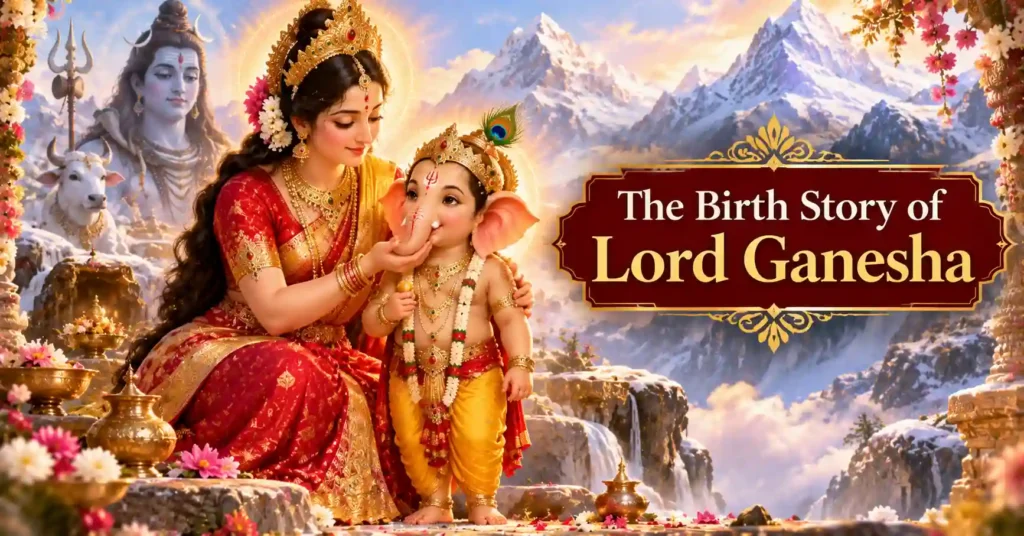
The story of Lord Ganesha’s birth is one of the most cherished narratives in Hindu tradition. According to the Shiva Purana, Goddess Parvati created a young boy from the turmeric paste and sacred substances from her own body. She breathed life into him and accepted him as her son.
One day, while Goddess Parvati was bathing, she instructed the boy to guard the entrance and allow no one inside. When Lord Shiva returned to his abode on Mount Kailash, the boy, unaware of Shiva’s identity, faithfully carried out his mother’s command and refused Him entry.
A confrontation followed, and despite the efforts of Shiva’s attendants, the young guardian stood his ground. In the ensuing conflict, Lord Shiva severed the boy’s head. When Goddess Parvati learned what had happened, she was overcome with grief and anger.
To console Parvati and restore peace, Lord Shiva ordered His attendants to bring the head of the first living being they encountered. They returned with the head of an elephant. Shiva placed the elephant’s head upon the boy’s body, restored him to life, and blessed him with a unique honor.
Lord Shiva declared that Ganesha would be known as Ganapati, the lord of His attendants, and that He would be worshipped before all other deities. From that day onward, Lord Ganesha became revered as the remover of obstacles (Vighnaharta), the god of wisdom, and the lord of auspicious beginnings.
Beyond the story itself, the birth of Lord Ganesha teaches important spiritual lessons about devotion, obedience, humility, and the transformative power of divine grace. It also explains why Lord Ganesha h
Why Is Lord Ganesha Worshipped First in Every Hindu Ritual?
Before the worship of any deity, Hindus traditionally invoke Lord Ganesha. Whether it is a puja, wedding, housewarming ceremony, business inauguration, or any new undertaking, Lord Ganesha is remembered first and offered prayers. This is why He is known as Prathama Pujya, the one who is worshipped before all others.
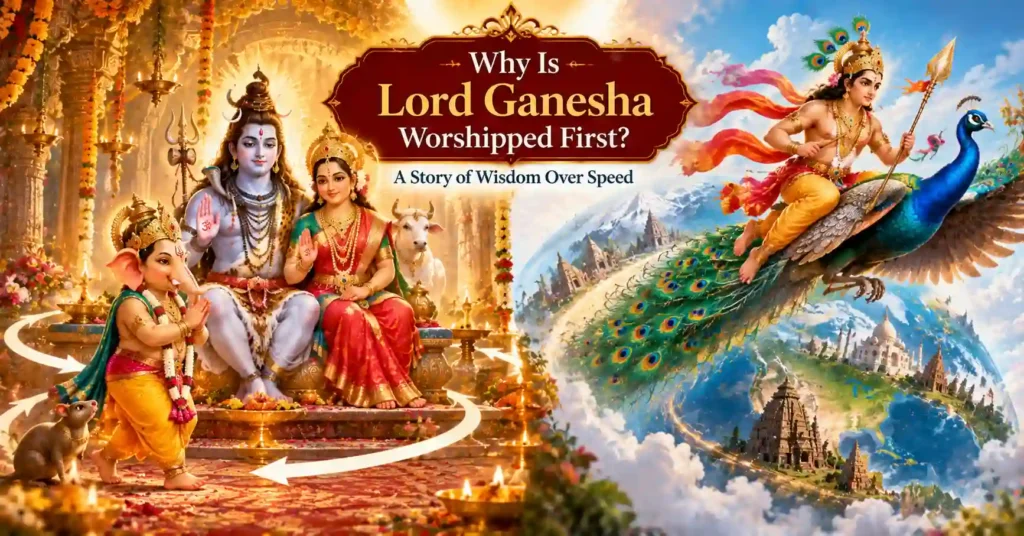
According to the Puranas, after restoring Ganesha to life, Lord Shiva blessed Him with a unique honor. He declared that Lord Ganesha would be worshipped before all gods and that no auspicious activity would begin without first seeking His blessings. This divine boon established Ganesha’s place at the beginning of every Hindu ritual.
Another popular story explains this honor through a contest between Lord Ganesha and his brother Kartikeya. The brothers were challenged to circle the universe, and the winner would receive special recognition. While Kartikeya set off on his peacock to travel the world, Ganesha simply circumambulated Lord Shiva and Goddess Parvati, declaring that his parents were his entire universe. Pleased by his wisdom and devotion, the gods granted Him the status of first worship.
Lord Ganesha is also known as Vighnaharta, the remover of obstacles. Devotees believe that remembering Him at the start of any task helps remove difficulties and ensures a smooth and successful outcome. For this reason, His blessings are sought before important decisions, journeys, ceremonies, and spiritual practices.
On a deeper level, worshipping Lord Ganesha first reminds us that wisdom should guide every action. His place at the beginning of all rituals teaches that success comes not only from effort but also from right understanding, humility, and devotion.
Ganesh Chaturthi in Hindu Scriptures
The significance of Ganesh Chaturthi is rooted in several Hindu scriptures and Puranas that describe the glory, worship, and divine role of Lord Ganesha. These texts present Him not only as the remover of obstacles but also as a symbol of wisdom, intellect, and spiritual awakening.
Among the most important texts dedicated to Lord Ganesha are the Ganesha Purana and the Mudgala Purana. These scriptures narrate His birth, divine exploits, forms, incarnations, and the spiritual benefits of His worship. They also emphasize His role as the deity who grants success and removes difficulties from the path of devotees.
The Mudgala Purana describes various manifestations of Lord Ganesha and highlights His ability to help devotees overcome inner weaknesses such as pride, greed, attachment, and ego. Through these teachings, Ganesha is portrayed as a guide on both worldly and spiritual journeys.
Scriptural traditions also praise the observance of Ganesh Chaturthi Vrat, stating that sincere worship of Lord Ganesha can bring blessings related to Dharma (righteousness), Artha (prosperity), Kama (fulfillment of desires), and Moksha (liberation).
These sacred texts help explain why Lord Ganesha is honored at the beginning of rituals, festivals, and important life events. They affirm His position as Prathama Pujya, the deity whose blessings are sought before all auspicious undertakings.
Did You Know? Interesting Facts About Lord Ganesha
Lord Ganesha is one of the most widely worshipped deities in Hinduism and is revered as the remover of obstacles (Vighnaharta) and the god of wisdom and new beginnings.
He is known by many names, including Ganapati, Vinayaka, Gajanana, Ekadanta, Lambodara, and Vighneshwara, each highlighting a unique aspect of His divine nature.
Lord Ganesha is traditionally worshipped before any Hindu ritual, ceremony, or auspicious undertaking, which is why He is known as Prathama Pujya, the first deity to be worshipped.
According to Hindu tradition, Lord Ganesha served as the divine scribe who wrote the Mahabharata as Sage Vyasa dictated the epic.
One of His most recognizable features is His broken tusk, which symbolizes sacrifice, perseverance, and the pursuit of knowledge.
Lord Ganesha’s elephant head represents wisdom, intelligence, and the ability to overcome obstacles through understanding and patience.
His large ears remind devotees to listen carefully, while His small eyes symbolize concentration and focused attention.
The mouse (Mushaka), Lord Ganesha’s vehicle, represents human desires and the restless mind. By riding the mouse, Ganesha teaches mastery over impulses and ego.
The sweet modak offered to Lord Ganesha symbolizes the spiritual bliss and rewards that come from wisdom, devotion, and self-discipline.
Durva grass, one of His favorite offerings, represents simplicity, humility, and purity of devotion.
Lord Ganesha is closely associated with learning and education, and many students pray to Him before examinations or the beginning of their studies.
The festival of Ganesh Chaturthi celebrates His birth and is observed with great devotion in homes, temples, and public celebrations across India and around the world.
Ganesh Visarjan, the immersion of Lord Ganesha’s idol at the end of the festival, symbolizes the cycle of creation and dissolution and reminds devotees that the divine is eternal.
Beyond blessings for success and prosperity, Lord Ganesha’s teachings encourage wisdom, humility, devotion, patience, and the ability to face life’s challenges with a calm and balanced mind.
The Symbolism of Lord Ganesha's Elephant Head
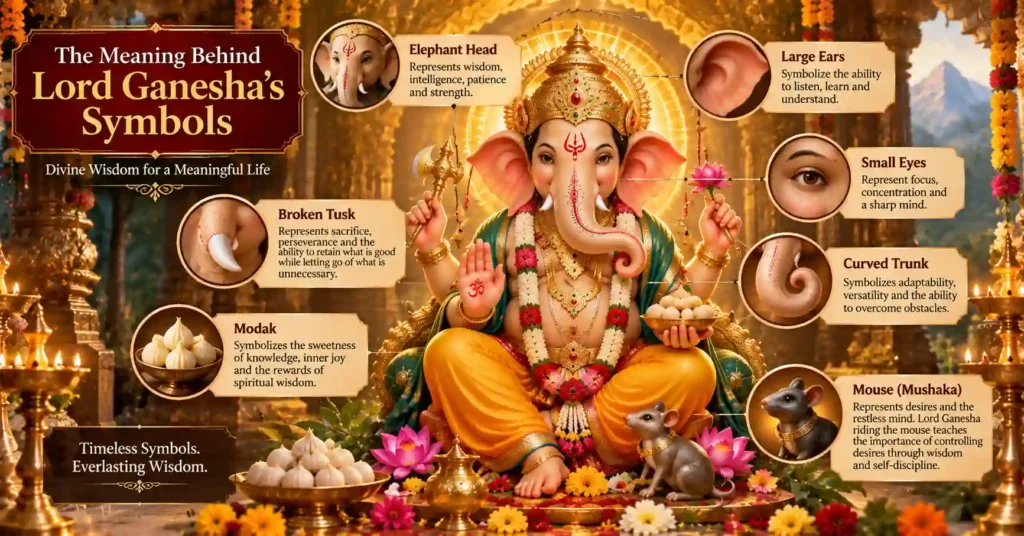
One of the most distinctive features of Lord Ganesha is His elephant head. While it originates from the story of His birth, Hindu tradition also sees it as a profound symbol of wisdom, strength, and spiritual understanding.
The elephant is admired for its intelligence, patience, and calm nature. By giving Ganesha the head of an elephant, the scriptures remind devotees that true success comes not merely from physical strength but from wisdom, discernment, and thoughtful action.
The elephant’s large head symbolizes the importance of thinking broadly and cultivating higher knowledge. It encourages devotees to look beyond immediate concerns and develop a deeper understanding of life and dharma.
An elephant can remove obstacles from its path with ease. Similarly, Lord Ganesha is revered as Vighnaharta, the remover of obstacles, helping devotees overcome difficulties in both worldly and spiritual pursuits.
The elephant is also known for its excellent memory. This quality symbolizes awareness, learning, and the ability to retain spiritual wisdom. For this reason, students, scholars, and seekers often pray to Lord Ganesha before beginning their studies.
On a deeper level, the elephant head teaches that wisdom should govern actions, emotions, and desires. It reminds devotees that a calm mind, guided by knowledge and humility, is one of the greatest strengths a person can possess.
The symbolism of Lord Ganesha’s elephant head continues to inspire devotees to cultivate intelligence, patience, compassion, and spiritual insight in their daily lives.
The Meaning of Ganesha's Large Ears, Small Eyes and Curved Trunk
Every feature of Lord Ganesha’s form carries a spiritual message. His large ears, small eyes, and curved trunk are not merely physical characteristics but symbols that teach valuable lessons for daily life and spiritual growth.
Large Ears: Listen More, Speak Less
Lord Ganesha’s large ears symbolize the importance of listening carefully. Just as an elephant can hear sounds from great distances, devotees are encouraged to listen with patience, openness, and understanding.
The large ears also remind us to absorb wisdom, pay attention to good advice, and distinguish truth from distraction. Spiritual growth often begins with the ability to listen before reacting.
Small Eyes: Focus and Concentration
Ganesha’s small eyes represent concentration, attention, and clear vision. They teach devotees to remain focused on their goals and not become distracted by temporary challenges.
In spiritual life, small eyes symbolize looking beyond appearances and developing insight into deeper truths. They encourage mindfulness, discipline, and steady effort.
Curved Trunk: Adaptability and Efficiency
The trunk of an elephant is both powerful and delicate. It can uproot a tree or pick up a tiny flower with equal ease. For this reason, Lord Ganesha’s curved trunk symbolizes adaptability, balance, and practical wisdom.
The trunk teaches that true strength lies in knowing when to be firm and when to be gentle. It also reminds devotees to adapt to changing circumstances while remaining rooted in dharma and spiritual values.
Together, these features convey a timeless message: listen carefully, stay focused on what truly matters, and approach life’s challenges with wisdom, flexibility, and balance.
What Does Lord Ganesha's Broken Tusk Symbolize?
One of the most recognizable features of Lord Ganesha is His single tusk, which has earned Him the name Ekadanta, meaning “the One-Tusked Lord.” While several stories explain how Ganesha lost one of His tusks, the symbol carries profound spiritual lessons that continue to inspire devotees.
According to a popular tradition, Lord Ganesha broke His tusk and used it as a writing instrument when recording the Mahabharata as Sage Vyasa dictated the epic. This act demonstrated His commitment to duty, knowledge, and keeping His word.
The broken tusk symbolizes sacrifice for a higher purpose. It teaches that achieving something meaningful often requires giving up personal comfort, pride, or attachment. Lord Ganesha willingly sacrificed a part of Himself to complete a task of great importance.
The tusk also represents the ability to retain what is good and discard what is unnecessary. Just as one tusk remains while the other is absent, devotees are encouraged to hold on to wisdom, truth, and virtue while letting go of negativity, ego, and harmful habits.
Another interpretation links the broken tusk to overcoming duality. It reminds devotees to rise above opposing forces such as success and failure, praise and criticism, or pleasure and pain, and remain balanced in all situations.
Through the symbolism of His broken tusk, Lord Ganesha teaches perseverance, self-discipline, wisdom, and the importance of dedicating one’s efforts to a noble cause.
The Symbolism of Mushaka (The Mouse)
Every aspect of Lord Ganesha’s form carries a deeper meaning, including His vehicle, Mushaka, the mouse. At first glance, the pairing of a mighty elephant-headed deity with a small mouse may seem unusual, but it contains profound spiritual symbolism.
In Hindu tradition, the mouse represents desires, restlessness, and the wandering mind. Just as a mouse can quickly move from one place to another and squeeze into the smallest spaces, human desires often jump from one object to another, making it difficult to find lasting peace and contentment.
By riding the mouse, Lord Ganesha demonstrates mastery over desires and impulses. He teaches devotees that the mind should be guided by wisdom rather than controlled by cravings, distractions, or ego.
The mouse is also known for its ability to reach places that larger animals cannot. This symbolizes Lord Ganesha’s power to remove obstacles from even the most difficult situations and to reach the hearts of all devotees, regardless of their circumstances.
Another lesson comes from the contrast between Ganesha’s large form and the small mouse beneath Him. It reminds us that true greatness is not measured by size, status, or power. Even the smallest being has an important role in the divine order and deserves respect.
The symbolism of Mushaka encourages devotees to control desires, overcome ego, and use wisdom to guide their thoughts and actions. When the restless mind is brought under control, it becomes a helpful companion rather than an obstacle on the spiritual path.
Why Are Modak and Durva Grass Offered to Lord Ganesha?
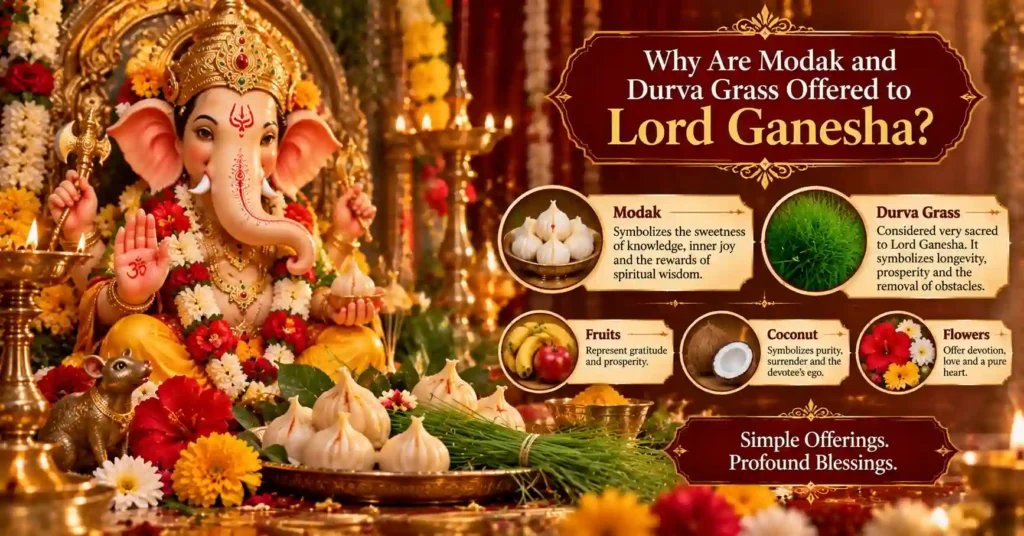
Among the many offerings made to Lord Ganesha, Modak and Durva Grass hold a special place. Both are deeply connected to Hindu tradition and carry symbolic meanings that go beyond ritual worship.
Why Is Modak Offered to Lord Ganesha?
Modak is a sweet dumpling traditionally prepared with rice flour, coconut, and jaggery. It is considered Lord Ganesha’s favorite food and is often offered during Ganesh Chaturthi and other Ganapati worship ceremonies.
Spiritually, the sweet filling of the modak symbolizes the joy, wisdom, and inner bliss that come from spiritual knowledge. Just as the sweetness is hidden inside the modak, true happiness is found within rather than in external possessions.
Offering modak reminds devotees that the rewards of devotion, discipline, and right living are ultimately sweet and fulfilling.
Why Is Durva Grass Offered to Lord Ganesha?
Durva (Bermuda grass) is one of the most sacred offerings in Ganesha worship. According to Hindu tradition, Lord Ganesha is especially pleased by sincere offerings of fresh Durva grass.
Durva symbolizes humility, simplicity, purity, and resilience. Even when cut, it grows back quickly and continues to thrive. This quality represents the ability to overcome challenges and remain strong in the face of difficulties.
The offering also teaches that Lord Ganesha values devotion and sincerity more than expensive gifts. A simple offering made with faith is considered more meaningful than a grand offering made without devotion.
The Deeper Message Behind These Offerings
Together, Modak and Durva Grass convey an important spiritual lesson. Modak represents the sweetness of wisdom and spiritual fulfillment, while Durva symbolizes humility and perseverance.
These offerings remind devotees that true success comes when knowledge is combined with simplicity, devotion, and inner strength. Through such symbols, Lord Ganesha’s worship continues to teach timeless values that remain relevant in everyday life.
Ganesh Chaturthi Puja Vidhi at Home
Performing Ganesh Chaturthi Puja at home is a beautiful way to welcome Lord Ganesha and seek His blessings for wisdom, prosperity, and the removal of obstacles. While traditions may vary, the essence of the worship is devotion, sincerity, and faith.
1. Clean the Home and Puja Area
Begin by cleaning the house and preparing a dedicated space for the puja. A clean and peaceful environment is considered auspicious for welcoming Lord Ganesha.
2. Install the Ganesh Idol
Place the idol of Lord Ganesha on a clean platform decorated with a cloth, flowers, and rangoli if desired. Many devotees perform Ganapati Sthapana during the auspicious puja muhurat.
3. Take a Sankalpa
Offer prayers and make a sincere resolve (Sankalpa) for the puja. Pray for wisdom, harmony, success, and spiritual growth for yourself and your family.
4. Invoke Lord Ganesha
Light a diya and incense sticks. Chant simple prayers such as:
Om Gam Ganapataye Namah
Invite Lord Ganesha to accept your worship and blessings.
5. Offer Flowers and Sacred Items
Offer flowers, Durva grass, sandalwood paste, fruits, coconut, and other traditional items. These offerings symbolize devotion, gratitude, and respect.
6. Offer Modak and Prasad
Present modak or other sweets as bhog. Since modak is considered Lord Ganesha’s favorite offering, it is commonly included in Ganesh Chaturthi worship.
7. Perform Aarti
Sing Ganesh Aarti with devotion and gratitude. Family members often gather together to participate in the aarti and prayers.
8. Conclude with Prayers
Offer your final prayers and seek Lord Ganesha’s blessings for wisdom, good health, prosperity, and success in all righteous endeavors.
Important Reminder
The most important aspect of Ganesh Chaturthi Puja is not the complexity of the ritual but the sincerity of devotion. Even a simple prayer offered with faith and a pure heart is believed to please Lord Ganesha.
Ganesh Chaturthi Vrat Rules and Offerings
Many devotees observe a Ganesh Chaturthi Vrat to seek Lord Ganesha’s blessings for wisdom, prosperity, success, and the removal of obstacles. While fasting practices vary by region and family tradition, the vrat is primarily observed with devotion, self-discipline, and sincere prayer.
Common Vrat Rules
Wake up early, bathe, and wear clean clothes before beginning the vrat.
Perform Ganesh Puja during the auspicious muhurat and offer prayers with faith.
Maintain purity in thoughts, words, and actions throughout the day.
Some devotees observe a full fast, while others consume fruits, milk, and vrat-friendly foods.
Avoid tamasic foods and focus on prayer, mantra chanting, and spiritual reflection.
Recite Ganesh mantras, stotras, or devotional hymns dedicated to Lord Ganesha.
Break the fast after completing the puja according to family or regional customs.
Traditional Offerings to Lord Ganesha
The following offerings are commonly made during Ganesh Chaturthi worship:
Modak – Lord Ganesha’s favorite sweet, symbolizing spiritual bliss and wisdom.
Durva Grass – Represents humility, purity, and resilience.
Red Flowers – Offered as a symbol of devotion and respect.
Coconut – Represents surrender of the ego to the Divine.
Fruits – Symbolize gratitude and the fruits of righteous actions.
Sandalwood Paste – Offered for purity and auspiciousness.
Laddu and Other Sweets – Prepared as prasad and shared among devotees.
The Spirit of the Vrat
The true purpose of the Ganesh Chaturthi Vrat is not merely abstaining from food but cultivating devotion, self-control, gratitude, and remembrance of Lord Ganesha. The vrat encourages devotees to seek inner wisdom, overcome obstacles, and begin new endeavors with faith and a positive mindset.
Whether observed through a strict fast or simple devotional practices, the sincerity of one’s devotion is considered the most important offering to Lord Ganesha.
Ganesh Chaturthi Celebrations Across India
Ganesh Chaturthi is celebrated with immense devotion and enthusiasm across India. While the core purpose of the festival remains the same, the customs, rituals, and cultural expressions vary from region to region, reflecting the country’s rich spiritual heritage.
In many households, devotees install idols of Lord Ganesha, perform daily pujas, sing bhajans, and offer modaks and other traditional sweets. Temples organize special prayers, devotional programs, and community gatherings throughout the festival.
Public celebrations are especially vibrant in cities and towns where beautifully decorated pandals are set up for worship. These gatherings often feature devotional music, cultural performances, spiritual discourses, and charitable activities that bring communities together.
The festival concludes with Ganesh Visarjan, when devotees bid farewell to Lord Ganesha and immerse the idol in a water body with prayers and chants. This emotional ceremony symbolizes gratitude, devotion, and the belief that the Lord returns to bless His devotees again the following year.
Beyond the festivities, Ganesh Chaturthi strengthens family bonds, community spirit, and collective devotion. It serves as a reminder that faith, wisdom, and unity can help people overcome obstacles and move forward with confidence and hope.
Regional Traditions of Ganesh Chaturthi
Ganesh Chaturthi is celebrated throughout India, but each region adds its own unique customs and traditions to the festival.
Maharashtra
Maharashtra is widely known for its grand Ganesh Chaturthi celebrations. Large public pandals, community worship, devotional processions, and elaborate Ganesh Visarjan ceremonies attract millions of devotees every year. The festival gained renewed prominence during the freedom movement through the efforts of Bal Gangadhar Tilak, who encouraged public celebrations to foster unity.
Karnataka
In Karnataka, devotees celebrate the festival with home pujas, temple worship, cultural programs, and offerings of traditional sweets. Many families prepare special dishes and gather for prayers dedicated to Lord Ganesha.
Andhra Pradesh and Telangana
Known as Vinayaka Chavithi, the festival is observed with elaborate idol installations, devotional singing, and community celebrations. Temples and homes alike are decorated with flowers and festive decorations.
Tamil Nadu
In Tamil Nadu, the festival is commonly known as Pillayar Chaturthi. Devotees offer kozhukattai, a sweet dumpling similar to modak, and perform special prayers seeking Lord Ganesha’s blessings.
Goa
Many families in Goa create eco-friendly clay idols and celebrate the festival with traditional rituals, prayers, and family gatherings that emphasize simplicity and devotion.
Other Parts of India
Ganesh Chaturthi is also celebrated in Gujarat, Odisha, West Bengal, Uttar Pradesh, Madhya Pradesh, and many other regions. Although customs may differ, the devotion to Lord Ganesha and the spirit of seeking wisdom and auspicious beginnings remain the same.
These regional traditions demonstrate how Lord Ganesha’s worship transcends linguistic, cultural, and geographical boundaries, uniting devotees through faith and devotion.
Ganesh Visarjan: Meaning, Ritual and Spiritual Significance
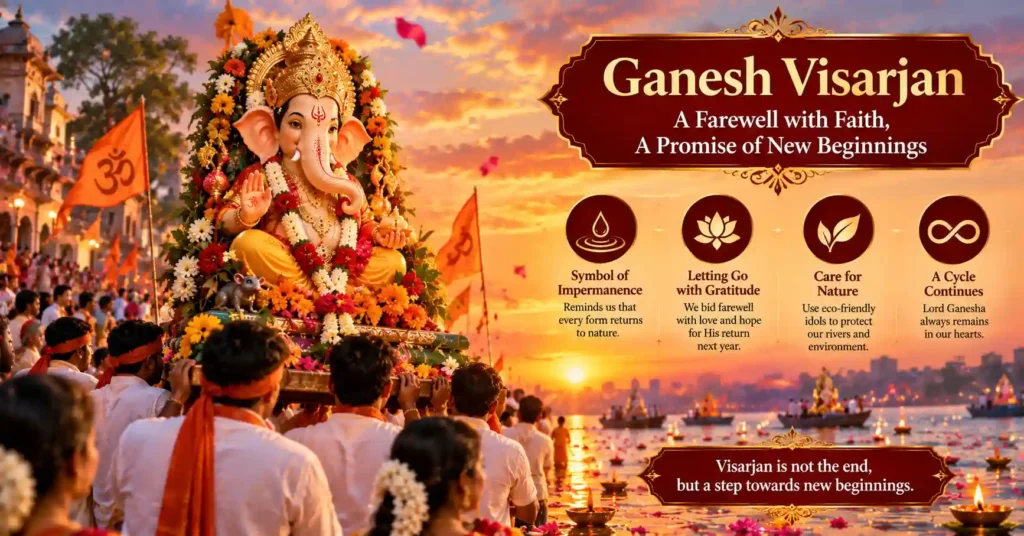
Ganesh Visarjan marks the conclusion of Ganesh Chaturthi celebrations. On this day, devotees bid farewell to Lord Ganesha by immersing His idol in a river, lake, sea, or other water body with prayers, devotional songs, and chants of “Ganpati Bappa Morya, Pudhchya Varshi Lavkar Ya” (O Lord Ganesha, come again soon next year).
What Does Visarjan Mean?
The word Visarjan means “immersion” or “farewell.” It signifies the ceremonial return of Lord Ganesha’s physical form to the five elements of nature. While the idol is immersed, devotees believe that Lord Ganesha’s blessings and divine presence remain with them.
Why Is Ganesh Visarjan Performed?
According to Hindu tradition, Lord Ganesha visits His devotees during Ganesh Chaturthi and returns to His divine abode after the festival. The immersion ceremony expresses gratitude for His blessings and symbolizes the completion of His earthly visit.
Visarjan also reminds devotees that all physical forms are temporary. Everything in the material world is created, exists for a time, and eventually returns to its source.
The Spiritual Significance of Ganesh Visarjan
Ganesh Visarjan teaches several profound spiritual lessons:
Impermanence: All worldly forms are temporary, while the Divine is eternal.
Detachment: Devotees learn to let go with gratitude rather than attachment.
Renewal: Every ending creates space for a new beginning.
Faith: Although the idol is immersed, Lord Ganesha’s presence remains in the hearts of devotees.
The ritual encourages devotees to carry Lord Ganesha’s teachings of wisdom, humility, and devotion into their daily lives long after the festival ends.
Eco-Friendly Ganesh Visarjan
In recent years, many devotees have adopted eco-friendly practices by using natural clay idols and environmentally conscious immersion methods. These efforts help preserve water bodies while honoring the spirit of the festival.
Ganesh Visarjan beautifully captures the essence of Sanatan Dharma: embracing change, honoring the cycles of life, and remembering that the Divine is present beyond all physical forms.
The Spiritual Meaning of Ganesh Chaturthi
While Ganesh Chaturthi is celebrated with prayers, festivities, and cultural traditions, its deeper purpose is spiritual transformation. The festival encourages devotees to invite the qualities of Lord Ganesha into their lives and overcome the obstacles that hinder personal and spiritual growth.
Lord Ganesha is revered as the remover of obstacles, but the greatest obstacles often lie within. Negative habits, ego, fear, ignorance, anger, and attachment can prevent a person from reaching their full potential. Ganesh Chaturthi reminds devotees to identify and overcome these inner barriers through wisdom, self-discipline, and devotion.
The festival also symbolizes new beginnings. Just as Lord Ganesha is worshipped before every auspicious undertaking, devotees are encouraged to approach new phases of life with faith, clarity, and a positive mindset. Whether starting a career, education, relationship, or spiritual practice, His blessings are sought for guidance and success.
Another important lesson comes from the installation and immersion of the Ganesh idol. Welcoming Lord Ganesha into the home represents inviting divine wisdom into one’s life, while Ganesh Visarjan teaches detachment and acceptance of life’s natural cycles. The ritual reminds devotees that while physical forms may change, the Divine remains eternal.
The symbols associated with Lord Ganesha also carry spiritual teachings. His elephant head represents wisdom, His large ears encourage listening, His small eyes symbolize focus, and His mouse vehicle teaches mastery over desires. Together, these symbols offer practical guidance for living a balanced and meaningful life.
At its heart, Ganesh Chaturthi is a celebration of faith, wisdom, humility, and inner growth. It reminds devotees that with devotion, right understanding, and divine grace, every obstacle can become an opportunity for transformation.
Benefits of Worshipping Lord Ganesha
Lord Ganesha is worshipped by millions of devotees as the remover of obstacles, the god of wisdom, and the lord of auspicious beginnings. His worship is believed to bring both spiritual and worldly benefits, helping devotees navigate life’s challenges with faith and clarity.
1. Helps Remove Obstacles
Lord Ganesha is known as Vighnaharta, the remover of obstacles. Devotees pray to Him before starting important tasks, seeking His blessings to overcome difficulties and achieve success.
2. Enhances Wisdom and Knowledge
As the deity of intellect and learning, Lord Ganesha is especially revered by students, teachers, writers, and scholars. His worship encourages clear thinking, good judgment, and a deeper understanding of life.
3. Brings Success in New Beginnings
Whether beginning a new job, business, journey, relationship, or spiritual practice, devotees seek Lord Ganesha’s blessings for a smooth and auspicious start.
4. Promotes Inner Peace and Confidence
Praying to Lord Ganesha helps cultivate faith, patience, and a positive outlook. Many devotees find comfort and strength through His presence during challenging times.
5. Encourages Humility and Self-Discipline
The symbolism of Lord Ganesha teaches important virtues such as humility, focus, perseverance, and control over desires. These qualities support personal growth and spiritual development.
6. Strengthens Devotion and Spiritual Awareness
Regular worship encourages devotees to remember the Divine in their daily lives. It fosters gratitude, self-reflection, and a deeper connection with spiritual values.
7. Invites Prosperity and Well-Being
Lord Ganesha is often associated with prosperity, abundance, and overall well-being. Devotees pray for harmony, happiness, and success in both family and professional life.
8. Inspires a Balanced Approach to Life
Through His symbols and teachings, Lord Ganesha reminds devotees to combine wisdom with action, strength with compassion, and ambition with humility.
Ultimately, the greatest benefit of worshipping Lord Ganesha is the cultivation of a wiser, calmer, and more spiritually grounded life. His blessings inspire devotees to face challenges with courage and move forward with confidence and faith.
Simple Ways to Celebrate Ganesh Chaturthi at Home
Ganesh Chaturthi can be celebrated meaningfully at home, regardless of the size of the celebration. What matters most is devotion, gratitude, and remembrance of Lord Ganesha’s teachings.
1. Welcome Lord Ganesha with Devotion
Install a Ganesh idol or place an image of Lord Ganesha in a clean and peaceful area of your home. Decorate the space with flowers, lamps, and simple festive decorations.
2. Perform a Simple Ganesh Puja
Offer flowers, Durva grass, fruits, and sweets while chanting prayers or mantras such as “Om Gam Ganapataye Namah.” Even a short and sincere puja can be spiritually meaningful.
3. Offer Modak or Homemade Prasad
Prepare modaks or any homemade sweet as an offering to Lord Ganesha. Sharing prasad with family members fosters devotion and togetherness.
4. Chant Mantras and Bhajans
Spend time reciting Ganesh mantras, singing devotional songs, or listening to spiritual discourses related to Lord Ganesha and Ganesh Chaturthi.
5. Read Sacred Stories
Read stories about Lord Ganesha’s birth, His role in writing the Mahabharata, and the lessons behind His symbols. This helps children and adults connect with the deeper meaning of the festival.
6. Practice Charity and Kindness
Ganesh Chaturthi is also an opportunity to help others. Donating food, supporting those in need, or performing acts of kindness reflects the values of compassion and service.
7. Choose Eco-Friendly Celebrations
If installing an idol, consider using a natural clay idol and environmentally friendly decorations. This helps honor both tradition and nature.
8. Reflect on Lord Ganesha’s Teachings
Take a few moments to reflect on qualities associated with Lord Ganesha, such as wisdom, patience, humility, and perseverance. Consider how these values can be applied in daily life.
Celebrating Ganesh Chaturthi at home does not require elaborate arrangements. A simple observance performed with faith, devotion, and gratitude can create a meaningful spiritual experience for the entire family.
Common Misconceptions About Lord Ganesha
Over the centuries, many stories and traditions associated with Lord Ganesha have been simplified or misunderstood. Understanding these misconceptions can help devotees appreciate His symbolism and teachings more deeply.
1. Lord Ganesha Is Worshipped Only for Material Success
Many people associate Lord Ganesha solely with wealth, success, or the removal of external obstacles. While devotees do seek His blessings for these purposes, His deeper role is to guide individuals toward wisdom, right judgment, self-discipline, and spiritual growth.
2. The Elephant Head Is Just a Mythological Feature
Lord Ganesha’s elephant head is not merely a unique physical characteristic. It symbolizes intelligence, patience, strength, and higher wisdom. Every feature of His form carries a spiritual lesson for devotees.
3. Worshipping Ganesha Automatically Removes All Problems
Lord Ganesha is known as the remover of obstacles, but this does not mean that challenges instantly disappear. His blessings help devotees develop the wisdom, courage, and perseverance needed to overcome difficulties and learn from them.
4. Ganesh Chaturthi Is Only About Festivities
While Ganesh Chaturthi is celebrated with music, decorations, and community events, its deeper purpose is spiritual reflection, devotion, self-improvement, and remembrance of Lord Ganesha’s teachings.
5. The Mouse Vehicle Has No Special Meaning
Some view Mushaka merely as Lord Ganesha’s vehicle. In reality, the mouse symbolizes desires, restlessness, and the wandering mind. Lord Ganesha riding the mouse teaches mastery over impulses and ego.
6. Only Grand Celebrations Please Lord Ganesha
Devotion is more important than scale. A simple prayer, sincere offering, or heartfelt remembrance is considered just as meaningful as elaborate rituals performed with external grandeur.
7. Lord Ganesha Is Relevant Only During Ganesh Chaturthi
Although Ganesh Chaturthi is the most famous festival dedicated to Him, Lord Ganesha is worshipped throughout the year. His teachings on wisdom, humility, focus, and perseverance remain relevant in everyday life.
By understanding these misconceptions, devotees can move beyond surface-level beliefs and connect more deeply with the spiritual significance of Lord Ganesha and His timeless teachings.
Philosophical Lessons from Lord Ganesha
Beyond the stories and rituals, Lord Ganesha’s form and teachings offer profound philosophical insights that remain relevant in everyday life. His symbolism encourages devotees to cultivate wisdom, humility, self-discipline, and a balanced approach to life’s challenges.
1. Wisdom Is Greater Than Strength
Lord Ganesha’s elephant head symbolizes intelligence and discernment. His life teaches that wisdom and right understanding often achieve what force and power cannot.
2. Listen More Than You Speak
Ganesha’s large ears remind us to listen carefully before acting or judging. True learning begins with attentive listening and an open mind.
3. Stay Focused on What Matters
His small eyes symbolize concentration and clarity of purpose. They encourage devotees to remain focused on their goals and avoid unnecessary distractions.
4. Adapt to Changing Circumstances
The curved trunk of Lord Ganesha demonstrates flexibility and adaptability. Just as the trunk can perform both delicate and powerful tasks, we should learn to respond wisely to different situations.
5. Control Desires Rather Than Being Controlled by Them
The mouse vehicle represents desires and the restless mind. By riding Mushaka, Lord Ganesha teaches that true freedom comes from mastering impulses rather than becoming their servant.
6. Make Sacrifices for a Higher Purpose
The broken tusk symbolizes dedication, perseverance, and self-sacrifice. Meaningful achievements often require discipline, commitment, and the willingness to put a greater purpose above personal comfort.
7. Begin Every Endeavor with the Right Mindset
As the deity of auspicious beginnings, Lord Ganesha reminds devotees to approach every task with preparation, humility, and faith. A strong foundation often determines the success of the journey ahead.
8. Balance Material and Spiritual Life
Lord Ganesha blesses devotees with prosperity and success, yet His teachings also emphasize wisdom, self-awareness, and spiritual growth. He shows that worldly responsibilities and spiritual values can coexist in harmony.
9. Overcome Obstacles Within
While Lord Ganesha is known as the remover of obstacles, His teachings suggest that many obstacles arise from within, such as fear, ego, anger, attachment, and ignorance. True progress begins by addressing these inner barriers.
10. Walk the Path of Dharma
At the heart of Lord Ganesha’s teachings is the importance of living with integrity, responsibility, compassion, and devotion. Following dharma helps create a meaningful and balanced life.
These timeless lessons explain why Lord Ganesha is revered not only as a deity but also as a guide for personal growth, spiritual development, and wise living.
Key Takeaways
- Ganesh Chaturthi celebrates the birth of Lord Ganesha, the remover of obstacles and the deity of wisdom, prosperity, and auspicious beginnings.
- The festival is observed on Bhadrapada Shukla Chaturthi and is one of the most widely celebrated Hindu festivals.
- Lord Ganesha is worshipped first in Hindu rituals because He was blessed by Lord Shiva to receive the first worship before all auspicious undertakings.
- The story of Lord Ganesha’s birth highlights the values of devotion, duty, and divine grace.
- His role as the scribe of the Mahabharata reflects His wisdom, dedication, and commitment to knowledge.
- Every symbol associated with Lord Ganesha carries a deeper meaning:
- Elephant Head – Wisdom and intelligence
- Large Ears – Listening and learning
- Small Eyes – Focus and concentration
- Curved Trunk – Adaptability and balance
- Broken Tusk – Sacrifice and perseverance
- Mouse Vehicle – Mastery over desires and ego
- Modak symbolizes the sweetness of spiritual wisdom, while Durva Grass represents humility and resilience.
- Ganesh Chaturthi encourages devotees to cultivate wisdom, humility, self-discipline, and faith in everyday life.
- Ganesh Visarjan symbolizes gratitude, detachment, and the understanding that while physical forms are temporary, the Divine is eternal.
- The festival teaches that many of life’s greatest obstacles are internal and can be overcome through devotion, right understanding, and spiritual growth.
- Lord Ganesha’s timeless teachings continue to inspire devotees to begin every endeavor with wisdom, positivity, and trust in divine guidance.
Conclusion
Ganesh Chaturthi is much more than a celebration of Lord Ganesha’s birth. It is a festival that brings together devotion, wisdom, symbolism, and spiritual reflection. From the story of His birth and His role as the first deity worshipped in Hindu traditions to the deeper meaning behind His elephant head, broken tusk, and mouse vehicle, every aspect of Lord Ganesha offers valuable lessons for life.
The festival reminds devotees to approach new beginnings with faith, overcome obstacles with wisdom, and cultivate qualities such as humility, patience, focus, and self-discipline. Through prayers, rituals, and reflection, Ganesh Chaturthi provides an opportunity to strengthen one’s connection with the Divine and apply timeless spiritual teachings in daily life.
As devotees welcome Lord Ganesha into their homes and hearts, they are reminded that true success is not measured only by external achievements but also by inner growth, right understanding, and devotion. May Lord Ganesha bless all with wisdom, prosperity, happiness, and the strength to overcome every obstacle on the path of life. 🙏
Suggested Reading
If you enjoyed learning about Ganesh Chaturthi, Lord Ganesha’s symbolism, and the spiritual meaning behind this beloved festival, you may also enjoy these related articles:
Hindu Festivals Explained: Meaning, Types, Calendar & Spiritual Importance
Understand how Hindu festivals are connected to the lunar calendar, seasons, deities, and spiritual traditions.
https://thesanatantales.com/hindu-festivals-explained/Gayatri Jayanti: Story, Meaning, Significance, Puja and Gayatri Mantra
Discover the significance of Goddess Gayatri, the Gayatri Mantra, and one of Hinduism’s most revered spiritual observances.
https://thesanatantales.com/gayatri-jayanti/Gupta Navratri: Meaning, 2026 Dates, Rituals and Spiritual Significance
Explore the lesser-known Navratri dedicated to the worship of Divine Shakti and spiritual practices.
https://thesanatantales.com/gupta-navratri/Mahashivratri: Meaning, Date, Rituals, Vrat Rules & Puja Vidhi
Learn about the great night of Lord Shiva, its spiritual symbolism, fasting rules, and sacred observances.
https://thesanatantales.com/mahashivratri/Holi: Festival of Colors, Date, Holika Dahan, Rituals, Story and Significance
Discover the deeper spiritual meaning behind Holi, one of India’s most vibrant and widely celebrated festivals.
https://thesanatantales.com/holi-festival/Ram Navami: Date, Puja Vidhi, Vrat, Significance and Lord Ram’s Birth Story
Explore the birth of Lord Rama, the importance of Ram Navami, and the values it teaches devotees.
https://thesanatantales.com/ram-navami/Narasimha Jayanti: Date, Story, Significance, Puja Vidhi and Celebrations
Learn about Lord Narasimha’s appearance, His protection of Prahlada, and the spiritual lessons of unwavering devotion.
https://thesanatantales.com/narasimha-jayanti/
Ganesh Chaturthi (Wikipedia)
Ganesh Chaturthi, also known as Vinayaka Chaturthi, is a Hindu festival celebrating the birth of Lord Ganesha and is observed annually during the month of Bhadrapada.
Ganesh Chaturthi (Wikipedia)
These articles will help deepen your understanding of Sanatan Dharma, Hindu festivals, devotional practices, and the spiritual teachings that continue to guide millions of devotees today.
FAQs
1. What is Ganesh Chaturthi?
Ganesh Chaturthi is a major Hindu festival that celebrates the birth of Lord Ganesha, the elephant-headed deity revered as the remover of obstacles, the god of wisdom, and the lord of auspicious beginnings. The festival is observed on the Chaturthi Tithi of Shukla Paksha in the Hindu month of Bhadrapada.
During the festival, devotees welcome Lord Ganesha into their homes and temples through prayers, offerings, devotional songs, and sacred rituals. Beautiful idols of Ganapati are installed and worshipped with great devotion before being immersed during Ganesh Visarjan.
Beyond its festive celebrations, Ganesh Chaturthi serves as a reminder to cultivate wisdom, humility, faith, and self-discipline while seeking divine guidance in all aspects of life.
2. Why is Lord Ganesha worshipped first?
Lord Ganesha is worshipped first because Hindu tradition recognizes Him as Prathama Pujya, the deity who receives worship before all other gods and goddesses during rituals, ceremonies, and auspicious occasions.
According to sacred traditions, Lord Shiva granted Ganesha this special honor after witnessing His devotion, wisdom, and dedication. Another popular story explains that Ganesha earned this privilege by demonstrating superior wisdom during a divine contest with His brother Kartikeya.
As Vighnaharta, the remover of obstacles, Lord Ganesha is invoked before beginning any important undertaking. His worship symbolizes starting every action with wisdom, clarity, humility, and divine blessings to ensure success and harmony.
3. What is the significance of Ganesh Chaturthi?
Ganesh Chaturthi commemorates the birth of Lord Ganesha and celebrates His role as the remover of obstacles, bestower of wisdom, and guide for new beginnings. It is one of the most widely observed festivals in Hinduism.
The festival encourages devotees to seek blessings for knowledge, prosperity, success, and spiritual growth. Through prayers, fasting, charity, and devotional practices, devotees strengthen their connection with Lord Ganesha and reflect upon His teachings.
On a deeper level, Ganesh Chaturthi reminds people to overcome inner obstacles such as ego, fear, ignorance, and attachment. It teaches that true success comes from combining effort with wisdom, humility, and devotion.
4. Why does Lord Ganesha have an elephant head?
According to Hindu tradition, Goddess Parvati created Ganesha and appointed Him as her guardian. When Lord Shiva returned and was denied entry, a conflict arose that resulted in Ganesha losing His head. To restore Him to life, Shiva placed the head of an elephant upon His body and blessed Him with divine status.
Spiritually, the elephant head carries profound symbolism. It represents wisdom, intelligence, patience, strength, and thoughtful decision-making.
The elephant is also known for its calm nature and ability to overcome obstacles. Through this symbolism, Lord Ganesha teaches devotees that wisdom and understanding are often more powerful than force or aggression.
5. What does Lord Ganesha's mouse vehicle represent?
Lord Ganesha’s vehicle, known as Mushaka, is one of the most meaningful symbols in Hindu iconography. The mouse represents human desires, temptations, and the restless nature of the mind.
Just as a mouse constantly moves from one place to another, the human mind often wanders among countless thoughts and distractions. By riding the mouse, Lord Ganesha demonstrates mastery over desires and impulses.
The symbolism teaches that wisdom should guide our actions rather than uncontrolled cravings or ego. It also reminds devotees that even the smallest beings have value and purpose in the divine order of creation.
6. Why is modak offered to Lord Ganesha?
Modak is traditionally regarded as Lord Ganesha’s favorite sweet and is one of the most common offerings made during Ganesh Chaturthi and other forms of Ganapati worship.
Spiritually, modak symbolizes the sweetness of knowledge, wisdom, and inner fulfillment. Its sweet filling hidden within the outer covering represents the deeper joy that comes from spiritual understanding rather than external possessions.
Offering modak reminds devotees that sincere devotion, discipline, and righteous living eventually lead to lasting happiness. It also reflects the belief that spiritual wisdom is the greatest reward one can attain in life.
7. What is the meaning of Lord Ganesha's broken tusk?
Lord Ganesha’s broken tusk is one of His most recognizable features and has earned Him the name Ekadanta, meaning “the One-Tusked Lord.”
According to a popular tradition, Ganesha broke His tusk to continue writing the Mahabharata when His writing instrument failed. Rather than interrupting the sacred task, He sacrificed part of Himself to fulfill His commitment.
The broken tusk symbolizes dedication, perseverance, sacrifice, and devotion to knowledge. It also teaches the ability to retain what is beneficial while letting go of what is unnecessary, encouraging devotees to focus on truth, wisdom, and higher goals.
8. What is Ganesh Visarjan?
Ganesh Visarjan is the ceremonial immersion of Lord Ganesha’s idol at the conclusion of Ganesh Chaturthi celebrations. It marks the symbolic farewell to the deity after days of worship, prayer, and devotion.
The ritual reflects the Hindu understanding that all material forms are temporary. While the physical idol returns to the elements of nature, devotees believe that Lord Ganesha’s blessings remain present in their lives.
Ganesh Visarjan also teaches gratitude, detachment, and acceptance of life’s cycles. It reminds devotees that every ending creates space for a new beginning and that the Divine remains eternal beyond physical forms.
9. Can Ganesh Chaturthi be celebrated at home?
Yes, Ganesh Chaturthi can be celebrated at home with devotion and simplicity. Many families install a Ganesh idol or image, perform daily puja, chant mantras, offer flowers and sweets, and participate in aarti together.
The spiritual value of the celebration depends more on sincerity than grandeur. Even a simple observance performed with faith and devotion is considered meaningful and pleasing to Lord Ganesha.
Home celebrations also provide an opportunity for families to learn about Ganesha’s stories, teachings, and symbolism. They help create a devotional atmosphere while strengthening family bonds and spiritual awareness.
10. What are the main teachings of Lord Ganesha?
Lord Ganesha’s teachings emphasize wisdom, humility, focus, perseverance, self-discipline, and devotion. Through His stories and symbols, He offers practical lessons that can guide both spiritual and everyday life.
His large ears encourage attentive listening, His small eyes symbolize concentration, His trunk represents adaptability, and His mouse vehicle teaches mastery over desires. Together, these symbols remind devotees to live thoughtfully and responsibly.
At the heart of His teachings is the importance of overcoming obstacles, both external and internal. Lord Ganesha encourages devotees to conquer fear, ego, anger, and ignorance while walking the path of dharma, wisdom, and spiritual growth.
Glossary of Important Terms
| Term | Meaning |
|---|---|
| Ganesh Chaturthi | A Hindu festival celebrating the birth of Lord Ganesha, observed on the fourth day (Chaturthi) of the bright fortnight (Shukla Paksha) in the month of Bhadrapada. |
| Lord Ganesha (Ganapati) | The elephant-headed Hindu deity revered as the remover of obstacles, god of wisdom, intellect, and auspicious beginnings. |
| Ganapati Sthapana | The ceremonial installation of a Lord Ganesha idol for worship during Ganesh Chaturthi. |
| Prathama Pujya | A title meaning “the first to be worshipped,” referring to Lord Ganesha’s special place in Hindu rituals. |
| Vighnaharta | “Remover of Obstacles,” one of the most popular names of Lord Ganesha. |
| Vinayaka | A revered name of Lord Ganesha meaning leader, guide, or remover of obstacles. |
| Ekadanta | “The One-Tusked Lord,” referring to Lord Ganesha’s broken tusk. |
| Mushaka | The mouse that serves as Lord Ganesha’s divine vehicle (vahana). |
| Modak | A sweet dumpling traditionally offered to Lord Ganesha as prasad. |
| Durva Grass | A sacred grass considered especially dear to Lord Ganesha and commonly offered during worship. |
| Puja | A ritual of worship involving prayers, offerings, and devotion. |
| Aarti | A devotional ritual involving the waving of a lamp before a deity while singing hymns. |
| Prasad | Blessed food offered to a deity and then distributed among devotees. |
| Vrat | A religious observance or fast undertaken with devotion and discipline. |
| Mantra | A sacred sound, word, or phrase chanted during worship and meditation. |
| Om Gam Ganapataye Namah | One of the most widely recited mantras dedicated to Lord Ganesha. |
| Ganesh Visarjan | The ceremonial immersion of Lord Ganesha’s idol at the conclusion of the festival. |
| Bhadrapada | The Hindu lunar month during which Ganesh Chaturthi is celebrated. |
| Shukla Paksha | The waxing phase of the moon in the Hindu lunar calendar. |
| Chaturthi | The fourth lunar day (Tithi) in the Hindu calendar. |
| Ganeshotsav | The festival period of Ganesh Chaturthi celebrations, often lasting up to ten days. |
| Dharma | Righteous living, duty, and moral order according to Hindu philosophy. |
| Moksha | Liberation from the cycle of birth and death. |
| Sankalpa | A sacred intention or resolve made before performing a religious ritual. |
References & Sources
This article is based on traditional Hindu scriptures, including the Ganesha Purana, Mudgala Purana, Shiva Purana, Brahma Vaivarta Purana, Ganapati Atharvashirsha, and other sacred texts associated with Lord Ganesha. It also draws upon traditional beliefs, temple practices, festival customs, devotional literature, and spiritual interpretations that have been preserved within Sanatan Dharma for generations.
The article incorporates commonly accepted teachings related to Lord Ganesha’s birth, symbolism, worship, Ganesh Chaturthi celebrations, Ganesh Visarjan, and the philosophical lessons associated with His divine form and attributes.
Note: Stories, rituals, and interpretations related to Lord Ganesha may vary across regions, sampradayas (traditions), temples, and Hindu communities. The purpose of this article is not to present any single tradition as the only authoritative view, but to explain widely accepted religious, cultural, and spiritual perspectives in a simple and accessible manner for devotees and readers interested in understanding the significance of Ganesh Chaturthi and Lord Ganesha.