Tarpan is one of the most sacred rituals in Sanatan Dharma for expressing gratitude toward our ancestors, sages, and deities. Through this ancient practice, devotees offer water with reverence and remembrance, acknowledging the blessings received from previous generations. While many people associate Tarpan with Pitru Paksha, its spiritual significance extends far beyond a single period of the year.
In Hindu tradition, life is not viewed as an isolated journey. We are connected to our family lineage, cultural heritage, and spiritual roots. This sacred observance serves as a beautiful reminder of that connection. By performing the ritual, one honors the ancestors who contributed to the family’s existence, values, and traditions.
Many devotees observe this ancestral rite during Pitru Paksha, on Amavasya, or on special remembrance days dedicated to departed family members. Whether performed at a sacred river, a pilgrimage site, or at home with sincerity and devotion, the practice symbolizes gratitude, duty, and respect toward those who came before us.
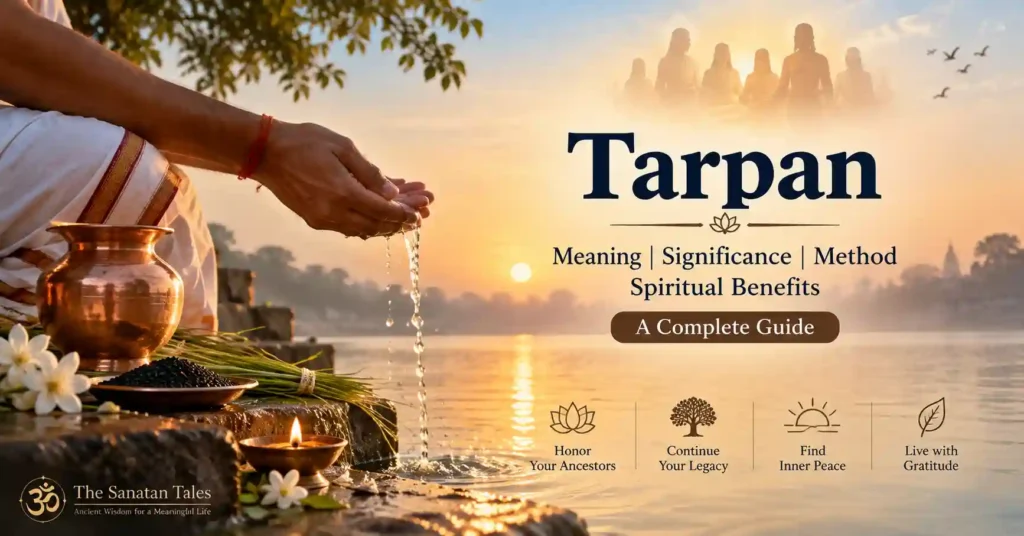
This guide explains the meaning of Tarpan, its origin, scriptural basis, method, timing, spiritual benefits, and importance during Pitru Paksha.
Tarpan at a Glance
| Aspect | Details |
|---|---|
| Meaning | Offering water with devotion to ancestors, sages, and deities |
| Sanskrit Root | Trup (to satisfy or nourish) |
| Main Purpose | Gratitude, remembrance, and fulfillment of ancestral duties |
| Common Type | Pitru Tarpan |
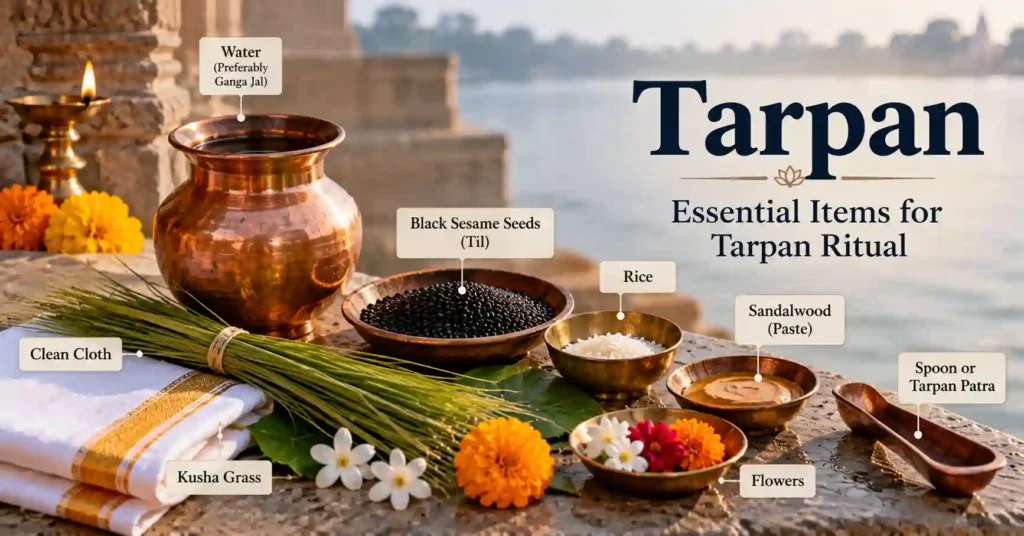
| Main Offerings | Water, black sesame seeds (til), Kusha grass, and Ganga Jal |
| Important Direction | South (for Pitru Tarpan) |
| Most Important Period | Pitru Paksha |
| Special Day | Sarva Pitru Amavasya |
| Spiritual Significance | Honors ancestors and expresses Pitru Rin (debt to ancestors) |
| Can Be Performed at Home? | Yes, following family traditions and proper procedure |
Quick Summary: Tarpan is a sacred Sanatan Dharma ritual of offering water to ancestors, sages, and deities. Most commonly performed as Pitru Tarpan during Pitru Paksha, it symbolizes gratitude, remembrance, and the fulfillment of ancestral duties.
Table of Contents
ToggleWhat Is Tarpan?
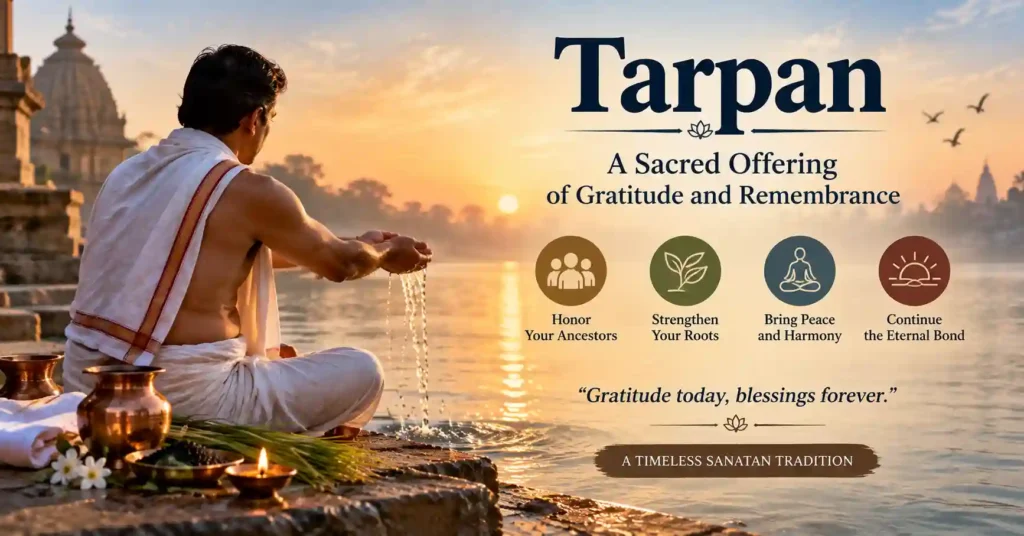
Tarpan is a traditional Hindu ritual in which water is offered with prayers and devotion to deities, sages, and ancestors. The ceremony is performed as an act of gratitude, respect, and remembrance. In its simplest form, it involves offering water through the hands while reciting prayers or mantras dedicated to the intended recipients.
The practice is deeply rooted in Vedic tradition and forms an important part of many Hindu rituals. According to traditional texts, this sacred offering is not limited to ancestors alone. It may also be dedicated to Devas (deities) and Rishis (sages), although Pitru Tarpan, which honors ancestors, remains the most widely observed form.
This ancestral rite is based on the belief that gratitude should extend beyond the living. Just as we honor parents, teachers, and elders during their lifetime, Sanatan Dharma encourages remembering departed ancestors through meaningful acts of devotion and remembrance.
The ritual is commonly observed during Pitru Paksha, Amavasya, Shraddha ceremonies, and other religious occasions. Many devotees also include this practice as part of their regular spiritual discipline and family traditions.
Tarpan Meaning and Origin
The Tarpan meaning is rooted in gratitude, remembrance, and respect. In Sanatan Dharma, Tarpan is a sacred ritual of offering water to ancestors, sages, and deities with devotion and prayers. It is one of the oldest traditions associated with honoring those who have contributed to our lives and spiritual heritage.
The word Tarpan comes from the Sanskrit root “Trup” (तृप्), which means to satisfy, nourish, or bring contentment. Through this sacred offering, devotees symbolically express gratitude and seek to honor their ancestors with sincerity and reverence.
In Hindu tradition, water holds special significance because it represents purity, life, and continuity. During the ritual, water is often offered along with black sesame seeds, Kusha grass, and prayers. These offerings serve as a symbolic expression of remembrance and respect for one’s family lineage.
Ancient Hindu texts describe different forms of this practice, including offerings to Devas (deities), Rishis (sages), and Pitrus (ancestors). Among these, Pitru Tarpan remains the most commonly observed form, especially during Pitru Paksha and Shraddha observances.
The origin of the ritual is closely linked to the Vedic concept of Pitru Yajna, one of the traditional duties that encourages individuals to remember and honor their ancestors. For centuries, families across India have followed this practice as a way of preserving family traditions, expressing gratitude, and maintaining a spiritual connection with previous generations.
Scriptural Basis of Tarpan
The practice of Tarpan is deeply rooted in the sacred texts of Sanatan Dharma. It is not merely a family custom but a ritual mentioned in various Vedic and post-Vedic scriptures. These texts emphasize gratitude toward ancestors and highlight the importance of remembering those who came before us.
One of the key foundations of this ritual is Pitru Yajna, one of the Pancha Maha Yajnas (Five Great Duties) prescribed in Hindu tradition. Pitru Yajna teaches that every person has a responsibility to honor their ancestors, who contributed to their existence, family heritage, and cultural values.
Ancient texts such as the Grihya Sutras, Dharma Shastras, Manusmriti, and several Puranas describe the offering of water and prayers to ancestors. These scriptures explain that sincere acts of remembrance help preserve respect for one’s lineage and strengthen the bond between generations.
The scriptures also mention different forms of this sacred observance dedicated to Devas (deities), Rishis (sages), and Pitrus (ancestors). Among these, Pitru Tarpan is the most widely practiced today and holds special significance as an expression of gratitude toward departed family members.
Many Hindu traditions recommend performing the ritual on Amavasya, during Shraddha ceremonies, and especially throughout Pitru Paksha. The central message remains timeless: honoring ancestors with devotion, gratitude, and humility is an important spiritual duty and a meaningful way to stay connected with one’s roots.
Why Is Tarpan Performed?
Tarpan is performed as an act of gratitude, remembrance, and respect toward ancestors, sages, and deities. In Sanatan Dharma, it is believed that every individual is connected to a lineage that extends across generations. This sacred practice provides an opportunity to acknowledge that connection and honor those whose lives, sacrifices, and blessings have shaped our existence.
One of the main purposes of Pitru Tarpan is to remember departed family members with devotion and sincerity. Just as people express love and respect to parents, teachers, and elders during their lifetime, this ancestral observance serves as a traditional way of continuing that respect after their passing. It keeps the memory of ancestors alive and reinforces family values across generations.
The ritual is also linked to the concept of Pitru Rin, the debt owed to one’s ancestors. Hindu tradition teaches that every person receives life, culture, traditions, and guidance through their family lineage. By offering water and prayers, devotees symbolically express gratitude for these blessings and fulfill an important spiritual responsibility.
Beyond its religious significance, the practice encourages reflection and humility. It reminds us that our achievements and opportunities are built upon the efforts of countless people who came before us. Remembering their contributions fosters a sense of gratitude and respect for our roots.
For many devotees, this observance is not simply a ritual but a heartfelt expression of remembrance. Whether performed during Pitru Paksha, on Amavasya, or during a Shraddha ceremony, it serves as a meaningful way to honor ancestors and preserve a spiritual connection with family heritage.
Who Receives Tarpan? Types of Tarpan
Although many people associate Tarpan with ancestors, Hindu scriptures describe several forms of this sacred offering. Traditionally, the ritual may be dedicated to Devas (deities), Rishis (sages), and Pitrus (ancestors). Each form reflects gratitude toward different sources of guidance, protection, and spiritual wisdom.
Deva Tarpan is offered to the deities who are believed to sustain and govern various aspects of creation. Through these offerings, devotees express reverence and appreciation for divine blessings received in life. It is often performed as part of larger religious rituals and ceremonies.
Rishi Tarpan is dedicated to the ancient sages who preserved and transmitted Vedic knowledge. The Vedas, Upanishads, and many sacred traditions have been passed down through the efforts of these great seers. This offering symbolizes respect for the spiritual wisdom that continues to guide humanity.
The most common form practiced today is Pitru Tarpan, which is dedicated to departed ancestors. During this ritual, water is offered with prayers and remembrance to parents, grandparents, and earlier generations. It holds special importance during Pitru Paksha, when families observe ancestral rites according to their traditions.
While the methods may vary, the purpose of these offerings remains the same: expressing gratitude, honoring those who have contributed to our lives, and maintaining a connection with our spiritual and cultural heritage.
What Is Pitru Tarpan and Why Is It Important?
Pitru Tarpan is the most widely practiced form of this ancestral ritual in Hindu tradition. It involves offering water with prayers to departed ancestors as a mark of gratitude, remembrance, and respect. The ceremony is commonly observed during Pitru Paksha, on Amavasya, and during Shraddha rites dedicated to family members who have passed away.
In Sanatan Dharma, ancestors are not viewed as forgotten figures of the past. They are remembered as an important part of the family lineage that has contributed to one’s life, values, traditions, and identity. Through this sacred observance, devotees acknowledge these contributions and express respect toward previous generations.
The practice is also closely connected with the concept of Pitru Rin, the ancestral debt. Hindu teachings explain that every person benefits from the sacrifices, guidance, and heritage passed down by their forefathers. This offering serves as a symbolic way of expressing gratitude and fulfilling this sacred responsibility.
Pitru Tarpan holds special importance during Pitru Paksha, the annual fortnight dedicated to ancestor remembrance. During this period, families perform ancestral rites and Shraddha according to the lunar tithi associated with their departed relatives. Many devotees consider this an especially meaningful time to offer prayers and remember loved ones.
Beyond ritual observance, Pitru Tarpan encourages a deeper appreciation of family heritage and continuity. It reminds us that while generations may pass, the bonds of gratitude, respect, and remembrance continue to connect families across time.
How to Do Tarpan at Home
Many devotees wonder how to do Tarpan at home. While customs may vary across regions and family traditions, the basic procedure of Pitru Tarpan is simple and can be performed with sincerity and devotion. The ritual involves offering water mixed with black sesame seeds while remembering one’s ancestors and praying for their peace and blessings.
Materials Required
- Copper, silver, brass, or gold vessel
- Clean water
- Ganga Jal (if available)
- Black sesame seeds (kale til)
- Kusha grass
Traditionally, copper vessels are most commonly used for this ancestral offering. These simple items are generally considered sufficient for performing the ritual respectfully.
Simple Method
1. Take a Bath and Prepare Yourself
- Wake up early, take a bath, and wear clean clothes.
- Sit comfortably facing the south direction.
2. Prepare the Water Offering
- Fill a copper or other auspicious vessel with water.
- Add a few drops of Ganga Jal and some black sesame seeds.
3. Use Kusha Grass
- Hold Kusha grass in your hand if available.
- Keep your mind focused on your ancestors.
4. Offer the Water
- Slowly pour the water through your joined palms toward the south direction.
- Remember your ancestors with devotion and gratitude.
5. Chant the Mantra
Recite:
👉 Om Pitrubhyaḥ Swadhā Namaḥ
- The mantra may be chanted three times or along with the names and gotra of the ancestors being remembered.
6. Conclude with a Prayer
- Pray for the peace, satisfaction, and blessings of your ancestors.
- Offer your respects with sincerity and gratitude.
The essence of this sacred practice lies not in elaborate arrangements but in heartfelt remembrance. Whether performed at home, a temple, or a sacred river, it serves as a meaningful way to honor one’s ancestors and stay connected to family heritage.
Best Time to Perform Tarpan
The timing of Tarpan is considered important in Hindu tradition. Although the ritual can be performed on various occasions throughout the year, certain days and periods are regarded as especially suitable for offering prayers and water to ancestors. Many devotees choose these occasions to perform Pitru Tarpan with greater focus and devotion.
One of the most common occasions for this sacred observance is Amavasya (New Moon Day). In many Hindu households, Amavasya is traditionally associated with ancestor remembrance and prayers. Some families also perform the ritual during annual Shraddha ceremonies based on the lunar tithi of a departed family member.
The most significant period for this practice is Pitru Paksha, the sixteen-day fortnight dedicated to honoring ancestors. During this sacred period, devotees perform ancestral rites and Shraddha according to the Hindu tithi associated with their ancestors. Many consider Pitru Paksha the most important time of the year for remembrance and gratitude toward previous generations.
A distinction is often made between daily observances and the special rites performed during Pitru Paksha. Daily offerings may be part of a regular spiritual routine, while the annual observance during Pitru Paksha is specifically focused on honoring departed ancestors. Both traditions are respected and followed according to family customs.
During Pitru Paksha, many traditions consider the midday period especially auspicious. Kutup Muhurat, usually falling around midday, is regarded as one of the most favorable times for ancestral offerings and Shraddha rituals. According to traditional belief, this period is particularly suitable for prayers, water offerings, and remembrance of one’s ancestors.
Pitru Paksha and the Importance of Tarpan
Pitru Paksha is a sacred sixteen-day period in the Hindu calendar dedicated to remembering and honoring ancestors. During these days, families perform rituals such as Tarpan and Shraddha to express gratitude toward departed family members. Because of its strong connection with ancestor remembrance, Pitru Paksha is considered the most important time of the year for performing Pitru Tarpan.
According to Hindu tradition, this period is devoted to prayers, offerings, charity, and remembrance of one’s lineage. Devotees offer water, black sesame seeds, and prayers while remembering their ancestors with respect and devotion. Many families also prepare food offerings and observe Shraddha rituals according to their family customs.
The importance of this sacred observance during Pitru Paksha lies in the opportunity it provides to honor generations that came before us. The practice reminds devotees that family traditions, values, and cultural heritage have been passed down through countless ancestors. By remembering them, one acknowledges these contributions with gratitude.
In 2026, Pitru Paksha begins on 26 September and concludes on 10 October with Sarva Pitru Amavasya, the most significant day of the ancestral fortnight. Traditionally, ancestral rites and Shraddha are performed according to the Hindu lunar tithi associated with an ancestor’s death anniversary. Families therefore observe different days depending on their ancestral records and traditions.
Even for those who do not know the exact tithi of their ancestors, Pitru Paksha offers a meaningful opportunity for remembrance and prayer. The period emphasizes gratitude, family continuity, and respect for one’s roots, making this ritual an important spiritual practice for many Hindu households.
Pitru Paksha 2026 Dates and Shraddha Calendar
During Pitru Paksha, ancestral rites and Shraddha are traditionally observed according to the Hindu lunar tithi (death anniversary tithi) of one’s ancestors. If you know the tithi on which an ancestor passed away, the main rituals of remembrance are usually performed on the corresponding day during Pitru Paksha.
In 2026, Pitru Paksha begins on 26 September 2026 and ends on 10 October 2026 with Sarva Pitru Amavasya. This sixteen-day period is considered the most important time of the year for Pitru Tarpan, ancestor remembrance, charitable acts, and prayers offered in honor of departed family members.
If the exact death tithi of an ancestor is known, devotees generally observe the appropriate rites and Shraddha on that specific day. If the tithi is unknown or has been forgotten, Sarva Pitru Amavasya is traditionally regarded as the most suitable occasion to offer prayers, ancestral offerings, and donations in their memory.
Pitru Paksha 2026 Shraddha Calendar
| Date & Day | Shraddha / Tarpan Observance |
|---|---|
| 26 September 2026 (Saturday) | Purnima Shraddha |
| 27 September 2026 (Sunday) | Pratipada Shraddha |
| 28 September 2026 (Monday) | Dwitiya Shraddha |
| 29 September 2026 (Tuesday) | Tritiya Shraddha |
| 30 September 2026 (Wednesday) | Chaturthi & Panchami Shraddha (Mahabharani) |
| 1 October 2026 (Thursday) | Shashthi Shraddha |
| 2 October 2026 (Friday) | Saptami Shraddha |
| 3 October 2026 (Saturday) | Ashtami Shraddha |
| 4 October 2026 (Sunday) | Matru Navami |
| 5 October 2026 (Monday) | Dashami Shraddha |
| 6 October 2026 (Tuesday) | Ekadashi Shraddha |
| 7 October 2026 (Wednesday) | Dwadashi Shraddha |
| 8 October 2026 (Thursday) | Trayodashi Shraddha |
| 9 October 2026 (Friday) | Chaturdashi Shraddha |
| 10 October 2026 (Saturday) | Sarva Pitru Amavasya |
For many families, this calendar serves as a guide for planning Tarpan, Shraddha, prayers, and charitable activities during the sacred fortnight. However, local traditions and regional Panchang calculations may vary slightly, so it is always advisable to consult a trusted Panchang or family priest when necessary.

Important Rules and Precautions During Tarpan
While Tarpan is a simple ritual, a few traditional guidelines are commonly followed during Pitru Tarpan. Customs may vary by region and family tradition, but the following practices are widely observed, especially during Pitru Paksha.
Important Guidelines
1. Perform the Ritual with Sincerity
- The intention behind the ritual is more important than elaborate arrangements.
- Offer prayers with gratitude and remembrance.
2. Face the South Direction
- Pitru Tarpan is traditionally performed facing south.
- This direction is symbolically associated with ancestors in Hindu tradition.
3. Use the Sacred Thread Correctly
- Those who wear a Janeu traditionally place it over the right shoulder during ancestral rites.
- This position is known as Apasavya.
4. Make Daily Offerings During Pitru Paksha if Possible
- Many devotees offer water mixed with black sesame seeds and Kusha grass throughout the sixteen-day period.
- Even a simple offering is considered meaningful when performed with devotion.
5. Observe Panchabali Where Customary
- Some families offer portions of food to a cow, crow, dog, deities, and small creatures such as ants.
- This practice reflects gratitude and respect for all forms of life.
6. If the Ancestor’s Tithi Is Unknown
- Perform the ritual on Sarva Pitru Amavasya.
- This day is traditionally dedicated to all ancestors whose death tithi is unknown or forgotten.
The most important aspect of this sacred observance is sincere remembrance. Whether performed at home, a temple, or a sacred river, it serves as a meaningful expression of gratitude toward one’s ancestors.
Benefits and Spiritual Significance of Tarpan
The benefits of Tarpan extend beyond the ritual itself. In Sanatan Dharma, this sacred observance is regarded as an act of gratitude that helps devotees remember their ancestors and stay connected to their family heritage. While the practice is simple, its spiritual message is profound and timeless.
One of the most important benefits of Pitru Tarpan is the opportunity to honor previous generations. The ritual encourages individuals to acknowledge the sacrifices, values, and traditions passed down through their family lineage. It serves as a reminder that our lives are shaped by the efforts of countless ancestors who came before us.
This ancestral practice also promotes qualities such as gratitude, humility, and respect. In a fast-paced world, it encourages devotees to pause and reflect on their roots. Remembering ancestors can strengthen a sense of identity and create a deeper appreciation for family bonds and cultural traditions.
From a spiritual perspective, the ritual is considered a way of fulfilling Pitru Rin, the ancestral debt described in Hindu teachings. By offering prayers and water with devotion, devotees symbolically express gratitude and uphold an important spiritual responsibility toward their lineage.
For many families, this sacred tradition is more than an annual observance during Pitru Paksha. It helps preserve family memories, strengthen cultural continuity, and reinforce the timeless values of remembrance, gratitude, and respect that lie at the heart of Sanatan Dharma.
Common Misconceptions About Tarpan
Despite being an ancient and widely practiced ritual, Tarpan is often misunderstood. Several beliefs surrounding the practice can create confusion for devotees. Understanding these misconceptions helps reveal the true purpose and significance of this sacred observance in Sanatan Dharma.
1. It Can Be Performed Only During Pitru Paksha
This is one of the most common misconceptions. While Pitru Paksha is the most important period for Pitru Tarpan, the ritual may also be observed on Amavasya, during Shraddha ceremonies, and on other occasions according to family traditions.
2. It Must Be Performed at a Sacred River
Many people believe the ritual is valid only when performed at places such as Gaya, Haridwar, Prayagraj, or Varanasi. Although these sites are considered highly sacred, the observance can also be performed at home with devotion, proper procedure, and sincere remembrance.
3. It Requires Expensive Ritual Arrangements
This ancestral offering is traditionally very simple. It generally requires only water, black sesame seeds, Kusha grass, and prayers. The spiritual intention behind the offering is considered far more important than elaborate arrangements or costly materials.
4. Only Elderly People Should Perform It
The practice is not restricted to any particular age group. Anyone who wishes to honor their ancestors and follow family traditions may participate according to the customs and guidance followed in their household.
5. It Has No Relevance in Modern Times
Some people view the ritual as merely an old tradition. However, many devotees see it as a meaningful way to remember ancestors, preserve family heritage, and express gratitude toward previous generations. Its message of remembrance, gratitude, and respect remains relevant even today.

Tarpan vs Shraddha vs Pind Daan
Many people use the terms Tarpan, Shraddha, and Pind Daan interchangeably, but they are distinct rituals with different purposes. All three are associated with honoring ancestors, yet each plays a unique role in Hindu traditions related to remembrance and gratitude.
1. What Is Tarpan?
This ritual involves offering water, usually mixed with black sesame seeds, along with prayers and remembrance. It is performed to express gratitude toward ancestors, sages, and deities. Pitru Tarpan is the most common form and is widely observed during Pitru Paksha.
2. What Is Shraddha?
Shraddha is a broader ancestral ceremony that may include water offerings, prayers, food offerings, charity, and remembrance rituals. It is generally performed on the annual death tithi of an ancestor or during Pitru Paksha. The word Shraddha itself means an act performed with faith and devotion.
3. What Is Pind Daan?
Pind Daan involves offering rice balls (pindas) and other ritual items to departed ancestors. It is considered an important part of certain Shraddha ceremonies and is especially associated with sacred pilgrimage sites such as Gaya, Prayagraj, and other ancestral ritual centers.
4. How Are They Related?
These practices are often performed together but are not the same. One focuses on offering water, another represents the complete remembrance ceremony, and the third involves specific ritual offerings made for ancestors. Depending on family traditions and religious customs, one or more of these observances may be followed.
5. Which Ritual Is Most Important?
Rather than viewing one practice as more important than another, Hindu tradition regards each as serving a different purpose. The common goal of these ancestral observances is to honor ancestors, express gratitude, and preserve a meaningful connection with family lineage and heritage.
Conclusion
Tarpan is a sacred practice that reflects one of the core values of Sanatan Dharma: gratitude toward those who came before us. Through the simple act of offering water and prayers, devotees remember their ancestors, honor their contributions, and maintain a meaningful connection with their family lineage.
Whether performed during Pitru Paksha, on Amavasya, or as part of a Shraddha ceremony, this sacred observance serves as a reminder that life is shaped by the blessings, sacrifices, and traditions passed down through generations. The ritual encourages humility, remembrance, and respect for one’s roots.
The beauty of this ancestral practice lies in its simplicity. It does not require elaborate arrangements or expensive offerings. What matters most is sincere devotion, gratitude, and the intention to honor ancestors with a pure heart.
In today’s fast-moving world, the ritual continues to offer a powerful message. By remembering our ancestors and acknowledging our heritage, we strengthen our connection to family, culture, and the timeless wisdom of Sanatan Dharma.
Key Takeaways
- Tarpan is a sacred Hindu ritual of offering water to ancestors, sages, and deities with devotion and gratitude.
- The word Tarpan comes from the Sanskrit root Trup, meaning “to satisfy” or “to nourish.”
- Pitru Tarpan is the most common form of Tarpan and is dedicated to honoring departed ancestors.
- The ritual is closely associated with Pitru Paksha, the sixteen-day period devoted to ancestor remembrance.
- Water, black sesame seeds (til), Kusha grass, and Ganga Jal are commonly used during Tarpan.
- Tarpan is traditionally performed while facing the south direction, which is associated with ancestors.
- Kutup Muhurat during midday is considered especially auspicious for Tarpan during Pitru Paksha.
- Tarpan can be performed at home with sincerity and proper procedure; a pilgrimage site is not mandatory.
- The ritual is connected with Pitru Rin, the ancestral debt described in Hindu teachings.
- If an ancestor’s death tithi is unknown, Sarva Pitru Amavasya is traditionally considered the most suitable day for Tarpan.
- Tarpan, Shraddha, and Pind Daan are related but distinct ancestral rituals with different purposes.
- The deeper purpose of Tarpan is gratitude, remembrance, respect for one’s lineage, and preservation of family heritage.
FAQs
What is Tarpan in Hinduism?
Tarpan is a sacred ritual in Hinduism in which water is offered with prayers to ancestors, sages, and deities. The word comes from the Sanskrit root Trup, meaning “to satisfy” or “to nourish.”
The ritual is performed as an expression of gratitude, remembrance, and respect. While there are different forms of Tarpan, Pitru Tarpan dedicated to ancestors is the most widely practiced, especially during Pitru Paksha and Shraddha ceremonies.
Why is Tarpan performed?
Tarpan is performed to honor ancestors and acknowledge the contributions they have made to one’s family lineage. It reflects the Hindu belief that gratitude should extend beyond the living to those who came before us.
The ritual is also connected with Pitru Rin, the ancestral debt described in Hindu teachings. By offering water and prayers, devotees symbolically express respect, remembrance, and appreciation toward previous generations.
Who can perform Tarpan?
Traditionally, Tarpan is performed by family members who wish to honor their ancestors and follow their family customs. The exact practices may vary according to regional traditions, family lineage, and guidance from elders or priests.
The ritual is ultimately based on devotion and remembrance. Many Hindu families consider sincere intention and respect for ancestors to be the most important aspects of performing Tarpan.
Can Tarpan be performed at home?
Yes, Tarpan can be performed at home. While sacred places such as Gaya, Haridwar, Prayagraj, and Varanasi are considered especially auspicious, performing the ritual at home is also widely accepted.
A simple setup with clean water, black sesame seeds, Kusha grass, and prayers is generally sufficient. What matters most is devotion, gratitude, and following the customs practiced within one’s family tradition.
What is the difference between Tarpan and Shraddha?
Tarpan is the ritual of offering water to ancestors, sages, and deities, while Shraddha is a broader ancestral ceremony that may include Tarpan, food offerings, prayers, charity, and remembrance rituals.
In many families, Tarpan forms one part of the Shraddha ceremony. Shraddha focuses on honoring ancestors with faith and devotion, whereas Tarpan specifically refers to the offering of water accompanied by prayers.
What is Pitru Tarpan?
Pitru Tarpan is the form of Tarpan dedicated specifically to departed ancestors. During the ritual, water mixed with black sesame seeds is offered while remembering parents, grandparents, and earlier generations.
Pitru Tarpan is most commonly performed during Pitru Paksha, on Amavasya, and during annual Shraddha ceremonies. It serves as a symbolic expression of gratitude, remembrance, and respect for one’s ancestors.
Which direction should one face while performing Tarpan?
During Pitru Tarpan, devotees traditionally face the south direction. In Hindu tradition, the south is symbolically associated with ancestors and ancestral rites.
The ritual is usually performed while sitting comfortably and offering water through joined palms. Although customs may differ among families, facing south remains one of the most widely followed practices during ancestral offerings.
What is the best time to perform Tarpan?
Tarpan may be performed on Amavasya, during Shraddha ceremonies, and throughout Pitru Paksha. Among these occasions, Pitru Paksha is considered the most significant period for ancestor remembrance.
Many traditions regard the midday period, particularly Kutup Muhurat, as especially suitable for performing Tarpan and Shraddha. However, local customs and Panchang calculations may vary.
What should I do if I do not know my ancestor's death tithi?
If the exact death tithi of an ancestor is unknown, Hindu tradition provides a simple solution. Devotees can perform Tarpan and offer prayers on Sarva Pitru Amavasya, the final and most important day of Pitru Paksha.
This day is traditionally dedicated to all ancestors whose death tithi is unknown, forgotten, or cannot be determined. Many families observe ancestral rites on this occasion for that reason.
Is Tarpan necessary during Pitru Paksha?
Pitru Paksha is regarded as the most important period for performing Pitru Tarpan, but the ritual can also be performed at other times of the year according to family traditions.
Many devotees choose to perform Tarpan during Pitru Paksha because the fortnight is specifically dedicated to ancestor remembrance. It provides an opportunity to honor departed family members through prayers, offerings, and acts of gratitude.
Suggested Reading
If you found this guide on Tarpan helpful, you may also enjoy exploring these related topics. Together, these articles explain the deeper concepts of ancestor remembrance, karma, rebirth, liberation, and the sacred traditions of Sanatan Dharma. Reading them will help you develop a broader understanding of Hindu philosophy and spiritual practices.
What Is Shraddha in Hinduism? Meaning, Rituals and Spiritual Significance
https://thesanatantales.com/shraddha-in-hinduism/
What Is Pitru Paksha and Why Is It Observed? Meaning, Significance, Rituals, and Spiritual Importance
https://thesanatantales.com/what-is-pitru-paksha/
What is Moksha? Meaning, Path to Liberation and Spiritual Truth
https://thesanatantales.com/what-is-moksha/
What Is Samsara? Meaning, Karma, and the Cycle of Rebirth
https://thesanatantales.com/what-is-samsara-rebirth-guide/
What Are the 16 Samskaras in Sanatan Dharma? Meaning, Names and Importance
https://thesanatantales.com/16-samskaras-in-sanatan-dharma/
Karma: Meaning, Types, Philosophy and How It Works in Sanatan Dharma
https://thesanatantales.com/karma/
Tarpan (Wikipedia)
https://en.wikipedia.org/wiki/Tarpan
About the Author
Yateendra Chaturvedi is a spiritual writer, researcher, devotee, and the founder of The Sanatan Tales. With over 35 years of professional experience and a lifelong interest in Sanatan Dharma, he writes about Hindu deities, temples, scriptures, festivals, Mahavidyas, sacred stories, rituals, and living traditions that continue to guide and inspire devotees across India.
Drawing from traditional scriptures, regional beliefs, temple traditions, devotional literature, and historical sources, he aims to present authentic, well-researched, and easy-to-understand content for modern readers. His work focuses on preserving spiritual wisdom, explaining sacred traditions, and helping seekers develop a deeper understanding of India’s rich spiritual heritage.
Through The Sanatan Tales, Yateendra strives to make the timeless teachings of Sanatan Dharma simple, meaningful, and relevant for today’s generation while maintaining respect for traditional sources, regional practices, and diverse spiritual perspectives.
Learn More About Yateendra Chaturvedi →
https://thesanatantales.com/about-the-author/
References & Sources
This article is based on teachings, traditions, and practices associated with Sanatan Dharma, including insights drawn from Hindu scriptures, ancestral observances, devotional traditions, Dharma Shastras, Puranic literature, and widely accepted spiritual teachings related to Tarpan, Shraddha, and Pitru Paksha. It also reflects guidance preserved through family customs, temple traditions, spiritual communities, and the guru-disciple lineage that has helped transmit Sanatan wisdom across generations.
Note: Rituals, customs, and interpretations related to Tarpan may vary across different regions, sampradayas, family traditions, and schools of thought within Sanatan Dharma. The purpose of this article is not to present any single practice as universally binding, but to provide a simple, practical, and reader-friendly overview of commonly followed traditions. Sanatan Dharma embraces diversity in worship, ritual observance, spiritual understanding, and personal practice while maintaining the shared values of gratitude, remembrance, and respect for one’s ancestors.
Explore More Topics from The Sanatan Tales