Moksha is one of the most important concepts in Sanatan Dharma because it represents the ultimate goal of spiritual life. While people naturally seek happiness, success, relationships, and fulfillment, Hindu philosophy teaches that lasting freedom comes through understanding the deeper nature of existence and the true self.
The concept of Moksha in Hinduism is closely connected with Karma, rebirth, Samsara, and self-realization. It explains why souls take repeated births, what causes suffering and attachment, and how spiritual liberation becomes possible. Understanding the meaning of Moksha helps place many other Hindu teachings into a larger spiritual framework.
Hindu scriptures such as the Upanishads, Bhagavad Gita, and Vedanta philosophy describe Moksha as liberation from ignorance and freedom from the cycle of birth and death. It is not merely a reward after death but a state of spiritual realization in which a person discovers their true nature beyond the limitations of the body, mind, and ego.
In this article, you will learn what Moksha is, its meaning and origin, scriptural significance, relationship with Karma and Samsara, the different paths to Moksha, whether householders can attain liberation, common misconceptions, and why Moksha remains one of the highest ideals in Sanatan Dharma.
Moksha at a Glance
| Aspect | Details |
|---|---|
| Meaning of Moksha | Liberation, release, or spiritual freedom from all bondage |
| Sanskrit Term | Moksha (मोक्ष) |
| What Is Moksha? | Freedom from the cycle of birth, death, and rebirth |
| Ultimate Goal | Self-realization and spiritual liberation |
| Related Concepts | Karma, Atman, Samsara, Dharma, Self-Realization |
| Mentioned In | Upanishads, Bhagavad Gita, Vedanta, Yoga Philosophy |
| One of the Four Purusharthas | Yes, considered the highest spiritual goal |
| Opposite Of | Ignorance (Avidya), attachment, and spiritual bondage |
| State of Being | Inner freedom, peace, wisdom, and liberation |
| How Is It Attained? | Through spiritual knowledge, devotion, selfless action, meditation, and self-realization |
Table of Contents
ToggleWhat is Moksha?
Moksha means liberation. It is freedom from the cycle of birth, death, and rebirth, but it also refers to freedom from inner suffering, ignorance, fear, attachment, and mental restlessness.
In the Bhagavad Gita, the Upanishads, and other spiritual texts, liberation is described as the highest goal of human life. It is a state of lasting peace that is not dependent on external circumstances.
According to Sanatan Dharma, human life is guided by four Purusharthas, or aims of life:
| Purushartha | Meaning |
|---|---|
| Dharma | Living with righteousness and responsibility |
| Artha | Earning resources and creating stability |
| Kama | Fulfilling desires and enjoying life |
| Moksha | Attaining spiritual freedom and self-realization |
The first three goals help a person live a balanced worldly life. The fourth goes beyond worldly achievements and points toward ultimate freedom.
This state is not considered something new that must be created or acquired. Spiritual teachings explain that it is the realization of one’s true nature, which already exists beyond the body, mind, and ego.
For this reason, many seekers ask not only “What is Moksha?” but also how it can be experienced in daily life. The answer lies in understanding the Self, overcoming attachment, and discovering the inner peace that is independent of changing circumstances.
In simple words, it is the realization of the Atman, the true Self, and freedom from the cycle of rebirth. This is why it is regarded as the highest form of spiritual liberation in Sanatan Dharma.
Why Is Moksha Considered the Highest Goal of Life?
Sanatan Dharma describes four Purusharthas, or goals of human life: Dharma, Artha, Kama, and Moksha.
Dharma provides moral and spiritual guidance. Artha helps create stability and prosperity. Kama allows the experience of human desires and enjoyment.
These three goals support a balanced and meaningful life. However, they are connected to the changing world and cannot provide permanent fulfillment.
Moksha is considered the highest goal because it addresses the deepest human search for lasting peace and freedom. It goes beyond temporary achievements, possessions, and experiences.
For this reason, spiritual traditions regard liberation as the culmination of human life and spiritual evolution.
| Purushartha | Purpose |
|---|---|
| Dharma | Righteous living and duty |
| Artha | Material well-being and security |
| Kama | Desire, enjoyment, and fulfillment |
| Moksha | Spiritual liberation and self-realization |
Moksha, Karma and the Cycle of Samsara
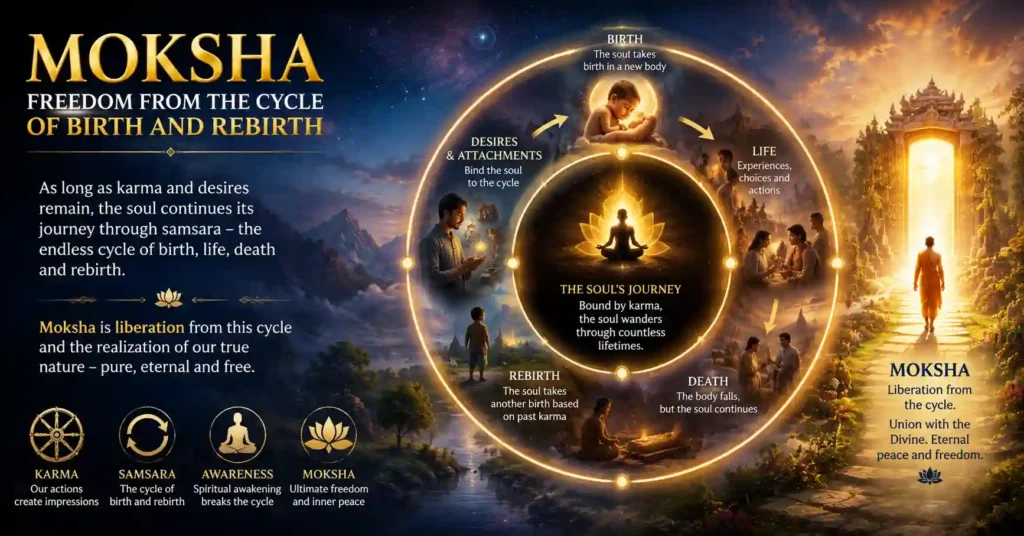
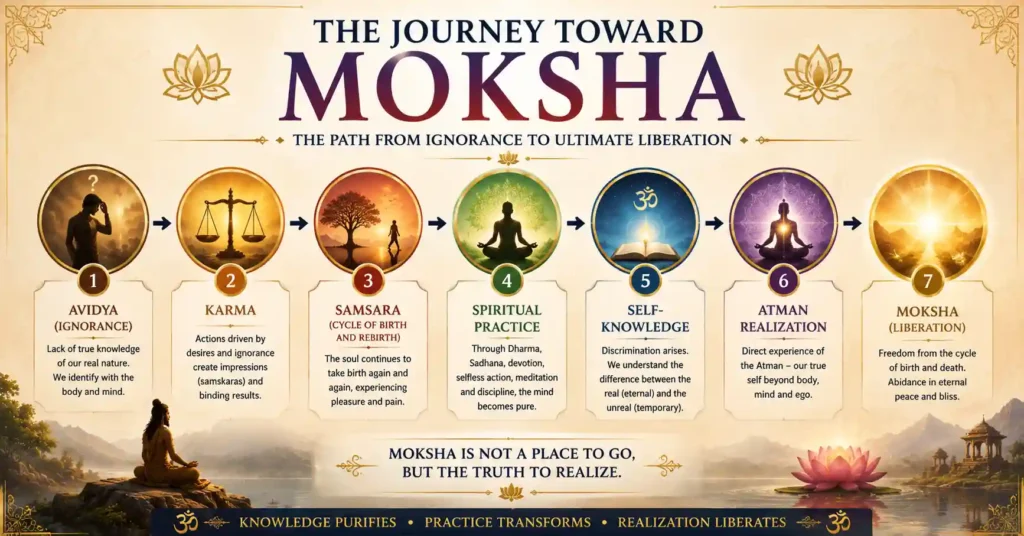
Samsara is the cycle of birth, life, death, and rebirth. Understanding this cycle is essential to understanding Moksha in Hinduism and other Indian spiritual traditions.
According to these teachings, the soul continues to take birth because of karma and attachment. As long as desires, impressions, and unresolved tendencies remain, the cycle continues.
Karma is more than simply good or bad actions. It includes thoughts, intentions, choices, and the impressions they leave on the mind.
The three main types of karma are:
| Type of Karma | Meaning |
|---|---|
| Sanchita Karma | The accumulated karma from past lives |
| Prarabdha Karma | The portion of karma currently shaping this life |
| Kriyamana Karma | New karma created through present actions |
Because of karma, life is both influenced by the past and shaped by present choices. This is why karma and Moksha are closely connected.
Desires lead to actions, actions create impressions, and impressions often give rise to new desires. This cycle keeps the mind restless and binds the soul to Samsara.
In daily life, karma also appears as conditioning. Repeated thoughts and reactions gradually become habits that shape behavior and identity. A person may begin to believe, “I am angry” or “I am not confident,” even though these are temporary patterns rather than their true nature.
Spiritual teachings explain that karma is influenced not only by action but also by intention. The same action can produce different results depending on the awareness and motivation behind it.
For this reason, liberation is not achieved by avoiding action. Instead, it comes through acting with awareness, responsibility, and detachment from the results.
As self-awareness grows, a space begins to appear between impulse and action. In that space lies the possibility of freedom. This marks the beginning of the journey toward spiritual liberation and freedom from the cycle of rebirth.
The Five Kleshas: Inner Obstacles to Liberation
Even when a person understands the ideas of karma and Samsara, inner obstacles often continue to create suffering and attachment. In Yoga philosophy, these obstacles are known as Kleshas.
The five Kleshas are:
| Klesha | Meaning |
|---|---|
| Avidya | Ignorance of one’s true nature |
| Asmita | Ego or false identification with the self |
| Raga | Attachment to pleasure |
| Dvesha | Aversion to pain and discomfort |
| Abhinivesha | Fear of loss, change, or death |
Avidya causes people to mistake temporary things for permanent reality. Asmita creates a strong attachment to personal identity and ego.
Raga pulls the mind toward pleasure, while Dvesha pushes it away from situations it dislikes. Abhinivesha creates fear and the instinct to cling to life and familiar experiences.
These Kleshas are not enemies to be defeated. They are patterns that influence thoughts, emotions, and behavior.
The path to liberation is not about suppressing these tendencies but about understanding them with awareness. As wisdom grows, their influence gradually weakens, allowing a person to move closer to inner freedom and lasting peace.
Moksha and the Three Gunas
According to Sanatan Dharma, all human behavior and mental tendencies are influenced by three fundamental qualities known as the Three Gunas. These qualities shape thoughts, emotions, actions, and perceptions.
| Guna | Characteristics |
|---|---|
| Tamas | Inertia, laziness, confusion, ignorance |
| Rajas | Activity, desire, ambition, restlessness |
| Sattva | Clarity, wisdom, harmony, balance |
Every person experiences all three Gunas in different proportions. At times the mind may feel clear and peaceful, while at other times it may become restless, distracted, or dull.
A person influenced by Tamas may resist change, avoid responsibility, or postpone important actions. A person dominated by Rajas may remain constantly busy yet still feel dissatisfied and driven by endless desires.
Sattva brings inner balance, compassion, and clarity. It supports spiritual growth and helps cultivate wisdom. However, spiritual teachings explain that even Sattva is ultimately a quality of the mind and not the final state of liberation.
For this reason, Moksha is described as going beyond all three Gunas. It is a state in which a person is no longer controlled by ignorance, restlessness, or even attachment to mental purity.
In daily life, these qualities continuously rise and fall. Understanding their influence helps a person observe thoughts and emotions with greater awareness rather than becoming trapped by them. This self-awareness is an important step on the path to spiritual freedom.
What is Moksha as a State of Consciousness?
Moksha is not a physical place that a person reaches after death. It is a state of consciousness in which one realizes their tru
e nature beyond the body, mind, thoughts, and emotions.
In this state, a person recognizes that they are the awareness that observes all experiences. Thoughts continue to arise, but they are observed without becoming a source of attachment or suffering.
As spiritual understanding deepens, a witnessing awareness begins to develop. Emotions may still appear, but they no longer control every reaction or decision.
At first, this shift can feel difficult. The mind is accustomed to holding on to desires, opinions, and identities. The ego seeks control, while attachments create a sense of comfort and security.
Over time, self-awareness brings a different perspective. Instead of being carried away by every thought and emotion, a person learns to observe them with greater clarity and detachment.
In ordinary life, the mind constantly moves between memories of the past and expectations of the future. This continuous mental activity often creates restlessness and dissatisfaction.
In the state of Moksha, there is inner stillness even amidst activity. A space develops between awareness and thought, bringing a sense of peace, freedom, and stability that is not dependent on external circumstances.
How Moksha Relates to Daily Life
Moksha is not separate from everyday life. Many people think it is only for saints, monks, or those who renounce the world, but spiritual teachings describe it as an inner transformation that can begin in ordinary situations.
Small moments of awareness often reveal what liberation points toward. For example, when a person notices anger arising but chooses not to react immediately, a space appears between the emotion and the response. In that moment, there is freedom from compulsion.
Similarly, when peace is experienced without any external reason, it shows that happiness is not entirely dependent on circumstances, possessions, or achievements.
As self-awareness grows, people begin to notice how much suffering is created by attachment, expectations, and automatic reactions. Understanding this gradually reduces their influence.
These moments may seem small, but they reflect the same inner freedom that spiritual traditions associate with Moksha. In this way, the journey toward liberation begins not in some distant future but in the awareness of everyday life.
Can Moksha Be Fully Explained in Words?
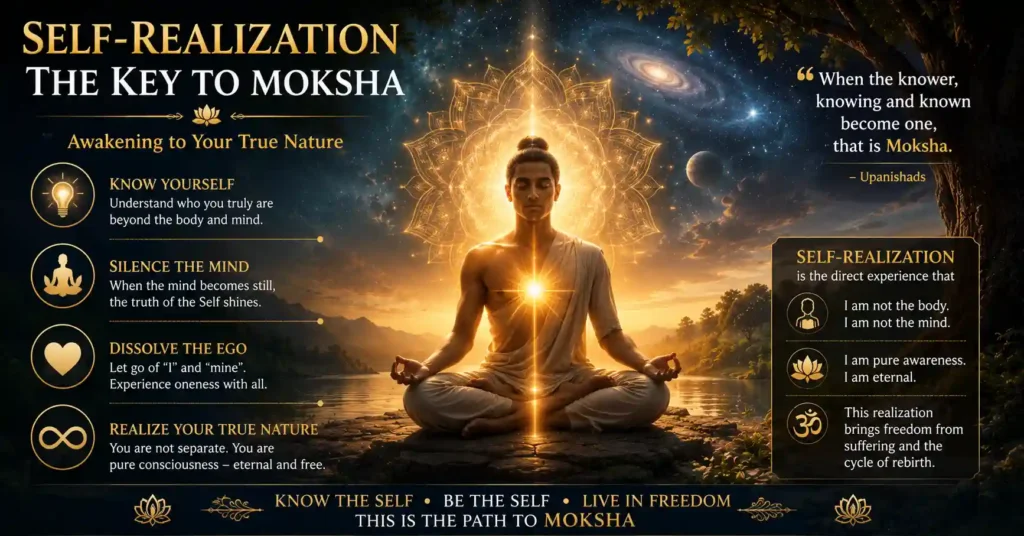
Spiritual traditions often explain that liberation can be discussed, studied, and contemplated, but it cannot be fully captured through words alone.
Language can describe the path, the obstacles, and the experiences that lead toward realization. However, the direct experience of truth is said to go beyond intellectual understanding.
This is why many sages use examples, stories, and metaphors when discussing spiritual realization. Such teachings point toward the experience, but they are not the experience itself.
For this reason, spiritual knowledge is often described as something that must ultimately be realized rather than merely understood.
Moksha in the Bhagavad Gita and Upanishads
The Bhagavad Gita and the Upanishads are among the most important sources for understanding Moksha in Sanatan Dharma.
The Upanishads teach that the true Self, known as the Atman, is eternal and beyond the body and mind. According to these teachings, suffering arises when a person identifies only with the physical world and forgets their true nature.
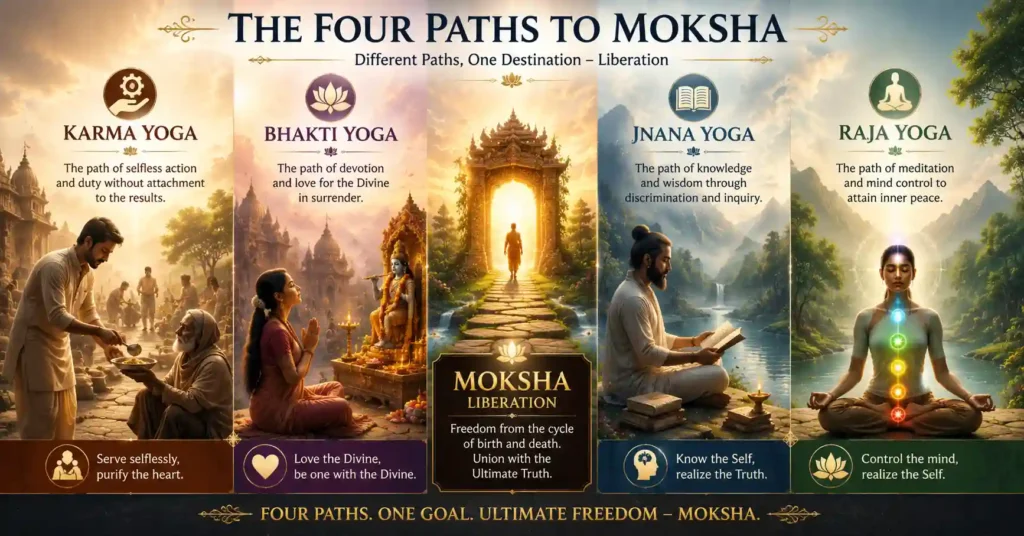
The Bhagavad Gita explains that liberation can be approached through different spiritual paths. These include selfless action (Karma Yoga), devotion to the Divine (Bhakti Yoga), meditation and self-discipline (Raja Yoga), and spiritual knowledge (Jnana Yoga).
A central message of the Gita is that a person should perform their duties without attachment to the results. Such action gradually purifies the mind and supports inner freedom.
Both the Bhagavad Gita and the Upanishads emphasize that lasting peace comes not from external achievements but from realizing the deeper truth of one’s existence.
The Four Traditional Paths to Liberation
Sanatan Dharma recognizes that people have different temperaments and spiritual inclinations. For this reason, several paths are described to help seekers progress toward spiritual realization.
While the approaches may differ, their ultimate purpose is the purification of the mind and the discovery of one’s true nature.
| Path | Main Focus |
|---|---|
| Karma Yoga | Selfless action without attachment to results |
| Bhakti Yoga | Devotion, love, and surrender to the Divine |
| Jnana Yoga | Self-inquiry, wisdom, and spiritual knowledge |
| Raja Yoga | Meditation, self-discipline, and mastery of the mind |
These paths are not mutually exclusive. Many spiritual traditions encourage a balanced combination of action, devotion, knowledge, and meditation.
The choice of path often depends on an individual’s nature, but all are intended to reduce ignorance, attachment, and ego while supporting inner transformation.
The Role of the Guru and Divine Grace in Moksha
Personal effort plays an important role on the path to Moksha. Through study, self-reflection, meditation, and spiritual practice, a person gradually develops greater awareness and understanding.
However, there are stages where effort alone may not be enough. The mind is trying to understand a reality that lies beyond its usual way of thinking. This can create confusion, doubt, or a false sense of progress.
This is where the guidance of a Guru becomes valuable. A true Guru does not give something new to the seeker. Instead, the Guru helps remove misunderstanding and points out what is preventing deeper realization.
Many spiritual obstacles arise not from a lack of knowledge but from incorrect understanding. A person may believe they have overcome ego and attachment, while subtle forms of both still remain. An experienced Guru can help reveal these hidden patterns.
| Role of a Guru | How It Helps |
|---|---|
| Removes confusion | Clarifies spiritual teachings |
| Corrects misunderstandings | Prevents self-deception on the path |
| Provides guidance | Helps navigate challenges in practice |
| Encourages self-inquiry | Supports deeper self-realization |
Alongside effort and guidance, many traditions also speak about divine grace. Grace does not replace personal effort, but it supports and strengthens the spiritual journey.
Sometimes, after years of sincere practice, a deeper understanding arises naturally and effortlessly. It may feel as though an inner barrier has dissolved and a new clarity has emerged.
Spiritual teachers often describe this as grace. Effort prepares the mind and heart, while grace allows deeper realization to unfold at the right time.
For this reason, many traditions emphasize the importance of both sincere effort and humility. Together, they help a seeker move closer to self-realization and spiritual liberation.
Samadhi and Moksha: Understanding the Highest States of Awareness
Samadhi is a deep state of meditation in which the mind becomes completely still and focused. However, this stillness is not sleep, unconsciousness, or dullness. It is a state of clear awareness free from mental distractions.
Many spiritual traditions describe Samadhi as an important stage on the path to self-realization and spiritual liberation. Different levels of Samadhi reflect progressively deeper states of awareness.
| Type of Samadhi | Description |
|---|---|
| Savikalpa Samadhi | The mind is deeply calm and focused, but there is still awareness of an object such as a mantra, breath, or divine form. |
| Nirvikalpa Samadhi | The distinction between the observer and the observed disappears. Only pure awareness remains. |
| Sahaja Samadhi | A natural state of awareness that continues even during daily activities and ordinary life. |
In Savikalpa Samadhi, a person experiences profound concentration and inner peace. Although the mind is quiet, there is still a subtle awareness of “I am meditating.”
Nirvikalpa Samadhi is considered a deeper state. Here, the usual sense of individuality dissolves, and awareness exists without mental activity or separation. Because this experience goes beyond ordinary thought, it is often described as difficult to express in words.
Sahaja Samadhi is regarded by many spiritual traditions as the most natural and complete state. A person can perform daily duties, interact with others, and live an ordinary life while remaining inwardly calm and established in awareness.
This state is closely associated with Moksha because awareness remains steady regardless of external circumstances. Instead of being limited to periods of meditation, inner peace becomes a natural way of living.
Moksha and Ego Dissolution
Ego does not mean confidence, self-respect, or personality. In spiritual teachings, ego refers to the strong identification with the body, mind, thoughts, emotions, and personal identity.
In daily life, ego appears in many subtle ways. It seeks recognition, wants control, reacts strongly to praise and criticism, and creates a constant sense of “mine” and “not mine.”
This identification often becomes the source of attachment, fear, comparison, and suffering. A person begins to define themselves through roles, achievements, opinions, and possessions.
| Ego-Based Thinking | Awareness-Based Understanding |
|---|---|
| I am my achievements | Achievements are part of life, not my true identity |
| I need approval from others | My worth is not dependent on external validation |
| Everything must go my way | Life can be accepted with greater balance |
| I am my thoughts & emotions | Thoughts and emotions can be observed without attachment |
Ego dissolution does not mean a person loses their individuality or stops functioning in the world. Instead, it means the attachment to a fixed identity gradually becomes weaker.
A person continues to live, work, speak, and fulfill responsibilities, but they are no longer driven by the constant need to defend an image or prove their importance.
As self-awareness grows, reactions become less automatic. The mind becomes more open, flexible, and less centered on personal gain or loss.
Spiritual traditions describe Moksha as complete freedom from false identification. When a person realizes that their true nature is beyond the body, mind, and ego, a deeper sense of peace and freedom naturally arises.
Jivanmukti and Videhamukti: Two Stages of Moksha
Spiritual traditions often describe Moksha in two stages: Jivanmukti and Videhamukti. Both represent liberation, but they refer to different states of freedom.
| Type | Meaning |
|---|---|
| Jivanmukti | Liberation experienced while living |
| Videhamukti | Final liberation after the death of the physical body |
Jivanmukti means attaining inner freedom while still living in the world. A person continues to perform daily duties, maintain relationships, and participate in life, but remains free from attachment, fear, and inner conflict.
Externally, a Jivanmukta may appear like any other person. The difference lies in their inner state. They are not controlled by ego, desires, or emotional reactions and remain established in peace and self-awareness.
A Jivanmukta responds to situations with wisdom rather than reacting impulsively. Actions continue, but they are performed without attachment to personal gain or loss.
Videhamukti refers to the final liberation that occurs after the body is shed. According to spiritual teachings, there is no further return to the cycle of birth and death because all karmic bondage has come to an end.
In simple terms, Jivanmukti is freedom experienced during life, while Videhamukti is the completion of that freedom beyond the physical existence. Together, they illustrate the highest goal of spiritual liberation in Sanatan Dharma.
Qualities of a Liberated Person
A liberated person does not behave in a dramatic or supernatural way. Their transformation is primarily internal, but it naturally influences how they live and respond to the world.
They remain calm during difficult situations. This does not mean they are free from challenges, but they are no longer disturbed by them in the same way as before.
Praise and criticism have less influence on their sense of self. Their inner peace does not depend on the opinions, approval, or recognition of others.
They perform actions with sincerity and responsibility but without attachment to the results. As a result, they experience less anxiety, expectation, and disappointment.
A liberated person also develops natural compassion. They understand the suffering of others and respond with kindness, yet they are not overwhelmed by emotional reactions.
| Quality | Description |
|---|---|
| Inner Peace | Remains calm in changing circumstances |
| Detachment | Acts without attachment to outcomes |
| Compassion | Cares for others without emotional dependence |
| Equanimity | Remains balanced in praise and criticism |
| Self-Awareness | Lives with clarity rather than ego-driven reactions |
Like the ocean that remains deep and steady beneath the waves, a liberated person maintains inner stability despite the changing conditions of life.
Most importantly, the constant mental struggle gradually disappears. There is less need for validation, control, or comparison, allowing life to be lived with simplicity, clarity, and freedom.
Gradual and Sudden Liberation
Spiritual traditions explain that liberation does not unfold in the same way for everyone.
For some seekers, understanding develops gradually through study, self-reflection, meditation, and spiritual practice. Over time, attachment weakens, awareness deepens, and inner clarity grows. This is often described as a gradual path to liberation.
For others, there may be a sudden breakthrough in understanding. After years of preparation, a moment arrives when the truth becomes clear and long-standing confusion disappears. This is sometimes referred to as sudden realization.
Both approaches are considered valid. What appears to be a sudden awakening is often supported by years of inner preparation, even if that preparation is not immediately visible.
Likewise, a gradual path may include moments of profound insight that transform a person’s understanding in an instant.
| Path | Description |
|---|---|
| Gradual Liberation | Spiritual understanding deepens step by step through practice and self-awareness |
| Sudden Realization | A rapid shift in understanding that reveals a deeper truth after sufficient preparation |
Ultimately, the pace of spiritual growth varies from person to person. What matters most is sincere effort, self-awareness, and a genuine desire to understand one’s true nature.
Moksha vs Heaven: What Is the Difference?
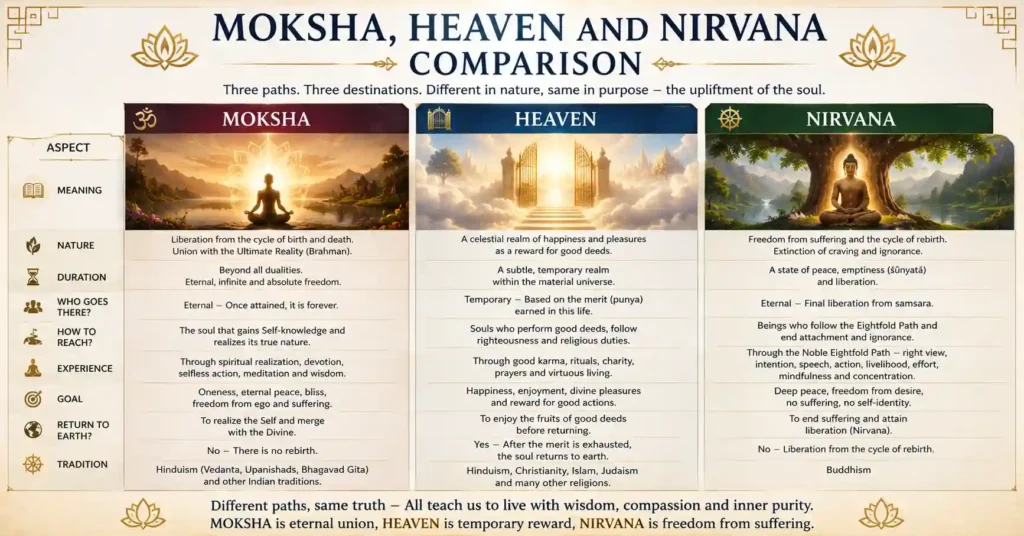
Many people assume that Moksha and heaven are the same, but Sanatan Dharma describes them as very different states.
Heaven is generally understood as a realm where a soul experiences the positive results of good karma. These experiences may be pleasant and rewarding, but they are not permanent.
According to traditional teachings, when the results of accumulated good karma are exhausted, the soul returns to the cycle of birth and death.
Moksha is fundamentally different. It is not a heavenly realm or a temporary reward. It is complete freedom from the cycle of Samsara itself.
The key difference can be understood as follows:
| Heaven | Moksha |
|---|---|
| Result of good karma | Freedom from karma |
| Temporary experience | Permanent liberation |
| Part of the cycle of rebirth | Freedom from the cycle of rebirth |
| Dependent on karmic merit | Beyond karmic bondage |
| A state that can end | A state of ultimate freedom |
In simple terms, heaven is an experience within the cycle of existence, while Moksha is freedom from the cycle altogether.
This distinction is important because Sanatan Dharma regards liberation as the highest spiritual goal, surpassing even the most enjoyable heavenly experiences.
Common Misconceptions About Moksha
Many misunderstandings exist about Moksha, especially when it is viewed only as a distant spiritual concept.
One common misconception is that liberation is only meant for monks, saints, or people who renounce the world. However, spiritual texts such as the Bhagavad Gita teach that inner freedom can be pursued while fulfilling one’s responsibilities in daily life.
Another misunderstanding is that Moksha means escaping life or rejecting the world. In reality, it involves changing one’s relationship with desires, attachments, and ego rather than avoiding responsibilities.
Some people also assume that Moksha is the same as heaven. Traditional teachings distinguish between the two, explaining that heavenly realms are temporary, while liberation is freedom from the cycle of rebirth itself.
| Misconception | Traditional Understanding |
|---|---|
| Moksha is only for monks | It is open to all sincere seekers |
| Moksha means escaping life | It means freedom from attachment and ignorance |
| Moksha is the same as heaven | Liberation goes beyond temporary heavenly states |
| Liberation requires abandoning duties | Spiritual growth can occur while fulfilling responsibilities |
Understanding these distinctions helps make the concept of liberation more practical and relevant to everyday life.
Common Obstacles on the Spiritual Path
Spiritual traditions teach that the greatest obstacles are often internal rather than external. A person may study spiritual teachings and practice regularly, yet remain held back by deep-rooted habits and attachments.
Ignorance of one’s true nature creates confusion and strengthens identification with the body, mind, and ego. Attachment to desires and expectations can also keep the mind restless and dependent on external circumstances.
Fear, pride, anger, and excessive attachment to personal identity often make inner freedom more difficult to experience. These obstacles do not disappear overnight, but awareness gradually weakens their influence.
| Obstacle | Effect |
|---|---|
| Ignorance (Avidya) | Hides the true nature of the Self |
| Ego (Ahankara) | Creates false identification |
| Attachment (Raga) | Produces dependence and craving |
| Aversion (Dvesha) | Creates resistance and suffering |
| Fear (Abhinivesha) | Strengthens insecurity and attachment |
Recognizing these obstacles is an important step because lasting transformation begins with awareness rather than suppression.
How to Attain Moksha in Daily Life
Many people wonder how Moksha can be approached in practical life. Spiritual teachings explain that the journey toward liberation does not begin with extraordinary actions. It begins with awareness.
One of the first steps is observing thoughts, emotions, and reactions without immediately acting on them. This creates a space between awareness and habitual behavior, allowing greater clarity and self-understanding.
Another important practice is reducing attachment to outcomes. When actions are performed sincerely but without emotional dependence on success or failure, the mind becomes more balanced and peaceful.
Spending time in silence each day can also be helpful. Even a few minutes of quiet reflection allows the mind to slow down and creates an opportunity for deeper self-awareness.
Understanding personal patterns is equally important. When a person recognizes recurring habits, fears, and attachments, they gradually lose their hold. Awareness weakens conditioning and supports inner growth.
Some traditional practices associated with the path to liberation include:
| Practice | Purpose |
|---|---|
| Self-Observation | Develops awareness of thoughts and reactions |
| Meditation | Cultivates inner stillness and clarity |
| Selfless Action (Karma Yoga) | Reduces attachment to results |
| Self-Inquiry | Encourages understanding of the true Self |
| Guidance from a Guru | Helps remove confusion and misunderstanding |
These are not rigid rules but practical directions. Liberation is not achieved through force or struggle. It unfolds through understanding, awareness, and gradual inner transformation.
For this reason, the path to Moksha begins not with dramatic changes but with small moments of awareness in everyday life.
Key Takeaways
- Moksha is liberation from the cycle of birth, death, and rebirth.
- It is achieved through self-realization, awareness, and freedom from attachment.
- Karma, Samsara, the Gunas, and ego are key concepts in understanding spiritual bondage.
- Different paths such as Karma Yoga, Bhakti Yoga, Jnana Yoga, and meditation support spiritual growth.
- A Guru, sincere effort, and divine grace are often considered important on the spiritual journey.
- Liberation can be experienced while living (Jivanmukti) and completed beyond physical existence (Videhamukti).
Conclusion
Many people search for the meaning of Moksha because they want a simple and practical understanding of this profound spiritual concept.
In simple words, Moksha is freedom from attachment, mental disturbance, inner conflict, and the cycle of birth and rebirth. It is the realization of one’s true nature and the discovery of a peace that does not depend on external circumstances.
Moksha is not something distant or reserved only for saints. It is a journey of understanding rather than force, and it begins with greater awareness in everyday life.
Even small changes matter. A little less attachment, a little more awareness, and a little more clarity can gradually transform how a person experiences life.
Over time, old patterns begin to weaken, reactions become less automatic, and inner freedom grows naturally. The path unfolds through understanding, not pressure or struggle.
Ultimately, understanding what Moksha is can change the way a person relates to life itself, bringing greater peace, clarity, stability, and spiritual freedom.
Suggested Reading
If the idea of Moksha has inspired you, these related articles will help you explore the deeper concepts connected to liberation, self-realization, karma, detachment, and spiritual growth in Sanatan Dharma.
- Atma and Parmatma: Understanding the Soul and the Supreme
https://thesanatantales.com/atma-and-parmatma/ - Karma Kya Hai Aur Kaise Kaam Karta Hai
https://thesanatantales.com/karma/ - Detachment in Hindu Philosophy: The Deep Meaning of Vairagya and Inner Freedom
https://thesanatantales.com/detachment-in-hindu-philosophy/ - Spiritual Awakening: Meaning and Signs Beginners Often Experience
https://thesanatantales.com/spiritual-awakening/ - Ahankara: Ego in Spiritual Life, Meaning, Signs & How to Overcomne It
https://thesanatantales.com/ahankara/ - Sthitpragya: Meaning, Qualities, Bhagavad Gita Teaching and Daily Life
https://thesanatantales.com/sthitpragya/ - Kaal in Sanatan Dharma: The Eternal Science of Time, Yugas and Cosmic Cycles
https://thesanatantales.com/kaal-in-sanatan-dharma/ - Vaitarni Nadi: What Happens After Death and How the Soul Crosses It
https://thesanatantales.com/vaitarni-nadi/ - Moksha (Wikipedia)
https://en.wikipedia.org/wiki/Moksha
As you explore these topics, the meaning of Moksha gradually becomes clearer. Concepts such as karma, the soul, detachment, self-awareness, and inner freedom are all connected parts of the same spiritual journey described in Sanatan Dharma.
FAQs
What is Moksha in simple words?
Moksha is the highest spiritual goal in Sanatan Dharma. In simple words, it means liberation from the cycle of birth, death, and rebirth, known as Samsara.
It is also freedom from ignorance, attachment, fear, and the suffering created by constant desires and mental disturbances. A person who attains Moksha realizes their true nature beyond the body, mind, and ego.
Rather than being a place, Moksha is a state of inner freedom, peace, and self-realization.
What is the difference between Moksha and heaven?
Moksha and heaven are not the same.
Heaven is generally described as a temporary realm where a soul enjoys the results of good karma. Once those karmic results are exhausted, the soul returns to the cycle of birth and rebirth.
Moksha, on the other hand, is complete liberation from the cycle itself. It is not a temporary reward but a permanent state of spiritual freedom.
For this reason, Sanatan Dharma considers Moksha the highest goal of life, beyond even heavenly pleasures.
How can a person attain Moksha?
Spiritual traditions describe several paths that can help a person move toward Moksha. These include selfless action (Karma Yoga), devotion (Bhakti Yoga), meditation (Raja Yoga), and self-knowledge (Jnana Yoga).
The journey usually begins with self-awareness. By observing thoughts, reducing attachment, performing duties without selfish expectations, and seeking spiritual understanding, a person gradually develops inner freedom.
Many traditions also emphasize the importance of a Guru, sincere effort, and divine grace in supporting spiritual growth.
Is Moksha possible while living?
Yes. This state is known as Jivanmukti, which means liberation while living.
A Jivanmukta continues to live in the world, perform responsibilities, and interact with others, but remains free from deep attachment, fear, and ego-driven reactions.
Such a person experiences inner peace regardless of external circumstances. They are not controlled by praise and criticism, success and failure, or constant mental conflict.
What role does karma play in Moksha?
Karma plays a central role in understanding liberation.
According to Sanatan Dharma, actions, intentions, and thoughts create impressions that influence future experiences. These karmic impressions help keep the soul bound to the cycle of Samsara.
As awareness grows, a person learns to act without attachment to results. Spiritual knowledge helps reduce ignorance, while selfless action prevents the creation of new karmic bondage.
This gradual purification of karma supports the journey toward Moksha.
Is Moksha only for monks and saints?
No. Sanatan Dharma teaches that Moksha is available to all sincere seekers, regardless of whether they live a monastic or household life.
The Bhagavad Gita explains that spiritual growth can take place while fulfilling daily responsibilities. What matters is not abandoning the world but changing one’s relationship with it.
A person can progress toward liberation through awareness, right action, devotion, self-discipline, and spiritual understanding while living an ordinary life.
What is the relationship between Moksha and the soul?
According to Sanatan Dharma, the soul (Atman) is eternal and distinct from the physical body.
Moksha is attained when a person realizes their true nature as the Atman rather than identifying only with the body, mind, emotions, or social identity.
This realization removes ignorance and reveals the deeper spiritual truth that has always been present. Because of this, many scriptures describe Moksha as self-realization rather than the acquisition of something new.
What are the signs of a person moving toward Moksha?
A person moving toward Moksha often experiences gradual inner transformation rather than dramatic external changes.
Attachment to outcomes begins to reduce. Emotional reactions become less intense. There is greater self-awareness, patience, compassion, and mental clarity.
Such a person becomes less dependent on external validation and more capable of maintaining peace during both pleasant and difficult situations.
These qualities do not appear overnight but develop naturally through spiritual practice and deeper understanding.
What is the difference between Jivanmukti and Videhamukti?
Jivanmukti refers to liberation experienced while living. A person remains active in the world but is inwardly free from attachment, ego, and suffering.
Videhamukti refers to the final liberation that occurs after the death of the physical body. According to traditional teachings, there is no further return to the cycle of birth and rebirth.
Together, these two concepts explain how liberation can be experienced both during life and beyond it.
Why is Moksha considered the highest goal of life?
Sanatan Dharma describes four Purusharthas or goals of human life: Dharma (righteous living), Artha (material well-being), Kama (fulfillment of desires), and Moksha (liberation).
While the first three help a person live a balanced worldly life, Moksha represents the ultimate spiritual goal because it leads to lasting freedom and self-realization.
It is considered the highest goal because it brings an end to ignorance, suffering, karmic bondage, and the cycle of rebirth, revealing the deepest truth of existence.
Glossary of Important Terms
| Term | Meaning |
|---|---|
| Moksha | Liberation from the cycle of birth, death, and rebirth. It is considered the highest spiritual goal in Sanatan Dharma. |
| Samsara | The continuous cycle of birth, life, death, and rebirth through which the soul passes. |
| Atman | The eternal Self or soul that exists beyond the physical body and mind. |
| Karma | The law of cause and effect, where actions, intentions, and thoughts influence future experiences. |
| Sanchita Karma | The accumulated karma from past lives that has not yet produced results. |
| Prarabdha Karma | The portion of accumulated karma currently shaping a person’s present life. |
| Kriyamana Karma | New karma created through present actions, thoughts, and intentions. |
| Purusharthas | The four goals of human life: Dharma, Artha, Kama, and Moksha. |
| Dharma | Righteous living, duty, moral responsibility, and living in harmony with cosmic order. |
| Artha | Material well-being, prosperity, and resources needed for life. |
| Kama | Desire, enjoyment, pleasure, and emotional fulfillment. |
| Guru | A spiritual teacher who guides seekers by removing ignorance and clarifying spiritual truths. |
| Jnana Yoga | The path of spiritual knowledge and self-inquiry leading to self-realization. |
| Bhakti Yoga | The path of devotion and love toward the Divine. |
| Karma Yoga | The path of selfless action performed without attachment to results. |
| Raja Yoga | The path of meditation, self-discipline, and mental mastery. |
| Samadhi | A deep meditative state in which the mind becomes still and awareness becomes highly concentrated. |
| Savikalpa Samadhi | A meditative state where awareness remains focused on an object, mantra, or experience. |
| Nirvikalpa Samadhi | A state where the distinction between observer and observed disappears, leaving pure awareness. |
| Sahaja Samadhi | A natural state of continuous awareness maintained even during daily activities. |
| Jivanmukti | Liberation attained while still living in the physical body. |
| Videhamukti | Final liberation after the death of the physical body, with no further rebirth. |
| Ahankara | Ego or the false identification of the Self with the body, mind, and personal identity. |
| Avidya | Spiritual ignorance or misunderstanding of one’s true nature. |
| Kleshas | The mental and emotional obstacles that create suffering and keep a person bound to Samsara. |
| Asmita | Ego-consciousness or identification with the individual self. |
| Raga | Attachment to pleasure, possessions, people, or experiences. |
| Dvesha | Aversion, dislike, or avoidance of unpleasant experiences. |
| Abhinivesha | Fear of loss, change, or death; the instinctive attachment to life. |
| Gunas | The three fundamental qualities of nature that influence the mind and behavior. |
| Sattva | The Guna of purity, harmony, wisdom, and clarity. |
| Rajas | The Guna of activity, desire, ambition, and restlessness. |
| Tamas | The Guna of inertia, ignorance, laziness, and confusion. |
| Vairagya | Detachment from worldly attachments and dependence on external outcomes. |
| Self-Realization | Direct realization of one’s true nature as the Atman beyond body and mind. |
| Divine Grace | Spiritual assistance or blessing that supports inner transformation and realization. |
About the Author
Yateendra Chaturvedi is a spiritual writer, researcher, devotee, and the founder of The Sanatan Tales. With over 35 years of professional experience and a lifelong interest in Sanatan Dharma, he writes about Hindu deities, temples, scriptures, festivals, Mahavidyas, sacred stories, rituals, and living traditions that continue to guide and inspire devotees across India.
Drawing from traditional scriptures, regional beliefs, temple traditions, devotional literature, and historical sources, he aims to present authentic, well-researched, and easy-to-understand content for modern readers. His work focuses on preserving spiritual wisdom, explaining sacred traditions, and helping seekers develop a deeper understanding of India’s rich spiritual heritage.
Through The Sanatan Tales, Yateendra strives to make the timeless teachings of Sanatan Dharma simple, meaningful, and relevant for today’s generation while maintaining respect for traditional sources, regional practices, and diverse spiritual perspectives.
Learn More About Yateendra Chaturvedi →
https://thesanatantales.com/about-the-author/
References & Sources
This article is based on teachings and concepts found in the sacred scriptures and philosophical traditions of Sanatan Dharma, including the Vedas, Upanishads, Bhagavad Gita, Yoga philosophy, Vedanta, and other traditional spiritual texts. It also draws upon widely accepted interpretations preserved through the guru-disciple tradition and scholarly studies of Hindu philosophy.
Note: Beliefs, interpretations, and spiritual practices may vary across different traditions, sects, and schools of thought within Sanatan Dharma. The purpose of this article is not to present any single viewpoint as the absolute truth, but to explain widely accepted spiritual and philosophical perspectives on Moksha in a simple and accessible manner.
Read More Interesting Articles on Sanatan Dharma