
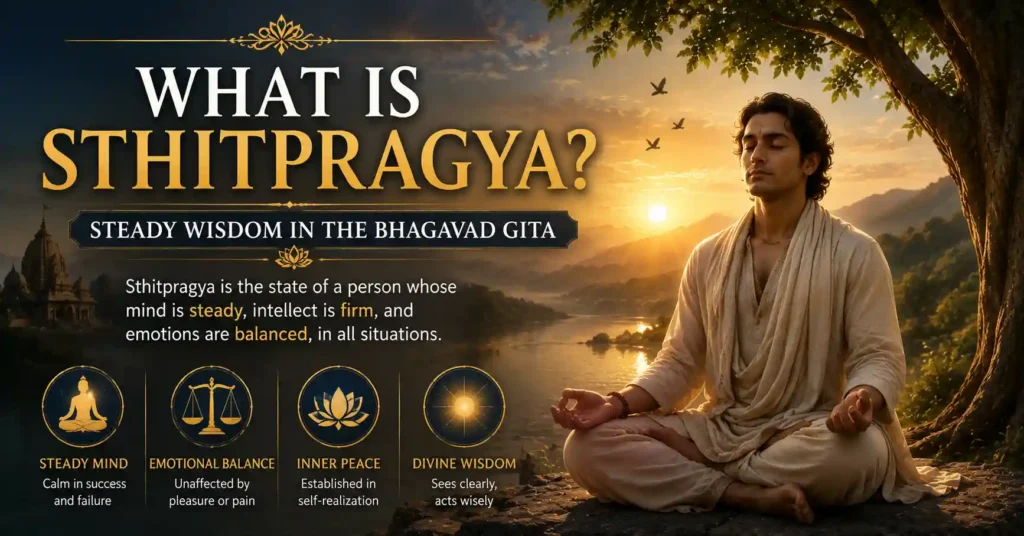
Sthitaprajna, commonly written as Sthitpragya, is one of the most profound ideals described in the Bhagavad Gita. It refers to a person whose wisdom remains steady, whose mind stays calm, and whose inner peace is not shaken by the changing circumstances of life.
The word itself comes from two Sanskrit terms. Sthita means steady, stable, or firmly established, while Prajna means wisdom, higher understanding, or inner intelligence. Together, they describe a person who remains established in wisdom, regardless of success or failure, pleasure or pain, praise or criticism.
In the Bhagavad Gita, Lord Krishna explains that such a person is not free from life’s challenges. Instead, they have learned to rise above attachment, selfish desires, and emotional disturbances. Their peace comes from being firmly rooted in the Self (Atman), rather than depending on external situations.
This state is not achieved by suppressing emotions or withdrawing from the world. It is the natural result of self-knowledge, spiritual discipline, and living with awareness. In many traditions of Sanatan Dharma, such a realised soul is also described as a Jivanmukta, one who is liberated while still living in the world.
In this article, you will learn the meaning of Sthitpragya, its qualities, the teachings of the Bhagavad Gita, its spiritual significance, and how this timeless wisdom can help you cultivate greater balance, clarity, and inner peace in your daily life.
Quick Facts
| Aspect | Details |
|---|---|
| Meaning | A person established in steady wisdom and inner balance |
| Sanskrit Name | स्थितप्रज्ञ (Sthitaprajna / Sthitpragya) |
| Mentioned In | Bhagavad Gita, Chapter 2 |
| Explained By | Lord Krishna in His dialogue with Arjuna |
| Core Qualities | Inner stability, self-awareness, detachment, emotional balance, wisdom |
| Spiritual Goal | To remain steady amidst life’s changing circumstances and progress towards Moksha |
| Related Concepts | Dharma, Karma Yoga, Vairagya, Jivanmukta, Atman |
| Relevant Today | Helps develop resilience, clarity, peace of mind, and balanced decision-making |
Table of Contents
ToggleWhat Does Sthitpragya Really Mean?
Sthitpragya is a Sanskrit term that describes a person established in steady wisdom, inner balance, and unwavering awareness. In some English translations of the Bhagavad Gita, it is also spelled Sthitaprajna.
The word is formed from two Sanskrit terms. Sthita means steady, stable, or firmly established, while Prajna means wisdom, higher understanding, or inner intelligence.
Together, they describe a person whose wisdom remains steady in every situation. Such a person is not disturbed by success or failure, pleasure or pain, or praise and criticism because their peace comes from within.
This is much more than intellectual knowledge. It is wisdom that has become a natural part of one’s life through self-awareness, spiritual discipline, and direct experience of the Self (Atman).
In simple words, Sthitpragya is not merely something to understand. It is a higher state of consciousness that a seeker gradually attains through spiritual growth and inner transformation.
Why Did Arjuna Ask About Sthitpragya?
Before Lord Krishna describes the qualities of Sthitpragya, Arjuna asks a sincere and important question. Standing on the battlefield of Kurukshetra, he is confused, emotionally disturbed, and uncertain about his duty.
After hearing Krishna’s teachings on the nature of the Self (Atman), Karma, and wisdom, Arjuna wants to understand how true spiritual wisdom is reflected in a person’s life. He does not ask about theories or philosophy alone. Instead, he asks how a person established in steady wisdom lives, speaks, behaves, and responds to the world.
This question is important because it shifts the discussion from spiritual knowledge to practical living. Lord Krishna’s answer shows that real wisdom is not measured by what a person knows, but by how they think, act, and remain balanced during life’s changing circumstances.
For this reason, the teachings on Sthitpragya in Chapter 2 of the Bhagavad Gita continue to inspire spiritual seekers who wish to transform knowledge into daily practice.
Meaning of Steady Wisdom in the Bhagavad Gita
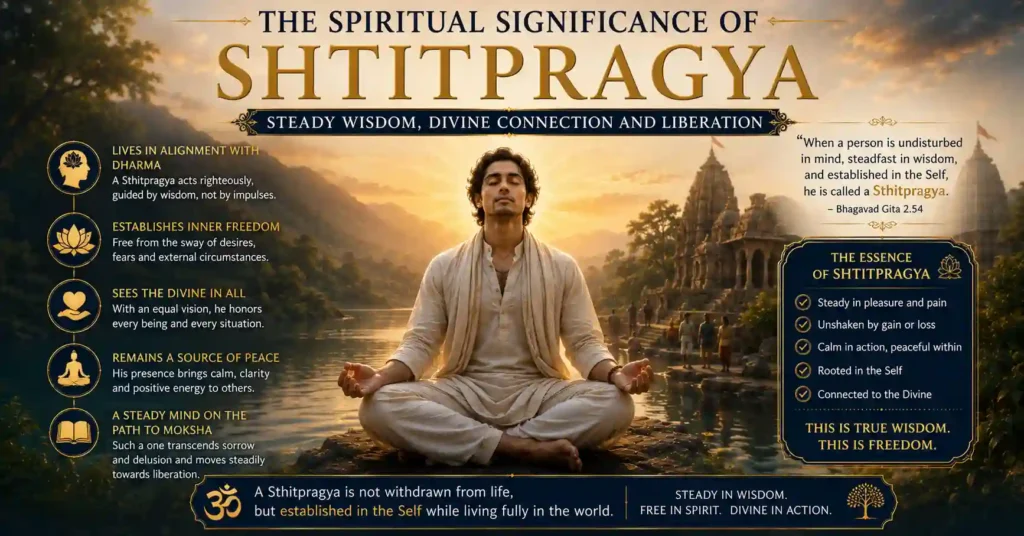
In the Bhagavad Gita, Lord Krishna describes Sthitpragya as a person whose wisdom remains steady and whose mind stays balanced in every situation. Such a person is not controlled by changing emotions or external circumstances.
This state is not achieved by constantly suppressing thoughts or forcing oneself to remain calm. It is the natural result of inner wisdom, self-awareness, and freedom from attachment.
A person established in steady wisdom does not become overwhelmed by success or discouraged by failure. Likewise, pleasure and pain, praise and criticism, gain and loss do not disturb their inner peace.
This does not mean becoming emotionless or indifferent. Rather, it means responding to life’s experiences with clarity, balance, and discrimination instead of reacting impulsively.
According to the Bhagavad Gita, this inner stability is one of the highest qualities of a spiritual seeker. It reflects a mind that is firmly established in the Self (Atman) and no longer dependent on the changing conditions of the external world.
Sthitpragya in the Bhagavad Gita
In Chapter 2 of the Bhagavad Gita, Arjuna asks Lord Krishna an important question: How does a person established in steady wisdom live, speak, sit, and walk? Through this question, he seeks to understand the qualities of an enlightened person.
Lord Krishna explains that such a person is free from selfish desires, remains calm in both pleasure and pain, and performs every duty without attachment to the results. Their happiness comes from within rather than from external achievements or possessions.
As the chapter unfolds, Krishna describes many qualities of a person established in steady wisdom. They are free from excessive attachment, fear, and anger. They remain balanced in success and failure, exercise control over their senses, and stay firmly rooted in the Self (Atman).
These teachings are not merely a description of an ideal person. They provide a practical guide for every spiritual seeker who wishes to cultivate inner peace, self-mastery, and lasting wisdom in daily life.
Sthitpragya in Bhagavad Gita: Important Verses
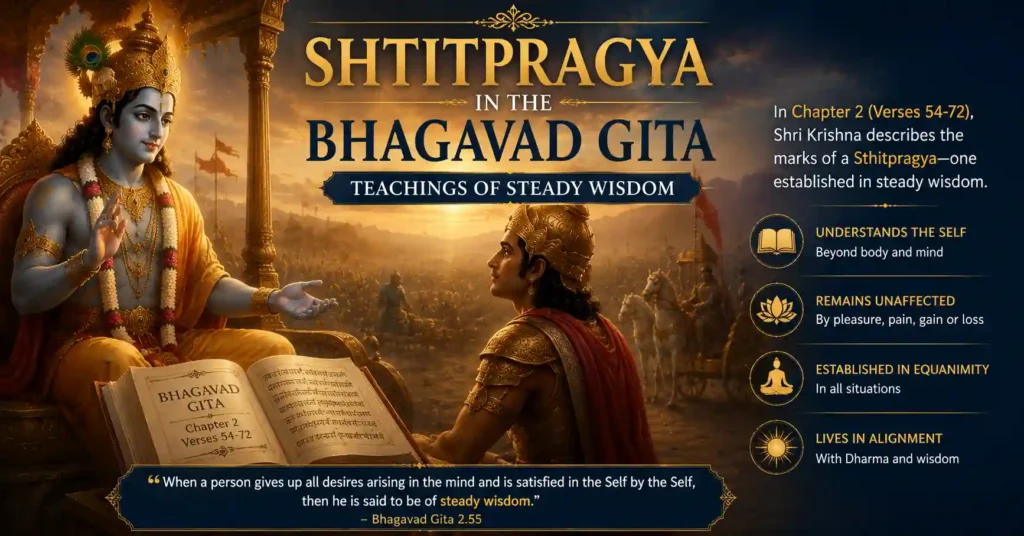
The teachings on Sthitpragya are found primarily in Chapter 2 of the Bhagavad Gita, beginning with Arjuna’s question in Verse 2.54. Lord Krishna answers this question through a series of verses that describe the qualities, conduct, and inner state of a person established in steady wisdom.
| Verse | Teaching |
|---|---|
| Bhagavad Gita 2.54 | Arjuna asks how a person of steady wisdom speaks, lives, and behaves. |
| Bhagavad Gita 2.55 | Krishna explains that freedom from selfish desires and contentment in the Self are the first signs of steady wisdom. |
| Bhagavad Gita 2.56–2.57 | A wise person remains balanced in happiness and sorrow, success and failure, without attachment or hatred. |
| Bhagavad Gita 2.58 | The famous tortoise analogy teaches the importance of withdrawing the senses from unnecessary distractions. |
| Bhagavad Gita 2.64–2.65 | Sense control and inner discipline lead to peace, clarity, and stable intelligence. |
| Bhagavad Gita 2.70–2.72 | Krishna concludes by describing the peaceful state of one who has overcome desires and attained lasting spiritual fulfilment. |
These verses are among the most profound teachings of the Bhagavad Gita. Rather than describing an unattainable ideal, they present a practical path that every sincere seeker can gradually follow through self-awareness, discipline, devotion, and righteous living.
Qualities of a Person with Steady Wisdom
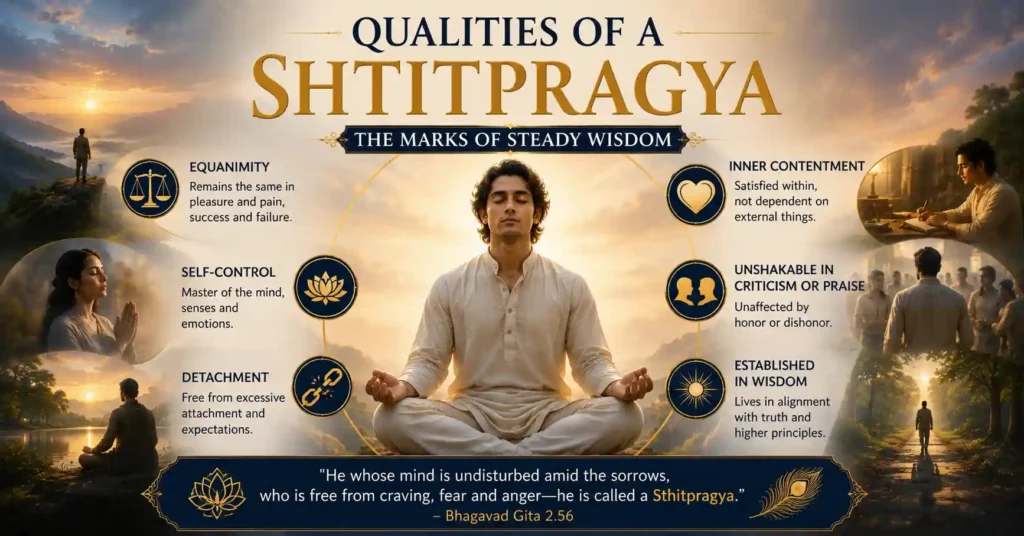
Lord Krishna describes the qualities of a person established in steady wisdom in a simple yet profound way. These qualities are not developed overnight. They gradually arise through self-awareness, spiritual discipline, and inner transformation.
| Quality | Meaning |
|---|---|
| Balanced in Dualities | Remains calm in success and failure, pleasure and pain, praise and criticism. External situations do not disturb inner peace. |
| Free from Selfish Desires | Finds lasting contentment within rather than constantly seeking happiness through possessions or achievements. |
| Freedom from Fear and Anger | Emotions may arise naturally, but they do not control thoughts, decisions, or actions. |
| Acts Without Attachment | Performs every duty sincerely without becoming attached to the results or expecting rewards. |
| Control Over the Senses | Like a tortoise withdrawing its limbs, knows when to withdraw the senses from unnecessary distractions and temptations. |
| Inner Stability | Remains steady, clear, and composed even during life’s most challenging situations. |
These qualities do not make a person indifferent or inactive. Instead, they enable them to respond to every situation with wisdom, compassion, and emotional balance.
The Bhagavad Gita teaches that this steady state develops gradually through sincere spiritual practice. As attachment weakens and self-awareness grows, inner peace becomes a natural way of living rather than something that has to be constantly maintained.
Sthitpragya in Daily Life
The teachings of the Bhagavad Gita are meant to be lived, not merely read. The qualities of Sthitpragya become meaningful when they are reflected in our thoughts, actions, and responses to everyday situations.
Suppose someone speaks harshly to you. The mind may immediately react with anger, hurt, or disappointment. A person established in steady wisdom first observes the situation before responding.
This does not mean they never experience emotions. Rather, they do not allow emotions to control their words, decisions, or actions. They respond with awareness instead of impulse.
The same balance can be seen in many situations. Success does not create pride, failure does not bring despair, and praise or criticism does not disturb inner peace.
Living this way does not require withdrawing from the world. It means performing your responsibilities with a calm mind, clear judgment, and inner stability, regardless of the circumstances around you.

Common Misunderstandings About Sthitpragya
One of the biggest misunderstandings is that Sthitpragya means becoming emotionless or detached from life. The Bhagavad Gita does not teach suppression of emotions or indifference towards others.
A person established in steady wisdom experiences the same human emotions as everyone else. The difference is that emotions do not take control of their thoughts, words, or actions.
Such a person feels joy without becoming attached to it and faces sorrow without losing inner balance. They continue to fulfil their responsibilities with compassion, wisdom, and self-awareness.
True steadiness is not numbness. It is the ability to remain calm, clear, and centred while fully participating in life’s changing experiences.
How to Become Sthitpragya
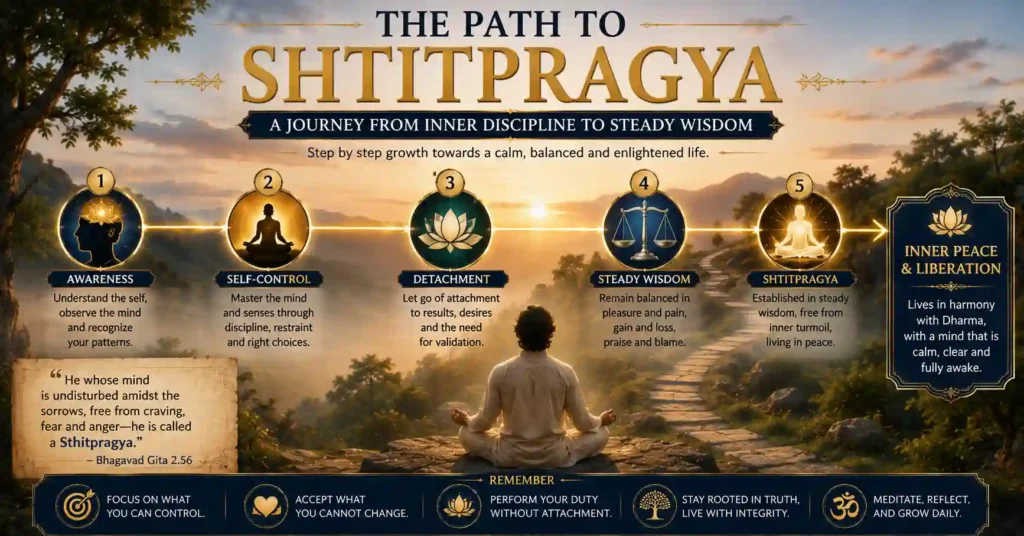
Becoming Sthitpragya is not something that happens overnight. It is a gradual journey of self-awareness, spiritual practice, and inner transformation.
The first step is learning to observe your thoughts, emotions, and reactions without immediately identifying with them. This awareness helps you respond with wisdom instead of reacting impulsively.
Regular spiritual practices such as meditation, prayer, self-reflection, and the study of sacred scriptures gradually calm the mind and strengthen inner stability. Equally important is performing your daily duties sincerely without becoming attached to the results.
Trust in Bhagwan, good company (Satsang), and living according to Dharma also help cultivate this higher state of consciousness. Over time, these simple practices reduce attachment, quiet the mind, and deepen inner peace.
There is no need to rush or seek perfection. Every small step taken with sincerity brings you closer to steady wisdom and lasting inner balance.
Can Anyone Become Sthitpragya?
One of the most encouraging teachings of the Bhagavad Gita is that the ideal of Sthitpragya is not limited to monks, sages, or renunciates. Lord Krishna shares these teachings with Arjuna, a warrior and a householder who is actively engaged in worldly responsibilities.
This reminds us that steady wisdom can be cultivated by anyone who sincerely follows the path of Dharma, performs their duties selflessly, and gradually develops self-awareness and inner discipline.
The journey is different for every individual. Some progress through devotion (Bhakti Yoga), others through selfless action (Karma Yoga), meditation (Dhyana Yoga), or the pursuit of knowledge (Jnana Yoga). Regardless of the path, the destination is the same: a mind that remains balanced and firmly established in wisdom.
The Bhagavad Gita does not expect perfection from the very beginning. It encourages sincere effort, steady practice, and gradual inner transformation. Every step taken with awareness brings a seeker closer to lasting peace and spiritual maturity.
Spiritual Significance of Sthitpragya
In the deeper teachings of Sanatan Dharma, Sthitpragya represents a very high stage of spiritual evolution. Such a person is no longer governed by attachment, fear, ego, or the constant ups and downs of the mind.
In many traditions, a person established in steady wisdom is also regarded as a Jivanmukta, one who is spiritually liberated while still living in the world. They continue to perform their duties and interact with others, yet remain inwardly free and unaffected by changing circumstances.
Their peace does not depend on success, possessions, or the opinions of others. Having realised the Self (Atman), they experience lasting contentment that arises from within rather than from the external world.
The Bhagavad Gita presents this state as an ideal for every spiritual seeker. It reminds us that the purpose of spiritual practice is not simply to gain knowledge, but to transform that knowledge into wisdom, inner freedom, and ultimately, the path towards Moksha.
Did You Know?
The teachings on Sthitpragya appear in the second chapter of the Bhagavad Gita, often called the “Summary of the Gita,” because it introduces many of the central spiritual principles explained in later chapters.
Sthitpragya and the Three Gunas (Sattva, Rajas and Tamas)
The teachings of Sthitpragya are closely connected with the philosophy of the three Gunas: Sattva, Rajas, and Tamas.
A person whose mind is dominated by Rajas is often restless, driven by desires, and constantly seeking results. When Tamas becomes dominant, the mind may experience laziness, confusion, or lack of motivation. As Sattva increases, clarity, peace, and balanced thinking naturally develop.
The qualities of steady wisdom described in the Bhagavad Gita become possible when the mind is purified and increasingly influenced by Sattva. However, Lord Krishna also explains that the ultimate spiritual goal is to rise beyond all three Gunas and realise the true Self (Atman).
Understanding this relationship helps us see that Sthitpragya is not simply a personality trait. It is the result of gradual inner purification, self-awareness, and spiritual growth.
Why This Wisdom Matters Today
Modern life is filled with constant distractions, busy schedules, and emotional pressures. It is easy for the mind to become restless, anxious, or overwhelmed by the demands of everyday life.
The teachings of Sthitpragya remind us that lasting peace does not come from changing the world around us. It comes from developing inner stability, self-awareness, and the ability to remain balanced in every situation.
Whether you are managing responsibilities at work, facing personal challenges, or following a spiritual path, this timeless wisdom offers practical guidance for living with greater clarity, resilience, and peace of mind.
Although described thousands of years ago in the Bhagavad Gita, the qualities of steady wisdom remain just as meaningful today. They continue to inspire people seeking a calmer, more purposeful, and spiritually fulfilling life.
Benefits of Understanding Sthitpragya
Understanding Sthitpragya is not only useful for spiritual seekers. Its teachings can positively influence every aspect of daily life.
As you begin observing your thoughts and emotions with greater awareness, you gradually become less reactive and more thoughtful in your decisions. Instead of being controlled by anger, fear, or anxiety, you learn to respond with patience and clarity.
This wisdom also helps strengthen relationships. When the mind remains balanced, misunderstandings reduce, communication improves, and compassion naturally grows.
Professionally, the teachings encourage sincere effort without becoming overwhelmed by success or discouraged by failure. This creates greater confidence, resilience, and peace of mind.
Above all, the ideal of Sthitpragya reminds us that lasting happiness comes from inner stability rather than constantly changing external circumstances. This understanding becomes a strong foundation for both personal well-being and spiritual growth.
Key Takeaways
- Sthitpragya is a person established in steady wisdom, inner balance, and self-awareness.
- The concept is explained by Lord Krishna in Chapter 2 of the Bhagavad Gita.
- A person established in steady wisdom remains calm amidst success and failure, pleasure and pain, and praise and criticism.
- This state develops gradually through self-awareness, spiritual discipline, devotion, meditation, and selfless action.
- The goal is not to suppress emotions but to respond with wisdom instead of reacting impulsively.
- The teachings of Sthitpragya remain highly relevant in modern life, helping cultivate resilience, clarity, and lasting inner peace.
- Every sincere seeker can gradually progress towards this ideal through consistent practice and righteous living.
Conclusion
Sthitpragya is not just an ideal described in the Bhagavad Gita. It is a timeless guide for anyone seeking lasting peace, emotional balance, and spiritual growth.
Lord Krishna teaches that true wisdom is not measured by knowledge alone but by the ability to remain steady amidst life’s changing circumstances. A person established in steady wisdom performs every duty with sincerity, remains free from attachment, and finds lasting contentment within the Self (Atman).
This state is not achieved through force or by escaping the world. It develops gradually through self-awareness, disciplined living, devotion, and sincere spiritual practice. Every small step towards greater awareness brings the mind closer to inner stability.
Whether you are beginning your spiritual journey or seeking a deeper understanding of the Bhagavad Gita, the teachings of Sthitpragya offer practical guidance for living with wisdom, compassion, and peace. They remind us that while the world around us will always change, true strength lies in remaining steady within.
Suggested Reading
If you found this guide to Sthitpragya helpful, you may also enjoy these articles from our Sanatan Wisdom & Philosophy section. Together, they explore the timeless teachings of Sanatan Dharma, helping you understand Dharma, Karma, inner balance, spiritual wisdom, Self-realization, and the path towards Moksha.
Sanatan Dharma: Meaning, Origin, Core Principles and Way of Life
https://thesanatantales.com/sanatan-dharma-meaning/
What Are the Four Purusharthas? A Simple Guide to Dharma, Artha, Kama and Moksha
https://thesanatantales.com/purusharthas/
Karma Yoga Meaning: Action without Attachment
https://thesanatantales.com/karma-yoga/
Sattva Rajas Tamas (Triguna): Meaning, Significance and Role in Daily Life
https://thesanatantales.com/sattva-rajas-tamas-meaning/
Spiritual Awakening: Meaning and Signs Beginners Often Experience
https://thesanatantales.com/spiritual-awakening/
Sri Vidya: Meaning, Philosophy, Sri Chakra and the Sacred Path of Lalita Tripura Sundari
https://thesanatantales.com/sri-vidya-meaning/
Chausath Yogini (64 Yogini): Story, Names, Temples and Spiritual Significance
https://thesanatantales.com/chausath-yogini/
Sthitpragya (Quora)
https://www.quora.com/What-is-Sthitpragya
FAQs
What is Sthitpragya in simple words?
Sthitpragya is a Sanskrit term used in the Bhagavad Gita to describe a person whose wisdom remains steady and whose mind stays calm in every situation. Such a person is not easily disturbed by success or failure, pleasure or pain, or praise and criticism.
This does not mean becoming emotionless. Rather, it means developing inner balance, self-awareness, and the ability to respond wisely instead of reacting impulsively.
Where is Sthitpragya mentioned in the Bhagavad Gita?
The concept of Sthitpragya is explained in Chapter 2 of the Bhagavad Gita, beginning with Arjuna’s question about the qualities of a person established in steady wisdom. Lord Krishna then describes how such a person thinks, speaks, acts, and remains balanced in all circumstances.
These teachings are among the most important philosophical discussions in the Gita and continue to guide spiritual seekers today.
What are the main qualities of a Sthitpragya?
A person established in steady wisdom remains calm during both favourable and difficult situations. They perform their duties sincerely without becoming attached to the results.
According to the Bhagavad Gita, such a person gradually becomes free from excessive attachment, fear, anger, and ego. Their actions are guided by wisdom, compassion, and self-awareness rather than by emotional impulses.
Is Sthitpragya the same as a Jivanmukta?
In many traditions of Sanatan Dharma, a Sthitpragya is often regarded as a Jivanmukta, meaning one who is spiritually liberated while still living in the world.
Although different traditions may explain these terms in slightly different ways, both describe a person who has attained deep inner freedom, lasting peace, and freedom from attachment.
How can someone become Sthitpragya?
Becoming Sthitpragya is a gradual process that develops through self-awareness, meditation, devotion, selfless action, and the sincere study of spiritual teachings.
The Bhagavad Gita teaches that steady wisdom grows when a person learns to control the mind, reduce attachment to results, perform their duties according to Dharma, and cultivate a deeper connection with the Self (Atman).
Does Sthitpragya mean giving up family and worldly responsibilities?
No. The Bhagavad Gita does not teach abandoning responsibilities to attain steady wisdom. Instead, it encourages people to fulfil their duties with sincerity while remaining free from selfish attachment.
A person established in steady wisdom continues to live in society, care for family, and perform daily responsibilities, but without allowing external circumstances to disturb their inner peace.
What is the difference between Sthitpragya and Vairagya?
Vairagya means detachment from selfish desires and excessive attachment to worldly pleasures. It is an important spiritual quality that helps purify the mind.
Sthitpragya is a higher state in which that detachment has matured into lasting wisdom, inner stability, and complete mental balance. In simple terms, Vairagya prepares the seeker, while Sthitpragya reflects the fruit of that inner transformation.
Why is the teaching of Sthitpragya relevant today?
Modern life is filled with stress, distractions, uncertainty, and constant emotional pressure. The teachings of Sthitpragya provide practical guidance for developing inner stability and emotional resilience without escaping from daily responsibilities.
By applying these principles, people can make wiser decisions, build healthier relationships, and live with greater peace, clarity, and purpose, even in today’s fast-changing world.
Glossary of Important Terms
| Term | Meaning |
|---|---|
| Sthitpragya | A person established in steady wisdom, inner balance, and self-awareness, as described by Lord Krishna in the Bhagavad Gita. |
| Sthitaprajna | An alternative English transliteration of the Sanskrit word Sthitpragya, commonly used in many translations of the Bhagavad Gita. |
| Bhagavad Gita | One of the most revered scriptures of Sanatan Dharma, containing the dialogue between Lord Krishna and Arjuna on Dharma, Karma, and spiritual wisdom. |
| Prajna | A Sanskrit word meaning wisdom, higher knowledge, insight, or inner intelligence. |
| Sthita | A Sanskrit word meaning steady, stable, firm, or firmly established. |
| Atman | The eternal Self or soul that is beyond the physical body and mind. |
| Jivanmukta | A person who has attained spiritual liberation (Moksha) while still living in the world. |
| Dharma | Righteous duty, moral responsibility, and the principles that sustain harmony in individual and social life. |
| Karma Yoga | The path of selfless action taught in the Bhagavad Gita, where duties are performed without attachment to the results. |
| Vairagya | Detachment from selfish desires and worldly attachments, leading to greater inner freedom and spiritual growth. |
| Moksha | Liberation from the cycle of birth and death (Samsara) and union with the Supreme Reality. |
| Samsara | The continuous cycle of birth, death, and rebirth experienced by the soul until liberation is attained. |
| Yoga | A spiritual discipline that unites the individual Self with the Supreme Reality through right living, meditation, devotion, and self-realization. |
| Self-realization | The direct experience and understanding of one’s true nature as the eternal Atman, beyond the body and mind. |
| Steady Wisdom | The English meaning of Sthitpragya, referring to unwavering inner wisdom, emotional balance, and spiritual maturity. |
About the Author
Yateendra Chaturvedi is a spiritual writer, researcher, devotee, and the founder of The Sanatan Tales. With over 35 years of professional experience and a lifelong interest in Sanatan Dharma, he writes about Hindu deities, temples, scriptures, festivals, Mahavidyas, sacred stories, rituals, and living traditions that continue to guide and inspire devotees across India.
Drawing from traditional scriptures, regional beliefs, temple traditions, devotional literature, and historical sources, he aims to present authentic, well-researched, and easy-to-understand content for modern readers. His work focuses on preserving spiritual wisdom, explaining sacred traditions, and helping seekers develop a deeper understanding of India’s rich spiritual heritage.
Through The Sanatan Tales, Yateendra strives to make the timeless teachings of Sanatan Dharma simple, meaningful, and relevant for today’s generation while maintaining respect for traditional sources, regional practices, and diverse spiritual perspectives.
Learn More About Yateendra Chaturvedi →
https://thesanatantales.com/about-the-author/
References & Sources
This article is based on the teachings of Sanatan Dharma, including insights from Hindu scriptures, traditional philosophical concepts, and widely accepted spiritual interpretations. It also draws upon traditional knowledge preserved through the guru-disciple (Guru-Shishya) tradition and various religious and scholarly study sources.
Note: Beliefs, interpretations, and spiritual practices may vary across different traditions, sects, and schools of thought within Sanatan Dharma. The purpose of this article is not to present any single interpretation as the absolute truth, but to explain widely accepted philosophical and spiritual concepts in a simple, balanced, and accessible manner.
Read More Interesting Articles on Sanatan Dharma