Have you ever heard someone say that repeated obstacles in life may be connected to Pitru Dosha? In many Hindu families, this term is often discussed during Pitru Paksha, Shraddha, or Tarpan. Yet, despite being widely known, Pitru Dosha is also one of the most misunderstood concepts in Hindu tradition.
Many people immediately associate Pitru Dosha with fear, bad luck, or a family curse. However, traditional Hindu teachings present a much deeper and more meaningful perspective. Rather than focusing on fear, the concept is closely linked to ancestral remembrance, gratitude, family lineage, and the idea of fulfilling one’s duties toward those who came before us. According to traditional beliefs, honoring ancestors through Shraddha, Tarpan, charity, and righteous living helps maintain harmony between generations.
The word Pitru means ancestors, while Dosha refers to an imbalance or condition that deserves attention. In Jyotisha (Vedic astrology), the term is commonly used to describe ancestral obligations, inherited family patterns, or unresolved duties connected to one’s lineage. Different traditions interpret it differently, and there is no single universally accepted definition.
This article explains the Pitru Dosha meaning, its traditional causes, signs, scriptural significance, connection with Pitru Rin, and the remedies commonly practiced in Sanatan Dharma. Most importantly, we will explore why this concept is better understood as a reminder of gratitude and responsibility rather than a reason for fear.
Pitru Dosha at a Glance
| Aspect | Details |
|---|---|
| Meaning | Ancestral imbalance or unresolved ancestral obligation |
| Related Concept | Pitru Rin (Debt to Ancestors) |
| Connected With | Ancestor remembrance, family lineage, gratitude |
| Commonly Discussed In | Hindu traditions and Vedic astrology |
| Associated Astrological Factors | Sun, Ninth House, Rahu, Ketu |
| Traditional Practices | Shraddha, Tarpan, Pind Daan, charity |
| Important Period | Pitru Paksha |
| Core Message | Honor and remember your ancestors |
| Is It a Curse? | Traditionally, no. It is generally viewed as a reminder of ancestral duties. |
In Sanatan Dharma, ancestors are not viewed as distant figures of the past. They are remembered as an important part of the family lineage that connects previous generations with the present. The concept of ancestral remembrance is deeply rooted in Hindu traditions and is reflected through rituals such as Shraddha and Tarpan.
The idea often associated with Pitru Dosha is not merely about astrology. At its heart lies the principle of gratitude toward those who gave us life, values, culture, and heritage. Many traditional teachings link ancestral peace with the well-being of future generations.
While astrologers may interpret the concept through planetary positions and birth charts, the spiritual message remains centered on remembrance, duty, and respect for one’s forefathers. Understanding this broader perspective helps remove unnecessary fear and brings focus back to the values emphasized in Sanatan Dharma.
Table of Contents
ToggleWhat Is Pitru Dosha?
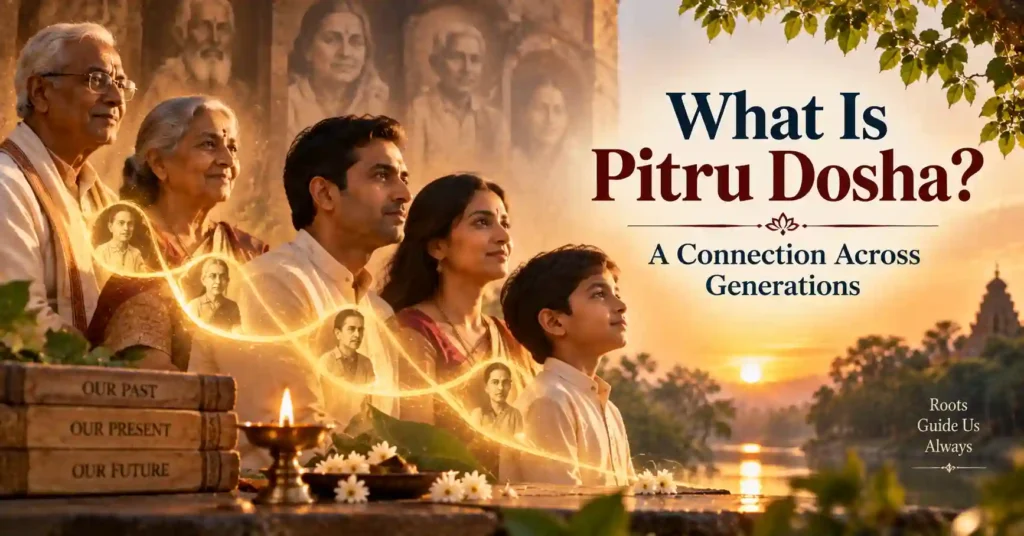
In simple terms, Pitru Dosha is a traditional concept in Hindu astrology that is associated with unresolved ancestral obligations or duties toward one’s forefathers. The word Pitru means ancestors, while Dosha refers to an imbalance or condition that requires attention. It is often linked to the broader concept of Pitru Rin, the debt of gratitude owed to the family lineage.
According to traditional beliefs, this condition is reflected in a birth chart through certain combinations involving the Sun, the Ninth House, Rahu, or Ketu. However, there is no single universally accepted astrological rule for identifying it. Different astrologers and traditions may interpret it in different ways.
A common misunderstanding is that Pitru Dosha is an ancestral curse. Classical Hindu thought generally presents a more balanced view. It is better understood as a reminder to honor one’s ancestors through remembrance, gratitude, Shraddha, Tarpan, charity, and righteous conduct. The emphasis is on fulfilling duties rather than fearing punishment.
The deeper spiritual message behind this concept is that every person is connected to a larger family lineage. By remembering those who came before us and respecting family traditions, we strengthen our bond with the past while carrying forward its wisdom into the future. In this sense, ancestral karma is not only about rituals but also about gratitude, responsibility, and continuity across generations.
Meaning of Pitru Rin (Ancestral Debt)
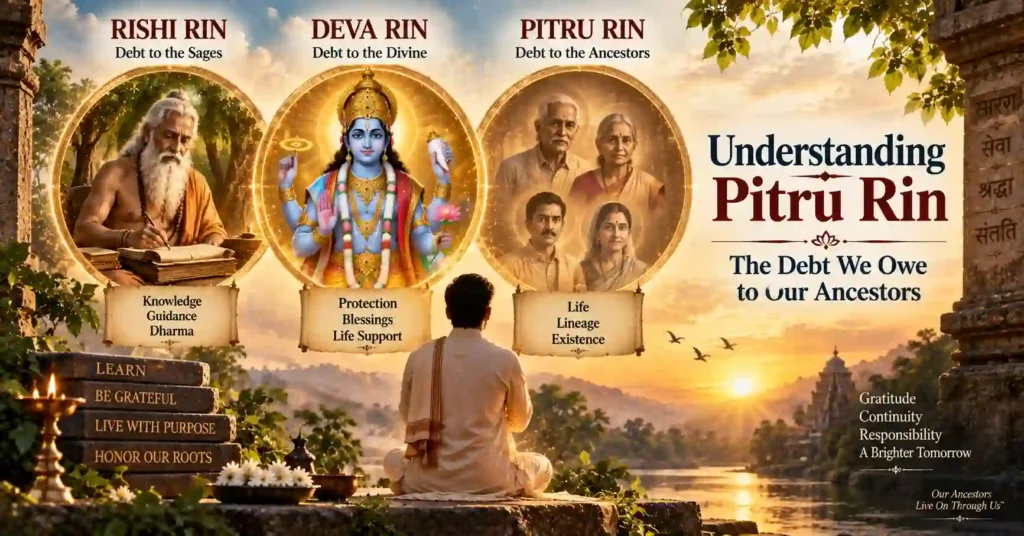
To truly understand Pitru Dosha, it is important to first understand the concept of Pitru Rin. In Sanatan Dharma, Rin means a debt or sacred obligation. It does not refer to money or material repayment. Instead, it refers to the responsibilities we naturally inherit through life, family, and society. Hindu philosophy teaches that every person is born with certain duties that should be fulfilled with gratitude and awareness.
Ancient Hindu teachings describe three primary debts (Rina Traya): Deva Rin (debt to the divine forces), Rishi Rin (debt to the sages who preserved spiritual knowledge), and Pitru Rin (debt to parents and ancestors who gave us life and lineage). Among these, Pitru Rin is directly connected with family heritage, ancestral blessings, and the continuation of values across generations.
The idea behind Pitru Rin is simple yet profound. We inherit our body, family traditions, culture, values, and opportunities from those who came before us. Because of these gifts, Hindu tradition encourages individuals to remember their ancestors with respect, care for their parents and elders, live a righteous life, and participate in ancestral remembrance rituals such as Shraddha, Tarpan, and Pind Daan.
Many traditional interpretations view Pitru Dosha as being connected to an unfulfilled ancestral obligation. However, the deeper spiritual message is not about fear or punishment. It is about gratitude, continuity, and honoring the lineage that made our existence possible. When viewed through this lens, Pitru Rin becomes a reminder to acknowledge our roots and carry forward the wisdom, values, and blessings of previous generations.
Scriptural Basis Behind Pitru Dosha
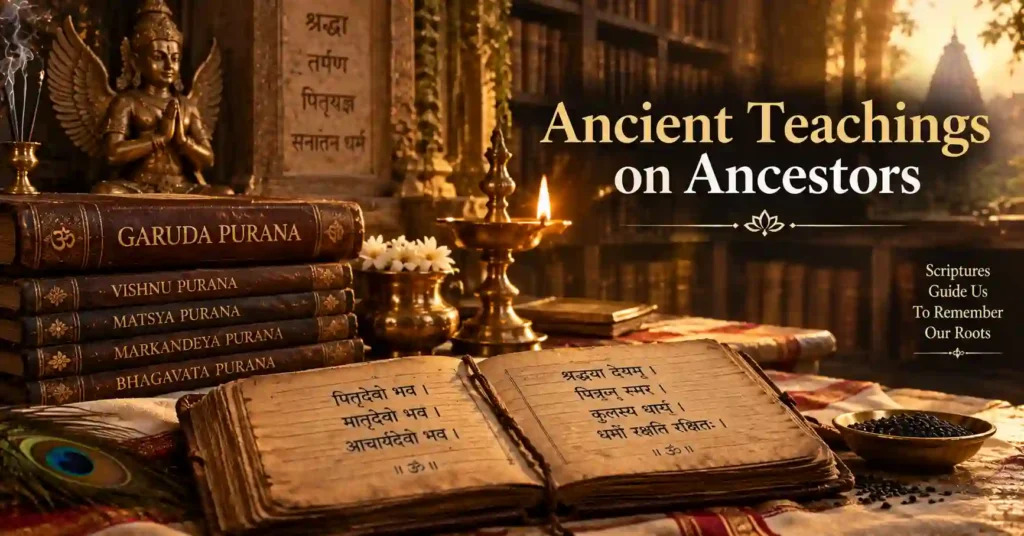
The concept associated with Pitru Dosha is rooted in broader Hindu teachings about ancestors, gratitude, and sacred duties rather than in a single scripture dedicated exclusively to the subject. Ancient texts emphasize the importance of remembering forefathers through Shraddha, Tarpan, and other ancestral rites. These practices are closely connected to the idea of Pitru Rin, the debt owed to one’s lineage and ancestors.
Among the scriptures frequently referenced in discussions about ancestral duties is the Garuda Purana. The text highlights the significance of Shraddha and offerings made for departed ancestors. It explains that descendants should remember and honor both paternal and maternal lineages through prayers and offerings. The Purana presents ancestor remembrance as an important aspect of Dharma and family responsibility.
Other Dharmashastra texts, Grihya Sutras, and Puranas also discuss ancestral rituals and their role in maintaining continuity between generations. Traditional teachings describe Shraddha as an act of faith, gratitude, and remembrance rather than a ritual based on fear. These texts encourage descendants to preserve family values and fulfill duties toward parents, elders, and ancestors.
From a spiritual perspective, the scriptural message is simple: human life is connected to a lineage that extends beyond the present generation. By honoring ancestors through sincere remembrance, charity, prayer, and righteous living, individuals acknowledge the sacrifices and blessings that helped shape their lives. This principle forms the foundation upon which later interpretations of Pitru Dosha are understood.
What Causes Pitru Dosha According to Tradition?
Different Hindu traditions and astrological schools explain the causes of Pitru Dosha in different ways. While there is no single universally accepted definition, most interpretations connect it with unresolved ancestral duties, neglected remembrance rituals, or karmic patterns associated with the family lineage. The concept is closely linked to Pitru Rin, the ancestral debt that descendants are expected to acknowledge through gratitude, remembrance, and righteous living.
Common Causes Mentioned in Traditional Beliefs
- Neglect of Shraddha and ancestral remembrance rituals
- Failure to perform Tarpan or other traditional offerings for ancestors
- Ignoring important family responsibilities passed down through generations
- Disrespect toward parents, elders, or family traditions
- Unresolved ancestral karmic patterns within the lineage
- Unfulfilled duties, promises, or responsibilities connected to forefathers
- Strong unfulfilled desires or unresolved issues believed to affect future generations
Another traditional explanation relates to family karma. Certain schools of thought believe that actions performed by previous generations may leave a karmic imprint on the family lineage. However, these interpretations should be understood as traditional beliefs rather than established facts, and different communities may explain them differently.
From an astrological perspective, practitioners often examine the Sun, the Ninth House, its ruling planet, and the influence of Rahu, Ketu, or Saturn while assessing ancestral themes in a birth chart. Even here, there is no single rule accepted by all astrologers. Responsible astrologers emphasize that a complete horoscope analysis is necessary and that one planetary combination alone should never be used to create fear.
Ultimately, the traditional message behind Pitru Dosha is not blame or fear. The focus remains on honoring ancestors, maintaining family values, fulfilling duties sincerely, and expressing gratitude for the lineage from which we come.
How Is Pitru Dosha Identified in Astrology?
In Vedic astrology, Pitru Dosha is generally associated with certain planetary combinations that are believed to indicate ancestral influences or unresolved family obligations. However, it is important to understand that there is no single universally accepted formula for identifying it. Different astrologers and traditions may use different methods when analyzing a birth chart.
While interpretations vary, astrologers often pay special attention to the following factors:
- The position and strength of the Sun, which represents father, lineage, and ancestral heritage
- The Ninth House, traditionally associated with ancestors, blessings, Dharma, and family traditions
- The influence of Rahu or Ketu on the Sun, Moon, or Ninth House
- Certain combinations involving Saturn, Rahu, Ketu, and ancestral houses
- Afflictions to the Ninth House lord or significant ancestral indicators in the horoscope
Many people make the mistake of assuming that a single planetary placement automatically confirms ancestral imbalance. In reality, experienced astrologers usually examine the entire horoscope before drawing conclusions. Factors such as planetary strength, aspects, house placements, and overall chart context are all considered together.
It is also important to remember that astrology offers interpretations rather than certainties. A birth chart should not be used to create fear or anxiety. The deeper purpose of examining ancestral indicators is to encourage self-reflection, gratit
Common Signs Associated With Pitru Dosha
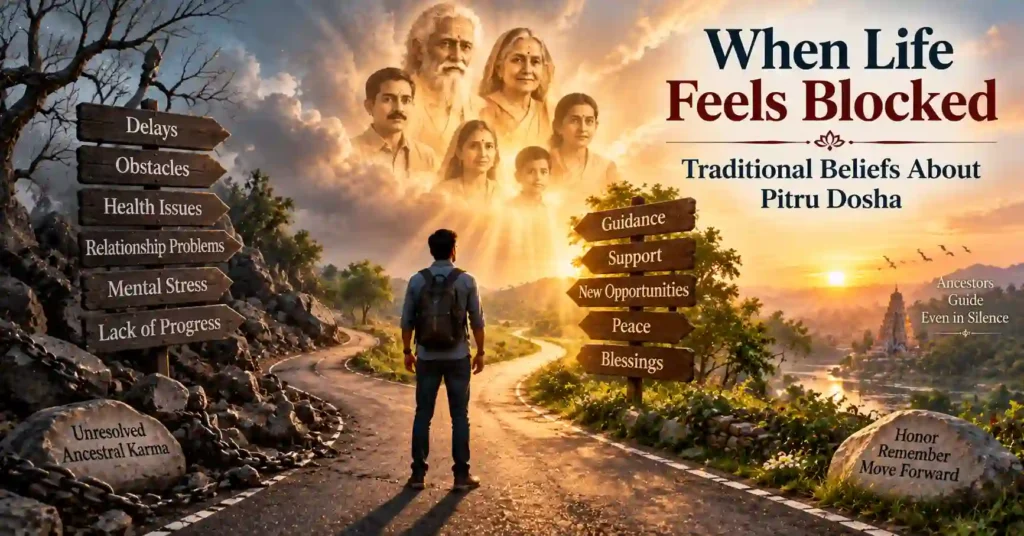
According to traditional beliefs and some schools of Vedic astrology, certain recurring challenges in life may be associated with ancestral imbalance or unfulfilled ancestral obligations. However, it is important to remember that these signs are not proof of Pitru Dosha. Life difficulties can arise for many reasons, and no single event should be automatically linked to ancestral influences.
Some astrologers and traditional practitioners commonly associate the following situations with ancestral concerns:
- Repeated obstacles despite sincere efforts
- Frequent delays in marriage or family-related matters
- Ongoing family disputes across generations
- Strained relationship with parents, especially the father
- Repeated financial instability without a clear reason
- Lack of peace or harmony within the household
- Difficulties related to having children in some traditional interpretations
- A feeling that similar challenges keep repeating within the family lineage
Many traditional texts and teachers emphasize that these signs should be viewed with caution. Experiencing one or more of these situations does not automatically mean a person has Pitru Dosha. Personal choices, circumstances, health, relationships, and many other factors can influence life’s challenges.
The real purpose of discussing these traditional signs is not to create fear but to encourage reflection on family values, ancestral remembrance, and one’s responsibilities toward parents and elders. Sanatan Dharma places great importance on gratitude and respect for those who came before us, regardless of astrological interpretations.
Is Pitru Dosha a Curse?
One of the biggest misconceptions surrounding Pitru Dosha is the belief that it is a curse placed upon a family by unhappy ancestors. This idea often creates unnecessary fear and anxiety. However, traditional Hindu teachings generally do not describe ancestral obligations in such a simplistic or fear-based manner.
In many spiritual traditions within Sanatan Dharma, the concept is better understood as a reminder of Pitru Rin, the debt of gratitude owed to parents and ancestors. The emphasis is on remembrance, respect, and fulfilling family responsibilities rather than on punishment. Ancestors are traditionally viewed as guiding forces who deserve honor and prayers, not as beings waiting to harm their descendants.
Fear-based interpretations have become common in some modern discussions, especially when astrology is presented without proper context. However, many respected teachers emphasize that ancestor-related practices such as Shraddha, Tarpan, charity, and service to parents are acts of gratitude and spiritual connection. Their purpose is to strengthen family bonds and preserve cultural values.
The deeper message behind Pitru Dosha is not fear, but awareness. It encourages individuals to remember their roots, honor the sacrifices of previous generations, and live with responsibility and gratitude. When viewed from this perspective, the concept becomes less about misfortune and more about maintaining harmony between the past, present, and future.
Why Ancestor Worship Matters in Sanatan Dharma
Ancestor remembrance has been an important part of Sanatan Dharma for thousands of years. Hindu tradition teaches that our lives are connected to an unbroken chain of generations. The values we follow, the culture we inherit, and even our family traditions are gifts passed down by those who came before us. Remembering ancestors is therefore seen as an expression of gratitude rather than merely a ritual obligation.
Through practices such as Shraddha, Tarpan, and Pitru Paksha observances, devotees acknowledge the contributions of their forefathers and pray for their peace. These traditions help keep family history alive and remind younger generations of their roots. In this way, ancestor worship is not focused on the past alone but also on preserving values for the future.
Sanatan Dharma also emphasizes respect for parents and elders as a sacred duty. Serving parents, caring for family members, and living according to Dharma are often regarded as meaningful ways of honoring one’s ancestors. These actions reflect the spirit of Pitru Rin, which teaches that gratitude should be expressed not only through rituals but also through everyday conduct.
The concept of Pitru Dosha is often discussed in connection with ancestor worship because both are rooted in the same principle: acknowledging the lineage that made our existence possible. Whether through prayer, charity, remembrance, or righteous living, the ultimate goal is to maintain a bond of gratitude, respect, and continuity across generations.
Traditional Remedies for Pitru Dosha
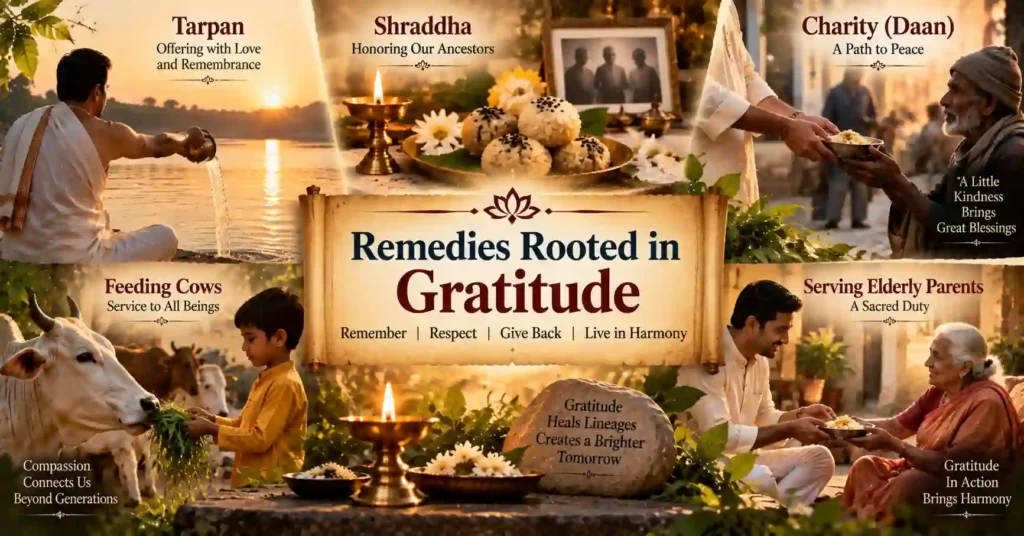
In Hindu tradition, the remedies associated with Pitru Dosha are not intended to create fear or superstition. Instead, they focus on remembrance, gratitude, charity, and fulfilling duties toward ancestors. These practices are believed to strengthen the connection between generations and help individuals honor their family lineage with sincerity and respect.
Common Traditional Remedies
- Performing Shraddha for departed ancestors
- Offering Tarpan with water, black sesame seeds, and prayers
- Performing Pind Daan at sacred pilgrimage sites where appropriate
- Participating in ancestral remembrance during Pitru Paksha
- Donating food, clothing, or essential items to those in need
- Feeding cows, birds, or other living beings as an act of compassion
- Serving and caring for parents, elders, and family members
- Reciting prayers or mantras dedicated to ancestors
- Supporting charitable and dharmic activities in memory of forefathers
Among these practices, Shraddha and Tarpan are the most commonly observed. These rituals are traditionally performed with faith and gratitude, expressing respect for ancestors and seeking their blessings. Many families observe them annually during Pitru Paksha, while others perform them on specific remembrance days.
It is important to remember that the spirit behind these remedies matters more than the ritual itself. Hindu teachings consistently emphasize sincerity, compassion, charity, and respect for elders. These qualities are considered meaningful ways of honoring ancestors and fulfilling one’s responsibilities toward the family lineage.
Rather than viewing these practices as a way to remove a curse, Sanatan Dharma encourages devotees to see them as acts of remembrance and gratitude. The deeper purpose is to strengthen family values, preserve traditions, and cultivate a sense of connection with those who came before us.
Pitru Paksha and Pitru Dosha
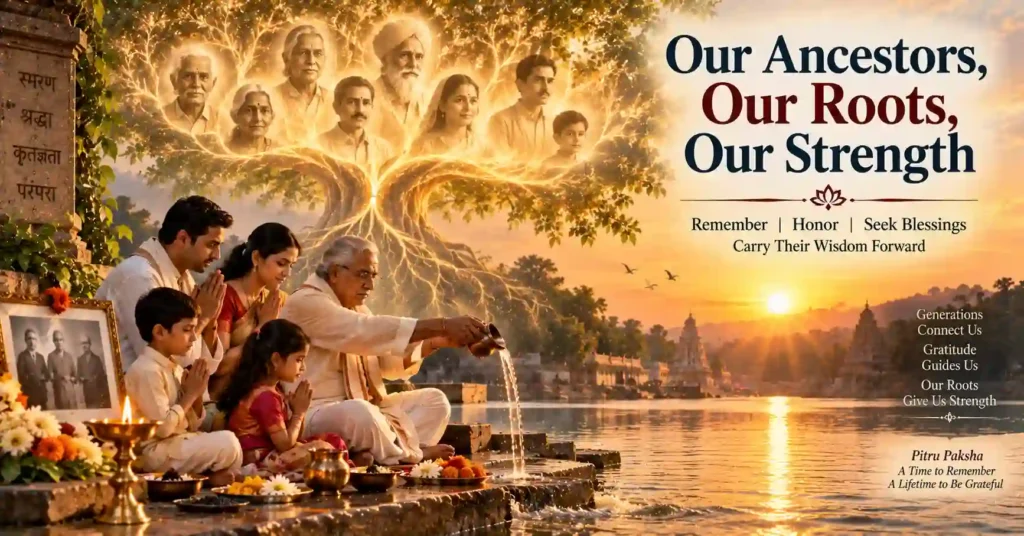
Pitru Paksha is a sacred period in the Hindu calendar dedicated to remembering, honoring, and praying for departed ancestors. Observed during the Krishna Paksha (waning phase of the Moon) in the month of Bhadrapada or Ashwin, this fortnight holds special significance for families who wish to express gratitude toward their forefathers through traditional rituals and prayers.
The connection between Pitru Dosha and Pitru Paksha comes from the belief that this period is especially suitable for performing ancestral rites such as Shraddha, Tarpan, and Pind Daan. Many devotees use these days to offer prayers, water, food, and charitable donations in memory of their ancestors. These acts are seen as expressions of love, respect, and remembrance rather than mere ritual obligations.
Some traditional beliefs suggest that ancestral blessings become especially important during Pitru Paksha. As a result, families often gather to perform remembrance ceremonies, visit sacred places, and engage in charitable activities. Whether one follows these customs for spiritual, cultural, or family reasons, the period serves as a meaningful reminder of the bond between past and present generations.
At its heart, Pitru Paksha teaches gratitude. It encourages people to pause, remember the sacrifices of those who came before them, and acknowledge that every generation builds upon the efforts of the previous one. This message aligns closely with the deeper understanding of Pitru Dosha, which emphasizes responsibility, remembrance, and respect for one’s ancestral lineage.
Common Misconceptions About Pitru Dosha
Because of fear-based discussions and misinformation, many myths have developed around Pitru Dosha. These misconceptions often cause unnecessary anxiety and can distract people from the deeper spiritual message of gratitude, remembrance, and family responsibility found in Sanatan Dharma.
Common Misconceptions
- Every life problem is caused by Pitru Dosha.
Life challenges can arise from many factors, including personal choices, circumstances, health, relationships, and karma. Not every difficulty should be linked to ancestral influences. - It is an ancestral curse.
Traditional Hindu teachings generally do not describe ancestor-related obligations as a curse. The emphasis is on honoring ancestors and fulfilling family duties. - Only expensive rituals can resolve it.
Many traditions place equal importance on sincere prayer, charity, service to parents, and living a righteous life. - It affects every member of a family in the same way.
Individual experiences, beliefs, and circumstances differ from person to person. General assumptions should be avoided. - A single planetary combination confirms ancestral imbalance.
Responsible astrologers usually analyze the entire birth chart rather than relying on one isolated factor. - Ancestors are angry and want to punish descendants.
Hindu traditions typically view ancestors as respected members of the lineage whose blessings and remembrance are valued.
The spread of these misconceptions often comes from incomplete information or sensational interpretations. Understanding the concept in its proper spiritual and cultural context helps remove fear and encourages a more balanced perspective.
When approached with wisdom, the discussion around Pitru Dosha becomes less about misfortune and more about gratitude, self-reflection, family values, and honoring the legacy of previous generations.
Philosophical Insight: The Deeper Message Behind Pitru Dosha
Beyond astrology, rituals, and traditional beliefs, the deeper meaning of Pitru Dosha lies in the value of gratitude. Sanatan Dharma teaches that no person exists in isolation. We are part of a continuous stream of generations, connected to the sacrifices, wisdom, struggles, and blessings of those who came before us.
Ancestors may leave behind more than material wealth. They pass on culture, traditions, values, faith, and life lessons that shape future generations. Remembering them helps cultivate humility and reminds us that many of the opportunities we enjoy today are built upon the efforts of our parents, grandparents, and forefathers.
From this perspective, ancestor remembrance is not merely about performing rituals. It is about living responsibly, caring for one’s family, respecting elders, preserving noble values, and contributing positively to society. These actions honor the lineage in a meaningful and lasting way.
The philosophical message is simple yet profound: gratitude strengthens relationships across generations. When we acknowledge our roots, we develop a deeper appreciation for life itself. In this sense, the discussion around Pitru Dosha ultimately points toward remembrance, responsibility, and the timeless Hindu principle of honoring those who helped make our journey possible.
Conclusion
Pitru Dosha is one of the most discussed yet often misunderstood concepts in Hindu tradition. While it is commonly associated with ancestral influences in Vedic astrology, its deeper meaning goes far beyond planetary combinations and predictions. At its core, the concept is closely connected to gratitude, family lineage, and the sacred responsibility of remembering those who came before us.
Throughout Sanatan Dharma, ancestors are honored through practices such as Shraddha, Tarpan, Pind Daan, charity, and service to parents and elders. These traditions reflect the belief that every generation is linked to the previous one through values, culture, and shared heritage. The purpose of these practices is not to create fear but to nurture respect, remembrance, and continuity.
It is also important to recognize that traditional interpretations vary. Not every life challenge should be attributed to Pitru Dosha, and no single astrological indication can define a person’s destiny. A balanced understanding encourages self-reflection, responsible living, and appreciation for the blessings received from one’s ancestors.
Ultimately, the true message behind Pitru Dosha is not about curses or misfortune. It is a reminder to honor our roots, fulfill our responsibilities with sincerity, and carry forward the wisdom and values of previous generations. When approached with faith, gratitude, and understanding, ancestor remembrance becomes a meaningful spiritual practice that strengthens the bond between the past, present, and future.
Key Takeaways
- Pitru Dosha is traditionally associated with ancestral obligations and family lineage in Hindu thought.
- The concept is closely connected to Pitru Rin, the debt of gratitude owed to parents and ancestors.
- Different traditions and astrologers may interpret ancestral influences in different ways.
- Shraddha, Tarpan, Pind Daan, charity, and service to parents are among the most common traditional practices associated with ancestor remembrance.
- Pitru Paksha is considered an important period for honoring departed ancestors through prayers and offerings.
- Traditional signs linked to ancestral imbalance should be viewed as beliefs and interpretations, not as guaranteed outcomes.
- Hindu scriptures emphasize gratitude, remembrance, and family responsibilities rather than fear.
- Ancestor worship in Sanatan Dharma is rooted in respect, continuity, and preserving family values.
- Living a righteous life and caring for parents and elders are meaningful ways of honoring one’s lineage.
- The deeper message behind Pitru Dosha is gratitude, responsibility, and appreciation for the generations that shaped our lives.
FAQs
1. What is Pitru Dosha in Hinduism?
Pitru Dosha is a term used in Vedic astrology to describe an ancestral obligation or unresolved duty connected to one’s lineage. It is commonly associated with the concept of Pitru Rin, the debt of gratitude owed to parents and ancestors. Traditional interpretations often examine the Sun, the Ninth House, and the influence of Rahu or Ketu while assessing this condition.
Rather than viewing it as a curse, many Hindu traditions understand it as a reminder to honor ancestors through remembrance, Shraddha, Tarpan, charity, and righteous living. The emphasis is on gratitude and responsibility rather than fear.
2. Is Pitru Dosha a curse from ancestors?
No. One of the biggest misconceptions is that ancestors punish their descendants through Pitru Dosha. Traditional teachings generally do not support this fear-based interpretation. Instead, the concept is often explained as a symbolic indication of unfinished ancestral duties or the need for remembrance and gratitude.
Ancestors are usually regarded as respected members of the lineage whose blessings and remembrance are valued. The purpose of ancestral rituals is to express gratitude and maintain family continuity, not to avoid punishment.
3. How is Pitru Dosha identified in astrology?
Astrologers commonly study the Sun, the Ninth House, its ruling planet, and the influence of Rahu, Ketu, or Saturn when examining ancestral themes in a birth chart. Certain combinations involving these factors are sometimes associated with ancestral obligations or family karma.
However, there is no universally accepted formula for identifying this condition. Experienced astrologers analyze the entire horoscope rather than relying on a single planetary placement. A complete chart assessment is considered essential before drawing conclusions.
4. What are the traditional remedies for Pitru Dosha?
Traditional remedies focus on gratitude, remembrance, and service rather than fear. Common practices include Shraddha, Tarpan, Pind Daan, charitable donations, feeding the needy, serving parents and elders, and participating in ancestral observances during Pitru Paksha.
Many traditions emphasize that sincerity is more important than elaborate rituals. Living according to Dharma, respecting family values, and caring for elders are also considered meaningful ways of honoring ancestors and fulfilling ancestral responsibilities.
5. What is the connection between Pitru Paksha and Pitru Dosha?
Pitru Paksha is the sacred fortnight dedicated to ancestor remembrance. During this period, many families perform Shraddha, Tarpan, and other rituals to honor departed ancestors and express gratitude for their blessings.
Because ancestral rites are central to Pitru Paksha, the period is often associated with discussions about Pitru Dosha and Pitru Rin. Many devotees believe it is an especially meaningful time to remember ancestors, perform charitable acts, and strengthen family traditions.
6. Can women perform Shraddha or Tarpan for ancestors?
Practices vary across regions, family traditions, and sampradayas. In many modern Hindu families, women participate in ancestral remembrance, prayers, and offerings, especially when circumstances require it. Some traditions also permit women to perform Tarpan and Shraddha under specific conditions.
Since customs differ widely, it is advisable to follow family traditions or seek guidance from a knowledgeable priest familiar with one’s lineage and local practices. The spirit of remembrance and gratitude remains the central principle.
7. Does every family have Pitru Dosha?
No. It is incorrect to assume that every family has Pitru Dosha. The term is used in specific astrological and traditional contexts, and not all families are considered to have ancestral imbalances according to those interpretations.
At the same time, Hindu philosophy teaches that everyone carries Pitru Rin, the natural debt of gratitude toward parents and ancestors. This universal principle should not be confused with a specific astrological indication.
8. What is the deeper spiritual message behind Pitru Dosha?
The deeper message is gratitude. The concept reminds us that our lives are connected to generations of people who contributed to our existence, values, culture, and opportunities. Remembering ancestors helps cultivate humility and appreciation for the sacrifices made by previous generations.
From a spiritual perspective, honoring ancestors is not only about rituals. It is also about caring for family, respecting elders, preserving traditions, and living a life guided by Dharma. In this way, ancestral remembrance becomes a meaningful practice that connects the past, present, and future.
Suggested Reading
If you found this guide on Pitru Dosha helpful, you may also enjoy exploring these related topics. Together, these articles provide deeper insights into ancestor remembrance, Shraddha rituals, Pitru Paksha observances, ancestral duties, karma, rebirth, liberation, and other important teachings of Sanatan Dharma.
Exploring these subjects will help you better understand the spiritual principles behind honoring ancestors and fulfilling Pitru Rin.
What Is Pitru Paksha and Why Is It Observed? Meaning, Significance, Rituals, and Spiritual Importance
https://thesanatantales.com/what-is-pitru-paksha/
Sarva Pitru Amavasya: Meaning, Rituals and Spiritual Significance
https://thesanatantales.com/sarva-pitru-amavasya/
What Is Shraddha in Hinduism? Meaning, Rituals and Spiritual Significance
https://thesanatantales.com/shraddha-in-hinduism/
Tarpan: Meaning, Significance, Method, Spiritual Benefits, and Pitru Paksha Guide
https://thesanatantales.com/tarpan/
What Is Pind Daan? Meaning, Rituals, Purpose and Spiritual Significance
https://thesanatantales.com/pind-daan/
What Is Moksha? Meaning, Path to Liberation and Spiritual Truth
https://thesanatantales.com/what-is-moksha/
What Is Samsara? Meaning, Karma, and the Cycle of Rebirth
https://thesanatantales.com/what-is-samsara-rebirth-guide/
Pinda (Riceball Offering) – Wikipedia
https://en.wikipedia.org/wiki/Pinda_(riceball)
Ancestor Worship – Wikipedia
https://en.wikipedia.org/wiki/Veneration_of_the_dead
About the Author
Yateendra Chaturvedi is a spiritual writer, researcher, devotee, and the founder of The Sanatan Tales. With over 35 years of professional experience and a lifelong interest in Sanatan Dharma, he writes about Hindu deities, temples, scriptures, festivals, Mahavidyas, sacred stories, rituals, and living traditions that continue to guide and inspire devotees across India.
Drawing from traditional scriptures, regional beliefs, temple traditions, devotional literature, and historical sources, he aims to present authentic, well-researched, and easy-to-understand content for modern readers. His work focuses on preserving spiritual wisdom, explaining sacred traditions, and helping seekers develop a deeper understanding of India’s rich spiritual heritage.
Through The Sanatan Tales, Yateendra strives to make the timeless teachings of Sanatan Dharma simple, meaningful, and relevant for today’s generation while maintaining respect for traditional sources, regional practices, and diverse spiritual perspectives.
Learn More About Yateendra Chaturvedi →
https://thesanatantales.com/about-the-author/
References & Sources
This article is based on teachings, values, and practices associated with Sanatan Dharma, including insights drawn from Hindu scriptures, traditional spiritual knowledge, ancestral remembrance traditions, Vedic philosophy, devotional practices, and widely accepted teachings related to Shraddha, Tarpan, Pitru Paksha, and Pitru Rin. It also reflects guidance preserved through family traditions, spiritual communities, and the guru-disciple lineage that has helped transmit Sanatan wisdom across generations.
Note: Beliefs, interpretations, astrological views, and ancestral practices may vary across different traditions, sampradayas, regions, and individual paths within Sanatan Dharma. The purpose of this article is not to promote any single interpretation as the absolute truth, but to present commonly accepted spiritual and cultural perspectives in a simple, balanced, and reader-friendly manner. Sanatan Dharma embraces diverse approaches to ancestor remembrance, devotion, Dharma, spiritual growth, and self-realization.
Explore More Topics from The Sanatan Tales