
Among the many forms of Lord Shiva worshipped across Sanatan Dharma, Kaal Bhairav stands apart in a unique way. His appearance is fierce, his symbols are powerful, and his name itself evokes a sense of awe.
Yet devotees who worship him do not see him as frightening. They see him as a protector, a guardian who stands beside those who walk the path of truth.
Kaal Bhairav is worshipped as the lord of time, the destroyer of ego, and the guardian of sacred order. He reminds human beings that time never stops, actions always carry consequences, and truth eventually reveals itself.
In temples, scriptures, village traditions, and spiritual teachings, Kaal Bhairav appears in different forms,
yet his message remains the same. He protects dharma, removes hidden negativity, and helps sincere seekers move toward greater awareness.
For some devotees, Bhairav Baba is a protector from fear and obstacles. For others, he is a profound spiritual force who teaches detachment and self-awareness. I
n sacred cities like Kashi, he is honored as the divine guardian who watches over the holy land and its pilgrims.
Understanding Kaal Bhairav is not simply learning about another deity. It is understanding a deeper truth about time, responsibility, and spiritual awakening.
Do you want to read in Hindi
Table of Contents
ToggleWho is Kaal Bhairav?
Kaal Bhairav is one of the most powerful manifestations of Lord Shiva. He represents Shiva’s protective, corrective, and transformative energy.
The word “Kaal” has multiple meanings. It refers to time, destiny, death, and the force that eventually transforms all things. The word “Bhairav” is often interpreted as “the one who removes fear” or “the one who destroys ignorance.”
Together, Kaal Bhairav represents the divine power that governs time and reveals truth.
Unlike forms of Shiva that emphasize peace and meditation, Bhairav represents alertness, protection, discipline, and spiritual vigilance. He appears when arrogance grows, when dharma is threatened, or when spiritual correction becomes necessary.
Across India, devotees worship Bhairav Baba as:
- Protector of sacred places
- Guardian of pilgrims
- Destroyer of fear
- Remover of obstacles
- Defender of truth
- Keeper of karmic balance
Many traditions also regard him as the guardian of spiritual seekers who sincerely pursue self-transformation.
Meaning of the Name Kaal Bhairav
The name itself contains profound spiritual symbolism.
Meaning of Kaal
In Sanskrit, Kaal can mean:
- Time
- Death
- Change
- Destiny
- Cosmic transformation
Time governs every aspect of life. It creates, preserves, changes, and eventually dissolves all forms. No human being can escape its influence.
When Bhairav is called Kaal Bhairav, he becomes the divine force that governs this eternal flow of time.
Meaning of Bhairav
The word Bhairav is often explained through different Sanskrit interpretations.
One traditional understanding describes Bhairav as:
- Bha – illumination or divine light
- Ra – protection and sustenance
- Va – dissolution of ignorance
In this interpretation, Bhairav becomes the force that illuminates truth, protects righteousness, and destroys ignorance.
Another traditional explanation describes Bhairav as the one who removes fear by helping devotees confront reality directly.
The Deeper Spiritual Meaning
The name Kaal Bhairav teaches a powerful lesson.
Everything changes.
Positions, wealth, beauty, power, and achievements eventually pass away. What remains is truth, awareness, and the consequences of our actions.
Kaal Bhairav reminds devotees not to waste life in illusion. He encourages them to live honestly, act responsibly, and remain aware of the sacred value of time.
Why Lord Shiva became Bhairav
One question naturally comes to many devotees: why did Lord Shiva take the form of Bhairav? The answer lies in understanding what Bhairav truly represents.
We often think of Shiva as the silent yogi, sitting beyond the noise of the world. He is compassion, stillness, and infinite awareness. But life is not always calm. There are times when arrogance grows, truth is ignored, and dharma begins to weaken.
In such moments, the same Shiva appears in a different form.
Bhairav is not separate from Shiva. He is Shiva responding when balance needs to be restored.
A simple way to understand this is to imagine a vast, peaceful ocean. Most of the time, it remains still and calm. But when needed, waves rise from that very ocean. In the same way, Bhairav emerges from Shiva when action becomes necessary.
Many traditions describe Shiva as silent awareness and Bhairav as that awareness in motion. Shiva watches. Bhairav acts.
This is why Bhairav’s appearance is fierce. His fierceness is not born from anger or cruelty. It comes from responsibility. He stands against falsehood, ego, and disorder, not out of punishment but to protect truth and preserve harmony.
For devotees, Bhairav serves as a reminder that compassion and discipline must walk together. Sometimes kindness comforts us. Sometimes it corrects us. Both come from the same divine source.
In that sense, Bhairav is not merely a fierce deity. He is Shiva’s protective presence, ensuring that truth is never forgotten and that the path of dharma remains open for those who sincerely seek it.
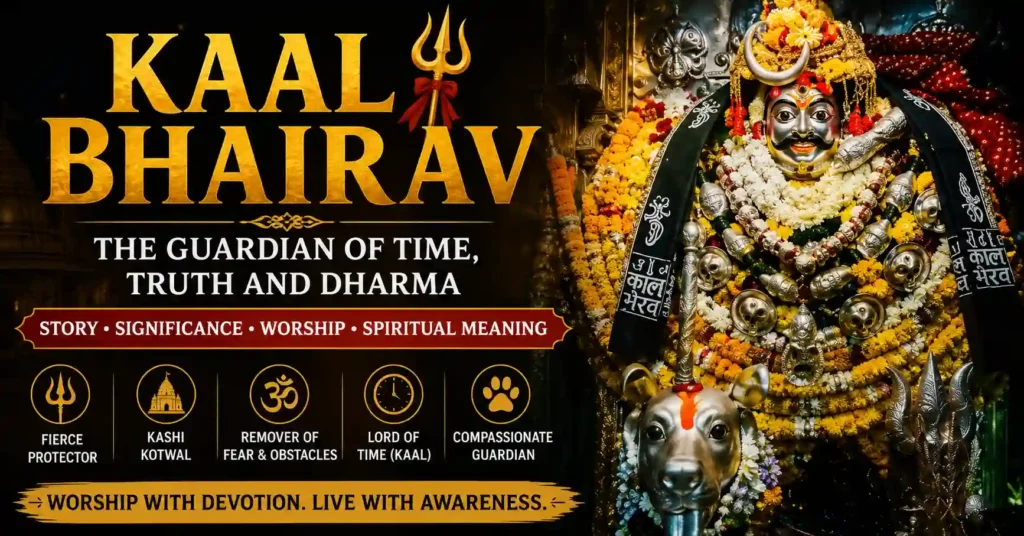
The story of Brahma's Fifth Head and The Birth of Kaal Bhairav
The most well-known story connected with Kaal Bhairav comes from the Shiva Purana and several other sacred traditions.
According to the story, a debate once arose between Lord Brahma and Lord Vishnu. Both wished to establish who was supreme among them. As the discussion grew more intense, Lord Shiva appeared in the form of an endless pillar of divine light.
This radiant column stretched beyond imagination. It had no visible beginning and no visible end.
To settle the matter, Vishnu journeyed downward in search of its base, while Brahma traveled upward looking for its summit. They searched for a long time, but neither could find the limits of Shiva’s infinite form.
Eventually, Vishnu returned and honestly admitted that he could not find the end of the divine light.
Brahma, however, chose a different path. Instead of accepting the truth, he claimed that he had reached the top and declared himself victorious.
This moment is important because the story is not merely about two gods. It is about a struggle that exists within every human being. Sometimes truth asks us to accept our limitations, while ego pushes us to protect our pride.
When Brahma’s false claim disturbed the balance of dharma, Lord Shiva manifested a fierce form from his own divine energy.
That form was Kaal Bhairav.
Bhairav confronted Brahma and severed his fifth head, the head that had become associated with pride, arrogance, and falsehood.
At first glance, the story may seem harsh. But spiritual traditions have long understood it in a symbolic way.
The fifth head represents the ego that refuses to accept truth. It represents self-deception, pride, and the tendency to place oneself above wisdom.
Kaal Bhairav’s action symbolizes the removal of these obstacles.
The deeper message of the story is not punishment. It is transformation.
Bhairav does not destroy the individual. He destroys the ignorance that prevents spiritual growth. He removes the false identities that keep a person trapped in pride and illusion.
This is why devotees see Kaal Bhairav not as a frightening deity, but as a compassionate guardian who helps seekers move closer to truth.
Sometimes the greatest blessing is not receiving what we want. Sometimes it is having our ego removed so that wisdom can finally arise.
The Journey of Bhairav and the Fall of the Skull
After removing Brahma’s fifth head, Bhairav incurred the sin associated with Brahma-hatya. As part of his penance, he wandered across sacred lands carrying Brahma’s skull in his hand.
Wherever he went, the skull remained attached to him. It would not leave him despite his journey through many holy places.
Eventually, Bhairav arrived in the sacred city of Kashi, known today as Varanasi. The moment he entered the holy city, the skull detached from his hand and fell to the ground.
This place later became known as Kapal Mochan.
For devotees, this event symbolizes liberation from karmic burden and spiritual purification. It reflects the belief that sacred awareness and divine grace can free a soul from the weight of past actions.
From that time onward, Kaal Bhairav became closely associated with Kashi and came to be revered as its eternal guardian.
Even today, devotees believe that Bhairav Baba watches over the sacred city, protecting pilgrims and seekers who come in search of spiritual blessings.
Kaal Bhairav in the Shiva Purana
The Shiva Purana presents Bhairav as the force that steps forward when truth is threatened and balance begins to weaken.
His actions are never driven by anger or personal desire. They arise from the need to protect dharma and restore order.
In this Purana, Bhairav is seen as:
Protector of dharma
Destroyer of arrogance
Corrector of falsehood
Guardian of spiritual discipline
The message is simple yet profound.
Divine compassion does not mean ignoring wrongdoing. Sometimes compassion also requires correction, accountability, and responsibility.
Bhairav represents this aspect of divine justice, where truth is protected and balance is restored.
Kaal Bhairav in the Skanda Purana
The Skanda Purana gives special importance to Kaal Bhairav’s connection with Kashi.
In this sacred text, he is described as Kshetrapala, the guardian and protector of the holy city. His role is not limited to protecting a physical place. He is believed to safeguard the spiritual sanctity of Kashi itself.
According to long-standing traditions, pilgrims visiting Kashi are encouraged to seek the blessings of Kaal Bhairav. Many devotees believe that a pilgrimage remains incomplete without paying respects to the city’s divine guardian.
This belief continues to live on in Varanasi today, where devotion to Kaal Bhairav remains an important part of the sacred journey.
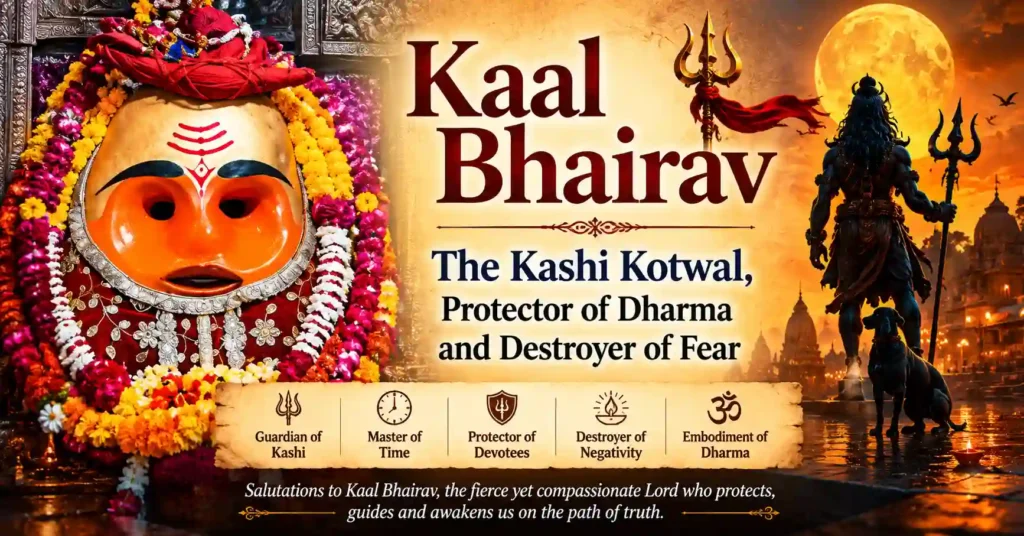
Kaal Bhairav as the Kashi Kotwal
One of the most beloved titles of Kaal Bhairav is “Kashi Kotwal.“
The word Kotwal traditionally means a chief guardian, protector, or keeper of order. In spiritual traditions, Kaal Bhairav is revered as the divine guardian of Kashi.
According to local beliefs, he watches over the sacred city, protects pilgrims, and preserves the spiritual discipline of Varanasi. Many devotees believe that Lord Shiva himself entrusted the protection of Kashi to Bhairav Baba.
This is why countless pilgrims visit the Kaal Bhairav Temple during their Kashi Yatra. There is also a popular saying in Varanasi that one should seek the blessings of Baba Vishwanath and pay respects to Kaal Bhairav, the guardian of the holy city.
Whether understood literally or symbolically, the message remains meaningful.
Spiritual progress requires both grace and discipline. Lord Shiva represents grace, while Kaal Bhairav represents discipline. Together, they guide devotees on the path toward liberation.
Why no Pilgrimage to Kashi feels Complete without Kaal Bhairav
For many devotees, visiting Kashi is much more than a journey to a sacred city. It is a spiritual experience connected with devotion, self-reflection, and the hope of liberation.
Within this holy city, Kaal Bhairav holds a special place. For generations, pilgrims have believed that the guardian of Kashi should be honored along with Lord Vishwanath.
This tradition reflects a simple yet meaningful understanding. Every sacred journey calls for responsibility. Every blessing asks for awareness. Every act of devotion requires sincerity.
Kaal Bhairav is believed to embody these values.
For this reason, countless devotees continue to offer prayers at his temple before completing their pilgrimage. His presence reminds them that spiritual life is not only about seeking blessings, but also about living truthfully, following dharma, and valuing the precious gift of time.
Ujjain Kaal Bhairav Temple and Its Unique Traditions
Among all the temples dedicated to Kaal Bhairav, the Kaal Bhairav Temple of Ujjain holds a very special place. Located in the sacred city of Ujjain in Madhya Pradesh, this temple is closely connected with the spiritual heritage of Mahakal and the ancient traditions of Shaiva worship.
The temple is believed to be several centuries old, with references linking it to the Paramara period and later Tantric traditions. For many devotees, a pilgrimage to Ujjain feels incomplete without visiting both Mahakaleshwar Jyotirlinga and Kaal Bhairav.
One of the most widely known traditions of this temple is the offering of liquor to the deity. Devotees offer it with deep reverence, and according to temple tradition, the offering mysteriously disappears when presented before the deity.
For outsiders, this practice may seem unusual. However, within certain Tantric and Shaiva traditions, it symbolizes the transformation of worldly tendencies into spiritual awareness. The offering is not viewed as indulgence but as surrender.
The temple attracts thousands of devotees seeking protection, courage, and relief from obstacles. Many people visit before beginning important life decisions, believing that Bhairav’s blessings bring clarity and strength.
Major Kaal Bhairav Temples in India
While Kashi and Ujjain are the most famous centers of Bhairav worship, several important temples dedicated to Kaal Bhairav can be found across India.
Kaal Bhairav Temple, Varanasi
Located near Visheshwarganj in Varanasi, this temple is regarded as one of the most sacred Bhairav shrines in India.
Here, Kaal Bhairav is worshipped as the Kotwal of Kashi. Devotees believe he protects the holy city and watches over pilgrims who arrive seeking spiritual blessings.
Kaal Bhairav Temple, Ujjain
One of the most visited Bhairav temples in India and famous for its unique offering traditions.
Adi Bhairav Temple, Varanasi
Often visited alongside the main Kaal Bhairav Temple, this shrine is associated with ancient traditions of Bhairav worship in Kashi.
Bhairavnath Temples in North India
Across Rajasthan, Himachal Pradesh, Uttarakhand, Haryana, and Uttar Pradesh, numerous temples honor Bhairavnath as a village guardian and protector deity.
Nepal’s Kaal Bhairav Shrines
In Nepal, especially in Kathmandu, Kaal Bhairav holds great cultural and spiritual importance. Large images and temples dedicated to him continue to be important centers of devotion.
These temples reveal how Bhairav worship has remained a living tradition across different regions and communities.
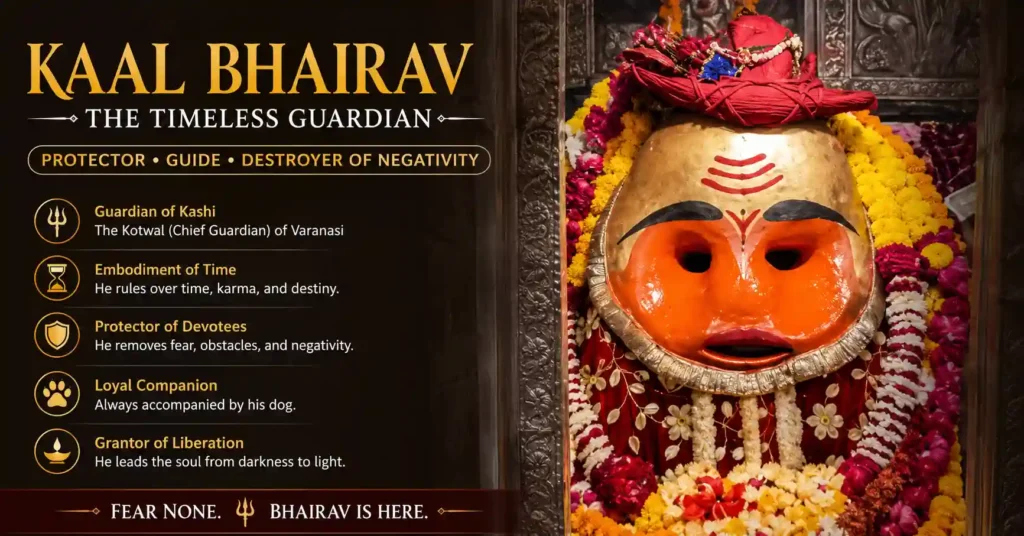
The symbolism of Kaal Bhairav's form
At first glance, Kaal Bhairav’s appearance may seem fierce. Yet every aspect of his form carries profound spiritual meaning.
His symbols are not intended to create fear. They are meant to awaken awareness.
Each symbol teaches devotees something about life, truth, and spiritual growth.
The deeper one studies Bhairav’s iconography, the more one realizes that every element points toward inner transformation.
The Spiritual MMeaning of Bhairav's Dog Companion
One of the most recognizable features of Kaal Bhairav is his dog companion.
Many devotees wonder why such a powerful deity is associated with a dog.
In spiritual symbolism, the dog represents:
- Loyalty
- Alertness
- Faithfulness
- Protection
- Instinct guided by awareness
The dog teaches vigilance.
Just as a loyal guardian remains alert throughout the night, a spiritual seeker must remain alert to ego, ignorance, and harmful tendencies.
This symbolism is one reason why feeding black dogs is often regarded as a devotional act connected with Bhairav worship.
The practice is not merely ritualistic. It expresses compassion, gratitude, and respect for a symbol closely associated with the deity.
The Skull Bowl and Its Spiritual Meaning
Kaal Bhairav is often depicted carrying a skull bowl, known as a kapala.
To modern eyes, this image may seem intense, but its meaning is deeply symbolic. The skull serves as a reminder of impermanence and the ever-changing nature of worldly life.
Everything in the physical world eventually changes. Beauty fades, wealth changes hands, and power rises and falls.
The skull bowl reminds devotees that attachment to temporary identities and possessions can become a source of suffering. Through this symbol, Bhairav encourages seekers to look beyond what is temporary and remember what is eternal.
For this reason, the skull is not seen merely as a symbol of death. It is also a symbol of wisdom and spiritual understanding.
The Trident and The Three Dimensions of Life
The trident, or trishula, is another important symbol associated with Kaal Bhairav.
Traditionally, the three prongs are interpreted in many ways:
- Creation, preservation, and dissolution
- Body, mind, and spirit
- Past, present, and future
- Action, knowledge, and will
The trident reminds devotees that spiritual growth requires balance.
A person who develops only knowledge without discipline remains incomplete. A person who develops power without wisdom creates suffering. The trident symbolizes integrated living.
The Snakes of Kaal Bhairav
Snakes appear frequently in the iconography of Shiva and Bhairav.
In spiritual traditions, snakes represent:
- Transformation
- Awareness
- Hidden energy
- Mastery over fear
Most people spend their lives running from fear.
Bhairav teaches something different.
He encourages devotees to face fear directly and understand it.
Once fear is understood, it loses much of its power.
This is why snakes become symbols of mastery rather than danger.

The Ashta Bhairavas
One of the most important yet often overlooked aspects of Bhairav worship is the concept of the Ashta Bhairavas.
The term Ashta Bhairava means “Eight Bhairavas.”
These eight forms are believed to protect the eight directions of existence and maintain cosmic order.
Different traditions provide slightly different descriptions, but the most commonly recognized forms include:
- Asitanga Bhairava
- Ruru Bhairava
- Chanda Bhairava
- Krodha Bhairava
- Unmatta Bhairava
- Kapala Bhairava
- Bhishana Bhairava
- Samhara Bhairava
Each form represents a particular aspect of spiritual protection and transformation.
Together they symbolize complete guardianship over the universe.
The concept also reminds devotees that divine protection operates in many forms, not just one.
Different forms of Bhairava
Over centuries, various forms of Bhairava have become prominent in different regions and traditions.
While all are manifestations of Shiva’s Bhairava energy, each emphasizes a different spiritual quality.
Kaal Bhairav
The most widely worshipped form.
He governs time, karma, discipline, and spiritual accountability.
Batuk Bhairav
Batuk Bhairav appears in a youthful and compassionate form.
Devotees often worship him for protection, removal of obstacles, and household well-being.
He is especially popular among families seeking a gentle form of Bhairava’s blessings.
Swarnaakarshan Bhairav
This form is associated with prosperity, abundance, and removal of financial difficulties.
The deeper teaching behind this worship is balance rather than greed.
True prosperity includes both material stability and spiritual wisdom.
Ashta Bhairava
The collective form of the eight directional guardians.
This aspect highlights Bhairava’s role as a cosmic protector.
Regional Bhairava Traditions
Across India, Bhairava appears under many local names.
Some communities worship Bhairavnath as a village protector.
Others honor him as a guardian of mountains, forests, cattle, or sacred boundaries.
These traditions reveal how deeply Bhairava worship has become woven into the spiritual life of local communities.
Why Bhairava Appears in So Many Different Forms
A common question among devotees is why there are so many forms of Bhairava.
The answer lies in the diversity of human needs. A seeker struggling with fear may connect with Batuk Bhairav.
A pilgrim visiting Kashi may seek the blessings of Kaal Bhairav. Someone focused on prosperity may worship Swarnaakarshan Bhairav.
A Tantric practitioner may meditate upon deeper Bhairava principles described in ancient texts. The forms differ, but the essence remains the same.
Each form ultimately points toward truth, awareness, courage, discipline, and liberation.
Bhairava appears in many forms because human beings approach the divine through many paths.
Kaal Bhairav in Shaiva Siddhanta
Within the Shaiva Siddhanta tradition, Kaal Bhairav is understood as the active and protective power of Lord Shiva. Shiva represents supreme consciousness, stillness, and infinite compassion. Bhairav represents the force that protects this divine order and prevents it from falling into chaos.
In this understanding, Bhairav is not separate from Shiva. He is Shiva acting through discipline, boundaries, and corrective action.
Life requires both compassion and responsibility. If compassion exists without discipline, disorder follows. If discipline exists without compassion, rigidity develops. Bhairav and Shiva together symbolize the perfect balance between these two principles.
Shaiva Siddhanta teaches that spiritual growth requires devotion, self-control, ethical conduct, and awareness of one’s actions. Bhairav helps devotees develop these qualities by removing arrogance, laziness, and self-deception.
For this reason, Bhairav is not viewed merely as a fierce deity. He is a guardian of spiritual maturity.
Kaal Bhairav in Kashmir Shaivism
Kashmir Shaivism offers one of the deepest and most profound understandings of Bhairav.
In many popular traditions, devotees worship Bhairav as a divine protector standing outside themselves. Kashmir Shaivism takes the seeker further inward.
Here, Bhairav is understood as the highest state of consciousness itself.
Ancient texts such as the Vijnana Bhairava Tantra describe Bhairava not primarily as a form carrying weapons or guarding sacred spaces, but as the limitless awareness present within every living being.
This awareness exists before thought.
Before fear.
Before identity.
Before all mental activity.
According to these teachings, liberation occurs when a seeker recognizes this ever-present awareness.
The Bhairava of Kashmir Shaivism is not merely the destroyer of external negativity. He is the dissolver of ignorance itself.
Bhairava and the Vijnana Bhairava Tantra
The Vijnana Bhairava Tantra is one of the most respected spiritual texts associated with Bhairava traditions.
Rather than focusing on rituals alone, this text offers meditation methods designed to help seekers recognize pure awareness.
Many practices involve:
- Awareness of breath
- Observation of silence
- Awareness between thoughts
- Observation of sound
- Mindful perception
The text teaches that divine realization can arise in ordinary moments when awareness becomes fully present.
From this perspective, Kaal Bhairav is not simply a deity to be worshipped.
He becomes a doorway to direct spiritual experience.
This is one reason why Kashmir Shaivism remains highly respected among spiritual practitioners and scholars.
Bhairava in Village and Folk Traditions
Beyond temples and scriptures, Bhairava occupies a special place in the living traditions of India.
Across villages in North India, Rajasthan, Uttarakhand, Himachal Pradesh, Madhya Pradesh, Haryana, and many other regions, Bhairavnath is worshipped as a protector of communities.
People turn to him for:
- Protection of villages
- Protection of cattle
- Protection during travel
- Protection of crops
- Protection from harmful influences
In many rural communities, Bhairava is regarded as a deity who guards boundaries and preserves order.
Unlike philosophical discussions found in scriptures, village traditions focus on practical faith.
People trust Bhairav Baba as a guardian who watches over everyday life.
These traditions demonstrate how Bhairava worship continues to remain vibrant and relevant in modern times.

Bhairava in South Indian traditions
In South India, Bhairava is commonly worshipped as a guardian deity of temples.
Many ancient temples contain Bhairava shrines near entrances, outer boundaries, or sacred corridors. Devotees often visit these shrines before leaving the temple premises.
In Tamil Nadu, Karnataka, Andhra Pradesh, and Kerala, Bhairava worship has existed for centuries as part of broader Shaiva traditions.
Special prayers are often offered on Ashtami nights. Oil lamps, simple offerings, and silent devotion are common forms of worship.
The emphasis is usually on discipline, protection, and spiritual vigilance.
Benefits of Kaal Bhairav Worship
Devotees approach Kaal Bhairav for many different reasons. While traditions vary, certain benefits are commonly associated with sincere worship.
Courage during difficult times
Many devotees feel stronger and more confident when facing uncertainty.
Bhairav’s energy is associated with fearlessness and inner strength.
Greater discipline
Kaal Bhairav is closely linked with responsibility and accountability.
His worship encourages self-control, commitment, and consistency.
Removal of mental confusion
Devotees often describe feeling more focused and clear after regular prayer and mantra chanting.
Protection from negativity
Many traditions believe Bhairav protects devotees from harmful influences, both external and internal.
Spiritual growth
At a deeper level, Bhairav helps seekers confront ego, attachment, and ignorance.
This inner transformation is considered one of the greatest blessings of his worship.
It is important to understand that these benefits are not magical rewards.
Traditional teachings emphasize sincerity, ethical conduct, and devotion as essential foundations.
How to Worship Kaal Bhairav at Home
One of the most beautiful aspects of Bhairav worship is its simplicity.
A devotee does not need elaborate arrangements.
A clean space, sincere intention, and regular practice are often considered sufficient.
Basic home worship
You may offer:
- Clean water
- Flowers
- Black sesame seeds
- Mustard oil lamp
- Incense
Sit quietly before the image or murti and spend a few moments calming the mind.
Offer prayers with humility rather than expectation. Bhairav worship emphasizes sincerity more than ritual complexity.
Kaal Bhairav Mantra
One of the most commonly chanted mantras is:
ॐ कालभैरवाय नमः
Om Kaalabhairavaya Namah
This simple mantra is suitable for most devotees.
Many people chant it:
- During morning prayers
- On Ashtami
- On Saturdays
- During periods of difficulty
- Before important decisions
Regular chanting is believed to promote clarity, courage, and spiritual focus.
Beej Mantras and Traditional Guidance
Certain Bhairava traditions include powerful beej mantras. These mantras are usually transmitted through a qualified guru or lineage.
This is not because devotees should fear the mantra. Rather, traditional teachers emphasize proper understanding, pronunciation, and discipline.
For most household devotees, simple devotion and regular chanting of “Om Kaalabhairavaya Namah” is considered sufficient.
Bhairav Ashtami
Among all festivals associated with Bhairava worship, Bhairav Ashtami is the most important.
This sacred day commemorates the manifestation of Kaal Bhairav. It is observed during the Krishna Paksha Ashtami of the Margashirsha month.
Across India, devotees celebrate this occasion through:
- Temple visits
- Mantra chanting
- Charity
- Fasting
- Spiritual reflection
- Night-long prayers
Many Bhairav temples conduct special rituals and devotional programs on this day.
The atmosphere is often filled with deep devotion and reverence.
Kalashtami and Monthly Observances
Apart from Bhairav Ashtami, devotees also observe Kalashtami every month.
Kalashtami falls on the eighth day of the waning moon phase.
Many practitioners consider this day especially favorable for:
- Prayer
- Meditation
- Mantra chanting
- Self-reflection
Regular observance helps cultivate discipline and spiritual awareness over time.
What Kaal Bhairav Teaches to Modern Seekers
Modern life often feels rushed, distracted, and uncertain.
People constantly struggle with pressure, fear, comparison, and mental restlessness.
This is one reason Kaal Bhairav continues to resonate with so many devotees today.
His teachings remain surprisingly relevant.
He reminds us that:
- Time is precious.
- Truth matters.
- Actions have consequences.
- Discipline creates freedom.
- Awareness is more valuable than appearances.
Bhairav teaches that real strength comes not from controlling others but from mastering oneself.
He encourages people to face reality honestly instead of escaping it.
In a world filled with distractions, this message feels more important than ever.
For many devotees, Kaal Bhairav is not merely a deity from ancient scriptures.
He becomes a living reminder to use time wisely, act truthfully, and walk through life with courage and awareness.
Common Misconceptions about Kaal Bhairav
Over the centuries, many misconceptions have developed around Kaal Bhairav. Some arise from incomplete understanding, while others come from focusing only on his fierce appearance without understanding his deeper spiritual significance.
Misconception 1: Kaal Bhairav is a deity of fear
This is perhaps the most common misunderstanding.
While Bhairav appears fierce, his role is protective, not frightening. His fierce form symbolizes the destruction of ego, falsehood, and ignorance. Devotees who worship him sincerely often describe him as compassionate, protective, and deeply reassuring.
Misconception 2: Bhairav worship is only for Tantric practitioners
Although Bhairav holds an important place in certain Tantric traditions, his worship is not limited to them.
Across India, ordinary household devotees worship Bhairav Baba through simple prayers, lamps, flowers, and mantra chanting. His blessings are sought by people from all walks of life.
Misconception 3: Bhairav worship requires complicated rituals
Most devotees practice very simple forms of worship.
A clean space, sincere devotion, and regular remembrance are considered more important than elaborate rituals.
Misconception 4: Kaal Bhairav represents anger
Bhairav’s energy is not anger. It is divine correction.
Just as a loving parent may firmly guide a child when necessary, Bhairav represents the force that restores balance when ego and disorder become excessive.
Misconception 5: Bhairav only protects against external problems
Traditional teachings emphasize that Bhairav’s greatest work happens within.
He helps devotees confront fear, attachment, confusion, laziness, and self-deception. His deepest protection is often spiritual rather than material.
Conclusion
Kaal Bhairav is one of the most profound and fascinating manifestations of Lord Shiva. He is the guardian of sacred spaces, the protector of dharma, the lord of time, and the destroyer of falsehood.
His fierce appearance often captures attention, but his deeper message touches the heart. He teaches that time is precious, truth cannot be avoided, and spiritual growth requires honesty, courage, and discipline.
From the ancient streets of Kashi to the temples of Ujjain, from the teachings of the Puranas to the insights of Kashmir Shaivism, Bhairav continues to guide seekers across generations.
For some, he is a protector.
For others, he is a teacher.
For many devotees, he becomes both.
To remember Kaal Bhairav is to remember that every moment of life is sacred. The path of truth may not always be easy, but it is always worth walking.
And in that journey, countless devotees believe that Bhairav Baba walks beside them, protecting, guiding, and reminding them to live with awareness, responsibility, and unwavering faith.
Suggested Reading
If you enjoyed learning about Kaal Bhairav, you may also explore these related articles on thesanatantales.com:
If you enjoyed learning about Kaal Bhairav, you may also like exploring these related articles on thesanatantales.com. Together, they offer a deeper understanding of Bhairava’s different forms, spiritual significance, and place within Sanatan Dharma.
Batuk Bhairav: The Gentle Protector Who Removes Fear and Obstacles
https://thesanatantales.com/batuk-bhairav/
Swarnaakarshan Bhairav: The Attractor of Wealth and Abundance
https://thesanatantales.com/swarnakarshan-bhairav/
Ashta Bhairava: Guardians of Time, Direction, and Dharma
https://thesanatantales.com/ashta-bhairava/
Kaal Bhairav Ashtakam: Meaning, Benefits and Spiritual Significance
https://thesanatantales.com/kaal-bhairav-ashtakam/
Bhairav Tattva: The Principle of Time, Truth, and Awakening
https://thesanatantales.com/bhairav-tattva/
Shiva and Bhairav: Meaning, Connection & Spiritual Path
https://thesanatantales.com/shiva-and-bhairav-guide/
Bhairava (Wikipedia)
https://en.wikipedia.org/wiki/Bhairava
FAQs
Who is Kaal Bhairav in Hinduism?
Kaal Bhairav is one of the most powerful forms of Lord Shiva. He is worshipped as the guardian of time, protector of dharma, destroyer of ego, and the divine guardian of Kashi.
Why is Kaal Bhairav called the Kashi Kotwal?
Kaal Bhairav is known as the Kashi Kotwal because he is believed to be the divine guardian and protector of Varanasi (Kashi). According to tradition, no pilgrimage to Kashi is considered complete without seeking his blessings.
What are the benefits of worshipping Kaal Bhairav?
Devotees believe that Kaal Bhairav worship helps remove fear, increase courage, improve discipline, protect from negativity, clear obstacles, and strengthen spiritual awareness.
Which day is best for Kaal Bhairav worship?
Kalashtami, which falls on the eighth day of the waning moon every month, is considered especially auspicious. Bhairav Ashtami and Saturdays are also important for worship.
Can Kaal Bhairav remove fear and obstacles?
Many devotees worship Kaal Bhairav for protection from fear, confusion, and obstacles. His teachings encourage courage, truthfulness, and inner strength.
What is the relationship between Lord Shiva and Kaal Bhairav?
Kaal Bhairav is not separate from Lord Shiva. He is a fierce manifestation of Shiva who appears to protect dharma, destroy arrogance, and maintain cosmic order.
What is Bhairav Ashtami and why is it important?
Bhairav Ashtami is the sacred festival that commemorates the appearance of Kaal Bhairav. Devotees observe fasting, visit temples, chant mantras, and perform special prayers on this day.
Why is a dog associated with Kaal Bhairav?
The dog is considered the vahana (vehicle) of Kaal Bhairav. It symbolizes loyalty, alertness, protection, and faithfulness. Feeding black dogs is considered a devotional act in many traditions.
What mantra is commonly chanted for Kaal Bhairav?
The most popular mantra is:
ॐ कालभैरवाय नमः
Om Kaalabhairavaya Namah
This mantra is chanted for protection, courage, and spiritual clarity.
Can women worship Kaal Bhairav?
Yes. Women can worship Kaal Bhairav, chant his mantras, visit his temples, and participate in devotional practices. There is no scriptural prohibition on his worship by women.
What is the difference between Kaal Bhairav and Batuk Bhairav?
Kaal Bhairav represents Shiva’s fierce and protective aspect connected with time and discipline. Batuk Bhairav is a youthful and gentler form who is often worshipped for protection, prosperity, and removal of obstacles.
Is Kaal Bhairav worship connected with Tantra?
Yes, Kaal Bhairav has an important place in several Tantric traditions. However, simple devotional worship of Bhairav is also common among ordinary devotees and householders.
Glossary of Important Terms
| Term | Meaning |
|---|---|
| Kaal Bhairav | A powerful manifestation of Lord Shiva associated with time, protection, discipline, truth, and spiritual transformation. |
| Bhairava | A fierce yet compassionate form of Lord Shiva who removes fear, ignorance, and ego while protecting devotees. |
| Lord Shiva | One of the principal deities of Hinduism, worshipped as the Supreme Reality in Shaivism and the source of all Bhairava forms. |
| Kaal | A Sanskrit word meaning time, destiny, death, change, and cosmic transformation. |
| Dharma | The universal principle of righteousness, moral order, and duty that sustains the universe. |
| Karma | The law of cause and effect through which actions shape future experiences and spiritual growth. |
| Kashi (Varanasi) | One of Hinduism’s holiest cities, regarded as the sacred abode of Lord Shiva and protected by Kaal Bhairav. |
| Kashi Kotwal | A traditional title of Kaal Bhairav, recognizing him as the divine guardian and protector of Varanasi. |
| Kshetrapala | The guardian deity of a sacred place, temple, or pilgrimage site. Kaal Bhairav is revered as the Kshetrapala of Kashi. |
| Kapal Mochan | A sacred site in Varanasi where Brahma’s skull is believed to have fallen from Bhairava’s hand, symbolizing liberation from karmic burden. |
| Brahma’s Fifth Head | A symbolic story representing the destruction of ego, pride, falsehood, and ignorance through divine wisdom. |
| Kapala | A skull bowl carried by Bhairava, symbolizing impermanence, detachment, and spiritual wisdom. |
| Trishula (Trident) | A sacred weapon representing creation, preservation, dissolution, and mastery over body, mind, and spirit. |
| Dog (Shvana) | The sacred companion and vehicle (vahana) of Bhairava, symbolizing loyalty, vigilance, protection, and faithfulness. |
| Vahana | The divine vehicle or mount associated with a Hindu deity. |
| Snake (Naga) | A sacred symbol representing transformation, awakened energy, wisdom, and mastery over fear. |
| Ashta Bhairava | The eight principal forms of Bhairava who guard the eight directions and uphold cosmic order. |
| Batuk Bhairav | The youthful and compassionate form of Bhairava worshipped for protection, guidance, and the removal of obstacles. |
| Swarnakarshan Bhairav | A form of Bhairava associated with prosperity, harmony, and responsible abundance. |
| Shaivism (Shaiva Tradition) | A major Hindu tradition centered on the worship of Lord Shiva as the Supreme Being. |
| Shaiva Siddhanta | A philosophical school of Shaivism that emphasizes devotion, discipline, and spiritual liberation through Shiva’s grace. |
| Kashmir Shaivism | A non-dual Shaiva philosophy that views Bhairava as the highest state of pure consciousness. |
| Vijnana Bhairava Tantra | A revered scripture of Kashmir Shaivism presenting meditation techniques to realize pure awareness. |
| Tantra | A spiritual tradition that uses meditation, mantra, rituals, and symbolism for inner transformation and self-realization. |
| Mantra | A sacred sound or phrase repeated in prayer or meditation to invoke divine blessings and focus the mind. |
| Om Kaalabhairavaya Namah | A widely chanted mantra dedicated to Kaal Bhairav for protection, courage, and spiritual clarity. |
| Beej Mantra | A sacred seed mantra that represents the essential spiritual energy of a deity. |
| Bhairav Ashtami | The most important annual festival dedicated to Kaal Bhairav, commemorating his manifestation. |
| Kalashtami | The monthly observance dedicated to Kaal Bhairav on the eighth day of the waning moon. |
| Mahakaleshwar | The famous Jyotirlinga in Ujjain closely associated with Kaal Bhairav worship. |
| Jyotirlinga | A sacred shrine where Lord Shiva is worshipped as an infinite pillar of divine light. |
| Ujjain | An ancient pilgrimage city known for Mahakaleshwar Jyotirlinga and the famous Kaal Bhairav Temple. |
| Pilgrimage (Yatra) | A sacred journey to holy places undertaken for devotion, purification, and spiritual growth. |
| Awareness | A state of clear consciousness emphasized in Bhairava teachings as the foundation of spiritual awakening. |
| Detachment | Freedom from ego, excessive attachment, and illusion while fulfilling one’s responsibilities. |
| Liberation (Moksha) | Freedom from the cycle of birth and death through realization of one’s true spiritual nature. |
| Spiritual Discipline | Consistent practice of devotion, self-control, ethical living, and meditation that leads to inner growth. |
About the Author
Yateendra Chaturvedi is a spiritual writer, researcher, devotee, and the founder of The Sanatan Tales. With over 35 years of professional experience and a lifelong interest in Sanatan Dharma, he writes about Hindu deities, temples, scriptures, festivals, Mahavidyas, sacred stories, rituals, and living traditions that continue to guide and inspire devotees across India.
Drawing from traditional scriptures, regional beliefs, temple traditions, devotional literature, and historical sources, he aims to present authentic, well-researched, and easy-to-understand content for modern readers. His work focuses on preserving spiritual wisdom, explaining sacred traditions, and helping seekers develop a deeper understanding of India’s rich spiritual heritage.
Through The Sanatan Tales, Yateendra strives to make the timeless teachings of Sanatan Dharma simple, meaningful, and relevant for today’s generation while maintaining respect for traditional sources, regional practices, and diverse spiritual perspectives.
Learn More About Yateendra Chaturvedi →
https://thesanatantales.com/about-the-author/
References & Sources
This article is based on Shaiva and Bhairava traditions followed within Sanatan Dharma, traditional beliefs associated with Lord Bhairava, religious narratives, folk traditions, and insights gathered from various spiritual and religious study sources. Some concepts discussed in this article are also inspired by interpretations found in guru-disciple lineages, temple traditions, and devotional literature.
Note: Beliefs, stories, and methods of worship related to Lord Bhairava may differ across regions, sects, and spiritual traditions. The purpose of this article is not to present any single viewpoint as the absolute truth, but to explain commonly accepted religious and spiritual perspectives in a simple and accessible manner.
Explore More Topics from The Sanatan Tales




Comments are closed.