In Sanatan Dharma, liberation is not promised only to sages who renounce the world. It is also gently offered to householders, pilgrims, and ordinary devotees who walk sacred paths with faith and devotion.
This timeless belief is beautifully reflected in Saptapuri, the seven holy cities in Sanatan Dharma, also known as the Seven Sacred Cities of India. According to ancient scriptures, these Mokshadayika cities hold a special place in Hindu tradition because they are believed to guide sincere seekers on the path to moksha, or liberation.
These cities are not quiet museums of the past. They are living centres of faith, filled with temples, rituals, festivals, and countless pilgrims. Though often busy and crowded, each carries a spiritual presence that has inspired devotees for thousands of years.
Many pilgrims say that even without performing elaborate rituals, simply spending time in these sacred places brings peace, devotion, and a feeling of inner lightness.
In this guide, you will discover what Saptapuri is, why these seven cities are considered sacred, their scriptural significance, and what makes each destination an important stop on the timeless Saptapuri pilgrimage.
The journey through the sacred cities of Hinduism is not only about where your feet travel. It is about where your soul slowly learns to let go.
Table of Contents
ToggleWhat Is Saptapuri in Sanatan Dharma and Why It Matters
Saptapuri is the collective name for the seven holy cities in Sanatan Dharma that are traditionally believed to bestow moksha, or liberation from the cycle of birth and death.
The word Sapta means “seven,” and Puri means “city.” Together, Saptapuri refers to the Seven Sacred Cities of India, each revered for its unique spiritual significance.
The importance of Saptapuri is mentioned in several ancient Hindu scriptures, including the Garuda Purana, Skanda Purana, Padma Purana, and Brahma Purana. These sacred texts describe the seven cities as Mokshadayika, meaning “the givers of liberation.”
A well-known Sanskrit verse beautifully lists these sacred cities:
अयोध्या मथुरा माया काशी काञ्ची अवन्तिका ।
पुरी द्वारावती चैव सप्तैते मोक्षदायिकाः ॥
Transliteration:
Ayodhya Mathura Maya Kashi Kanchi Avantika,
Puri Dvaravati Chaiva Saptaite Mokshadayikah.
Meaning:
“Ayodhya, Mathura, Maya (Haridwar), Kashi, Kanchi, Avantika (Ujjain), and Dwaravati (Dwarka) are the seven sacred cities that grant liberation.”
Although different Puranas emphasize different legends, deities, and spiritual practices, the list of these seven holy cities in Sanatan Dharma remains remarkably consistent. This continuity reflects the deep reverence these places have held in Hindu tradition for centuries.
The seven sacred cities are:
Ayodhya – the birthplace of Shri Ram and the symbol of dharma.
Mathura – the birthplace of Shri Krishna and the land of divine love.
Haridwar (Maya) – the gateway to the Ganga and spiritual purification.
Kashi (Varanasi) – the eternal city of Lord Shiva and liberation.
Kanchipuram – the sacred city of ancient temples, wisdom, and Shakti worship.
Ujjain (Avantika) – the city of Mahakaleshwar and spiritual transformation.
Dwarka (Dvaravati) – the royal kingdom of Shri Krishna and the ideal of detached action.
Together, these cities are more than sacred destinations on a Saptapuri pilgrimage. They represent a timeless spiritual journey where devotion, wisdom, righteous living, purification, courage, and surrender gradually lead the soul toward moksha.
Each city offers a unique lesson, making Saptapuri not just a pilgrimage across Bharat, but a path of inner awakening.
Saptapuri at a Glance
Before exploring each of the Seven Holy Cities in Sanatan Dharma, here’s a quick overview of Saptapuri and its spiritual significance.
| Feature | Details |
|---|---|
| Meaning | Sapta means “seven” and Puri means “city.” Together, Saptapuri refers to the Seven Sacred Cities of India. |
| Number of Sacred Cities | 7 |
| Cities Included | Ayodhya, Mathura, Haridwar (Maya), Kashi (Varanasi), Kanchipuram, Ujjain (Avantika), and Dwarka (Dvaravati) |
| Mentioned In | Garuda Purana, Skanda Purana, Padma Purana, Brahma Purana, and other Hindu scriptures |
| Spiritual Significance | These cities are revered as Mokshadayika, meaning places traditionally believed to guide devotees towards moksha. |
| Principal Deities | Shri Ram, Shri Krishna, Lord Shiva, Maa Ganga, Shakti, and Lord Vishnu |
| Ideal Time to Visit | October to March (varies slightly by city and festival season) |
| Best Known For | Ancient temples, sacred rivers, pilgrimage traditions, and spiritual heritage |
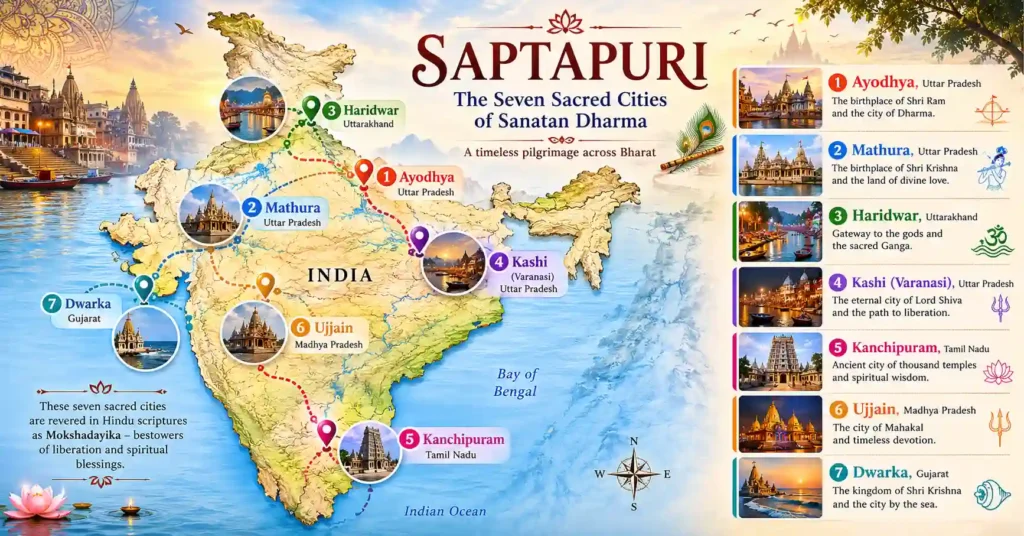
The Seven Sacred Cities on the Map of India
The Seven Holy Cities in Sanatan Dharma are spread across different regions of India, reflecting the vast spiritual heritage of Bharat.
From the sacred banks of the Ganga in the north to the ancient temple city of Kanchipuram in the south, each destination offers a unique experience of devotion, history, and pilgrimage.
The map below shows the location of all seven Saptapuri cities, helping pilgrims understand their geographical spread and plan their journey more easily.
Why Millions of Devotees Visit Saptapuri Every Year
For centuries, Saptapuri has attracted saints, pilgrims, scholars, and seekers from every corner of Bharat. While each of the seven cities has its own deity, traditions, and festivals, devotees are drawn by a common desire to deepen their faith and move closer to the Divine.
Some pilgrims come to seek blessings before beginning a new phase of life. Others visit to perform ancestral rites, fulfil long-held vows, celebrate sacred festivals, or simply experience the spiritual atmosphere that these ancient cities have preserved for generations.
Unlike ordinary travel, a Saptapuri pilgrimage is viewed as a journey of both the body and the soul. Every temple visited, every sacred river crossed, and every prayer offered becomes an opportunity for self-reflection, gratitude, and inner growth.
Whether one visits a single city or all seven, the pilgrimage reminds devotees that the true destination is not only a sacred place but also a life rooted in dharma, bhakti, and the timeless values of Sanatan Dharma.
Why Saptapuri Is Called Mokshadayika in Scriptures
In Sanatan Dharma, moksha is the ultimate goal of human life. It is freedom from the endless cycle of birth and death and the soul’s union with the Divine.
The seven holy cities in Sanatan Dharma are called Mokshadayika, meaning “the givers of liberation.” Ancient scriptures praise these sacred places because they inspire devotion, righteous living, self-reflection, and surrender to God.
The spiritual power of these cities is not believed to come from the land alone. Rather, it arises from centuries of worship, sacred temples, the presence of saints, and the continuous chanting of God’s name.
The Puranas teach that visiting these holy cities with faith, performing virtuous deeds, and remembering the Divine can help purify the mind and gradually reduce the burden of accumulated karma.
Many spiritual teachers also describe Saptapuri as an inner journey. Each city represents a timeless virtue that helps a seeker move closer to liberation.
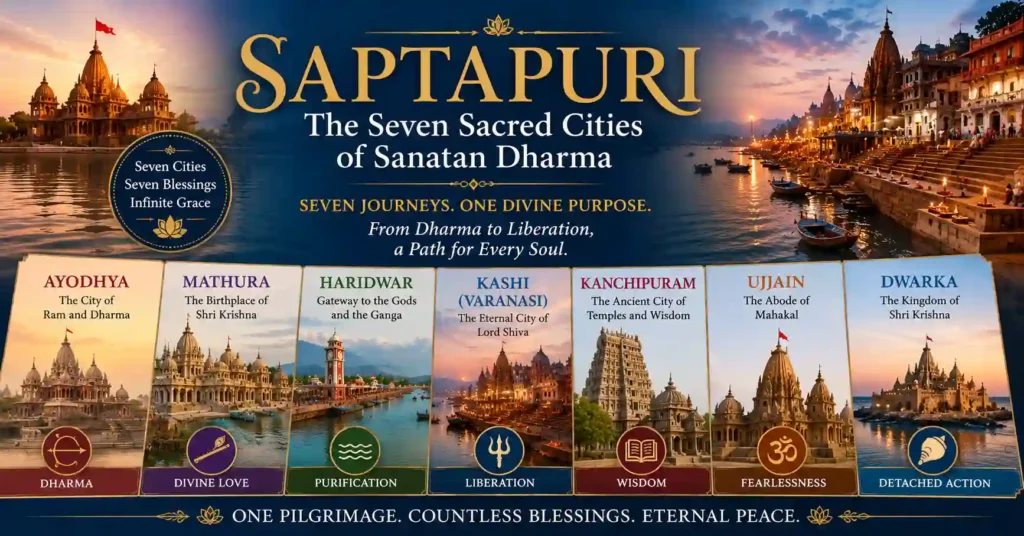
For example, devotees often associate Ayodhya with dharma, Mathura with divine love, Haridwar with purification, Kashi with liberation, Kanchipuram with wisdom, Ujjain with fearlessness, and Dwarka with detached action.
These symbolic associations are not rigid scriptural classifications. Instead, they are devotional reflections that help pilgrims understand the deeper spiritual message of the Saptapuri pilgrimage.
Many pilgrims may not immediately notice an inner transformation during their visit. Yet, through prayer, reflection, and devotion, these sacred cities often leave a lasting impression on the heart and inspire a lifelong journey towards spiritual growth.
Why Only These Seven Cities Are Called Saptapuri
A common question among pilgrims is why Saptapuri includes only these seven cities when Sanatan Dharma is home to countless sacred temples and pilgrimage destinations.
The answer lies in the ancient Puranas. These seven cities are repeatedly described as Mokshadayika, meaning places that are especially associated with guiding sincere devotees towards moksha, or liberation from the cycle of birth and death.
Each city also represents a unique aspect of spiritual growth. Ayodhya teaches dharma, Mathura awakens divine love, Haridwar inspires purification, Kashi symbolises liberation, Kanchipuram nurtures wisdom, Ujjain represents fearlessness, and Dwarka teaches detached action.
This does not mean that other sacred places such as Vrindavan, Rameswaram, Tirupati, or Jagannath Puri are less important. Every pilgrimage destination in Sanatan Dharma has its own unique spiritual significance and blessings.
What makes Saptapuri unique is that these seven cities have been collectively recognised in ancient scriptures for centuries as sacred destinations that symbolically guide a devotee through different stages of the spiritual journey towards moksha.
Together, they remind pilgrims that liberation is not reached through a single sacred place, but through a lifetime of faith, devotion, righteous living, self-reflection, and surrender to the Divine.
Scriptural References to Saptapuri
The concept of Saptapuri is deeply rooted in Hindu scriptures and has been preserved through centuries of pilgrimage traditions. Several Puranas refer to these seven sacred cities as places of exceptional spiritual importance and describe them as Mokshadayika, or givers of liberation.
Some of the principal scriptural references include:
| Scripture | Reference to Saptapuri |
|---|---|
| Garuda Purana | Lists the seven sacred cities as places that help devotees progress towards moksha. |
| Skanda Purana | Describes the spiritual greatness of cities such as Kashi and Avantika (Ujjain) in dedicated sections while affirming the importance of the seven sacred cities. |
| Padma Purana | Highlights the spiritual merit of visiting sacred pilgrimage centres and praises several of the Saptapuri cities. |
| Brahma Purana | Refers to the sanctity of these ancient cities and their role in preserving dharma and pilgrimage traditions. |
| Vishnu Purana | Describes the glory of Mathura and Dwarka, reinforcing their importance in Vaishnava tradition. |
| Valmiki Ramayana | Celebrates Ayodhya as the sacred birthplace and kingdom of Shri Ram. |
| Bhagavata Purana | Describes the divine significance of Mathura and Dwarka through the life and teachings of Shri Krishna. |
Although each scripture emphasises different cities, deities, and legends, together they preserve a consistent tradition that recognises Saptapuri as the Seven Holy Cities in Sanatan Dharma.
This remarkable continuity has inspired pilgrims for centuries and continues to make these sacred cities among the most revered destinations in Hindu pilgrimage.
Ayodhya: The City of Ram and Dharma
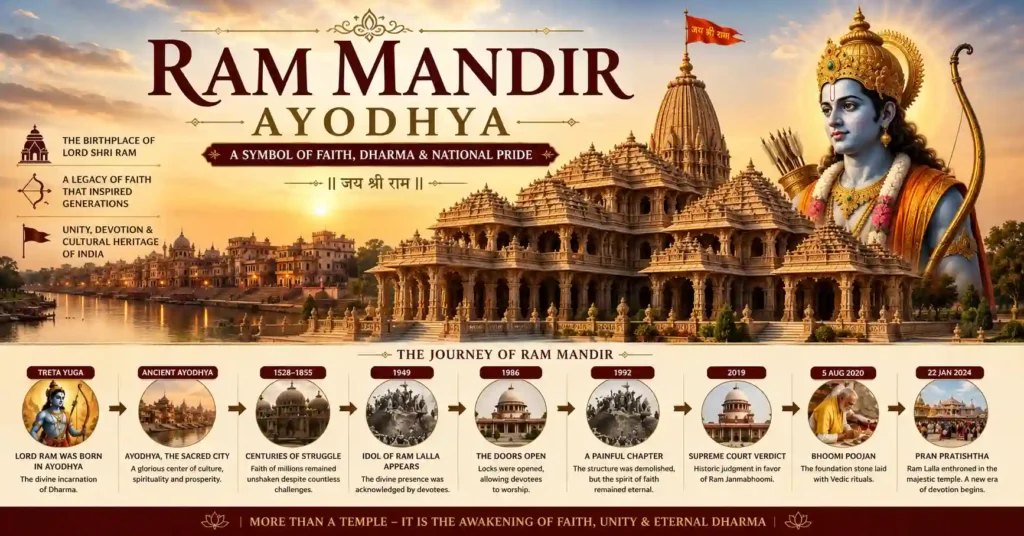
Ayodhya is one of the most revered cities in Saptapuri and is traditionally regarded as the ancient capital of the Kosala Kingdom. It is celebrated across the Ramayana as the birthplace of Maryada Purushottam Shri Ram, whose life continues to inspire millions through the ideals of truth, duty, and righteousness.
Ancient scriptures such as the Garuda Purana and Skanda Purana include Ayodhya among the seven holy cities in Sanatan Dharma, praising it as a sacred place that guides devotees towards moksha.
At the spiritual heart of the city stands the magnificent Shri Ram Janmabhoomi Mandir, a place of immense faith for devotees from across the world. Many pilgrims also visit Hanuman Garhi, Kanak Bhavan, and Ram Ki Paidi, where the holy Sarayu River flows peacefully through the city.
Taking a dip in the Sarayu and offering prayers on its banks is considered an act of spiritual purification. While this practice is rooted in long-standing tradition, devotees believe it helps cultivate inner peace and devotion.
Ayodhya is more than the birthplace of Shri Ram. It represents maryada, the path of living with discipline, compassion, responsibility, and unwavering commitment to dharma.
Pilgrims often spend quiet moments along the Sarayu, watching the gentle flow of the river. Many describe this simple experience as one of the most peaceful parts of their Saptapuri pilgrimage, reminding them that spiritual growth begins with inner stillness.
The best time to visit Ayodhya is from October to March, when the weather is pleasant for temple visits and sightseeing. Festivals such as Ram Navami and Deepotsav transform the city into a vibrant centre of devotion, attracting lakhs of pilgrims every year.
According to Hindu tradition, remembering the name of Shri Ram with sincere devotion brings peace to the heart and strengthens one’s journey towards spiritual liberation. This timeless faith continues to make Ayodhya one of the most cherished Seven Sacred Cities of India.
Mathura: Krishna's Land of Divine Love
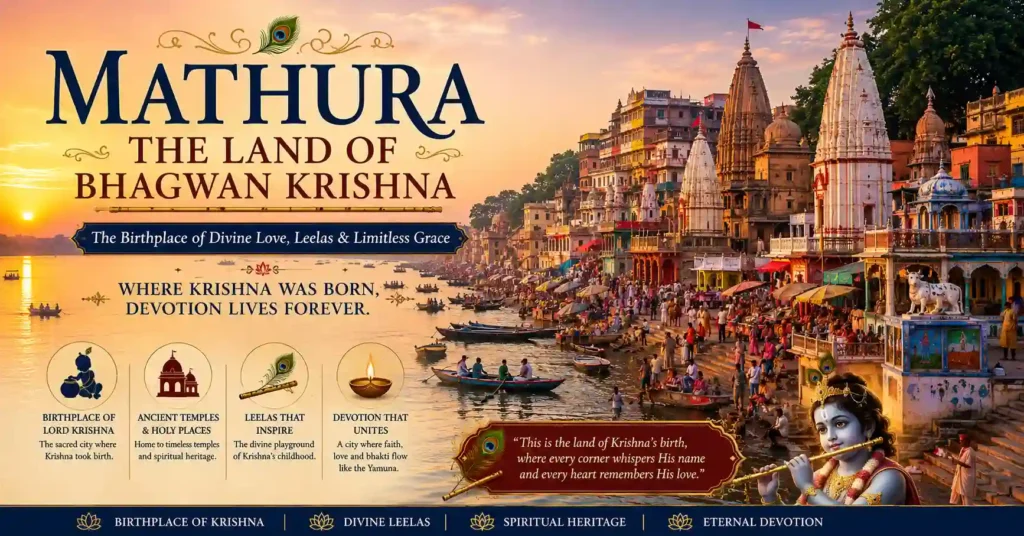
Mathura is one of the Saptapuri and is revered as the sacred birthplace of Shri Krishna, the eighth incarnation of Lord Vishnu. If Ayodhya teaches the path of dharma, Mathura awakens the heart through divine love, devotion, and joyful surrender.
The city’s spiritual importance is celebrated in the Bhagavata Purana, Harivamsha, and Vishnu Purana, which describe Mathura as the place where Lord Krishna appeared to restore righteousness and protect dharma.
At the heart of the city stands the Shri Krishna Janmabhoomi Temple, one of the most important pilgrimage sites in India. Devotees also visit Vishram Ghat, where tradition says Shri Krishna rested after defeating King Kansa.
Many pilgrims extend their journey to nearby Vrindavan, Gokul, and Govardhan, where Krishna’s childhood pastimes and divine leelas continue to inspire millions of devotees. Together, these sacred places form the spiritual heart of Braj Bhoomi.
Unlike many pilgrimage destinations, devotion in Mathura feels deeply personal. Here, Krishna is worshipped not only as the Supreme Lord but also as a beloved child, friend, guide, and eternal companion.
The city comes alive during Janmashtami, the colourful Braj Holi, and the sacred month of Kartik, when thousands of devotees gather for kirtans, parikramas, and temple celebrations. The best time to visit is from October to March, when the weather is pleasant for pilgrimage.
In Saptapuri, Mathura represents prema bhakti, the path of selfless divine love that gently dissolves ego and brings the devotee closer to God. Its timeless atmosphere reminds pilgrims that the journey to moksha is guided not only by discipline but also by love, devotion, and complete surrender to Shri Krishna.
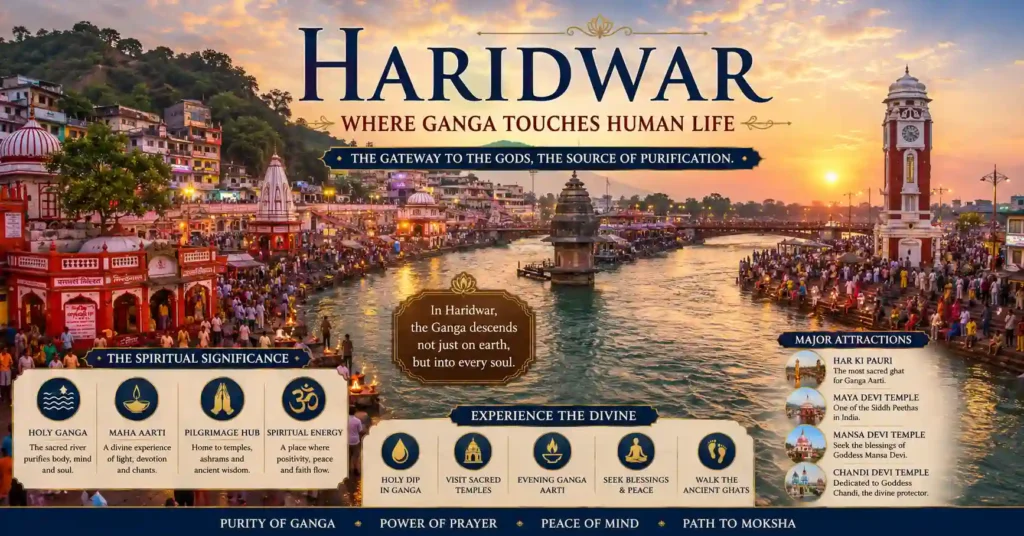
Haridwar: Where the Ganga Touches Human Life
Haridwar is one of the Saptapuri and is traditionally known as Maya in ancient scriptures. It marks the sacred place where the holy River Ganga leaves the Himalayas and enters the plains, making it one of the most revered pilgrimage destinations in Sanatan Dharma.
For centuries, Haridwar has welcomed saints, pilgrims, and seekers beginning their spiritual journey. It is also regarded as the traditional gateway to the Char Dham Yatra in Uttarakhand.
The spiritual heart of the city is Har Ki Pauri, home to the sacred Brahma Kund. Every evening, thousands of devotees gather here to witness the magnificent Ganga Aarti, where lamps, devotional chants, and the flowing river create an unforgettable atmosphere of faith.
According to Hindu tradition, drops of amrit fell at Haridwar during the Samudra Manthan, making the city one of the four sacred sites that host the Kumbh Mela. Bathing in the Ganga here is believed to purify the mind, reduce the burden of accumulated karma, and inspire a life of devotion.
Haridwar also comes alive during the Kanwar Yatra, when millions of Shiva devotees collect holy Ganga water to offer at Shiva temples across North India. These living traditions continue to preserve the city’s timeless spiritual heritage.
The best time to visit is from February to April and October to November, when the weather is pleasant for temple visits and pilgrimage. Festivals such as Kumbh Mela, Ardh Kumbh, Ganga Dussehra, and Kartika Purnima make the city even more vibrant.
In Saptapuri, Haridwar represents purification. It reminds pilgrims that every spiritual journey begins by cleansing the mind, cultivating humility, and surrendering to the Divine, just as the sacred Ganga selflessly flows to nourish all.
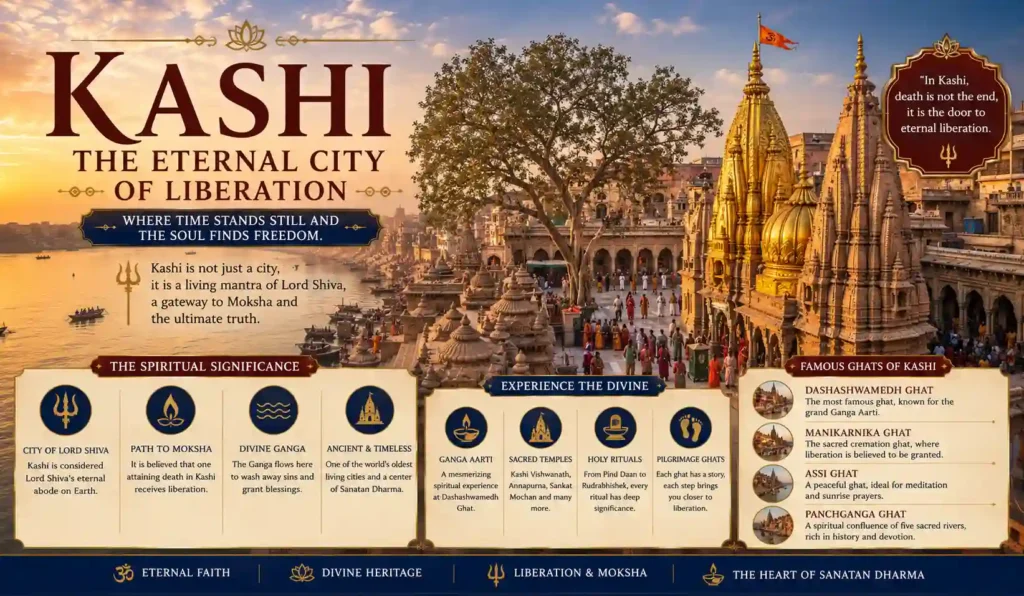
Kashi: The Eternal City of Liberation
Kashi, also known as Varanasi or Banaras, is regarded as the spiritual heart of Saptapuri. Revered as one of the world’s oldest living cities, it has been a centre of learning, devotion, and pilgrimage for thousands of years.
Ancient archaeological discoveries from nearby Aktha and Ramnagar suggest that this sacred region has been inhabited since around 1800 BCE. Its spiritual glory is celebrated extensively in the Kashi Khanda of the Skanda Purana, where Kashi is described as the beloved city of Lord Shiva.
At the centre of the city’s spiritual life stands the Shri Kashi Vishwanath Temple, one of the twelve Jyotirlingas. Pilgrims also visit the Annapurna Devi Temple, Kal Bhairav Temple, Dashashwamedh Ghat, and the sacred Manikarnika Ghat, each holding a special place in the traditional Kashi pilgrimage.
According to long-standing Hindu tradition, Lord Shiva blesses sincere devotees with the Taraka Mantra at the time of death in Kashi, helping the soul attain liberation. This sacred belief has made Kashi one of the most cherished destinations for seekers of moksha.
Life and death exist side by side in this timeless city. While the evening Ganga Aarti at Dashashwamedh Ghat celebrates the joy of devotion, the eternal flames of Manikarnika Ghat gently remind pilgrims of life’s impermanence and the soul’s eternal nature.
The best time to visit is from October to March, when the weather is pleasant for temple visits and exploring the ancient ghats. Festivals such as Dev Deepawali, Mahashivratri, and Kartik Purnima draw millions of devotees from across the world.
In Saptapuri, Kashi represents liberation. It teaches that when devotion overcomes fear and attachment, the soul moves closer to the ultimate goal of moksha, making Kashi one of the most sacred Seven Holy Cities in Sanatan Dharma.
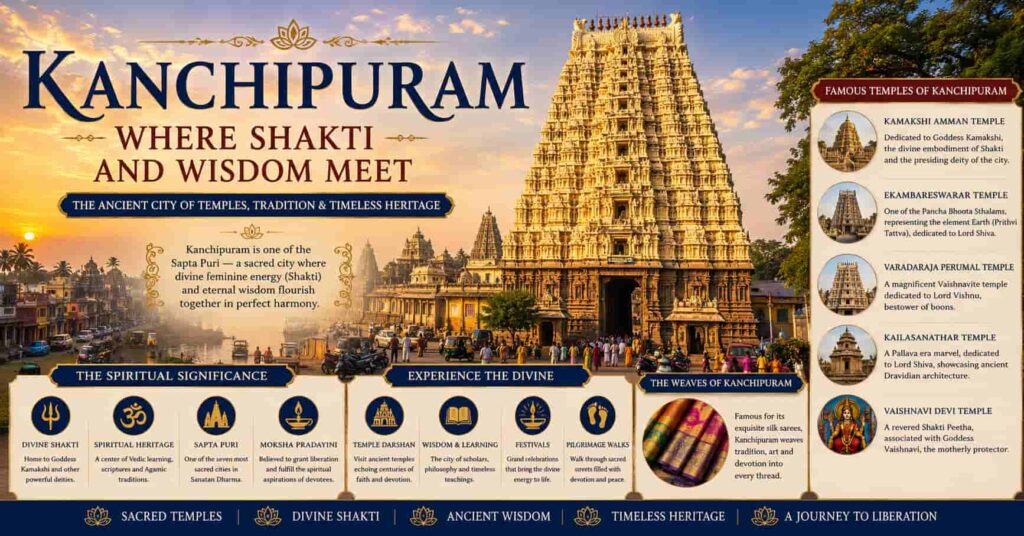
Kanchipuram: Where Shakti and Wisdom Meet
Kanchipuram is one of the sacred cities of Saptapuri and is among the oldest continuously inhabited cities in South India. Often called the City of a Thousand Temples, it has been a renowned centre of spirituality, philosophy, and learning for centuries.
The city is home to the revered Kamakshi Amman Temple, one of the most important centres of Shakti worship in South India. It is also famous for the Ekambareswarar Temple, one of the Pancha Bhoota Sthalas, where Lord Shiva is worshipped as the Prithvi (Earth) Lingam.
Kanchipuram is equally sacred to Vaishnavas. The magnificent Varadaraja Perumal Temple, one of the 108 Divya Desams, attracts devotees from across the country and reflects the city’s rich Vaishnava heritage.
Historically, Kanchipuram flourished under the Pallava dynasty and became a meeting place for Shaivism, Vaishnavism, Buddhism, and Jainism. Great spiritual teachers, including Adi Shankaracharya, further enriched its reputation as a centre of wisdom and devotion.
Pilgrims often describe Kanchipuram as peaceful and deeply grounding. Its ancient temples, towering gopurams, and centuries-old traditions create an atmosphere that naturally encourages prayer, reflection, and spiritual learning.
The best time to visit is from November to February, when the weather is ideal for exploring the city’s many temples. Festivals such as Panguni Uthiram, Vaikunta Ekadashi, and the Brahmotsavam celebrations draw thousands of devotees every year.
In Saptapuri, Kanchipuram represents the harmony of wisdom and devotion. It reminds pilgrims that true spiritual growth blossoms when knowledge, humility, and unwavering faith walk together on the path towards moksha.
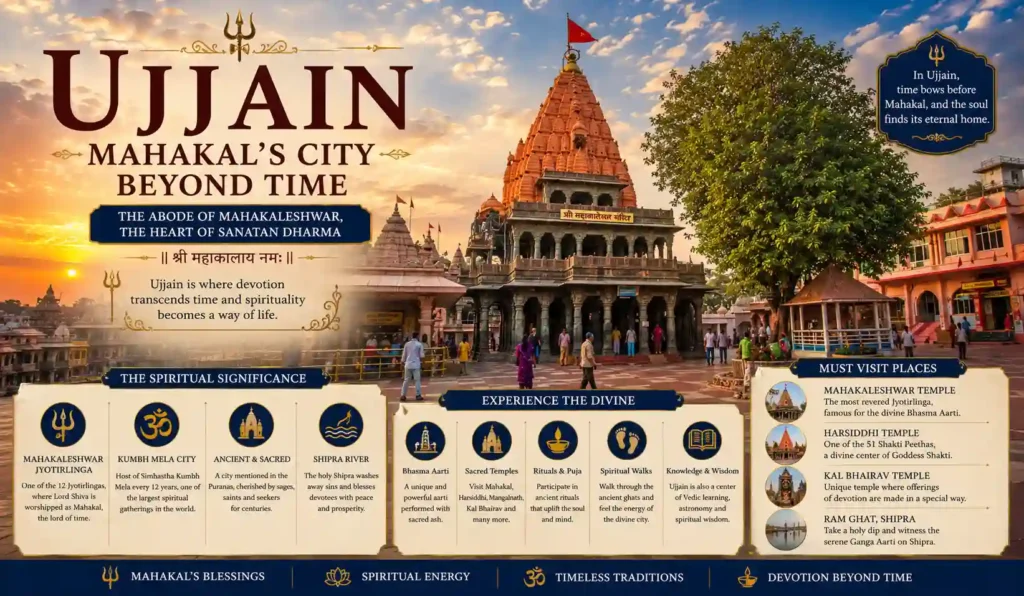
Ujjain: Mahakal's City Beyond Time
Ujjain, known as Avantika in ancient scriptures, is one of the sacred cities of Saptapuri. It has long been revered as a centre of spirituality, learning, astronomy, and Shaiva tradition.
The city’s spiritual greatness is praised in the Avantika Khanda of the Skanda Purana. In ancient India, Ujjain also served as an important centre for astronomy and was once regarded as the country’s prime meridian.
At the heart of Ujjain stands the Shri Mahakaleshwar Temple, one of the twelve Jyotirlingas. Lord Shiva is worshipped here as Mahakal, the eternal Lord of Time who protects devotees from the fear of death and the cycle of birth and rebirth.
The temple is especially famous for its early morning Bhasma Aarti, one of the most unique and revered rituals in Sanatan Dharma. Pilgrims also visit the Harsiddhi Temple, Kal Bhairav Temple, and the sacred banks of the Shipra River, making Ujjain a complete pilgrimage destination.
Every twelve years, Ujjain hosts the Simhastha Kumbh Mela, one of the largest religious gatherings in the world. Millions of saints and devotees gather here to take a holy dip in the Shipra and participate in spiritual ceremonies.
The best time to visit is from October to March, especially during Mahashivratri, when the city is filled with devotion and grand celebrations. The peaceful atmosphere after Mahakal’s darshan leaves a lasting impression on many pilgrims.
In Saptapuri, Ujjain represents fearlessness and inner transformation. It reminds devotees that when one surrenders to Mahakal, the fear of time, change, and death gradually gives way to faith, courage, and the hope of moksha.
Dwarka: Krishna's Kingdom by the Sea
Dwarka is one of the sacred cities of Saptapuri and is revered as the royal kingdom established by Shri Krishna after leaving Mathura. It is also one of the four sacred Char Dham pilgrimage destinations, making it one of the holiest places in Sanatan Dharma.
The city’s glory is described in the Mahabharata, Harivamsha, and Bhagavata Purana, where Dwarka is portrayed as a magnificent city built by the divine architect Vishwakarma. According to tradition, the ancient city later submerged beneath the Arabian Sea after Lord Krishna’s earthly pastimes came to an end.
Marine archaeological explorations off the coast of Gujarat have revealed submerged structures near present-day Dwarka. While scholars continue to study these discoveries, they have added to the city’s enduring historical and spiritual fascination.
At the heart of the pilgrimage stands the magnificent Shri Dwarkadhish Temple, dedicated to Lord Krishna as the King of Dwarka. Devotees also visit Bet Dwarka, Rukmini Devi Temple, Gomti Ghat, and the Nageshwar Jyotirlinga, all of which form an important part of the traditional pilgrimage circuit.
The sea surrounding Dwarka offers a quiet reminder that even the greatest kingdoms are temporary, while the soul’s relationship with the Divine is eternal. This timeless message continues to inspire pilgrims who seek both devotion and inner peace.
The best time to visit is from October to February, when the weather is pleasant for temple visits and coastal pilgrimage. Festivals such as Janmashtami, Holi, and Kartik Purnima fill the city with devotional celebrations and vibrant spiritual energy.
In Saptapuri, Dwarka represents detached action. Lord Krishna’s life teaches that one can fulfil every worldly responsibility with sincerity while remaining inwardly free through devotion, wisdom, and complete surrender to God. This profound lesson makes Dwarka one of the most inspiring Seven Holy Cities in Sanatan Dharma.

Comparing the Seven Sacred Cities of Saptapuri
Although all seven cities are collectively known as Saptapuri, each has its own spiritual identity, presiding deity, and unique lesson for devotees. The table below offers a quick comparison of the Seven Holy Cities in Sanatan Dharma.
| Sacred City | Presiding Deity | Spiritual Significance | Symbolic Teaching | State |
|---|---|---|---|---|
| Ayodhya | Shri Ram | Birthplace of Lord Ram and the ideal of righteous living | Dharma (Righteousness) | Uttar Pradesh |
| Mathura | Shri Krishna | Birthplace of Lord Krishna and centre of Krishna Bhakti | Divine Love (Prema Bhakti) | Uttar Pradesh |
| Haridwar (Maya) | Maa Ganga & Lord Shiva | Gateway to the Ganga and sacred purification | Purification | Uttarakhand |
| Kashi (Varanasi) | Lord Shiva | Eternal city of Lord Shiva and the path to moksha | Liberation | Uttar Pradesh |
| Kanchipuram | Shiva, Vishnu & Shakti | Ancient centre of temples, philosophy, and spiritual learning | Wisdom | Tamil Nadu |
| Ujjain (Avantika) | Lord Mahakal (Shiva) | Home of the Mahakaleshwar Jyotirlinga and spiritual transformation | Fearlessness | Madhya Pradesh |
| Dwarka (Dvaravati) | Shri Krishna | Lord Krishna’s royal kingdom and one of the Char Dham | Detached Action | Gujarat |
Together, these sacred cities represent different stages of a seeker’s spiritual journey. While each destination has its own traditions and practices, they collectively guide devotees towards a life of devotion, wisdom, and ultimately moksha.
Sacred Rivers Associated with the Seven Holy Cities
Rivers have always been an integral part of pilgrimage in Sanatan Dharma. Most of the Seven Holy Cities in Sanatan Dharma are located on the banks of sacred rivers, symbolising purity, life, and spiritual renewal. Pilgrims traditionally take a holy dip, offer prayers, or perform rituals along these riverbanks before visiting the temples.
| Sacred City | Sacred River | Spiritual Significance |
|---|---|---|
| Ayodhya | Sarayu | Symbol of purity, devotion, and the life of Shri Ram |
| Mathura | Yamuna | Closely associated with the divine leelas of Shri Krishna |
| Haridwar | Ganga | Sacred river believed to cleanse the mind and inspire spiritual purification |
| Kashi (Varanasi) | Ganga | Considered the holiest river for worship, ancestral rites, and the pursuit of moksha |
| Kanchipuram | Vegavathi (traditional association) | Revered in local temple traditions and ancient legends |
| Ujjain | Shipra | Sacred river of the Simhastha Kumbh Mela and Shaiva pilgrimage |
| Dwarka | Gomti River (Gomti Creek) | Holy waters where pilgrims perform rituals before visiting Dwarkadhish Temple |
Across these sacred cities, rivers are more than geographical landmarks. They are regarded as living embodiments of divine grace, reminding pilgrims that just as flowing water renews the earth, sincere faith renews the human heart.
Festivals That Bring the Seven Sacred Cities to Life
The Seven Holy Cities in Sanatan Dharma are vibrant centres of faith throughout the year, but their spiritual energy reaches its peak during major festivals. These celebrations preserve ancient traditions, bring communities together, and allow devotees to experience the living heritage of Saptapuri.
| Sacred City | Major Festival | Highlights |
|---|---|---|
| Ayodhya | Ram Navami, Deepotsav | Grand celebrations of Shri Ram’s birth, temple processions, devotional singing, and millions of lamps illuminating the city. |
| Mathura | Janmashtami, Braj Holi | Krishna’s birth celebrations, Ras Leela performances, colourful Holi festivities, and devotional kirtans. |
| Haridwar | Kumbh Mela, Ganga Dussehra | Holy dips in the Ganga, grand aartis, spiritual discourses, and gatherings of saints from across India. |
| Kashi (Varanasi) | Dev Deepawali, Mahashivratri | Illuminated ghats, Ganga Aarti, Shiva processions, and devotional celebrations throughout the city. |
| Kanchipuram | Vaikunta Ekadashi, Panguni Uthiram, Brahmotsavam | Temple processions, traditional rituals, and vibrant celebrations in the city’s ancient temples. |
| Ujjain | Mahashivratri, Simhastha Kumbh Mela | Bhasma Aarti, Shiva worship, sacred bathing in the Shipra River, and one of the world’s largest religious gatherings. |
| Dwarka | Janmashtami, Holi, Kartik Purnima | Festive temple decorations, Krishna bhajans, processions, and special rituals at the Dwarkadhish Temple. |
Experiencing these festivals offers pilgrims a unique opportunity to witness the rich devotional traditions that have flourished in Saptapuri for centuries. While festival periods attract large crowds, they also reveal the living spirit of Sanatan Dharma, where faith, culture, and community come together in celebration.
The Architectural and Historical Heritage of Saptapuri
The Seven Holy Cities in Sanatan Dharma are not only centres of devotion but also living museums of India’s spiritual and cultural heritage. Their temples, ghats, monuments, and ancient streets preserve traditions that have flourished for thousands of years.
Each city reflects a different chapter in the story of Indian civilization. Ayodhya represents the ideals of the Ramayana, while Mathura preserves the living legacy of Shri Krishna and the sacred land of Braj.
Haridwar has welcomed pilgrims for centuries as the gateway to the Himalayas and the Char Dham Yatra. Its ghats and timeless Ganga traditions continue to shape the spiritual life of millions.
Kashi is among the world’s oldest continuously inhabited cities, where ancient temples, sacred ghats, and centuries-old rituals remain part of everyday life. Ujjain preserves the rich heritage of astronomy, learning, and Shaiva worship that made it one of ancient India’s great cultural centres.
In South India, Kanchipuram showcases magnificent Dravidian temple architecture through its towering gopurams and beautifully carved temples. Dwarka, with its coastal temples and marine archaeological discoveries, connects scriptural tradition with ongoing historical research.
Together, these sacred cities form a remarkable bridge between history and faith. Their architecture reflects the artistic excellence of different dynasties, while their living traditions continue to inspire pilgrims, scholars, and visitors from around the world.
More than ancient monuments, Saptapuri represents an unbroken spiritual heritage where history, culture, architecture, and devotion continue to exist side by side. This timeless continuity is one of the reasons these cities remain among the most revered pilgrimage destinations in Sanatan Dharma.
Why Saptapuri Still Matters Today
Although the idea of Saptapuri comes from ancient Hindu scriptures, its message remains deeply relevant in today’s fast-paced world. These sacred cities continue to welcome millions of pilgrims seeking not only blessings but also peace, clarity, and a deeper connection with their spiritual roots.
Each city reminds us of an eternal value that remains meaningful even today. Ayodhya inspires righteous living, Mathura teaches unconditional love, Haridwar encourages inner purification, Kashi reminds us of life’s impermanence, Kanchipuram values wisdom, Ujjain nurtures courage, and Dwarka teaches us to perform our duties without attachment.
For many devotees, visiting the Seven Holy Cities in Sanatan Dharma is not simply about completing a pilgrimage. It is an opportunity to slow down, reflect on life’s purpose, and reconnect with timeless values that often get lost in the demands of modern life.
Whether you visit one city or all seven, the true gift of Saptapuri lies in the transformation it inspires. The journey may begin with travel across Bharat, but its greatest destination is a heart filled with faith, compassion, and devotion.
Best Time to Visit Saptapuri
The Saptapuri pilgrimage can be undertaken throughout the year, but the ideal time depends on the weather and the festivals celebrated in each sacred city. Most pilgrims prefer travelling between October and March, when the climate is pleasant across much of India.
| Sacred City | Best Time to Visit | Major Festivals |
|---|---|---|
| Ayodhya | October to March | Ram Navami, Deepotsav |
| Mathura | October to March | Janmashtami, Braj Holi, Kartik Festival |
| Haridwar | February to April, October to November | Kumbh Mela, Ardh Kumbh, Ganga Dussehra |
| Kashi (Varanasi) | October to March | Dev Deepawali, Mahashivratri, Kartik Purnima |
| Kanchipuram | November to February | Vaikunta Ekadashi, Panguni Uthiram, Brahmotsavam |
| Ujjain | October to March | Mahashivratri, Simhastha Kumbh Mela |
| Dwarka | October to February | Janmashtami, Holi, Kartik Purnima |
While festival seasons offer a deeply spiritual experience filled with rituals, processions, and devotional celebrations, they also attract large crowds. If you prefer a quieter pilgrimage, consider visiting outside the major festival dates.
Traditionally, Saptapuri is not a journey meant to be rushed. Many devotees complete the pilgrimage over several years, visiting one sacred city at a time. This gradual approach allows pilgrims to experience the unique spiritual atmosphere and timeless wisdom of each destination with greater devotion and reflection.
How to Plan a Saptapuri Pilgrimage
A Saptapuri pilgrimage is not meant to be rushed. Many devotees visit one or two sacred cities each year, allowing time for prayer, reflection, and a deeper connection with each destination.
If you wish to complete the pilgrimage in a single journey, a well-planned itinerary can make your travel smoother and more comfortable.
| Pilgrimage Route | Suggested Cities |
|---|---|
| North India | Haridwar → Ayodhya → Mathura → Kashi |
| Central India | Ujjain |
| South India | Kanchipuram |
| West India | Dwarka |
Most pilgrims require 10 to 15 days to visit all seven cities comfortably, depending on travel time and the number of temple visits planned.
The nearest airports, railway stations, and highways connect all seven cities, making the pilgrimage accessible by air, rail, or road. Advance booking is recommended during festivals such as Ram Navami, Janmashtami, Mahashivratri, Kumbh Mela, and Deepotsav, when pilgrim numbers increase significantly.
Rather than trying to see every temple in a short time, spend a few quiet moments in prayer, attend an aarti if possible, and experience the unique spiritual atmosphere of each city. The true essence of Saptapuri lies not in completing a checklist, but in allowing every sacred place to inspire devotion, reflection, and inner transformation.
Essential Tips for a Saptapuri Pilgrimage
A Saptapuri pilgrimage is not just a journey across sacred cities but also an opportunity for spiritual growth. Following a few simple practices can make your pilgrimage more meaningful and respectful of local traditions.
Dress modestly while visiting temples and sacred places. Traditional attire is appreciated at many pilgrimage sites.
Remove your footwear before entering temples and follow the instructions given by the temple authorities.
Respect local customs and rituals. If you are unsure about any tradition, observe other devotees or seek guidance from temple volunteers.
Attend an aarti whenever possible. Participating in the morning or evening prayers offers a deeper experience of the city’s spiritual atmosphere.
Carry valid identification and keep digital or printed copies of hotel bookings and travel tickets, especially during major festivals.
Travel light and wear comfortable footwear, as many temple complexes and ghats require considerable walking.
Stay hydrated and plan your visits during the cooler parts of the day, particularly if travelling in warmer months.
Follow photography rules. Many temples do not allow photography inside the sanctum or prayer areas.
Help keep sacred places clean by avoiding single-use plastics and disposing of waste responsibly.
Be patient during festivals. Large gatherings are a part of the pilgrimage experience, and waiting peacefully in queues reflects the spirit of devotion.
Above all, remember that the true purpose of Saptapuri is not simply to visit seven sacred cities. A pilgrimage becomes truly meaningful when it inspires humility, gratitude, compassion, and a stronger connection with the Divine.
How Saptapuri Is Different from Char Dham
Although Saptapuri and Char Dham are both among the most revered pilgrimage traditions in Sanatan Dharma, they have different spiritual purposes and include different sacred destinations.
| Aspect | Saptapuri | Char Dham |
|---|---|---|
| Meaning | Seven Holy Cities believed to guide devotees towards moksha | Four sacred pilgrimage sites established to promote spiritual unity across Bharat |
| Number of Places | 7 | 4 |
| Sacred Destinations | Ayodhya, Mathura, Haridwar, Kashi, Kanchipuram, Ujjain, and Dwarka | Badrinath, Dwarka, Jagannath Puri, and Rameswaram |
| Primary Focus | Spiritual growth, sacred cities, and the journey towards liberation | Pilgrimage to four major temples located in different regions of India |
| Common Destination | Dwarka | Dwarka |
Both pilgrimages hold immense spiritual significance and complement one another rather than compete. Many devotees undertake both journeys at different stages of their lives as expressions of faith and devotion.
While Saptapuri highlights seven ancient cities associated with moksha, Char Dham symbolises a pilgrimage across the four directions of Bharat, encouraging spiritual unity and devotion throughout the country. Together, they reflect the rich diversity and timeless pilgrimage traditions of Sanatan Dharma.
Gentle Reflection for Today's Pilgrim
Saptapuri is not only a pilgrimage across the Seven Holy Cities in Sanatan Dharma. It is also a sacred journey within our own hearts.
Every city offers a timeless spiritual lesson.
Ayodhya teaches dharma.
Mathura awakens divine love.
Haridwar inspires purification.
Kashi reminds us of liberation.
Kanchipuram nurtures wisdom.
Ujjain awakens fearlessness.
Dwarka teaches detached action.
Together, these sacred cities guide a pilgrim from righteous living to complete surrender. They remind us that the path to moksha is shaped not only by the places we visit, but also by the virtues we cultivate within ourselves.
Perhaps that is the deepest message of Saptapuri. The journey begins on the roads of Bharat, but it is completed in the transformation of the soul.
Conclusion
Saptapuri, the Seven Holy Cities in Sanatan Dharma, is far more than a collection of ancient pilgrimage destinations. Each sacred city carries its own history, traditions, temples, and spiritual wisdom, guiding devotees towards a deeper understanding of dharma, devotion, and ultimately moksha.
Whether you stand on the banks of the Sarayu in Ayodhya, witness the Ganga Aarti in Haridwar, seek Lord Shiva’s blessings in Kashi, or offer prayers at Dwarkadhish Temple, every step of the Saptapuri pilgrimage becomes an opportunity for inner transformation.
Not every devotee completes this pilgrimage in a single journey, and many choose to visit these sacred cities over several years. What truly matters is not how quickly the journey is completed, but the faith, humility, and devotion with which it is undertaken.
May the timeless wisdom of Saptapuri inspire your own spiritual path, bringing peace to your heart, strength to your faith, and a deeper connection with the eternal values of Sanatan Dharma.
A Final Blessing for Every Pilgrim
May the sacred journey of Saptapuri fill your heart with peace, strengthen your faith, and guide you towards a life rooted in dharma, devotion, and compassion.
Whether you visit one sacred city or complete the entire Saptapuri pilgrimage, may every prayer, every step, and every moment of reflection bring you closer to the Divine. May the blessings of Shri Ram, Shri Krishna, Lord Shiva, Maa Ganga, and the countless saints associated with these holy cities illuminate your spiritual path and inspire you to carry the timeless wisdom of Sanatan Dharma into your daily life.
Suggested Reading
If you found this guide on Saptapuri inspiring, continue your spiritual journey by exploring these sacred pilgrimage destinations from The Sanatan Tales. Each article offers deeper insights into Sanatan Dharma, temple traditions, and the timeless wisdom of Bharat’s holy places.
Kedarnath Temple: Complete Pilgrimage Guide
https://thesanatantales.com/kedarnath-dham-yatra/Mahakaleshwar Temple Ujjain: Complete Pilgrimage Guide
https://thesanatantales.com/mahakaleshwar-temple-ujjain/Vrindavan: A Complete Pilgrimage Guide
https://thesanatantales.com/vrindavan/51 Shakti Peethas: Sacred Places Where Maa Sati Still Lives
https://thesanatantales.com/51-shakti-peethas/Ambaji Temple Gujarat: Complete Pilgrimage Guide
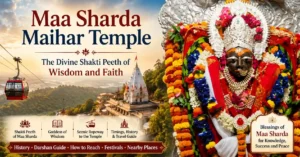
https://thesanatantales.com/ambaji-temple-gujarat/Maihar Sharda Devi Temple: Complete Pilgrimage Guide
https://thesanatantales.com/maihar-sharda-devi-temple/Vindhyavasini Devi Temple: Complete Pilgrimage Guide
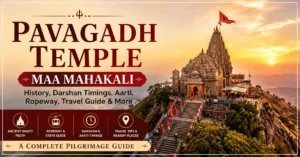
https://thesanatantales.com/vindhyavasini-devi-temple/Pavagadh Kalika Temple: Complete Pilgrimage Guide
https://thesanatantales.com/pavagadh-kalika-temple/Salasar Balaji Temple: Complete Pilgrimage Guide
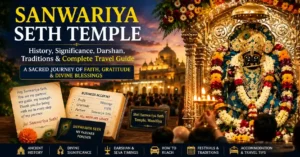
https://thesanatantales.com/salasar-balaji-temple/Sanwariya Seth Temple: Complete Pilgrimage Guide
https://thesanatantales.com/sanwariya-seth-temple-mandfiya/Sapta Puri (Wikipedia)
https://en.wikipedia.org/wiki/Sapta_Puri
FAQs
What is Saptapuri in Sanatan Dharma?
Saptapuri refers to the Seven Holy Cities in Sanatan Dharma that are traditionally believed to help devotees move towards moksha, or liberation from the cycle of birth and death. These sacred cities are Ayodhya, Mathura, Haridwar, Kashi, Kanchipuram, Ujjain, and Dwarka. Ancient scriptures such as the Garuda Purana, Skanda Purana, Padma Purana, and Brahma Purana describe them as Mokshadayika, meaning “the givers of liberation.” Each city is associated with a unique spiritual lesson and continues to attract millions of pilgrims every year.
Which are the Seven Holy Cities in Sanatan Dharma?
The Seven Holy Cities in Sanatan Dharma, collectively known as Saptapuri, are Ayodhya, Mathura, Haridwar (Maya), Kashi (Varanasi), Kanchipuram, Ujjain (Avantika), and Dwarka (Dwaravati). Each city is connected with a major deity and represents a different aspect of spiritual growth, including dharma, devotion, purification, wisdom, fearlessness, and liberation.
Why is Kashi considered the most important city in Saptapuri?
Kashi, also known as Varanasi, is regarded as the spiritual heart of Saptapuri because it is believed to be the eternal city of Lord Shiva. According to long-standing Hindu tradition, sincere devotees who leave their body in Kashi receive Lord Shiva’s divine grace, helping the soul move towards liberation. The city’s sacred ghats, the Kashi Vishwanath Jyotirlinga, and centuries-old traditions make it one of the most revered pilgrimage destinations in Sanatan Dharma.
Is Saptapuri mentioned in Hindu scriptures?
Yes. Saptapuri is mentioned in several ancient Hindu scriptures, including the Garuda Purana, Skanda Purana, Padma Purana, and Brahma Purana. A well-known Sanskrit verse lists these seven cities as Mokshadayika, meaning places that help sincere devotees progress towards spiritual liberation. While each Purana highlights different legends and traditions, the list of the seven sacred cities remains remarkably consistent.
Do we need to visit all seven cities to attain moksha?
Sanatan Dharma teaches that moksha ultimately depends on God’s grace, righteous living, devotion, selfless actions, and spiritual knowledge. Visiting the Saptapuri is considered highly meritorious and spiritually uplifting, but simply travelling to these cities does not guarantee liberation. Pilgrimage is meant to deepen faith, purify the mind, and inspire a life centred on dharma and devotion.
What is the best time to visit Saptapuri?
The ideal time for a Saptapuri pilgrimage is generally between October and March, when the weather is pleasant in most of the seven cities. However, some destinations are best visited during specific festivals such as Ram Navami in Ayodhya, Janmashtami in Mathura and Dwarka, Mahashivratri in Kashi and Ujjain, or the Kumbh Mela in Haridwar. Pilgrims seeking a quieter experience may prefer travelling outside the major festival seasons.
Why is Ujjain important in Saptapuri?
Ujjain, known as Avantika in ancient scriptures, is one of the Seven Holy Cities in Sanatan Dharma and the home of the Mahakaleshwar Jyotirlinga. It is closely associated with Lord Shiva as Mahakal, the Lord of Time. The city is also famous for the Simhastha Kumbh Mela, the sacred Shipra River, and its rich heritage of astronomy, learning, and Shaiva traditions.
How is Saptapuri different from Char Dham?
Although both are important pilgrimage traditions, they serve different spiritual purposes. Saptapuri consists of seven ancient cities traditionally associated with moksha, while Char Dham refers to the four sacred pilgrimage sites of Badrinath, Dwarka, Jagannath Puri, and Rameswaram, established to promote spiritual unity across India. Interestingly, Dwarka is the only destination that is part of both Saptapuri and Char Dham.
Which deity is worshipped in each of the Seven Holy Cities?
Each city of Saptapuri has a unique spiritual identity. Ayodhya is dedicated to Shri Ram, Mathura and Dwarka to Shri Krishna, Haridwar to Maa Ganga and Lord Shiva, Kashi to Lord Shiva, Kanchipuram to Shiva, Vishnu, and Shakti, and Ujjain to Lord Mahakal (Shiva). Together, these sacred cities reflect the rich diversity and unity of Sanatan Dharma.
Can the Saptapuri pilgrimage be completed in one trip?
Yes, it is possible to complete the Saptapuri pilgrimage in a single extended journey if time and travel arrangements permit. However, many devotees prefer to visit one or two sacred cities at a time over several years. This traditional approach allows pilgrims to experience each destination with greater devotion, reflection, and understanding rather than rushing through all seven cities.
Glossary of Important Terms
Understanding these key Sanskrit and spiritual terms will help you better appreciate the significance of Saptapuri and the Seven Holy Cities in Sanatan Dharma.
| Term | Meaning |
|---|---|
| Saptapuri | The seven sacred cities in Sanatan Dharma that are traditionally believed to guide devotees on the path towards moksha (liberation). |
| Moksha | Liberation from the cycle of birth and death (samsara) and union with the Divine. |
| Mokshadayika | A Sanskrit term meaning “givers of liberation.” It refers to sacred places believed to help sincere devotees progress towards moksha. |
| Dharma | Righteous living, moral duty, and the principles that uphold harmony in life and the universe. |
| Bhakti | Loving devotion and complete surrender to God through faith, prayer, and worship. |
| Jyotirlinga | One of the twelve most sacred shrines of Lord Shiva, where He is worshipped in the form of a divine pillar of light. |
| Tirtha | A sacred place of pilgrimage where devotees seek spiritual purification, blessings, and inner transformation. |
| Ghat | A series of stone steps leading to a sacred river, used for bathing, worship, and religious ceremonies. |
| Darshan | The sacred act of seeing and receiving the blessings of a deity, saint, or holy place. |
| Parikrama | The devotional practice of walking clockwise around a temple, shrine, sacred hill, or holy place as an act of reverence. |
| Puranas | Ancient Hindu scriptures that preserve stories of deities, creation, sacred places, kings, and spiritual teachings. |
| Sanatan Dharma | The eternal spiritual tradition of India, commonly known as Hinduism, based on timeless principles, scriptures, and righteous living. |
About the Author
Yateendra Chaturvedi is a spiritual writer, researcher, devotee, and the founder of The Sanatan Tales. With over 35 years of professional experience and a lifelong interest in Sanatan Dharma, he writes about Hindu deities, temples, scriptures, festivals, Mahavidyas, sacred stories, rituals, and living traditions that continue to guide and inspire devotees across India.
Drawing from traditional scriptures, regional beliefs, temple traditions, devotional literature, and historical sources, he aims to present authentic, well-researched, and easy-to-understand content for modern readers. His work focuses on preserving spiritual wisdom, explaining sacred traditions, and helping seekers develop a deeper understanding of India’s rich spiritual heritage.
Through The Sanatan Tales, Yateendra strives to make the timeless teachings of Sanatan Dharma simple, meaningful, and relevant for today’s generation while maintaining respect for traditional sources, regional practices, and diverse spiritual perspectives.
Learn More About Yateendra Chaturvedi →
https://thesanatantales.com/about-the-author/
References and Sources
This article is based on traditional beliefs, scriptural references, and pilgrimage traditions associated with Saptapuri, the Seven Holy Cities in Sanatan Dharma.
The content has been prepared using information from Hindu scriptures such as the Garuda Purana, Skanda Purana, Padma Purana, Brahma Purana, Vishnu Purana, and the Ramayana, along with traditional pilgrimage literature, historical studies, archaeological findings, and widely accepted religious sources.
Note: The spiritual significance, customs, and traditions associated with these sacred cities may vary across different sampradayas, regional traditions, and lineages within Sanatan Dharma. Historical interpretations, archaeological research, and scriptural narratives may also differ in certain aspects.
The purpose of this article is to present a balanced, respectful, and easy-to-understand overview based on widely accepted Hindu traditions and available historical knowledge, rather than to establish any single interpretation as the absolute truth.
Explore More Fascinating Topics from Sanatan Dharma