The Durga and Mahishasura Story is one of the most powerful and inspiring narratives in Sanatan Dharma. It tells how Maa Durga emerged as the embodiment of divine power to defeat Mahishasura, a mighty demon whose arrogance and tyranny threatened the balance of the universe.
More than a tale of a great battle, the Durga and Mahishasura Story symbolizes the eternal victory of Dharma over Adharma, righteousness over evil, and divine wisdom over ignorance. It also explains why Maa Durga is revered as Mahishasura Mardini, the slayer of the buffalo demon.
In this article, you will discover the complete Durga and Mahishasura Story, including Mahishasura’s rise to power, the creation of Maa Durga, the epic battle between the Divine Mother and the demon king, and the spiritual lessons hidden within this sacred narrative.
You will also learn about the significance of this story in Sanatan Dharma, its connection to Navratri and Vijayadashami, the symbolism of Mahishasura Mardini, and the timeless teachings that continue to inspire devotees today.
For centuries, devotees have drawn strength from this story because it reminds us that no matter how powerful evil may appear, truth, courage, and divine grace ultimately prevail. The enduring message of the Durga and Mahishasura Story continues to guide seekers on the path of faith, inner strength, and spiritual growth.
Table of Contents
ToggleDurga and Mahishasura Story Snapshot
| Aspect | Details |
|---|---|
| Event | Maa Durga’s battle against Mahishasura |
| Main Characters | Maa Durga, Mahishasura, Brahma, Vishnu, Shiva, Devas |
| Scriptural Sources | Devi Mahatmya, Markandeya Purana, Durga Saptashati |
| Core Theme | Victory of Dharma over Adharma |
| Significance | Origin of Mahishasura Mardini and Navratri celebrations |
| Key Lesson | Divine power ultimately defeats arrogance and evil |
Durga and Mahishasura Story: How Maa Durga Defeated Mahishasura
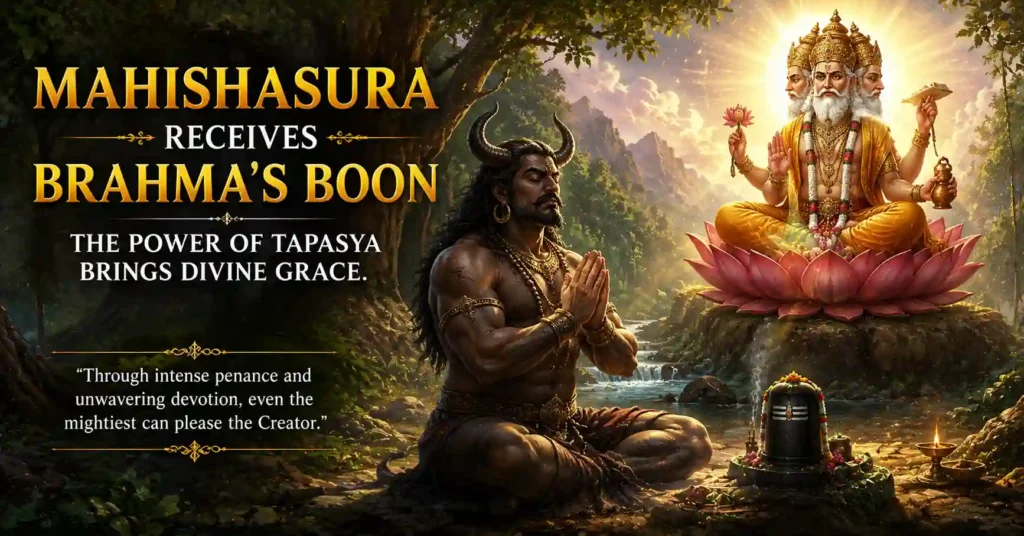
The Durga and Mahishasura Story begins with Mahishasura, a powerful asura who desired absolute control over the three worlds. Although he possessed great strength, he was not satisfied. He wanted a power that would make him impossible to defeat.
Determined to achieve this goal, Mahishasura performed severe tapasya for many years to please Lord Brahma. His penance was so intense that it impressed the creator deity, who finally appeared before him and offered him a boon.
Filled with excitement, Mahishasura asked for immortality. However, Lord Brahma explained that every being born into creation must one day die. Realizing that immortality could not be granted, Mahishasura carefully chose another request.
He asked that no god, demon, celestial being, or man should be capable of killing him. Believing women to be weak and insignificant, he deliberately excluded them from the boon. Pleased with his tapasya, Brahma granted the request.
Armed with this powerful blessing, Mahishasura became increasingly arrogant. What had begun as devotion slowly transformed into pride, and pride soon became tyranny. Convinced that no one could challenge him, he set out to conquer the three worlds.
With a vast army of asuras behind him, Mahishasura defeated many kings and rulers. His victories increased his confidence, and before long, he turned his attention toward Svarga, the heavenly kingdom of the devas.
A terrible war broke out between the devas and the asura armies. Indra fought with his Vajra, Agni unleashed divine fire, and countless celestial warriors joined the battle. Yet despite their courage, none of them could overcome Mahishasura.
Protected by Brahma’s boon and blessed with immense strength, the demon king gradually overwhelmed the heavenly forces. He possessed the ability to change forms and often appeared as a gigantic buffalo, making him even more difficult to defeat.
Eventually, the devas were forced to retreat. Mahishasura seized control of Svarga, drove the gods from their celestial home, and claimed Indra’s throne for himself. The heavens now stood under the rule of the buffalo demon.
As Mahishasura’s power spread, suffering increased throughout creation. The devas wandered without a kingdom, sages were disturbed in their spiritual practices, and Dharma began to weaken. Fear and injustice spread across the three worlds.
Unable to defeat the demon king themselves, the devas approached Lord Brahma, Lord Vishnu, and Lord Shiva. With folded hands, they described the suffering caused by Mahishasura and prayed for divine intervention.
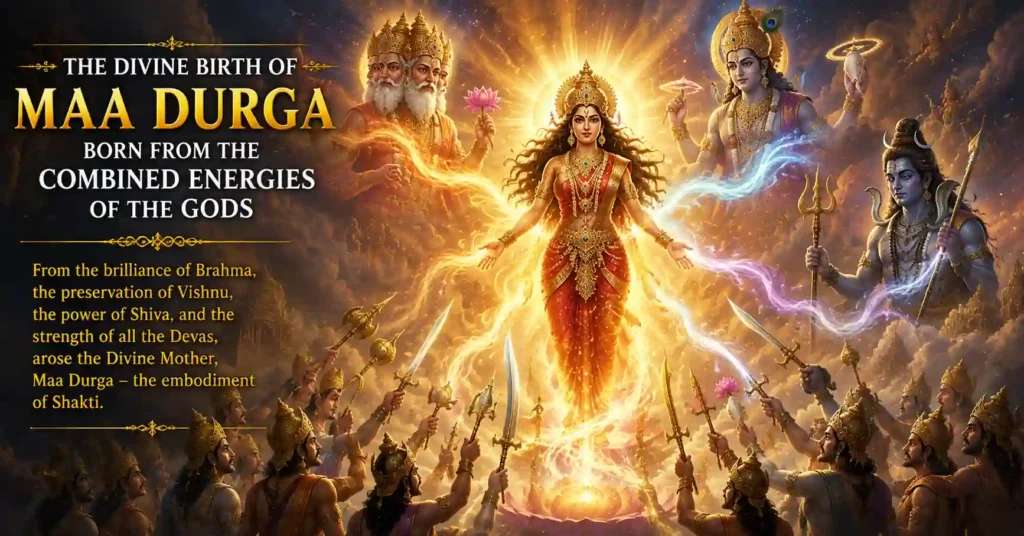
Hearing their plea, Vishnu and Shiva became filled with righteous anger. From their bodies emerged brilliant rays of divine energy. At the same time, powerful energies emerged from Brahma and all the other devas.
These divine energies united into a single blazing radiance that illuminated the heavens. From this extraordinary light appeared a magnificent goddess whose beauty, strength, and splendor surpassed anything the devas had ever seen.
This was Maa Durga, the embodiment of Divine Shakti and the combined power of all the gods. The devas immediately understood that she had appeared to restore Dharma and defeat Mahishasura.
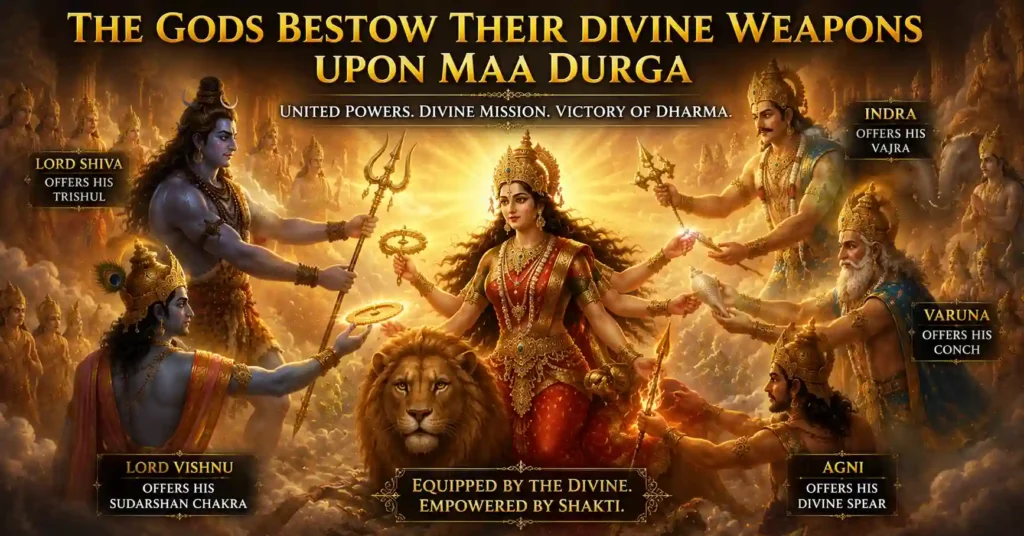
One by one, the gods offered their divine weapons to the goddess. Lord Shiva gave his Trishul, Lord Vishnu presented the Sudarshana Chakra, and Indra offered his Vajra. Other deities gifted celestial weapons, ornaments, and divine powers.
Himalaya presented a majestic lion to serve as her vehicle. Mounted upon her lion and armed with the weapons of the gods, Maa Durga shone like a thousand suns, radiating divine power in every direction.
When Mahishasura learned of her appearance, he was astonished. Hearing of her beauty and splendor, he sent messengers to invite her to become his queen. Confident in his own power, he believed no one would dare refuse him.
Maa Durga calmly rejected the proposal. She declared that she had come only to destroy evil and restore righteousness. Her words enraged Mahishasura, who immediately ordered his armies to attack.
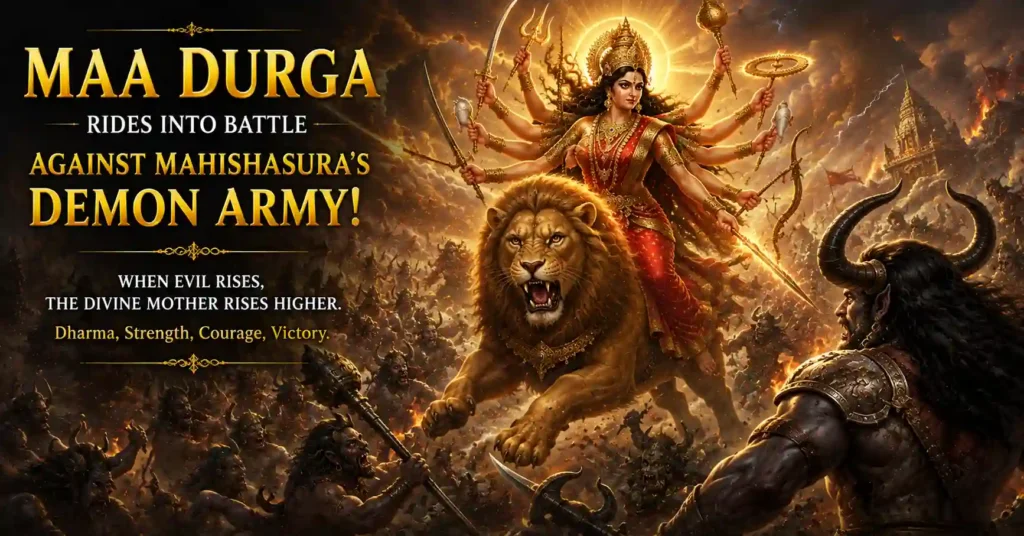
A great battle began between the forces of Dharma and Adharma. Thousands of asuras rushed toward the goddess, but Maa Durga met them fearlessly. Riding her lion, she moved across the battlefield like a storm, defeating powerful demon commanders one after another.
The battle continued day after day. The skies echoed with the clash of celestial weapons, and the earth trembled beneath the fury of the conflict. Yet the Divine Mother remained calm, powerful, and unstoppable.
As more of his generals fell, Mahishasura finally entered the battlefield himself. The demon king unleashed his full strength against the goddess, determined to prove that no force in creation could defeat him.
Mahishasura repeatedly changed forms during the battle. At one moment he appeared as a raging buffalo, at another as a lion, an elephant, or a mighty warrior. Each transformation brought new attacks and new challenges.
Yet Maa Durga countered every move with divine skill and unwavering courage. No matter what form the demon assumed, the goddess remained firmly in control of the battle.
The fierce struggle continued for nine days and nine nights. The devas watched with hope while the asuras watched with growing fear. All of creation seemed to pause as the final outcome approached.
On the tenth day, Mahishasura once again charged forward in his buffalo form. With tremendous force, he rushed toward the goddess, determined to destroy her once and for all.
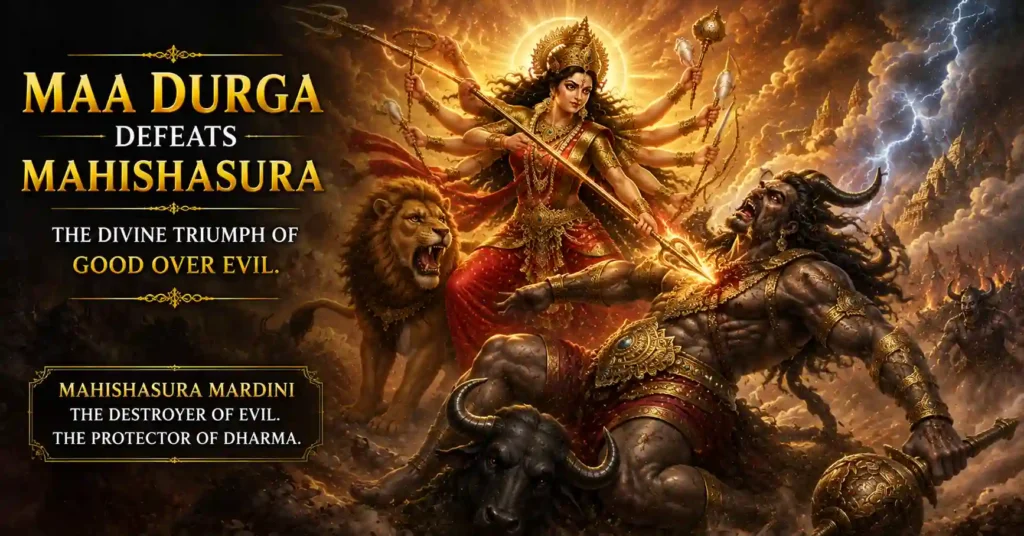
At that decisive moment, Maa Durga leaped forward and confronted him directly. Using her divine strength, she pinned the demon and struck him with her Trishul. As Mahishasura attempted another transformation, the goddess delivered the final blow.
The mighty buffalo demon fell, and his reign of terror came to an end. The defeat of Mahishasura marked the victory of Dharma over Adharma and restored balance to the universe.
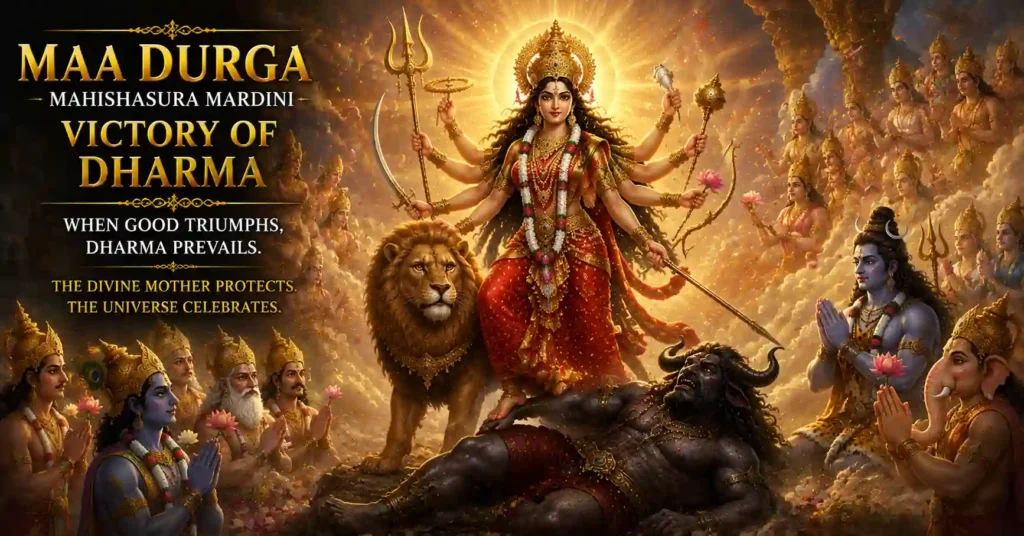
The devas rejoiced and filled the heavens with prayers and praise. Flowers showered from the sky, celestial music echoed through the worlds, and the gods honored the Divine Mother for her victory.
From that day forward, Maa Durga became revered as Mahishasura Mardini, the slayer of Mahishasura. Her triumph became an eternal symbol of courage, righteousness, and the power of Divine Shakti.
Even today, devotees remember this sacred victory during Navratri and celebrate it on Vijayadashami. The Durga and Mahishasura Story continues to inspire millions by reminding them that no matter how powerful evil may appear, truth, faith, and divine grace ultimately prevail.
What Does the Durga and Mahishasura Story Teach Us?
The Durga and Mahishasura Story is much more than an account of a divine battle. It contains timeless spiritual lessons about courage, righteousness, devotion, and the power of Divine Shakti.
1. Dharma Ultimately Triumphs Over Adharma
One of the central messages of the story is that evil may appear powerful for a time, but it can never prevail forever.
Mahishasura’s strength and victories made him arrogant, yet his reign eventually came to an end. The story reminds devotees that truth, righteousness, and Dharma ultimately overcome injustice and wrongdoing.
2. Pride and Arrogance Lead to Downfall
Mahishasura gained immense power through tapasya and received a valuable boon from Lord Brahma.
However, instead of using his blessings wisely, he allowed pride and arrogance to control his actions. His downfall teaches that power without humility can become destructive.
3. Divine Shakti Protects Creation
The appearance of Maa Durga demonstrates that the Divine always acts to restore balance when Dharma is threatened.
When the devas could not overcome Mahishasura, Divine Shakti manifested in the form of the Goddess to protect creation and remove suffering.
4. Inner Demons Must Also Be Conquered
Many devotees view Mahishasura as a symbol of negative qualities that exist within the human mind.
Pride, anger, greed, ego, and ignorance can become obstacles on the spiritual path. The victory of Maa Durga reminds us to overcome these inner enemies through self-discipline and devotion.
5. Courage Is Essential in the Face of Challenges
Maa Durga did not retreat when confronted by powerful enemies. She faced every challenge with determination, strength, and fearlessness.
The story encourages devotees to remain courageous during difficult times and to trust that perseverance can help overcome even the greatest obstacles.
6. Divine Grace Supports the Righteous
The devas sought refuge in the Divine when they could not solve their problems alone.
Their prayers were answered through the manifestation of Maa Durga. This teaches that sincere faith and devotion can attract divine grace and guidance during times of hardship.
7. Good Always Has the Power to Rise Again
The defeat of Mahishasura restored balance to the universe and brought hope back to the three worlds.
The enduring message of the Durga and Mahishasura Story is that darkness never has the final victory. No matter how difficult circumstances may seem, righteousness, faith, and divine power can restore harmony and peace.
Why Is the Durga and Mahishasura Story Important in Sanatan Dharma?
The Durga and Mahishasura Story holds a special place in Sanatan Dharma because it represents the triumph of Divine Shakti over evil. More than a story of a great battle, it is a sacred reminder that Dharma is always protected by the Divine.
1. It Celebrates the Power of Divine Shakti
One of the most important aspects of this story is the manifestation of Maa Durga as the embodiment of Divine Shakti.
When the devas were unable to defeat Mahishasura, the combined energies of the gods took the form of the Divine Mother. This highlights the supreme power of Shakti in preserving cosmic balance.
2. It Explains Why Maa Durga Is Called Mahishasura Mardini
The story is the foundation of Maa Durga’s revered title, Mahishasura Mardini, which means “the slayer of Mahishasura.”
This title symbolizes the victory of righteousness over evil and continues to inspire devotees across generations.
3. It Forms the Spiritual Basis of Navratri
The events of the Durga and Mahishasura Story are closely connected to the celebration of Navratri.
During these sacred nine nights, devotees worship different forms of Maa Durga and remember her victory over the buffalo demon. The festival culminates with Vijayadashami, which celebrates the triumph of Dharma.
4. It Teaches the Eternal Struggle Between Good and Evil
The battle between Maa Durga and Mahishasura represents the ongoing struggle between Dharma and Adharma.
While the story takes place on a cosmic scale, its message also applies to everyday life, reminding devotees to choose righteousness over negative influences.
5. It Highlights the Importance of the Divine Feminine
The story demonstrates that the Divine Feminine is not merely nurturing and compassionate but also powerful and protective.
Maa Durga appears when creation is threatened, showing that strength and compassion can exist together in perfect harmony.
6. It Inspires Devotees to Face Challenges Fearlessly
Devotees often look to Maa Durga as a source of courage during difficult times.
Her determination, fearlessness, and unwavering commitment to Dharma encourage seekers to remain strong in the face of adversity and trust in divine guidance.
7. Its Message Remains Relevant Today
Although the story is ancient, its teachings remain timeless.
The victory of Maa Durga reminds us that arrogance, injustice, and negativity may appear powerful for a time, but they can never overcome truth, faith, and righteousness.
For devotees, the Durga and Mahishasura Story is far more than a mythological narrative. It is a sacred teaching that celebrates Divine Shakti, inspires courage, and reinforces the belief that Dharma will ultimately prevail.
Did You Know?
The Durga and Mahishasura Story contains many fascinating details that reveal the deeper significance of Maa Durga’s victory and the power of Divine Shakti. These insights help devotees appreciate why this sacred story remains so important in Sanatan Dharma.
1. Maa Durga Was Created to Defeat Mahishasura
According to traditional accounts, the devas could not defeat Mahishasura because of the boon granted by Lord Brahma.
To restore balance and protect creation, the combined divine energies of the gods manifested as Maa Durga.
2. Mahishasura’s Arrogance Led to His Downfall
Mahishasura believed no woman could ever challenge his strength.
This assumption became his greatest mistake and ultimately led to his defeat at the hands of the Divine Mother.
3. The Name Mahishasura Means Buffalo Demon
The word Mahisha means buffalo, while Asura means demon.
Because of his ability to take the form of a powerful buffalo, he became known as Mahishasura.
4. Every Divine Weapon Had a Special Purpose
Before the battle, the gods presented Maa Durga with their most powerful weapons.
These gifts symbolized the unity of the devas and their faith in the Divine Mother’s ability to defeat evil.
5. The Lion Represents Fearlessness
Maa Durga’s lion is one of the most recognizable symbols associated with the goddess.
It represents courage, strength, determination, and the ability to face challenges without fear.
6. The Battle Is Connected to Navratri
The nine-day battle between Maa Durga and Mahishasura is traditionally associated with Navratri.
During this festival, devotees honor different forms of the Divine Mother and celebrate the victory of Dharma.
7. Maa Durga Is Revered as Mahishasura Mardini
After defeating the buffalo demon, Maa Durga became known as Mahishasura Mardini.
This title means “the Slayer of Mahishasura” and remains one of her most revered names.
8. The Story Carries a Deeper Spiritual Meaning
Many devotees view Mahishasura as a symbol of ego, pride, anger, and ignorance.
The victory of Maa Durga reminds seekers to overcome these inner obstacles through devotion, discipline, and spiritual wisdom.
9. The Story Is Preserved in Sacred Texts
The most well-known account of this sacred narrative is found in the Devi Mahatmya, which is part of the Markandeya Purana.
These scriptures celebrate the power of the Divine Mother and her role in protecting Dharma.
10. The Message Remains Relevant Today
The Durga and Mahishasura Story continues to inspire devotees because its message is timeless.
It reminds us that no matter how powerful evil may appear, righteousness, faith, and Divine Shakti ultimately prevail.
Conclusion
The Durga and Mahishasura Story is one of the most powerful and beloved narratives in Sanatan Dharma. More than a tale of a divine battle, it is a timeless reminder that Dharma ultimately triumphs over Adharma, no matter how powerful evil may appear.
Through the Durga and Mahishasura Story, devotees witness the extraordinary manifestation of Maa Durga, who emerged to protect creation and restore cosmic balance. Her victory over Mahishasura symbolizes the triumph of righteousness, courage, and Divine Shakti over arrogance, injustice, and ignorance.
The story continues to inspire millions because its teachings remain relevant even today. It reminds us that challenges, obstacles, and negative influences can be overcome through faith, determination, and trust in the Divine.
In a world often filled with uncertainty and conflict, the Durga and Mahishasura Story offers hope and reassurance that truth and righteousness will ultimately prevail. By reflecting on the courage and strength of Maa Durga, devotees can cultivate inner resilience, spiritual confidence, and a deeper connection with the Divine Mother.
The enduring message of the Durga and Mahishasura Story is that Divine Shakti always rises to protect Dharma. Through devotion, courage, and faith, seekers can overcome both external challenges and the inner obstacles that stand in the way of spiritual growth.
Suggested Reading
If the Durga and Mahishasura Story inspired you, you may enjoy exploring other sacred stories and teachings that highlight the power of Divine Shakti, the triumph of Dharma over Adharma, and the role of the Divine in protecting creation. Like the Durga and Mahishasura Story, these timeless narratives reveal how faith, courage, devotion, and divine grace help restore balance in the world.
Many devotees are drawn to the Durga and Mahishasura Story because it beautifully demonstrates the victory of righteousness over evil. Across Sanatan Dharma, numerous stories remind us that whenever Dharma is threatened, the Divine manifests in different forms to guide, protect, and uplift creation.
Parvati Tapasya: How Goddess Parvati Won Lord Shiva Through Devotion
https://thesanatantales.com/parvati-tapasya-for-shiva/
Ardhanarishvara: The Sacred Union of Shiva and Shakti
https://thesanatantales.com/ardhanarishvara/
Markandeya and Shiva Story: How Devotion Conquered Death
https://thesanatantales.com/markandeya-and-shiva-story/
The Story of Gajendra Moksha: Vishnu’s Rescue of His Devotee
https://thesanatantales.com/gajendra-moksha-story/
Birth of Lord Ganesha: The Story Behind His Elephant Head
https://thesanatantales.com/birth-of-lord-ganesha/
Spiritual Stories of Sanatan Dharma
https://thesanatantales.com/spiritual-stories-of-sanatan-dharma/
Durga (Wikipedia)
https://en.wikipedia.org/wiki/Durga
Each of these stories carries unique spiritual lessons, yet all reflect the same truth found in the Durga and Mahishasura Story: faith, courage, devotion, and Divine Shakti have the power to overcome even the greatest challenges. These sacred teachings continue to inspire devotees to uphold Dharma, trust in divine guidance, and face life’s obstacles with strength and determination.
FAQs
1. What Is the Durga and Mahishasura Story?
The Durga and Mahishasura Story is one of the most important narratives in Sanatan Dharma. It describes how Maa Durga appeared to defeat Mahishasura, a powerful demon king who had become arrogant after receiving a boon from Lord Brahma.
When Mahishasura conquered the heavens and troubled the devas, the combined divine energies of the gods manifested as Maa Durga. After a fierce battle, she defeated the demon and restored Dharma.
The story symbolizes the victory of righteousness over evil and remains a central part of Hindu spiritual tradition.
2. Why Did Maa Durga Fight Mahishasura?
Maa Durga fought Mahishasura to protect creation and restore cosmic balance.
After receiving a powerful boon, Mahishasura became arrogant and used his strength to conquer the three worlds. He defeated the devas, seized control of heaven, and spread fear and injustice.
Since no god or man could kill him, Divine Shakti manifested as Maa Durga to defeat the demon and re-establish Dharma.
3. Who Was Mahishasura?
Mahishasura was a powerful asura who performed intense tapasya and received a boon from Lord Brahma.
The boon protected him from being killed by gods, demons, or men. Believing himself invincible, he became proud and began conquering kingdoms, celestial realms, and even the heavens.
In the Durga and Mahishasura Story, he represents arrogance, ego, and the misuse of power.
4. How Was Maa Durga Created?
According to traditional accounts, Maa Durga emerged from the combined divine energies of Brahma, Vishnu, Shiva, and the other devas.
The gods realized that Mahishasura could not be defeated by any of them individually. Their united energies took the form of the Divine Mother, who possessed immense strength and divine power.
This manifestation of Shakti became known as Maa Durga, the protector of Dharma and destroyer of evil.
5. Why Is Maa Durga Called Mahishasura Mardini?
Maa Durga is called Mahishasura Mardini because she defeated and destroyed Mahishasura.
The title means “the Slayer of Mahishasura” and commemorates her victory over the buffalo demon.
It is one of the most revered names of the Divine Mother and highlights her role as the protector of righteousness and cosmic order.
6. What Is the Spiritual Meaning of the Durga and Mahishasura Story?
The Durga and Mahishasura Story carries profound spiritual symbolism.
Many devotees view Mahishasura as representing negative qualities such as ego, pride, greed, anger, and ignorance. Maa Durga symbolizes divine wisdom, inner strength, and spiritual power.
The story teaches that through faith, discipline, and devotion, individuals can overcome their inner obstacles and move closer to spiritual growth.
7. How Is the Durga and Mahishasura Story Connected to Navratri?
The Durga and Mahishasura Story is closely associated with the festival of Navratri.
Traditional accounts describe the battle between Maa Durga and Mahishasura as lasting for nine days and nine nights. During Navratri, devotees worship different forms of the Divine Mother and celebrate her strength and compassion.
The festival concludes with Vijayadashami, which commemorates her final victory over Mahishasura.
8. Which Scriptures Mention the Durga and Mahishasura Story?
The most famous account of the Durga and Mahishasura Story appears in the Devi Mahatmya, a revered section of the Markandeya Purana.
The story is also referenced in various Shakta traditions, devotional literature, temple teachings, and spiritual commentaries dedicated to the Divine Mother.
These sources preserve the narrative and its deeper spiritual teachings for future generations.
9. What Does Mahishasura Symbolize in Hindu Philosophy?
In many spiritual interpretations, Mahishasura symbolizes the lower tendencies of the human mind.
His arrogance, pride, and desire for domination represent qualities that can lead individuals away from Dharma and spiritual growth.
The defeat of Mahishasura by Maa Durga symbolizes the victory of higher consciousness, wisdom, and self-mastery over these negative influences.
10. Why Is the Durga and Mahishasura Story Still Relevant Today?
The Durga and Mahishasura Story remains relevant because its message is timeless.
People continue to face challenges, fears, temptations, and obstacles in everyday life. The story reminds devotees that courage, faith, perseverance, and divine grace can help overcome even the most difficult situations.
Its enduring lesson is that truth, righteousness, and Divine Shakti ultimately prevail over darkness and adversity.
References & Sources
This article is based on traditional teachings and narratives associated with the Durga and Mahishasura Story, one of the most revered accounts of the Divine Mother’s victory over evil in Sanatan Dharma. The story has been preserved through sacred scriptures, devotional traditions, temple teachings, and spiritual commentaries that celebrate the power of Divine Shakti.
The article draws upon concepts and references found in the Devi Mahatmya (also known as the Durga Saptashati or Chandi Path), a revered section of the Markandeya Purana, which contains the most well-known account of Maa Durga’s battle against Mahishasura.
It also reflects teachings found in Shakta traditions, Puranic literature, devotional texts, and traditional interpretations that explore the significance of Maa Durga, Mahishasura Mardini, Divine Shakti, Dharma, and the triumph of righteousness over evil.
These sources have been used to present the Durga and Mahishasura Story, its symbolism, and its spiritual lessons in a simple, beginner-friendly manner while remaining aligned with the broader teachings and living traditions of Sanatan Dharma.
Explore More Topics from The Sanatan Tales