Bhairav is often seen only through his fierce form. Many people imagine him as a deity connected with fear, punishment, or difficult spiritual paths.
Yet devotees who feel drawn to Bhairav often experience something very different. They see him as a protector, a guide, and a presence that helps them face life’s deepest uncertainties with courage.
In Sanatan Dharma, Bhairav Tattva is not understood only as a form of Lord Shiva. It is a deeper spiritual principle that represents awareness, truth, discipline, and transformation.
Bhairav appears wherever illusion begins to hide reality and wherever clarity becomes necessary for growth.
His purpose is not to create fear but to remove the ignorance, attachments, and false identities that keep a person trapped in fear.
For devotees, Bhairav is a guardian who offers protection. For seekers, he is a guide standing at the threshold of inner transformation.
For spiritual traditions, he is the keeper of sacred boundaries, reminding us that truth and discipline are as important as compassion and devotion.
To understand Bhairav Tattva is to look beyond the fierce imagery and discover a profound teaching about awareness, honesty, and the courage to face reality as it is.
Behind the fearsome appearance lies a timeless principle that helps seekers move from confusion to clarity, from illusion to truth, and from fear to freedom.
Table of Contents
ToggleWhat Is Bhairav Tattva?
In Sanatan Dharma, a tattva is more than a form or idea. It is an underlying reality that helps us understand how life and consciousness truly work. Bhairav Tattva represents the force of awakened awareness that removes illusion and reveals truth.
Bhairav does not create fear. He exposes the attachments, assumptions, and false identities that give rise to fear. As illusion falls away, clarity begins to emerge.
This is why Bhairav Tattva is closely connected with moments of transition. It appears wherever one state gives way to another, whether between ignorance and wisdom, darkness and light, or destruction and renewal.
The traditional association of Bhairav with crossroads, cremation grounds, and thresholds reflects this deeper symbolism.
For this reason, Bhairav is never merely decorative. His presence serves a purpose. He appears when truth must be restored, when confusion must be cleared, and when a seeker is ready to move toward deeper awareness.
Bhairav and Shiva: Two Expressions of the Same Consciousness
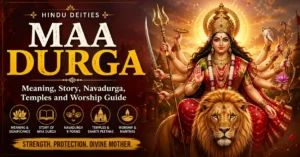
Bhairav is Shiva, yet he reveals a different dimension of the same divine consciousness.
When devotees think of Shiva, they often remember the meditating yogi seated in deep stillness, radiating peace, compassion, and detachment. Bhairav reflects that same consciousness, but in a form that becomes active when truth needs protection and illusion must be removed.
In spiritual traditions, it is said that when life moves in harmony with dharma, Shiva remains silent. But when ego grows, confusion spreads, or false authority begins to dominate, that same divine presence appears as Bhairav.
This is not a manifestation of anger. It is a manifestation of clarity. Bhairav removes whatever stands between the seeker and the truth, even when those obstacles appear respectable, powerful, or deeply rooted.
Perhaps this is why Bhairav is feared by the ego but deeply trusted by sincere devotees. What he removes is never truth itself, but the illusions that prevent truth from being seen.
The Story Behind Bhairav's Emergence
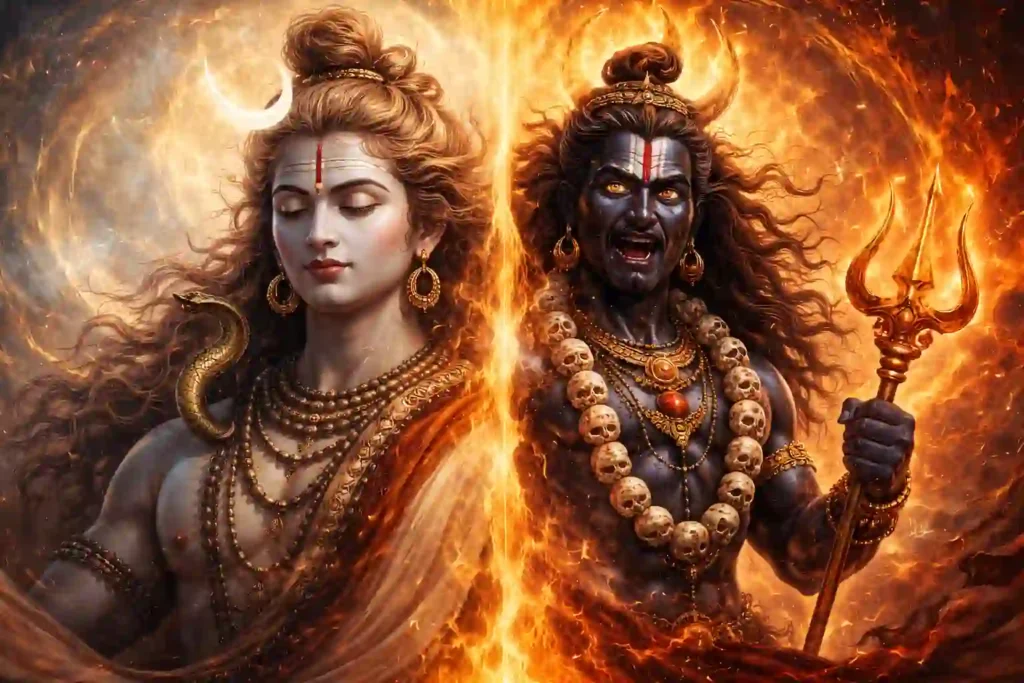
One of the most well-known stories associated with Bhairav begins with a dispute between Brahma and Vishnu. As both debated who was supreme, Shiva appeared as an endless pillar of divine light stretching beyond sight in every direction.
Vishnu accepted that he could not find its beginning or end. Brahma, however, continued to claim superiority. From this infinite Jyotirlinga emerged Bhairav.
According to the tradition, Bhairav severed Brahma’s fifth head. On the surface, the story may appear harsh, but its deeper meaning is symbolic. The act represents the destruction of pride, false claims, and the ego that separates a person from truth.
The skull that Bhairav carried is often understood as a reminder of that burden rather than an instrument of punishment.
The story reaches its resolution in Kashi, where the skull finally fell away. Symbolically, this marks the restoration of truth and the dissolution of ego. For this reason, Bhairav came to be revered as a guardian of sacred order, spiritual discipline, and karmic balance.
Bhairav Tattva in Scripture and Sacred Tradition
Shiva Purana
The Shiva Purana helps devotees understand Shiva not only as a deity but as the supreme consciousness that sustains, transforms, and dissolves creation. Throughout the text, Shiva appears in different forms according to the needs of time and circumstance.
In the stories connected with Bhairav, the focus is often on the removal of pride, false knowledge, and misuse of authority. Bhairav does not appear simply to punish. He appears to restore balance when truth has been overshadowed by ego. Through these narratives, Bhairav emerges as a force that protects dharma and restores spiritual clarity.
Linga Purana
The Linga Purana places great emphasis on the formless nature of Shiva, symbolised by the Jyotirlinga. It reminds devotees that the highest reality cannot be possessed, measured, or limited by human understanding.
Within this context, Bhairav appears as the guardian of that truth. When pride causes individuals to forget the sacred and limitless nature of reality, Bhairav intervenes to restore humility and right understanding. This perspective highlights Bhairav’s role as a protector of spiritual wisdom rather than a figure of destruction alone.
Skanda Purana and the Kashi Tradition
The Skanda Purana contains detailed descriptions of sacred places, especially Kashi, one of the holiest cities in Sanatan Dharma. It presents Kashi not merely as a geographical location but as a sacred space where the possibility of liberation is always present.
In this tradition, Bhairav is revered as the Kotwal, or guardian, of Kashi. Devotees believe that his blessings help seekers enter the deeper spiritual current of the city. His role is not simply to guard a place but to protect its sacred purpose and spiritual power.
Bhairava Tantras and the Vijnana Bhairava Tantra
Tantric traditions offer another important perspective on Bhairav. Texts such as the Bhairava Tantras and the Vijnana Bhairava Tantra present Bhairav not only as a deity but as a state of awakened consciousness.
The Vijnana Bhairava Tantra, structured as a dialogue between Bhairava and Devi, explores numerous ways of entering higher awareness. Through breath, meditation, sound, silence, and attentive observation, the text teaches that spiritual awakening can arise through direct experience. Here, Bhairav appears not as a fearsome figure but as a guide who leads seekers toward deeper awareness and inner freedom.
Together, these traditions reveal that Bhairav is far more than a fierce form of Shiva. He is also a profound spiritual principle that points toward truth, awareness, and liberation.
Bhairav as the Guardian of Kashi
Kashi is often described as a city that exists beyond ordinary time. In the spiritual imagination of Sanatan Dharma, it is not merely a place on a map but a sacred space where the journey of the soul takes on a deeper meaning. Death here is not viewed as an ending, but as a crossing from one state of existence to another.
Bhairav is believed to stand as the guardian of that crossing.
Tradition regards him as the protector of seekers, sacred rituals, and the spiritual order of Kashi itself. This is why many devotees honour Bhairav before undertaking important rites or pilgrimages within the city. His presence is seen as a source of guidance, protection, and spiritual readiness.
Bhairav does not stand in the way of liberation. Rather, he prepares the seeker for it. In this sense, his role is not that of a gatekeeper who excludes, but of a guardian who helps ensure that the journey toward freedom unfolds with clarity and awareness.
The Symbolism of Bhairav
Bhairav’s symbols are not merely decorative. Each one carries a deeper spiritual meaning and reflects an aspect of Bhairav Tattva.
| Symbol | Spiritual Meaning |
|---|---|
| Dog | Alertness, loyalty, and unwavering awareness |
| Skull Bowl | Impermanence and the release of ego |
| Trident (Trishul) | Balance of creation, preservation, and dissolution |
| Serpents | Mastery over fear, instinct, and inner energies |
| Minimal Clothing | Freedom from social illusion and false identity |
These symbols remind devotees that spiritual growth is not about escaping life but about seeing it clearly. Together, they reflect Bhairav’s role as a guide who helps seekers move beyond fear, attachment, and illusion while remaining firmly rooted in truth.
Kaal and the Deeper Meaning of Time
Before understanding Kaal Bhairav as a form, it is helpful to understand the deeper meaning of kaal, or time.
In Sanatan Dharma, time is not seen as a neutral force that simply moves events forward. Time reveals truth. It gradually removes what is temporary and exposes what is real. In this sense, Bhairav is closely connected with the transformative power of time itself.
Many devotees believe that Bhairav brings clarity into situations that have remained uncertain for a long time. Old patterns begin to break, false assumptions are challenged, and realities that were once hidden become difficult to ignore. This process is not always comfortable, but it can be deeply transformative.
Perhaps this is why Bhairav is associated with truth, discipline, and awakening. What cannot stand on a foundation of truth eventually falls away, allowing something more authentic to emerge in its place
Bhairav in Tantra and Shakta Traditions
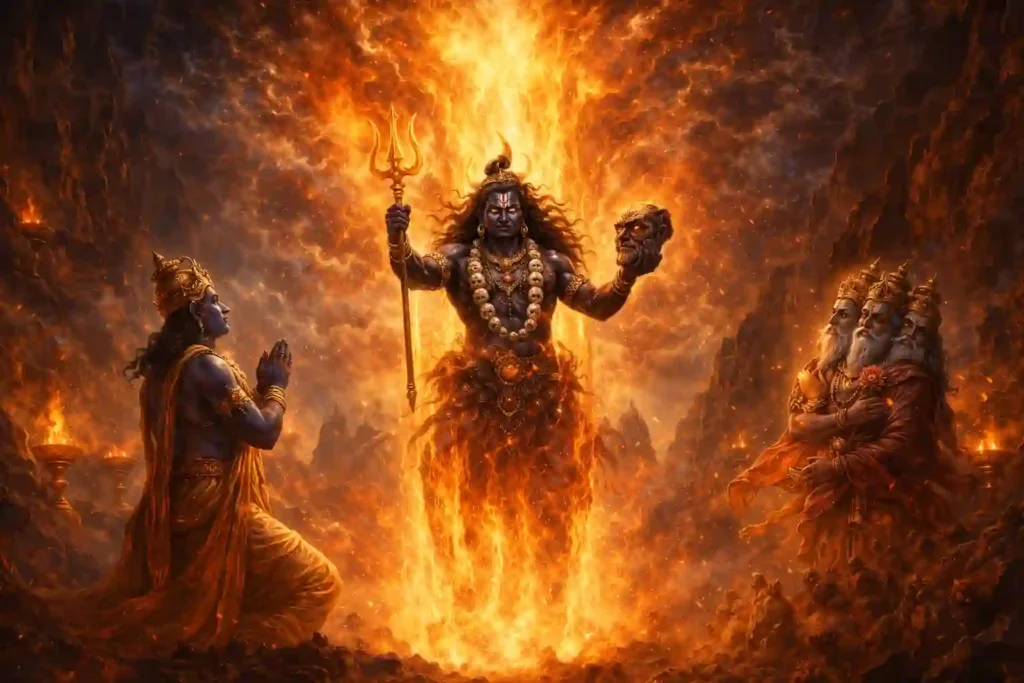
In Shakta and Tantric traditions, Bhairav is often invoked before deeper spiritual practices begin. He is regarded as a protector and guide who helps practitioners remain grounded as they move through powerful inner experiences.
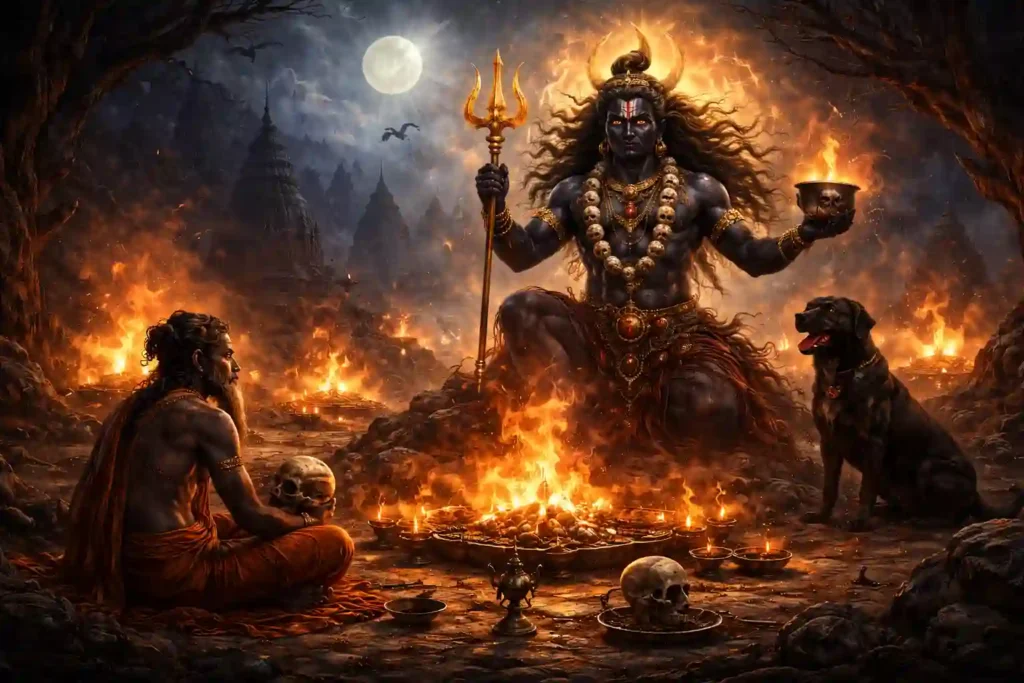
Many symbols associated with Bhairav, such as cremation grounds, night worship, skull imagery, and other unconventional elements, are not meant to promote fear or indulgence.
Traditionally, they serve as reminders of impermanence, detachment, and the need to move beyond limiting fears and attachments.
For this reason, Bhairav is often seen as a stabilising presence within Tantric practice. Traditional teachings emphasise that spiritual discipline, guidance, and self-awareness are essential.
Bhairav’s role is not only to protect the practitioner but also to ensure that the pursuit of spiritual knowledge remains balanced and purposeful.
Seen in this light, Bhairav represents the courage to face deeper truths about life, death, and the self while remaining firmly rooted in awareness and discipline.
Bhairav Tattva in Kashmir Shaivism
In Kashmir Shaivism, Bhairava is understood not merely as a deity but as the highest state of consciousness itself. Here, Bhairava represents the infinite awareness from which all experience arises and into which all experience returns.
Rather than focusing only on external worship, this tradition emphasises recognising one’s own true nature as a reflection of that universal consciousness.
For many philosophers and mystics of Kashmir Shaivism, Bhairava is the ultimate reality that exists beyond fear, form, and limitation.
This understanding gives Bhairav Tattva a deeper dimension. The fierce imagery associated with Bhairava is not intended to inspire fear but to symbolise the power that destroys ignorance and awakens direct awareness.
Through contemplation, meditation, and inner recognition, the seeker gradually moves from limited identity toward the expansive state described as Bhairava consciousness.
The Wisdom of the Vijnana Bhairava Tantra
Among the texts associated with Bhairava, the Vijnana Bhairava Tantra holds a special place. Presented as a dialogue between Bhairava and Devi, it explores numerous methods through which ordinary awareness can be transformed into direct spiritual experience.
Rather than focusing primarily on ritual, the text teaches meditation through breath, sound, silence, emotion, concentration, and moments of heightened awareness.
The significance of this text lies in its understanding of Bhairava as pure consciousness rather than merely a divine form. It teaches that every experience, when approached with awareness, can become a doorway to spiritual awakening.
For this reason, many seekers regard the Vijnana Bhairava Tantra as one of the most profound expressions of Bhairav Tattva, revealing how inner awareness itself becomes the path to liberation.
Ashta Bhairava: Guardians of the Eight Directions
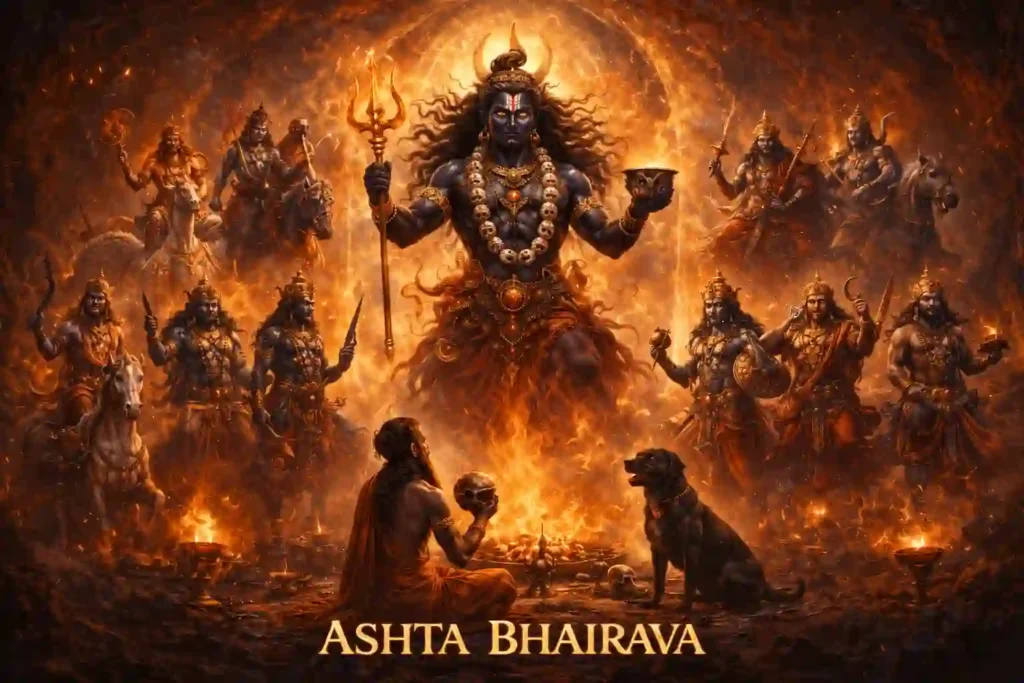
Bhairav is traditionally said to manifest as Ashta Bhairava, the eight forms that guard the eight directions of space. Together, these forms symbolise the complete protection of cosmic order and spiritual balance. Each Bhairava is associated with a specific direction, energy, and aspect of divine guardianship.
Beyond their directional role, the Ashta Bhairavas remind devotees that spiritual challenges can arise from many directions in life. Their presence symbolises vigilance, protection, and the ability to maintain balance amid changing circumstances.
The forms, symbols, and traditions associated with the Ashta Bhairavas are extensive and are often studied separately. Their deeper significance and individual roles will be explored in a dedicated article.
Batuk Bhairav: The Child Form of Divine Protection
Bhairav is not always depicted in a fierce form. Among his many manifestations, Batuk Bhairav appears as a divine child, combining innocence with protection and spiritual strength.
This form is especially beloved in many households and is often approached with simplicity and affection. Batuk Bhairav reminds devotees that true protection does not always appear through fearsome power. Sometimes it is expressed through innocence, purity of heart, and sincere devotion.
His worship reflects a gentle aspect of Bhairav, showing that behind the fierce guardian lies a compassionate presence that watches over devotees with care and grace.
Bhairav and the Mahavidya Tradition
In several Shakta traditions, Bhairava is closely associated with the Mahavidyas, the ten great wisdom goddesses who represent different aspects of the Divine Mother’s power and wisdom.
Traditional teachings often describe each Mahavidya as being accompanied by a corresponding Bhairava. In this relationship, Bhairava serves as a protector, guardian, and complementary aspect of divine consciousness.
Together, they express the inseparable unity of Shakti and Shiva, where divine power and pure awareness exist as one reality.
For devotees of Kali, Tara, Tripura Sundari, Bhairavi, and the other Mahavidyas, Bhairava is not viewed as a secondary presence.
He represents the steady, witnessing consciousness that supports spiritual transformation and protects the sacred path of the seeker.
While the Mahavidyas reveal the many powers of the Divine Mother, Bhairava reflects the awareness that remains present behind those manifestations.
Together, they offer a deeper understanding of reality and the profound harmony between consciousness and divine energy within Shakta traditions.
Bhairav in Nath and Aghora Traditions
Bhairav also holds an important place within Nath and Aghora traditions, where he is revered as a symbol of fearlessness, discipline, and direct spiritual experience.
These traditions often emphasise transcending social conditioning, confronting inner limitations, and recognising the sacred presence that exists beyond conventional distinctions of purity and impurity.
Although the practices of Nath yogis and Aghora practitioners can differ significantly, both traditions regard Bhairav as a powerful guide on the path of transformation.
Their teachings highlight the importance of courage, self-mastery, and unwavering awareness, qualities that closely reflect the deeper meaning of Bhairav Tattva within Sanatan Dharma.
Regional Bhairav Traditions and Folk Continuity
Across villages, towns, and sacred regions, Bhairav appears in many local forms such as Bhairavnath, Kshetrapal Bhairav, and other guardian deities closely connected with community traditions.
These regional expressions are not separate from Bhairav. Rather, they reflect how the same divine presence becomes part of local culture and everyday life.
Even today, Bhairav remains deeply woven into the religious traditions of many communities across India and Nepal. In some places, devotees visit Bhairav shrines before beginning important journeys, starting new ventures, or participating in major temple festivals.
He is often regarded as a vigilant protector who watches over both sacred spaces and the people who depend upon them.
While local names, rituals, and stories may vary, the devotion behind them remains remarkably similar.
Whether worshipped as Bhairavnath, Kshetrapal Bhairav, or another regional form, Bhairav continues to be seen as a guardian who protects boundaries, preserves order, and offers strength during uncertain times.
These living traditions show how Bhairav remains relevant across generations. He is not only remembered through ancient scriptures and temples but also through the faith, customs, and daily practices of countless devotees.
Inner Transformation Through Bhairav Upasana
Many devotees associate Bhairav upasana with positive inner changes, including:
Greater courage during difficult phases of life
Improved mental clarity and focus
Strength during periods of uncertainty and transition
A deeper willingness to confront one’s own limitations and fears
These experiences are understood differently by each devotee, yet a common theme often emerges. Bhairav is not approached merely for comfort or reassurance. Rather, he is revered as a guide who encourages honesty, discipline, and spiritual growth.
In this sense, Bhairav does not strengthen illusion. He strengthens truth. By helping devotees face reality with courage and awareness, he becomes a powerful force for inner transformation.
Benefits of Bhairav Upasana
Bhairav upasana is often described as a journey of inner transformation rather than a search for external rewards. Devotees turn to Bhairav not only for protection but also for the courage to face themselves honestly.
As spiritual practice deepens, a person may begin to recognise fears, attachments, and patterns that were previously ignored. This process is not always comfortable, yet it is often regarded as an important step toward greater self-awareness and growth.
For many devotees, the deeper significance of Bhairav lies in this ability to inspire honesty, discipline, and inner strength. Rather than encouraging escape from reality, Bhairav Tattva invites the seeker to face life with clarity, courage, and a willingness to transform.
Who Should Worship Bhairav?
Bhairav is often associated with honesty, discipline, and inner courage. For this reason, many devotees feel drawn to him during periods of uncertainty, self-reflection, or spiritual seeking.
Householders may worship Bhairav through simple devotion and prayer, while dedicated seekers may explore his teachings more deeply through study, meditation, and spiritual practice. The path may differ from person to person, but sincerity remains at its heart.
Perhaps one of the most important lessons associated with Bhairav is patience. Spiritual growth cannot be rushed, and transformation rarely happens overnight. Bhairav reminds devotees that truth reveals itself gradually to those who approach it with humility, discipline, and faith.
Bhairav in Temple Worship and Living Practice
Across India, Bhairav temples share certain common features, even though local customs may vary from region to region. These often include:
Night or twilight worship
Mustard oil lamps
Offerings associated with simplicity and discipline
Feeding dogs as an act of seva
Prayers for protection, courage, and clarity
Kalashtami, the eighth lunar day of Krishna Paksha, is considered especially sacred for Bhairav devotees. Many observe the day through prayer, restraint, and spiritual reflection. Bhairav worship is generally marked by sincerity and discipline rather than outward display.
Temple traditions dedicated to Bhairav vary across regions, yet the underlying reverence remains remarkably similar. In Kashi, Kaal Bhairav is honoured as the guardian of the city and is often worshipped before important religious activities.
In Ujjain, Bhairav worship has developed distinctive local customs that reflect his role as a protector and remover of obstacles. Similar traditions can also be found in parts of Rajasthan, Himachal Pradesh, Uttarakhand, and Nepal.
Despite these regional differences, Bhairav temples continue to emphasise discipline, sincerity, and protection. Devotees often approach Bhairav seeking courage, guidance, and the strength to navigate difficult phases of life.
These living traditions show how Bhairav remains not only a profound spiritual principle but also a deeply worshipped presence in everyday devotional life.
Conclusion
Bhairav Tattva is not merely about fierce imagery, sacred symbols, or ancient stories. At its heart, it points toward a deeper truth about awareness, courage, and transformation. It reminds us that spiritual growth often begins when we are willing to see ourselves honestly and let go of the illusions that hold us back.
For devotees, Bhairav is more than a guardian. He is a presence that inspires strength during uncertainty, clarity during confusion, and faith during times of change. His teachings encourage seekers to move beyond fear and walk the path of truth with sincerity and discipline.
Perhaps this is the deepest message of Bhairav Tattva: when awareness protects truth, fear gradually loses its power. What remains is not darkness, but a clearer understanding of oneself, the world, and the divine presence that guides every step of the journey.
Suggested Reading
Bhairav Tattva is best understood when explored through its many forms, traditions, and spiritual expressions. The following articles delve deeper into Bhairav’s connection with Shiva, Kashi, the Mahavidyas, and the various manifestations through which devotees experience his presence and guidance.
Kaal Bhairav: Story, Significance, Kashi Kotwal, Worship and Spiritual Meaning
https://thesanatantales.com/kaal-bhairav/
Ashta Bhairav: Powerful Guardians of Time, Direction, and Dharma
https://thesanatantales.com/ashta-bhairav/
Batuk Bhairav: The Gentle Protector Who Removes Fear and Obstacles
https://thesanatantales.com/batuk-bhairav/
Swarnakarshan Bhairav: The Hidden Path of Wealth, Stability, and Inner Alignment
https://thesanatantales.com/swarnakarshan-bhairav/
Shiva and Bhairav: Meaning, Connection & Spiritual Path
https://thesanatantales.com/shiva-and-bhairav/
Bhagwan Shiv: The Supreme Consciousness Beyond Creation and Destruction
https://thesanatantales.com/bhagwan-shiv/
Das Mahavidya: Meaning, Origin, 10 Goddesses, Temples and Spiritual Path
https://thesanatantales.com/das-mahavidya/
Bhairava (Wikipedia)
https://en.wikipedia.org/wiki/Bhairava
FAQs
What is Bhairav Tattva?
Bhairav Tattva refers to the spiritual principle represented by Bhairav rather than a specific deity alone. In Sanatan Dharma, it signifies the force of awakened awareness that removes illusion, reveals truth, and guides seekers toward clarity. Bhairav Tattva is associated with fearlessness, discipline, transformation, and the deeper realities that exist beyond ego and ignorance.
Is Bhairav dangerous?
No. Bhairav is not dangerous to sincere devotees. Traditional teachings describe Bhairav as a protector who removes obstacles, fear, and falsehood. His fierce appearance symbolises the destruction of ignorance rather than harm to those who approach him with respect and devotion.
Is Bhairav only a tantric deity?
No. Although Bhairav is highly revered in Tantric traditions, his presence extends far beyond Tantra. He appears in Puranic literature, Shaiva traditions, temple worship, folk practices, and the sacred traditions of Kashi. Bhairav is worshipped by householders, ascetics, and spiritual seekers alike.
What is the difference between Bhairav and Kaal Bhairav?
Bhairav is a broad term that refers to various manifestations of Shiva’s fierce and protective aspect. Kaal Bhairav is one specific form associated with time (Kaal), karmic order, and the guardianship of Kashi. While all Kaal Bhairav forms are Bhairav, not every form of Bhairav is Kaal Bhairav.
Why are dogs associated with Bhairav?
The dog is traditionally regarded as the vahana (vehicle) of Bhairav. Symbolically, it represents loyalty, alertness, protection, and the ability to remain watchful. Feeding dogs is considered an act of seva associated with Bhairav in many traditions.
Can householders worship Bhairav?
Yes. Bhairav worship is not limited to ascetics or advanced practitioners. Many householders worship Bhairav through simple prayers, lighting lamps, observing Kalashtami, and remembering him with devotion. Traditional worship emphasises sincerity, discipline, and respect rather than complexity.
What is the role of Bhairav in Kashmir Shaivism?
In Kashmir Shaivism, Bhairava is often understood as the highest reality itself rather than merely a deity. He represents limitless consciousness, pure awareness, and the source from which all existence emerges. This tradition views Bhairava as the ultimate state of spiritual awakening and self-recognition.
How is Bhairav related to the Mahavidyas?
In several Shakta traditions, each Mahavidya is associated with a corresponding Bhairava. This relationship symbolises the inseparable unity of Shakti and Shiva. While the Mahavidyas express divine power and wisdom, Bhairava represents the conscious principle that supports and complements those manifestations.
What are the benefits of Bhairav upasana?
Devotees traditionally associate Bhairav upasana with courage, clarity, discipline, protection, and inner strength. Many worshippers believe that Bhairav helps remove fear, reduce confusion, strengthen determination, and guide seekers through difficult phases of life and spiritual growth.
Is Bhairav worship suitable for beginners?
Yes. Beginners can approach Bhairav through simple devotion, prayer, and respectful remembrance. While some advanced traditions involve specialised practices, sincere worship does not require complex rituals. The most important qualities are faith, honesty, and consistency.
Does Bhairav represent destruction or transformation?
Bhairav primarily represents transformation. While he destroys ignorance, arrogance, and illusion, this destruction serves a higher purpose. It clears the way for wisdom, spiritual growth, and a deeper understanding of truth.
Why is Bhairav associated with Kashi?
Bhairav is revered as the Kotwal, or guardian, of Kashi. Traditional belief holds that he protects the sacred city and oversees its spiritual order. Devotees often seek Bhairav’s blessings when visiting Kashi, recognising him as the guardian of one of Hinduism’s holiest pilgrimage sites.
Glossary of Important Terms
| Term | Meaning |
|---|---|
| Bhairav Tattva | The spiritual principle of awakened awareness that removes illusion and reveals truth. |
| Bhairav | A powerful form of Shiva associated with protection, discipline, truth, and transformation. |
| Sanatan Dharma | The eternal spiritual tradition commonly known as Hinduism. |
| Tattva | A fundamental principle or underlying reality that explains existence and consciousness. |
| Shiva | The supreme consciousness from whom Bhairav emerges as a protective and transformative aspect. |
| Consciousness | Pure awareness that exists beyond ego, fear, and limitations. |
| Dharma | Cosmic order, righteousness, duty, and spiritual harmony. |
| Maya | Illusion that hides reality and creates attachment and ignorance. |
| Awareness | The state of clear perception and spiritual wakefulness. |
| Transformation | Inner change that leads from ignorance to wisdom and freedom. |
| Jyotirlinga | A sacred manifestation of Shiva as an infinite pillar of divine light. |
| Brahma | The creator deity in the Hindu Trimurti. |
| Vishnu | The preserver deity in the Hindu Trimurti. |
| Ego (Ahamkara) | The false sense of self that separates a person from spiritual truth. |
| Kashi | The sacred city of Varanasi, regarded as one of the holiest places in Sanatan Dharma. |
| Kotwal of Kashi | Title of Bhairav as the divine guardian and protector of Kashi. |
| Shiva Purana | A major scripture describing Shiva’s forms, teachings, and divine roles. |
| Linga Purana | A Purana focusing on Shiva, the Lingam, and spiritual wisdom. |
| Skanda Purana | One of the largest Hindu scriptures containing sacred geography and spiritual teachings. |
| Bhairava Tantra | Tantric texts that explore Bhairav as divine consciousness and spiritual awakening. |
| Vijnana Bhairava Tantra | A revered scripture teaching meditation methods for attaining higher awareness. |
| Tantra | A spiritual tradition that uses meditation, rituals, and inner practices for transformation. |
| Shakta Tradition | A tradition centered on the worship of Divine Mother Shakti. |
| Kashmir Shaivism | A philosophical school that views Bhairava as the highest universal consciousness. |
| Liberation (Moksha) | Freedom from the cycle of birth, death, and suffering. |
| Upasana | Devotional worship or spiritual practice performed with dedication. |
| Kaal | Time as a transformative force that reveals truth and dissolves illusion. |
| Kaal Bhairav | A form of Bhairav associated with time, karma, discipline, and protection. |
| Ashta Bhairava | The eight forms of Bhairav who guard the eight directions. |
| Batuk Bhairav | Child form of Bhairav symbolizing innocence, protection, and grace. |
| Mahavidya | One of the ten wisdom goddesses representing aspects of Divine Mother’s power. |
| Shakti | Divine energy and creative power of the universe. |
| Devi | The Divine Mother and supreme feminine principle in Hindu traditions. |
| Nath Tradition | A yogic tradition emphasizing self-mastery, meditation, and direct experience. |
| Aghora Tradition | A spiritual path focused on transcending fear, duality, and social conditioning. |
| Bhairavnath | A regional form of Bhairav worshipped as a guardian deity. |
| Kshetrapal Bhairav | Bhairav as the protector of sacred spaces, villages, and regions. |
| Trishul (Trident) | Symbol of mastery over creation, preservation, and dissolution. |
| Skull Bowl (Kapala) | Symbol of impermanence, humility, and transcendence of ego. |
| Dog | Sacred companion of Bhairav representing loyalty, vigilance, and awareness. |
| Serpents | Symbols of spiritual energy, fearlessness, and mastery over instincts. |
| Cremation Ground | Symbolic place representing impermanence and spiritual detachment. |
| Seva | Selfless service performed as an act of devotion. |
| Kalashtami | Sacred lunar observance dedicated to Bhairav worship. |
| Spiritual Discipline | Consistent practice that cultivates awareness, truth, and self-mastery. |
| Inner Transformation | The process of overcoming fear, attachment, and ignorance through spiritual growth. |
| Sacred Boundaries | Spiritual and ethical limits protected by Bhairav to preserve dharma. |
| Truth (Satya) | Ultimate reality that Bhairav reveals by removing illusion and falsehood. |
About the Author
Yateendra Chaturvedi is a spiritual writer, researcher, devotee, and the founder of The Sanatan Tales. With over 35 years of professional experience and a lifelong interest in Sanatan Dharma, he writes about Hindu deities, temples, scriptures, festivals, Mahavidyas, sacred stories, rituals, and living traditions that continue to guide and inspire devotees across India.
Drawing from traditional scriptures, regional beliefs, temple traditions, devotional literature, and historical sources, he aims to present authentic, well-researched, and easy-to-understand content for modern readers. His work focuses on preserving spiritual wisdom, explaining sacred traditions, and helping seekers develop a deeper understanding of India’s rich spiritual heritage.
Through The Sanatan Tales, Yateendra strives to make the timeless teachings of Sanatan Dharma simple, meaningful, and relevant for today’s generation while maintaining respect for traditional sources, regional practices, and diverse spiritual perspectives.
Learn More About Yateendra Chaturvedi →
https://thesanatantales.com/about-the-author/
References & Sources
This article is based on Shaiva and Bhairava traditions followed within Sanatan Dharma, traditional beliefs associated with Lord Bhairava, religious narratives, folk traditions, and insights gathered from various spiritual and religious study sources. Some concepts discussed in this article are also inspired by interpretations found in guru-disciple lineages, temple traditions, and devotional literature.
Note: Beliefs, stories, and methods of worship related to Lord Bhairava may differ across regions, sects, and spiritual traditions. The purpose of this article is not to present any single viewpoint as the absolute truth, but to explain commonly accepted religious and spiritual perspectives in a simple and accessible manner.
Explore More Fascinating Topics from Sanatan Dharma