Maa Matangi is the ninth Mahavidya, one of the ten great wisdom goddesses of the Shakta tradition. She is associated with speech, music, knowledge, creativity, and the mysterious power through which inner wisdom becomes expression.
She is often called the Tantric Saraswati, but her role extends beyond learning and intellectual knowledge.
In many traditions, Maa Matangi represents the power of sacred speech, inspired expression, and the wisdom that emerges from places society often overlooks or misunderstands.
Among the Mahavidyas, Matangi holds a unique position. She appears after Dhumavati, the goddess of emptiness and dissolution, and before Kamala, the goddess of abundance and fulfillment.
For this reason, many practitioners see her as the force that transforms inner realization into creative expression and meaningful action.
Her symbolism connects speech, mantra, music, and consciousness. She is also associated with Vishuddha Chakra, the throat center where thought becomes expression and silence takes form as sound.
Through this connection, Maa Matangi teaches that words are not merely tools of communication but carriers of awareness, intention, and spiritual power.
To understand Maa Matangi is to explore much more than a goddess of speech. It is to explore the relationship between knowledge and expression, silence and sound, inner realization and the way it is shared with the world.
Table of Contents
ToggleWhy Maa Matangi Comes After Dhumavati and Before Kamala
The position of Maa Matangi as the ninth Mahavidya is not accidental. The Mahavidyas are often understood as more than ten individual goddesses. Together, they can also be seen as stages in the unfolding of spiritual consciousness.
Before Matangi appears, the seeker encounters Dhumavati, the goddess of loss, emptiness, and disillusionment. Dhumavati strips away false identities, attachments, and expectations. She represents the stage where familiar supports disappear and deeper truths begin to emerge.
After this emptiness, Matangi arises. She teaches the seeker how to return to the world with greater wisdom and awareness. Speech, creativity, knowledge, and action are restored, but they are no longer driven by ego or ignorance. Instead, they become expressions of a deeper understanding.
After Matangi comes Kamala, the goddess of abundance, harmony, and fulfillment. In this way, Matangi stands at a symbolic bridge between inner realization and outer flourishing. She shows how spiritual insight can be expressed through words, actions, creativity, and daily life.
For many practitioners, this sequence carries an important teaching. Awakening is not the end of the journey. What matters is how that realization is expressed, communicated, and lived. Maa Matangi represents that sacred transition from inner wisdom to meaningful expression.
Scriptural References and Traditional Sources
Maa Matangi appears within the broader Mahavidya tradition preserved in Shakta and Tantric literature. References to her are found across texts associated with the Mahavidyas, Sri Vidya traditions, and later Tantric works.
While different scriptures emphasize different aspects of her nature, they consistently portray her as a manifestation of divine speech, wisdom, and transformative knowledge.
Different lineages place emphasis on different forms of the goddess. Some focus on Raja Matangi as the embodiment of refined speech, royal authority, and artistic mastery, while others emphasize Uchchhishta Matangi and her role in transcending social limitations and inner conditioning.
Because these traditions evolved through multiple lineages over centuries, descriptions of Matangi may vary between scriptures, temples, and oral traditions.
Understanding these variations helps devotees appreciate the richness of her worship while recognizing that no single tradition represents the entirety of her sacred identity.
Maa Matangi and the Power of Sacred Expression
Among the Mahavidyas, Maa Matangi governs articulation and expression. Kali dissolves ego, Tripura Sundari reveals divine beauty, and Bhairavi ignites discipline. Matangi brings these inner realizations into the realm of speech, communication, creativity, and action.
She transforms knowledge into language, music, teaching, leadership, and meaningful expression. In many Tantric traditions, wisdom is not considered complete until it can be understood, communicated, and applied in life. For this reason, Matangi is often associated with the power that allows inner realization to take form in the world.
This symbolism extends beyond ordinary speech. Mantra recitation, poetry, music, debate, teaching, diplomacy, and persuasive communication are all connected with her domain. These are seen as different ways through which knowledge moves from silence into expression.
For many practitioners, Maa Matangi represents the understanding that spiritual growth is not only about gaining wisdom but also about expressing it responsibly. Through her grace, speech becomes more conscious, communication becomes more meaningful, and knowledge becomes a living force rather than a private experience.
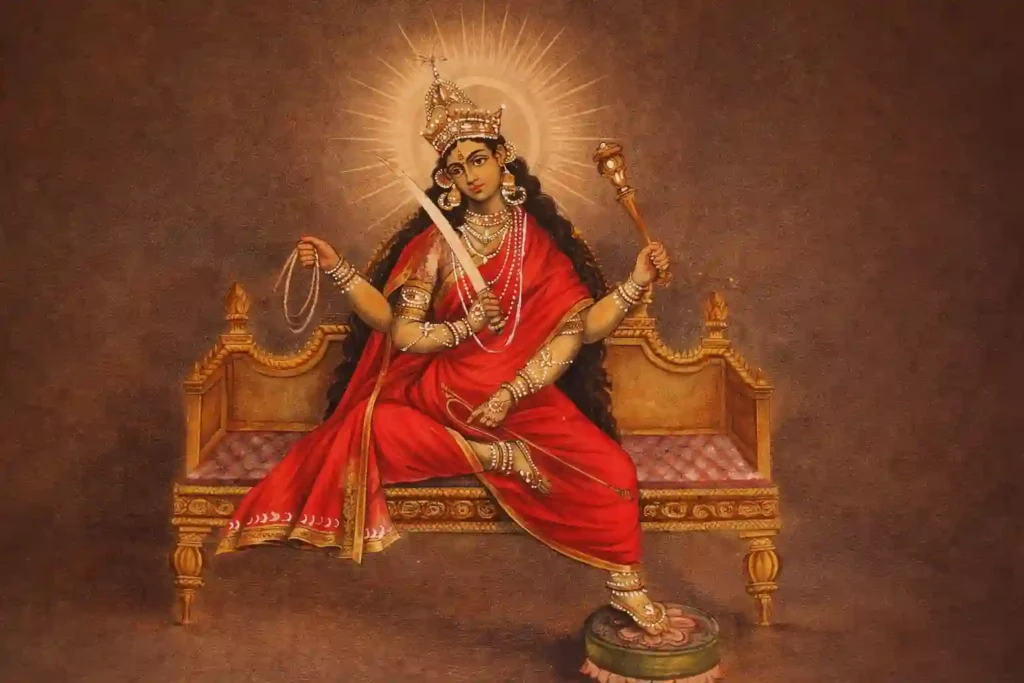
Goddess of Vaikhari Vak and the Science of Sound
antric traditions describe four stages of speech: Para, Pashyanti, Madhyama, and Vaikhari. Para is the unmanifest state of pure awareness from which sound originates. Pashyanti is the subtle stage where sound exists as vision or intuition. Madhyama is the inner formation of thought and mental speech. Vaikhari is the final stage where speech becomes audible and enters the external world.
Maa Matangi presides over Vaikhari Vak, the stage where inner consciousness takes shape as spoken word, music, mantra, and communication. Her role reflects the belief that speech is not separate from consciousness but one of its most visible expressions.
For this reason, she is sometimes described as Para-Vaikhari, the divine power through which subtle awareness becomes meaningful expression. Inspired speech, poetry, teaching, music, and even leadership can be understood as manifestations of this principle when guided by wisdom and clarity.
This symbolism gives Maa Matangi a unique place among the Mahavidyas. She reminds devotees that words carry power. Speech can educate, inspire, heal, guide, or transform. In this sense, communication becomes more than a practical skill. It becomes a spiritual responsibility.
For this reason, her worship has long been associated with teachers, writers, artists, musicians, speakers, and leaders whose lives depend upon the ability to express truth, knowledge, and insight effectively.
Maa Matangi and the Vishuddha Chakra
Maa Matangi is closely associated with Vishuddha Chakra, the throat center that governs communication, self-expression, truthfulness, and the transformation of thought into speech.
In Yogic and Tantric traditions, this chakra represents the point where inner awareness becomes audible expression. It is the bridge between what is experienced within and what is shared with the world.
Her connection with Vishuddha reflects her role as the goddess of language, mantra, music, and sacred sound. Devotees often view her as the power that helps refine communication, remove fear of expression, and align speech with wisdom.
This symbolism goes beyond speaking well. Vishuddha is traditionally associated with purity of expression, where words become aligned with truth rather than impulse, fear, or confusion. In this sense, Maa Matangi represents not only the power to speak, but also the wisdom to know when, why, and how speech should be used.
Through this symbolism, Maa Matangi teaches that words carry spiritual responsibility and should be used with awareness, truthfulness, and compassion.
Maa Matangi and Saraswati: Similar Yet Different
While Saraswati is primarily associated with learning, scholarship, refinement, and the structured transmission of knowledge, Maa Matangi represents inspired expression, intuitive wisdom, and the living power of speech.
Both goddesses are connected with knowledge, but they illuminate different dimensions of it.
In symbolic terms, Saraswati is often linked with disciplined learning, sacred texts, and formal knowledge, while Matangi is associated with spontaneous insight, creative expression, poetry, music, and the wisdom that emerges beyond conventional boundaries. For this reason, she is often called the Tantric Saraswati.
This distinction helps explain why Maa Matangi is revered not only by students and scholars but also by poets, artists, musicians, speakers, leaders, and spiritual practitioners.
Her domain extends beyond acquiring knowledge into the ability to express, communicate, and bring that knowledge to life.
Rather than opposing one another, Saraswati and Matangi can be understood as complementary forms of wisdom. One refines knowledge, while the other gives it voice and expression.
Iconography and Symbolism of Maa Matangi
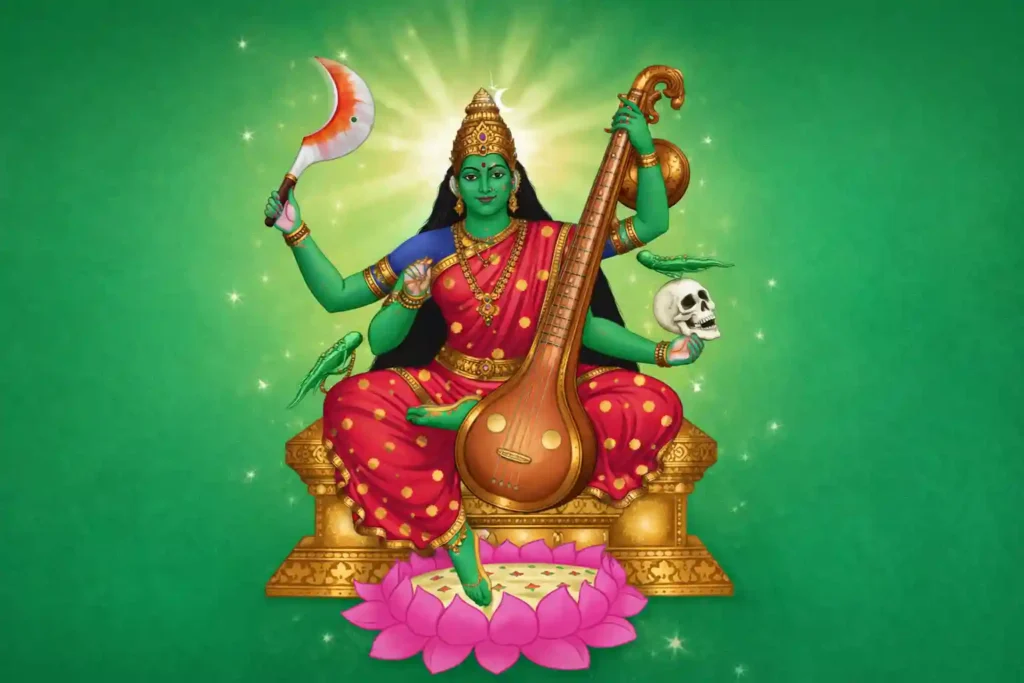
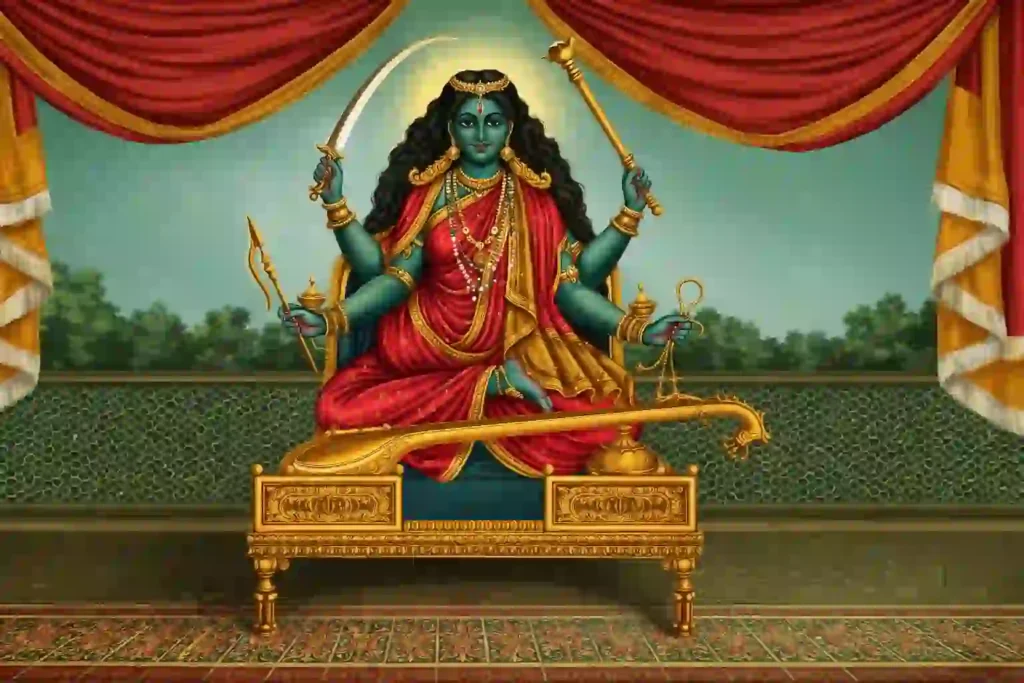
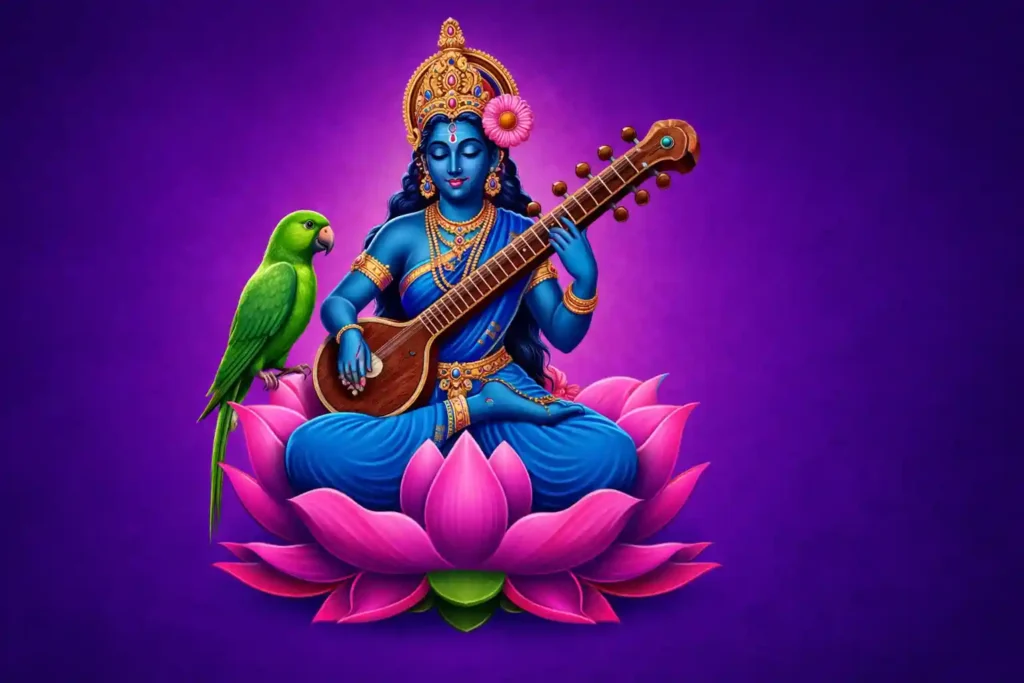
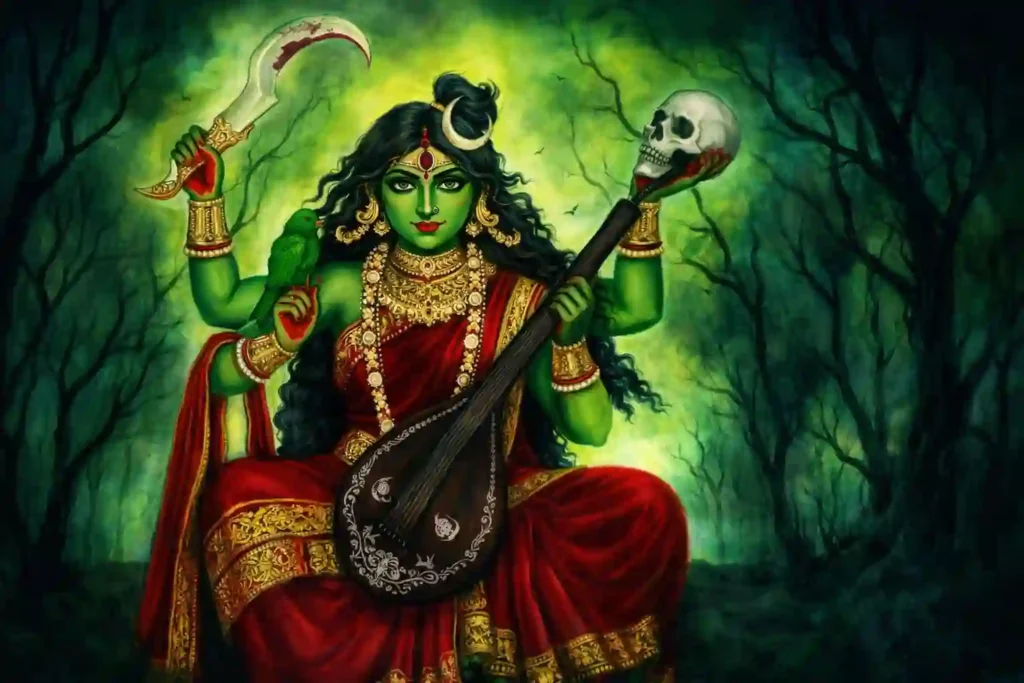
Maa Matangi is often depicted with an emerald-green or dark bluish complexion. In many traditions, this symbolism is linked with Mercury.
The planet associated with intelligence, communication, learning, and expression. Her appearance reflects wisdom that is vibrant, creative, and alive rather than withdrawn from the world.
In her Raja Matangi or Shyamala form, she is shown seated upon a jeweled throne while playing a veena adorned with precious gems. This imagery reflects her mastery over music, language, rhythm, and the harmonious expression of knowledge.
The veena carries deeper symbolism as well. Traditional interpretations connect it with the subtle body, where its central structure represents the flow of spiritual energ.
Its strings symbolize the many channels through which consciousness expresses itself. Through this imagery, Maa Matangi is shown bringing harmony to thought, speech, and action.
A parrot often accompanies the goddess and serves as one of her most recognizable symbols. The parrot represents Vak Shakti, the power of speech and expression. It also reflects repetition, learning, and the transmission of knowledge.
In many traditions, the parrot symbolizes the journey from repeating sacred words to truly understanding and embodying their meaning.
Together, these symbols present Maa Matangi as a goddess who transforms knowledge into expression, creativity into wisdom, and speech into a vehicle for spiritual growth.
The Meaning of Uchchhishta in Maa Matangi Worship
As Uchchhishta Chandalini, Maa Matangi is associated with offerings that are symbolically considered leftover or incomplete.
This aspect of her worship is often misunderstood when viewed only through a literal lens.
In Tantric traditions, Uchchhishta represents much more than physical leftovers. It symbolizes the subtle residue that remains after experiences have been lived, understood, and absorbed.
Through this symbolism, Maa Matangi teaches that spiritual wisdom can emerge from places that society may overlook, reject, or consider impure.
Her worship encourages devotees to move beyond rigid ideas of purity and impurity, while confronting inner conditioning, fear, and shame.
The deeper teaching is not the rejection of sacred traditions but the recognition that the Divine cannot be confined by social boundaries alone.
For this reason, Maa Matangi is often seen as a goddess who reveals sacredness in unexpected places.
Her presence reminds seekers that divine awareness is not limited to temples or ritual spaces. It can be discovered wherever sincerity, wisdom, and spiritual awareness are present.
Mythological Origins and Sacred Narratives of Maa Matangi
Several traditions preserve different accounts of Maa Matangi’s origin, each highlighting a distinct aspect of her spiritual significance.
Some legends describe her emergence from the leftovers of a divine meal shared by Shiva and Parvati, while others tell of Parvati assuming the form of a Chandala maiden to test Shiva’s realization and freedom from social distinctions.
In this narrative, Shiva recognized the Divine beyond external appearances and embraced her true nature.
The Chandala maiden then revealed herself as Uchchhishta Matangi, a form associated with transcending limitations and conventional boundaries.
Other traditions identify Matangi as the daughter of Sage Matanga, born through intense penance and spiritual devotion.
These accounts emphasize her connection with wisdom, knowledge, and the power gained through spiritual discipline.
Although the stories differ, they share a common message. Divine wisdom is not confined by appearance, social status, or established norms.
Through these narratives, Maa Matangi emerges as a goddess who reveals sacred truth in places where people may not expect to find it.
Maa Matangi in the Sri Vidya Tradition
Within the Sri Vidya tradition, Maa Matangi is revered as Mantrini or Raja Shyamala, the divine minister of Goddess Lalita Tripura Sundari. She is associated with speech, music, wisdom, communication, and the proper expression of mantra.
While Lalita represents supreme sovereignty, Matangi is often understood as the power through which that divine will is communicated and expressed within creation.
Sri Vidya traditions describe her as a goddess who governs language, sound, learning, and sacred expression.
For this reason, she occupies an important place in Sri Vidya worship and is closely associated with mantra recitation, music, poetry, and refined speech.
She is also linked with the Geya Chakra, a realm associated with sound, music, and vibrational expression within the symbolic structure of the Sri Yantra.
Through this connection, Maa Matangi represents the movement of wisdom into expression and the transformation of knowledge into living experience.
For many Sri Vidya practitioners, her worship is valued not only for eloquence and learning but also for cultivating clarity, discernment, and the ability to express spiritual understanding in daily life.
Forms of Maa Matangi and Their Inner Role
Maa Matangi is worshipped in several forms, each highlighting a different aspect of her power and symbolism.
Among these, Raja Matangi, Uchchhishta Matangi, and Laghu Shyamala are the most widely known within Tantric and Sri Vidya traditions.
Raja Matangi, also known as Shyamala, is associated with refined speech, wisdom, leadership, diplomacy, music, and artistic excellence.
She represents the graceful and elevated expression of knowledge, making her especially revered by teachers, writers, musicians, and those whose lives depend on communication.
Uchchhishta Matangi reflects a more transformative aspect of the goddess. Through her symbolism, devotees are encouraged to move beyond social conditioning, fear of judgment, and limiting beliefs.
She teaches that spiritual growth often begins when one transcends external labels and discovers the sacred presence within all aspects of life.
Laghu Shyamala is traditionally regarded as a gentler and more accessible form of Matangi.
In some lineages, she is worshipped as an introductory form that prepares the devotee for deeper practices associated with Raja Matangi and other advanced forms of the goddess.
Together, these forms reveal the many dimensions of Maa Matangi, from eloquence and creativity to inner transformation and spiritual maturity.
Maa Matangi in the Sri Vidya Tradition
Within the Sri Vidya tradition, Maa Matangi is revered as Shyamala or Raja Matangi, the Mantrini of Goddess Lalita Tripura Sundari. She is associated with speech, music, wisdom, communication, and the transmission of sacred knowledge.
Her role extends beyond eloquence alone, reflecting the power through which divine wisdom becomes understandable and expressible within the world.
Traditional Sri Vidya teachings describe her as the divine minister who governs mantra, language, diplomacy, artistic expression, and refined communication.
While Lalita Tripura Sundari represents supreme sovereignty and ultimate reality, Matangi is often understood as the force that conveys and articulates that divine will.
For this reason, devotees frequently view her as a bridge between inner realization and outer expression. She represents the movement of wisdom from silent awareness into words, music, teaching, and meaningful action.
Her place within Sri Vidya highlights an important spiritual principle. Realization is not only about inner experience but also about how truth is expressed, communicated, and lived in everyday life.
Through Maa Matangi, knowledge becomes expression, and expression becomes a path of spiritual growth.
Maa Matangi and Uchchhishta Ganapati
Maa Matangi shares a close association with Uchchhishta Ganapati in several Tantric traditions. Both are connected with the principle of Uchchhishta, a concept that carries symbolic meanings far beyond its literal interpretation.
In these traditions, Uchchhishta represents what remains after an experience has been fully received, processed, and assimilated.
For this reason, Uchchhishta Ganapati is often worshipped before or alongside Maa Matangi in certain lineages.
The pairing symbolizes the refinement of instinct, desire, and worldly experience before the seeker gains mastery over speech, expression, and higher knowledge.
Together, they represent complementary aspects of spiritual transformation. Uchchhishta Ganapati helps remove inner obstacles and harmonize instinctive energies, while Maa Matangi transforms that refined awareness into wisdom, communication, creativity, and sacred expression.
Different traditions explain their relationship in different ways. Some regard Matangi as the Shakti of Uchchhishta Ganapati, while others describe a maternal or deeply interconnected spiritual bond between them.
Despite these variations, both deities are frequently honored together within Tantric practice because of their shared association with transformation, integration, and the awakening of deeper awareness.
Temple Worship and Living Traditions of Maa Matangi
While Maa Matangi is known through Tantric literature, her presence also survives through living traditions, temple worship, and regional devotional practices.
In some communities she is worshipped as Raja Matangi or Shyamala, while in others she is identified with local manifestations of the Divine Mother.
Several traditions associate Goddess Meenakshi of the Meenakshi Amman Temple with Raja Matangi because of shared symbolism such as the green complexion, royal authority, and connection with the parrot.
At Kamakhya, Maa Matangi is honored within the wider Mahavidya tradition and forms part of the region’s rich Tantric heritage. In Gujarat, some communities revere her through local forms such as Modheshwari, reflecting the regional diversity of Devi worship.
Devotees often approach Maa Matangi for blessings related to speech, education, music, artistic excellence, leadership, and effective communication.
While Tantric traditions emphasize deeper ritual and symbolic dimensions, temple worship generally focuses on devotion, prayer, offerings, and community participation.
This diversity reflects the broader nature of Sanatan Dharma, where the same deity may be understood through scripture, ritual, regional customs, and personal devotion.
Together, these traditions help preserve Maa Matangi as a living and actively worshipped form of the Divine Mother.
Scripture, Temple Tradition and Regional Beliefs
Not every belief associated with Maa Matangi comes from the same source. Some teachings originate in Tantric scriptures, while others arise from temple traditions, regional customs, and oral transmission.
Over time, local communities have developed their own devotional understandings of the goddess while remaining connected to the wider Shakta tradition.
For example, the identification of certain regional goddesses with Raja Matangi is often based on devotional and regional traditions rather than a single universally accepted scriptural statement.
Likewise, specific ritual practices may differ between Sri Vidya practitioners, Mahavidya upasakas, and local temple communities.
Recognizing these distinctions helps readers understand the diversity of Sanatan Dharma and appreciate how scriptural teachings and living traditions can coexist within the same spiritual framework.
Mantras and Disciplined Sound Practice
Mantra plays an important role in the worship of Maa Matangi. Among the mantras associated with her, one of the most widely recited is:
Om Hreem Kleem Hum Matangaye Phat Swaha
Traditional practitioners associate this mantra with clarity of speech, creative expression, confidence, wisdom, and the refinement of communication.
Like many Mahavidya mantras, its deeper significance lies not only in the words themselves but also in the discipline, concentration, and devotion with which it is practiced.
Maa Matangi is also worshipped through Gayatri and other lineage-specific mantras that emphasize knowledge, eloquence, artistic inspiration, and sacred expression.
In many traditions, mantra japa is performed during quiet periods of the day, often in silence and with focused awareness, allowing the practitioner to cultivate a deeper connection with the goddess and the power of conscious speech.
For devotees, mantra practice is not simply a method of gaining abilities or benefits. It is also a way of refining thought, speech, and awareness so that communication becomes more truthful, purposeful, and aligned with wisdom.
The Meaning of Maa Matangi’s Bija Mantras
Like many Mahavidyas, Maa Matangi is worshipped through sacred seed syllables known as bija mantras. These sounds are not merely words but symbolic expressions of divine energy.
Hreem is often associated with the power of consciousness and divine manifestation. Kleem represents attraction, harmony, and the drawing together of scattered energies.
Hum is linked with protection and inner strength, while Phat symbolizes the cutting away of obstacles and negativity.
Traditional practitioners view these syllables as sacred vibrations that work on the mind and subtle body.
While advanced mantra practices require initiation and guidance, understanding the symbolic meaning of the bija mantras helps devotees appreciate the deeper philosophy behind Matangi worship.
Vashikaran and Its Ethical Tantric Meaning
In Tantric traditions, the concept of Vashikaran is often misunderstood. At its deeper level, it does not refer to controlling or manipulating others. Instead, it points toward mastery over one’s own speech, thoughts, emotions, and presence.
Maa Matangi is associated with the power of expression, communication, and influence.
Through her symbolism, devotees learn that true influence arises not from force but from clarity, wisdom, and authenticity. When words are aligned with truth and inner awareness, they naturally carry greater impact.
This understanding gives Vashikaran a more spiritual meaning. Rather than domination, it becomes the ability to communicate effectively, inspire confidence, and express oneself with conviction and responsibility.
In this sense, Maa Matangi represents ethical influence rooted in wisdom rather than control over others.
For many practitioners, this teaching reflects one of the deeper lessons of Matangi worship. Speech becomes most powerful when it is guided by self-mastery, sincerity, and conscious awareness.
Vamachara Traditions and the Worship of Maa Matangi
In some Vamachara or left-hand Tantric traditions, Maa Matangi is worshipped through practices that intentionally challenge conventional ideas of purity and impurity.
These practices are rooted in specific lineages and are understood within a highly structured spiritual framework rather than as acts of rebellion or social defiance.
The purpose of such rituals is not to reject sacred values but to help the practitioner transcend limiting attachments, conditioning, and dualistic thinking.
Traditional teachers emphasize that these practices require discipline, self-control, mental purity, and proper guidance.
For this reason, advanced Tantric rituals associated with Maa Matangi are traditionally undertaken only under the supervision of a qualified guru.
The emphasis remains on inner transformation and spiritual maturity rather than the outward form of the ritual itself.
Across traditions, an important principle remains unchanged: transcending social concepts of purity never implies abandoning ethical conduct, self-restraint, or moral responsibility.
The deeper goal is the realization of divine presence beyond external distinctions while remaining grounded in wisdom and discipline.
Astrological Associations of Maa Matangi
Maa Matangi is commonly associated with Mercury (Budh), the planet connected with communication, intelligence, learning, language, and self-expression.
Because of this connection, devotees often seek her blessings for clarity of thought, effective communication, artistic talent, and intellectual growth.
Some traditions also invoke Maa Matangi during challenging astrological periods associated with Rahu. Rahu is often linked with confusion, obsession, unconventional thinking, and sudden change.
Within a spiritual context, these same qualities can be transformed into creativity, innovation, and fresh insight when guided by wisdom and awareness.
For this reason, Maa Matangi is sometimes viewed as a goddess who helps bring clarity to mental confusion and direction to scattered energies.
Her symbolism emphasizes the transformation of raw potential into meaningful expression, allowing knowledge, creativity, and communication to be used constructively rather than chaotically.
As with many astrological associations in Sanatan Dharma, these interpretations may vary between traditions, lineages, and practitioners.
However, the common theme remains the same: Maa Matangi is associated with the refinement of thought, speech, and intelligent expression.
Maa Matangi’s Gifts of Creativity, Expression and Inner Transformation
She governs the Chaturshashti Kalas, the sixty four arts, from music and poetry to architecture and alchemy. Her grace brings sudden creative breakthroughs.
The legend of Kalidasa shows her power. Once unlearned, he gained poetic mastery after Shyamala touched his tongue.
His Shyamala Dandakam remains central to her worship. Maa Matangi helps devotees digest rejected experiences. Trauma, chaos, and suppressed expression become wisdom through her grace.
Liminal Spaces and Cremation Ground Symbolism
As a Mahavidya, Maa Matangi is closely associated with boundaries, transitions, and spaces that exist between established definitions.
Cremation grounds, leftovers, and social margins appear frequently in her symbolism because they represent places where familiar identities and assumptions begin to dissolve.
In Tantric traditions, these liminal spaces are not viewed as impure. Instead, they symbolize transformation, impermanence, and the movement from one state of awareness to another.
They remind the seeker that spiritual growth often occurs when old patterns, attachments, and limitations are left behind.
For this reason, Maa Matangi is sometimes described as a guardian of thresholds. She presides over the point where inner change becomes possible and where deeper truths can emerge beyond social labels and conditioned thinking.
Her connection with such spaces teaches that spiritual wisdom is not confined to comfort, status, or external approval.
By standing at the edges of accepted norms, Maa Matangi reveals the sacred presence that exists even in places that are often overlooked, misunderstood, or feared.
Through this symbolism, she encourages seekers to move beyond attachment to identity and discover a deeper freedom rooted in awareness.
Dhyana and the Meditative Symbolism of Maa Matangi
Traditional dhyana, or sacred visualization, plays an important role in understanding Maa Matangi. She is often visualized with an emerald-green complexion, seated on a jeweled throne, holding a veena, and accompanied by a parrot.
Each symbol carries meaning. The veena represents harmony between thought, speech, and action.
The parrot symbolizes repetition, mantra, and the power of refined expression. Her green form is associated with growth, communication, and living wisdom.
During contemplation, devotees reflect on Matangi as the force that transforms scattered thoughts into meaningful expression.
This symbolism makes her especially relevant for seekers who wish to cultivate clarity, creativity, and truthful communication.
The Matangi Yantra and Subtle Body Science
The Matangi Yantra is regarded as a sacred geometric representation of Maa Matangi’s energy and consciousness.
In traditional practice, it is used as a support for meditation, concentration, mantra recitation, and contemplation of the goddess.
The central bindu symbolizes the source from which sound, thought, and expression arise. Surrounding geometric forms and petals represent the unfolding of that subtle energy into language, creativity, and manifested experience.
Some traditions also associate the petals with the vibrational power of Sanskrit sounds and sacred speech.
Tantric symbolism connects the yantra with the subtle body and the movement of consciousness through different levels of expression.
Just as Maa Matangi governs speech, music, and communication, the yantra is believed to help harmonize the flow of inner awareness and refine the connection between thought and expression.
Her veena is often interpreted as a symbol of the sushumna nadi, the central energy channel described in Yogic traditions.
Through this imagery, Maa Matangi represents the alignment of thought, speech, creativity, and spiritual perception.
Together, the yantra and the veena symbolize the transformation of inner awareness into conscious expression and sacred sound.
Why Maa Matangi Remains Relevant Today
Although rooted in ancient Tantric traditions, Maa Matangi continues to hold relevance in modern life.
In a world shaped by communication, media, education, technology, and the constant exchange of information, her symbolism speaks directly to the challenges of expression and responsible speech.
Students, writers, artists, teachers, speakers, and professionals often relate to her as a source of clarity, creativity, confidence, and effective communication.
Her association with speech and expression makes her especially meaningful in an age where words can influence, inspire, educate, or divide.
Maa Matangi’s teachings remind devotees that communication is not simply about speaking more.
It is about expressing truth with wisdom, awareness, and purpose. Her symbolism encourages thoughtful speech, creative expression, and the responsible use of knowledge.
For this reason, many devotees continue to find inspiration in Maa Matangi’s teachings.
Her message remains timeless: knowledge gains its highest value when it is understood, expressed clearly, and used for the benefit of others.
Final Understanding of Maa Matangi
Maa Matangi represents the power through which inner awareness becomes expression. She is associated with speech, music, wisdom, creativity, and the ability to communicate truth with clarity and purpose.
Among the Mahavidyas, she holds a unique place as the goddess who transforms knowledge into living expression.
Her teachings remind devotees that wisdom is not meant to remain hidden within the mind. It must be expressed through words, actions, creativity, and the way we engage with the world.
For this reason, she is closely associated with communication, sacred sound, artistic inspiration, and conscious speech.
Through her many forms and symbols, Maa Matangi encourages seekers to move beyond fear, limitation, and social conditioning.
She reveals that spiritual growth is not only about inner realization but also about how that realization is shared, communicated, and lived.
For devotees, her worship is ultimately a reminder that speech carries power. When guided by awareness, wisdom, and sincerity, words can inspire, heal, teach, and transform.
In this way, Maa Matangi continues to be revered as the Mahavidya who turns inner wisdom into meaningful expression.
Suggested Reading
If you found the teachings of Maa Matangi meaningful, the journey does not end here. She is one part of the larger Das Mahavidya tradition, where each goddess reveals a different aspect of Shakti and spiritual transformation.
Together, the Mahavidyas form a complete path that explores creation, dissolution, wisdom, discipline, compassion, abundance, and liberation. The following articles will help you understand how Maa Matangi fits within this wider spiritual tradition.
Das Mahavidya: The Ten Great Wisdom Goddesses of Tantra
https://thesanatantales.com/das-mahavidya/Maa Kali: The First Mahavidya and Goddess of Time
https://thesanatantales.com/maa-kali-first-mahavidya/Maa Tara: The Compassionate Savior and Second Mahavidya
https://thesanatantales.com/maa-tara-second-mahavidya/Tripura Sundari: The Goddess of Divine Beauty and Consciousness
https://thesanatantales.com/tripura-sundari-third-mahavidya/Maa Bhuvaneshwari: The Cosmic Queen of Space
https://thesanatantales.com/maa-bhuvaneshwari-fourth-mahavidya/Maa Bhairavi: The Mahavidya of Discipline and Spiritual Fire
https://thesanatantales.com/maa-bhairavi-fifth-mahavidya/Maa Chinnamasta: The Goddess of Self-Sacrifice and Transformation
https://thesanatantales.com/maa-chinnamasta-sixth-mahavidya/Maa Dhumavati: The Mahavidya of Emptiness and Detachment
https://thesanatantales.com/maa-dhumavati-seventh-mahavidya/Maa Baglamukhi: The Goddess Who Stills Negative Forces
https://thesanatantales.com/maa-baglamukhi-eighth-mahavidya/Maa Kamalatmika: The Mahavidya of Prosperity and Fulfillment
https://thesanatantales.com/maa-kamalatmika-tenth-mahavidya/
Matangi (Wikipedia)
https://en.wikipedia.org/wiki/Matangi
FAQs
Who Is Maa Matangi?
Maa Matangi is the ninth Mahavidya in the Das Mahavidya tradition of Shakta Tantra. She is revered as the goddess of speech, music, wisdom, creativity, and sacred expression.
Often called the Tantric Saraswati, she represents the power that transforms inner knowledge into spoken words, artistic creation, and meaningful communication.
Why Is Maa Matangi Called the Tantric Saraswati?
Maa Matangi is known as the Tantric Saraswati because both goddesses are associated with knowledge, speech, and learning.
However, while Saraswati is linked with formal education and refined wisdom, Matangi governs inspired expression, spontaneous creativity, mantra power, and the deeper spiritual dimensions of speech within Tantric traditions.
Why Is Maa Matangi the Ninth Mahavidya?
In the traditional sequence of the Mahavidyas, Maa Matangi appears after Dhumavati and before Kamala.
She symbolizes the return of wisdom, expression, and creative engagement after the seeker has passed through the lessons of loss, detachment, and inner emptiness represented by Dhumavati.
Her position reflects the transformation of realization into living expression.
What Are the Benefits of Worshipping Maa Matangi?
Devotees worship Maa Matangi for clarity of speech, creative inspiration, wisdom, confidence, artistic talent, and effective communication.
She is especially revered by students, writers, teachers, musicians, speakers, and seekers who wish to express their thoughts with greater truth, grace, and impact.
Which Planet Is Associated With Maa Matangi?
Maa Matangi is commonly associated with Mercury (Budh), the planet connected with communication, intelligence, learning, language, and analytical thinking.
In some traditions, she is also invoked to help transform the challenging influences of Rahu into higher wisdom and creativity.
Can Maa Matangi Be Worshipped at Home?
Yes, simple worship of Maa Matangi can be performed at home through prayer, meditation, mantra chanting, and devotional offerings.
However, advanced Tantric rituals and specialized mantra practices traditionally require initiation and guidance from a qualified guru.
What Does the Parrot Symbolize in Maa Matangi's Iconography?
The parrot is one of Maa Matangi’s most recognizable symbols. It represents speech, communication, mantra repetition, learning, and the transmission of wisdom. The parrot reflects her role as the goddess who governs the living power of language and expression.
Is Maa Matangi the Same as Saraswati?
No. Although both goddesses are associated with knowledge and speech, they are distinct forms of the Divine Mother.
Saraswati represents structured learning, scholarship, and refinement, while Maa Matangi embodies inspired speech, creative expression, and the transformative power of sound within the Tantric tradition.
What Is the Spiritual Meaning of Maa Matangi?
Spiritually, Maa Matangi represents the transformation of inner awareness into meaningful expression. She teaches that wisdom should not remain hidden within the mind but should flow into words, actions, music, art, and service.
Her worship encourages seekers to speak truthfully, think clearly, and use their talents for higher purposes.
Glossary of Important Terms
| Term | Meaning |
|---|---|
| Maa Matangi | The ninth Mahavidya, associated with speech, music, wisdom, creativity, and sacred expression. |
| Mahavidya | One of the ten great wisdom goddesses of the Shakta tradition. |
| Das Mahavidya | The group of ten divine wisdom goddesses representing different aspects of spiritual awakening. |
| Shakta Tradition | A Hindu tradition centered on the worship of the Divine Mother (Shakti). |
| Shakti | Divine feminine energy that manifests as creation, knowledge, and transformation. |
| Sacred Speech | The spiritual power of words, sound, and conscious communication. |
| Vishuddha Chakra | The throat chakra associated with communication, truth, and self-expression. |
| Vak Shakti | The divine power of speech and expression. |
| Vaikhari Vak | The audible and spoken stage of speech in Tantric philosophy. |
| Para Vak | The highest and unmanifest form of speech arising from pure consciousness. |
| Pashyanti Vak | The subtle stage of speech experienced as intuition or inner vision. |
| Madhyama Vak | The mental stage where thoughts form before becoming spoken words. |
| Tantra | A spiritual tradition using mantras, rituals, meditation, and sacred symbolism for transformation. |
| Tantric Saraswati | A title of Maa Matangi highlighting her connection to wisdom, expression, and sacred knowledge. |
| Saraswati | The goddess of learning, knowledge, arts, and education. |
| Raja Matangi | A royal form of Matangi associated with eloquence, leadership, music, and refined expression. |
| Shyamala | Another name for Raja Matangi, revered in Sri Vidya traditions. |
| Uchchhishta Matangi | A form of Matangi associated with transcending social conditioning and limitations. |
| Laghu Shyamala | A gentler and more accessible form of Maa Matangi worship. |
| Uchchhishta | Symbolically represents what remains after experience, teaching transcendence beyond conventional boundaries. |
| Chandala | Traditionally an outcaste; in Matangi symbolism, represents transcendence of social distinctions. |
| Sri Vidya | A major Tantric tradition centered on the worship of Lalita Tripura Sundari. |
| Mantrini | The divine minister of Lalita Tripura Sundari, identified with Maa Matangi. |
| Lalita Tripura Sundari | The supreme goddess of beauty, consciousness, and divine sovereignty in Sri Vidya. |
| Geya Chakra | A realm associated with sacred sound, music, and vibrational expression in Sri Vidya. |
| Mantra | A sacred sound, syllable, or phrase used for spiritual practice. |
| Mantra Japa | Repetitive chanting of a sacred mantra. |
| Bija Mantra | A seed syllable containing concentrated spiritual energy. |
| Hreem | A sacred seed mantra associated with consciousness and divine manifestation. |
| Kleem | A bija mantra associated with attraction, harmony, and integration. |
| Hum | A seed syllable symbolizing protection and inner strength. |
| Phat | A mantra syllable symbolizing the removal of obstacles and negativity. |
| Vashikaran | In its higher meaning, mastery over one’s own speech, thoughts, and influence. |
| Vamachara | A Tantric path that challenges conventional concepts to transcend limitations. |
| Uchchhishta Ganapati | A Tantric form of Ganesha closely associated with Maa Matangi. |
| Veena | A sacred musical instrument symbolizing harmony, wisdom, and expression. |
| Parrot | A symbol of speech, learning, mantra repetition, and communication. |
| Chaturshashti Kalas | The traditional sixty-four arts governed by Maa Matangi. |
| Kalidasa | The renowned Sanskrit poet traditionally associated with the blessings of Shyamala Matangi. |
| Shyamala Dandakam | A celebrated devotional hymn dedicated to Goddess Shyamala (Matangi). |
| Mercury (Budh) | The planet associated with intelligence, language, communication, and learning. |
| Rahu | A shadow planet linked with unconventional thinking, transformation, and innovation. |
| Dhyana | Meditation or sacred visualization of a deity. |
| Yantra | A sacred geometric diagram used for worship and meditation. |
| Matangi Yantra | A yantra representing Maa Matangi’s energy of speech, creativity, and wisdom. |
| Bindu | The central point of a yantra symbolizing the source of consciousness and sound. |
| Sushumna Nadi | The central subtle energy channel in Yogic traditions. |
| Liminal Spaces | Symbolic threshold spaces associated with transformation and spiritual transition. |
| Cremation Ground Symbolism | Represents impermanence, transformation, and transcendence of limitations. |
| Conscious Communication | The mindful use of speech aligned with wisdom, truth, and awareness. |
| Sacred Sound | The spiritual understanding that sound and speech carry transformative power. |
| Inner Realization | Direct spiritual understanding that arises through awareness and experience. |
| Creative Expression | The ability to transform wisdom and insight into words, music, art, and action. |
About the Author
Yateendra Chaturvedi is a spiritual writer, researcher, devotee, and the founder of The Sanatan Tales. With over 35 years of professional experience and a lifelong interest in Sanatan Dharma, he writes about Hindu deities, temples, scriptures, festivals, Mahavidyas, sacred stories, rituals, and living traditions that continue to guide and inspire devotees across India.
Drawing from traditional scriptures, regional beliefs, temple traditions, devotional literature, and historical sources, he aims to present authentic, well-researched, and easy-to-understand content for modern readers. His work focuses on preserving spiritual wisdom, explaining sacred traditions, and helping seekers develop a deeper understanding of India’s rich spiritual heritage.
Through The Sanatan Tales, Yateendra strives to make the timeless teachings of Sanatan Dharma simple, meaningful, and relevant for today’s generation while maintaining respect for traditional sources, regional practices, and diverse spiritual perspectives.
Learn More About Yateendra Chaturvedi →
https://thesanatantales.com/about-the-author/
References & Sources
This article is based on beliefs and traditions followed within the Shakta traditions of Sanatan Dharma, traditional knowledge associated with the Dashamahavidya tradition, Shakti worship, Devi sadhana, and insights drawn from various spiritual and religious study sources.
Some concepts discussed in this article are also inspired by teachings and interpretations preserved through the guru-disciple tradition.
Note: Beliefs, interpretations, and spiritual practices may vary across different traditions, sects, and paths within Sanatan Dharma. The purpose of this article is not to present any single viewpoint as the absolute truth, but to explain widely accepted religious and spiritual perspectives in a simple and accessible manner.
Explore More Fascinating Topics from Sanatan Dharma