There are moments when life slows down and a quiet question rises inside us. Who am I really? Am I only this body, this name, this role I play every day? Or is there something deeper that stays unchanged even when everything else keeps moving? But what are Atma and Parmatma?
Sanatan Dharma answers this question gently, without fear or force. It speaks of Atma and Parmatma, not as distant ideas, but as living truths meant to be felt and understood in daily life.
This wisdom is not meant only for monks or spiritual scholars. It is meant for ordinary people living ordinary lives, facing joy and loss, success and failure, love and confusion. The teachings of Atma and Parmatma are meant to bring clarity, not complexity.
In this article, you will understand the meaning of Atma and Parmatma, their relationship, how they are explained in Sanatan Dharma, why we feel separate from the Supreme, and how this timeless wisdom can help you live with greater peace, purpose, and self-awareness.
When understood slowly, these teachings help a person live with less fear, greater inner peace, and deeper trust in life.
Atma and Parmatma at a Glance
| Aspect | Quick Answer |
|---|---|
| Meaning of Atma | The eternal soul or true Self present in every living being. |
| Meaning of Parmatma | The Supreme Soul or Supreme Consciousness that pervades the entire universe. |
| Main Difference | Atma is the individual soul, while Parmatma is the Supreme Soul. |
| Purpose of Life | To realize the true nature of the Atma and its relationship with Parmatma. |
| Main Obstacles | Ignorance (Avidya), ego, attachment, and worldly desires. |
| Path to Realization | Dharma, Karma Yoga, Bhakti Yoga, Jnana Yoga, meditation, and self-inquiry. |
| Ultimate Goal | Moksha, liberation from the cycle of birth and death. |
Table of Contents
ToggleWhat Is Atma in Sanatan Dharma?
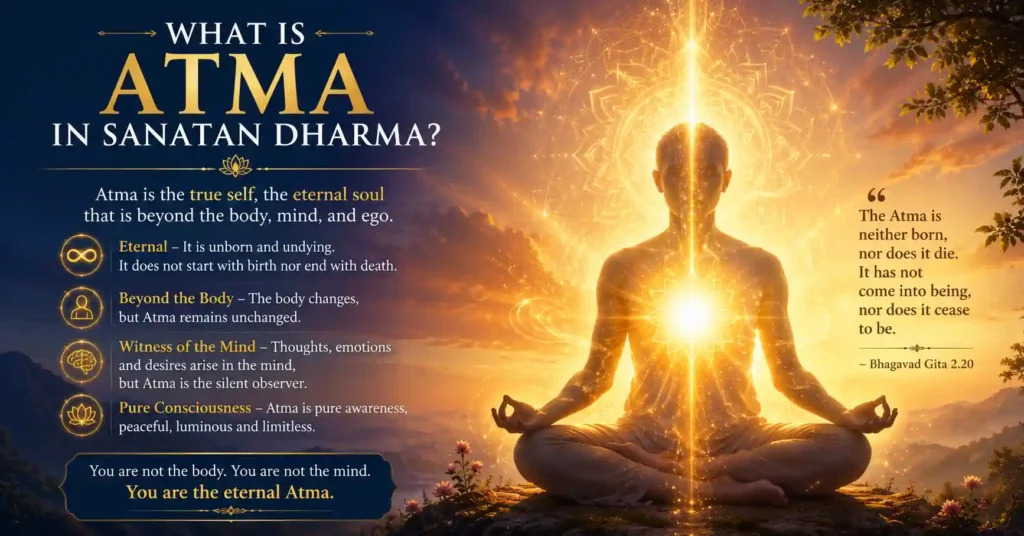
Atma means the true Self or the eternal soul that exists within every living being. In Sanatan Dharma, the Atma is not the physical body, the restless mind, or the personality shaped by thoughts and experiences. It is the unchanging awareness that remains the same throughout life.
The body grows, ages, and eventually perishes. The mind keeps changing with emotions, desires, and memories. The Atma, however, remains eternal, pure, and untouched by these changes. It is the silent witness that observes every experience without being affected by it.
The Bhagavad Gita explains that the Atma is never born and never dies. It cannot be cut by weapons, burned by fire, drenched by water, or dried by the wind. While the body changes, the Atma continues its journey beyond birth and death.
Understanding the Atma changes the way we see ourselves. Instead of identifying only with the body or the mind, we begin to recognize our eternal nature. This awareness brings inner strength, reduces fear, and helps us face life’s ups and downs with greater peace and balance.
Key Characteristics of Atma
| Characteristic | Meaning |
|---|---|
| Eternal | Exists beyond birth and death. |
| Pure | Free from sin, impurity, and worldly changes. |
| Unchanging | Remains the same despite changes in the body and mind. |
| Conscious | The source of awareness and life. |
| Witness | Observes thoughts, emotions, and actions without attachment. |
What Is Parmatma, the Supreme Reality?
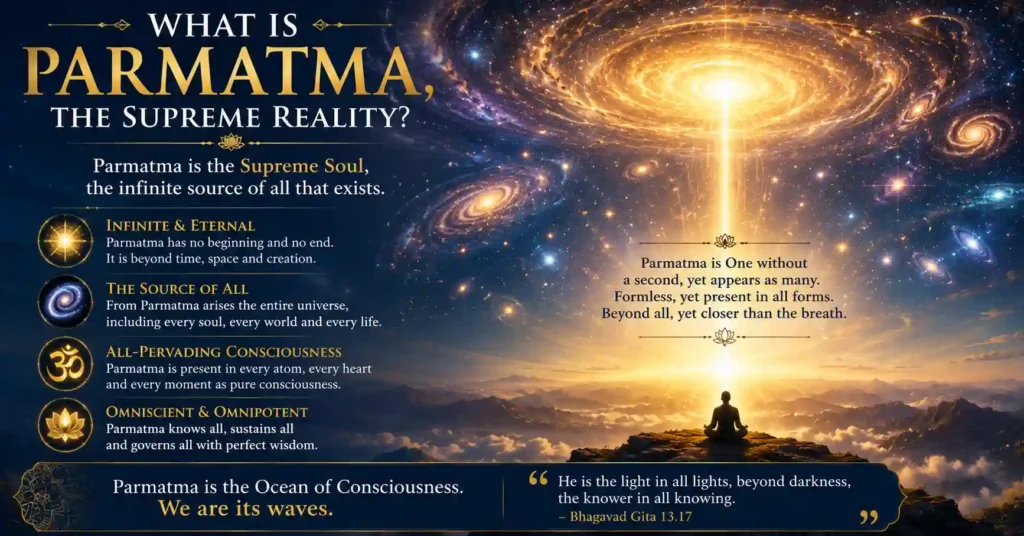
Parmatma is the Supreme Consciousness and the ultimate reality from which all creation originates and into which everything ultimately returns. In Sanatan Dharma, Parmatma is eternal, infinite, and present in every living being and every part of the universe.
If Atma is the individual soul that experiences life through one body, Parmatma is the universal consciousness that pervades all beings. While each Atma appears separate, every soul exists because of the presence of the Supreme.
Sanatan Dharma describes Parmatma in different ways to suit different spiritual paths. Some devotees worship Parmatma as a personal God with divine form and qualities, while others meditate upon the Supreme as the formless, limitless truth known as Brahman.
Both approaches are accepted because the Supreme cannot be confined to a single image, name, or description. Whether worshipped with form or realized as the formless Absolute, Parmatma remains the same eternal reality beyond human understanding.
Recognizing Parmatma as the source of all life inspires humility, compassion, and devotion. It reminds us that the same divine presence exists within ourselves and every living being.
Different Ways Sanatan Dharma Describes Parmatma
| Perspective | Description |
|---|---|
| With-Form (Saguna) | Worshipped as the personal God with divine qualities and forms. |
| Formless (Nirguna) | Realized as the infinite, formless Brahman beyond all attributes. |
| Universal Presence | Exists in every being and throughout the entire universe. |
| Supreme Reality | The eternal source, sustainer, and ultimate goal of all existence. |
Atma, Jivatma and Parmatma: Understanding the Difference
Many people use the terms Atma, Jivatma, and Parmatma interchangeably, but they have distinct meanings in Sanatan Dharma. Understanding these differences makes it easier to grasp the teachings of the Bhagavad Gita, the Upanishads, and Vedanta.
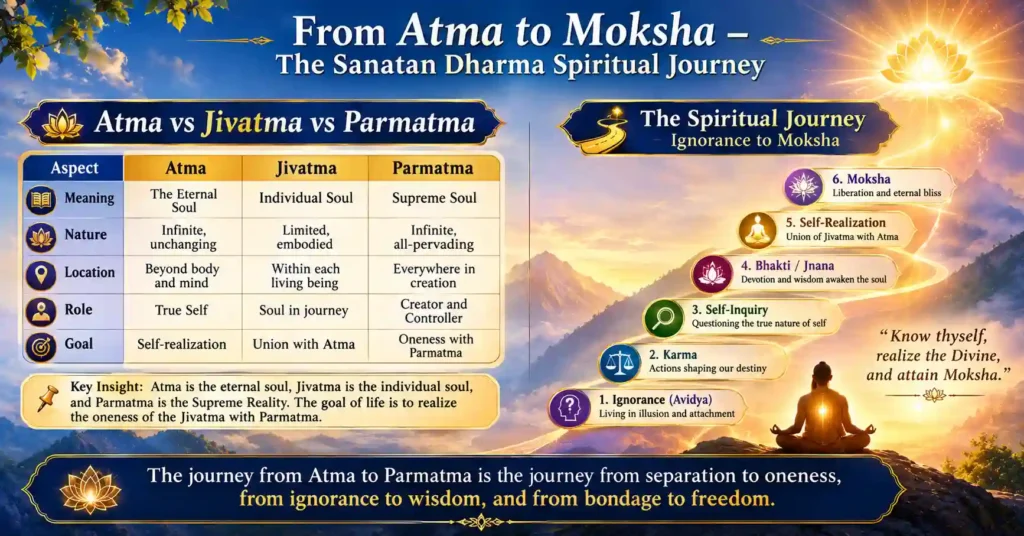
| Aspect | Atma | Jivatma | Parmatma |
|---|---|---|---|
| Meaning | The eternal true Self or soul. | The individual soul associated with a living being. | The Supreme Soul or Supreme Consciousness. |
| Nature | Eternal, pure, and unchanging. | The Atma identified with the body, mind, and ego due to Avidya (ignorance). | Infinite, all-pervading, and the source of all creation. |
| Role | The true spiritual identity of every being. | Experiences birth, death, karma, and rebirth in the material world. | Sustains, guides, and exists within all beings and the entire universe. |
| Affected by Karma? | No. The Atma remains untouched by actions. | Yes. The Jivatma experiences the results of karma until liberation. | No. Parmatma is beyond karma and all worldly limitations. |
| Ultimate Goal | To realize its eternal nature. | To overcome ignorance and attain Moksha. | To guide all souls towards spiritual realization and liberation. |
Although these terms are closely related, they describe different aspects of spiritual reality. Understanding the distinction between Atma, Jivatma, and Parmatma helps remove confusion and provides a stronger foundation for understanding self-realization, Karma, and Moksha in Sanatan Dharma.
How Are Atma and Parmatma Related?
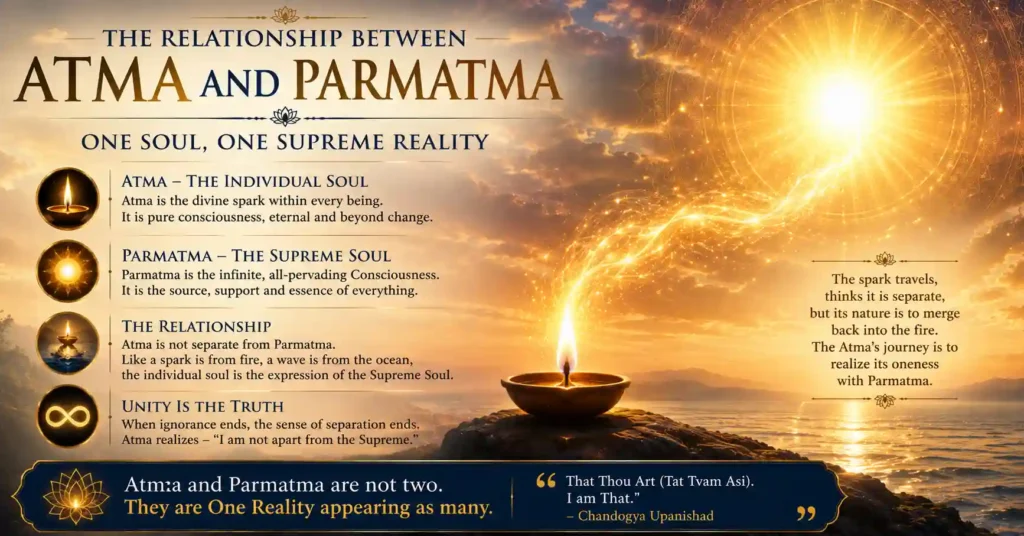
In simple words, Atma is the individual soul, while Parmatma is the Supreme Soul or Supreme Consciousness. Understanding the relationship between them is one of the central teachings of Sanatan Dharma.
The relationship between Atma and Parmatma is not about physical distance. It is about realizing our true spiritual nature. When the mind becomes calm through self-reflection, devotion, or meditation, a person begins to experience an inner peace that does not depend on external circumstances. This peace is a glimpse of the soul’s connection with the Supreme.
Different schools of Vedanta explain this relationship in different ways. Advaita Vedanta teaches that Atma and Parmatma are ultimately one reality. Vishishtadvaita explains that the individual soul is inseparably connected to the Supreme while remaining distinct. Dvaita Vedanta teaches that the soul and the Supreme are eternally different but united through devotion.
A simple analogy is that of the sun and its rays. The rays shine because of the sun, yet the sun remains the source. Similarly, the Atma exists because of Parmatma and depends upon the Supreme for its existence.
The purpose of spiritual life is not to become something new, but to realize our true relationship with the Supreme. As ignorance fades, the soul naturally experiences greater peace, wisdom, and devotion.
Different Vedanta Views on Atma and Parmatma
| School-of Vedanta | Relationship |
|---|---|
| Advaita | Atma and Parmatma are ultimately one reality. |
| Vishishtadvaita | The soul is part of the Supreme but retains its individuality. |
| Dvaita | Atma and Parmatma are eternally distinct, connected through devotion. |
Did You Know?
According to Sanatan Dharma, the Atma is eternal. It is never created and never destroyed, while the body is temporary.
The purpose of spiritual life is not to create the soul, but to recognize its true nature and its eternal relationship with Parmatma.
What Do the Bhagavad Gita and Upanishads Teach About Atma and Parmatma?
The concepts of Atma and Parmatma are not based on philosophical ideas alone. They are deeply rooted in the sacred scriptures of Sanatan Dharma, especially the Bhagavad Gita and the principal Upanishads.
In the Bhagavad Gita, Lord Krishna explains that the Atma is eternal, unborn, and indestructible. While the body undergoes birth, growth, old age, and death, the Atma remains unchanged. This understanding removes the fear of death and helps a person perform their duties with courage and wisdom.
The Upanishads describe Parmatma as the Supreme Reality that exists within every being and throughout the universe. They encourage seekers to look within through self-inquiry, meditation, and spiritual knowledge rather than searching for the Divine only in the external world.
One of the most well-known Upanishadic teachings is “Tat Tvam Asi” (That Thou Art). It reminds the seeker that the same divine reality which sustains the universe is also present within every individual.
Together, the Bhagavad Gita and the Upanishads teach that the purpose of human life is to realize the true nature of the Atma, understand its relationship with Parmatma, and progress towards Moksha through righteous living, devotion, selfless action, and spiritual wisdom.
Key Scriptural Teachings
- Bhagavad Gita: The Atma is eternal and cannot be destroyed.
- Upanishads: Parmatma is the infinite reality present everywhere.
- Tat Tvam Asi: The Divine exists within every being.
- Ultimate Goal: Self-realization and Moksha through spiritual knowledge, Dharma, Karma Yoga, and Bhakti.
Why Do We Feel Separate from Parmatma?
If the unity between Atma and Parmatma is real, why do we often feel lonely, fearful, and disconnected from the Divine?
According to Sanatan Dharma, the answer lies in Avidya, or spiritual ignorance. From childhood, we learn to identify ourselves with the body, name, family, profession, and social roles. Over time, we forget our true identity as the eternal Atma.
This false identification gives rise to the ego. Here, ego does not simply mean pride or arrogance. It is the mistaken belief that we are only the body and the mind. As a result, we begin to feel limited, vulnerable, and separate from others and from Parmatma.
From this sense of separation arise many fears, including the fear of loss, failure, rejection, and death. The more we identify with temporary things, the more these fears grow.
Sanatan Dharma does not judge this condition. It sees it as a natural stage in the soul’s journey. Through self-inquiry, devotion, right action, and spiritual knowledge, this ignorance gradually fades, allowing the Atma to recognize its eternal relationship with Parmatma.
How the Sense of Separation Develops
| Cause | Result |
|---|---|
| Identifying with the body | Fear of aging and death |
| Attachment to possessions and relationships | Fear of loss |
| Ego and false identity | Feeling separate from others and the Divine |
| Spiritual ignorance (Avidya) | Forgetting one’s true nature as the Atma |
Sanatan Dharma Teaches Self-Realization, Not Fear
Sanatan Dharma teaches that the purpose of spiritual life is to realize our true nature and our relationship with Parmatma. It encourages understanding, self-inquiry, and personal experience rather than blind acceptance.
The scriptures invite every seeker to ask questions, reflect deeply, and gain wisdom through study, meditation, devotion, and righteous living. Spiritual growth comes from inner transformation, not from fear.
The goal of life is not to escape the world but to live in it with awareness, compassion, and Dharma. As the feeling of separation gradually fades, our thoughts, words, and actions become more balanced and selfless.
When we begin to recognize the same divine presence in ourselves and others, devotion becomes an expression of love rather than obligation. Duty becomes selfless service, and everyday life itself becomes a path toward spiritual growth.
What This Understanding Brings
| Realization | Positive Change |
|---|---|
| Knowing the true Self | Greater inner peace and confidence |
| Seeing Parmatma in all beings | Compassion and respect for others |
| Living according to Dharma | Selfless actions and responsible living |
| Practising devotion with understanding | Love instead of fear or obligation |
How Does One Realize the Atma?
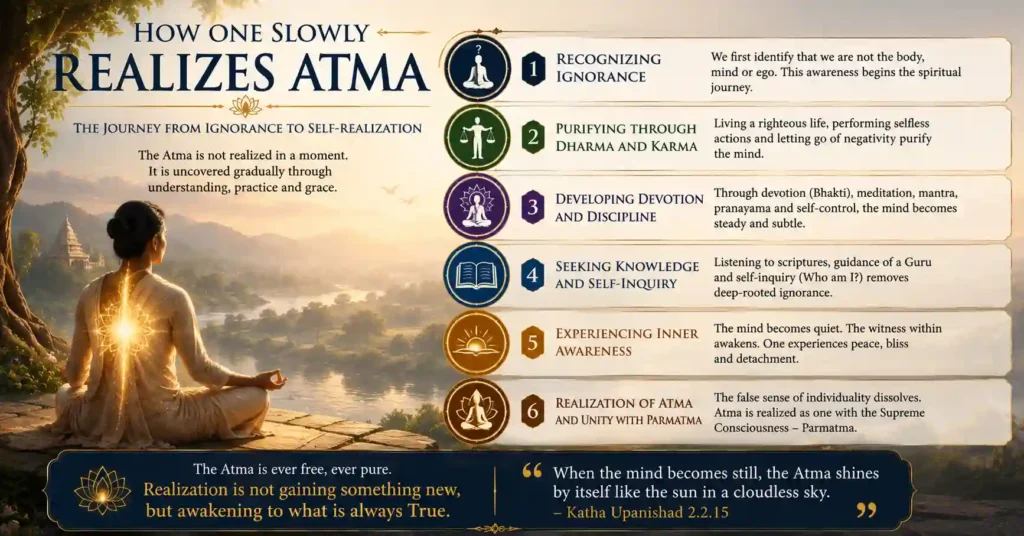
Realizing the Atma is not usually a sudden event. For most people, it is a gradual journey of inner growth, self-discovery, and spiritual practice. As the mind becomes calmer and the heart becomes purer, the soul’s true nature is revealed.
This realization begins with small but meaningful steps. Spending a few moments in silence, performing daily duties without attachment to results, practising devotion, and reflecting on spiritual teachings gradually transform the mind and bring greater inner peace.
Sanatan Dharma recognizes that every seeker is different. Therefore, it offers several paths to realize the Atma and deepen one’s connection with Parmatma. These paths may be followed individually or together, depending on one’s nature.
Four Traditional Paths to Self-Realization
| Path | Focus |
|---|---|
| Jnana Yoga | Self-inquiry and spiritual knowledge |
| Bhakti Yoga | Devotion and loving surrender to the Divine |
| Karma Yoga | Selfless action without attachment to results |
| Raja Yoga | Meditation, discipline, and control of the mind |
No single path is considered suitable for everyone. What matters most is sincerity, regular practice, and a genuine desire to know one’s true Self. With patience and perseverance, the journey toward realizing the Atma naturally unfolds.
The Role of Karma in Realizing the Atma
Karma plays an important role in the journey of realizing the Atma. In Sanatan Dharma, every action leaves an impression on the mind. Actions performed with selfish desires and attachment strengthen the ego, while selfless actions help purify the mind.
The Bhagavad Gita teaches the principle of Nishkama Karma, performing one’s duties without attachment to the results. When actions are done with sincerity, responsibility, and without excessive expectation, the mind becomes calmer and lighter.
A peaceful mind reflects the true nature of the Atma more clearly. As attachment, pride, and selfishness gradually reduce, inner wisdom begins to shine, helping a person recognize their eternal connection with Parmatma.
Karma is not a system of reward and punishment. It is a law of cause and effect that helps the soul learn, grow, and evolve through experience. Every action becomes an opportunity for spiritual progress when performed with awareness and the right intention.
Practising Karma Yoga helps you
- Reduce attachment to success and failure.
- Purify the mind through selfless actions.
- Perform your duties sincerely instead of acting from selfish motives.
- Develop humility by reducing ego and pride.
- Progress towards self-realization through right action and awareness.
This way, Karma becomes more than action. It becomes a spiritual path that prepares the mind to realize the Atma and deepen one’s connection with Parmatma.
How Atma and Parmatma Transform Daily Life
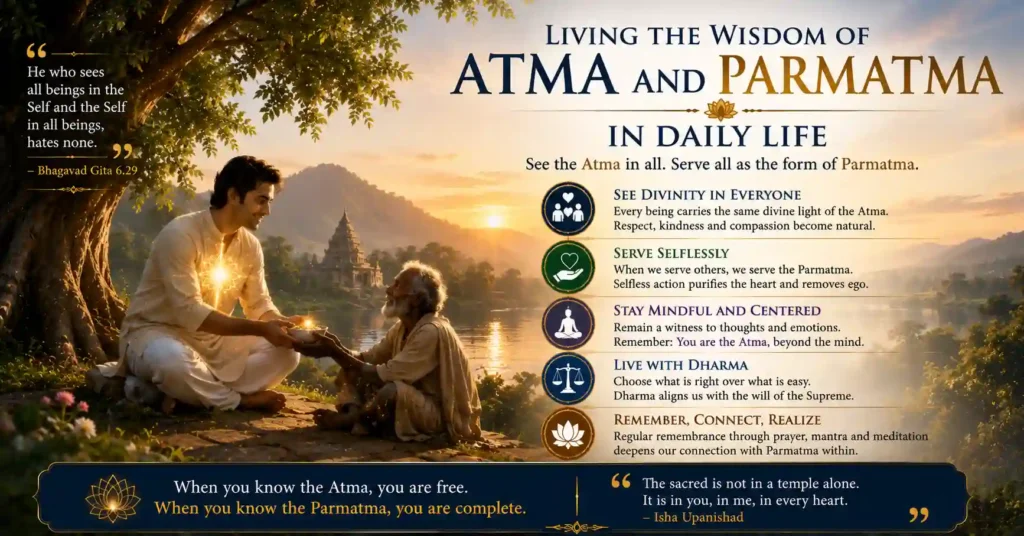
The wisdom of Atma and Parmatma is not meant to remain in scriptures or philosophical discussions. Its true purpose is to transform the way we think, act, and respond in everyday life.
When a person understands that they are the Atma, they no longer identify only with the body or the ego. Insults lose their sharpness, praise no longer creates pride, and the fear of death gradually begins to fade because the soul is eternal.
Recognizing Parmatma in every living being naturally develops compassion, patience, and respect. Even during disagreements, we become less judgmental and more understanding, knowing that the same divine presence exists in everyone.
This wisdom also influences daily decisions. It encourages us to perform our duties honestly, forgive more easily, remain calm during difficulties, and serve others without selfish motives. Problems still arise, but they no longer define our inner peace or our true identity.
Living the Wisdom of Atma and Parmatma
- Face criticism with calmness instead of reacting with anger.
- Remain humble in success without allowing praise to strengthen the ego.
- Accept loss with inner strength, knowing that everything in the material world is temporary.
- Treat every person with compassion and respect, seeing the presence of Parmatma in all beings.
- Make decisions based on Dharma rather than selfish desires or temporary emotions.
- Perform your daily duties sincerely without attachment to rewards or recognition.
This understanding gradually transforms ordinary life into a spiritual journey, where every thought, action, and relationship becomes an opportunity to grow closer to Parmatma.
The Role of Devotion in Realizing Atma and Parmatma
Devotion, or Bhakti, is often misunderstood as blind faith. In Sanatan Dharma, true devotion is a loving relationship with the Divine based on trust, surrender, and personal experience. It brings the heart closer to Parmatma while helping the seeker discover the true nature of the Atma.
When love is directed towards the Divine, the heart gradually becomes free from selfishness, anger, and pride. This inner purity makes it easier to understand spiritual truths that cannot be realized through logic alone.
Sanatan Dharma teaches that Bhakti Yoga and Jnana Yoga complement each other. Knowledge removes ignorance, while devotion fills the heart with humility, gratitude, and compassion. Together, they help the seeker progress towards self-realization.
You can nurture devotion through simple daily practices such as:
- Offering sincere prayers with faith and gratitude.
- Chanting God’s name or mantras to calm the mind.
- Reading sacred scriptures to deepen spiritual understanding.
- Performing selfless service (Seva) without expecting rewards.
- Remembering Parmatma in daily thoughts, words, and actions.
A devoted heart and a clear mind always walk together. As devotion matures, spiritual knowledge becomes a living experience rather than just an intellectual idea.
How Atma and Parmatma Lead to Moksha
Understanding Atma and Parmatma is not merely a philosophical exercise. In Sanatan Dharma, this wisdom ultimately leads the seeker towards Moksha, the highest goal of human life.
Moksha means freedom from ignorance, attachment, and the continuous cycle of birth and death (Samsara). It is attained when a person realizes their true nature as the eternal Atma and develops a deep understanding of their relationship with Parmatma.
Sanatan Dharma explains that this realization does not happen through knowledge alone. It grows through righteous living, selfless action, devotion, meditation, and sincere self-inquiry. As these practices purify the mind, attachment gradually weakens and inner peace naturally increases.
A person moving towards Moksha continues to fulfil worldly responsibilities but is no longer controlled by fear, ego, or excessive desires. Such a life becomes balanced, compassionate, and guided by Dharma.
The journey towards Moksha includes:
- Understanding that the Atma is eternal.
- Recognizing Parmatma as the Supreme Reality.
- Living according to Dharma.
- Practising Karma Yoga without attachment.
- Growing through Bhakti, meditation, and self-inquiry.
- Developing inner peace, wisdom, and compassion.
Each of these steps gradually brings the seeker closer to self-realization and lasting inner freedom.
Moksha is not about escaping the world. It is about living with the wisdom that the eternal Atma is forever connected with Parmatma.
Common Misunderstandings About Atma and Parmatma
Many misconceptions arise because the concepts of Atma and Parmatma are subtle and often misunderstood. Clearing these doubts helps us understand the teachings of Sanatan Dharma more accurately.
Some common misunderstandings include:
- Atma is the same as the thinking mind. It is not. The mind thinks, remembers, and feels emotions, while the Atma is the eternal witness that observes all these experiences.
- Parmatma is distant, watching and judging us. Sanatan Dharma teaches that Parmatma is present within every being and throughout the universe. The Supreme is closer than our own breath.
- Realizing Parmatma means losing your individuality. Spiritual realization does not destroy the soul. It frees us from ignorance, fear, and limited identification with the body and ego.
- Spiritual wisdom is only for monks or renunciates. The teachings of Atma and Parmatma are meant for everyone. A householder can also progress through righteous living, devotion, selfless action, and self-inquiry.
Understanding these truths removes confusion and helps us walk the spiritual path with greater clarity, confidence, and inner peace.
Key Takeaways
- Atma is the eternal soul that exists within every living being.
- Parmatma is the Supreme Soul and the ultimate source of all existence.
- Understanding the relationship between Atma and Parmatma is central to Sanatan Dharma.
- Karma, Bhakti, meditation, and self-inquiry help purify the mind and support self-realization.
- Realizing the Atma gradually reduces fear, ego, and attachment while bringing greater peace and wisdom.
- The ultimate goal is Moksha, liberation through realizing one’s eternal relationship with Parmatma.
Conclusion
The journey of Atma and Parmatma is not about reaching a distant destination. It is about removing the ignorance that hides our true nature and discovering the eternal connection between the individual soul and the Supreme.
As fear gradually gives way to faith, peace naturally grows. As the ego softens, wisdom becomes clearer. And as awareness deepens, life is no longer driven by confusion but guided by inner clarity and purpose.
The Supreme is not waiting somewhere far away. Parmatma is always present, within us, around us, and in every living being. The more we understand this timeless wisdom of Sanatan Dharma, the more we experience compassion, freedom, and lasting inner peace.
The journey begins not by becoming someone new, but by remembering who we have always been, the eternal Atma, forever connected to Parmatma.
Suggested Reading
Understanding Atma and Parmatma becomes even more meaningful when explored alongside other core teachings of Sanatan Dharma. The following articles will help you deepen your understanding of the soul, karma, dharma, detachment, time, and the eternal principles that guide spiritual life.
1. Why Do Hindus Have So Many Gods? The Truth Behind Many Deities in Sanatan Dharma
https://thesanatantales.com/why-do-hindus-have-so-many-gods/
2. Karma: Meaning, Types, Philosophy and How It Works in Sanatan Dharma
https://thesanatantales.com/karma/
3. How to Seek Forgiveness for Unintentional Sins in Sanatan Dharma
https://thesanatantales.com/how-to-seek-forgiveness-for-unintentional-sins/
4. What Is Detachment in Hindu Philosophy? A Powerful Path to Inner Freedom
https://thesanatantales.com/detachment-in-hindu-philosophy/
5. Kaal in Sanatan Dharma: The Eternal Science of Time, Yugas and Cosmic Cycles
https://thesanatantales.com/kaal-in-sanatan-dharma/
6. Sanatan Dharma Meaning: What Is Sanatan Dharma and Its Core Principles
https://thesanatantales.com/sanatan-dharma-meaning/
7. Atma (Wikipedia)
https://en.wikipedia.org/wiki/Atma
FAQs
What Is Atma and Parmatma?
Atma is the eternal soul or true Self that exists within every living being, while Parmatma is the Supreme Soul or Supreme Consciousness that is the source of all creation. In Sanatan Dharma, the Atma is individual, whereas Parmatma is universal and all-pervading.
The Atma does not die when the body dies. It continues its spiritual journey through different births until it attains liberation (Moksha). Parmatma, on the other hand, is eternal, infinite, and beyond birth, death, time, and space.
Although different schools of Vedanta explain their relationship in different ways, all agree that understanding Atma and Parmatma helps a person realize their true nature, live according to Dharma, and move towards lasting peace and self-realization.
What is the difference between Atma and Parmatma?
The main difference between Atma and Parmatma is that Atma is the individual soul present within every living being, while Parmatma is the Supreme Soul or Supreme Consciousness that exists everywhere.
The Atma experiences life through a particular body, whereas Parmatma is beyond all limitations of time, space, and form. Although different schools of Vedanta explain their relationship differently, all agree that Parmatma is the ultimate source of all existence.
Understanding this relationship helps a seeker develop humility, devotion, and a deeper awareness of their true spiritual nature.
What do the Bhagavad Gita and Upanishads say about Atma and Parmatma?
The Bhagavad Gita teaches that the Atma is eternal, unborn, and indestructible. It cannot be destroyed by weapons, fire, water, or wind because it is beyond the physical body.
The Upanishads describe Parmatma as the infinite reality that exists within and beyond the universe. They explain that spiritual wisdom comes from realizing the eternal connection between the individual soul and the Supreme.
Together, these sacred texts form the foundation of Sanatan Dharma’s understanding of Atma and Parmatma.
Can a person realize Atma and Parmatma while living a normal family life?
Yes. Sanatan Dharma teaches that spiritual realization is not limited to monks or renunciates. A householder can also progress on the spiritual path while fulfilling family and social responsibilities.
Living according to Dharma, performing selfless actions, practising devotion, meditating regularly, and studying sacred teachings gradually purify the mind and help one realize the Atma.
What matters most is sincerity, discipline, and a genuine desire to know the truth.
How can I experience the presence of Parmatma in daily life?
The presence of Parmatma is experienced through a purified mind and a compassionate heart rather than through the physical senses alone.
Daily practices such as meditation, prayer, mantra chanting, selfless service, and living according to Dharma gradually reduce mental distractions and increase inner awareness.
As spiritual understanding deepens, many seekers begin to experience greater peace, gratitude, compassion, and a sense of divine presence in everyday life.
Does realizing the Atma mean giving up worldly responsibilities?
No. Sanatan Dharma does not teach that everyone must renounce the world. Instead, it encourages people to perform their duties with honesty, compassion, and without attachment to personal gain.
The Bhagavad Gita explains that spiritual growth comes from living responsibly while maintaining inner detachment. This approach is known as Karma Yoga.
A person can pursue family life, work, and society while continuing their journey toward self-realization.
What is the ultimate goal of understanding Atma and Parmatma?
The ultimate goal is Moksha, or liberation from ignorance and the cycle of birth and death. This is achieved by realizing the true nature of the Atma and its eternal relationship with Parmatma.
As this understanding grows, fear, ego, and attachment gradually decrease. In their place arise inner peace, wisdom, compassion, and freedom.
Sanatan Dharma teaches that this realization is the highest purpose of human life because it leads to lasting spiritual fulfillment rather than temporary worldly happiness.
Glossary of Important Terms
| Term | Meaning |
|---|---|
| Atma | The eternal soul or true Self that exists within every living being. |
| Parmatma | The Supreme Soul or Supreme Consciousness, the source and sustainer of the universe. |
| Jivatma | The individual soul associated with a living being as it experiences birth, life, and death. |
| Brahman | The infinite, formless, absolute reality described in the Upanishads. Many Vedanta traditions identify Brahman as the ultimate truth. |
| Moksha | Liberation from the cycle of birth and death through realization of one’s true spiritual nature. |
| Karma | The universal law of cause and effect, where every action produces corresponding results. |
| Dharma | Righteous living, moral duty, and the principles that uphold harmony and order in life. |
| Bhakti | Loving devotion and surrender to the Divine as a path to spiritual growth. |
| Jnana | Spiritual knowledge and wisdom gained through study, reflection, and self-inquiry. |
| Avidya | Spiritual ignorance that causes a person to identify with the body and mind instead of the eternal Atma. |
| Maya | The cosmic illusion that makes the temporary world appear as the ultimate reality, hiding the true nature of the Atma. |
| Nishkama Karma | Performing one’s duties without attachment to personal gain or the results of actions. |
| Vedanta | A major school of Hindu philosophy based on the Upanishads, Bhagavad Gita, and Brahma Sutras that explains the nature of Atma, Parmatma, and liberation. |
| Self-Realization | The direct realization that one’s true identity is the eternal Atma rather than the physical body or mind. |
About the Author
Yateendra Chaturvedi is a spiritual writer, researcher, devotee, and the founder of The Sanatan Tales. With over 35 years of professional experience and a lifelong interest in Sanatan Dharma, he writes about Hindu deities, temples, scriptures, festivals, Mahavidyas, sacred stories, rituals, and living traditions that continue to guide and inspire devotees across India.
Drawing from traditional scriptures, regional beliefs, temple traditions, devotional literature, and historical sources, he aims to present authentic, well-researched, and easy-to-understand content for modern readers. His work focuses on preserving spiritual wisdom, explaining sacred traditions, and helping seekers develop a deeper understanding of India’s rich spiritual heritage.
Through The Sanatan Tales, Yateendra strives to make the timeless teachings of Sanatan Dharma simple, meaningful, and relevant for today’s generation while maintaining respect for traditional sources, regional practices, and diverse spiritual perspectives.
Learn More About Yateendra Chaturvedi →
https://thesanatantales.com/about-the-author/
References & Sources
This article is based on the teachings of Sanatan Dharma as presented in traditional Hindu scriptures, philosophical texts, and widely accepted spiritual commentaries. It also draws upon established religious traditions and scholarly resources to explain the subject in a simple and easy-to-understand manner.
Note: Interpretations and practices may vary across different schools of thought, traditions, and lineages within Sanatan Dharma. The purpose of this article is not to promote any single viewpoint as the absolute truth, but to present widely accepted spiritual and philosophical perspectives in a balanced and accessible way.
Read More Interesting Articles on Sanatan Dharma