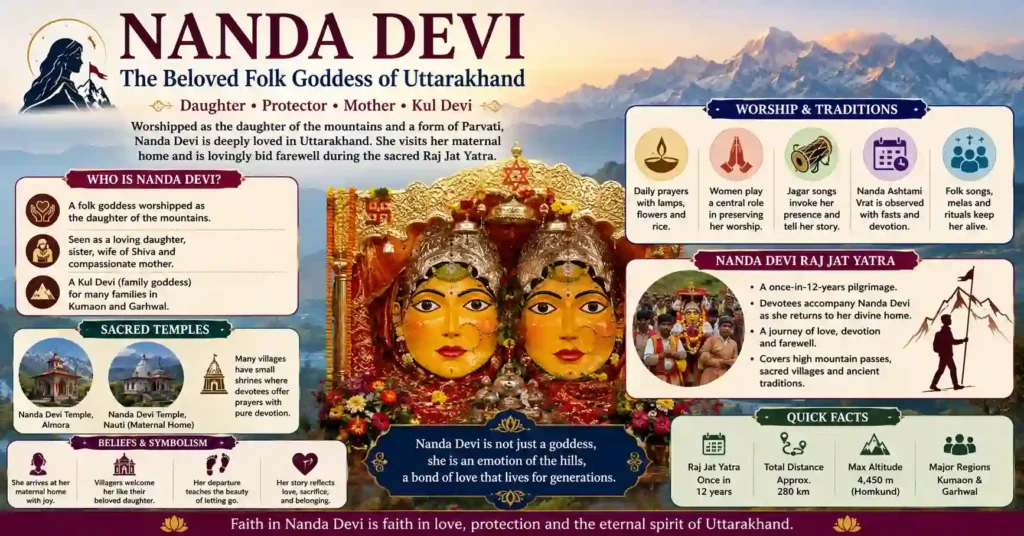
Nanda Devi is much more than a revered goddess in Uttarakhand. She is the beloved daughter of the Himalayas, a family deity for countless households, and a symbol of love, sacrifice, and devotion whose worship has been preserved through generations of living tradition.
In the villages of Kumaon and Garhwal, faith does not exist only inside temples or sacred scriptures. It lives in mountain homes, evening prayers, folk songs, oil lamps glowing at dusk, and stories lovingly passed from grandparents to children. These traditions have kept the goddess close to the hearts of the people for centuries.
Unlike many deities who are worshipped from a distance, she is welcomed as a daughter returning to her maternal home, honoured as a compassionate mother, and remembered with tears during her farewell. This deep emotional bond is reflected in the Nanda Devi Raj Jat Yatra, Nanda Ashtami, village fairs, jagar traditions, and countless local customs that continue to thrive across Uttarakhand.
In this article, you’ll discover the story of Nanda Devi, her connection with Goddess Parvati, the living folk traditions surrounding her worship, sacred temples, Raj Jat Ya
Quick Facts About Nanda Devi
| Aspect | Details |
|---|---|
| Revered As | Beloved Folk Goddess of Uttarakhand and a regional manifestation of Goddess Parvati |
| Primary Regions of Worship | Kumaon and Garhwal, Uttarakhand |
| Major Festival | Nanda Ashtami |
| Famous Pilgrimage | Nanda Devi Raj Jat Yatra (held approximately once every 12 years) |
| Important Temples | Nanda Devi Temple (Almora), Nauti Village Temple, and numerous village shrines across Uttarakhand |
| Associated Deity | Lord Shiva |
| Sacred Role | Daughter of the Himalayas, Kul Devi, Protector of Families and Villages |
| Key Traditions | Jagar, Nanda Devi Mahotsav, Raj Jat Yatra, village fairs, and folk rituals |
| Main Devotees | Communities across Uttarakhand and devotees of the Divine Mother throughout India |
| Core Values | Faith, family, protection, compassion, cultural heritage, and devotion |
Did You Know?
- The Nanda Devi Raj Jat Yatra is often called the Himalayan Kumbh because of its scale, spiritual significance, and the thousands of devotees who participate.
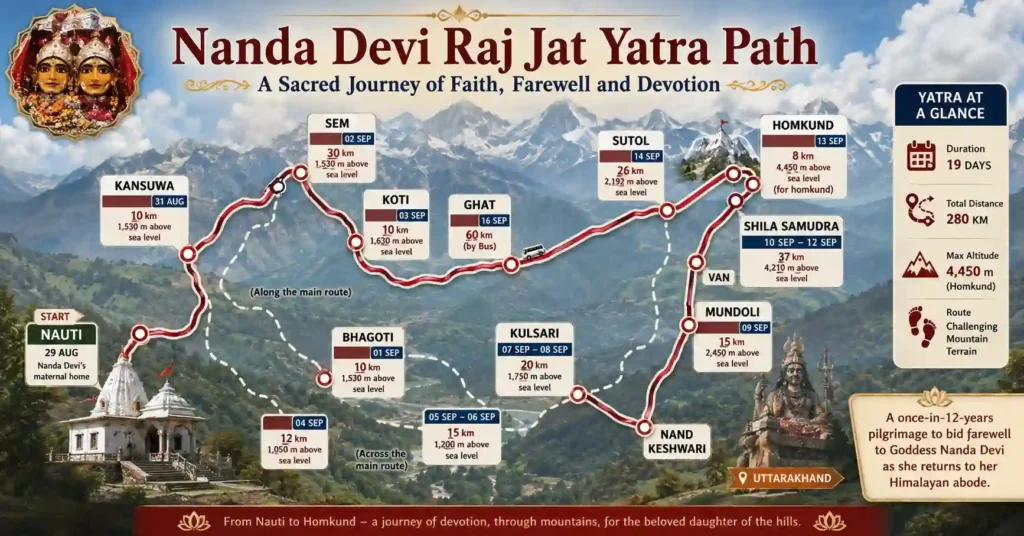
- The pilgrimage traditionally takes place about once every twelve years and covers nearly 280 kilometers through the Himalayan mountains.
- The rare Chausingya Khadu (four-horned ram) traditionally leads the sacred procession and is regarded as an auspicious symbol.
- Many villages in Uttarakhand consider the goddess their Kul Devi and preserve her worship through oral traditions, festivals, and family rituals.
Table of Contents
ToggleWhy She Is the Beloved Folk Goddess of Uttarakhand
In the hill villages of Kumaon and Garhwal, the goddess is not remembered only during festivals or special occasions. She is regarded as a living presence who watches over families, protects villages, and shares in the joys and sorrows of everyday life.
Many devotees believe her presence can be felt in the changing seasons, the flowing mountain streams, the peaceful silence of the forests, and moments of heartfelt prayer. This deep connection makes her an inseparable part of village life.
Children grow up listening to her stories from their grandparents, while mothers and grandmothers preserve her memory through evening prayers, folk songs, and traditional rituals. These living traditions have been passed down orally for centuries and continue to shape Uttarakhand’s cultural identity.
Unlike many deities who are approached mainly through elaborate rituals, she is loved as a daughter returning to her maternal home, a compassionate mother who protects her children, and a family guardian who understands human emotions. Devotees speak to her with affection rather than fear, believing that sincere devotion is more important than grand offerings.
This emotional bond is what makes her one of the most cherished folk deities of Uttarakhand. It also explains why traditions such as Nanda Ashtami, the Raj Jat Yatra, and the sacred Jagar continue to keep her worship alive across generations.
Origins of Her Worship in Uttarakhand
The worship of the goddess in Uttarakhand has its roots in living folk traditions that have been preserved for centuries. Long before these beliefs were documented, they were passed from one generation to the next through stories, songs, seasonal festivals, and community rituals.
Village elders, priests, and folk singers played an important role in preserving these traditions. They shared local legends, recited sacred narratives during gatherings, and kept the memory of the goddess alive through oral storytelling rather than written records.
For many hill families, devotion began with personal faith and lived experience. People believed she protected their homes, blessed their harvests, and guided them through difficult times. This deep trust gradually gave shape to local customs, annual fairs, fasting traditions, and sacred pilgrimages.
As these practices continued across generations, they became an integral part of the spiritual and cultural life of Kumaon and Garhwal. Over time, this rich folk tradition blended naturally with the broader traditions of Sanatan Dharma, where local deities have long been revered alongside the major forms of the Divine.
The Goddess as Daughter, Bride, and Mother in Folk Belief
At the heart of this living tradition is a deeply emotional story that has been cherished by the people of Uttarakhand for generations. The goddess is believed to have been born in the Himalayan mountains, lovingly raised by her parents, and later married to Lord Shiva, who resides in the high peaks of Kailash.
After her marriage, she leaves her maternal home like every daughter, yet her bond with the mountains never fades. Folk traditions say that she returns from time to time to visit her people, who welcome her with love, devotion, and heartfelt celebration.
During her arrival, villages come alive with joy. Homes are cleaned, temples are decorated, lamps are lit, and women sing traditional welcome songs that have echoed through the hills for centuries. These rituals are expressions of affection, reflecting the belief that a beloved daughter has come home.
Her departure is equally emotional. As she begins her symbolic journey back to her husband’s abode, devotees bid her farewell with prayers, songs, and tears. The sadness is not born of fear but of the natural emotions that accompany the departure of a cherished daughter.
This beautiful cycle of arrival and farewell forms the spiritual heart of many local festivals, especially the Raj Jat Yatra and Nanda Ashtami celebrations. More than rituals, these traditions express the values of love, family, belonging, and devotion that continue to define the cultural identity of Uttarakhand.
Sacred Temples Dedicated to the Goddess
Although much of her worship takes place inside homes and village shrines, a few temples hold a special place in the hearts of devotees. These sacred sites are not only places of prayer but also centers where centuries-old traditions, festivals, and community gatherings continue to thrive.
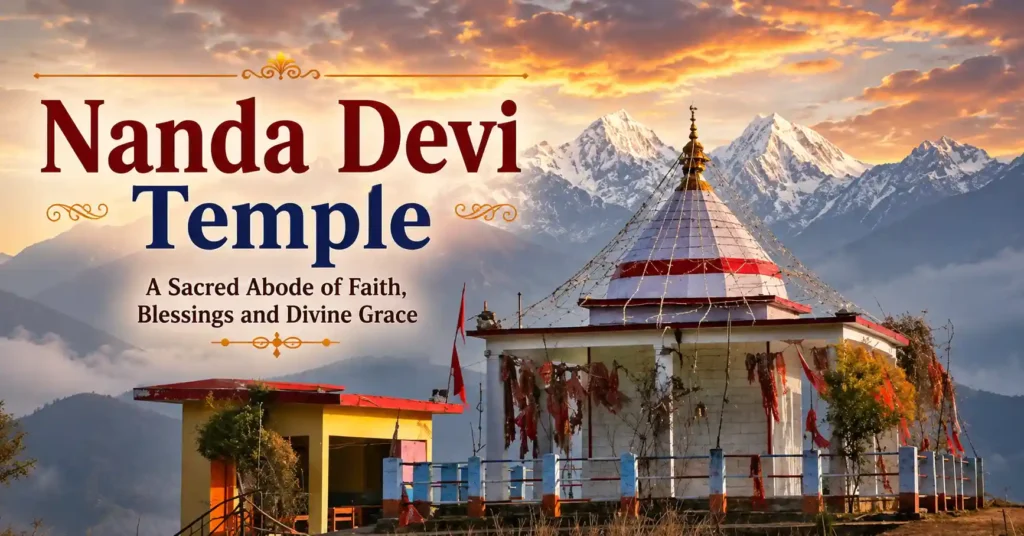
The Nanda Devi Temple in Almora is one of the most revered shrines dedicated to the goddess. Devotees visit throughout the year to offer prayers, seek blessings, and participate in the famous Nanda Devi Mahotsav, a festival that reflects the region’s deep cultural and spiritual heritage.
Another highly sacred shrine is the Nanda Devi Temple in Nauti Village, Chamoli. According to local tradition, Nauti is regarded as the goddess’s maternal home, making it the spiritual starting point of the Raj Jat Yatra. During this pilgrimage, the village becomes the center of devotion as thousands gather to bid her a symbolic farewell.
Beyond these well-known temples, countless villages across Kumaon and Garhwal have small shrines dedicated to the goddess. Though simple in appearance, these sacred spaces remain the heart of community worship, where daily prayers, seasonal festivals, and age-old customs continue to keep the tradition alive.
Together, these temples reflect a unique aspect of Uttarakhand’s spiritual culture. They are valued not for their size or grandeur but for the enduring faith, memories, and emotional connection they inspire among generations of devotees.
Most temples dedicated to the goddess are community-managed rather than monumental complexes, reflecting the intimate nature of Himalayan folk worship.
Symbols Associated with Nanda Devi Worship
Like many sacred traditions in Sanatan Dharma, the worship of Nanda Devi is enriched by symbols that carry deep spiritual and cultural meaning. These symbols are not merely decorative but represent devotion, protection, purity, and the close relationship between the goddess and her devotees.
During festivals and the Raj Jat Yatra, offerings such as flowers, traditional ornaments, sacred cloth, grains, and lamps are presented with reverence. In many villages, beautifully decorated palanquins (dolis) carrying the goddess are central to community processions, reflecting the belief that she visits and blesses her devotees.
One of the most distinctive symbols associated with the Raj Jat Yatra is the Chausingya Khadu, the rare four-horned ram that traditionally leads the pilgrimage. Devotees regard it as an auspicious sign and a sacred guide chosen for the journey to Homkund.
Together, these sacred symbols remind devotees that faith is expressed not only through prayers but also through meaningful traditions that have been preserved across generations.
Daily Worship and Simple Puja Rituals
The worship of the goddess is simple, heartfelt, and deeply rooted in everyday life. Devotees do not believe that elaborate rituals are necessary to express their faith. Instead, they offer prayers with love, humility, and gratitude.
In many homes, worship begins by lighting an oil lamp and offering fresh flowers, rice, turmeric, vermilion, or homemade sweets. Families often recite simple prayers or sing traditional folk hymns in their local language, creating a warm and personal atmosphere of devotion.
Unlike practices governed by strict ritual procedures, these traditions place greater importance on sincere faith than on perfection. Devotees believe that a pure heart and genuine devotion are more valuable than grand ceremonies or costly offerings.
This simplicity has helped preserve the tradition across generations. Whether in a village shrine, a family home, or during a community festival, the goddess continues to be worshipped with the same affection, making her an inseparable part of daily life in Uttarakhand.
Role of Women in Preserving This Sacred Tradition
Women have played a central role in preserving this sacred tradition across generations. Mothers, daughters, and grandmothers pass down the goddess’s stories through prayers, fasting, folk songs, and everyday conversations, ensuring that each generation grows up with a deep sense of devotion.
In many households and villages, women lead family rituals, prepare offerings, and teach children the customs associated with festivals and community worship. Their participation keeps these traditions alive not only in temples but also within the home.
Many devotees see their own lives reflected in the goddess’s journey as a beloved daughter who leaves her maternal home after marriage yet remains emotionally connected to her family. This shared experience gives her story a deeply personal meaning, especially for women across the Himalayan region.
Through their devotion and dedication, generations of women have helped preserve these living traditions. Their role has ensured that the values of faith, family, compassion, and cultural heritage continue to flourish in the villages of Uttarakhand.
Jagar: Invoking the Goddess Through Sacred Folk Songs
In Uttarakhand, Jagar is a sacred folk ritual performed to invoke the blessings of local deities and ancestral spirits through devotional music and prayer. More than a ceremony, it is a living tradition that preserves the region’s spiritual heritage, oral history, and collective memory.
During a Jagar, folk singers recount the goddess’s birth, her sacred journeys, her joyful return to her maternal home, and the sorrow of her farewell. These stories are carried through rhythmic singing, traditional instruments, and generations of oral tradition.
As night falls, oil lamps glow softly while the steady rhythm of the dhol and damau echoes through the hills. The devotional songs rise and fall like mountain winds, creating an atmosphere of reverence that draws the community together in prayer.
Many devotees believe these sacred nights bring them closer to the goddess’s presence. For them, Jagar is not simply a performance but an act of heartfelt devotion, where faith, music, and tradition become one.
Nanda Ashtami: The Most Important Festival Dedicated to the Goddess
Nanda Ashtami, also known as Nandashtami Vrat, is one of the most sacred festivals celebrated in honour of the goddess across Uttarakhand. Observed during the month of Bhadrapada (August-September), the festival reflects the deep emotional bond between the people and their beloved daughter of the Himalayas.
On this auspicious day, many devotees, especially women, observe a fast and offer prayers for the well-being, happiness, and prosperity of their families. Homes and village temples are cleaned and decorated, oil lamps are lit, and traditional offerings are made with devotion.
In several towns and villages, the festival is marked by devotional singing, community prayers, and local fairs. Families gather to remember the goddess through folk traditions that have been preserved for generations, strengthening both spiritual faith and community bonds.
Even in places where large processions or annual fairs are not organised, Nandashtami Vrat continues to keep this living tradition alive. Its simplicity allows every household to participate, ensuring that the devotion is passed from one generation to the next.
How Nanda Devi Is Celebrated Across Uttarakhand
Although the devotion to Nanda Devi is shared across Uttarakhand, the way she is worshipped varies from one region to another. Every village and temple preserves its own customs while honoring the same Divine Mother with faith and reverence.
In Kumaon, devotees celebrate the goddess with colourful fairs, temple processions, folk dances, devotional singing, and community gatherings. The famous Nanda Devi Mahotsav of Almora is one of the region’s most cherished cultural and religious celebrations, drawing thousands of devotees every year.
In Garhwal, worship is closely associated with ancient village traditions and the sacred Raj Jat Yatra. Many communities organize special prayers, offer traditional bhog, sing Jagar, and participate in rituals that have been preserved for generations.
Despite these regional differences, the spirit of the celebration remains the same. Whether in a large temple or a small Himalayan village, devotees express gratitude, seek blessings for their families, and celebrate the enduring bond between the goddess and the people of Uttarakhand.
Raj Jat Yatra: A Sacred Farewell Through the Himalayas
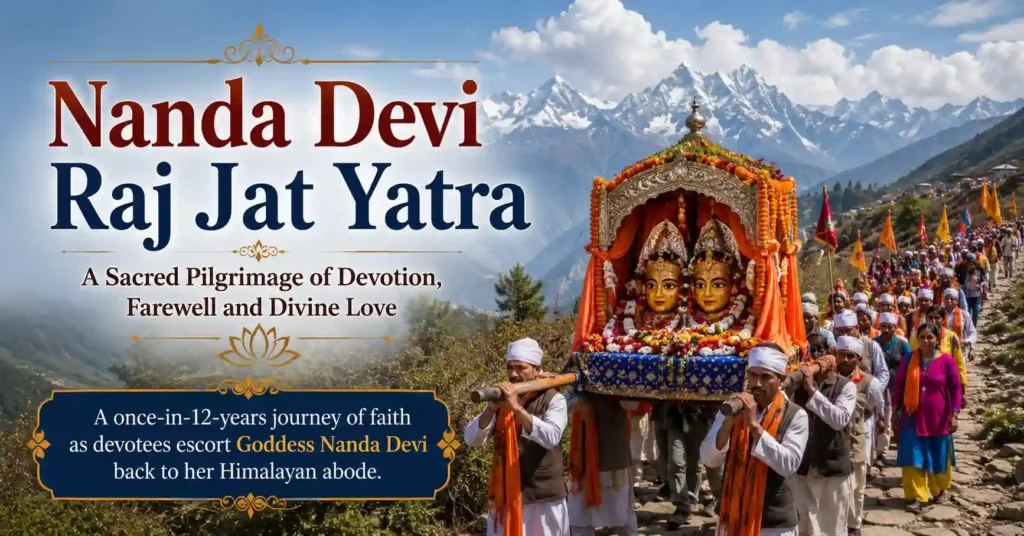
The Raj Jat Yatra is regarded as one of the most sacred pilgrimages of Uttarakhand. In local tradition, it is not viewed as a journey of physical endurance but as a deeply emotional farewell, where devotees accompany the goddess as she symbolically returns to her divine abode after visiting her maternal home.
Beginning from Nauti Village, the pilgrimage passes through remote Himalayan landscapes, ancient villages, alpine meadows, and high mountain trails. Every step is seen as an act of devotion, reminding pilgrims of the enduring bond between the people and their beloved goddess.
Along the route, moments of complete silence often replace conversation, broken only by footsteps, devotional chants, and quiet prayers. Faces may show exhaustion, yet the spirit of the pilgrims remains unwavering as they continue their sacred journey with faith and humility.
Many devotees walk with folded hands and tearful eyes, believing they are offering a heartfelt farewell to a beloved daughter. For them, the pilgrimage is not merely a religious procession but a profound expression of love, gratitude, and surrender that has united communities across generations.
The Spiritual Meaning of Arrival and Farewell
One of the most profound teachings of this living tradition is the acceptance of separation as a natural part of life. Folk belief reminds devotees that true love is not measured by holding on but by knowing when to let go with faith, dignity, and hope.
The goddess’s arrival fills villages with joy, celebration, and togetherness. Her farewell, however, is equally sacred, symbolising the belief that every meeting and every parting has its place in the divine order of life.
This message reflects the experiences of countless families. Children grow up and leave their parental homes, daughters begin new chapters after marriage, and loved ones sometimes part, yet the bonds of love and remembrance remain unbroken.
For many devotees, these traditions offer more than religious rituals. They provide comfort during life’s changes, teaching that love, faith, and cherished memories continue to live in the heart even after physical separation.
Nanda Devi Mela: A Celebration of Faith and Community
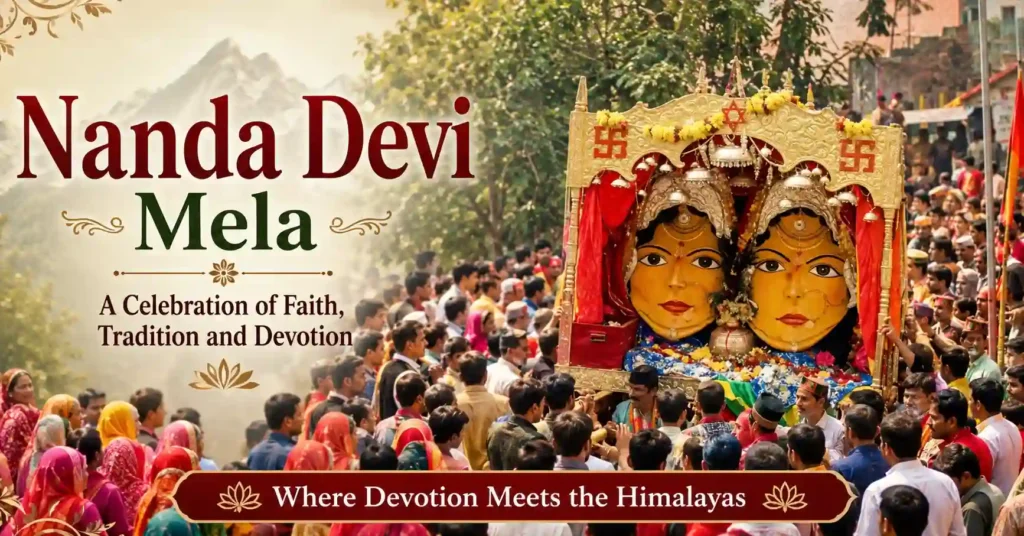
The Nanda Devi Mela is one of the most cherished cultural and religious celebrations in Uttarakhand. Held in several towns and villages, especially Almora, it brings together devotees, local communities, and visitors to honour the goddess through shared faith and tradition.
During the festival, temples are beautifully decorated, devotional songs fill the air, and families gather to offer prayers with love and gratitude. Traditional music, folk performances, and community gatherings create an atmosphere that reflects the rich cultural heritage of the Himalayan region.
For many people, the mela is more than an annual celebration. It is an opportunity to reconnect with their roots, renew family traditions, and pass on stories and customs to the younger generation.
Year after year, these gatherings strengthen the bonds between faith, culture, and community. They remind devotees that living traditions continue to flourish when they are celebrated together and shared across generations.
Why Many Hill Families Revere Her as Their Kul Devi
For many families across Kumaon and Garhwal, the goddess is revered as their Kul Devi, or family deity. Her worship is not adopted later in life but inherited through generations, becoming an integral part of a family’s spiritual identity and traditions.
Devotion begins at home, where children learn family customs from their parents and grandparents. Important occasions such as births, marriages, housewarming ceremonies, and other milestones are often marked with prayers seeking the blessings of the family’s presiding deity.
Many families also make personal vows as an expression of gratitude or faith. These traditions strengthen the emotional bond between generations, ensuring that the family’s devotion continues even as lifestyles and circumstances change.
Today, many people from Uttarakhand live in different parts of India and abroad, yet they continue to remember their Kul Devi through annual prayers, family gatherings, and visits to their ancestral villages whenever possible. This enduring connection has helped preserve the tradition far beyond the Himalayan region.
What Blessings Do Devotees Seek from Nanda Devi?
Devotees turn to Nanda Devi with prayers for peace, protection, prosperity, and the well-being of their families. In the Himalayan tradition, she is regarded as a compassionate mother who watches over her devotees and offers strength during life’s challenges.
Many people seek her blessings before important milestones such as marriages, the birth of a child, the beginning of a new home, or other significant family occasions. Farmers and villagers also pray for good harvests, harmony, and protection from natural hardships, reflecting the close relationship between the goddess and daily life in the mountains.
Rather than focusing only on material wishes, her worship also inspires devotees to cultivate humility, gratitude, compassion, and faith. These timeless values have remained at the heart of her worship for generations and continue to guide families today.
Connection with Goddess Parvati and Lord Shiva
In the broader traditions of Sanatan Dharma, the goddess is widely regarded as a regional manifestation of Goddess Parvati, the divine consort of Lord Shiva. This understanding beautifully connects the living folk traditions of Uttarakhand with the larger spiritual heritage of Hinduism.
At the same time, local devotion gives her a unique identity. In the villages of Kumaon and Garhwal, she is lovingly remembered as a daughter of the Himalayas, whose annual visits and symbolic farewell reflect the emotions of family life rather than distant divinity.
For many devotees, these two forms exist in harmony. They honour her as the compassionate Mother Goddess worshipped across Sanatan Dharma while also cherishing her as their own daughter, protector, and family deity. One tradition enriches the other without diminishing its unique character.
This beautiful blend of folk belief and spiritual philosophy is one of the reasons her worship has remained meaningful across generations. It allows local customs to flourish while staying deeply connected to the timeless traditions of Sanatan Dharma.
How Folk Worship Reflects a Different Expression of Shakti
Within the broader traditions of Sanatan Dharma, the goddess is revered as a manifestation of Shakti, the Divine Mother who embodies strength, compassion, wisdom, and protection. In the folk traditions of Uttarakhand, however, devotees express this divine presence through a more intimate and family-centered relationship.
Rather than approaching her primarily as a cosmic force, local communities lovingly remember her as a daughter, a mother, and a compassionate guardian who shares in the joys and sorrows of everyday life. This emotional closeness gives the tradition its distinctive character.
Devotees come to her with trust rather than fear, offering simple prayers instead of elaborate rituals. The emphasis is on love, belonging, gratitude, and the quiet confidence that the Divine listens to every sincere heart.
This unique expression of devotion does not stand apart from Shakti worship. Instead, it reflects how the universal Divine Mother is experienced through the culture, traditions, and lived faith of the Himalayan people.
Cultural Legacy of Nanda Devi in Uttarakhand
Nanda Devi is not only worshipped as a deity but is also deeply woven into the cultural identity of Uttarakhand. Her influence can be seen in traditional festivals, folk music, village fairs, local art, and community gatherings that have preserved Himalayan customs for centuries.
Across the Kumaon and Garhwal regions, generations have passed down stories, devotional songs, and rituals associated with the goddess through oral tradition. These practices have helped preserve local history, strengthen community bonds, and keep ancient traditions alive despite changing times.
The annual celebrations dedicated to the goddess also support local artisans, musicians, priests, and traditional craftsmen who contribute to the region’s rich cultural heritage. For many villages, these festivals are not only religious occasions but also important expressions of collective identity and shared values.
Today, the legacy of Nanda Devi continues to inspire people far beyond Uttarakhand. Through literature, research, photography, documentaries, and cultural events, her traditions are gaining wider recognition while remaining rooted in the faith and devotion of the Himalayan people.
Why This Living Tradition Continues Today
Despite migration, changing lifestyles, and the influence of modern life, this sacred tradition continues to flourish across Uttarakhand and among families living far from their ancestral villages. Its strength lies not in grand institutions but in the devotion of ordinary people who have preserved it with love.
Women continue to sing traditional folk songs, elders share stories with younger generations, and families observe annual vrats and festivals with the same reverence as their ancestors. These simple acts of devotion keep the tradition alive in homes as much as in temples.
Many people who have moved to cities still return to their native villages during important festivals or remember their family deity through prayer and community gatherings. In this way, the emotional bond with the goddess remains strong, regardless of distance.
More than a religious practice, this living tradition has become a symbol of Uttarakhand’s cultural identity. It continues to inspire faith, strengthen family ties, and preserve the spiritual heritage of the Himalayan people for future generations.
Conclusion
Nanda Devi is much more than a revered folk deity of Uttarakhand. She represents the enduring values of love, family, compassion, and unwavering faith that have shaped the lives of mountain communities for generations.
Through village traditions, sacred temples, Nanda Ashtami, Jagar, and the Raj Jat Yatra, her presence continues to inspire countless devotees.
Her story reminds us that devotion does not always require grand rituals or elaborate ceremonies. Sometimes, it lives in a simple prayer, a lamp lit at dusk, a folk song passed from one generation to the next, or the heartfelt farewell of a beloved daughter returning to her divine home.
In preserving these living traditions, the people of Uttarakhand have also preserved an important part of Sanatan Dharma. Their faith shows that the Divine can be experienced not only in sacred temples but also in everyday acts of love, gratitude, remembrance, and community.
May this timeless tradition continue to inspire future generations, reminding us that the deepest expressions of devotion are often the simplest and the most heartfelt.
Key Takeaways
- Nanda Devi is one of Uttarakhand’s most beloved folk goddesses.
- She is widely revered as a regional manifestation of Goddess Parvati.
- The Raj Jat Yatra is among the most sacred Himalayan pilgrimages.
- Nanda Ashtami and Nanda Devi Mahotsav continue to preserve centuries-old traditions.
- Her worship reflects the deep connection between faith, family, and Himalayan culture.
Suggested Reading
If you enjoyed learning about Nanda Devi, you may also like exploring these revered regional deities, sacred traditions, and living folk beliefs from different parts of India. Each article offers a deeper understanding of the unique legends, temples, festivals, and devotional practices that enrich the diverse spiritual heritage of Sanatan Dharma.
Folk Deities of Uttarakhand and Himachal: Gods of Hills and Forests
https://thesanatantales.com/folk-deities-of-uttarakhand-and-himachal/
Goludevta: The Folk God of Justice in Uttarakhand
https://thesanatantales.com/goludevta-folk-god-of-justice/
Dhari Devi: The Guardian Goddess of Uttarakhand and Char Dham
https://thesanatantales.com/dhari-devi-temple/
Khandoba: Story, Jejuri Temple, Jatra and Worship Traditions
https://thesanatantales.com/khandoba-god-jejuri-temple-story/
Khodiyar Maa: Story, History, Temples, Miracles and the Beloved Kuldevi of Gujarat
https://thesanatantales.com/khodiyar-maa/
Tulja Bhavani: The Mother Who Blessed Shivaji Maharaj
https://thesanatantales.com/tulja-bhavani-shivaji-maharaj-story/
Gugga Pir: The Folk Snake Deity of North India Who Protects Life Beyond Religion
https://thesanatantales.com/gugga-pir-the-folk-snake-deity-of-north-india/
Khatu Shyam Baba: Story, History, Temple and Divine Blessings
https://thesanatantales.com/khatu-shyam-baba/
Nanda Devi (Wikipedia)
https://en.wikipedia.org/wiki/Nanda_Devi_Raj_Jat
FAQs
Who is Nanda Devi in Hinduism?
Nanda Devi is one of the most revered folk goddesses of Uttarakhand and is widely worshipped as a regional manifestation of Goddess Parvati. In the traditions of Kumaon and Garhwal, she is lovingly regarded as the daughter of the Himalayas, the consort of Lord Shiva, and the divine protector of families and villages. Her worship beautifully combines the spiritual principles of Sanatan Dharma with centuries-old Himalayan folk traditions.
Why is Nanda Devi called the beloved daughter of Uttarakhand?
Unlike many deities who are worshipped primarily as powerful cosmic beings, Nanda Devi is affectionately revered as the daughter of every household in Uttarakhand. Her annual festivals and the Raj Jat Yatra symbolically represent a daughter’s journey from her parental home to her husband Lord Shiva’s abode at Mount Kailash. This emotional bond makes her worship deeply personal and unique among Hindu traditions.
What is the significance of the Nanda Devi Raj Jat Yatra?
The Nanda Devi Raj Jat Yatra is one of the longest and most sacred pilgrimages in the Himalayas, traditionally held about once every twelve years. Beginning from Nauti village in Chamoli district, the yatra passes through remote mountain routes before reaching Homkund. For devotees, it is not just a pilgrimage but a symbolic farewell to the Divine Daughter, expressing devotion, gratitude, and the timeless relationship between the goddess and her people.
When is Nanda Ashtami celebrated?
Nanda Ashtami is observed on the Ashtami (eighth day) of the Shukla Paksha in the Hindu month of Bhadrapada, usually falling in August or September. Devotees visit temples, observe fasting, offer flowers and traditional sweets, sing folk hymns, and participate in community celebrations. The festival is especially important in the Kumaon and Garhwal regions of Uttarakhand.
Which are the most famous temples dedicated to Nanda Devi?
Some of the most important temples include the historic Nanda Devi Temple in Almora, which hosts the famous Nanda Devi Mahotsav, and the Nanda Devi Temple at Nauti Village, the traditional starting point of the Raj Jat Yatra. In addition to these renowned shrines, hundreds of village temples across Uttarakhand continue to preserve her living worship through local festivals, rituals, and folk traditions.
Why is Nanda Devi considered a Kul Devi by many families?
Many families in Uttarakhand worship her as their Kul Devi (family deity), believing she blesses the household with protection, prosperity, harmony, and well-being. Her worship is often passed down through generations, with families offering prayers during important occasions such as births, marriages, festivals, and annual ancestral traditions. Even those living outside Uttarakhand continue these customs to remain connected with their roots.
What is Jagar and how is it connected with Nanda Devi?
Jagar is a sacred folk tradition of Uttarakhand in which devotional songs, music, and oral narratives are offered to invoke divine blessings. Dedicated Jagars honour Nanda Devi by recounting her stories, virtues, and connection with the people of the Himalayas. Beyond its religious significance, Jagar also preserves the region’s oral history, folk music, and cultural heritage, making it one of Uttarakhand’s most treasured traditions.
How is Nanda Devi worship different from other forms of Goddess Parvati?
Theologically, Nanda Devi is regarded as a regional manifestation of Goddess Parvati. However, her worship places special emphasis on her role as a beloved daughter, family protector, and village guardian rather than focusing solely on her cosmic form. This unique devotional relationship reflects how Sanatan Dharma embraces diverse regional traditions while honouring the same Divine Mother in different ways.
Can devotees outside Uttarakhand worship Nanda Devi?
Yes. Devotion to Nanda Devi is not limited to Uttarakhand. Anyone who reveres Goddess Parvati and the Divine Mother can offer simple prayers with faith and sincerity. Many families living across India and abroad continue to celebrate Nanda Ashtami, remember their ancestral traditions, and participate in community gatherings that honour the goddess.
What does the worship of Nanda Devi teach devotees?
Her worship teaches that true devotion is rooted in love, humility, gratitude, and faith rather than elaborate rituals. It reminds devotees to honour family relationships, preserve cultural traditions, respect nature, and remain spiritually connected to their roots. These timeless values have helped keep her worship alive across generations and continue to inspire devotees even today.
Glossary of Important Terms
| Term | Meaning |
|---|---|
| Nanda Devi | The beloved folk goddess of Uttarakhand, widely revered as a regional manifestation of Goddess Parvati and worshipped as the divine daughter, protector, and Kul Devi by many communities. |
| Raj Jat Yatra | A sacred Himalayan pilgrimage held approximately once every twelve years, symbolizing the ceremonial farewell of Nanda Devi to her divine home at Mount Kailash. |
| Nanda Ashtami | An annual Hindu festival celebrated on the Shukla Ashtami of the month of Bhadrapada to honor Nanda Devi through fasting, prayers, fairs, and cultural celebrations. |
| Kul Devi | A family or ancestral goddess worshipped by generations of a particular lineage for protection, prosperity, and spiritual guidance. |
| Jagar | A traditional devotional ritual of Uttarakhand that combines folk music, storytelling, and sacred songs to invoke divine blessings and preserve oral traditions. |
| Kumaon | One of the two major cultural regions of Uttarakhand where Nanda Devi is deeply revered through temples, festivals, and folk traditions. |
| Garhwal | The western cultural region of Uttarakhand, known for its ancient temples, sacred pilgrimages, and enduring worship of Nanda Devi. |
| Nauti Village | A historic village in Chamoli district that serves as the traditional starting point of the Nanda Devi Raj Jat Yatra. |
| Homkund | A sacred high-altitude destination in the Himalayas where the Raj Jat Yatra traditionally concludes after its challenging pilgrimage. |
| Chausingya Khadu | A rare four-horned ram regarded as an auspicious symbol that traditionally leads the Nanda Devi Raj Jat Yatra. |
| Mahotsav | A grand religious festival or celebration. The Nanda Devi Mahotsav in Almora is among the most significant annual celebrations dedicated to the goddess. |
| Shakti | The divine feminine energy in Sanatan Dharma, representing creation, protection, compassion, wisdom, and cosmic power. |
| Goddess Parvati | The consort of Lord Shiva and the Divine Mother in Hinduism, of whom Nanda Devi is traditionally regarded as a regional manifestation in Uttarakhand. |
| Mount Kailash | The sacred Himalayan abode of Lord Shiva and Goddess Parvati, symbolically regarded as the destination of Nanda Devi during the Raj Jat Yatra. |
| San |
About the Author
Yateendra Chaturvedi is a spiritual writer, researcher, devotee, and the founder of The Sanatan Tales. With over 35 years of professional experience and a lifelong interest in Sanatan Dharma, he writes about Hindu deities, temples, scriptures, festivals, Mahavidyas, sacred stories, rituals, and living traditions that continue to guide and inspire devotees across India.
Drawing from traditional scriptures, regional beliefs, temple traditions, devotional literature, and historical sources, he aims to present authentic, well-researched, and easy-to-understand content for modern readers. His work focuses on preserving spiritual wisdom, explaining sacred traditions, and helping seekers develop a deeper understanding of India’s rich spiritual heritage.
Through The Sanatan Tales, Yateendra strives to make the timeless teachings of Sanatan Dharma simple, meaningful, and relevant for today’s generation while maintaining respect for traditional sources, regional practices, and diverse spiritual perspectives.
Learn More About Yateendra Chaturvedi →
https://thesanatantales.com/about-the-author/
Sources and Tradition
This article is based on the religious beliefs, folk traditions, and cultural heritage associated with Nanda Devi worship in Uttarakhand. The information has been compiled from traditional Hindu scriptures where applicable, regional oral traditions, temple customs, historical accounts, and various spiritual and cultural study sources.
Some interpretations also reflect practices that have been preserved through generations by local communities and the guru-disciple tradition.
Note: Beliefs, rituals, festivals, and regional practices related to Nanda Devi may vary across different parts of Uttarakhand and among various communities. The purpose of this article is not to present any single tradition or interpretation as the absolute truth, but to provide a simple, respectful, and balanced overview of the widely accepted religious, cultural, and spiritual perspectives surrounding the beloved folk goddess of Uttarakhand.
Explore More Fascinating Topics from Sanatan Dharma