
Whenever Shani Jayanti approaches, many devotees experience a mix of deep devotion and quiet apprehension. For some, Shani Dev is associated with challenges and difficult phases of life.
Yet, in Sanatan Dharma, he is revered as the divine guardian of karma, justice, discipline, patience, and self-awareness. Rather than being a deity of fear, Shani Dev reminds us that every action has its rightful consequence and every challenge offers an opportunity for inner growth.
More than a religious festival, Shani Jayanti is a sacred occasion to reflect on our thoughts, actions, and way of living.
Devotees observe the day through Shani Puja, mantra chanting, charity, prayer, and sincere self-reflection, seeking not only relief from difficulties but also the strength to lead a righteous and disciplined life.
In today’s fast-paced world, where stress, impatience, and constant distractions have become common, the teachings of Shani Dev remain deeply relevant. This festival encourages us to slow down, accept responsibility for our actions, cultivate humility, and strengthen our spiritual journey.
In this guide, you will learn about the date, tithi, Panchang, significance, Puja Vidhi, vrat, story, rituals, mantra, and spiritual meaning of Shani Jayanti, helping you understand why this sacred occasion continues to inspire millions of devotees every year.
Shani Jayanti at a Glance
| Aspect | Details |
|---|---|
| Festival Name | Shani Jayanti |
| Observed By | Hindus and devotees of Shani Dev across India and abroad |
| Dedicated To | Lord Shani (Shani Dev), the deity of justice, karma, discipline, and Saturn (Shani Graha) |
| Celebrated On | Jyeshtha Amavasya (New Moon day of the Jyeshtha month) |
| Date | Changes every year according to the Hindu lunar calendar |
| Main Deity | Shani Dev |
| Spiritual Significance | Honours Shani Dev’s appearance and inspires self-discipline, righteous living, patience, and awareness of karma |
| Key Rituals | Shani Puja, sesame oil offering, mantra chanting, charity, fasting (vrat), Hanuman Chalisa recitation, and meditation |
| Common Offerings | Black sesame seeds, sesame oil, black cloth, mustard oil lamp, blue or black flowers (where customary) |
| Sacred Mantra | Om Sham Shanicharaya Namah |
| Famous Temples | Shani Shingnapur (Maharashtra), Thirunallar Saneeswaran Temple (Tamil Nadu), Kokilavan Dham (Uttar Pradesh) |
| Symbolic Message | Good karma, justice, humility, patience, responsibility, and spiritual growth |

Did You Know?
Did you know? Contrary to popular belief, Shani Dev is not a deity of punishment but the divine dispenser of justice in Sanatan Dharma. He rewards and challenges people according to their karma, without bias or favoritism.
This is why Shani Jayanti is observed not only to seek blessings but also to reflect on one’s actions, cultivate discipline, and strengthen the path of righteousness.
Table of Contents
ToggleShani Jayanti Date, Tithi and Panchang
In 2027, Shani Jayanti will be observed on Friday, 4 June 2027, on the auspicious occasion of Jyeshtha Amavasya.
Devotees across India will observe the festival by offering prayers to Shani Dev, chanting sacred mantras, performing Shani Puja, lighting sesame or mustard oil lamps, and giving charity.
| Panchang Details (2027) | Information |
|---|---|
| Festival | Shani Jayanti |
| Date | Friday, 4 June 2027 |
| Tithi | Jyeshtha Amavasya |
| Day | Friday |
| Hindu Month | Jyeshtha |
| Dedicated To | Lord Shani (Shani Dev) |
| Amavasya Begins | 4 June 2027, 4:05 AM* |
| Amavasya Ends | 5 June 2027, 1:09 AM* |
*Timings are based on the Indian Standard Time (IST) Panchang and may vary slightly depending on your location. Always refer to your local Panchang for precise observance.
Why is Shani Jayanti Celebrated on Amavasya?
Shani Jayanti is observed on Jyeshtha Amavasya, the New Moon day of the Hindu month of Jyeshtha. According to Sanatan tradition, this sacred day marks the appearance (Jayanti) of Lord Shani Dev, the divine guardian of karma, justice, and discipline.
Amavasya holds special spiritual significance because it is considered a time for introspection, prayer, and inner purification. With the moon absent from the night sky, devotees are encouraged to turn their attention inward, reflect on their actions, and strengthen their connection with the Divine.
The observance of Shani Jayanti on Amavasya beautifully complements the teachings of Shani Dev. Just as the dark night invites quiet reflection, Shani Dev inspires individuals to examine their karma, let go of ego, and cultivate virtues such as patience, honesty, humility, and self-discipline.
For this reason, many devotees observe fasting, perform Shani Puja, chant sacred mantras, offer charity, and engage in meditation on this auspicious day. These practices are not merely rituals but opportunities for spiritual growth and self-improvement.
Shani Jayanti reminds us that true transformation begins with self-awareness. By reflecting on our thoughts and actions and striving to live according to dharma, we honour the timeless teachings of Lord Shani Dev and move towards a more balanced and meaningful life.
What is Shani Jayanti?
Shani Jayanti is the sacred festival that marks the appearance (Jayanti) of Lord Shani (Shani Dev), the divine deity of karma, justice, discipline, and righteousness in Sanatan Dharma.
It is observed every year on Jyeshtha Amavasya, the New Moon day in the Hindu month of Jyeshtha, with devotion and reverence across India. On this auspicious occasion, devotees worship Shani Dev through Shani Puja, mantra chanting, fasting (vrat), lighting sesame oil lamps, and acts of charity.
These sacred practices are performed to seek his blessings for patience, inner strength, wisdom, and the courage to walk the path of dharma. In Sanatan tradition, Shani Dev is regarded as the giver of karmic results, rewarding or challenging individuals according to their actions with complete fairness and impartiality.
Therefore, Shani Jayanti is much more than a religious festival. It is a day for self-reflection, spiritual discipline, and renewing one’s commitment to righteous living.
Although many people associate Shani Dev with hardships, the deeper message of Shani Jayanti is one of transformation rather than fear. The festival reminds us that honesty, humility, patience, and good karma ultimately lead to inner peace, spiritual growth, and lasting happiness.
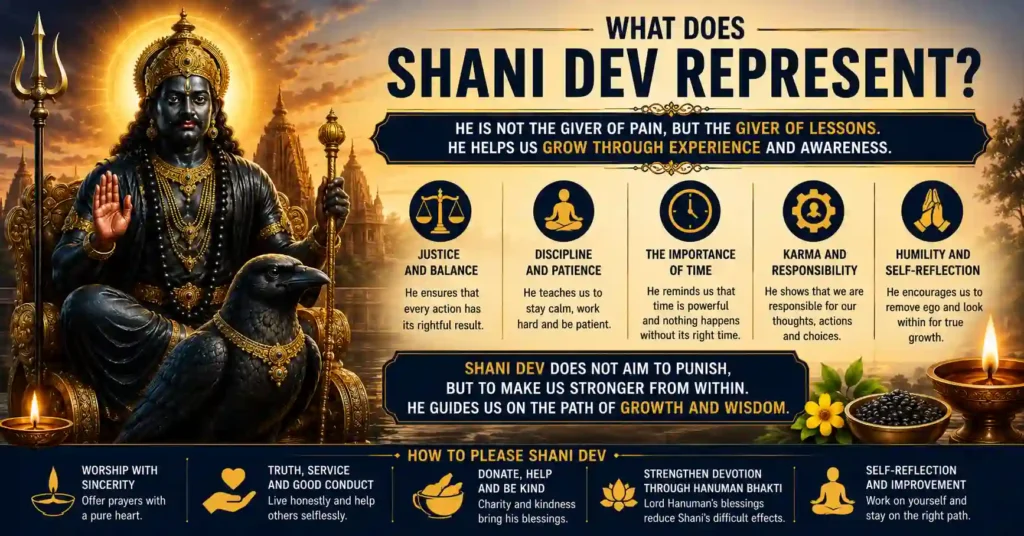
Symbols and Iconography of Shani Dev
The form of Lord Shani Dev is rich in symbolism. Every aspect of his appearance conveys a spiritual lesson rather than merely serving as artistic decoration. Understanding these symbols helps devotees appreciate his role as the divine guardian of karma, justice, discipline, and righteous living.
Some of the most important symbols associated with Shani Dev include:
Crow
The crow is the traditional vehicle (vahana) of Shani Dev. It symbolises alertness, wisdom, justice, and the ability to recognise the consequences of one’s actions. The crow reminds devotees to remain mindful of their thoughts, words, and deeds.
Dark Blue or Black Complexion
Shani Dev is traditionally depicted with a dark blue or black complexion. This represents depth, detachment, stability, and the vastness of the universe. It also reminds devotees to look beyond external appearances and focus on inner character.
Danda (Staff)
The staff held by Shani Dev symbolises authority, discipline, and justice. It signifies his responsibility to uphold dharma and impartially deliver the fruits of karma without favour or prejudice.
Trident, Bow or Other Weapons
In different traditions, Shani Dev may be shown carrying a trident, bow, sword, or mace. These represent the power to remove ignorance, protect righteousness, and overcome negative tendencies that prevent spiritual growth.
Slow Movement
Shani Dev is associated with the slow-moving planet Saturn. His gradual movement symbolises patience, perseverance, and the understanding that meaningful success and spiritual progress take time. Just as karma unfolds gradually, lasting transformation also develops through consistent effort.
Together, these symbols remind devotees that Shani Dev is not a deity of fear but a compassionate teacher who encourages honesty, patience, humility, responsibility, and unwavering commitment to the path of dharma.
Who is Shani Dev?
Shani Dev, also known as Lord Shani or Shanideva, is the Hindu deity of karma, justice, discipline, and righteousness.
He is traditionally regarded as the son of Surya Dev (the Sun God) and Mata Chhaya, and is one of the Navagrahas (nine celestial deities) in Sanatan Dharma.
Shani Dev is associated with the planet Saturn (Shani Graha) and is revered as the impartial dispenser of karmic results.
In Sanatan tradition, Shani Dev rewards or challenges individuals according to their actions, without favour or prejudice. His influence is often described as slow but profound, encouraging patience, responsibility, perseverance, and spiritual growth.
Rather than being a symbol of fear, he reminds devotees that every action has consequences and that righteous living ultimately leads to inner peace. Many saints and spiritual teachers explain that Shani Dev helps people look beyond worldly attachments and confront their true nature.
Through life’s challenges, he inspires humility, self-discipline, honesty, and maturity, guiding individuals toward wisdom and self-realisation.
The deeper spiritual meaning of Shani Dev lies in cultivating good karma, accepting responsibility for one’s actions, and remaining steadfast on the path of dharma, even during life’s most difficult phases.
Why is Shani Dev Known as the Giver of Karmic Results?
The principle of karma is one of the fundamental teachings of Sanatan Dharma. It explains that every thought, word, and action creates consequences that eventually return to the individual. Good deeds bring positive results, while harmful actions lead to challenges that encourage learning and growth.
Shani Dev is known as the giver of karmic results because he represents divine justice, fairness, and accountability. He neither favours nor discriminates against anyone. Instead, he is believed to impartially deliver the fruits of each person’s karma, reminding devotees that righteous actions and ethical living are the true foundations of lasting happiness.
According to Hindu tradition, Shani Dev’s influence is not meant to create fear but to inspire self-reflection and transformation. Periods associated with Shani often encourage people to develop patience, discipline, humility, and perseverance while letting go of ego and harmful habits.
For this reason, devotees worship Shani Dev not only to seek relief from difficulties but also to cultivate good karma, strengthen their character, and walk the path of dharma with honesty, responsibility, and unwavering faith.
What is the Difference Between Shani Dev and Shani Graha?
Many people use the terms Shani Dev and Shani Graha (Saturn) interchangeably, but they are not exactly the same. Understanding the difference helps devotees appreciate both the spiritual and astrological aspects of Sanatan Dharma.
Shani Dev is the divine deity who represents justice, karma, discipline, patience, and righteous living. He is worshipped as the impartial giver of karmic results, encouraging every individual to live with honesty, humility, and responsibility.
Shani Graha, on the other hand, refers to the planet Saturn in Vedic astrology (Jyotish). Its position in a person’s horoscope is traditionally believed to influence different phases of life, such as career, health, relationships, and spiritual growth.
According to Sanatan tradition, the influence of Shani Graha reflects the principles of karma governed by Shani Dev. Astrology explains when certain karmic experiences may unfold, while the worship of Shani Dev inspires devotees to respond to those experiences with patience, faith, self-discipline, and righteous conduct.
Rather than seeing Shani Graha as a source of fear, devotees are encouraged to view it as an opportunity for self-improvement and spiritual progress. The true message of Shani Dev is that good karma, sincere effort, and unwavering commitment to dharma ultimately lead to inner peace and lasting happiness.

Stories and Legends Connected with Shani Dev
The life and significance of Shani Dev are described in several Puranas, traditional scriptures, and regional legends of Sanatan Dharma. While some accounts vary across traditions, they all portray Shani Dev as the divine guardian of justice, karma, discipline, and spiritual growth.
One of the most well-known stories is his birth to Surya Dev (the Sun God) and Mata Chhaya. According to tradition, Shani Dev performed intense tapasya (penance) from an early age, earning the blessings of Lord Shiva, who entrusted him with the responsibility of impartially delivering the fruits of karma.
Another popular legend describes the meeting between Hanuman Ji and Shani Dev. According to traditional belief, Hanuman Ji rescued Shani Dev from captivity, and in gratitude, Shani Dev promised that sincere devotees of Hanuman would receive his grace and protection during challenging periods.
This belief is one of the reasons why many devotees recite the Hanuman Chalisa on Shani Jayanti and during Sade Sati or other Saturn-related astrological phases.
The story of King Vikramaditya and Shani Dev is another cherished folk tradition. It teaches that wealth, power, and status are temporary, while patience, humility, righteousness, and unwavering faith help a person overcome even the most difficult trials.
The story beautifully illustrates the deeper purpose of Shani Dev’s influence, which is not punishment but inner transformation and spiritual awakening.
Together, these stories remind devotees that Shani Dev is not merely associated with hardships. He is revered as a compassionate teacher who guides individuals towards wisdom, self-discipline, and the path of dharma through the timeless law of karma.
Scriptural References to Shani Dev
The significance of Lord Shani is described in several Hindu scriptures and traditional texts. While the details may vary across different traditions, these sources consistently portray him as the divine guardian of karma, justice, discipline, and righteous living.
| Scripture | Reference to Shani Dev |
|---|---|
| Brahma Purana | Describes the origin and role of Shani Dev as the impartial dispenser of karmic results. |
| Skanda Purana | Highlights the importance of righteous conduct, devotion, and worship associated with Shani Dev. |
| Padma Purana | Mentions the spiritual benefits of devotion, charity, and ethical living, principles closely linked with Shani worship. |
| Navagraha traditions | Recognise Shani as one of the nine celestial deities (Navagrahas), representing discipline, patience, justice, and the planet Saturn (Shani Graha). |
| Traditional Shani Stotras | Hymns such as the Shani Stotra and Dasharatha Shani Stotra are recited by devotees to seek wisdom, inner strength, and the blessings of Lord Shani. |
Many of the stories associated with Shani Dev, including his interactions with Hanuman Ji and King Vikramaditya, are preserved through regional traditions and devotional literature.
While these narratives may not appear in exactly the same form across every scripture, they continue to inspire millions of devotees by conveying timeless values such as humility, patience, justice, and unwavering faith.
The central teaching found across both scriptures and tradition is that Lord Shani does not punish without reason.
Instead, he encourages every individual to live according to dharma, perform good karma, and grow spiritually through honesty, discipline, and self-reflection.
Spiritual Significance of Shani Jayanti
The spiritual significance of Shani Jayanti extends far beyond rituals and religious observances. It is regarded as a sacred occasion to pause, reflect on one’s actions, and strengthen the values of dharma, self-discipline, and inner awareness.
Many saints and spiritual teachers describe this festival as a time for personal transformation rather than merely seeking relief from life’s difficulties.
Shani Dev symbolises patience, justice, humility, perseverance, and responsibility. His teachings remind us that challenges are not always obstacles but opportunities to overcome ego, learn valuable lessons, and grow into wiser and more compassionate individuals. In this way, Shani Dev guides devotees towards lasting spiritual maturity.
Unlike the common misconception that Shani Dev brings only suffering, Sanatan tradition teaches that his influence is ultimately constructive. He encourages people to accept the results of their karma with courage, cultivate righteous conduct, and remain steadfast even during difficult times. This journey of self-improvement leads to greater inner strength and peace.
Shani Dev is also associated with time (Kala), reminding us that meaningful growth happens gradually through patience, sincere effort, and perseverance. Just as time shapes every aspect of life, spiritual progress unfolds step by step through disciplined living and unwavering faith.
For devotees, Shani Jayanti is therefore not only a day to worship Shani Dev but also an opportunity to renew their commitment to honesty, humility, compassion, and good karma. The festival inspires us to live responsibly, serve others with kindness, and walk the path of dharma with faith and integrity.
Benefits of Worshipping Shani Dev
The worship of Lord Shani is not limited to seeking relief from difficult phases of life. In Sanatan Dharma, devotion to Shani Dev is regarded as a path to developing noble qualities that support both spiritual growth and everyday life.
While the results of worship are understood to vary according to one’s karma, faith, and sincere efforts, devotees traditionally believe that worshipping Shani Dev inspires positive transformation in many ways.
| Benefit | Spiritual Meaning |
|---|---|
| Develops Patience | Helps devotees remain calm and steadfast during life’s challenges. |
| Strengthens Self-Discipline | Encourages responsible actions, ethical living, and commitment to dharma. |
| Promotes Self-Reflection | Inspires individuals to examine their thoughts, actions, and habits with honesty. |
| Encourages Good Karma | Reminds devotees that righteous deeds lead to positive outcomes over time. |
| Builds Inner Strength | Helps cultivate resilience, perseverance, and emotional balance during difficult periods. |
| Reduces Ego | Teaches humility and the importance of accepting both success and setbacks with grace. |
| Deepens Spiritual Awareness | Encourages a stronger connection with prayer, meditation, and devotion to the Divine. |
The greatest blessing of Lord Shani is not merely freedom from difficulties but the wisdom to face every situation with patience, integrity, and unwavering faith. His teachings remind us that lasting peace comes through righteous living, selfless service, and sincere devotion.

Is Shani Dev Only Associated with Suffering?
Many people associate Shani Dev only with fear, hardships, or difficult phases of life. However, this is a common misconception. In Sanatan Dharma, Shani Dev is revered not as a deity of suffering but as the divine guardian of justice, karma, discipline, and righteousness.
Shani Dev is believed to impartially reward or challenge individuals according to their actions. His influence encourages people to reflect on their behaviour, fulfil their responsibilities, and lead a life based on honesty, humility, and dharma.
Rather than creating hardships without reason, he teaches valuable lessons that foster inner strength and spiritual growth.
Even periods such as Sade Sati or Shani Mahadasha, which are often viewed with anxiety, are not intended to inspire fear alone. According to traditional belief, these phases can become opportunities for self-discipline, patience, perseverance, and positive transformation when faced with faith and righteous conduct.
The deeper message of Shani Dev is one of hope rather than fear. By accepting the results of our karma with humility and striving to improve ourselves, we move closer to spiritual maturity, inner peace, and a more balanced life.
Why Are People Afraid of Shani Dev?
Many people fear Shani Dev because of widespread beliefs surrounding Saturn (Shani Graha), astrology, and challenging life events.
Financial setbacks, career delays, health concerns, or emotional struggles are often attributed solely to Shani’s influence, leading to the misconception that he is a bringer of misfortune.
However, Sanatan Dharma presents a much deeper understanding. Shani Dev is not feared because he causes suffering without reason, but because he is believed to hold every individual accountable for their karma.
His role is to encourage honesty, discipline, humility, and righteous living by helping people recognise the consequences of their actions.
Many saints and spiritual teachers explain that fear arises not from Shani Dev himself but from our attachment to comfort, success, and certainty.
When life brings delays, setbacks, or difficult lessons, people naturally resist change. Yet these experiences often become opportunities for self-reflection, inner strength, and spiritual growth.
When understood in the light of karma and dharma, Shani Dev is seen not as a deity of fear but as a compassionate guide who helps devotees overcome ego, develop patience, and move towards a more balanced and meaningful life.
His true purpose is not to punish but to awaken, transform, and lead individuals towards lasting wisdom and self-realisation.
Common Myths About Shani Dev
Over the years, many misconceptions have developed about Lord Shani. While traditional beliefs and astrology have shaped popular understanding, Sanatan Dharma teaches a much deeper and more balanced view of Shani Dev. Understanding these myths helps devotees approach him with faith rather than fear.
| Myth | Reality |
|---|---|
| Shani Dev only brings suffering. | Shani Dev is the divine guardian of justice who rewards and challenges individuals according to their karma. His purpose is spiritual growth, not punishment. |
| Everyone should fear Shani Dev. | Devotees who live honestly, perform good deeds, and follow dharma have no reason to fear him. He encourages righteousness and self-discipline. |
| Shani Dev is always angry. | Scriptures and traditions describe him as impartial and compassionate. He delivers justice without favour or prejudice. |
| Only people going through Sade Sati should worship Shani Dev. | Anyone can worship Shani Dev to cultivate patience, discipline, humility, and good karma, regardless of their astrological period. |
| Rituals alone can remove the effects of bad karma. | Worship is meaningful when accompanied by righteous actions, self-improvement, charity, and sincere devotion. |
The true message of Lord Shani is one of transformation rather than fear. He inspires devotees to examine their actions, develop strong character, and walk the path of dharma with patience, humility, and unwavering faith.
Auspicious Practices on Shani Jayanti
Shani Jayanti is observed with devotion, simplicity, and self-discipline. While rituals may vary across regions and family traditions, the day is widely regarded as an opportunity to worship Shani Dev, perform good deeds, and reflect on one’s karma.
Along with traditional Shani Puja, devotees also focus on inner purification through prayer, charity, and mindful living.
Common practices observed on Shani Jayanti include:
Worshipping Shani Dev with faith and devotion.
Lighting a sesame or mustard oil lamp before Shani Dev.
Offering black sesame seeds (kala til), sesame oil, or black cloth, where customary.
Chanting Shani mantras or reciting the Shani Stotra.
Reciting the Hanuman Chalisa, as many traditions associate Hanuman Ji’s worship with courage and protection.
Observing a vrat (fast) according to one’s health and family tradition.
Donating food, clothes, black sesame, or other essentials to the poor and needy.
Feeding crows or offering food to the underprivileged, where this forms part of local tradition.
Spending time in meditation, self-reflection, and prayer.
These practices are not performed merely to avoid difficulties or seek relief from planetary influences. Their deeper purpose is to cultivate humility, compassion, discipline, gratitude, and awareness of karma.
By combining sincere worship with selfless service and righteous conduct, devotees honour the true teachings of Shani Dev and strengthen their spiritual journey.
What Should Be Avoided on Shani Jayanti?
Shani Jayanti is not a day of fear but a day of self-discipline, humility, and spiritual reflection. Along with worship and charity, devotees are encouraged to avoid actions that create negative karma or disturb inner peace.
The true observance of this sacred festival lies as much in one’s conduct as in religious rituals.
On Shani Jayanti, many traditions advise devotees to avoid:
Anger, harsh speech, and unnecessary arguments.
Dishonesty, cheating, or unfair dealings.
Arrogance, ego, and disrespect towards elders, parents, teachers, or others.
Causing harm to people, animals, or nature.
Speaking ill of others, gossip, or spreading negativity.
Wasting food, money, or valuable resources.
Indulging in addictions or activities that disturb mental and spiritual balance.
Many traditions also emphasise practising kindness, compassion, forgiveness, and charity on this day. Helping those in need, respecting all living beings, and performing selfless acts are considered among the most meaningful ways to honour Shani Dev.
Above all, Shani Jayanti reminds devotees that true worship is reflected through righteous actions, humility, and a sincere commitment to living according to dharma.

Shani Jayanti Around India: Regional Traditions
Shani Jayanti is observed across India with deep devotion, although the customs and rituals may vary from one region to another.
While the central message of worshipping Lord Shani remains the same, local traditions add their own unique cultural expressions to the festival.
| Region | Common Traditions |
|---|---|
| Maharashtra | Thousands of devotees visit the famous Shani Shingnapur Temple, offer sesame oil, perform special pujas, and participate in devotional gatherings. |
| Uttar Pradesh | Temples such as Kokilavan Dham and the Shani Dev Temple in Varanasi attract large numbers of devotees who offer prayers, chant mantras, and recite the Hanuman Chalisa. |
| Tamil Nadu | At Thirunallar Saneeswaran Temple, devotees perform sacred baths, offer prayers to Shani Dev, and seek spiritual peace and divine blessings. |
| Delhi and North India | Special Shani Jayanti pujas, oil offerings, charity, and community satsangs are organised in many temples dedicated to Lord Shani. |
| Across India | Devotees observe fasting (vrat), light sesame or mustard oil lamps, chant Shani mantras, perform acts of charity, and reflect on the principles of karma, discipline, and righteous living. |
Although the rituals may differ from place to place, the essence of Shani Jayanti remains unchanged.
The festival inspires devotees to practise honesty, humility, compassion, patience, and good karma while strengthening their faith in the timeless teachings of Lord Shani Dev.
Simple Shani Jayanti Puja Vidhi
Devotees observe Shani Jayanti with sincerity, devotion, and simplicity. While the exact Puja Vidhi may vary according to family traditions and regional customs, the following steps are commonly followed:
Wake up early, take a holy bath, and wear clean, preferably dark or simple-coloured clothes.
Clean the place of worship and offer prayers to Lord Ganesha before beginning the puja.
Place an image or idol of Shani Dev on a clean altar and light a sesame or mustard oil lamp.
Offer black sesame seeds (kala til), sesame oil, blue or black flowers (where customary), and other traditional offerings with devotion.
Chant “Om Sham Shanicharaya Namah”, recite the Shani Stotra, or read the Hanuman Chalisa, as many traditions recommend Hanuman worship on this day.
Meditate for a few moments, pray for wisdom and righteous living, and seek the blessings of Shani Dev with humility.
Conclude the worship by donating food, clothes, black sesame, or other essentials to the poor and needy according to your capacity.
While these rituals are important, Shani Jayanti teaches that true worship goes beyond external offerings. Cultivating honesty, humility, compassion, self-discipline, and good karma is considered the highest form of devotion to Shani Dev.
How to Observe Shani Jayanti at Home
Visiting a Shani Dev temple on Shani Jayanti is considered auspicious, but it is not essential. Devotees can observe the festival at home with sincerity, devotion, and a peaceful mind. According to Sanatan Dharma, the purity of one’s intentions is more important than elaborate rituals.
A simple home observance may include the following practices:
| Practice | Purpose |
|---|---|
| Wake up early and take a bath | Begin the day with physical and mental purity. |
| Clean the prayer area | Create a peaceful and sacred space for worship. |
| Light a sesame or mustard oil lamp | Offer prayers to Lord Shani with devotion. |
| Offer black sesame seeds or flowers, where customary | Express reverence according to family or regional traditions. |
| Chant Shani mantras or recite the Hanuman Chalisa | Cultivate inner peace, courage, and spiritual discipline. |
| Spend time in meditation or silent prayer | Reflect on your actions and strengthen your connection with the Divine. |
| Perform an act of charity | Help someone in need through food, clothing, or other essential support. |
| Practise honesty, patience, and kindness throughout the day | Live the values that Lord Shani teaches. |
Even a simple prayer offered with faith is considered meaningful. Shani Jayanti reminds devotees that true worship is reflected not only in rituals but also in righteous actions, humility, compassion, and the commitment to live according to dharma.
Can Anyone Worship Shani Dev?
Yes. According to Sanatan Dharma, anyone can worship Lord Shani Dev with faith, sincerity, and a pure heart.
There is no restriction based on age, gender, caste, or astrological condition. Shani Dev blesses all devotees who strive to live a righteous and disciplined life.
Many people believe that only those experiencing Sade Sati, Shani Mahadasha, or other Saturn-related astrological periods should worship Shani Dev. However, this is a common misconception.
Worshipping Shani Dev is not limited to seeking relief from difficulties. It is also a way to cultivate patience, humility, honesty, and awareness of one’s actions.
Devotees may worship Shani Dev through simple acts such as:
| Practice | Spiritual Purpose |
|---|---|
| Offering sincere prayers | Expresses devotion and gratitude |
| Chanting Shani mantras | Cultivates inner peace and discipline |
| Lighting a sesame or mustard oil lamp | Symbolises removing ignorance and strengthening faith |
| Performing charity (daan) | Encourages compassion and positive karma |
| Reading Hanuman Chalisa | Inspires courage, devotion, and inner strength |
| Living truthfully and responsibly | The highest form of worship according to the teachings of Shani Dev |
Ultimately, the greatest offering to Shani Dev is not expensive rituals but a life guided by honesty, compassion, self-discipline, and good karma. His teachings remind us that sincere effort and righteous conduct are the true path to lasting peace and spiritual growth.

Simple Daily Practices to Honour Shani Dev
The teachings of Lord Shani are not limited to Shani Jayanti or Saturdays. Sanatan Dharma encourages devotees to practise righteousness every day through honest actions, self-discipline, and compassion. Even small daily efforts can help cultivate the virtues that Shani Dev represents.
Here are some simple practices that devotees can follow in their daily lives:
| Daily Practice | Spiritual Purpose |
|---|---|
| Speak truthfully | Builds honesty, integrity, and trust in all relationships. |
| Respect parents, elders, and teachers | Cultivates humility and gratitude. |
| Perform your duties sincerely | Reflects discipline and commitment to dharma. |
| Help those in need | Encourages compassion and creates positive karma. |
| Avoid harming people, animals, or nature | Promotes kindness and respect for all living beings. |
| Spend a few minutes in prayer or meditation | Brings mental peace and strengthens spiritual awareness. |
| Practise patience during difficulties | Develops resilience and emotional balance. |
| Reflect on your actions each day | Encourages self-improvement and mindful living. |
Lord Shani teaches that true devotion is expressed through the way we live each day. By practising honesty, patience, compassion, and responsibility in our daily lives, we honour his teachings and gradually move towards inner peace, wisdom, and spiritual growth.
Powerful Shani Dev Mantras
Chanting Shani Dev mantras with devotion and a calm mind is believed to help cultivate patience, discipline, inner peace, and spiritual strength.
While mantras are traditionally recited on Shani Jayanti and Saturdays, devotees may chant them daily according to their faith and spiritual practice.
1. Shani Beej Mantra
ॐ प्रां प्रीं प्रौं सः शनैश्चराय नमः॥
Om Praam Preem Praum Sah Shanaiścharāya Namah
This powerful Beej Mantra is traditionally chanted to seek the blessings of Shani Dev, strengthen inner resilience, and promote spiritual growth.
2. Shani Moola Mantra
ॐ शं शनैश्चराय नमः॥
Om Sham Shanaiścharāya Namah
One of the most widely recited mantras dedicated to Shani Dev, it is simple, easy to remember, and commonly chanted by devotees seeking peace, patience, and righteous living.
3. Vedic Shani Mantra
ॐ शन्नो देवीरभिष्टय आपो भवन्तु पीतये। शं योरभि स्रवन्तु नः॥
Om Shanno Devīr Abhiṣṭaya Āpo Bhavantu Pītaye, Sham Yor Abhi Sravantu Naḥ॥
This sacred Vedic mantra, found in the Yajurveda, is traditionally recited for peace, well-being, and divine blessings. It is also chanted by many devotees during Shani Puja and other spiritual observances.
Whatever mantra you choose, it is traditionally believed that sincere chanting with faith, humility, and disciplined living is more important than the number of repetitions. Devotion, good karma, and righteous conduct remain the true foundation of Shani Dev’s grace.
Charity (Daan) on Shani Jayanti and Its Spiritual Meaning
Charity (daan) is regarded as one of the most meaningful observances on Shani Jayanti. In Sanatan Dharma, offering help to those in need is considered an expression of compassion, humility, and gratitude rather than a ritual performed for material gain.
On this sacred day, many devotees donate food, clothes, black sesame seeds (kala til), mustard oil, footwear, umbrellas, or other essential items according to their capacity.
The value of charity lies not in the size of the offering but in the sincerity and selflessness with which it is given.
Some common forms of charity observed on Shani Jayanti include:
| Type of Charity | Spiritual Significance |
|---|---|
| Donating food (Anna Daan) | Nourishing the needy and cultivating compassion |
| Black sesame seeds (Kala Til) | Traditionally offered as a symbol of humility and purification |
| Mustard or sesame oil | Commonly donated during Shani worship as part of traditional observances |
| Clothes and footwear | Helping those in need with dignity and kindness |
| Supporting the poor, elderly, or differently abled | Encourages selfless service and positive karma |
| Feeding birds or animals, where customary | Reflects respect for all living beings and harmony with nature |
Shani Dev teaches that true devotion is reflected through righteous actions. Acts of charity performed with humility help reduce ego, strengthen empathy, and inspire devotees to live according to the principles of dharma.
More than any material offering, it is kindness, honesty, and selfless service that honour the timeless teachings of Lord Shani Dev.
The Connection Between Shani Dev and Hanuman Ji
The connection between Shani Dev and Hanuman Ji is one of the most respected and widely narrated traditions in Sanatan Dharma. It symbolises the power of devotion, humility, and righteousness over pride and adversity.
According to a popular tradition, Ravana imprisoned Shani Dev to prevent his influence and strengthen his own power. During his search for Mata Sita in Lanka, Hanuman Ji defeated Ravana’s forces and freed Shani Dev from captivity.
Grateful for this act of compassion, Shani Dev blessed Hanuman Ji and promised that he would be kind to those who sincerely worship Hanuman with faith and devotion.
This traditional belief is one of the reasons why many devotees recite the Hanuman Chalisa or worship Hanuman Ji during Shani Jayanti, Saturdays, Sade Sati, or other periods associated with Shani.
The practice is believed to bring courage, inner strength, patience, and protection during life’s challenges.
The deeper spiritual message of this story is not that Hanuman Ji removes karma, but that devotion, humility, righteous conduct, and unwavering faith give a person the strength to face karmic challenges with courage and wisdom.
It beautifully teaches that sincere bhakti and dharma help transform difficulties into opportunities for spiritual growth.
Famous Shani Dev Temples in India
Across India, many ancient temples are dedicated to Lord Shani Dev, attracting thousands of devotees throughout the year.
These sacred places are especially crowded on Saturdays and Shani Jayanti, when devotees gather to offer prayers, light sesame oil lamps, chant mantras, and seek blessings for strength, justice, and righteous living.
Some of the most revered Shani Dev temples include:
| Temple | State | Key Significance |
|---|---|---|
| Shani Shingnapur Temple | Maharashtra | Home to a self-manifested (Swayambhu) black stone idol of Shani Dev. The village is famous for its long-standing tradition of homes without door locks, reflecting faith in Shani Dev’s protection and justice. |
| Thirunallar Saneeswaran Temple | Tamil Nadu | One of the most revered Navagraha temples, where devotees worship Shani Dev and seek spiritual peace and relief during challenging astrological periods. |
| Kokilavan Dham | Uttar Pradesh | A renowned pilgrimage centre near Mathura, where devotees perform parikrama, offer sesame oil, chant Shani mantras, and seek blessings on Saturdays and Shani Jayanti. |
| Shani Dham Temple | Delhi | Known for its magnificent idol of Lord Shani and serene atmosphere, this temple attracts devotees from across North India seeking guidance, discipline, and divine blessings. |
| Shani Dev Temple, Lanka | Varanasi, Uttar Pradesh | An ancient and respected temple where devotees pray for justice, patience, protection, and the strength to overcome karmic challenges while visiting the sacred city of Kashi. |
Visiting these sacred places is considered an opportunity for self-reflection and strengthening one’s faith in the timeless teachings of Shani Dev.

What Does Shani Dev Teach Us in Modern Life?
In today’s fast-paced world, people often seek instant success, quick results, and constant recognition. Amid this rush, qualities such as patience, discipline, honesty, and perseverance are often overlooked.
The teachings of Shani Dev remind us that lasting success is built through sincere effort, righteous actions, and unwavering commitment to dharma.
Shani Dev teaches that every action has consequences and that true growth comes from accepting responsibility for our choices. Rather than taking shortcuts, he inspires us to cultivate integrity, humility, self-discipline, and resilience, even during challenging times.
The lessons of Shani Dev are especially relevant in modern life. Whether facing career setbacks, financial difficulties, personal struggles, or emotional uncertainty, his teachings encourage us to remain patient, learn from our experiences, and continue moving forward with faith and determination.
More than a religious observance, Shani Jayanti serves as a reminder to pause, reflect on our actions, and realign our lives with truth, compassion, and good karma.
By embracing these timeless values, devotees can develop inner strength, emotional balance, and a deeper connection with their spiritual journey.
Lessons We Can Learn from Shani Jayanti
Shani Jayanti is more than a festival of worship. It is a reminder that the principles taught by Lord Shani are timeless and can guide us in every stage of life. His teachings encourage us to become better individuals through discipline, integrity, and self-awareness.
| Life Lesson | What It Teaches |
|---|---|
| Take Responsibility | Accept the consequences of your actions instead of blaming others. |
| Be Patient | Success and spiritual growth take time and consistent effort. |
| Live Honestly | Truthfulness and fairness build lasting peace and trust. |
| Respect Everyone | Treat all people with humility and compassion, regardless of their position or status. |
| Perform Good Karma | Every good deed contributes to personal growth and the well-being of society. |
| Stay Strong During Difficult Times | Challenges are opportunities to learn, grow, and strengthen your character. |
| Remain Humble | Wealth, power, and success are temporary, but good character endures. |
The teachings of Lord Shani remain as relevant today as they were centuries ago. In a world filled with haste, competition, and uncertainty, Shani Jayanti reminds us that patience, honesty, discipline, and compassion are the true foundations of a meaningful and spiritually fulfilling life.
Key Takeaways
If you’re short on time, here are the most important things to remember about Shani Jayanti:
| Key Takeaway | Why It Matters |
|---|---|
| Shani Jayanti celebrates the appearance of Lord Shani. | It honours the deity of karma, justice, discipline, and righteous living in Sanatan Dharma. |
| Shani Dev is not a deity of fear. | He impartially rewards or challenges individuals according to their karma, encouraging spiritual growth. |
| The festival is a time for self-reflection. | Devotees examine their actions, cultivate humility, and renew their commitment to dharma. |
| Prayer should be accompanied by righteous conduct. | Honest living, compassion, patience, and charity are considered the highest forms of worship. |
| Anyone can worship Shani Dev. | Sincere devotion, good karma, and ethical living are more important than elaborate rituals or astrological conditions. |
| The teachings of Shani Dev remain relevant today. | They inspire patience, responsibility, resilience, and integrity in everyday life. |
Shani Jayanti reminds us that every action has consequences and that lasting peace comes through good karma, humility, discipline, and unwavering faith. By living according to these timeless values, devotees honour not only Lord Shani but also the eternal principles of Sanatan Dharma.
Reflection for the Day
Shani Jayanti invites us to look within rather than merely perform rituals. Before the day ends, take a few moments to reflect on these questions:
- Have I acted with honesty and fairness in my daily life?
- Do I accept responsibility for my actions?
- Where can I be more patient and disciplined?
- Have I helped someone without expecting anything in return?
- What one habit can I improve to walk more closely on the path of dharma?
These moments of self-reflection are themselves a form of worship. They remind us that the greatest offering to Lord Shani is not wealth or ritual, but a sincere effort to become a better human being.
Conclusion
Shani Jayanti is much more than a festival associated with Shani Graha or challenging phases of life. It is a sacred occasion to honour Shani Dev, the divine guardian of karma, justice, discipline, and righteousness, and to reflect on the way we live, think, and act.
In Sanatan Dharma, Shani Dev teaches that every action carries its own consequence and that patience, humility, honesty, and perseverance are essential for spiritual growth. His blessings inspire devotees to accept life’s challenges with courage, learn from their experiences, and remain committed to the path of dharma.
The true message of Shani Jayanti is not fear but self-awareness, transformation, and inner strength. By combining sincere worship with good karma, compassion, and disciplined living, devotees can deepen their spiritual journey and lead a more balanced and meaningful life.
If you would like to explore the timeless wisdom of Sanatan Dharma further, you may also enjoy reading about karma, Hanuman Ji, Kala Bhairava, and other festivals, deities, and spiritual traditions on The Sanatan Tales.
Suggested Reading
If you enjoyed learning about Shani Jayanti, you may also like these related articles from The Sanatan Tales that explore other important Hindu festivals, vrats, and sacred traditions:
Akshaya Tritiya: Date, Muhurat and Meaning
https://thesanatantales.com/akshaya-tritiya/
Hanuman Jayanti: Devotion and Strength
https://thesanatantales.com/hanuman-jayanti/
Ram Navami: Date, Puja Vidhi and the Sacred Birth Story of Lord Ram
https://thesanatantales.com/ram-navami/
Chaitra Navratri: Dates, Meaning, Rituals and Spiritual Significance
https://thesanatantales.com/chaitra-navratri/
Gayatri Jayanti: Story, Meaning and Significance
https://thesanatantales.com/gayatri-jayanti
Holi Festival: Meaning, History and Celebration
https://thesanatantales.com/holi-festival/
Mahashivratri: Meaning, Date, Rituals, Vrat Rules & Puja Vidhi
https://thesanatantales.com/mahashivratri
Gupta Navratri: Meaning, 2026 Dates, Rituals and Spiritual Significance
https://thesanatantales.com/gupta-navratri/
Makar Sankranti: Meaning, Date, Rituals, Puja, Traditions and Spiritual Significance
https://thesanatantales.com/makar-sankranti/
Shani Jayanti (Wikipedia)
https://en.wikipedia.org/wiki/Shani_Jayanti
FAQs
What is Shani Jayanti and why is it celebrated?
Shani Jayanti is a sacred Hindu festival that commemorates the appearance (Jayanti) of Lord Shani, the divine deity of karma, justice, discipline, and righteousness in Sanatan Dharma. It is observed every year on Jyeshtha Amavasya (the New Moon day of the Hindu month of Jyeshtha). Devotees celebrate the day by offering prayers, chanting mantras, observing vrat, performing charity, and reflecting on their actions. The festival reminds us that every action has consequences and encourages a life guided by honesty, patience, humility, and dharma.
When is Shani Jayanti celebrated?
Shani Jayanti falls every year on Jyeshtha Amavasya, according to the Hindu lunar calendar, so its date changes annually in the Gregorian calendar. Devotees should refer to a reliable Panchang for the exact date and timings in their location. The day is considered especially auspicious for Shani Puja, mantra chanting, charity, and spiritual self-reflection.
Is Shani Dev a deity of punishment or justice?
According to Sanatan Dharma, Lord Shani is primarily the deity of justice and karma, not punishment. He is believed to impartially deliver the results of each person’s actions, whether good or bad. Rather than inspiring fear, his teachings encourage individuals to accept responsibility for their choices, cultivate discipline, and live according to dharma. Challenges associated with Shani are traditionally viewed as opportunities for learning, self-improvement, and spiritual growth.
Can anyone worship Lord Shani Dev?
Yes. Anyone can worship Lord Shani Dev with sincerity and devotion. There are no restrictions based on age, gender, caste, or astrological condition. Many people believe only those experiencing Sade Sati or Shani Mahadasha should worship him, but this is a common misconception. Worshipping Shani Dev is a way to strengthen patience, honesty, humility, and good karma, making his teachings relevant for everyone.
What are the main rituals performed on Shani Jayanti?
Common observances include taking a holy bath, performing Shani Puja, lighting a sesame or mustard oil lamp, offering black sesame seeds, chanting Shani mantras, reciting the Hanuman Chalisa, observing a fast according to one’s tradition, and donating food or essential items to those in need. While rituals may vary by region and family custom, their deeper purpose is to cultivate compassion, discipline, gratitude, and righteous living rather than simply seeking material benefits.
Why is Hanuman Ji worshipped on Shani Jayanti?
Many devotees recite the Hanuman Chalisa on Shani Jayanti because of a popular traditional belief that Lord Hanuman once freed Shani Dev from captivity. In gratitude, Shani Dev is believed to have blessed Hanuman’s devotees with protection and strength during difficult times. Whether understood literally or symbolically, this tradition highlights the values of devotion, courage, humility, and unwavering faith.
What should be donated on Shani Jayanti?
Many devotees perform charity by donating food, black sesame seeds (kala til), mustard or sesame oil, clothes, footwear, or other essential items according to their capacity. Supporting the poor, elderly, or people in need is also considered a meaningful form of service. In Sanatan Dharma, the intention behind charity is more important than the value of the donation. Selfless giving reflects the qualities of compassion and humility that Lord Shani inspires.
Can Shani Jayanti be observed at home?
Yes. If you are unable to visit a temple, you can observe Shani Jayanti at home with equal devotion. Clean the prayer space, light a sesame or mustard oil lamp, offer prayers to Lord Shani, chant sacred mantras, read the Hanuman Chalisa, meditate, and perform an act of charity. Sanatan Dharma teaches that sincere devotion and righteous conduct are more important than elaborate rituals or expensive offerings.
What is the spiritual message of Shani Jayanti?
The central message of Shani Jayanti is that every action carries its own consequence. Lord Shani teaches patience, discipline, honesty, humility, and responsibility. The festival encourages devotees to reflect on their lives, correct their mistakes, perform good karma, and remain steadfast on the path of dharma. Its teachings continue to offer practical guidance for living a balanced and meaningful life.
How can we honour the teachings of Lord Shani in daily life?
The best way to honour Lord Shani is through everyday actions. Speaking truthfully, fulfilling responsibilities, respecting parents and elders, helping those in need, avoiding harm to others, practising self-discipline, and reflecting on one’s actions are all considered forms of worship. Shani Dev reminds us that lasting peace and spiritual growth are achieved not only through prayer but also through a life of integrity, compassion, and good karma.
Glossary of Important Terms
| Term | Meaning |
|---|---|
| Shani Dev | The Hindu deity of karma, justice, discipline, patience, and righteous living. |
| Shani Graha | The planet Saturn in Vedic astrology (Jyotish), associated with karmic lessons and discipline. |
| Shani Jayanti | The festival celebrating the appearance (Jayanti) of Lord Shani, observed on Jyeshtha Amavasya. |
| Jyeshtha Amavasya | The New Moon day in the Hindu month of Jyeshtha on which Shani Jayanti is observed. |
| Karma | The universal law that every action, thought, and intention has corresponding consequences. |
| Dharma | Righteous duty, moral values, and the path of ethical living in Sanatan Dharma. |
| Vrat | A religious fast or spiritual observance undertaken with devotion and self-discipline. |
| Puja | A ritual of worship performed through prayers, offerings, and devotion to a deity. |
| Mantra | A sacred word or verse chanted to deepen concentration, devotion, and spiritual awareness. |
| Daan (Charity) | The selfless act of giving food, clothes, money, or other essentials to those in need. |
| Kala Til | Black sesame seeds traditionally offered during Shani worship and charitable acts. |
| Hanuman Chalisa | A devotional hymn dedicated to Lord Hanuman, often recited on Shani Jayanti and Saturdays. |
| Sade Sati | A traditional astrological period of about seven and a half years associated with Saturn’s transit around the natal Moon. |
| Shani Mahadasha | A major planetary period of Saturn in Vedic astrology believed to influence different phases of life. |
| Navagraha | The nine celestial deities in Hindu tradition that represent the principal planetary influences, including Shani (Saturn). |
| Panchang | The traditional Hindu calendar used to determine tithi, nakshatra, and auspicious timings for religious observances. |
About the Author
Yateendra Chaturvedi is a spiritual writer, researcher, devotee, and the founder of The Sanatan Tales. With over 35 years of professional experience and a lifelong interest in Sanatan Dharma, he writes about Hindu deities, temples, scriptures, festivals, Mahavidyas, sacred stories, rituals, and living traditions that continue to guide and inspire devotees across India.
Drawing from traditional scriptures, regional beliefs, temple traditions, devotional literature, and historical sources, he aims to present authentic, well-researched, and easy-to-understand content for modern readers. His work focuses on preserving spiritual wisdom, explaining sacred traditions, and helping seekers develop a deeper understanding of India’s rich spiritual heritage.
Through The Sanatan Tales, Yateendra strives to make the timeless teachings of Sanatan Dharma simple, meaningful, and relevant for today’s generation while maintaining respect for traditional sources, regional practices, and diverse spiritual perspectives.
Learn More About Yateendra Chaturvedi →
https://thesanatantales.com/about-the-author/
References & Sources
This article is based on the teachings, beliefs, and traditions of Sanatan Dharma related to Lord Shani (Shani Dev), as preserved in Hindu scriptures, traditional commentaries, Navagraha worship practices, temple traditions, and devotional literature. It also draws upon widely accepted knowledge from texts such as the Puranas, Vedic traditions, Jyotish (Vedic astrology), Shani Stotras, and the living practices followed by devotees across India. Some explanations are further inspired by insights shared through the guru-disciple (Guru-Shishya) tradition and respected spiritual teachers.
Note: Beliefs, interpretations, rituals, and methods of worship associated with Lord Shani may vary across different regions, sampradayas (traditions), temples, and spiritual lineages within Sanatan Dharma. The purpose of this article is not to establish any one interpretation as the absolute truth, but to present widely accepted religious, cultural, and spiritual perspectives in a simple, balanced, and accessible manner.
Explore More Fascinating Topics from Sanatan Dharma