
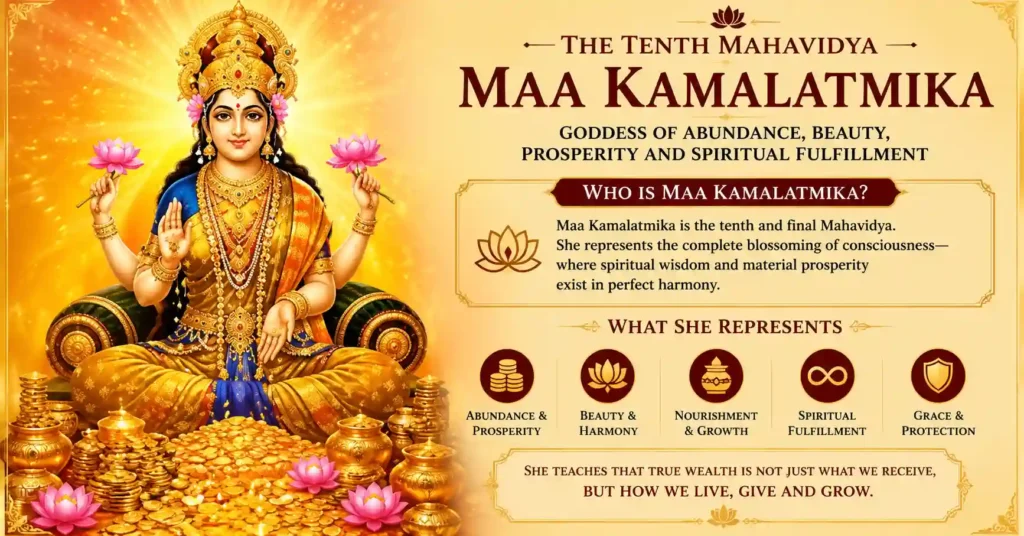
Maa Kamalatmika is the tenth and final Mahavidya in the Das Mahavidya tradition of Shakta Tantra. Also known as Kamala, she is closely associated with Goddess Lakshmi and represents prosperity, beauty, nourishment, auspiciousness, and spiritual fulfillment.
The ten Mahavidyas are worshipped as different manifestations of Divine Shakti. Some spiritual interpretations also understand them as revealing different aspects of inner transformation. Within this understanding, Maa Kamalatmika reminds devotees that spiritual wisdom can be expressed through everyday life, including family responsibilities, honest work, generosity, and care for others.
Her lotus seat, four arms, and the elephants shown in traditional depictions carry rich symbolic meanings. These images connect her with purity, abundance, blessings, and the sustaining power of the Divine Mother.
In this guide, we will explore Maa Kamalatmika’s meaning, symbolism, relationship with Lakshmi, place among the ten Mahavidyas, traditional worship, and associated mantras. We will also look at what her symbolism can teach us about living with gratitude, using prosperity responsibly, and maintaining spiritual balance.
Maa Kamalatmika at a Glance
| Detail | Information |
|---|---|
| Name | Maa Kamalatmika, also known as Kamala |
| Tradition | Shakta Tantra |
| Place Among the Mahavidyas | Tenth and final Mahavidya |
| Closely Associated Deity | Goddess Lakshmi |
| Main Symbolism | Prosperity, beauty, nourishment and spiritual fulfillment |
| Iconography | Lotus seat, four arms and elephants in traditional depictions |
| Bija Mantra | Shreem |
| Spiritual Message | Balance material well-being with wisdom, gratitude and responsible living |
Note: Details of worship, mantras and symbolism may vary across traditions and lineages.
Table of Contents
ToggleMaa Kamalatmika and the Spiritual Journey
The Das Mahavidyas represent ten distinct forms of Divine Shakti within the Shakta tradition. Each Goddess has her own identity, symbolism, and spiritual significance. Together, they offer devotees different ways to contemplate the power of the Divine Mother.
Maa Kamalatmika brings attention to an aspect of spiritual life that people experience every day: the relationship between inner wisdom and the world around us. Her association with prosperity, beauty, nourishment, and auspiciousness reminds devotees that spiritual reflection need not be separated from family life, honest work, relationships, and care for others.
Her message is not simply about acquiring wealth or enjoying comfort. It also invites reflection on how we receive and use what life provides. Gratitude, generosity, responsibility, and self-restraint can help ensure that material well-being supports a meaningful life.
Through her symbolism, Maa Kamalatmika encourages devotees to approach worldly responsibilities with awareness and devotion. Prosperity and spiritual growth can complement one another when guided by wisdom and a sense of responsibility.
Why Maa Kamalatmika Is the Tenth Mahavidya
Maa Kamalatmika holds the tenth and final position in the traditional list of the Das Mahavidyas, the ten wisdom goddesses of Shakta Tantra. Each Mahavidya represents a distinct form of Divine Shakti, with her own symbolism and spiritual significance.
The Mahavidyas are not understood in exactly the same way by every tradition. In some spiritual interpretations, their different forms invite reflection on the many dimensions of divine power and spiritual understanding. Maa Kamalatmika’s place at the end of the list can be contemplated as a reminder that spiritual wisdom also has a place in ordinary life.
Her association with prosperity, beauty, nourishment, and auspiciousness distinguishes her symbolism within the group. Through Kamalatmika, devotees can reflect on how spiritual values may guide their relationship with wealth, family responsibilities, work, and the well-being of others.
Her position as the tenth Mahavidya should not be taken to mean that every tradition teaches a fixed sequence of spiritual stages. Rather, it provides an opportunity to appreciate her distinctive place within the wider Das Mahavidya tradition.
Maa Kali, Tripura Sundari and Maa Kamalatmika: Key Differences
Maa Kali, Tripura Sundari (Shodashi), and Maa Kamalatmika are three distinct forms of Divine Shakti within the Das Mahavidya tradition. Each has her own symbolism and spiritual significance.
Maa Kali is associated with time, transformation, and the dissolution of ego and attachment. Her fierce form reminds devotees to face impermanence and look beyond their limited sense of identity.
Maa Tripura Sundari, also known as Shodashi, represents divine beauty, harmony, and the fullness of consciousness. Her symbolism invites reflection on the relationship between beauty, awareness, and the sacred nature of creation.
Maa Kamalatmika, also known as Kamala, is associated with prosperity, nourishment, beauty, and auspiciousness. Her symbolism encourages devotees to approach worldly well-being with gratitude, wisdom, and responsibility.
These descriptions highlight the distinctive qualities commonly associated with the three Goddesses. They are not a ranking of their spiritual importance, nor should they be treated as a universal sequence of spiritual stages. Each Goddess has a distinct place within Shakta worship and devotion.
Maa Kamalatmika and the Sri Vidya Tradition
Maa Kamalatmika and Maa Tripura Sundari (Shodashi) hold distinct places within the wider Shakta tradition. Maa Kamalatmika is revered as the tenth Mahavidya, while Sri Vidya is particularly associated with the worship of Tripura Sundari and the Sri Chakra.
The Sri Chakra is a sacred geometric diagram central to Sri Vidya practice. Its interlocking triangles and surrounding structures carry complex meanings within the tradition and are used as aids for worship and meditation.
Both Kamalatmika and Tripura Sundari are forms of Divine Shakti, but their identities and methods of worship should not be treated as interchangeable. Maa Kamalatmika is especially associated with prosperity, nourishment, beauty, and auspiciousness, while Sri Vidya places particular emphasis on Tripura Sundari and the Sri Chakra.
The relationship between these traditions can vary according to lineage and interpretation. Readers should therefore distinguish between their shared foundation in Shakta worship and the specific practices associated with each tradition.
What the Symbolism of Maa Kamalatmika Reveals
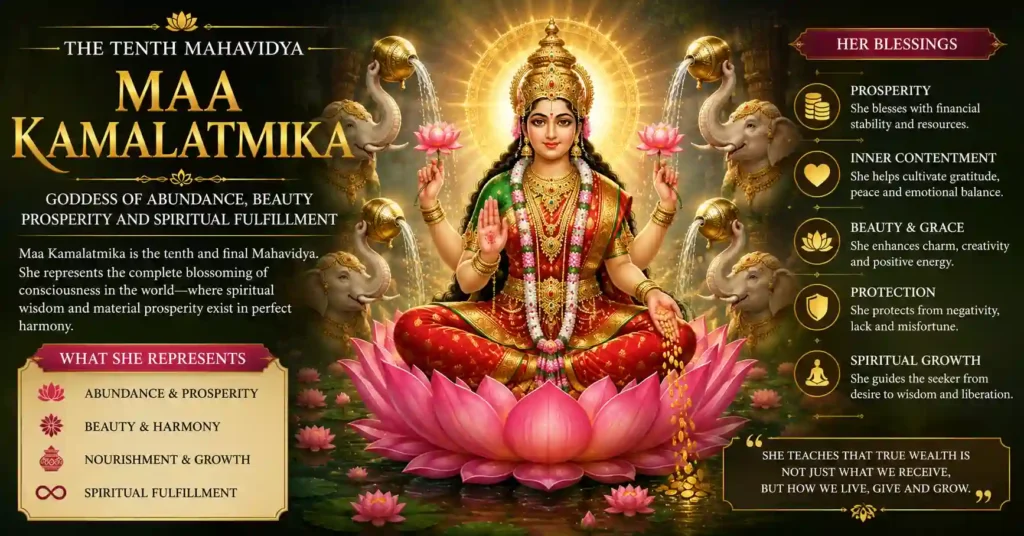
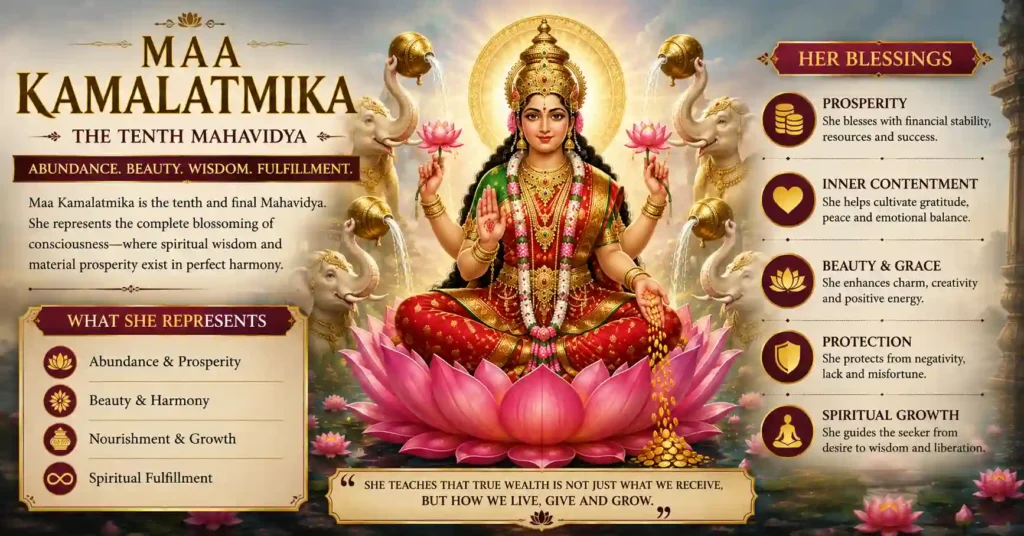
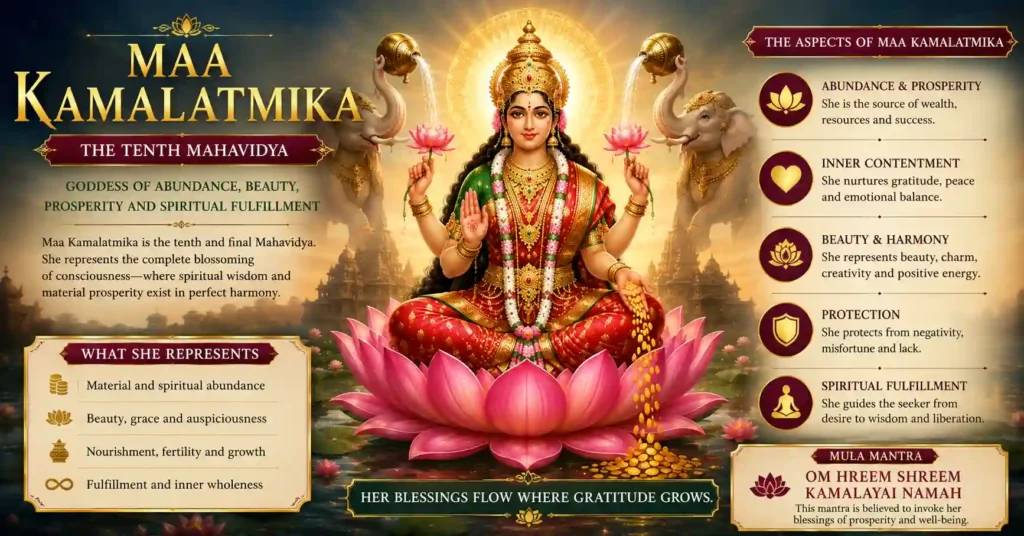
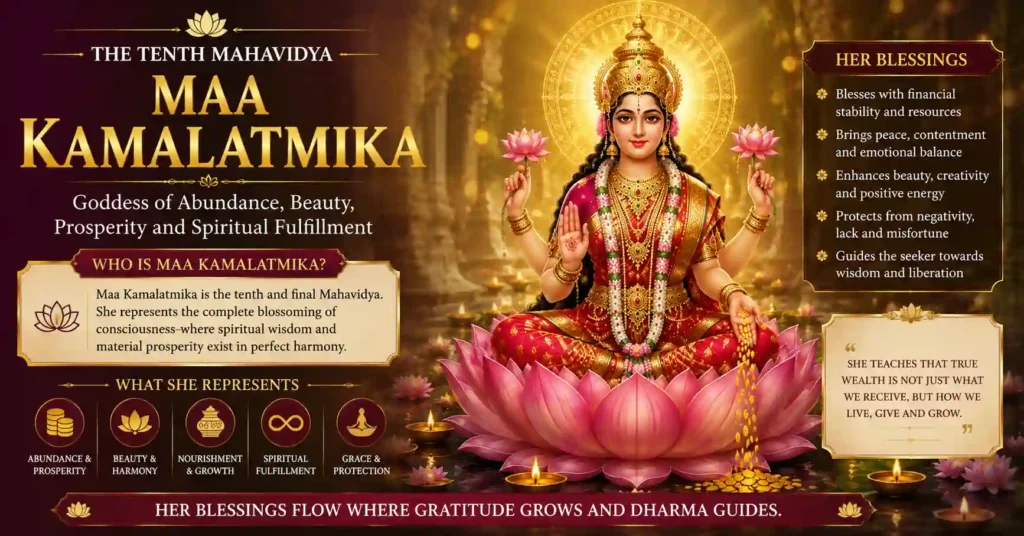
Maa Kamalatmika is traditionally depicted with a radiant golden complexion, symbolising auspiciousness, beauty, and abundance. Her appearance conveys the nourishing and benevolent qualities associated with the Divine Mother.
The Lotus: Maa Kamalatmika sits upon a fully bloomed lotus and is often shown holding lotus flowers in two of her hands. The lotus is associated with purity and spiritual growth. Growing in muddy water while rising above its surface, it offers a reminder that one can fulfil worldly responsibilities while remaining guided by spiritual values.
The Four Arms and Mudras: Maa Kamalatmika is commonly depicted with four arms. Two hold lotuses, while the other two display the Abhaya and Varada Mudras. Abhaya Mudra represents fearlessness and reassurance, while Varada Mudra signifies blessings and generosity.
The Four Elephants: In many traditional depictions, four elephants stand behind the Goddess and pour water over her. The elephants are associated with royal dignity, auspiciousness, and abundance. The water can be understood as a symbol of blessing, renewal, and nourishment. Some interpretations connect it with amrita, the divine nectar of immortality, although this meaning varies by tradition.
Grain and Nourishment: Certain representations include grain or rice alongside lotus imagery. These details can express Dhan (wealth) and Dhanya (grain or food), reminding devotees that prosperity involves not only material resources but also the nourishment that sustains life.
Taken together, these symbols portray Maa Kamalatmika as a Goddess associated with purity, blessings, prosperity, and nourishment. They also invite devotees to consider how abundance can be accompanied by wisdom, gratitude, and responsibility.
How Maa Kamalatmika Differs From Goddess Lakshmi
Maa Kamalatmika and Goddess Lakshmi share many symbols and qualities, including the lotus, prosperity, beauty, and auspiciousness. In some devotional traditions, Kamala is identified closely with Lakshmi, while Shakta Tantra gives Kamalatmika a distinct place among the ten Mahavidyas.
In mainstream Vaishnava traditions, Goddess Lakshmi is worshipped as the consort of Lord Vishnu and is associated with wealth, fortune, harmony, and well-being. Maa Kamalatmika, also known as Kamala, is revered as the tenth Mahavidya within the Shakta tradition. Her place in this tradition highlights the Divine Mother’s power as expressed through prosperity, nourishment, beauty, and abundance.
The distinction is therefore mainly one of tradition and theological context, rather than a simple claim that the two Goddesses are entirely separate. Their identities and relationship are understood differently across Hindu traditions and lineages.
For devotees, the symbolism of Maa Kamalatmika also offers a practical reflection: prosperity becomes more meaningful when accompanied by gratitude, generosity, responsibility, and spiritual awareness.
What Traditional Texts Say About Maa Kamalatmika
Maa Kamalatmika belongs to the Das Mahavidya tradition of Shakta Tantra, in which the Divine Mother is worshipped through different forms of Shakti. She is also known as Kamala and shares important symbolism with Goddess Lakshmi, particularly in relation to prosperity, beauty, and auspiciousness.
Traditional works such as the Shakta Pramoda and Tantrasara are cited in discussions of Mahavidya worship and related practices. However, specific descriptions of Maa Kamalatmika, her mantras, and her ritual procedures should be linked to the relevant passages rather than attributed to these texts without verification.
The Lakshmi Tantra and the Devi Bhagavata Purana are relevant to the broader study of Goddess traditions and Divine Shakti. Their inclusion in this discussion does not, by itself, establish that they describe Maa Kamalatmika in the same way as texts focused specifically on the Mahavidyas.
Accounts of the Goddess and her worship may differ across scriptures, regional customs, and spiritual lineages. A careful reading therefore distinguishes between direct textual descriptions, traditional interpretations, and contemporary explanations of her symbolism.
For readers who wish to study Maa Kamalatmika in greater depth, the most useful approach is to consult identifiable editions and passages from relevant traditional works. This helps preserve the richness of the tradition while avoiding unsupported scriptural claims.
How Lunar Fullness and Venus Are Associated With Maa Kamalatmika
Some spiritual interpretations associate Maa Kamalatmika with fullness, completeness, beauty, and auspiciousness. These qualities are also reflected in the symbolism of the fully bloomed lotus and the abundance traditionally associated with the Goddess.
The concept of the sixteen lunar kalas appears in Hindu spiritual traditions and is associated with fullness and completeness. However, a specific connection between Maa Kamalatmika and these sixteen kalas should be explained with reference to the particular text or lineage that teaches it.
Venus, known as Shukra in Vedic astrology, is traditionally associated with beauty, relationships, creativity, comfort, and material enjoyment. Some contemporary spiritual interpretations connect these qualities with Maa Kamalatmika’s symbolism of prosperity and refinement. This should be understood as an interpretive association rather than a universal rule of Kamalatmika worship.
These comparisons can offer readers a way to reflect on beauty, contentment, and responsible enjoyment of life. They should, however, remain distinct from established descriptions of the Goddess unless supported by specific traditional sources.
How Maa Kamalatmika Is Worshipped in Tantric Practice
Worship of Maa Kamalatmika varies across Shakta traditions and spiritual lineages. Devotion may include prayer, mantra recitation, offerings, meditation, and contemplation of the Goddess’s symbolism. More specialised Tantric practices may follow particular instructions given within a lineage.
Mantra Recitation: Shreem is a bija mantra associated with auspiciousness and prosperity in traditions that worship Maa Kamalatmika. The mantra Om Hreem Shreem Kamalayai Namah is also recited in some devotional contexts. Mantra forms and methods of recitation should be checked against a reliable traditional source.
Offerings and Devotional Practice: Flowers, lamps, incense, and other customary offerings may be used according to local practice. Some devotees use a Kamal Gatta mala, made from lotus seeds, for mantra recitation. Practices vary, so no single list of offerings should be treated as compulsory for every devotee.
Yantra and Meditation: Some practitioners use a Kamala Yantra as a focus for worship and meditation. Its use and the procedures associated with it may depend on the tradition being followed.
Certain Tantric lineages prescribe specific mantras, ritual procedures, or initiation for advanced sadhana. These should not be presented as universal requirements or undertaken solely on the basis of a general online guide. Beginners can approach the Goddess through sincere prayer and simple devotional practices appropriate to their family or regional tradition.
The central purpose of worship is to cultivate devotion and approach prosperity with gratitude, wisdom, and responsibility.
What the Kamala Yantra Symbolizes in Tantric Worship
A yantra is a sacred geometric design used in some Hindu traditions as a focus for worship, meditation, and contemplation. In traditions that use the Kamala Yantra, it serves as a visual aid for devotion to Maa Kamalatmika.
The yantra is associated with the Goddess’s symbolism of prosperity, auspiciousness, and abundance. Its geometric arrangement provides a focal point for concentration, while its sacred purpose is understood within the beliefs and practices of the tradition in which it is used.
The Kamala Yantra should not be treated merely as a device for attracting wealth. For devotees, its use may also support focused prayer and reflection on how prosperity can be approached with gratitude, responsibility, and spiritual awareness.
Specific yantra designs, methods of worship, and ritual procedures can differ between traditions. Those seeking to perform specialised Tantric rituals should follow reliable traditional instructions rather than assume that every yantra is used in the same way.
Why the Shreem Bija Mantra Is Central to Maa Kamalatmika Worship
Shreem is a sacred bija, or seed syllable, associated with prosperity, auspiciousness, and abundance in several Hindu devotional and Tantric traditions. It is widely connected with Goddess Lakshmi and is also used in devotional contexts associated with Maa Kamalatmika.
A bija mantra is understood within these traditions as more than an ordinary word. Its significance comes from its traditional use, spiritual meaning, and place within a particular form of worship.
For devotees, the association of Shreem with abundance can inspire reflection on more than material wealth. It can also serve as a reminder to cultivate gratitude, generosity, contentment, and responsible use of resources.
The exact mantras and methods of recitation associated with Maa Kamalatmika may vary across traditions and lineages. Devotees should consult reliable traditional guidance when following specialised Tantric practices rather than assuming that every mantra or procedure is suitable for everyone.
Ultimately, the devotional significance of Shreem lies in its association with auspiciousness and the blessings of the Divine Mother.
How Maa Kamalatmika Is Worshipped in Different Temple and Regional Traditions
Worship of the Divine Mother varies across India according to regional customs, temple traditions, and spiritual lineages. Maa Kamalatmika, as a Mahavidya within the Shakta tradition, is worshipped in contexts that may differ from the more widely familiar devotional worship of Goddess Lakshmi.
In traditions that specifically worship Maa Kamalatmika as a Mahavidya, devotional practices may include mantra recitation, offerings, meditation, and rituals followed within a particular lineage. The form and details of worship depend on the tradition being followed.
Her close association with Goddess Lakshmi also provides a connection with familiar themes of prosperity, nourishment, auspiciousness, and well-being. However, worship dedicated to Lakshmi should not automatically be described as a distinct Kamalatmika ritual.
Regional practices should be discussed with reference to specific temples, communities, or reliable accounts. This distinction helps readers appreciate the diversity of Hindu devotion without confusing related traditions or attributing practices to Maa Kamalatmika without sufficient evidence.
Which Festivals and Observances Are Associated With Maa Kamalatmika
Worship of Maa Kamalatmika varies across Shakta traditions and spiritual lineages. There is no single nationwide festival universally observed exclusively in her honour, so it is important to distinguish her specific worship from broader Hindu festivals associated with Goddess Lakshmi.
Diwali: Diwali is widely associated with Goddess Lakshmi and prayers for prosperity, auspiciousness, and well-being. Because Maa Kamalatmika is closely associated with Lakshmi, devotees may also reflect on her symbolism during this festival. However, Lakshmi worship on Diwali should not automatically be described as a distinct Kamalatmika ritual.
Gupt Navratri: Some Shakta practitioners observe Gupt Navratri as a period for worship associated with the Mahavidyas. The specific practices followed depend on the tradition and lineage.
Purnima (Full Moon): Full moon observances hold significance in various Hindu devotional traditions. If a particular Kamalatmika lineage recommends Purnima worship, that practice should be understood within its specific traditional context rather than treated as universal.
Rituals, offerings, and observances may differ between communities. Devotees should follow the customs of their family, temple, or spiritual tradition when undertaking specific forms of worship.
Kamala Jayanti: Significance and Observance
Kamala Jayanti is an observance associated with Maa Kamala, the tenth Mahavidya, also known as Kamalatmika. Drik Panchang identifies it with the Amavasya of the Ashwin month in the Purnimanta calendar, corresponding to Kartik Amavasya. The observance highlights the Goddess’s association with prosperity, auspiciousness, and abundance.
Maa Kamalatmika is closely associated with Goddess Lakshmi, and both are connected with wealth, nourishment, and well-being. However, the specific worship of Kamala as a Mahavidya belongs to the wider context of Shakta traditions and should not automatically be treated as identical to every Lakshmi Puja observance.
Devotees who observe Kamala Jayanti may offer prayers and reflect on the Goddess’s symbolism according to their family customs or spiritual lineage. The precise rituals and methods of worship can vary, so a single procedure should not be presented as compulsory for everyone.
The date of Kamala Jayanti follows the Hindu lunar calendar and changes each year. Anyone planning to observe it should check a reliable Panchang for the relevant year and location.
What Maa Kamalatmika Teaches for Modern Life
Maa Kamalatmika’s symbolism offers a meaningful way to reflect on prosperity, contentment, and responsibility in everyday life. Her association with abundance reminds devotees that well-being involves more than the amount of wealth a person possesses.
Value What You Have: Gratitude helps us recognise the importance of food, family, health, meaningful work, and the support we receive from others. It encourages contentment without preventing us from working towards a better future.
Use Prosperity Responsibly: Wealth and material comfort can support family responsibilities, education, charitable giving, and the well-being of others. Their value grows when they are guided by honesty and consideration rather than greed.
Balance Ambition With Inner Peace: Working towards financial security and personal goals is a natural part of life. Maa Kamalatmika’s symbolism invites devotees to pursue these goals without allowing constant comparison or dissatisfaction to dominate their lives.
Respect Beauty and Nourishment: Beauty, creativity, and nourishment are also part of a fulfilling life. Appreciating them can encourage care for our homes, relationships, surroundings, and communities.
For devotees, the broader lesson is to approach prosperity with gratitude, integrity, and wisdom. Material well-being and spiritual values can support one another when our choices reflect responsibility and care for others.
Conclusion
Maa Kamalatmika, the tenth Mahavidya in the Das Mahavidya tradition, represents prosperity, beauty, nourishment, auspiciousness, and spiritual fulfillment. Her symbolism reminds devotees that abundance is not limited to material wealth but also includes gratitude, generosity, and responsible living.
Her lotus, four arms, and traditional iconography offer different ways to reflect on purity, blessings, and the sustaining power of the Divine Mother. Her close association with Goddess Lakshmi also highlights the importance of prosperity and well-being in Hindu devotional traditions.
For devotees, Maa Kamalatmika’s message is to pursue a meaningful life without losing sight of spiritual values. When material well-being is guided by wisdom, integrity, and care for others, it can become part of a balanced and fulfilling life.
Suggested Reading
Maa Kamalatmika represents the completion of the Mahavidya journey, but her deeper meaning becomes even clearer when viewed alongside the other Mahavidyas.
Each goddess reveals a different aspect of transformation, wisdom, and Divine Shakti. If you would like to explore this sacred path further, these articles may help deepen your understanding.
Maa Kali: The First Mahavidya and the Power Beyond Time
https://thesanatantales.com/maa-kali-origin-story-meaning-power/
Tripura Sundari (Shodashi): The Mahavidya of Divine Beauty and Consciousness
https://thesanatantales.com/maa-lalita-tripura-sundari/
Maa Chhinnamasta: The Mahavidya Who Cuts Through Ego
https://thesanatantales.com/maa-chhinnamasta/
Maa Dhumavati: The Mahavidya of the Sacred Void
https://thesanatantales.com/maa-dhumavati-mahavidya/
Maa Matangi: The Mahavidya of Wisdom, Speech, and Inner Mastery
https://thesanatantales.com/maa-matangi-mahavidya/
Das Mahavidya: The Ten Wisdom Goddesses of Shakta Tantra
https://thesanatantales.com/das-mahavidya/
Kamalatmika (Wikipedia)
https://en.wikipedia.org/wiki/Kamalatmika
FAQs
Who Is Maa Kamalatmika?
Maa Kamalatmika is the tenth and final Mahavidya in the Das Mahavidya tradition of Shakta Tantra. She is a form of Divine Shakti associated with abundance, prosperity, beauty, nourishment, and spiritual fulfillment.
Within the Mahavidya tradition, she represents the completion of the spiritual journey, where wisdom and worldly life exist in harmony. Although often identified with Goddess Lakshmi, Maa Kamalatmika is worshipped as an independent and sovereign expression of the Divine Mother in many tantric traditions.
What are the benefits of Maa Kamalatmika worship?
Maa Kamalatmika is traditionally associated with prosperity, nourishment, harmony, beauty, and spiritual growth. Devotees worship her to cultivate gratitude, balance, inner contentment, and a healthy relationship with material abundance.
Is Maa Kamalatmika the same as Lakshmi?
Maa Kamalatmika is closely related to Lakshmi and is often identified with her in popular worship. However, within the Mahavidya tradition, she is viewed as an independent and sovereign form of Divine Shakti with a distinct tantric significance.
Why is Maa Kamalatmika called the tenth Mahavidya?
Maa Kamalatmika is regarded as the tenth and final Mahavidya because she symbolizes the completion of the spiritual journey. She represents the integration of wisdom, prosperity, fulfillment, and spiritual awareness within everyday life.
What is the main mantra of Maa Kamalatmika?
One of the most commonly recited mantras associated with Maa Kamalatmika is:
Om Hreem Shreem Kamalayai Namah
Many traditions also use longer mantras, often under the guidance of a qualified teacher or lineage.
What does the Shreem bija mantra mean?
Shreem is a sacred seed syllable traditionally associated with abundance, beauty, harmony, nourishment, and auspiciousness. In tantric traditions, it also symbolizes inner fullness and freedom from scarcity consciousness.
Which days are considered auspicious for Maa Kamalatmika worship?
Fridays, full moon nights, Diwali, and Gupt Navratri are commonly regarded as favorable times for Maa Kamalatmika worship. Specific observances may vary according to tradition and lineage.
What does the lotus symbolize in Maa Kamalatmika's iconography?
The lotus symbolizes purity, spiritual growth, and the ability to live in the world without becoming attached to it. It also represents prosperity guided by wisdom and inner balance.
Can beginners worship Maa Kamalatmika?
Yes. Many devotees begin with simple prayers, devotional worship, or the chanting of her name and mantras. More advanced tantric practices are traditionally learned under proper guidance.
How is Maa Kamalatmika connected with Venus (Shukra)?
Many traditions associate Maa Kamalatmika with Venus because both are linked with beauty, creativity, relationships, refinement, prosperity, and appreciation of life’s blessings. The connection is often understood symbolically as well as astrologically.
What does Maa Kamalatmika teach in modern life?
Maa Kamalatmika teaches that material success and spiritual growth do not have to oppose one another. Her symbolism encourages gratitude, ethical prosperity, inner balance, and the wise use of resources in everyday life.
Glossary of Important Terms
Term | Meaning |
|---|---|
Maa Kamalatmika | The tenth Mahavidya, associated with prosperity and auspiciousness. |
Das Mahavidya | The ten wisdom goddesses of Shakta Tantra. |
Mahavidya | A wisdom goddess representing an aspect of Divine Shakti. |
Shakti | The Divine feminine power. |
Shakta Tantra | A tradition centred on the worship of the Divine Mother. |
Kamala | Another name for Maa Kamalatmika. |
Lakshmi | Goddess associated with wealth, fortune, and prosperity. |
Sri Vidya | A tradition focused on Tripura Sundari and the Sri Chakra. |
Tripura Sundari (Shodashi) | A Mahavidya associated with divine beauty and consciousness. |
Maa Kali | A Mahavidya associated with time and transformation. |
Lotus (Kamala) | A symbol of purity and spiritual growth. |
Abhaya Mudra | A hand gesture symbolising fearlessness and protection. |
Varada Mudra | A hand gesture symbolising blessings and generosity. |
Amrita | The divine nectar of immortality. |
Bija Mantra | A sacred seed syllable used in spiritual practice. |
Shreem | A seed mantra associated with prosperity and auspiciousness. |
Sadhana | A disciplined spiritual practice. |
Kamal Gatta Mala | A rosary made from lotus seeds. |
Kamala Yantra | A sacred geometric design used in worship and meditation. |
Yantra | A sacred geometric design used as a focus for worship or meditation. |
Gupt Navratri | A Navratri period observed by some practitioners for specialised worship. |
Purnima | The full-moon day in the Hindu lunar calendar. |
Diwali | The festival of lights, widely associated with Goddess Lakshmi. |
Lakshmi Tantra | A traditional text concerning Goddess Lakshmi and her worship. |
Devi Bhagavata Purana | A Hindu Purana devoted to the Divine Mother. |
About the Author
Yateendra Chaturvedi is a spiritual writer, researcher, devotee, and the founder of The Sanatan Tales. With over 35 years of professional experience and a lifelong interest in Sanatan Dharma, he writes about Hindu deities, temples, scriptures, festivals, Mahavidyas, sacred stories, rituals, and living traditions that continue to guide and inspire devotees across India.
Drawing from traditional scriptures, regional beliefs, temple traditions, devotional literature, and historical sources, he aims to present authentic, well-researched, and easy-to-understand content for modern readers. His work focuses on preserving spiritual wisdom, explaining sacred traditions, and helping seekers develop a deeper understanding of India’s rich spiritual heritage.
Through The Sanatan Tales, Yateendra strives to make the timeless teachings of Sanatan Dharma simple, meaningful, and relevant for today’s generation while maintaining respect for traditional sources, regional practices, and diverse spiritual perspectives.
Learn More About Yateendra Chaturvedi →
https://thesanatantales.com/about-the-author/
References & Sources
This article is based on beliefs and traditions followed within the Shakta traditions of Sanatan Dharma, traditional knowledge associated with the Dashamahavidya tradition, Shakti worship, Devi sadhana, and insights drawn from various spiritual and religious study sources. Some concepts discussed in this article are also inspired by teachings and interpretations preserved through the guru-disciple tradition.
Note: Beliefs, interpretations, and spiritual practices may vary across different traditions, sects, and paths within Sanatan Dharma. The purpose of this article is not to present any single viewpoint as the absolute truth, but to explain widely accepted religious and spiritual perspectives in a simple and accessible manner.
Explore More Fascinating Topics from Sanatan Dharma
कमलात्मिका के साथ सदाशिव को बताया गया है संदर्भ प्रहलादगिरी गोस्वामी चौखंभा विश्व विद्यालय और सुरभारती कमलात्मिका साधना
धन्यवाद। आपने महत्वपूर्ण संदर्भ साझा किया। मुख्यधारा की परंपरा में माँ कमलात्मिका का संबंध भगवान विष्णु (नारायण) से माना जाता है, जबकि कुछ तांत्रिक ग्रंथों, जैसे तोडल तंत्र, में “विष्णुरूप सदाशिव” का उल्लेख मिलता है। मैं आपके द्वारा बताए गए संदर्भ का भी अध्ययन करूँगा और आवश्यकता होने पर लेख में उपयुक्त विद्वत टिप्पणी जोड़ूँगा। 🙏