There are some festivals that leave a lasting impression on the heart. Navratri is one of them. For nine sacred days, devotees remember the Divine Mother through prayer, fasting, bhajans, temple visits, and devotion. Yet behind these celebrations lies a deeper spiritual message.
The worship of Navadurga is not only about honoring nine forms of Maa Durga. It is also about understanding the different stages of spiritual growth. Each form of the Goddess reflects a quality that helps a seeker move forward on the path of life and faith.
From stability and discipline to courage, compassion, purification, and wisdom, the Navadurga journey mirrors the journey that many devotees experience within themselves.
Understanding these forms helps us appreciate not only the greatness of the Divine Mother but also the lessons she teaches through every stage of life.
Table of Contents
ToggleWhat Is Navadurga?
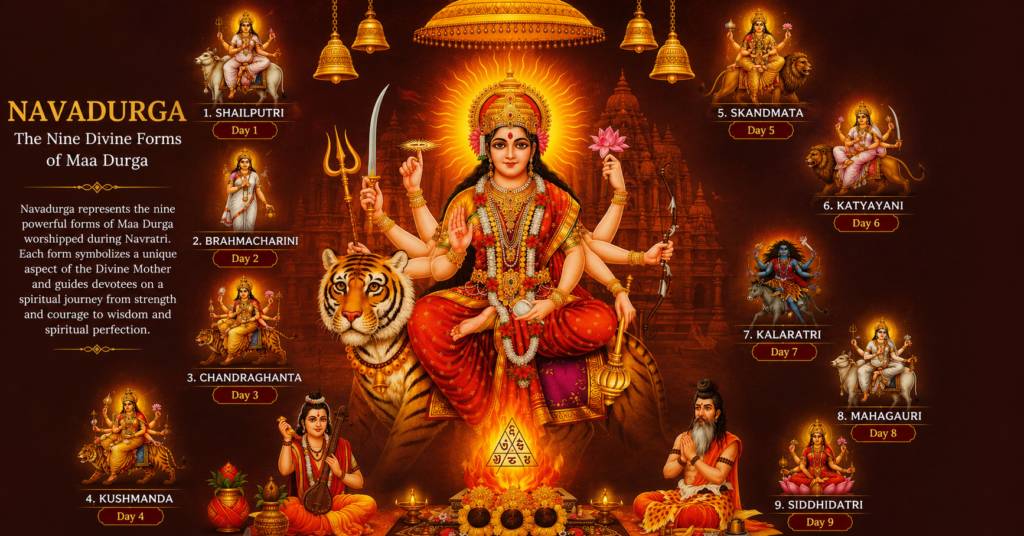
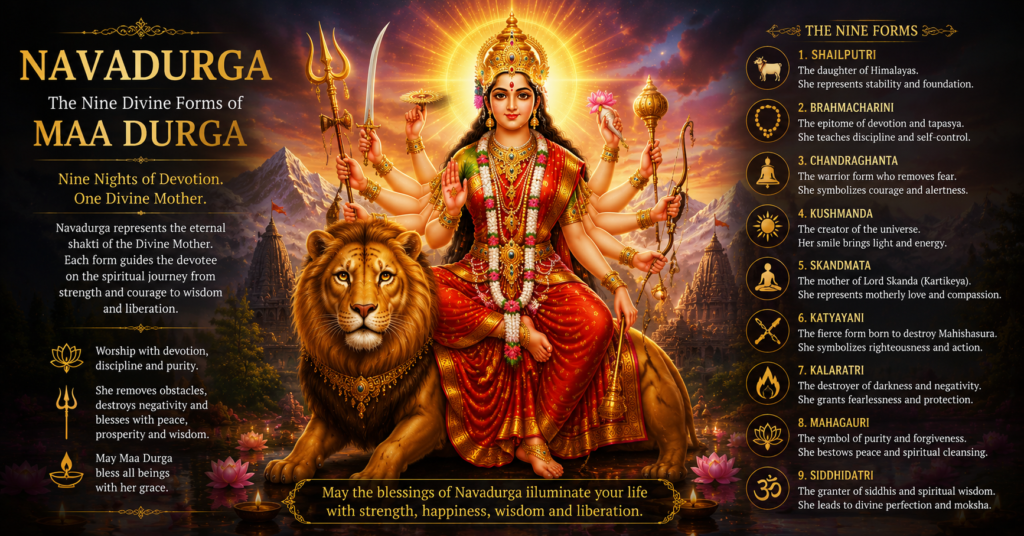
The word Navadurga is formed from two Sanskrit words. “Nava” means nine, while “Durga” refers to the Divine Mother who protects her devotees from difficulties and negativity. Together, Navadurga means the Nine Forms of Goddess Durga.
The nine forms of Navadurga are:
| Day | Form | Color | Main Blessing |
|---|---|---|---|
| 1 | Shailputri | Yellow | Stability and Strength |
| 2 | Brahmacharini | Green | Discipline and Devotion |
| 3 | Chandraghanta | Grey | Courage and Protection |
| 4 | Kushmanda | Orange | Creativity and Vitality |
| 5 | Skandamata | White | Compassion and Motherly Grace |
| 6 | Katyayani | Red | Righteous Strength |
| 7 | Kalaratri | Royal Blue | Protection from Negativity |
| 8 | Mahagauri | Pink | Purity and Peace |
| 9 | Siddhidatri | Purple | Wisdom and Fulfillment |
According to traditional Navratri worship, one form is honored on each of the nine days.
Although each form has a unique appearance, symbolism, and significance, devotees do not see them as separate goddesses. They are different manifestations of the same Divine Mother, expressing different aspects of divine energy.
Some forms appear gentle and nurturing, while others appear fierce and protective. Together they remind devotees that compassion and strength are both essential expressions of the Divine.
Scriptural Origin of Navadurga
The worship of the Divine Mother has deep roots in Sanatan Dharma and has been cherished through countless generations. The tradition of Navadurga is closely connected with Shakta worship and the celebration of Navratri.
One of the most important texts associated with Goddess worship is the Devi Mahatmya, also known as the Durga Saptashati or Chandi Path. While this sacred text does not present the Navadurga sequence exactly as it is followed today, it establishes the Divine Mother as the supreme power who protects creation and removes the forces of adharma.
Over time, temple traditions, devotional literature, regional customs, and oral traditions helped shape the Navadurga worship commonly practiced during Navratri. This is why certain details may vary across
different regions while the devotion to the Divine Mother remains the same. Some traditions focus on the spiritual symbolism of the nine forms, while others emphasize their role as protectors and guides.
Together, these perspectives reveal the richness and diversity of Sanatan Dharma.
Scriptural References to Navadurga
The worship of Navadurga is deeply rooted in the rich spiritual traditions of Sanatan Dharma. While the nine forms of Maa Durga are most commonly worshipped during Navratri, the reverence for the Divine Mother comes from a combination of sacred scriptures, devotional literature, temple traditions, and centuries of living spiritual practice.
Major Scriptural and Traditional Sources Associated with Navadurga
| Scripture / Tradition | Connection with Navadurga |
|---|---|
| Devi Mahatmya (Durga Saptashati) | Establishes the Divine Mother as the supreme power who destroys adharma and protects devotees |
| Devi Bhagavata Purana | Describes various forms and manifestations of the Divine Mother within Shakta traditions |
| Navadurga Stotra | Praises the nine forms of Maa Durga and their spiritual significance |
| Navratri Temple Traditions | Preserve the day-wise worship of the nine forms across India |
One of the most influential texts associated with Goddess worship is the Devi Mahatmya, also known as the Durga Saptashati or Chandi Path. This sacred scripture describes how the Divine Mother defeats powerful forces of adharma and restores cosmic balance.
Although the text does not present the Navadurga sequence exactly as it is observed during Navratri today, it establishes Maa Durga as the supreme protective force whose grace removes fear, negativity, and obstacles from the lives of devotees.
Another important source is the Devi Bhagavata Purana, one of the principal scriptures of the Shakta tradition. It glorifies the Divine Mother as the ultimate reality behind creation, preservation, and dissolution.
The Purana describes various manifestations of the Goddess and emphasizes that all forms of Devi are expressions of one supreme Divine Consciousness. This understanding forms the philosophical foundation for viewing the Navadurga as different manifestations of the same Divine Mother rather than separate deities.
The nine forms of Maa Durga are also praised in traditional devotional hymns such as the Navadurga Stotra, which is recited by many devotees during Navratri and other auspicious occasions. These hymns help devotees remember the qualities, symbolism, and spiritual lessons associated with each form of the Goddess.
Over the centuries, temple traditions, regional customs, oral teachings, and devotional practices further shaped the day-wise worship of Navadurga that is widely followed today.
While certain rituals and interpretations may vary across regions, the central message remains unchanged: the Divine Mother guides devotees through different stages of life, helping them cultivate strength, wisdom, devotion, courage, purity, and spiritual fulfillment.
Together, these scriptures and traditions preserve Navadurga not only as a sacred Navratri observance but also as a timeless spiritual path that continues to inspire millions of devotees across generations.
Why Is Navadurga Worshipped During Navratri?
Growth rarely happens all at once. A person learns patience through experience, develops courage through challenges, and gains wisdom through reflection. Many devotees believe that the sequence of the Navadurga reflects this gradual journey of inner growth.
Navratri, which means “Nine Nights,” is dedicated to the worship of the Divine Mother in her various forms. During these sacred days, devotees seek blessings for protection, prosperity, wisdom, and spiritual progress.
The order in which the Navadurga are worshipped is believed to carry symbolic meaning. The journey begins with grounding and stability, moves through discipline and courage, and eventually leads toward purification and spiritual realization.
Seen in this way, Navratri becomes much more than a festival. It becomes a reminder that every spiritual journey unfolds step by step, with each stage preparing the seeker for the next.
Navadurga and Durga Saptashati
For many devotees, the worship of Navadurga and the recitation of the Durga Saptashati are inseparable parts of Navratri. Across temples and homes, devotees not only honor the nine forms of Maa Durga day by day but also recite sacred verses that celebrate the Divine Mother’s victory over negative forces.
The Durga Saptashati, also known as the Devi Mahatmya or Chandi Path, is one of the most revered scriptures dedicated to the Divine Mother. It contains 700 verses that describe how the Goddess defeats powerful forces of adharma and restores balance to the universe.
Navadurga and Durga Saptashati at a Glance
| Navadurga Worship | Durga Saptashati |
|---|---|
| Focuses on the nine forms of Maa Durga | Focuses on the Divine Mother’s victories over evil forces |
| Observed day-by-day during Navratri | Recited throughout Navratri |
| Represents stages of spiritual growth | Represents the triumph of divine power |
| Encourages personal transformation | Encourages devotion, faith, and surrender |
| Highlights different manifestations of Shakti | Highlights the Goddess as the supreme protector |
Although the Durga Saptashati does not present the Navadurga sequence exactly as it is observed today, both traditions are united by the same spiritual message. The Divine Mother protects devotees, removes obstacles, destroys negativity, and guides seekers toward higher awareness.
Many devotees recite the Durga Saptashati during Navratri while worshipping the corresponding Navadurga form of the day. This combination of scripture, prayer, and devotion creates a deeper spiritual connection with the Goddess and helps devotees reflect on their own inner journey.
Viewed together, Navadurga and Durga Saptashati reveal two complementary aspects of spiritual life. The Navadurga represent the gradual evolution of the seeker through discipline, courage, compassion, purification, and wisdom, while the Durga Saptashati demonstrates the Divine Mother’s power to overcome ignorance, fear, ego, and negativity.
Together, they remind devotees that spiritual growth requires both personal effort and divine grace.
The Spiritual Journey Hidden Within Navadurga
Many devotees see Navadurga as more than nine divine forms worshipped during a festival. They see a complete spiritual path hidden within these manifestations of the Goddess.
Each Navadurga form reflects a stage of inner growth:
Form | Spiritual Lesson |
Shailputri | Stability and grounding |
Brahmacharini | Discipline and perseverance |
Chandraghanta | Courage and fearlessness |
Kushmanda | Creativity and positive energy |
Skandamata | Compassion and nurturing wisdom |
Katyayani | Righteous action |
Kalaratri | Destruction of fear and negativity |
Mahagauri | Purification and inner peace |
Siddhidatri | Spiritual fulfillment |
When viewed together, these forms create a beautiful map of inner transformation. The journey begins with establishing a strong foundation and gradually progresses toward wisdom, self-awareness, and deeper connection with the Divine.
This is one reason why Navadurga worship remains meaningful even today. It speaks not only about the Goddess but also about the challenges, growth, and transformation that every seeker experiences throughout life.
Shailputri: The Daughter of the Himalayas
Every journey needs a beginning, and every strong beginning needs a solid foundation. This is perhaps why the Navadurga journey starts with Maa Shailputri, a form that represents stability, grounding, and inner strength.
Her name means “Daughter of the Mountains,” and she is regarded as the daughter of King Himavan, the ruler of the Himalayas. In many traditions, she is identified with Devi Parvati in her earliest form and is seen as the first step on the spiritual path.
Maa Shailputri rides Nandi, the sacred bull, and carries a lotus and a trident. These symbols represent patience, purity, strength, and the power to overcome obstacles.
Together, they remind devotees that spritual growth begins only when life is rooted in balance and steadiness.
Many traditions also associate Shailputri with the root energy center, which symbolizes security and connection to the earth.
When devotees worship her, they often pray for courage, stability, and the strength to move forward without losing faith during difficult times.
Brahmacharini: The Goddess of Devotion and Tapasya
Some journeys test patience more than strength. A goal takes longer than expected, a difficult phase refuses to end, or a prayer seems unanswered despite sincere faith. In such moments, many devotees feel especially connected to Maa Brahmacharini.
Her name means “the one who walks the path of spiritual discipline.” She is usually depicted carrying a rosary and a water pot while walking barefoot. Her appearance is simple, yet her message is deeply powerful.
According to traditional narratives, Devi Parvati performed intense tapasya for many years in order to attain Lord Shiva. Her unwavering dedication became a symbol of devotion, patience, and spiritual commitment that continues to inspire seekers even today.
Maa Brahmacharini teaches that meaningful transformation rarely happens overnight. In a world that often seeks immediate results, she reminds devotees that true growth comes through discipline, faith, and steady effort.
Her blessings are often sought by students, seekers, and anyone facing a challenging path in life. She teaches that faith is not only about believing when everything is going well, but also about continuing to walk when the destination is not yet visible.
Chandraghanta: The Warrior of Courage and Protection
There are times when life demands courage. Fear, uncertainty, and challenges can make even simple decisions feel difficult. In such moments, many devotees remember Maa Chandraghanta, a form of the Divine Mother associated with bravery, protection, and inner strength.
The third day of Navratri is dedicated to Maa Chandraghanta. Her name comes from the crescent moon shaped like a bell that adorns her forehead. She is usually depicted riding a tiger and carrying various divine weapons, reflecting both grace and fearlessness.
Her form teaches an important lesson. Spirituality does not mean withdrawing from life’s challenges. The Divine Mother protects righteousness and gives devotees the strength to face difficulties with confidence and determination.
The bell-shaped moon on her forehead symbolizes awareness and awakening. Just as the sound of a bell draws attention, Chandraghanta is believed to awaken the soul from fear, confusion, and ignorance.
Many devotees worship her seeking courage during difficult phases of life. Her blessings are believed to strengthen confidence, remove fear, and help a person face challenges with a calm and steady mind.
Kushmanda: The Creator of Cosmic Light
Some beginnings arrive quietly. A new idea appears, a fresh opportunity emerges, or a small spark of hope changes the direction of life. Many devotees connect this creative and life-giving energy with Maa Kushmanda.
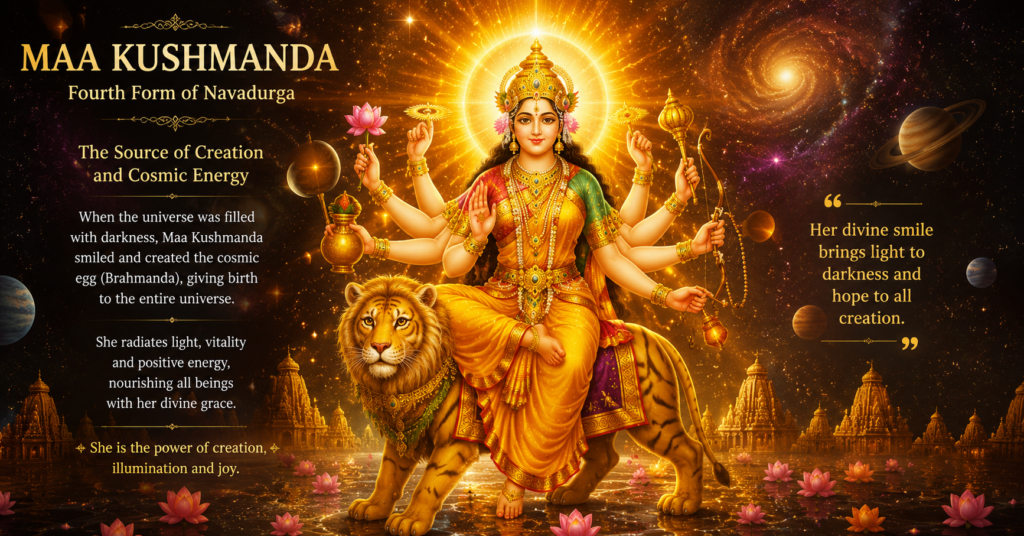
The fourth day of Navratri is dedicated to Maa Kushmanda. According to traditional beliefs, when the universe was surrounded by darkness, the Divine Mother smiled and creation began to unfold. Because of this belief, she is often associated with the creative force behind the cosmos.
Maa Kushmanda is usually depicted riding a lion and carrying various divine objects in her hands. These symbols represent vitality, abundance, and the power that sustains creation itself.
Her worship is especially meaningful for those seeking inspiration, positivity, and fresh beginnings. Just as sunlight gradually removes the darkness of night, devotees believe her blessings bring clarity, confidence, and renewed energy into life.
Spiritually, Kushmanda reminds us that even a small spark of divine energy can create extraordinary change. Creation, growth, and transformation often begin with a single moment of light.
Skandamata: The Compassionate Mother of Divine Wisdom
Strength is often associated with power and victory, yet some of the greatest strength in life is expressed through love, care, and sacrifice. This nurturing aspect of the Divine Mother is beautifully reflected in Maa Skandamata.
The fifth day of Navratri is dedicated to Maa Skandamata, the mother of Lord Skanda, who is also known as Kartikeya or Murugan. She is commonly depicted carrying the young deity in her lap while seated upon a lotus, symbolizing purity and divine wisdom.
Among the Navadurga forms, Skandamata represents unconditional love and compassionate protection. Her image reminds devotees that divine grace does not only guide and protect but also nurtures spiritual growth with patience and kindness.
The presence of Kartikeya in her lap symbolizes wisdom being protected and nourished by divine care. This is one reason why many devotees worship Skandamata seeking harmony within the family, blessings for children, and peace within the home.
Spiritually, she teaches that a loving heart is itself a source of strength. As the spiritual journey progresses, discipline and courage gradually blossom into compassion, understanding, and selfless service.
Katyayani: The Fierce Defender of Dharma
There are moments when kindness alone is not enough. Sometimes truth must be defended, injustice must be confronted, and courage must take the form of action. Maa Katyayani represents this powerful aspect of divine strength.
The sixth day of Navratri is dedicated to Maa Katyayani. According to traditional accounts, she appeared as the daughter of Sage Katyayan and later became the divine force that defeated the buffalo demon Mahishasura.
She is usually depicted riding a lion and carrying various weapons bestowed by the gods. These weapons symbolize the collective power of divine forces working together to restore balance and protect dharma.
Unlike anger driven by ego, Katyayani’s fierce nature represents righteous action. She teaches devotees that courage is not only about enduring challenges but also about standing firmly for what is right.
In many parts of India, young women worship Maa Katyayani seeking blessings for a harmonious married life and a suitable life partner. Spiritually, her worship inspires determination, clarity, and the strength to remain committed to truth even during difficult circumstances.
Kalaratri: The Destroyer of Fear and Darkness
Every spiritual journey eventually reaches a stage where a person must face their deepest fears. Doubts, insecurities, attachments, and inner darkness often become obstacles on the path of growth. Maa Kalaratri represents the divine power that helps overcome these challenges.
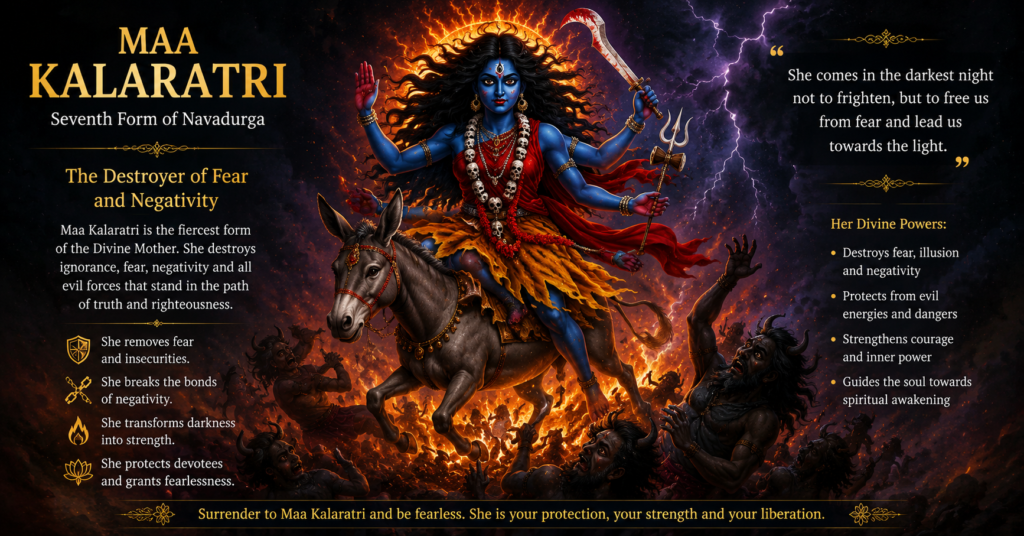
The seventh day of Navratri is dedicated to Maa Kalaratri. Among all the Navadurga forms, she is perhaps the most misunderstood because of her fierce appearance. She is depicted with a dark complexion, flowing hair, and a powerful presence that can appear intimidating.
Yet devotees regard her as one of the most protective and compassionate forms of the Divine Mother. Her terrifying appearance is directed toward negativity and ignorance, not toward sincere devotees.
Kalaratri symbolizes the destruction of fear, ego, and harmful influences. She reminds devotees that true transformation often begins when a person is willing to confront the darkness within.
Many people worship her seeking protection, courage, and freedom from fear. Her blessings are believed to help devotees face difficult situations with greater confidence and inner strength.
The message of Kalaratri is profound. Before light can fully emerge, darkness must first be understood and overcome.
Mahagauri: The Goddess of Purity and Grace
After periods of struggle and transformation, life sometimes enters a quieter phase. The mind feels lighter, old burdens begin to fade, and a sense of peace slowly emerges. Many devotees see this state reflected in Maa Mahagauri.
The eighth day of Navratri is dedicated to Maa Mahagauri. She is usually depicted wearing white garments and radiating serenity, purity, and grace. Her gentle appearance stands in contrast to the intense transformation represented by Maa Kalaratri.
Traditional narratives describe how Devi Parvati performed severe tapasya for many years. After this long period of spiritual discipline, her form became radiant and luminous, symbolizing purification and inner refinement.
Mahagauri represents the cleansing of the mind and heart. She reminds devotees that spiritual growth is not only about gaining strength but also about letting go of negativity, resentment, and unnecessary burdens.
Many devotees worship her seeking peace, harmony, emotional healing, and purity of thought. Her blessings inspire simplicity, humility, and devotion, helping the seeker move closer to inner balance.
Siddhidatri: The Granter of Spiritual Fulfillment
Every journey has a destination. After stability, discipline, courage, compassion, and transformation comes a stage of deeper understanding. In the Navadurga journey, this final stage is represented by Maa Siddhidatri.
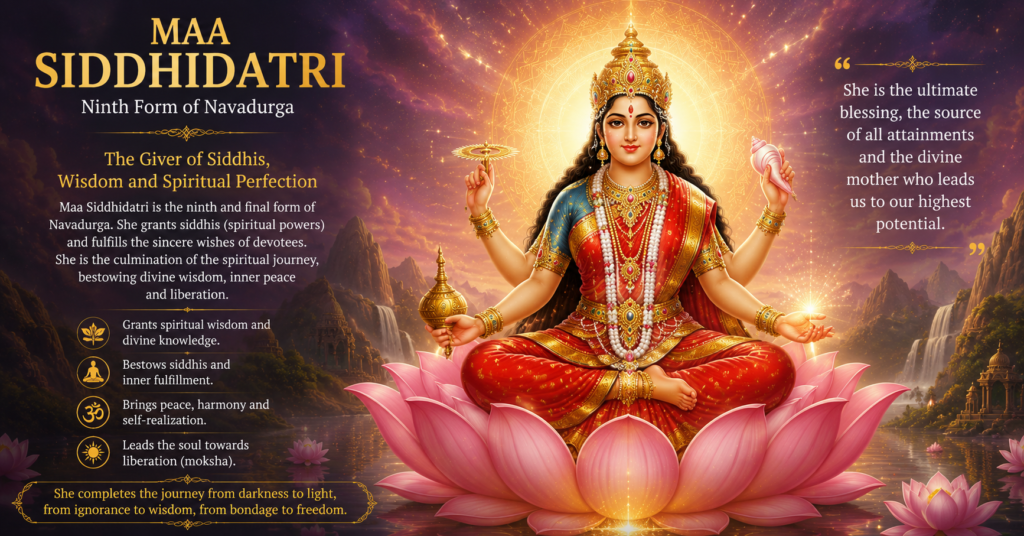
The ninth and final day of Navratri is dedicated to Maa Siddhidatri. Her name means “the giver of siddhis” or spiritual attainments. She is usually depicted seated on a lotus, symbolizing wisdom, fulfillment, and divine realization.
Among the Navadurga forms, Siddhidatri represents completeness. The seeker who began the journey with Shailputri’s grounding energy now reaches a stage where wisdom replaces confusion and spiritual awareness becomes stronger.
Many traditions associate Siddhidatri with higher realization and liberation. Her worship is not primarily about obtaining extraordinary powers but about awakening a deeper understanding of one’s connection with the Divine.
She reminds devotees that the highest blessing is not external success but inner contentment, spiritual wisdom, and closeness to the Divine Mother.
The Symbolism of the Nine Forms of Maa Durga
The Navadurga are often worshipped as nine individual forms of Maa Durga, yet together they reveal a deeper spiritual message. Each form represents a stage of inner growth that guides the devotee toward greater self-awareness and divine connection.
The journey of Navadurga can be understood as a path of transformation:
- Shailputri teaches stability and a strong foundation.
- Brahmacharini inspires discipline, devotion, and perseverance.
- Chandraghanta awakens courage and fearlessness.
- Kushmanda symbolizes creativity, positivity, and divine energy.
- Skandamata nurtures compassion, wisdom, and selfless love.
- Katyayani represents righteous strength and determination.
- Kalaratri helps overcome fear, negativity, and ignorance.
- Mahagauri reflects purity, peace, and spiritual refinement.
- Siddhidatri signifies wisdom, fulfillment, and divine realization.
When viewed together, Navratri becomes more than a religious festival. It becomes a symbolic journey of self-discovery, inner transformation, and a deeper relationship with the Divine Mother.
Many spiritual teachers describe Navadurga as an inner pilgrimage. The battles described in sacred traditions are not always external. Fear, anger, attachment, ego, jealousy, and ignorance can become obstacles on the spiritual path. Through her various forms, the Divine Mother helps devotees develop the strength, wisdom, and devotion needed to overcome these challenges.
For this reason, many devotees observe Navratri not only as a time of celebration but also as a period of self-reflection, spiritual discipline, and inner renewal. The deeper message of Navadurga is that transformation is possible for everyone and that every sincere step taken with faith can bring the seeker closer to the Divine.
Navadurga in the Shakta Tradition
Within the Shakta tradition, the Divine Mother is regarded as the supreme reality from whom all creation emerges and into whom all creation ultimately returns. From this perspective, the Navadurga are not merely nine forms worshipped during Navratri but nine expressions of one infinite Divine Consciousness.
The Shakta tradition teaches that:
- The Navadurga are manifestations of one Divine Mother.
- Each form expresses a unique aspect of Shakti, the cosmic divine energy.
- The nine forms represent different stages of spiritual growth and inner transformation.
- They embody both nurturing and protective aspects of the Divine.
- Together, they guide the seeker from worldly awareness toward spiritual realization.
According to Shakta philosophy, the Divine Mother is present in every aspect of existence. Her gentle forms nurture, protect, and guide devotees, while her fierce forms help destroy ignorance, fear, ego, and negative tendencies that obstruct spiritual progress.
Many Shakta traditions view the Navadurga sequence as a symbolic journey of awakening:
- Shailputri establishes stability and spiritual grounding.
- Brahmacharini teaches discipline and perseverance.
- Chandraghanta awakens courage and inner strength.
- Kushmanda inspires positivity and creative energy.
- Skandamata nurtures compassion and wisdom.
- Katyayani represents righteous action and determination.
- Kalaratri destroys fear and negativity.
- Mahagauri symbolizes purity and inner peace.
- Siddhidatri bestows wisdom, fulfillment, and spiritual realization.
In this way, the nine forms are not only deities to be worshipped but also spiritual principles to be understood and applied in daily life. This deeper interpretation helps explain why Navadurga worship remains central to Shakta traditions across India.
Beyond rituals and festivals, the Navadurga continue to inspire devotees seeking strength, wisdom, devotion, protection, and a deeper connection with the Divine Mother.
Navadurga Worship Across India Today
The worship of Navadurga remains a vibrant and living tradition across India. While the rituals and customs may vary from region to region, devotion to the Divine Mother continues to unite millions of devotees through prayer, fasting, festivals, and spiritual practice.
| Region | Popular Navratri Tradition |
|---|---|
| West Bengal | Durga Puja celebrations and community worship |
| Gujarat | Garba and Dandiya Raas dedicated to Shakti |
| North India | Fasting, Durga Saptashati recitation, and Kanya Puja |
| South India | Golu displays, devotional music, and Devi worship |
| Himachal Pradesh | Shakti temple pilgrimages and local Devi traditions |
In West Bengal, Navratri coincides with the grand celebration of Durga Puja. Beautifully crafted idols, community gatherings, devotional music, and cultural programs become part of the worship of the Divine Mother.
In Gujarat, devotion is expressed through Garba and Dandiya Raas. These traditional dances are performed in honor of Shakti and bring communities together in celebration and prayer.
In North India, fasting, Durga Saptashati recitation, temple visits, and Kanya Pujan are common practices. Many devotees worship each Navadurga form according to the day dedicated to her during Navratri.
In South India, Navratri often includes Golu displays, devotional music, and worship centered on different manifestations of the Goddess. In Himachal Pradesh and other Himalayan regions, ancient Shakti temples become important centers of pilgrimage.
Today, Navadurga worship is not merely an ancient tradition preserved in scriptures. It continues to be practiced by millions of devotees across India and around the world. During Navratri, temples organize special prayers, devotional singing, scriptural recitations, and community celebrations. Families gather for worship, offer prayers together, and spend time remembering the Divine Mother.
Many devotees observe fasts according to their capacity, visit temples, chant sacred mantras, read devotional texts, and dedicate time to spiritual reflection. In many communities, young girls are honored during Kanya Pujan as symbolic manifestations of the Divine Mother.
While practices may differ across regions and generations, the essence remains the same: devotion to Maa Durga and the pursuit of spiritual growth. These living traditions continue to inspire faith, strengthen cultural bonds, and help devotees connect with the timeless wisdom of Sanatan Dharma.
How Devotees Worship Navadurga During Navratri
The worship of Navadurga varies according to family customs, regional traditions, and spiritual lineages across India. While the rituals may differ from one household or community to another, the spirit of devotion remains the same. Navratri provides an opportunity for devotees to strengthen their connection with the Divine Mother through prayer, self-discipline, and spiritual reflection.
| Practice | Purpose |
|---|---|
| Daily worship of the Navadurga form associated with the day | Honor the Divine Mother through her nine manifestations |
| Recitation of Durga Saptashati and devotional hymns | Deepen devotion and spiritual reflection |
| Fasting according to personal capacity and health | Practice self-discipline and purification |
| Offering flowers, fruits, and sattvic food | Express gratitude and devotion |
| Visiting temples dedicated to Maa Durga | Seek blessings and participate in community worship |
| Chanting Durga mantras and sacred names | Focus the mind on the Divine Mother |
| Participating in devotional gatherings, bhajans, and kirtans | Strengthen faith through collective worship |
| Kanya Puja | Honor the Divine Mother through the worship of young girls |
| Practicing self-reflection and spiritual discipline | Cultivate inner growth and positive transformation |
While the outward forms of worship may vary, devotion remains the heart of Navratri. For many devotees, these nine sacred days are not only a time for prayer and rituals but also an opportunity for self-improvement, reflection, and spiritual renewal.
Along with external worship, devotees often focus on improving their thoughts, actions, and daily conduct. In this way, Navratri becomes more than a festival. It serves as a sacred period of inner transformation guided by the blessings of Maa Durga and the spiritual lessons embodied by the nine forms of Navadurga.
Conclusion
Navadurga is much more than the worship of nine divine forms during Navratri. Together, these manifestations of Maa Durga represent a profound spiritual journey that guides devotees from strength and discipline to wisdom and spiritual fulfillment.
From the grounding stability of Shailputri to the divine grace of Siddhidatri, each form embodies a unique lesson for life. Courage, devotion, compassion, self-discipline, inner transformation, and spiritual wisdom unfold step by step through the worship of the Divine Mother.
Whether approached through prayer, meditation, mantra chanting, ritual worship, or simple devotion, the teachings of Navadurga remain timeless and relevant. They remind us that spiritual growth is a gradual journey guided by faith, self-reflection, and divine grace.
Above all, Navadurga teaches that the Divine Mother is always present, nurturing, protecting, and guiding her devotees toward inner strength, wisdom, and a deeper connection with the sacred.
Suggested Reading
If you found this guide on Navadurga helpful, you may also enjoy these related articles on Navratri, Maa Durga worship, sacred rituals, devotional practices, and the timeless traditions of Sanatan Dharma.
Sharad Navratri 2026: Dates, Ghatasthapana Muhurat, Rituals and Significance
https://thesanatantales.com/sharad-navratri/
Ghatasthapana Guide: Meaning, Puja Vidhi, Samagri and Spiritual Significance
https://thesanatantales.com/ghatasthapana/
Maa Durga: Meaning, Story, Forms, Navadurga, Temples and Worship
https://thesanatantales.com/maa-durga-meaning-story-navadurga-worship/
Kanya Pujan in Navratri: Meaning, Ritual and Spiritual Significance
https://thesanatantales.com/kanya-pujan/
Kalash in Hinduism: Meaning, Symbolism, Kalash Sthapana and Spiritual Significance
https://thesanatantales.com/kalash-in-hinduism/
Durga Saptashati: Meaning, Story, 13 Chapters and Navratri Significance
https://thesanatantales.com/durga-saptashati-meaning-navratri/
Durga Chalisa: Lyrics, English Pronunciation, Hindi Meaning, Benefits & Significance
https://thesanatantales.com/durga-chalisa-lyrics-meaning/
Navarna Mantra: Meaning, Benefits, Chanting Rules and How to Chant
https://thesanatantales.com/navarna-mantra/
Argala Stotra: Lyrics, Meaning, Benefits and How to Chant
https://thesanatantales.com/argala-stotra/
Aarti of Maa Ambe: Lyrics, Meaning, Benefits and How to Perform
https://thesanatantales.com/aarti-of-maa-ambe/
Durga Mantras: Complete Guide to Powerful Mantras, Stotras, Chalisa and Aarti
https://thesanatantales.com/durga-mantras-stotras-chalisa-aarti/
Navratri Fasting Rules: What to Eat and What to Avoid During Vrat
https://thesanatantales.com/navratri-fasting-rules/
Navaratri (Wikipedia)
https://en.wikipedia.org/wiki/Navaratri
These articles will help you deepen your understanding of Navadurga, Maa Durga worship, Navratri rituals, sacred scriptures, mantra chanting, devotional practices, and the spiritual journey represented by the nine forms of the Divine Mother.
FAQs
What is the meaning of Navadurga?
Navadurga refers to the nine sacred forms of Maa Durga worshipped during the nine days of Navratri. Together, these forms symbolize different stages of spiritual growth, divine energy, and the journey of the soul toward wisdom, purification, and spiritual fulfillment.
Why are the Nine Forms of Maa Durga worshipped in a specific order?
According to traditional Navratri worship, each form of Maa Durga is honored on a specific day. Many devotees and spiritual traditions view this sequence as a symbolic journey that begins with stability and discipline, progresses through courage and transformation, and ultimately leads to spiritual realization and inner peace.
Is Navadurga the same as Maa Durga?
Yes. Navadurga refers to the nine manifestations of Maa Durga. Although each form has a unique appearance, symbolism, and significance, they are all expressions of the same Divine Mother and represent different aspects of her power and grace.
Which Navadurga form is worshipped on each day of Navratri?
The nine forms worshipped during Navratri are:
- Day 1 – Shailputri
- Day 2 – Brahmacharini
- Day 3 – Chandraghanta
- Day 4 – Kushmanda
- Day 5 – Skandamata
- Day 6 – Katyayani
- Day 7 – Kalaratri
- Day 8 – Mahagauri
- Day 9 – Siddhidatri
Each form is associated with a particular spiritual quality and lesson for devotees.
Which Navadurga form is associated with courage?
Maa Chandraghanta, worshipped on the third day of Navratri, is most closely associated with courage, protection, and fearlessness. Her form inspires devotees to face challenges with confidence and faith.
Which Navadurga form removes fear?
Maa Kalaratri is traditionally associated with the removal of fear, negativity, and ignorance. Despite her fierce appearance, she is regarded as a compassionate protector who helps devotees overcome inner and outer obstacles.
Which Navadurga form grants wisdom and spiritual fulfillment?
Maa Siddhidatri, worshipped on the ninth day of Navratri, is associated with spiritual fulfillment, wisdom, and divine realization. She represents the culmination of the seeker’s spiritual journey.
Can Navadurga be worshipped outside Navratri?
Yes. Although Navratri is the most important festival associated with Navadurga worship, many devotees pray to these forms throughout the year. Individual forms of Maa Durga are worshipped regularly in homes, temples, and spiritual traditions across India.
Which Navadurga form is considered the most powerful?
All nine forms of Navadurga are considered equally divine and powerful because they are manifestations of the same Divine Mother. Different devotees may feel a special connection with a particular form depending on their spiritual path, personal devotion, or tradition.
What is the spiritual significance of Navratri?
Navratri is a celebration of the Divine Mother’s power, compassion, and protection. Spiritually, it is viewed as a time for self-discipline, prayer, reflection, and inner transformation. The worship of Navadurga during these nine days reminds devotees that spiritual growth happens gradually through faith, effort, and divine grace.
Glossary of Important Terms
| Term | Meaning |
|---|---|
| Navadurga | The nine sacred forms of Maa Durga worshipped during the nine days of Navratri. |
| Maa Durga | The Divine Mother in Hindu tradition, revered as the protector of dharma and the destroyer of negative forces. |
| Navratri | A nine-night Hindu festival dedicated to the worship of the Divine Mother in her various forms. |
| Shakti | The divine cosmic energy or power that creates, sustains, and transforms the universe. |
| Shakta Tradition | A major Hindu tradition that worships the Divine Mother as the supreme reality. |
| Devi Mahatmya | A sacred text, also known as Durga Saptashati or Chandi Path, that glorifies the Divine Mother and her victories over evil forces. |
| Devi Bhagavata Purana | An important Shakta scripture that describes the Divine Mother and her various manifestations. |
| Durga Saptashati | A collection of 700 verses dedicated to the Divine Mother, traditionally recited during Navratri. |
| Navadurga Stotra | A devotional hymn that praises the nine forms of Maa Durga and their spiritual significance. |
| Tapasya | Spiritual discipline, austerity, or dedicated effort undertaken for self-purification and spiritual growth. |
| Dharma | The principle of righteousness, moral order, and duty that sustains harmony in life and society. |
| Adharma | Actions or forces that oppose righteousness, truth, and moral order. |
| Siddhi | A spiritual attainment, accomplishment, or divine blessing mentioned in Hindu traditions. |
| Siddhidatri | The ninth form of Navadurga, associated with spiritual fulfillment, wisdom, and divine realization. |
| Kanya Puja | A Navratri ritual in which young girls are honored as symbolic manifestations of the Divine Mother. |
| Chandi Path | Another name for the recitation of the Devi Mahatmya or Durga Saptashati. |
| Bhajan | A devotional song sung in praise of a deity. |
| Mantra | A sacred word, phrase, or prayer repeated during worship and meditation. |
| Sadhana | A spiritual practice undertaken to deepen devotion, self-discipline, and inner growth. |
| Spiritual Fulfillment | A state of inner contentment, wisdom, and closeness to the Divine, symbolized by Maa Siddhidatri. |
About the Author
Yateendra Chaturvedi is a spiritual writer, researcher, devotee, and the founder of The Sanatan Tales. With over 35 years of professional experience and a lifelong interest in Sanatan Dharma, he writes about Hindu deities, temples, scriptures, festivals, Mahavidyas, sacred stories, rituals, and living traditions that continue to guide and inspire devotees across India.
Drawing from traditional scriptures, regional beliefs, temple traditions, devotional literature, and historical sources, he aims to present authentic, well-researched, and easy-to-understand content for modern readers. His work focuses on preserving spiritual wisdom, explaining sacred traditions, and helping seekers develop a deeper understanding of India’s rich spiritual heritage.
Through The Sanatan Tales, Yateendra strives to make the timeless teachings of Sanatan Dharma simple, meaningful, and relevant for today’s generation while maintaining respect for traditional sources, regional practices, and diverse spiritual perspectives.
Learn More About Yateendra Chaturvedi →
https://thesanatantales.com/about-the-author/
References & Sources
This article is based on beliefs and traditions followed within the Shakta traditions of Sanatan Dharma, traditional knowledge associated with the Dashamahavidya tradition, Shakti worship, Devi sadhana, and insights drawn from various spiritual and religious study sources. Some concepts discussed in this article are also inspired by teachings and interpretations preserved through the guru-disciple tradition.
Note: Beliefs, interpretations, and spiritual practices may vary across different traditions, sects, and paths within Sanatan Dharma. The purpose of this article is not to present any single viewpoint as the absolute truth, but to explain widely accepted religious and spiritual perspectives in a simple and accessible manner.
Explore More Fascinating Topics from Sanatan Dharma